By Dr. Peter Kwasniewski of the New Liturgical Movement
On this octave day of the Assumption, we may meditate with profit on a remarkable medieval poem to Our Lady, “Ave rosa sine spinis,” which (in typically clever and pious fashion) takes the words of the angelic salutation and weaves the remaining words around them:
1 Â AVE rosa sine spinis,
Te quam Pater in divinis
Majestate sublimavit,
Et ab omni vae servavit.
2 Â MARIA stella dicta maris,
Tu a Nato illustraris
Luce clara deitatis,
Qua praefulges cunctis datis.
3 Â GRATIA PLENA te perfecit
Spiritus Sanctus dum te fecit
Vas divinae bonitatis
Et totius pietatis.
4 Â DOMINUS TECUM: miro pacto
Verbo in te carne facto
Opere trini conditoris:
o quam dulce vas amoris.
5 Â BENEDICTA IN MULIERIBUS:
Hoc testatur omnis tribus;
Coeli dicunt te beatam
Et super omnes exaltatam.
6 Â ET BENEDICTUS FRUCTUS VENTRIS TUI,
Quo nos semper dona frui
Per praegustum hic aeternum
Et post mortem in aeternum:
7 Â Hunc, Virgo, salutis sensum,
Tuae laudis gratum pensum,
Conde tuo sinu pia,
Clemens sume, O Maria. Amen.
As I studied this text, I was struck by the way in which everything it says about the Blessed Virgin Mary applies analogously to the traditional liturgies (Eastern and Western) of the Church.
1. HAIL, Rose without thorns, thou whom the Father by His majesty in heaven hast elevated and preserved from all woe.
The organically developed liturgies of the Church deserve our veneration; they are splendid roses, beautiful in their symmetry, lushness, color, and fragrance of holiness, without the thorns of rationalism, utilitarianism, anthropocentrism, and other baneful ideologies.
2. MARY, known as the Star of the Sea, thou art illuminated by thy Son with the bright light of divinity, by which thou shinest bright with all thy gifts.
Over the rising and falling waves of tempestuous centuries, the liturgy has been like a fixed star, immutable in its apostolic essence but growing, expanding, in its expression of that sacred core, so that the light of Christ may shine forth ever more clearly and illuminate the world. This shining is undisturbed by the caliginous machinations of committees.
3. FULL OF GRACE: the Holy Spirit perfected thee when He made thee into a vessel of divine goodness and of all mercy.
The Holy Spirit is the principal agent of genuine liturgy and its gradual development from age to age. By His gentle brooding the Church’s worship of God is perfected as a vessel of divine goodness and of all mercy, precluding the acceptance of radical rupture. How privileged we are to drink from this pellucid font! 4. THE LORD IS WITH THEE: the Word became flesh in thee in a wondrous way by the action of the Creator who is Three in One: O, how sweet is the vessel of love!
Through the liturgy, the Word becomes flesh in our midst, and O, how sweet is the pure vessel of this Eucharistic love! As with Mary, the traditional liturgy echoes and magnifies the Word of the Lord, without human compromise, without omitting the hard sayings, without deflecting adoration from the Real Presence and the mystery of the sovereign Sacrifice.
5. BLESSED ART THOU AMONGST WOMEN: all peoples bear witness to this. The heavens call thee blessed and high above all others.
How blessed among women is the Virgin in whom the Lord has done great things — the marvel of His Incarnation! Blessed, too, among prayers, high above all others, is the solemn, objective, and rational worship of the Church’s traditional liturgy, which exalts those who partake of it by lifting them above the private limits, idiosyncracies, and opinions of their age or place. All missionized peoples once bore witness to this universal blessing. May God grant it to be so in a future age.
6. AND BLESSED IS THE FRUIT OF THY WOMB: grant that we may enjoy Him always, as a foretaste here, and after death, eternally.
Per ipsum, et cum ipso, et in ipso . . . Our Lord Jesus Christ, Eternal High Priest, Victim, Altar, Thou givest Thyself to us in Holy Communion as the price of our redemption, the food of our pilgrimage, the earnest and foretaste of our eternal bliss! Canst Thou do anything more for us that Thou hast not already done? Thou art far more generous with us than we could ever deserve. We owe it to Thee to be faithful stewards of Thy manifold gifts, beginning and ending with the sacred liturgy, lest we be found unworthy servants who squandered Thy treasury.
7. O merciful virgin Mary, lay up in the holy refuge of thy Heart and mercifully receive this disposition to salvation and the pleasing duty of thy praise. Amen.
For us, the liturgy is a holy refuge, the heart of our Catholic life, where we raise up to God the sacrifice of praise and fulfill our vows to the Lord. By the Virgin’s prayers may He graciously accept our oblation, which we offer in union with all the saints of the Catholic Church across the ages.
* Â Â Â Â Â * Â Â Â Â Â *
At least two composers set this poem to music: Ludwig Senfl (1486-1542), who set verses 1-6, and the much better known Thomas Tallis (c. 1505-1585), whose set all seven verses in a magnificent meditation that lasts some eleven minutes:
The 16th Annual Assumption Mass, sponsored by Mater Ecclesiae in Berlin, New Jersey, will take place at the Cathedral Basilica of Saints Peter and Paul, located at Logan Circle in Philadelphia, at 7:00 p.m. tonight, August 15. This Mass is a festival of praise and thanksgiving on the feast of Our Lady’s great victory over sin and death. Each year, monumental music from the Church’s treasury is chosen, music that cannot be used in a small parish setting. People from across the Delaware Valley travel through traffic and all types of weather to attend. Some groups that will be participating again this year: Priests, deacons and seminarians from many dioceses, the Knights and Ladies of the Equestrian Order of the Holy Sepulchre of Jerusalem, the Sovereign Military Hospitaller Order of Saint John of Jerusalem of Rhodes and Malta, The Knights of Columbus, the Carmelites of Mater Ecclesiae, the Federation of North American Explorers, Juventutem of Lehigh Valley, PA, the altar servers and Blessed Imelda Society of Mater Ecclesiae, the altar servers and Maidens of the Miraculous Medal from Saint John the Baptist, Allentown, NJ. This Mass is also meant to be a manifestation of the beauty and growth of the Traditional Latin Mass Movement. We have been given a very great gift. Help us to share and proclaim it!
The Reverend Robert C. Pasley, KCHS, Rector of Mater Ecclesiae Church, will be the Celebrant and Preacher.
The Solemn High Mass will feature the Ars Laudis Festival Chorus and Orchestra. Mr. Nicholas Beck, a graduate of Westminster Choir College, will direct the singing of the Gregorian Propers. Dr. Timothy McDonnell will be the conductor for this Mass.
We are in the midst of the Annual Novena in preparation for the Feast of our beloved Saint Philomena at the home of the National Center of the Universal Archconfraternity located at Holy Martyrs Roman Catholic Church, 120 Allison Road, Oreland, Pennsylvania. All of her friends are invited to join us on these days for Mass at 8:30 am. St. Philomena sacramentals are available at her shrine in the Church and additional items are available at the Rectory Office.
We are very grateful for the generosity of so many of the long time devotees of Saint Philomena and are encouraged by the many people who have discovered and rediscovered Saint Philomena since she has moved to Oreland, Pennsylvania.
We especially invite you to join us for her Feast Day on August 11th. Mass is offered at 8:30 am and will be followed by the Novena Devotions and veneration of her relic. There will be a reception in the Father Szal Conference Room in the lower level of the Church where sacramentals will be available following Mass and Devotions.
St. Philomena, Powerful with God, New Light of the Church Militant, Invincible Champion of Chastity, pray for us!
First Friday, August 5, A.D. 2016, Traditional Latin Mass:
Priest: Fr. Harold B. Mc Kale, Parish Vicar of Our Lady of Mount Carmel Roman Catholic Church
Location:Â Rectory Chapel of St. Albert The Great Parish (address below)
Time:Â 7:00Â p.m., preceded by Confessions at 6:30Â p.m.
This Traditional Latin Mass will be the Mass of the Dedication of the Basilica of Saint Mary Major – Church of Our Lady of the Snows (3rd Class), offered in Reparation to The Sacred Heart of Jesus. White Vestments.
First Saturday, August 6, A.D. 2016, Traditional Latin Mass:Â
Priest: Fr. Gerald Carey, Parochial Vicar of Our Lady of Perpetual Help Roman Catholic Church
Location:Â Rectory Chapel of St. Albert The Great Parish (address below)
Time:Â 9:00 a.m., preceded by Confessions at 8:30 a.m.
This Traditional Latin Mass will be the Mass of the Transfiguration of Our Lord (2nd Class), offered in Reparation to The Immaculate Heart of Mary. White Vestments.
By Dr. Peter Kwasniewski of New Liturgical Movement
A regular NLM reader sent in this letter some weeks ago; it is reproduced below with the author’s permission.
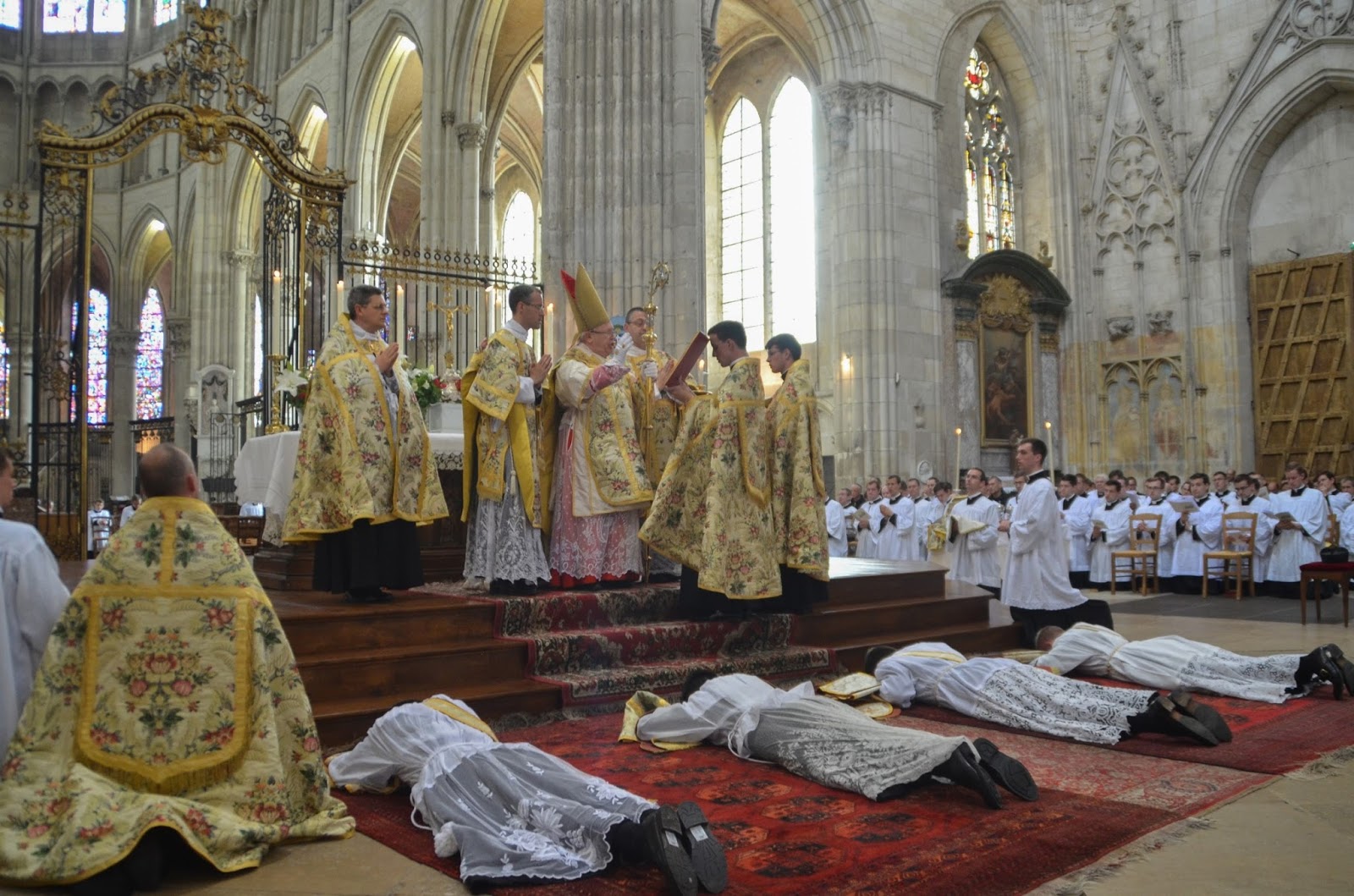
Men being ordained to the Sacred Priesthood in the traditional Roman Rite (2016)
I enjoyed your post on “The Logic of Incarnation and the Temptation of Disincarnation.†I am so weary of the snide remarks and condescending attitudes characteristic of those who dismiss the Traditional Latin Mass and traditional Roman devotions as a nostalgic preoccupation with externals. As if these things existed in a vacuum or were alien to the heritage of the universal Church! As if they were not the bread and butter of countless saints, still as powerful today in their meaning and impact as they ever were!
I would propose a scriptural sign that God Himself prizes “the externals.†If we re-read the books of Exodus, Leviticus, Numbers, etc., we discover a stunning amount of exacting detail that the Lord Himself insisted upon, concerning the specifications of the construction and adornment of His own ark and even the details of vesture and behavior of His priests. The best woods, precious metals, precious stones, and finest fabrics were specified by name. Burlap, ceramic, clay, and sand, incidentally, were not. Those books of the Old Testament are full of accounts of God specifying clearly who was to do which job and exactly how — down to which fingers to use for blessings (I think we could safely call that an early instance of rubrics). God was specific about how, in the externals, He wished to be worshipped, not because He’s an arch-snob but because He knew (as the architect of the human species) that fragrant cedars and jewels and gold filigree would inspire the human heart to higher thoughts of the Fountain of Pure Love than would bare wood and asymmetrical cement.
While there is room for some organic evolution in the minutiae of liturgy as the millennia progress, and while Christianity brings with it a certain artistic freedom as it moves through cultures, how could we ever be justified in the too-frequent modern enshrinement of ugliness and banality in construction, vesture, ritual, music, self-styled liturgical amendments (to “make†the liturgy “more relevantâ€), and general approach to God, simply because a few measly thousand years have passed? Has the immutable God evolved or devolved? Or rather, have we lost our way?
Both John Paul II and Benedict XVI reminded us that the first Mass, which Our Lord offered on the eve of His Passion, was replete with ritual and formality, stemming from the detailed worship of the Jews. The Mass of the Last Supper would have lasted several hours. Jesus did not despise or scorn such ritual; why should we? Nor was He in any hurry, despite the immense weight of sorrow resting on His sacred shoulders, and His divine knowledge that the gears of His own demise were cranking away. Why should we be in a hurry and consider it too much to kneel for a long while in God’s presence, or to pray in silence, or to sing the chants and listen to them?
I see (and lament) the fruit of the shallow theology that spawns a casual or perfunctory worship in many of the Catholic churches I have visited. It is revealed in the amount of respect shown the Real Presence by the congregants therein — both during Mass and outside of it. Does the cursory head bob truly equal a genuflection? Would any modern day human sovereign recognize one as equivalent to the other? Which, if they could choose, would they prefer for themselves as a sign of allegiance and fidelity?
Does the fact that many lay folk go right up to the Tabernacle and help themselves to its august Occupant bespeak a proper respect for Him? When they dare to handle the Body of Our Lord at Communion time, does it show deep respect for the Lord’s establishment of the priesthood itself and His sacrament of Holy Orders, in which the priests’ hands have been consecrated and anointed unto the specific purpose of handling the precious Body and Blood of the Creator of the world? Have we no humility to accept our status as fledglings that need to be fed by hand in the mouth? Have we forgotten that God struck down dead one Uzzah in the Old Testament (2 Sam. 6:6-7) when he presumed with seemingly good intention to lay his hand upon the exterior of the ark of the covenant to steady it (let alone its contents!)? Is this not the same God? While we know that Jesus taught us to pray to God as our Father, “Abba,†and while we find our salvation in communion with His flesh and blood, Jesus did not nullify all the previously known (Old Testament) attributes of His Father. “I have not come to destroy but to fulfill. . . .â€
I heard a story recently that sent a chill down my spine. Apparently a Moslem had been inside a Catholic church (I’m not sure why), and afterwards, he was talking with someone about what he had experienced. When this person said to him that Catholics believe that the Eucharist is really the body, blood, soul, and divinity of Christ, he replied: “No, they certainly don’t believe that, because they would behave in a totally different way if they actually believed it. They would get down on their faces in homage to the Almighty. But they acted as if nothing special were there.”
I think what is missing from the current age is the HOLY FEAR and its concomitant respectful behavior that are born of the realization of just WHO is enthroned — albeit in humble estate — in that little box in the center of the church that was once known and revered as the Holy of Holies. It bespeaks a pitiable blindness to the invisible realities, the angelic spirits, who are nevertheless present and attendant upon the King of Kings. Once upon a time, the Church was convinced that the Lord should be given royal treatment and worship. Thankfully these practices are still retained in the Church’s treasury of the Traditional Latin Mass.
July 15th is the traditional day for the feast known as the “Divisio Apostolorum – the Division (or ‘Dispersion’) of the Apostlesâ€, a feast which was very popular in the Middle Ages, and continued into the Tridentine period on many local calendars, but was never on the general Calendar. It is the liturgical commemoration of an ancient tradition that some time after the Ascension, (Durandus says twelve years), the Apostles cast lots for which part of the world each one of them would take, and spread out from Jerusalem to preach the Gospel in the various nations. The common Office of the Apostles refers to this idea repeatedly, as, for example, in the first antiphon of Matins, taken from Psalm 18. “Their sound hath gone forth into all the earth: and their words unto the ends of the world.â€, and likewise the third antiphon from Psalm 44, “Thou shalt make them princes over all the earth; they shall remember thy name, O Lord.â€
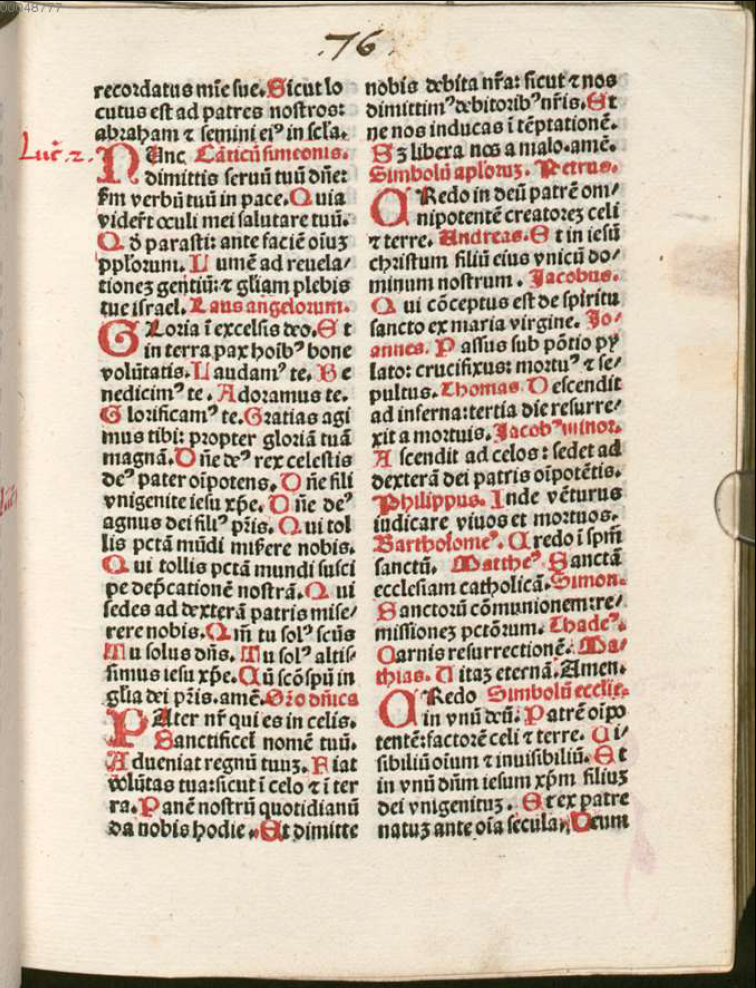
The earliest reference to this specific feast is a sequence which was well-known and widely used in the Middle Ages, written by one Godeschalk, a monk of Limburg abbey in western Germany, who died in 1098. It is written in the earlier and freer style of sequences like the Victimae Paschali, with less rhyme and structure than later ones such as St Thomas’ Lauda Sion or the Stabat Mater. It makes frequent use of the Patristic interpretation of the first words of Psalm 18, “The heavens proclaim the glory of Godâ€, according to which the “heavens†are understood to be the Apostles, as St Gregory says in the Breviary. (Common lesson of the 2nd nocturn of the Apostles.)
The Sequence “Caeli enarrant gloriam†in the Mass of the Division of the Apostles, starting towards the top of the second column here. (Click to enlarge.) From the Missal according to the Use of Augsburg, Germany, ca. 1510.
Thus the prayer which concludes it, (as is typical of the genre,) reads, “These are the heavens, in whom Thou dwellest, the Angel of great counsel, whom Thou didst call no longer servants, but friends, to whom Thou makest known all things which Thou hast heard from the Father. / Keep undivided, and in the bond of peace, the flock that was gathered by their division, that we may be one in Thee, as thou are one in the Father. / Have mercy on us, Thou that dwellest in the heavens.â€
The Gospel of the feast is that of the Ascension, (Mark 16, 14-20) but with the first verse left off, “Jesus appeared to the eleven as they were at table: and he upbraided them with their incredulity and hardness of heart, because they did not believe them who had seen him after he was risen again.†This omission is entirely appropriate for the common use of the feast among missionary congregations, since it celebrates the mission of the Apostles and their fulfillment of the commandment which Christ gives them in the verse which now opens the Gospel, “Go ye into the whole world, and preach the gospel to every creature.â€
There is a tradition known from the 4th century that the baptismal creed now called the Apostles’ Creed was composed as a rule of the Faith by the Twelve before this dispersal, with each one of them contributing an article. This is often represented in art, as here in the border of this page of the famous Hours of Catherine of Cleves, ca. 1440. (In the center is depicted the legend of the Ten Thousand Martyrs, represented symbolically by ten figures.)
It is also seen here in a Carthusian Breviary ca. 1490, (starting near the top of the right column), in which the name of an Apostle is printed in red before each article of the Creed.
Like many of the traditions held dear by the medievals, it was called into question by some of the scholars of the Renaissance, particularly at the time of the Council of Florence in 1438. As the Council wrestled with the question of reunion between the Eastern and Western churches, the issue of the Creeds, and especially the Latin addition of “Filioque†to that of Nicea, was of course one of the most important topics of discussion. The Latins, who recognized three Creeds used in the liturgy, the Apostles, the Nicene, and the Athanasian, were unpleasantly surprised to learn that the Greek delegates had never heard of the first of these.
Fr Nicholas Ayo, C.S.C., in a book on St Thomas’ Sermons on the Apostles’ Creed, beautifully summarizes why we may still refer to it by this name. “With the Apostles’ Creed we have the teaching of the Apostles as passed on by authentic apostolic succession. … The Creed summarizes the Scriptures, which in turn summarize the teaching of the early Church by the Apostles, who in turn were taught of Jesus, who was taught of God.†(Sermon-Conferences of St. Thomas Aquinas on the Apostles’ Creed, p. 175)
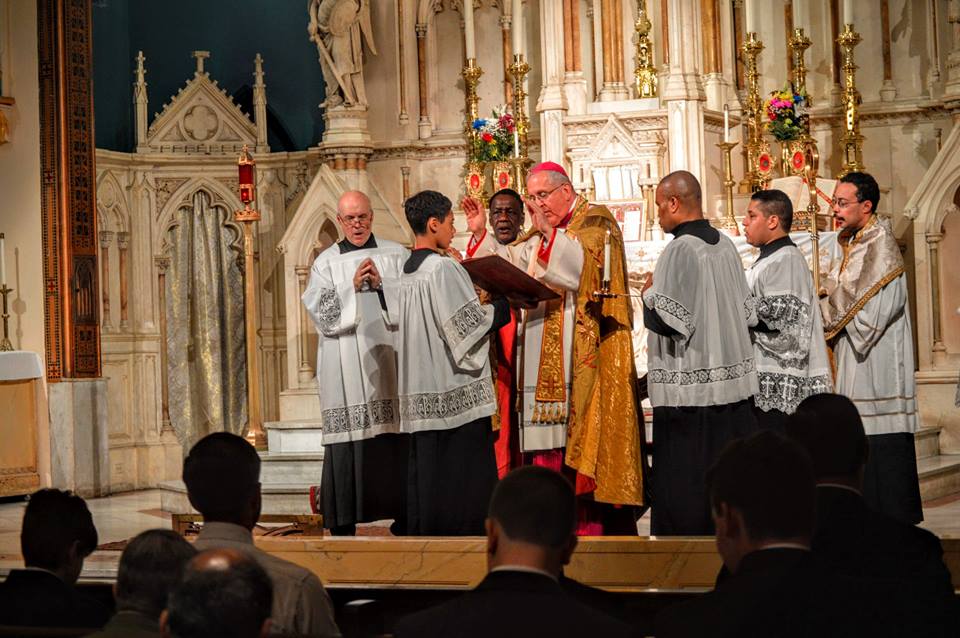
On Saturday, June 18, the Church of the Holy Innocents in New York City was honored to welcome one of the auxiliary bishops of the Archdiocese of New York, the Most Rev. John O’Hara, for the celebration of the Sacrament of Confirmation according to the traditional rites and ceremonies. The Veni Creator Spiritus was sung at the beginning, and Bishop O’Hara gave a wonderful exhortation to the candidates and those in attendance, mentioning how glad he was to be at Holy Innocents doing the Confirmations in the Old Rite. After the Confirmations, a solemn Te Deum was sung in thanksgiving for such a great occasion, followed by the recitation of the Rosary, and a Solemn Mass; Bishop O’Hara attended in choir and gave the homily, expressing his appreciation of the liturgy and the music (the Missa Quatuor vocum ad imitationem moduli ‘Exsultate Deo’ by François Cosset, c.1610-c.1664). Below are the photos taken by Mr. Arrys Ortanez.
By Dr. Peter Kwasniewski of New Liturgical Movement
Nine years have passed since the promulgation of the great Motu Proprio of Pope Benedict XVI, already included in the most recent edition of Denzinger and destined to be seen as one of the most important papal interventions of the modern period. Wherever the Motu Proprio has been received with obedience and put into practice by faithful sons of the Church, the fruits have been marvelous, well-nigh miraculous. Through learning and celebrating the usus antiquior, the priesthood of countless priests has been renewed, deepened, focused, enriched, re-connected with the fundamental spirituality of the Roman Catholic Church. This legislative act has provided a timely remedy for the demoralization of the clergy, the desacralization of the liturgy, and the deracination of the Christian people. Thus for its ambitiousness.
The same period has brought to light ambiguities and tensions in the Motu Proprio that future generations will have to resolve. For example, how exactly can one have two forms of the very same rite, when historically, and logically, there ought to be only one? If the shift to a reformed liturgy did not create a break within the Roman tradition, how then could it have been possible later on to establish, on equal canonical footing, two versions of the same rite? They are said to be two “uses†of the same rite, and yet there is far less difference between the Dominican, Carmelite, and old Roman uses (to take a few examples), than there is between the old Roman and the new Roman. The Motu Proprio did not attempt to solve these difficulties, but took a pragmatic approach, content to abide with perplexity. Thus for its modesty.
We must return, again and again, to certainties. Summorum Pontificum requires all Catholics to do the following:
Acknowledge that the usus recentior or Ordinary Form is valid and licit;
Acknowledge that the usus antiquior or Extraordinary Form is valid and licit;
Accept that Catholics should be free to worship the Lord by participating either in an OF Mass or in an EF Mass. Neither the OF nor the EF needs to be present in each parish or chapel, and it may not be possible immediately to bring in the EF wherever there is a demand for it, but such availability ought to be a goal towards which pastors earnestly work so that the faithful are well provided for within the confines of a given geographical area.
This is the bottom line of Summorum Pontificum as a practical document. If there are many OF Masses but no EF Mass within a reasonably conceived geographical sphere, then one or more clergy are failing to meet the spiritual needs and rights of the faithful in their care. They may not necessarily want to meet those needs and rights, but meet them they must, if they are to be good stewards of the mysteries, loyal sons of the Church, and true shepherds of the flock. The account they must give of their lives before the Eternal Judge will include an accounting on this point, too.
Pope Benedict XVI speaks of the Novus Ordo Missae as “ordinary expression of the lex orandi†(Art. 1) and says, in the letter to the bishops, that “the new Missal will certainly remain the ordinary Form of the Roman Rite, not only on account of the juridical norms, but also because of the actual situation of the communities of the faithful.†Curiously, some people take Pope Benedict XVI’s language to be prescriptive when it is obviously descriptive. He is describing a state of affairs, not prescribing how things ought to be.[1] How they ought to be is up to the Holy Spirit and the Catholic faithful; it is not the stroke of a papal pen that will determine whether or not Catholics make the usus antiquior their liturgical norm. The Motu Proprio unquestionably smoothed the path by which an increasing number of Catholics are, in fact, taking the usus antiquior as their normative liturgy, but it neither established nor disestablished anything. It noted that Catholics would, in the majority of cases, be attending the Novus Ordo, but it also pointed out that the old rite had never been abrogated and should be available to all who seek it. This established the necessary foundation for a potentially limitless expansion of the usus antiquior, to the point that it could become once again the norm that it had been for four centuries (and, in essence, for a millennium longer than that).
By its own internal logic, the Motu Proprio could not have been saying that the Novus Ordo must remain the norm; rather, it is currently the norm, and yet there is no inherent reason why it must remain so for any particular parish, diocese, religious community, or even the universal Church. This is why we are seeing more and more dedicated parishes created for it, more religious communities adopting it and flourishing under its beneficent influence. At a time when religious practice in the West is precipitously declining, we see the springing up of oases of zealous faith (including abundant family life) wherever the traditional liturgy is securely in place.
In the prudential order, Benedict XVI needed to reassure the faithful that no one will be forced to switch over from the Ordinary Form to the Extraordinary Form. But he made it likewise clear that if the clergy or the faithful wish to embrace the usus antiquior, then by all means they are free to do so, without molestation. They have to accept that the Missal of Paul VI is valid. They do not have to take it as normative for their own public worship (otherwise the exclusively EF parishes and religious communities would not be allowed to exist). They do not have to attend it any particular number of times per year. They do not have to believe it is the better or best form of the Roman Rite. They are perfectly free to prefer the older form of the Mass, or of the Divine Office, sacramental rites, and blessings. They may use the older form exclusively (provided they are fulfilling their Mass attendance obligations as Catholics); they are free to think it a superior liturgical rite, as far as the qualities proper to liturgy are concerned; they may believe that churchmen, even at the top tiers, made a tremendous mistake in pushing it aside. Such is the radical freedom for tradition that Pope Benedict XVI injected into the life of the Church.
There is nothing in the law of the Church, whether Canon Law or Summorum Pontificum, that asks anything more than the three points required of all Catholics, as stated above. Hence, if anyone starts to demand more of a Catholic, or concedes him less, they are acting in their own person, and not on behalf of the Church; they are speaking of themselves and not of God (cf. John 8:44); they are acting as vigilantes who have given themselves the job of policing and protecting the mainstream Church from the “dangers†and “errors†and “bad attitudes†of tradition-loving Catholics. It is hard to see how such threatening behavior can possibly be reconciled with fraternal charity, respect for ecclesiastical tradition, observance of canon law, or respect for the basic rights of the faithful.
Whatever its ambiguities or limitations may be, Summorum Pontificum remains the ultimate challenge to the modernist and progressivist tendency to treat traditionally-minded Catholics as if they were so much rubbish waiting to be picked up, carried off, and buried in the landfill, along with their missals, chasubles, copes, birettas, maniples, aspergiliums, and other Romish paraphernalia. Traditional Catholics do not deserve the ostracism, the contempt, or the double standard to which they are so frequently subjected. Liberal and conservative Catholics who do not recognize and repent of this spiritual problem in their own lives will have sins to answer for, even as traditional Catholics may sin by reacting to provocations and persecutions with disproportionate anger, excessive sadness, or despair.
Pope Benedict XVI desired to be a peacemaker and to encourage precisely those behaviors of generosity that would eventually heal the rifts, even as they paved the way to the restoration of liturgical tradition. It remains a scandal that so many professed “good Catholics†(clergy included) continue to ignore the legal demands of Summorum Pontificum and the real spiritual needs of many faithful children of the Church in every land. Those of us who are on the receiving end of bad treatment need to redouble our prayers, penances, and forgiveness, while we continue seeking to actualize the enormous promise of the Motu Proprio in our midst.
First Friday, July 1, A.D. 2016, Traditional Latin Mass (TLM) will be offered by Fr. Gerald Carey, Parochial Vicar of Our Lady of Perpetual Help Roman Catholic Church, at the Rectory Chapel of St. Albert The Great Parish at 7:00 p.m., preceded by Confession at 6:30 p.m. This TLM will the Mass of the Feast of The Most Precious Blood, offered in Reparation to The Sacred Heart of Jesus. Red Vestments.
First Saturday, July 2, A.D. 2016, Traditional Latin Mass (TLM) will also be offered by Fr. Gerald Carey at the Rectory Chapel of St. Albert The Great Parish at 9:00 a.m., preceded by Confession at 8:30 a.m. This TLM will be the Mass of the Visitation of the Most Blessed Virgin Mary to her cousin St. Elizabeth, offered in Reparation to The Immaculate Heart of Mary. White Vestments.
St. Albert The Great Parish is located at 212 Welsh Road, Huntingdon Valley, PA 19006, (T) 215-947-3500. The Rectory Chapel is in The Parish Center, behind the main Church which fronts on Welsh Road.