Random header image... Refresh for more!

NOTIFICATION OF FUNERAL MASS FOR DR. RUDOLPH MASCIANTONIO, CHAIRMAN EMERITUS OF THE LATIN LITURGY ASSOCIATION, PHILADELPHIA CHAPTER

A Requiem Mass for the repose of the soul of Rudolph Masciantonio will be offered on Saturday, October 29, at 11:30 a.m., at Mater Ecclesiae Roman Catholic Church, 261 Cross Keys Road, Berlin, New Jersey, followed by a catered luncheon in the church hall (Bishop DiMarzio Hall). Those who plan to attend the luncheon should RSVP by October 20th to watorchia@gmail.com with “Masciantonio Luncheon” in the Subject Line, so that we can give the caterer a number to prepare for.

In lieu of flowers, tax deductible donations should be made to the Latin Liturgy Association, Philadelphia Chapter, c/o William A. Torchia, Esq., Chairman, 118 S. 21st Street., Suite 615, Philadelphia, Pa., 19103. Donors will receive an acknowledgment of their donations to submit with their tax returns.

October 15, 2016   No Comments

First Friday, October 7, A.D. 2016, Traditional Latin Mass

Priest: Fr. Gerald Carey, Parochial Vicar of Our Lady of Perpetual Help Roman Catholic Church

Location: Rectory Chapel of St. Albert The Great Parish (address below)

Time: 7:00 p.m., preceded by Confessions at 6:30 p.m.

This Traditional Latin Mass will be the Mass of Our Lady of the Most Holy Rosary (2nd Class), offered in Reparation to The Sacred Heart of Jesus. White Vestments.

Address:

St. Albert The Great Parish
212 Welsh Road
Huntingdon Valley, PA 19006
(T) (215) 947-3500

The Rectory, also known as the Parish Center, is located behind the Church, which fronts on Welsh Road.

Mark Matthews

October 4, 2016   No Comments

First Saturday, October 1, A.D. 2016, Traditional Latin Mass

Priest: Fr. Harold B. Mc Kale, Parish Vicar of Our Lady of Mount Carmel Roman Catholic Church

Location: Rectory Chapel of St. Albert The Great Parish, (address below)

Time: 9:00 a.m., preceded by Confessions at 8:30 a.m.

This Traditional Latin Mass will be the Mass of The Immaculate Heart of Mary with a Commemoration of Saint Remigius, offered in Reparation to The Immaculate Heart of Mary. White Vestments.

Address:

St. Albert The Great Parish
212 Welsh Road
Huntingdon Valley, PA 19006
(T) (215) 947-3500

The Rectory, also known as the Parish Center, is located behind the Church, which fronts on Welsh Road.

Mark Matthews

September 30, 2016   No Comments

Ongoing Information Regarding Dr. Rudolph Masciantonio

Dear friends of Rudy Masciantonio,

I want to inform all of you that as Executor of Rudy’s Estate, I will be making all of his funeral arrangements, which will include a High Requiem Mass followed by a reception. I will announce the date and time of the Mass and Reception on the LLA Philadelphia Chapter site, latinliturgy.org/phila.

There is an initial posting if you have not already checked the site. There will be continuous postings for other events so you will have to check the listing on the left sidebar to see the postings for Rudy.

At the time of Rudy’s death, he was Chairman Emeritus of the LLA Philadelphia Chapter, and had been Chairman for approximately twenty-five years or more before his death. It was his wish that, upon his death, donations be made in his memory to the Latin Liturgy Association, Philadelphia Chapter. Please send any donations to the following address:

Latin Liturgy Association,
Philadelphia Chapter
c/o William A. Torchia, Esq., Chairman
118 S. 21st St., Ste. 615
Philadelphia, PA 19103

Thank you for giving your attention to this matter. Let us all pray for the repose of his soul.

Requiem aeternam dona ei Domine, et lux perpetua luceat ei. Requiescat in pace.

William A. Torchia, Esq., Chairman


September 29, 2016   No Comments

Dr. Rudolph Masciantonio, Requiescat in pace.

Dear Members:

It is with deep sadness that we have to announce the passing of our Chairman Emeritus, Dr. Rudolph Masciantonio. At this time there are no arrangements for his Memorial Service and Requiem Mass, but we will publish that information as soon as it is available.

We ask that you please pray for the repose of his soul. Requiescat in pace.

William A. Torchia, Esquire, Chairman


September 25, 2016   No Comments

“In Every Dictatorship The Past is Censured” — From the Life of a Diocesan Priest Who Discovered the Immemorial Mass of All Ages

From the Eponymous Flower Site. Although this article is three years old, it continues to have meaning today.


(Milan) Don Alberto Secci, born in 1963, ordained in 1988, is a priest of the Diocese of Novara on the border with Switzerland. Don Secci became famous when he announced with two other diocesan priests, that he was bringing the traditional form of the Roman Rite back according to the Motu Proprio Summorum Pontificum of Pope Benedict XVI.. The result was great resistance from the diocesan leadership, the rest of the clergy and public hostility. Today he may celebrate the Old Rite and proclaim the undiminished faith – in a tiny mountain village with a few hundred inhabitants. In an interview, he talks about the crisis in the Church and the importance of tradition.

As the three priests announced their decision according to  Summorum Pontificum,  there was massive resistance in the diocesan leadership and the rest of the clergy of the diocese who immediately stirred up  sedition  of  the parishioners against their pastor. The priests became a national news story. The entire press of Italy reported about them. They were described as “stubborn” and denounced as “agents provocateurs”.”We had become a scandal overnight, for the world and the diocese,” said Don Secci. The Pope generously granted the Motu Proprio “and for that, the Church can’t thank him enough,” said the priest. However, Rome was unable to prevail against the selfishness of some bishops who consider their diocese as a private fief. Two Priests are active today in the Southern Alps at Domodossola Verbania and close to the Swiss border, a pastors. To expand its reach, they run the Internet apostolate Radicati nella Fede (Rooted in Faith) and  seek the instruction of the faithful in the Church’s teaching of all time in their parish boundaries. In January, the fourth annual “Day of the Tradition” will take place, which Don Secci organizes once a year. The theme for 2014 is: “Winter in the Church after the Second Vatican Council”. The topic is taken from the book by Cristina Siccardi (see separate article The Winter of the Church after the Second Vatican Council – The new book to an open question )  who will be present as a speaker.
The interview with Don Alberto Secci was conducted by Riscossa Cristiana .
1) It is becoming increasingly apparent, even in relation to the celebration of the Holy Mass (Old Rite and New Rite) that there are two different ways to live the Catholic religion: priests and faithful, are oriented to lessons that are subject to the modern revolution, and other priests and faithful who adhere to the teachings and principles of the Church’s tradition. How do you think it will be possible one day to resolve this dichotomy again?
Don Alberto Secci: It is necessary that those who have the grace to recognize this terrible dichotomy, have to choose for God, to live in complete catholicity  according to Catholic tradition. This is the crucial point. In Christianity there is nothing abstract. You said: “also in relation to the celebration of the Holy Mass in the traditional rite”.  I’d rather say they remain Catholic, believers hold fast to the teachings and principles of the Church’s tradition.. The believers who are  held by the revolution, however, have only a vague Christian inspiration and the only in the best cases. To be precise, you said: “in reference to the Mass.”  Allow me to emphasize this “also”. Why? Not in the sense, as if there were just the Mass, because the Doctrine of the  Faith is inseparable from the Mass and  connected to the entire apostolate. But it is much more in the sense that the Catholic life is the continuation of grace, which comes above all through the sacraments, and thus is the center of the Holy Mass, indeed a Mass without an ambiguous rite. Therefore, If  someone had the grace to understand the dramatic situation,  he would not trade his   conscience for personal acquiescence. One must look for a traditional Mass site and make this the comprehensive place of education in the faith, in the broadest sense of the word, not just intellectually. Small centers of the normal Catholic life, quite modest and perhaps even quite poor, but largely because of the graces that they convey. This will be the solution, God willing. It is our duty to decide whether we want to tread a path of grace and therefore, tradition by loving the Church in Her suffering. God is the solution to this mystery ailment. But God has already solved everything. We are to lovingly care about the Church and not “politically.”
2) The “Day of the Tradition” in Verbania will take place this 19th January 2014 for the fourth time. Can you tell us what will happen and how the initiative was created?

Don Alberto Secci: It is simply a Sunday afternoon, which is entirely devoted to a burning topic of the faith. The day ends with the celebration of a singing show. For years, Don Stefano and I  have endeavored to move forward with a serious study of Christian doctrine for the faithful of our churches. The meetings are  held fortnightly. We place great value on them. The confusion that prevails today among Catholics is so great that we simply can not imagine standing aside, just because we love the tradition. It is necessary to know the Christianity, Church history, the Church teachers and the great spiritual Master. Christianity is so sublime and so beautiful because the whole work of God is unsurpassable and perfect. How could we not feel the desire to get to know it better and better?  I’m worried about those believers who move from one church to another in order to always something “more traditional “, but do not have the desire to be led in doctrine and spirituality. Sooner or later they will adopt a secular mentality again,  one perhaps  sooner than the other. I’ve met some people who were arrested by the Old Rite, but in their judgments and their behaviors were liberal. However, the truth of the faith must be the measure of our judgment and our actions. In order to give other people from further afield the opportunity to participate in our ministry that takes place for us throughout the year, we launched the “Day of Tradition”. It is a day that is dedicated to the Catholic doctrine, specifically a particular topic. It is also an opportunity to meet again, keep in touch, meet new people.

3) Does the life in the countryside as opposed to living in the city facilitate the understanding of the tradition?
Don Alberto Secci: No, today the disaster is global. It is not the mountain or the land itself which will help us, but the way you view the world, that is, whether they are really considered to have Catholic views. If so, whether the mountain or plain, small village or metropolis is the same. On the contrary, if a priest should be really determined to give his life in the grace received from Him, then the city offers even more opportunities for his apostolate. Personally, I must confess that I have always loved the solitude of the mountain, which always holds the same beauty and pain in itself and I have learned more and love more. For me anyway, it is the place where I live as a priest, which obedience to God. First,  the faithful are entrusted to me. I’m not picking any particular place,  that I’ve never done.
4) Why  precisely are those who want the Creed of the Holy Catholic Church  and are really serious to live it, are the only ones excluded from the discussion and public debate  or kept to religious themes, but but everything else is approved?
Don Alberto Secci: In every dictatorship, the past must be censored. No one must know how it once was before the dictatorship, which always claims to give new life to the world. And the dictatorships of the “liberals” are the worst and have always been the worst. When the schema of a dictatorship enters the Church, the censorship of the past is almost a dogma: “Today the Church has a new consciousness, you can not go back to the things of the past, even if they were sacred, but today they are no longer there, because the Church’s consciousness determines the truth in today.”  Something like that is thought by almost all today, and that is terrible. It is the fastest way to destroy the Church, as we see. The representatives of this thinking have access to almost all means of communication, because they are useful to “entertain” the people, they do not argue with the New Paganism, they do not startle, do not challenge them when they criticize, then only the Church, most of the time, but they just talk, they palaver and palaver and say this mostly nothing.
But it is enough that a child says  in his innocence, see, the king is naked, and already breaks the spell of censorship that the past is hidden, it  falls into place in a single moment. That’s why it will take more work from  the traditional side and less “whining”,  to help build the kingdom of God, according to the responsibility that God has entrusted to each of us objectively. There is no time to lose: Do all that stands in your way, so that the Catholic Church and the world is Christian.
5) What today indicts  the Church  of being in crisis?
Don Alberto Secci: The priesthood.  In the “modernized” Christendom, the  priesthood  has no place, because it is without meaning in  the new religion ultimately. That is the terrible consuming of Protestantism in our house, that is, in the Catholicity.
6) What can teach the tradition of the Church teach to  our time?
Don Alberto Secci: Quite simply, Christianity. You must do nothing else. Christianity is not reduced to a purely earthly matter, as does the prevailing flow, but Christianity as God’s grace. Christianity, which is not ashamed of the cross and therefore builds upon and aims to  grace. Christianity, which knows that grace is not a construct but is truly effective, and is capable of bringing about a civilization and high culture when man opens to her, as history has never seen. Tradition teaches the visible Church, that Christendom  in order to save many souls brings forth  Christianity, that is, a Christian society: therefore, if the Church of today wants the salvation of souls, then  She should cease to be ashamed of Christianity .
7) What does tradition teach to the pathological modern world, which consists of many broken families, of sick political decisions of cultures and ideologies that are in open contradiction to the law of nature and no longer has  clear goals and fixed points?
Don Alberto Secci: Tradition reminds everyone that one can not pretend that there is no original sin, when talking about the people and society. Man can not save himself, so he can’t  build a just society on his own. He needs the grace of Christ and indeed absolutely, without exception. Without grace that comes from God, there is no healthy people.
Tradition also points out that the Grace of God, the grace that Christ has given to us through the cross and conveyed to us through the Sacraments, can do all things. And if this is so, and that is so, then there is nothing that can prevent sanctity, if man does not reject it himself. Traditionalists are  the kindest, friendliest people because, they are in the  readiest place there is,  because he lives on the primacy of the supernatural life. For where God lives, everything becomes new in  true order.
8) Why should traditional people live better than a “modern” man?
Don Alberto Secci: Because he does not support his life by himself, but depends on God. One must live so that he always looks for the grace of God and  to do this with the joy of everything to His greater glory. The tradition is a way of simplicity, it does not look for luxury or  false comfort: God is everything, and so I live for Him. It is a life, everyone in his state of life, as Saint Benedict says, because the monk is simply a Christian. In the Middle Ages it was quite normal that even princes and princesses went to the monastery when they came of age. This was not an early form of retirement home for rich and powerful who could afford it at that time. No, it was because of their salvation because they knew that this was the most appropriate way to do what they knew to do, namely, to seek the grace of God, having previously lived by their rank and position, performing with their responsibility in the world.
9) In view of the many people who groan under the daily loads that consume their days full of hustle and bustle and work for an ultimately pointless existence as it appears to them, have  questions to which they can find no answer, how would you  describe to them the beauty of life  and also the beauty of death?
Life and death becomes beautiful when  one recognizes one’s own place and also lives: you belong to God and the whole of life has its meaning, and the questions suddenly get a clear answer when we recognize this commitment. And in God, in our Lord Jesus Christ, man suddenly realizes with astonishment that all is altogether well. One discovers the profound unity of everything. Life is  will be understood  in an entirely new depth and simplicity, it is wisdom. But that you do not get that without the Church, which of course was specially instituted by Christ with a clear task for It. But the Church is not a social, societal and thus horizontal means such as many others are The Church is the communion with Christ, It is the tradition. It is the tradition, because this bond with the Lord  through the Apostles represents an unbroken line willed by Christ and therefore, the certainty of salvation is mediated through the sacraments. Is there anything more shockingly beautiful  than that? Everything in this bond of grace with Christ, a bond that is historically observable  because it acts in history, finds its place. Nothing is free. If someone wants to live outside this order of God, which alone corresponds to the true nature of things and also of man, therefore following his true, unique development, he will eventually find only suffering and anguish, and finally death, with the real danger that this death is final, terrible and eternal. But God wants us in his own order, he wants to share with us the great beauty, the eternal life, in Him Himself.
Introduction / Translation: Giuseppe Nardi
Image: Messa in Latino
September 24, 2016   No Comments

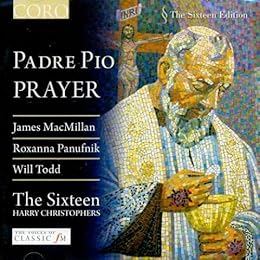
Padre Pio music on his feast day: Musical Setting of his “Prayer” (VIDEO), From Fr. Z’s Site

Today is the Feast of St. Pio, aka Padre Pio of Pietralcina, who died in 1968 and was canonized in 2002.  He was an amazing saint.

I have an affection for Padre Pio.  My bishop, who recently passed away – RIP, when he was a member of the Congregation for Causes of Saints was the “Ponente” of the cause of St. Pio .  I got a good look at the many volumes of the positio for the cause and heard some great anecdotes.

Here is something that you may not be aware of.

I am sure you have heard of the great (living) composer of both secular and sacred music James MacMillan.  Among the fine music has has written is, just as an example, the Tu Es Petrus we heard when Benedict XVI entered Westminster Cathedral during his state visit to England.

MacMillan wrote music in honor of St. “Padre” Pio!  It is sung by no less than The Sixteen.

US HERE – UK HERE

It is a setting of his “Prayer” HERE.

HERE, however, is a choir singing the Prayer:

Meanwhile,

September 24, 2016   No Comments

Nothing Superfluous — A Masterful Spiritual Guide to the Traditional Mass

By Dr. of the New Liturgical Movement

Nothing Superfluous: An Explanation of the Symbolism of the Rite of St. Gregory the Great [i.e., the traditional Latin Mass]. By the Rev. James W. Jackson, FSSP. Lincoln, NE: Redbrush, 2016. $17.95. Available from Fraternity Publishing.

This is a book whose publication I have been eagerly awaiting, ever since I saw the manuscript a couple of years ago and, subsequently, the tantalizing excerpts that have appeared each month in the newsletter of the North American district of the Fraternity of St. Peter.

Many readers will already be familiar with the genre of book to which this new one belongs: a running commentary on the parts and prayers of the traditional Latin Mass, probing their symbolism, looking into their theological depths, and offering suggestions for how one might enter into the great mystery of the Mass more consciously and obtain more spiritual fruit from it. There are many classics in this genre, particularly from the early and middle of the twentieth century, the heyday of the healthy Liturgical Movement.

This new book by Fr. Jackson, however — and I say it without hyperbole — is the best book of its kind I have ever read. Drawing upon centuries of commentarial tradition filtered through his long experience of offering the Holy Sacrifice with loving awe, Fr. Jackson is able to feed us with choice meat; there is no fluff here.

The book features two Forewords, one by Bishop James Conley of Lincoln, the other by Dom Phillip Anderson, Abbot of Clear Creek Monastery (neither of them strangers to readers of NLM).

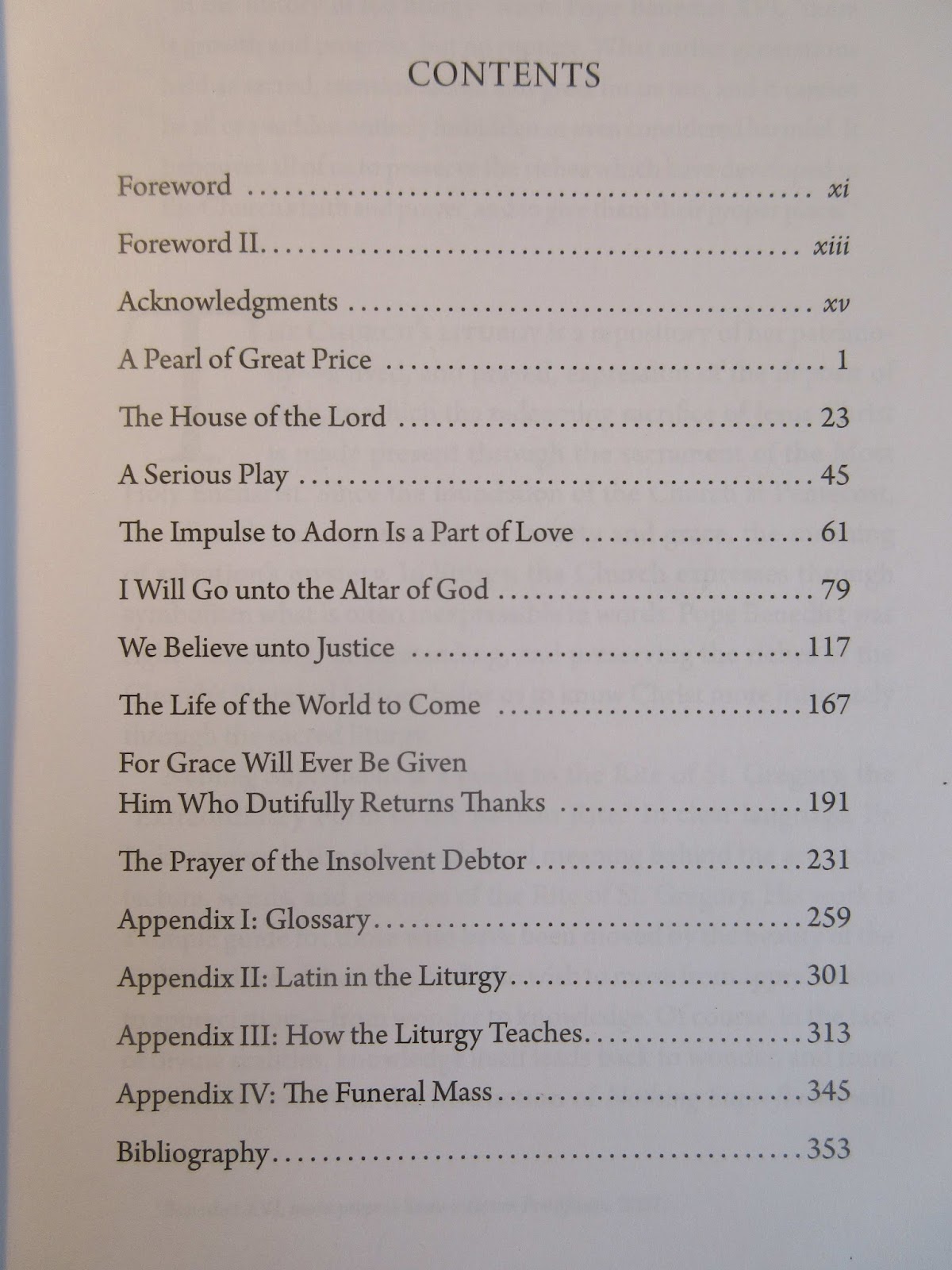
Chapter 1 talks about the language of the liturgy and how it speaks to our hearts (and why its very density of symbolism and stability of form is the precondition for real participation in it); chapter 2 speaks of the church building, its characteristics, furnishings, and objects; chapter 3 is about the liturgy as “serious play,” its leisureliness and relationship with wonder; chapter 4 looks into the sacristy and explains the different vestments; chapter 5 is on the ceremonies that precede the priest’s ascent of the altar; chapter 6 is on the Mass of the Catechumens; chapter 7 delves into the Creed and the Offertory (and what a rich commentary on the traditional Offertory prayers we get!); chapter 8 is dedicated entirely to the Canon of the Mass; chapter 9 to all that follows, from the Lord’s Prayer to the Last Gospel.

Appendix I is a substantial, detailed, and informative glossary of liturgical vocabulary; Appendix II explains and defends the use of Latin in the Roman liturgy; Appendix III speaks wisely of how the liturgy teaches most effectively when it is most fully itself, not when it busily sets about teaching people; Appendix IV is a short but convincing apologia for the traditional Requiem Mass in all its black-hued distinctiveness. The chapter headings are graced with old-school line drawings.

Every page glistens with gems of insight. For example, he throws down the gauntlet to those who would perpetually adapt the liturgy to modern man, changing it and strippping it down as they go along:

Does the fact that we no longer see shepherds and flocks every day mean that such images are no longer comprehensible? Is it because no one at our parish has ever met a seraph that the metaphorical power of this messenger no longer speaks to us? Half of all the poetry ever written makes use of images and terms that are not part of daily life. These words and symbols are a part of a biblical and liturgical mother tongue that simply cannot be replaced. It is a language that must be learned, not replaced. Divine realities only gradually yield their full significance. So understanding the liturgy is a lengthy and progressive process of becoming familiar with a particular reality. This is one of many reasons why the liturgy must have a great stability, not just in texts but also in gestures, vestments, and music. (2-3)

Fr. Jackson’s treatment of how the seven utterances of “Dominus vobiscum” in the liturgy correspond to the seven Gifts of the Holy Ghost, and why they come in the places and the order in which they do (pp. 110-16), is a tour de force. The discussion of why precious articles are used in worship, and the particular symbolism of each vestment of the celebrant, including the liturgical colors (pp. 61-78), is so beautifully and aptly put that it succeeds in being not only informative but deeply moving. The explanation of each part of the church building, e.g., windows, steps, bells, altars (pp. 23-44), reveals layer after layer of rich symbolism; one who reads these pages will never think about or encounter these things in quite the same way.

As one would expect (and yet still rejoice!) to find in a disciple of the great John Senior and his colleagues of the Integrated Humanities Program, this marvelous book always combines the verum, the bonum, and the pulchrum — that is, the rationale behind a certain object or practice or text, the moral and spiritual goodness of it, and its beauty, its radiance or splendor. Fr. Jackson, more than any author I have seen, appreciates that the Mass as a “poem,” the greatest poem our world has ever seen, a poem written by our Lord Jesus Christ and the Holy Spirit over the course of twenty centuries. He brings out the drama of the liturgy as a solemn re-presentation of the sacred mysteries of the life, death, and resurrection of Our Lord and a participation in their inexhaustible dynamism. The traditional Mass is not simply holy (although it is that, to the maximum degree); it is not simply doctrinally pure, ample, and trustworthy (for it is that, too, without a doubt); it is above all beautiful, orderly, and harmonious, elevating the senses, the imagination, the memory, the intellect, the will above themselves and into the precincts of the heavenly Jerusalem. It has a peculiar power to do all this because of the depth and organic complexity of its manifold elements, which grew up together slowly, intermingling, mutually resonating, reflecting both the graced illuminations of the Church and the subtle needs of human nature.

There are so many wonderful lines in this book: “People usually enter the Church by one of two doors: the door of the intelligence or the door of beauty. The first is open to scholars and intellectuals. The second is open to anyone — especially those who see with childlike wonder” (47). “The priest’s lifting up his hands has a profound human significance, as when a child reaches for his mother, or a friend sees an old friend, or a soldier puts his hands up as he surrenders” (139). Some of my favorite reflections have to do with silence:

The silence that the priest maintains here [at the foot of the altar] and in different places in the Sacred Liturgy is not an absence of sound. It has no gaps; it is a single great canticle, and the silence acts as an acoustic veil over the whole liturgy to reveal what the liturgy is. The Gregorian Rite has no artificial introduction of silence into the liturgy by the addition of pauses. When silence is at the beck and call of the celebrant, as opposed to the rite, the silence of the priest becomes the whole congregation waiting for him, wondering what is going to happen next. The silence in the Gregorian Rite is given as an integral part of the Mass, determined by the Church through two thousand years of development. And what often seems like silence in our rite is not quite silence; it is rather the priest praying to God in a low voice. (97)

The silence [of the Canon] also harmonizes with the mystery of Transubstantiation, in which the material elements of the bread and wine are changed into the Body and Blood of Christ, without the senses perceiving it or the created mind able to comprehend it; the Real Presence and sacrificial life of the Savior under the sacramental species are concealed beyond all discernment. So the holy silence is quite suited to indicate and to recall the concealment and depth, the incomprehensibility and ineffableness of the wonderful mysteries enacted on the altar. “The Lord is in his holy temple; let all the earth keep silence before him!” (Hab. 2:20)  (201)

I recommend this book without hesitation for every pastor (it could inspire many fine sermons), every educator (it is the ideal text for a high school or college liturgy practicum), every homeschooling parent — in truth, every faithful Catholic who wants to learn more about the mysteries of the Mass and how to enter more fully into them.

To purchase, visit Fraternity Publications.

September 18, 2016   No Comments

Cancellation of TLM at Shrine of Our Lady in Bucks County

Unfortunately due to schedule conflicts the Traditional Latin Mass will NOT be offered this Month (Sept. 11, 2016) at the Shrine of Our Lady of Czestochowa. We hope to resume on the Second Sunday of October.
Please pray for holy vocations to the Priesthood and Religious Life.
Pray also for our Nation and our Church.

September 9, 2016   No Comments

For the Record: Bishop Fellay explains what has been offered to SSPX by Rome and what Prelature will look like

Taken unedited from Rorate Caeli Blog, September 3, 2016:

“The videos were recorded in a conference in the United States on August 24, 2016. The main points are in the two videos below, especially the last one. We do not add comments, but let the declarations stand as they are.”

Please view the videos in the order in which they appear.

Thanks to Reader PD

September 3, 2016   No Comments