by William A. Torchia, Esq.
By Dr. Peter Kwasniewski of New Liturgical Movement
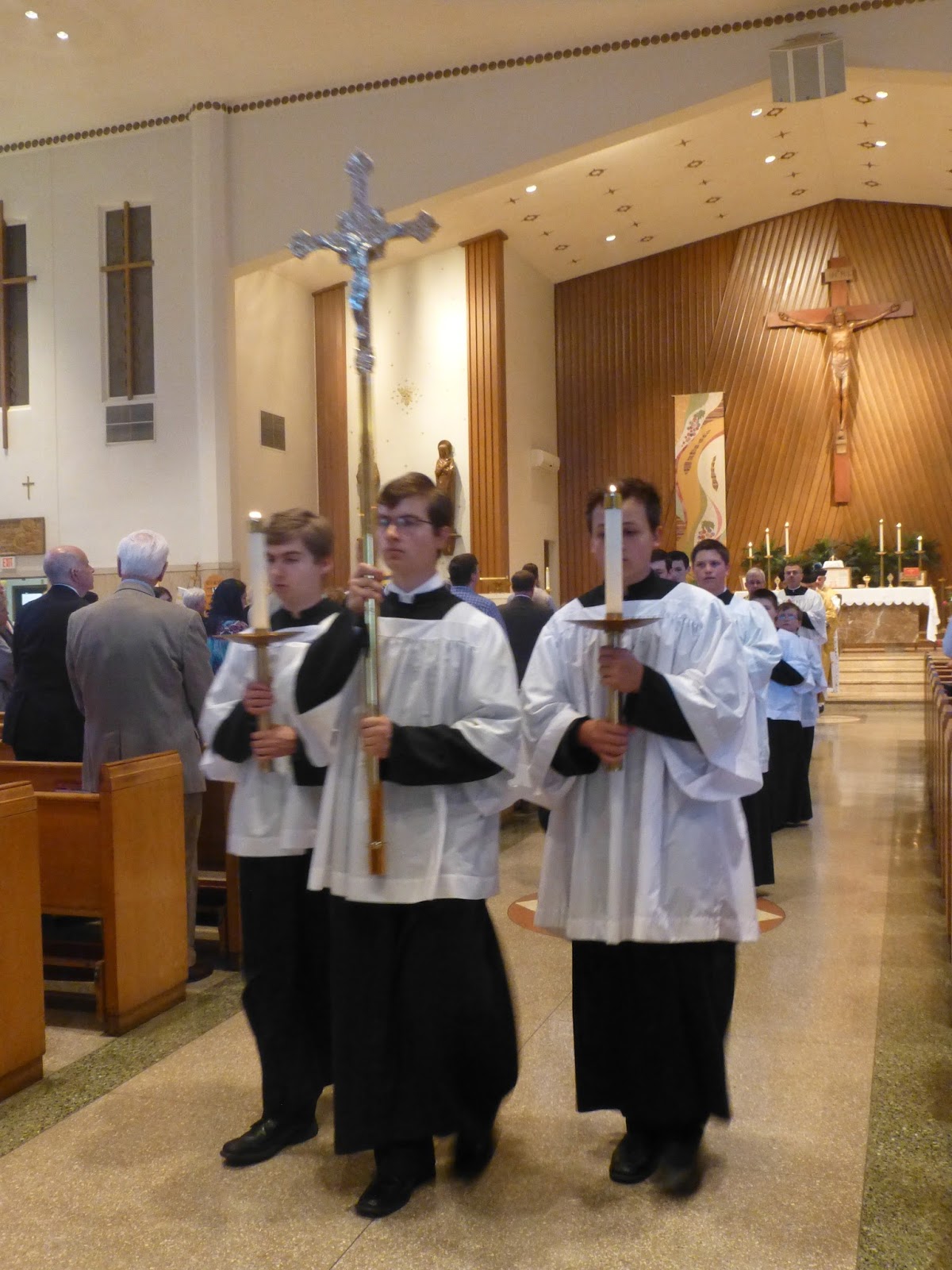
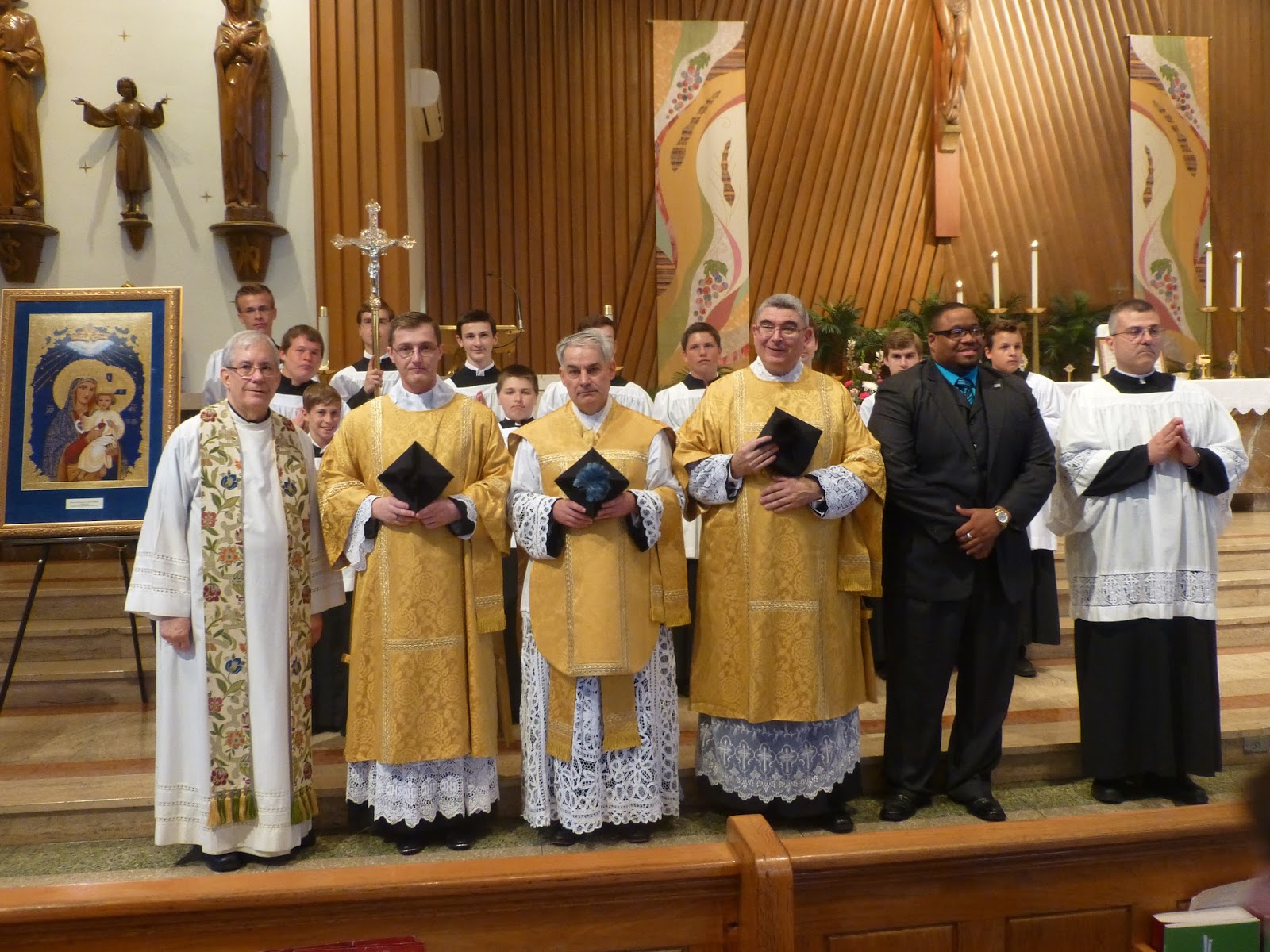
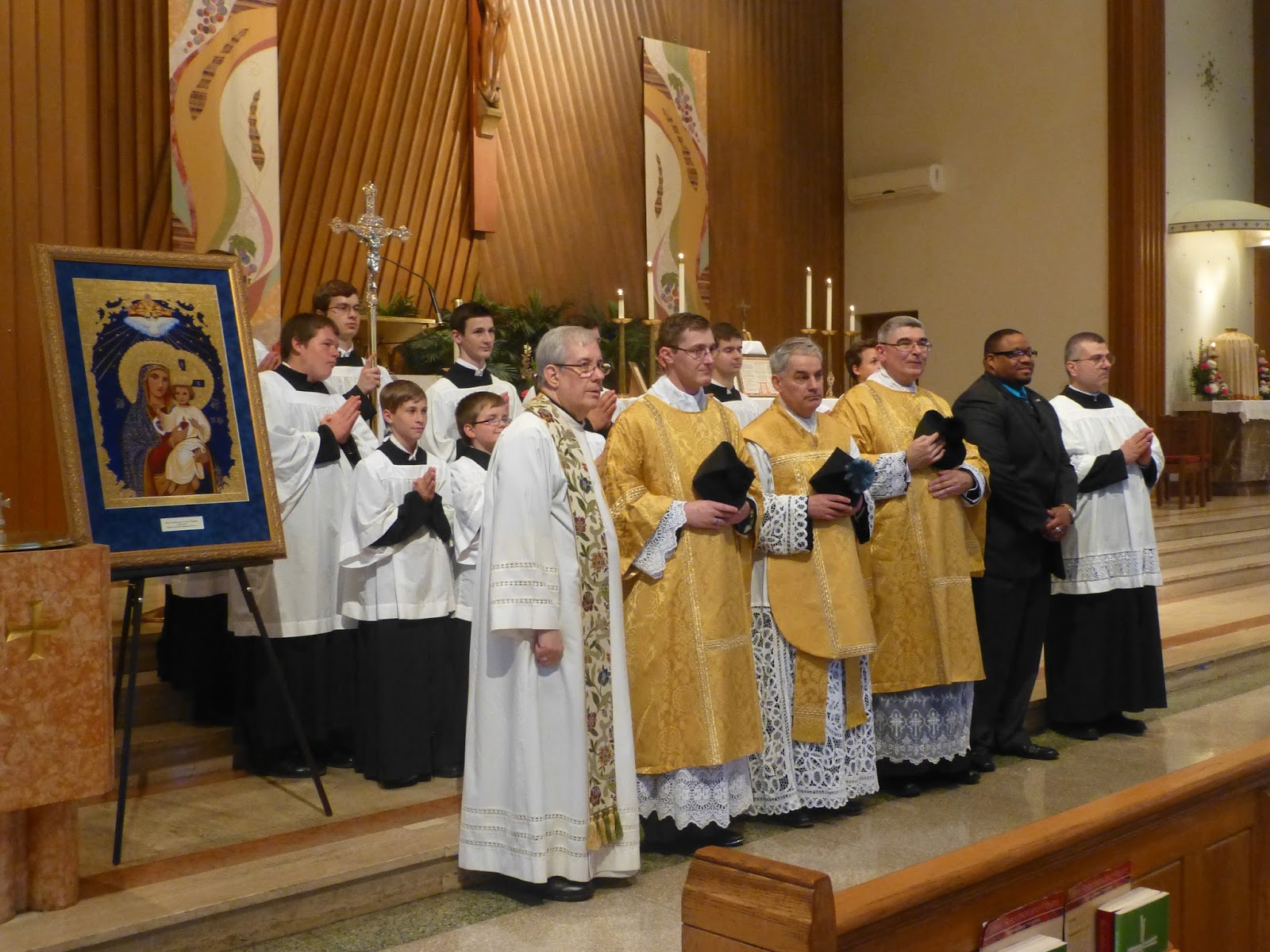
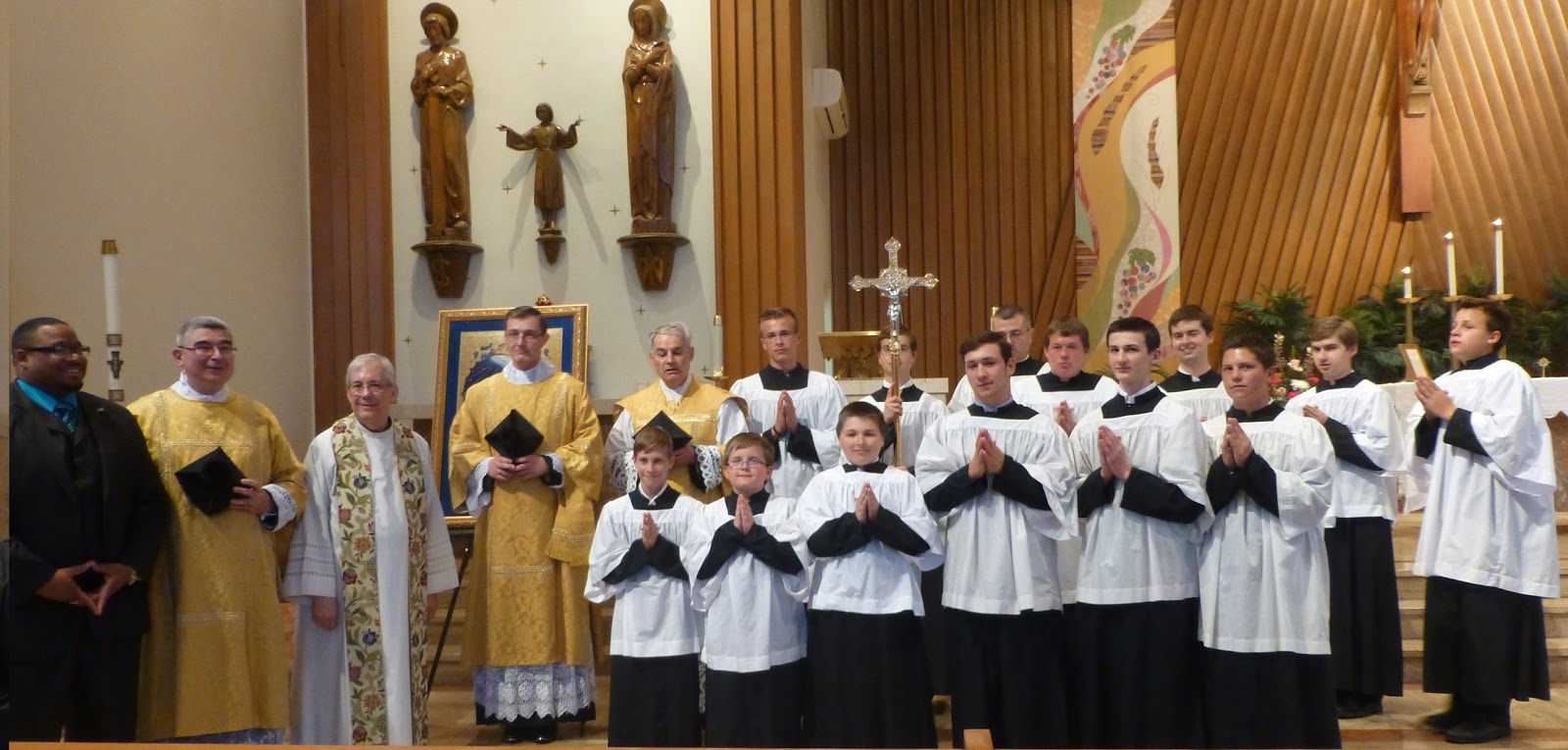
As has been true of each Colloquium in past years, the Sacred Music Colloquium XXVI in St. Louis, which concluded today, was uplifting in its liturgies, abundant in musical glories, and rich in friendships. Next year’s Colloquium, in St. Paul, Minnesota, promises to be a worthy successor.
Seven members of the New Liturgical Movement site participated this year: Charles Cole, William Riccio, Fr. Robert Pasley, Peter Kwasniewski, Jennifer Donelson, William Mahrt, and Joel Morehouse. (The last two were not available for the photo.) We are standing here before the right-hand entrance of the front of the St. Louis Cathedral Basilica — one of the most magnificent spaces in which I have ever had the privilege to sing! The Palestrina Missa Papae Marcelli, with the six seconds of resonance, truly brought us into the precincts of the heavenly Jerusalem.
by William A. Torchia, Esq.
By Dr. Peter Kwasniewski of New Liturgical Movement
Dirigatur, Domine, oratio mea, sicut incensum in conspectu tuo. Let my prayer, O Lord, be directed as incense in Thy sight. (Psalm 140[141]:2)
St. Thomas Aquinas, in the fourth book of his
Commentary on the Sentences of Peter Lombard, states: “Figures that signify what should always be done should not end, as is clear in the example of using incense, which signifies devotion.â€[1] In context, Aquinas is arguing about whether circumcision should cease once baptism is in place, but what I was struck by is his matter-of-fact statement — said without any fear of contradiction — that the use of incense is just one of those symbols that we willÂ
always be using in our rites, since it signifies devotion, which ought always to be present.
At this point in the text, the editors of the Parma edition of Aquinas decided to insert a lengthy note, which is rather unusual. Evidently they thought readers would wish to know just how and when incense was used to express devotion:
Incense in Italy was not used in antiquity in the sacred rites of the Gentiles. Each one used to bring to the gods what he had at hand: honey, wine, milk, but mostly fruits or the first fruits; then they used to give those things that come from grains, like spelt and liba (cakes). Â However, after this incense was imported from Arabia into Greece and Italy, although it was brought at great expense to Rome, people of every class could nevertheless purchase a little bit easily, even the poorest, which they would use as an offering. Â The poor would offer three grains of incense with their three fingers. But the use of incense in the cult of the true God is extremely ancient. Whence Henry Cannegieter [1691-1770] must be rebuked for asserting the following propositions: 1) Christians abhorred the use of incense in the Sacred Rites or Mass. 2) There were no thymiamata [resin compositions of incense] in the ancient Church.[2]
Where Henry Cannegieter doubted the use of incense in the ancient Church or in the Mass, considering it an abomination, G. W. F. Hegel in Phenomenology of Spirit considered its use a sign of “the Unhappy Consciousness,†which, for him,
is only a movement towards thinking, and so is devotion. Its thinking as such is no more than the chaotic jingling of bells, or a mist of warm incense, a musical thinking that does not get as far as the Notion [or Concept], which would be the sole, immanent objective mode of thought. . . . What we have here, then, is the inward movement of the pure heart which feels itself, but itself as agonizingly self-divided, the movement of an infinite yearning . . . . At the same time, however, this essence is the unattainable beyond which, in being laid hold of, flees, or rather has already flown.[3]
For Hegel, devotion means abortive thinking, a gesturing towards conceptual clarity without attaining it. Devotion substitutes the ringing of bells and clouds of incense for rigorous thought; it settles for music rather than science. Yet what I find so delightfully odd is that Hegel has portrayed not an imperfection but, on the contrary, one important reason why the Christian is superior to the mere logician or scientist: the fact that the Christian is possessed of an infinite longing for the divine — this, a gift of God’s grace! — and that he is agonizingly self-divided, since he sees in himself, fallen creature that he is, both a renewed spirit that belongs to Christ and an old Adam that stubbornly clings to the earth. It is precisely through the virtue of devotion that he yields himself up again and again, like incense, to God, as to one who is not only ineffable and inaccessible but also nearer to me than I am to myself, present in all things as the one who holds them in being and endows them with their forms, capacities, energies, and destinies. It is only from the unbeliever that devotion’s object flees or has flown, only to him that it is unattainably beyond.
The saint has become incense that burns upwards to God and in so doing diffuses to men the sweet fragrance of divine gifts. He is flame that, in the intensity of his desire to keep burning and set others aflame, consumes whatever dares oppose it, the last remnants of selfish preoccupations and preferences. In unison with all voices of the Catholic tradition, St. Thomas teaches that holiness — which in one place he defines as “purity consecrated to Godâ€[4] — is judged strictly in terms of charity, whereby one’s very self is handed over, yielded up, made wholly sacred.
We can learn much from pondering the narrow-mindedness of Cannegieter and Hegel. Cannegieter thinks the use of incense either superfluous or idolatrous; Hegel thinks it primitive and prephilosophical. For the one it is a form of excess, for the other a defect or retardation. What neither seems to grasp is the realm of symbol as symbol, and man as homo liturgicus whose path between creation and eternity is strewn with signs that clue him in or lead him astray. We cannot not be immersed in a world of signs; our only choice is which signs to surround ourselves with and what to make of them. Indeed, the result of iconoclasm and minimalism is the anti-trinitarian sign of emptiness, coldness, and barrenness, as we have seen and heard in all too many modern churches and liturgies.
It was fashionable for people in the sixties and seventies to talk about how Catholics had “grown up†(or how they needed to grow up… with a finger wagged at the stubborn folks who clung to the old ways), and thus had outgrown the need for medieval accretions and Baroque courtly excrescences. But such talk betrays an utterly superficial way of thinking, a fusion of the imbecilities of Cannegieter and Hegel. In reality, man matures by growing out to the things he loves and the signs he communicates with, and growing in to his own soul, which is experienced as more real and more important than the ephemeral and transient world.
This is the Christian addressed by (and, in a certain sense, created by) the traditional liturgy. This liturgy, too, has matured over great ages, expanding outward to encompass all the symbols it could reach, and moving inward by developing fully its own inner potentialities, becoming ever more itself.[5] This liturgy beckons and forms man in its image. Its sign-saturation becomes, over time, our sign-language. We think and feel in the images, words, and gestures it offers to us and inculcates in us.
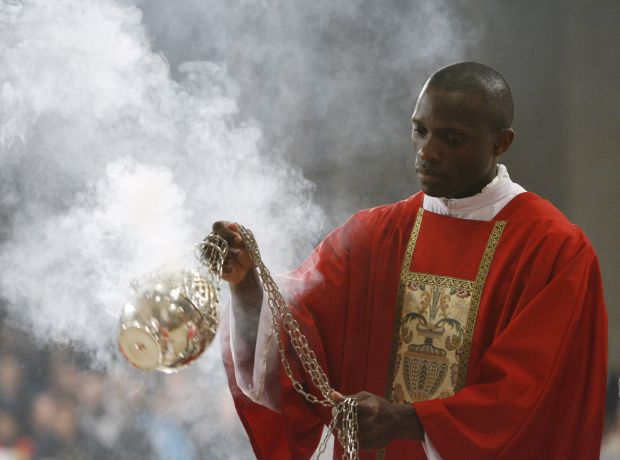
Let us remember, with St. Thomas, the profound symbolism of incense, which should be in front of our eyes, filling our nostrils, clouding our imagination, and concentrating our minds. Its burning up, releasing billows of smoke and fragrance, is the offering of our hearts to God in sweet sacrifice that lifts us up to His throne in adoration. It is the outward sign of our inward devotion, and while it does not effect what it signifies, it affects what it permeates.
NOTES
[1] In IV Sent., d. 1, q. 2, art. 5, qa. 1, obj. 3: “Praeterea, figuralia quae significant id quod semper faciendum est, non debet cessare, sicut de thurificatione, quae significat devotionem, patet.â€
[2] “Thus in Italia non erat antiquitus adhibitum in Sacris Deorum Gentilium. Quisque ad Deos ferebat quod obvium erat, mel, vinum, lac, plerique vero fruges, aut frugum primitias; deinde dabant quae ex frugibus his fiebant, farra et liba. Verum posteaquam Thus ex Arabia in Graeciam, atque in Italiam advectum est, quanquam magnis impensis Romam asportabatur, facile tamen tantillum inde comparabant cujusque fortunae homines etiam tenuissimi, quod Deo libarent. Pauperes tribus digitis tria grana thuris offerebant. Sed thuris usus in cultu veri Dei antiquissimus est. Unde reprobandus est Henricus Cannegieter asserens propositiones sequentes: 1. Christiani abhorruerunt a thuris usu in sacris; 2. Thymiamata ex thure in vetere Ecclesia nulla fuerunt.â€
[3] Phenomenology of Spirit, trans. A. V. Miller (Oxford: Oxford University Press, 1977), §217, p. 131.
[4] “Sanctitas enim importat puritatem consecratam deo†(Super ad Heb. 7, lec. 4). At Summa theologiae II-II, q. 81, a. 8, Thomas notes that the word sanctus may be derived from sanguine tinctus, sprinkled in blood. This purifying consecration and consecrated purity comes not from ourselves, but from Christ alone (cf. Heb. 9:14–15; Heb. 10:19; Jn. 1:12–13; 1 Th. 4:3).
[5] Nota bene, ever more itself—which is precisely why one must question the bizarre Byzantinisms grafted on to the Roman rite in the liturgical reform.
by William A. Torchia, Esq.
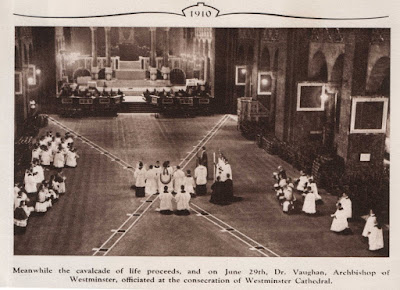
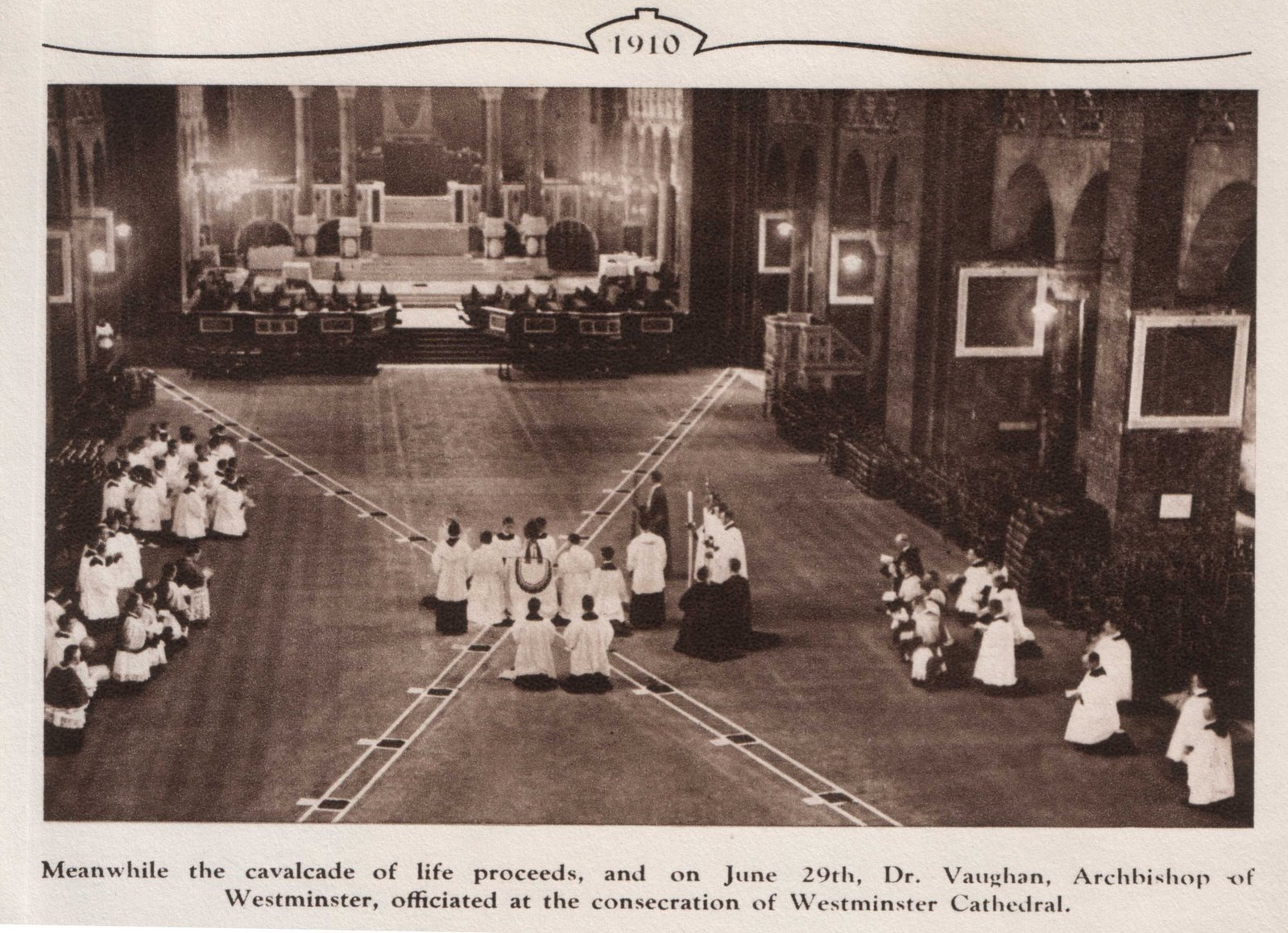
The long vigil of fifteen years has ended. Fifteen years of strong endeavour have achieved a splendid triumph. The crowning act was the Consecration on Tuesday. The act was clothed with all the solemnity with which the Church, with its matchless heritage of ritual, knows how to surround its life and express its spirit. And now Westminster Cathedral takes its place among the great Cathedrals of the world, unique and original in design, itself alone, with its own message, and its own significance. The predilection of Bentley was for Gothic art ; he has produced a masterpiece which is old and new, individual and alone. In style it spans the centuries, finds its foundations in the years of early Christianity as it emerged in freedom from the catacombs, and now the great act of Consecration has set an eternal seal upon it.â€
– From the July 2, 1910 edition of the Tablet. Click here to read the whole account of the ceremony, a really splendid piece of writing.
The dedication of the Cathedral of the Most Precious Blood took place over two days, June 28th and June 29th of 1910. The photograph above shows the part of the ceremony in which the bishop writes the letters of the Latin and Greek alphabets with his crook in the ashes which have been sprinkled over the floor of the nave.
by William A. Torchia, Esq.
Greetings,
Our Apostolate was created by the Archdiocese of Philadelphia to provide a formal structure for the community using the 1962 Missal at St Paul’s Church on Christian Street. When Fr Carey
left that parish the Community celebrated a Sung Mass each Sunday first at Holy Trinity Church, 6th and Spruce Streets and then at St Edmond’s Church at 21st Street and Snyder Ave. in South Philadelphia. It was able to have a full Holy Week at Holy Trinity and has celebrated with High Mass a number of the greater feasts at the Cathedral Basilica of SS Peter & Paul through the hospitality of the Rector, Father Dennis Gill.
Despite the hard work and support of many, it became apparent that neither numbers nor income was sufficient to sustain a Sunday Mass after the end of Paschaltide this year.
The Archdiocesan Worship Office suggested that regular worshippers at St Edmond’s would find place at the long-established Mass in the Extraordinary Form celebrated at the Church of Our Lady of Lourdes at 63rd Street and Lancaster Avenue in the Overbrook section of the City. The Traditional Latin Mass Community of Philadelphia has therefore been attached to the Traditional Latin Mass apostolate at that Parish.
Everyone associated with the work at St Paul’s and the other locations is welcome at the 9.30 a.m. Sung Mass each Sunday. It is hoped that many will attend and will add their support to the work at Our Lady of Lourdes.
Father Michael Rock, O. de M., has warmly welcomed those coming to the Extraordinary Form at the Parish. On the third Sunday of each month following Mass there is coffee and refreshments in the Parish Hall and newcomers may find this a useful place to meet the Lourdes congregation.
The Church is easily reached by public transportation either by the Paoli line of the Regional Rail System (the Overbrook Station is served hourly on Sundays), and by trolley service from the City Hall Station. Street Parking in the vicinity of the Church seems fairly easy to find.
We urge all our friends of the Traditional Latin Mass Community to support this celebration of the Latin Mass with their presence and generosity.
John T Lilley,
Co-ordinator
by William A. Torchia, Esq.
Dear Rev.,
After more than a year of planning, I am pleased to announce that we have found a home for TLM in Bucks County at the National Shrine of Our Lady of Czestochowa. Father Rafal Walczyk, the Prior of the Monastery, has graciously given us permission to use their beautiful downstairs chapel for our Latin Mass.
Initially, the TLM will be monthly and then, assuming we have sufficient numbers to justify it, we will increase the frequency to weekly.  The monthly TLM mass will be held the SECOND SUNDAY of each month at 11 a.m.
The first Mass is only 2 1/2 weeks away. It will be held on Sunday, July 10th at 11 a.m., and will be a Low Mass. Please mark this on your calendar and plan on attending. Also, spread the word to anyone who might be interested.
Our Celebrant for this first Mass will be Fr. Jason Kulczynski. He is the Pastor of Holy Martyrs in Oreland, Pennsylvania. I want to thank him for his interest and help in getting this Mass established.
In addition to Fr. Kulczynski, we do need other priests who are willing to assist us when he cannot accommodate our schedule. Right now, we have one other priest who has agreed to help; ideally, though, we would like to have a group of 4-5 priests on whom we could rely to say Mass. This should be a sufficient number so that if one priest has a conflict on a scheduled Sunday, we would be able to find a back-up from among the remaining priests. If you know a priest that might be willing to assist us, please let me know. We are also in need of altar boys.
As we move forward, we also hope to be able to celebrate the TLM, on occasion, as a High Mass. For this, we will need singers, so please let me know if this is something you could help with. We also plan on creating a website for our Bucks County TLM Group in the near future.
Please pray for the success of the Latin Mass here in Bucks County and I hope to see you on Sunday, July 10th.
In Jesus, Mary and Joseph,

James Todd
Email:Â toddason@verizon.net
Cell:Â Â Â Â 215-421-8858
p.s. Until the website is complete the main source of communication will be by emails, like this one. If you talk with people that are interested, please have them sign up to get on this email list. They can do so by going to www.pewsitter.com/latin/
by William A. Torchia, Esq.
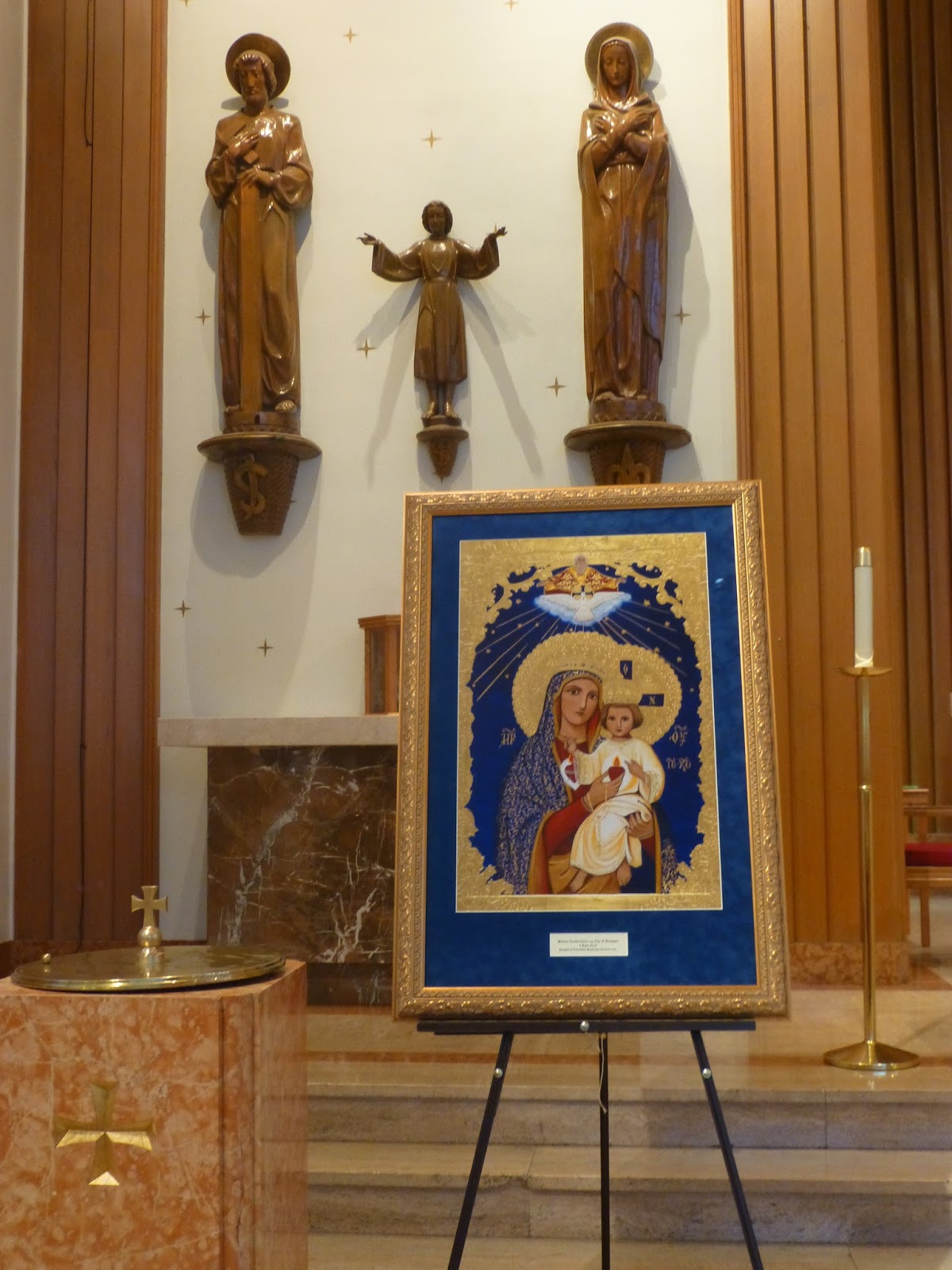
On Saturday, 4 June 2016, in a historic ceremony sponsored by the Knights of Columbus Woodlawn Council 2161, the City of Aliquippa, Pennsylvania, was solemnly consecrated to the Immaculate Heart of Mary and the Sacred Heart of Jesus.
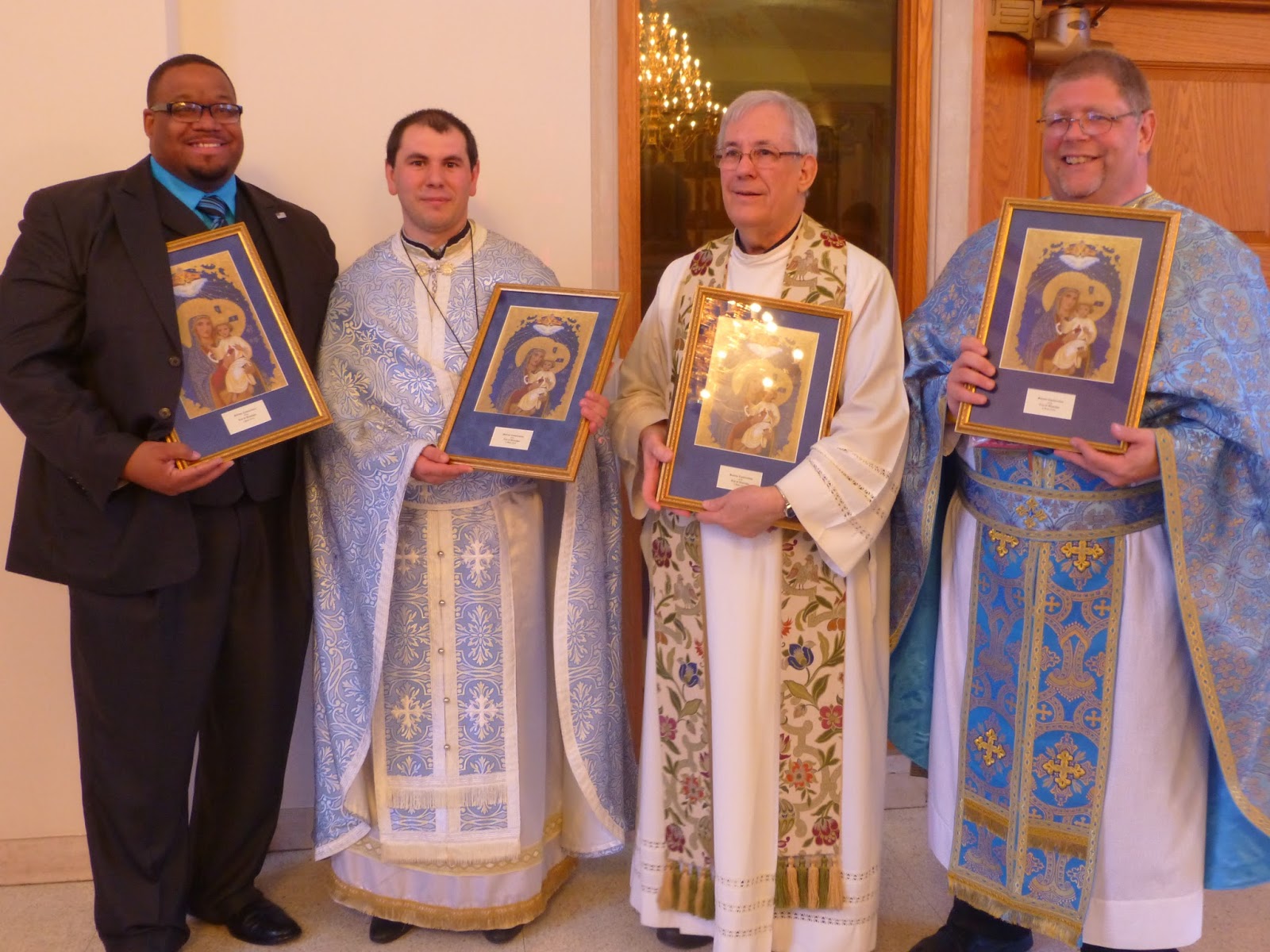
The consecration was performed by the pastors of the three Catholic parishes located in Aliquippa, and the mayor.
Consecrators:
Reverend Father Paul C. Householder, Pastor
St. Titus Roman Catholic Church, Aliquippa
Reverend Father Mykhaylo Shkyndya, Pastor
St. George Byzantine (Ruthenian) Catholic Church, Aliquippa
Reverend Father Michael Polosky, Pastor
Ss. Peter & Paul Ukrainian Catholic Church, Aliquippa
The Honorable Dwan B. Walker
Mayor of the City of Aliquippa
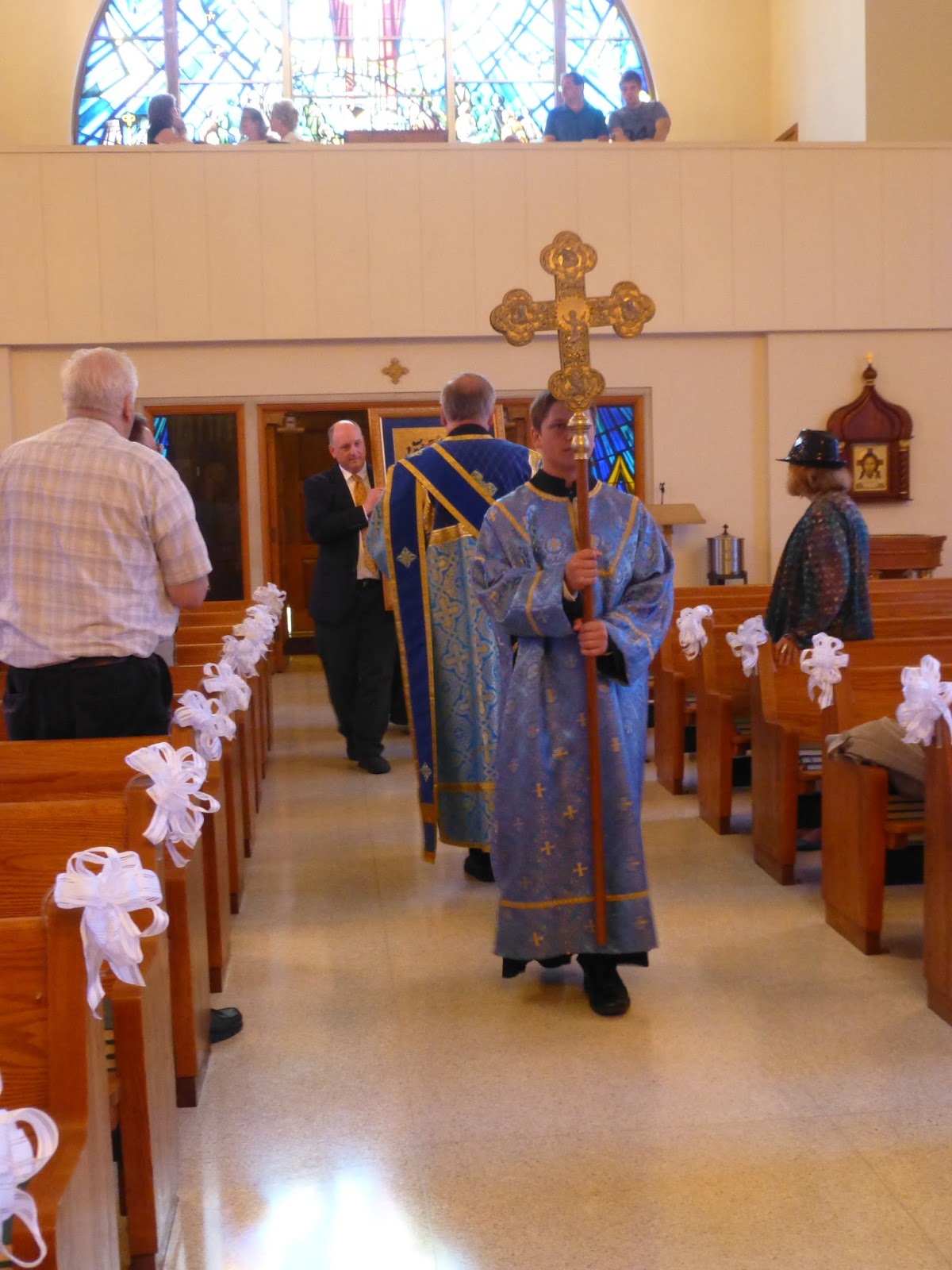
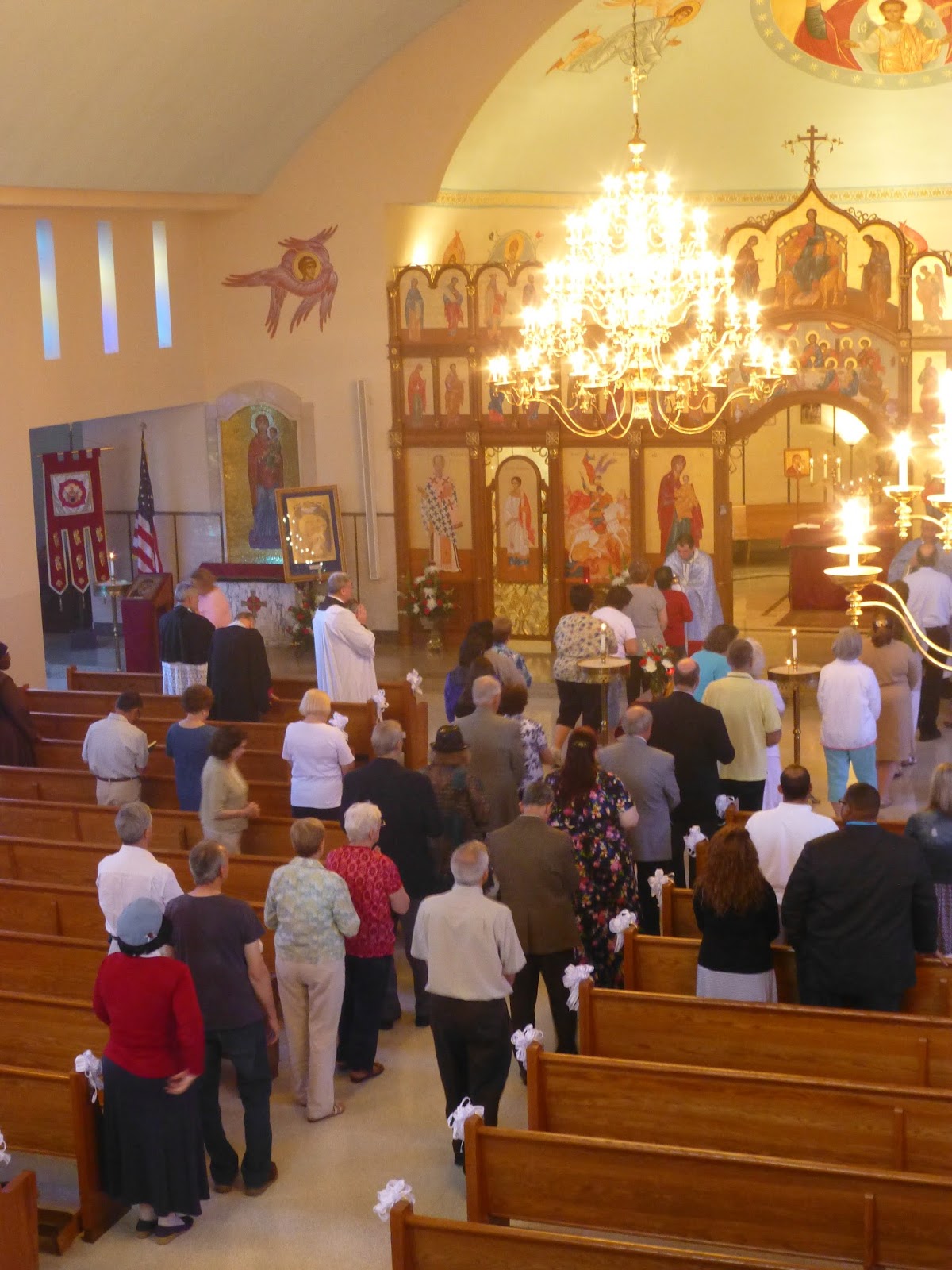
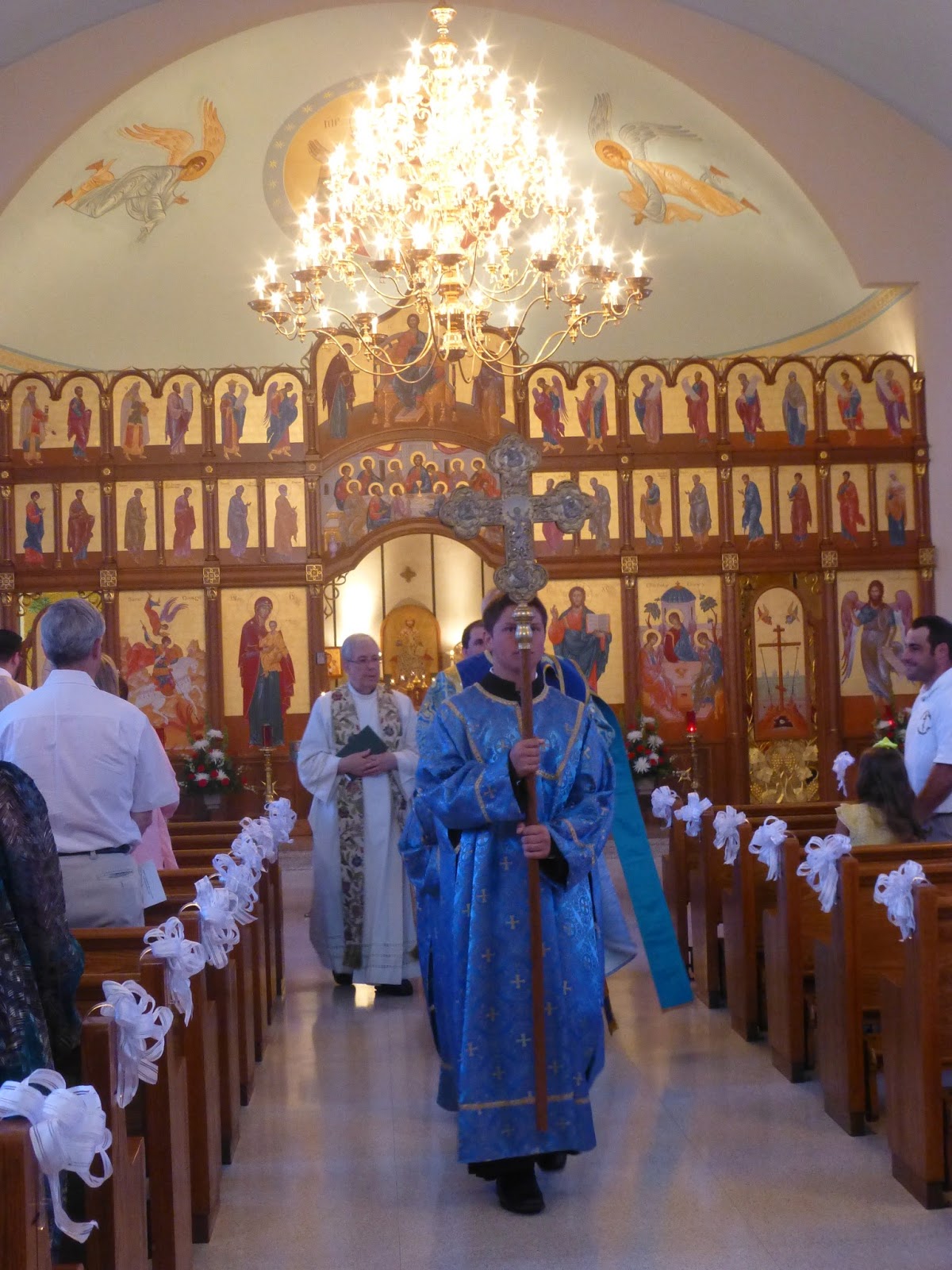
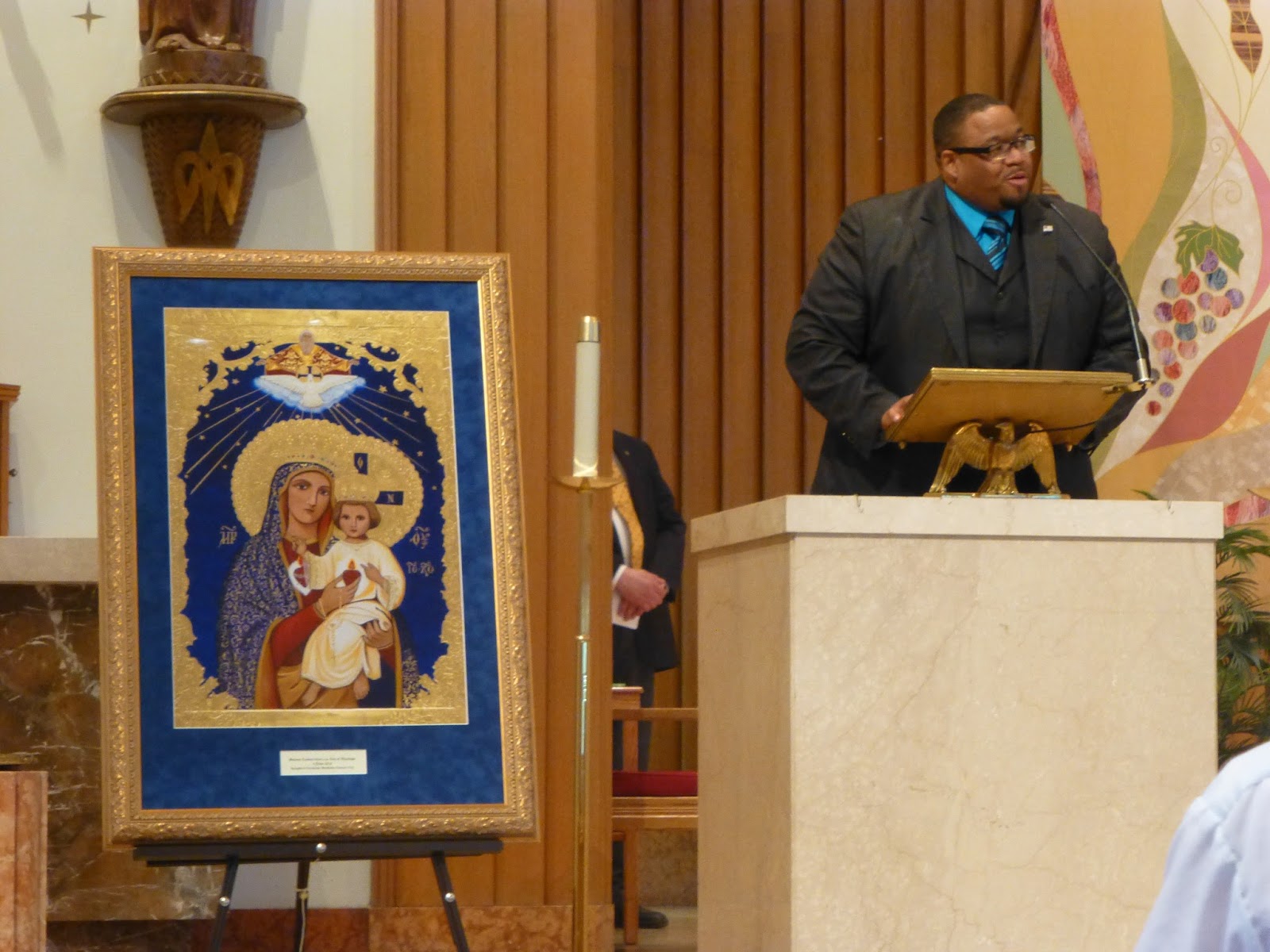
The day’s ceremonies began at 10:30 AM with a procession into St. George Church with the Icon of the Sacred & Immaculate Hearts.
The assembled faithful then prayed the Holy Rosary before the Icon.
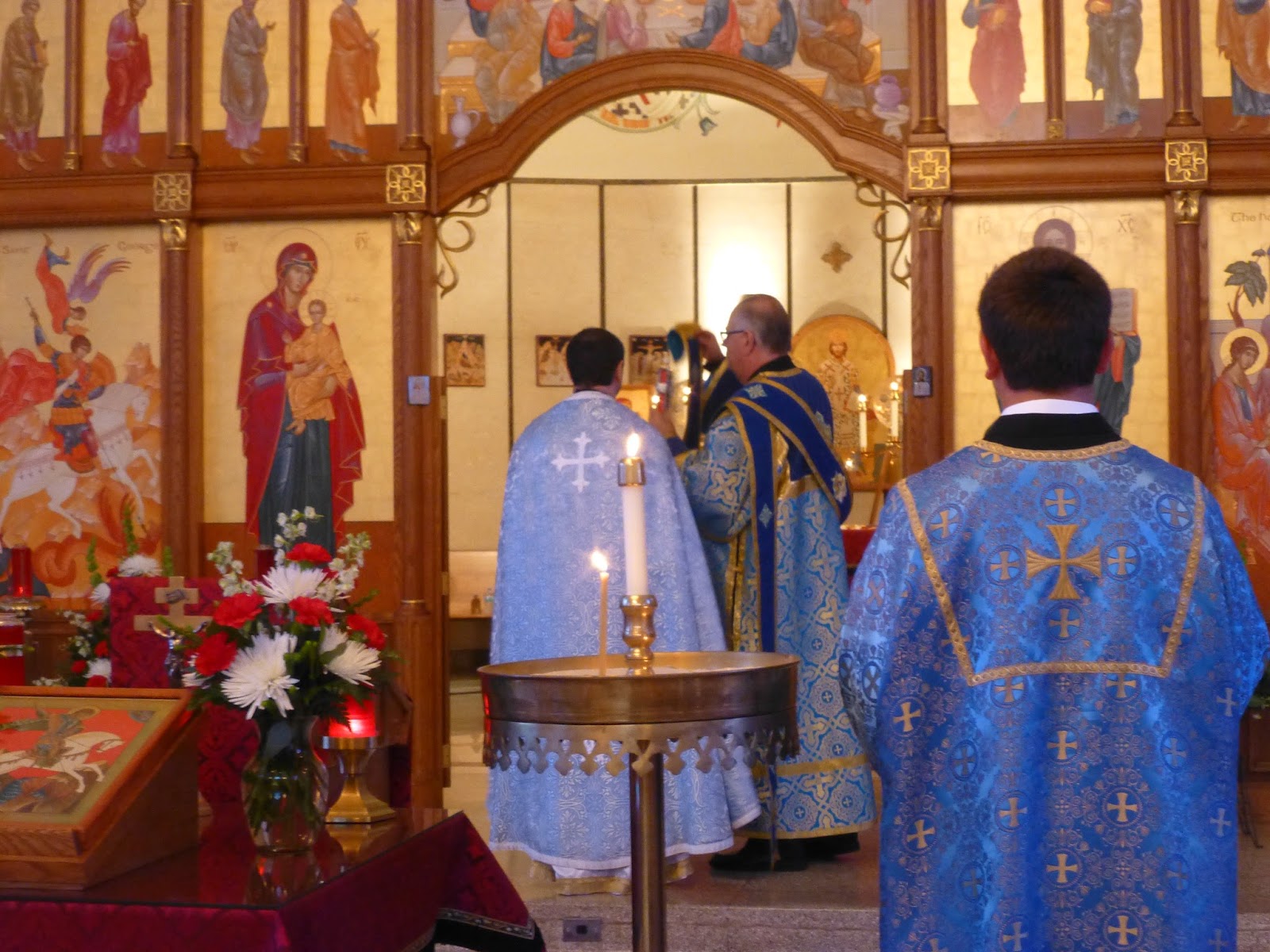
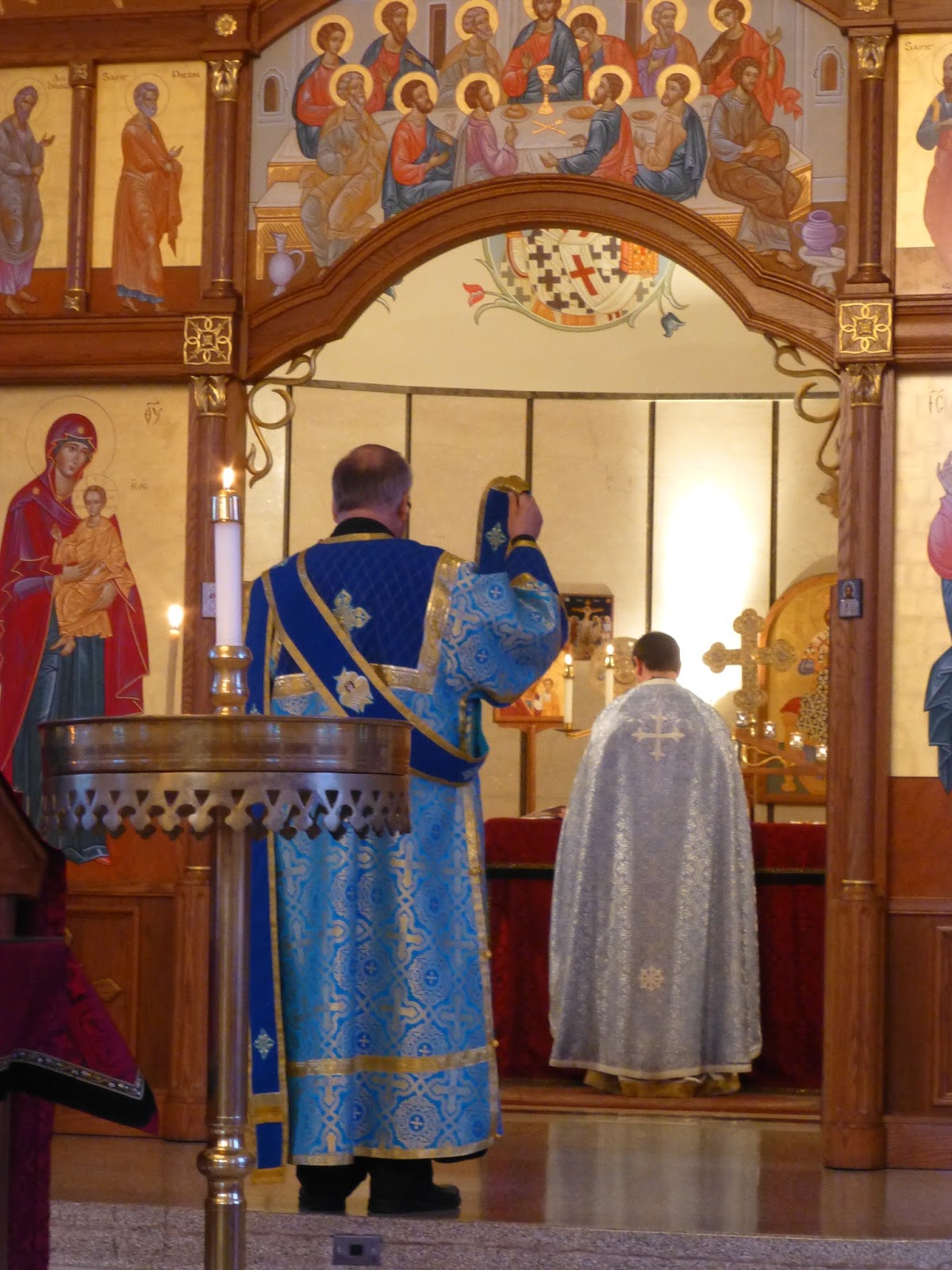
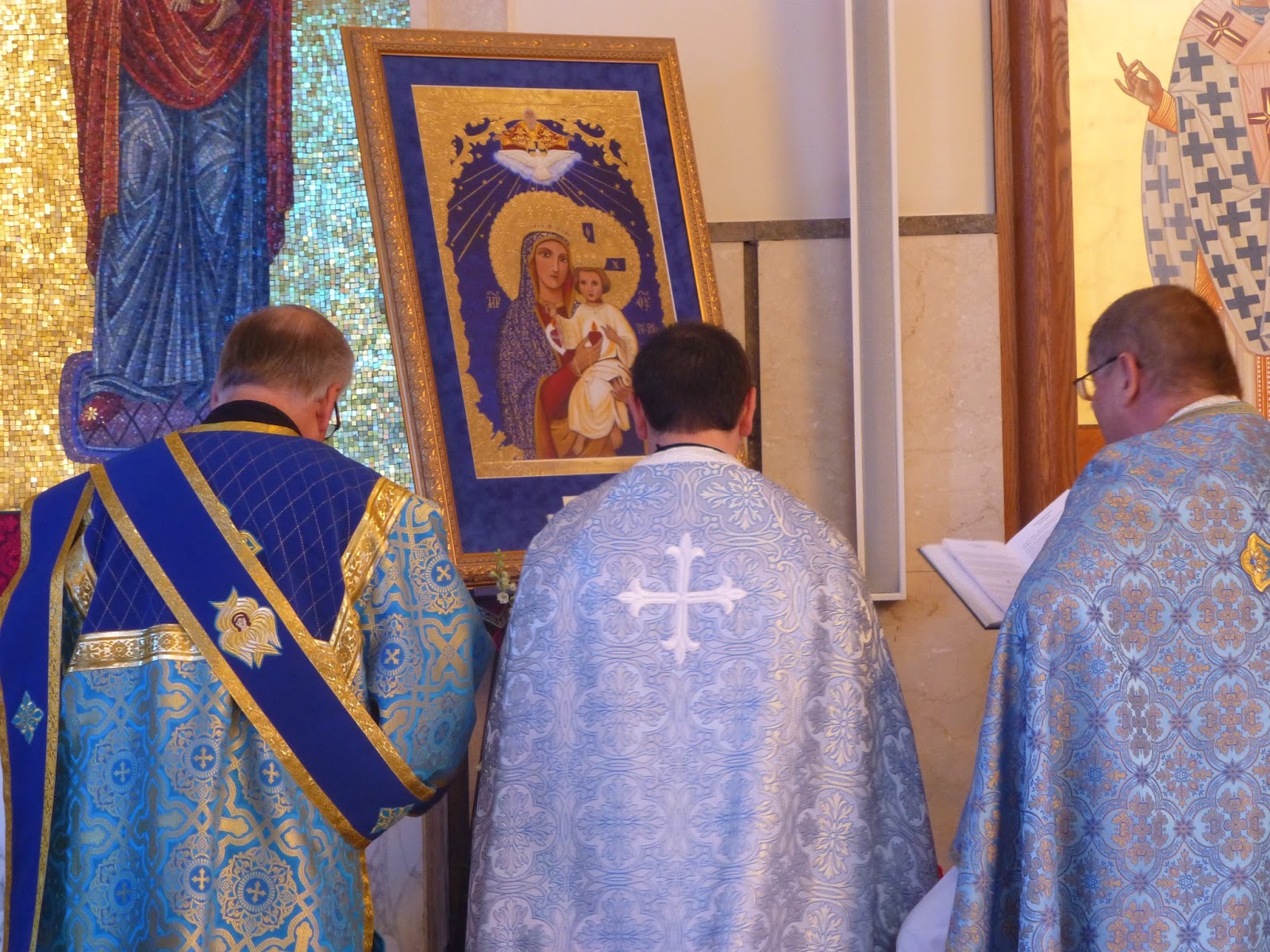
At 11:00 AM the Divine Liturgy in honor of the Blessed Virgin Mary began, with the Eastern Rite clergy in their traditional blue Marian vestments.
Deacon Thomas J. Klacik of St. Mary Byzantine Catholic Church, Ambridge, Pennsylvania, served the Divine Liturgy. Â Also featured was the choir of Ss. Peter & Paul Ukrainian Catholic Church, Ambridge, under the direction of Lisa Hladio.
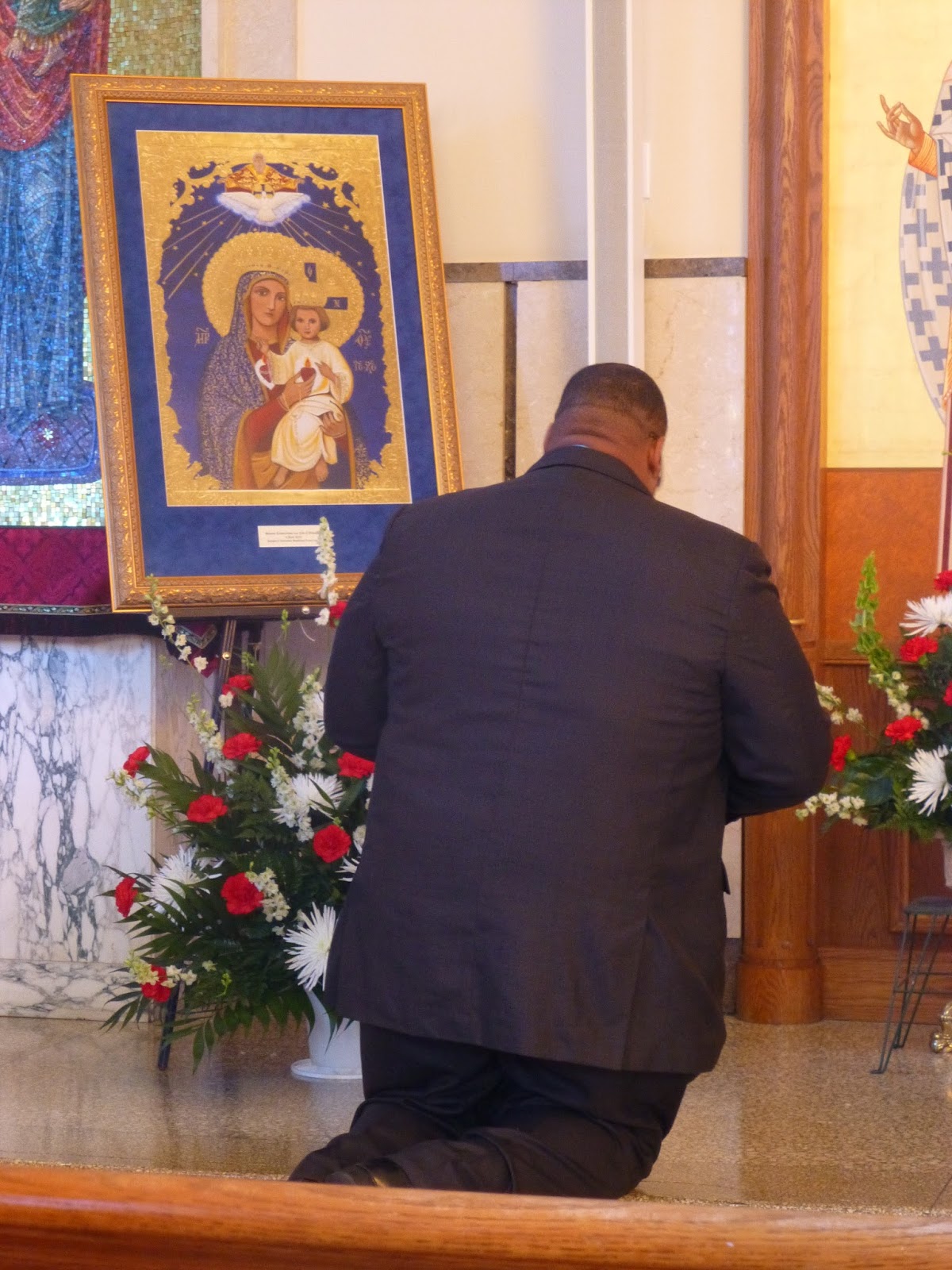
Following the Divine Liturgy, the clergy and mayor knelt before the Icon and recited the solemn consecration prayers.
At the conclusion of the ceremonies, the Knights of Columbus Woodlawn Council 2161 presented the pastors and mayor with framed icon prints, and the mayor presented the priests with solemn consecration proclamation certificates and city flags.
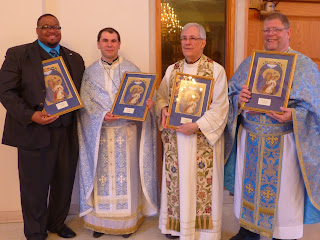 |
| Mayor Walker, Fr. Shkyndya, Fr. Householder & Fr. Polosky |
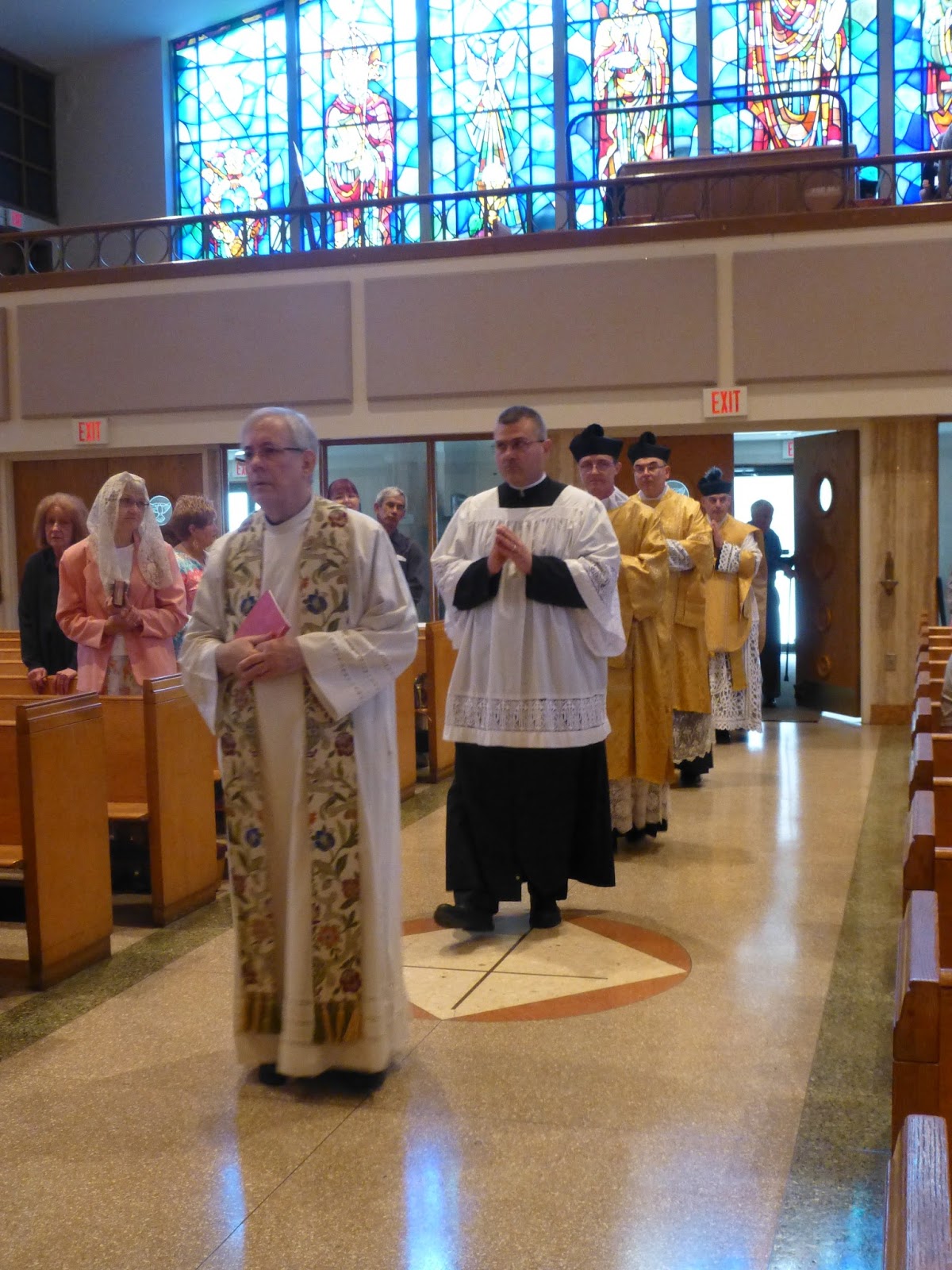
The day’s events then moved to nearby St. Titus Church for a 1:00 PM Solemn High Traditional Latin Mass offered in thanksgiving for the consecration of the city.
Just prior to the start of Mass, Mayor Walker read the proclamation of consecration.
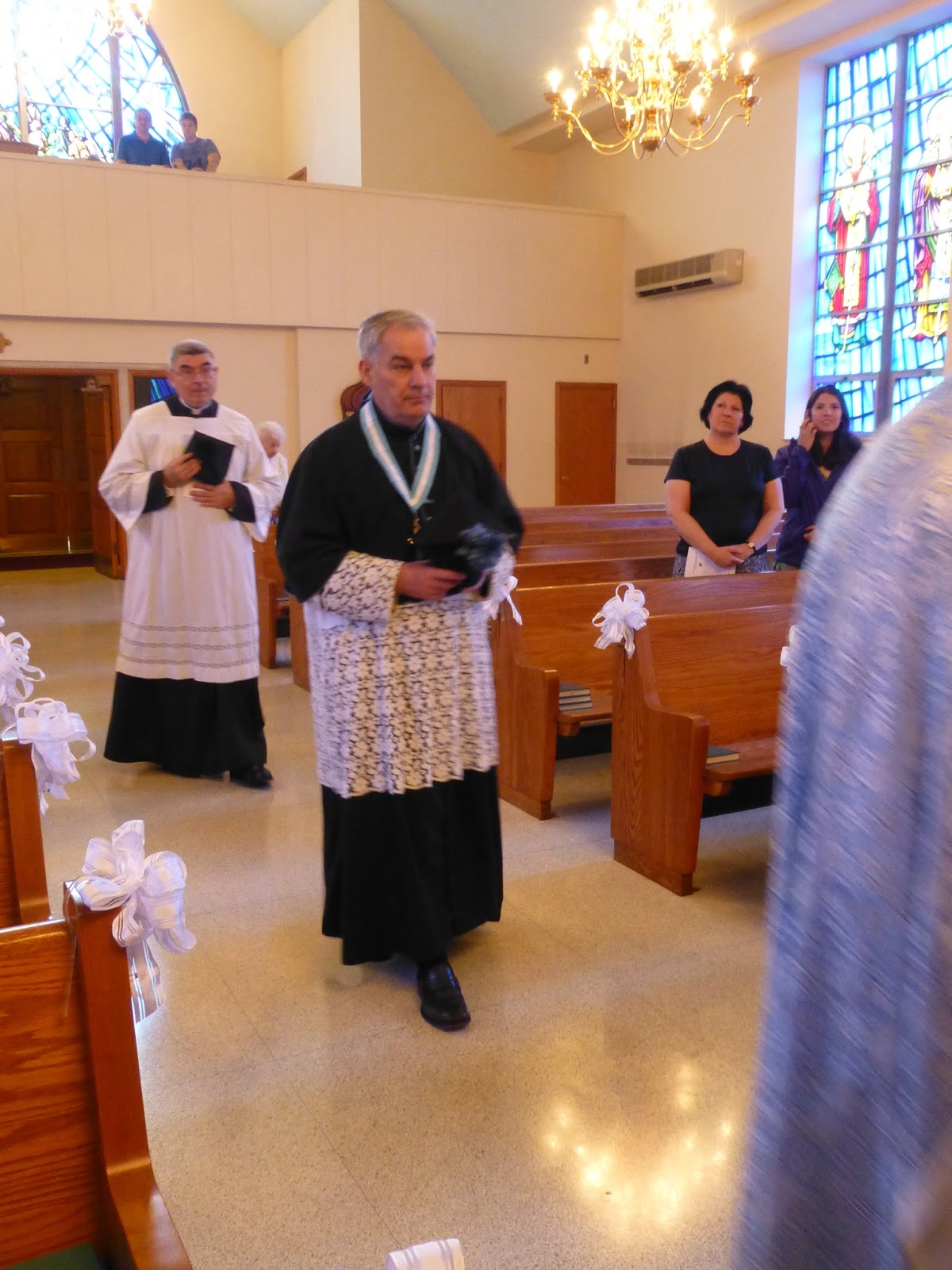
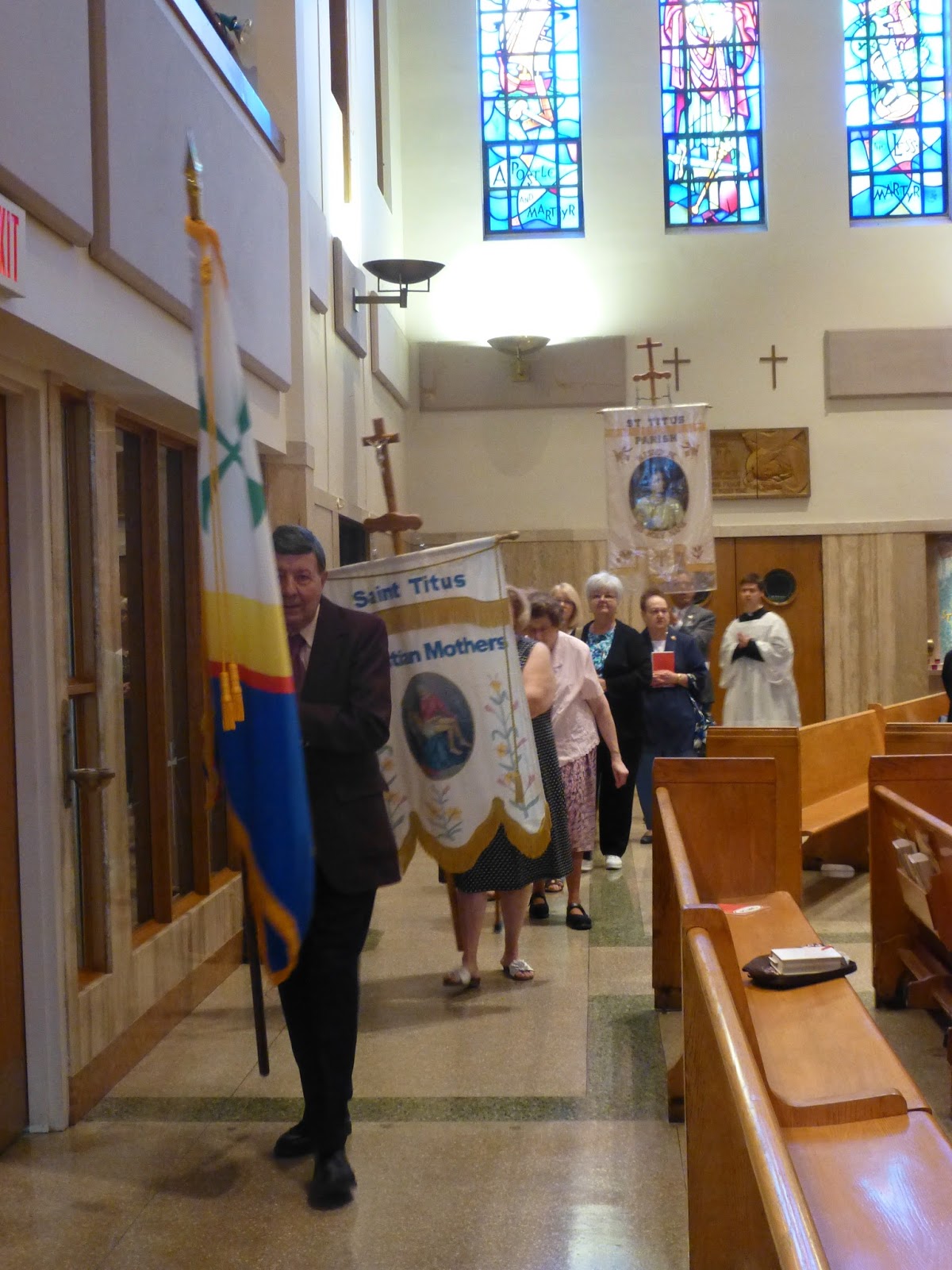
The procession into St. Titus Church was lead by the Knights of Columbus flag, followed by the St. Titus Christian Mothers and the St. Titus Holy Name Society.
Canon Jean-Marie Moreau of the Institute of Christ the King Sovereign Priest offered the Votive Mass of Christ the King. Â Fr. Ladis J. Cizik served as deacon and Fr. David G. Rombold served as subdeacon.
The Bach Choir of Pittsburgh sang Mozart’s Coronation Mass under the direction of Jon Eric Schreiber, Associate Conductor, with organist Bryan Lohr.
Catholic Family News sent a reporter to cover the day’s ceremonies. Their article with photos can be viewed
here.
Most Sacred Heart of Jesus,
have mercy on us.
Â
Immaculate Heart of Mary,
pray for us.
by William A. Torchia, Esq.
By Lawrence Lew OP, for the New Liturgical Movement
The Order of Preachers celebrates its 800th Jubilee this year. Before our founder St Dominic received papal confirmation of the Order, though, he had lived in Osma as a canon regular under the Rule of St Augustine. Indeed, Pope Honorius III had confirmed the Order of Preachers likewise as a group of canons regular. Like our founder we Dominicans still profess obedience to the Rule of St Augustine, and like other canons (both secular and regular) we wear a kind of mozzetta with a hood as part of our habit – we call this part a ‘capuce’. However, to distinguish ourselves from canons, our founding stories tell of how Our Lady gave Blessed Reginald of Orleans (one of the first Dominicans) a monastic scapular that henceforth replaced the canon’s rochet.
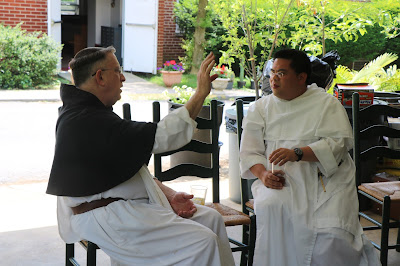
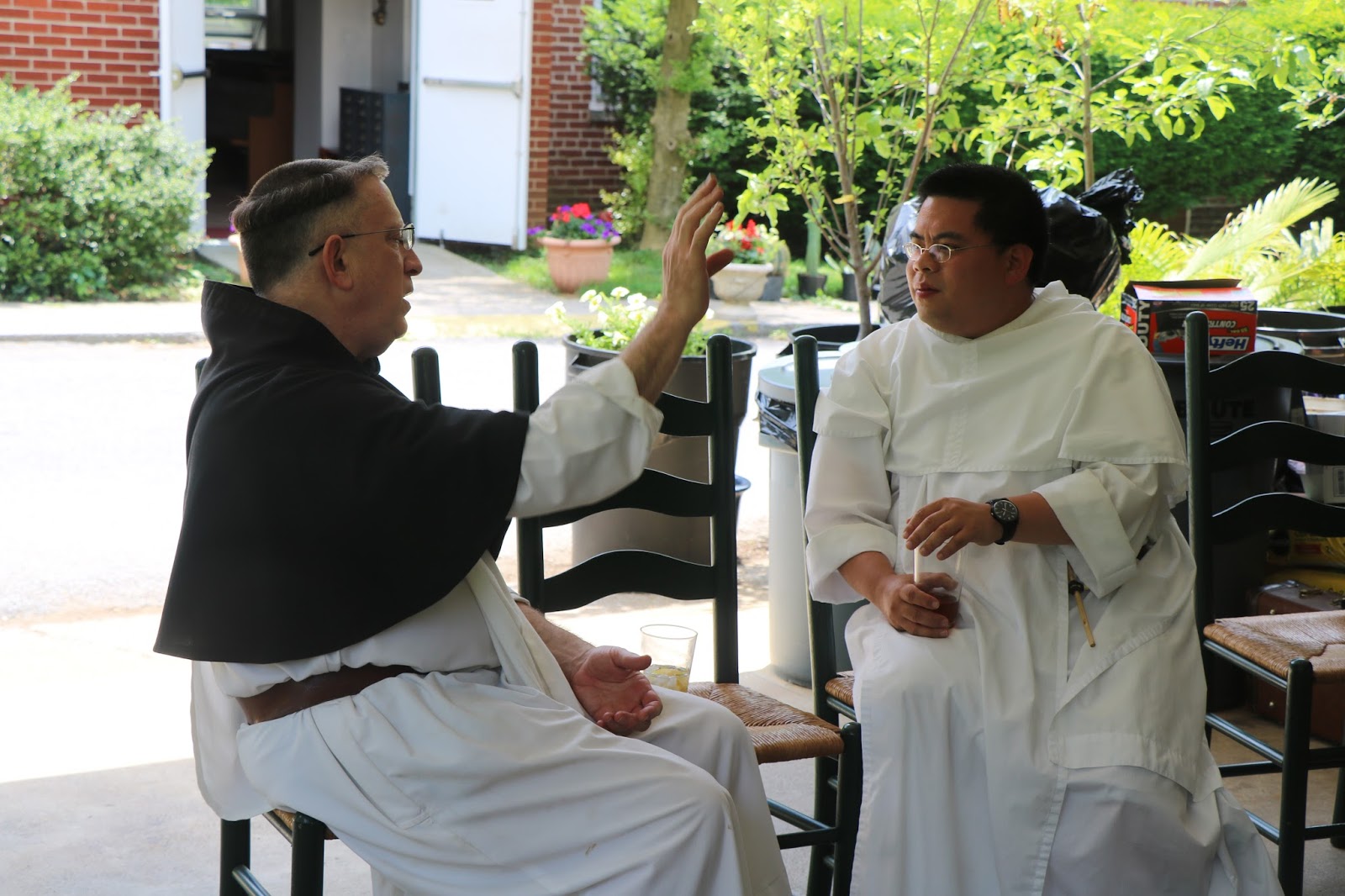
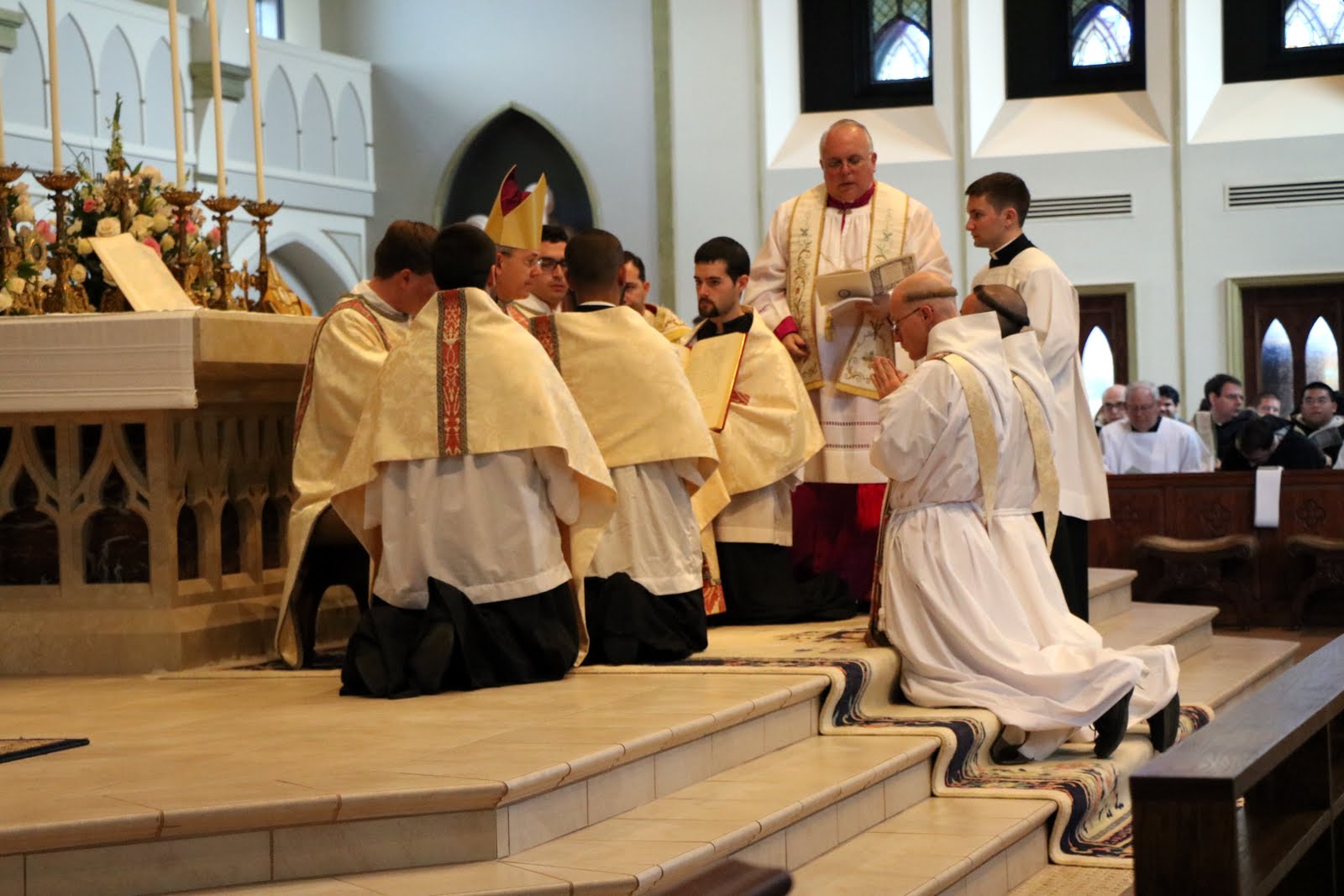
In this Jubilee Year, our Dominican heritage as canons regular living under the Rule of St Augustine was especially brought to my remembrance recently when I had the chance to spend the Memorial Day weekend with the Canons Regular of the New Jerusalem (CRNJ). The CRNJ are a relatively recent American foundation who, after some years of a somewhat peripatetic existence, have finally settled down in the Diocese of Wheeling-Charleston, thanks to the hospitality and wisdom of Bishop Michael J. Bransfield who agreed to give the CRNJ canonical recognition, and who duly incardinated their clerics into his diocese. Hence, in October last year, two canons regular were ordained in Charles Town, WV by Bishop Athanasius Schneider; it was a most beautiful and joyous occasion. Since that occasion, I have been keen to find out more about the CRNJ and their life but it wasn’t until last weekend, with the academic year over, that I had the chance to visit the community.
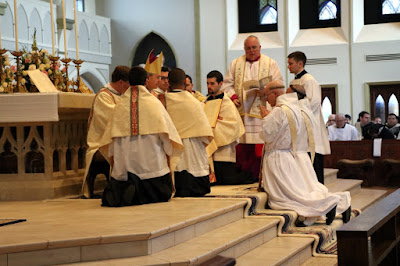
The Canons Regular of the New Jerusalem have their Priory, dedicated to Our Lady of the Annunciation, in Charles Town, WV. The dedication recalls the Augustinian canons’ foundation at Walsingham, the ancient Shrine to Our Lady in England; the CRNJ are founded to make reparation for the destruction of that Shrine and for the abandonment of the Catholic Faith by the canons regular during the Protestant Reformation.
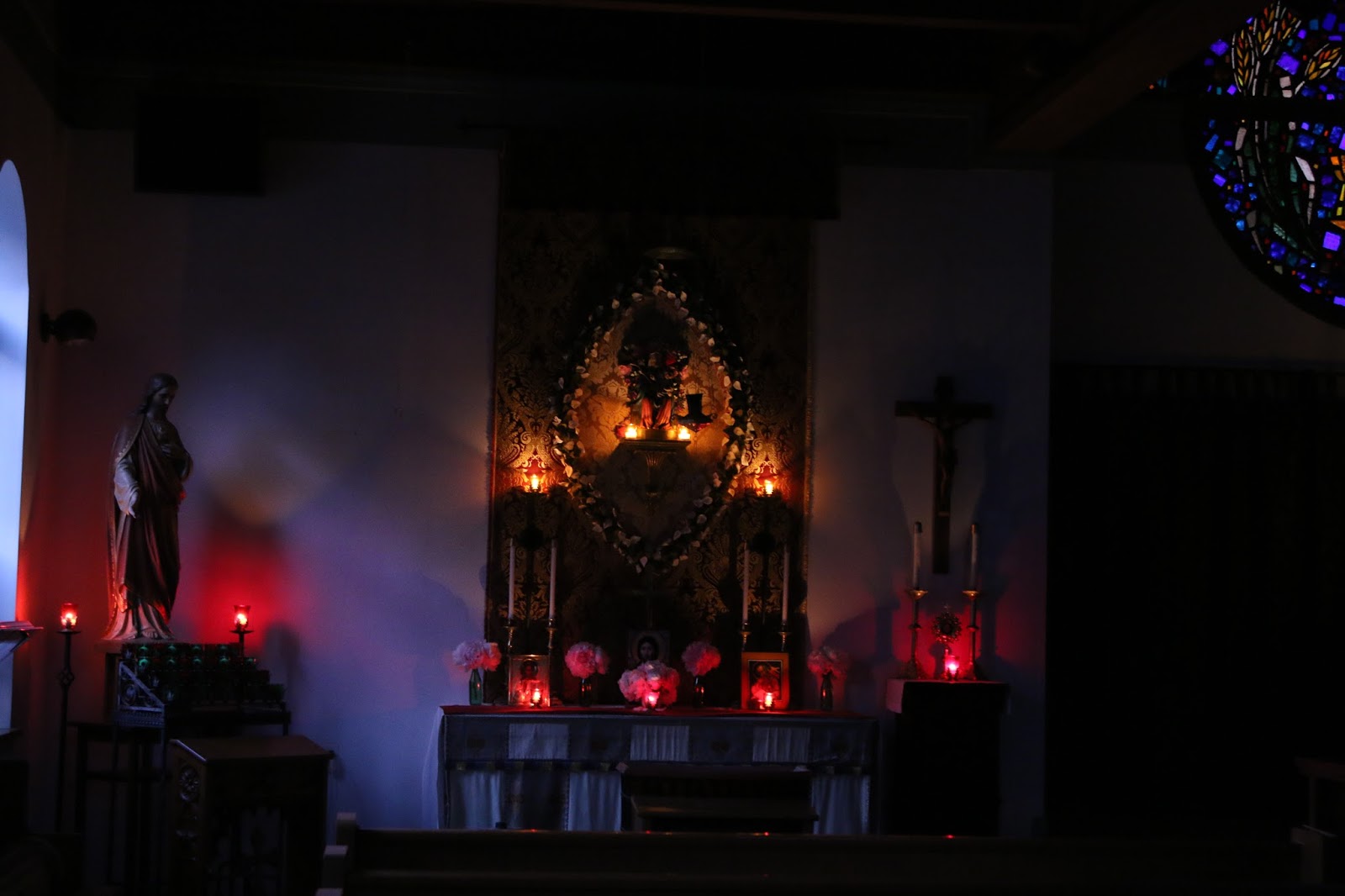
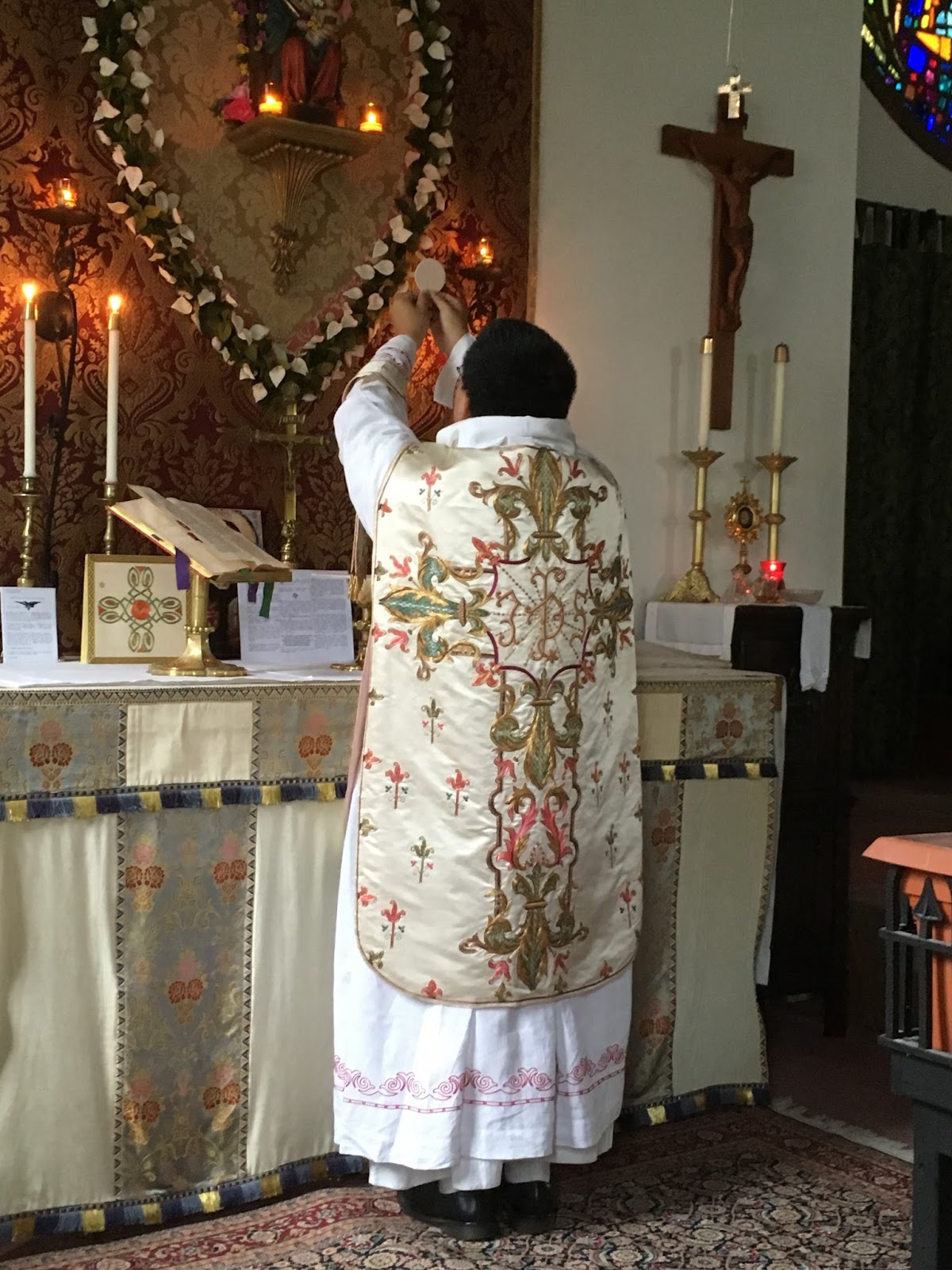
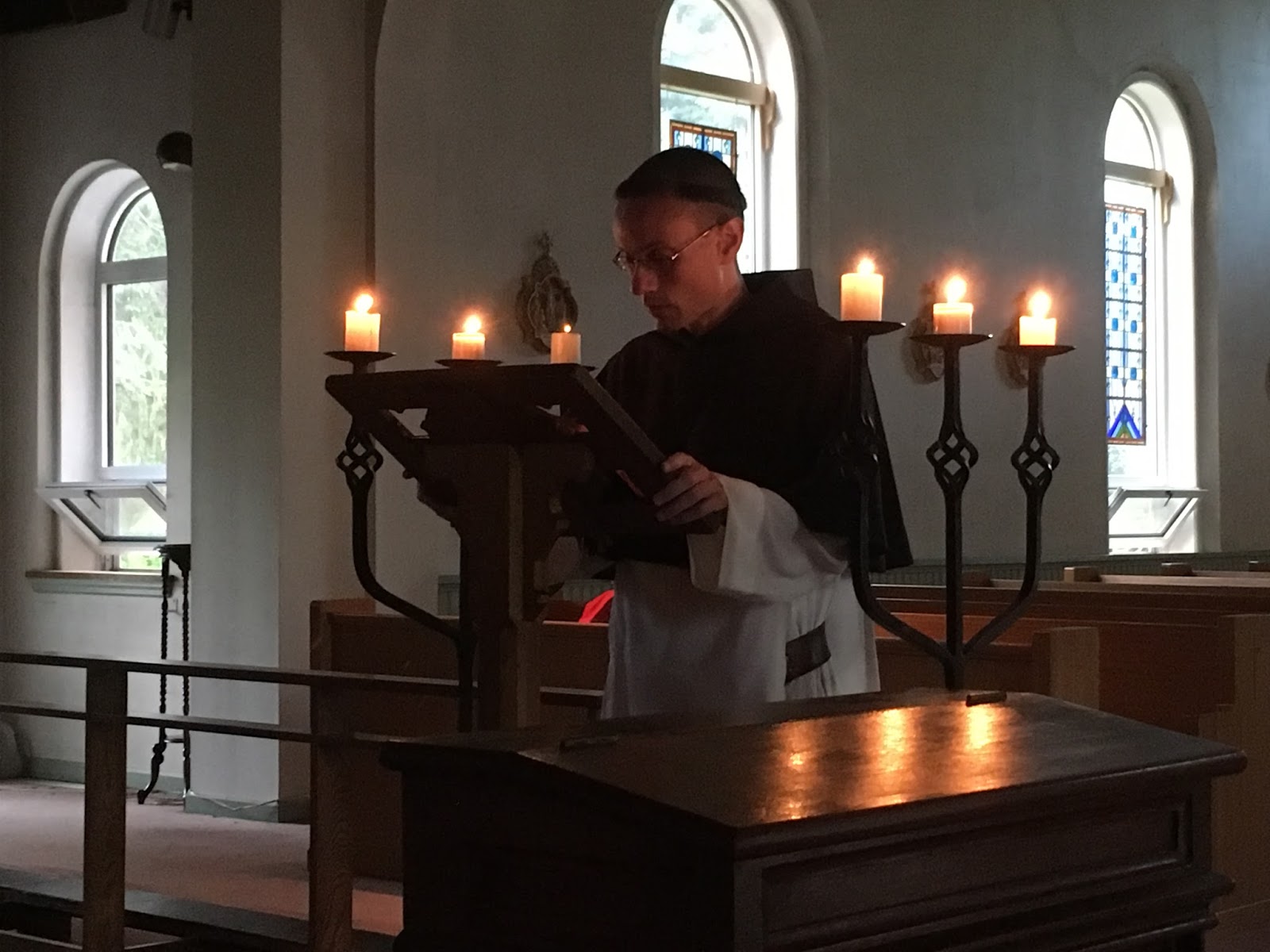
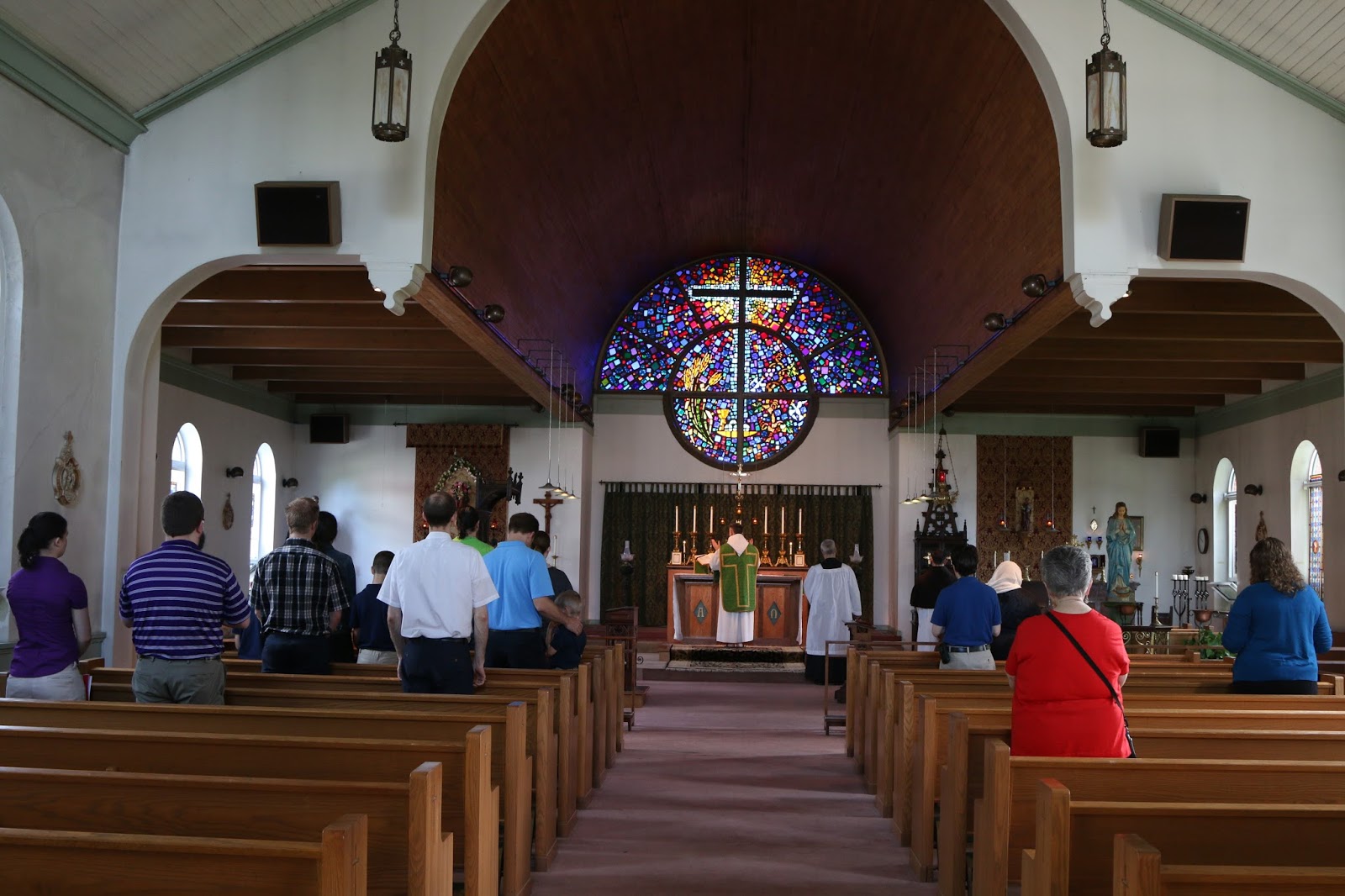
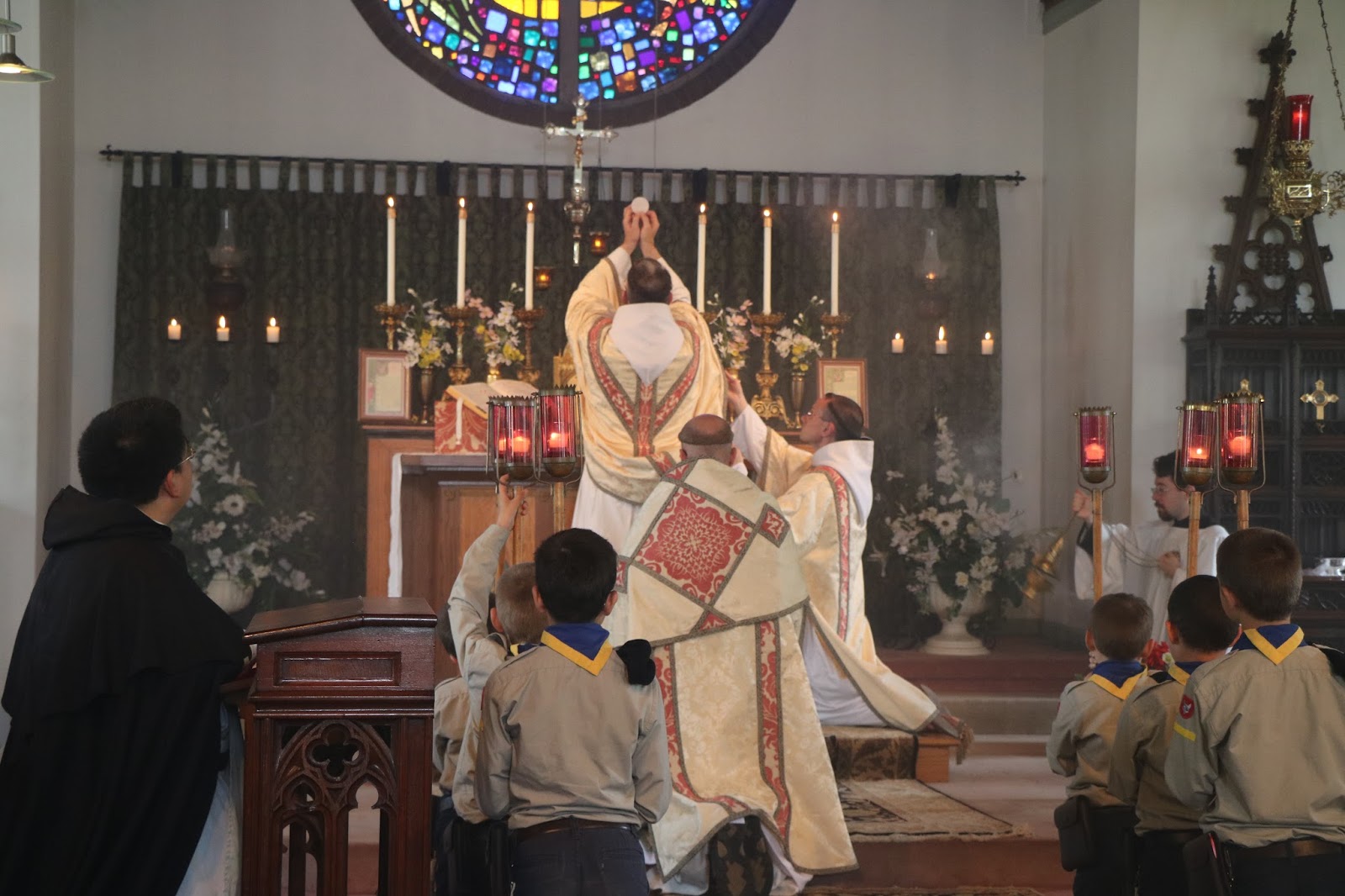
Located just a block from the heart of historic Charles Town which was founded in 1786 by Charles Washington (brother of the first U.S. President), the canons have the care of a small church which belongs to the Diocese but which is given to them as their permanent oratory. It is a charming rural church which the CRNJ have transformed into a sanctuary of worship and prayer, reminiscent of the medieval Shrine of Walsingham in its intimacy and candle-lit beauty; votive candles burn constantly before the image of Our Lady of Walsingham at the Lady Altar. As an English Dominican, I was glad to be able to celebrate private Low Masses in the Dominican rite at this Altar.


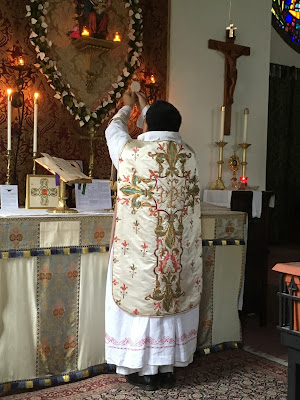
The Liturgy here at the CRNJ is celebrated in its entirety according to the Extraordinary Form, both the Mass and the Divine Office, and the other sacraments. Often the liturgical form can be separated from the rest of one’s religious life. So, for example, if one occasionally celebrates the Mass according to the 1962 Missal, the Mass in this form is somewhat marooned from the rest of the former Liturgy and also from a religious life that gave it its context. This is not the case for the CRNJ, and I found this deeply attractive. For the old Mass in Latin flowed organically from the Latin Divine Office, as well as from the other sacraments such as Confession, for example. Thus I had the chance to hear Confessions in the older form in Latin on Sunday before the High Mass, and one sees at once the connection between the prayers and formulas used in Confession, and again at the beginning of the Mass. Moreover, as I stood in choir and prayed the psalms of Matins in Latin, I felt a connection to St Dominic, who would have done likewise with his fellow canons regular in Osma. And as I looked at the tonsures on the heads of these canons today I recalled that St Dominic and the other Dominican saints are often shown with tonsures, as had been our practice too until recently.
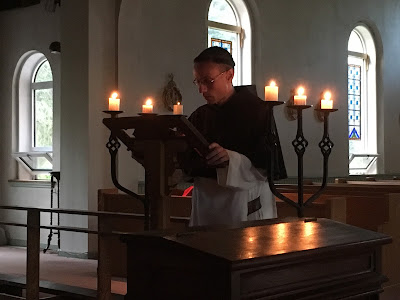
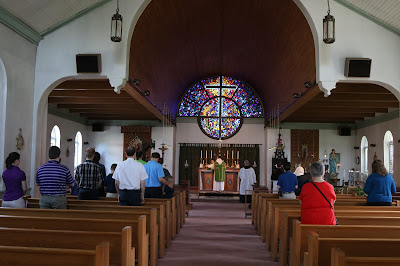
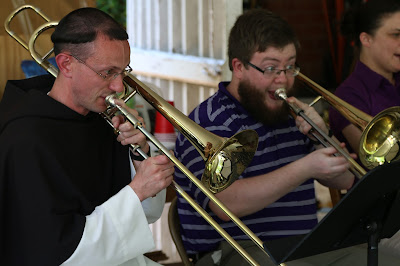
This Liturgy and way of life has, in our time, become extraordinary. And yet, what made my experience of the CRNJ life so beautiful was the ordinariness of it all. With the Canons Regular of the New Jerusalem, I glimpsed what it was like for 21st-century religious to pray in Latin ordinarily, to sing the old Mass ordinarily, and to work and live in the habit ordinarily. And because it was ordinary the Liturgy also seemed relaxed without becoming casual, organic and lovely rather than an oddity or showpiece as can be the case elsewhere when the Extraordinary Form is something out-of-the- ordinary for which clergy and singers have to be imported for an ‘event’.
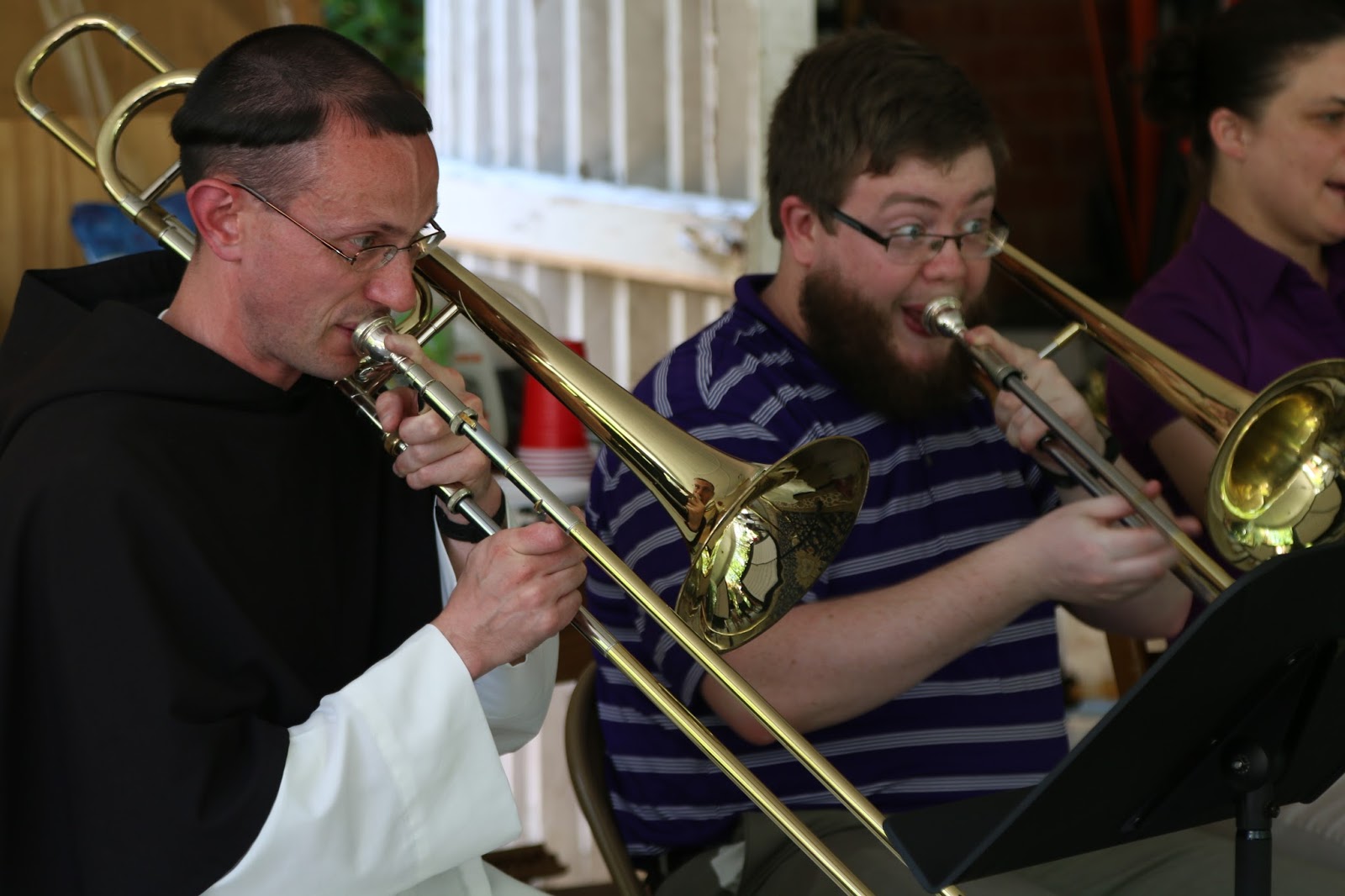
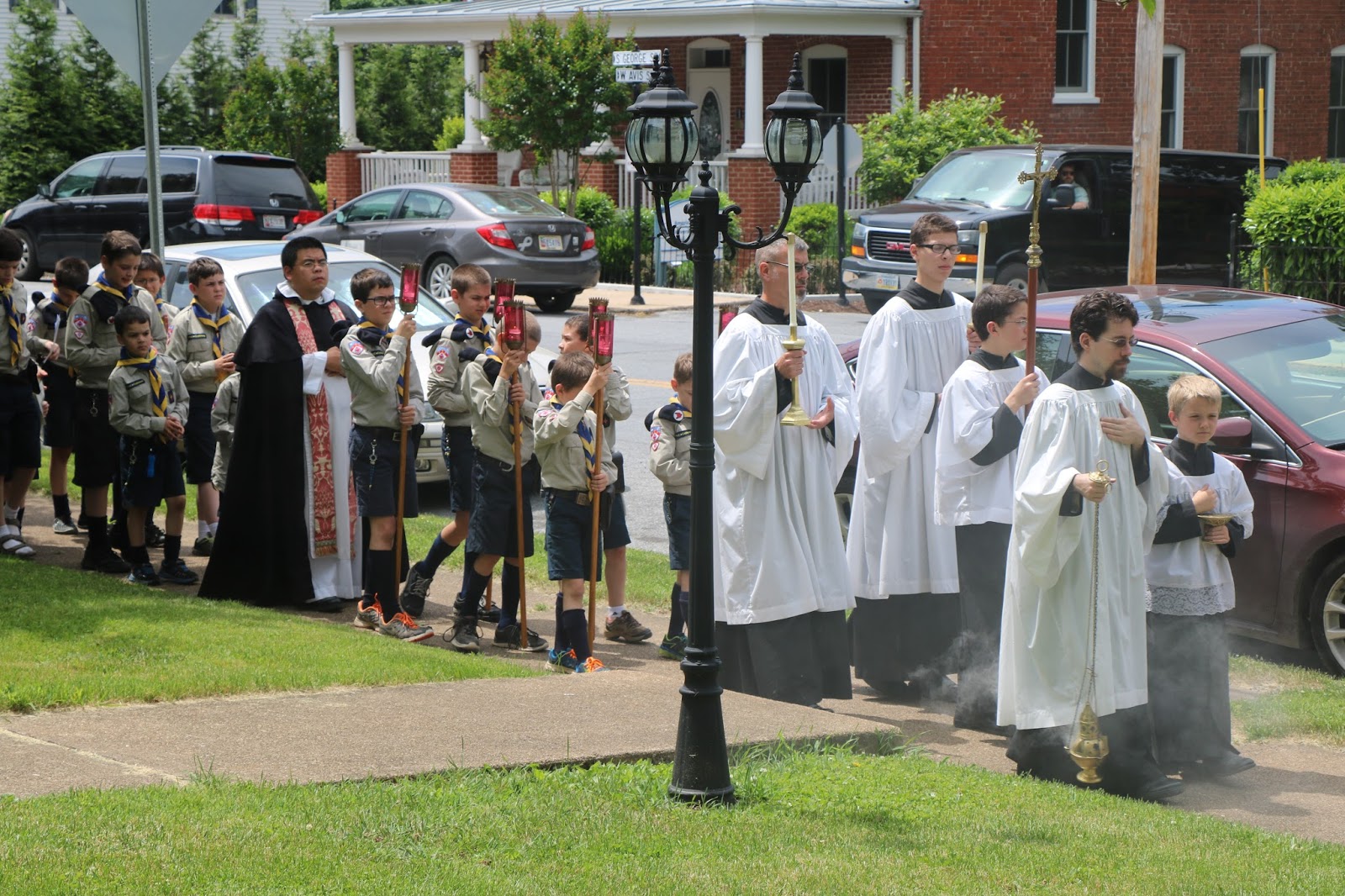
The result of the canons’ commitment to this life and Liturgy is the creation of a culture. This is to be expected since the ‘cultus‘ of the Liturgy has always enriched the surrounding culture and imbued it with beauty; the Faith and its liturgical expressions gave rise to a civilisation. Hence, the canons have attracted a goodly congregation to their oratory who, together with them, form a civilisation of love and beauty. As a result, a talented group of young Catholic musicians come here regularly, and they sang Byrd’s Propers for Corpus Christi at the Sunday Mass, which on this weekend was kept as an ‘external solemnity’ of Corpus Christi; I preached this Homily at the Mass. The Gregorian chant Ordinary for the Mass was sung by the whole congregation, and a Schola sang Gregorian chant hymns and antiphons during the Eucharistic Procession, while the congregational hymns during these devotions were sung by all in four-part harmony. Present at the Mass were many young families with plenty of lively children who were actively involved in the celebrations.
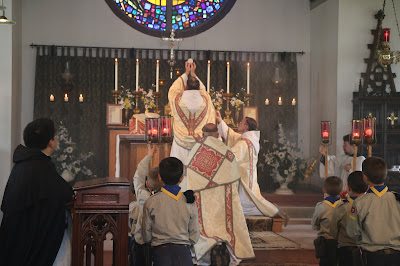
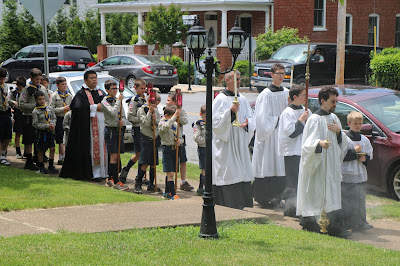
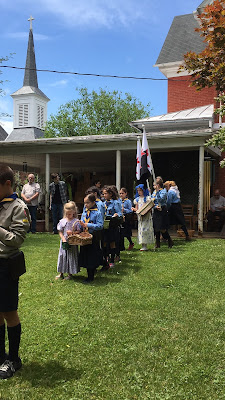
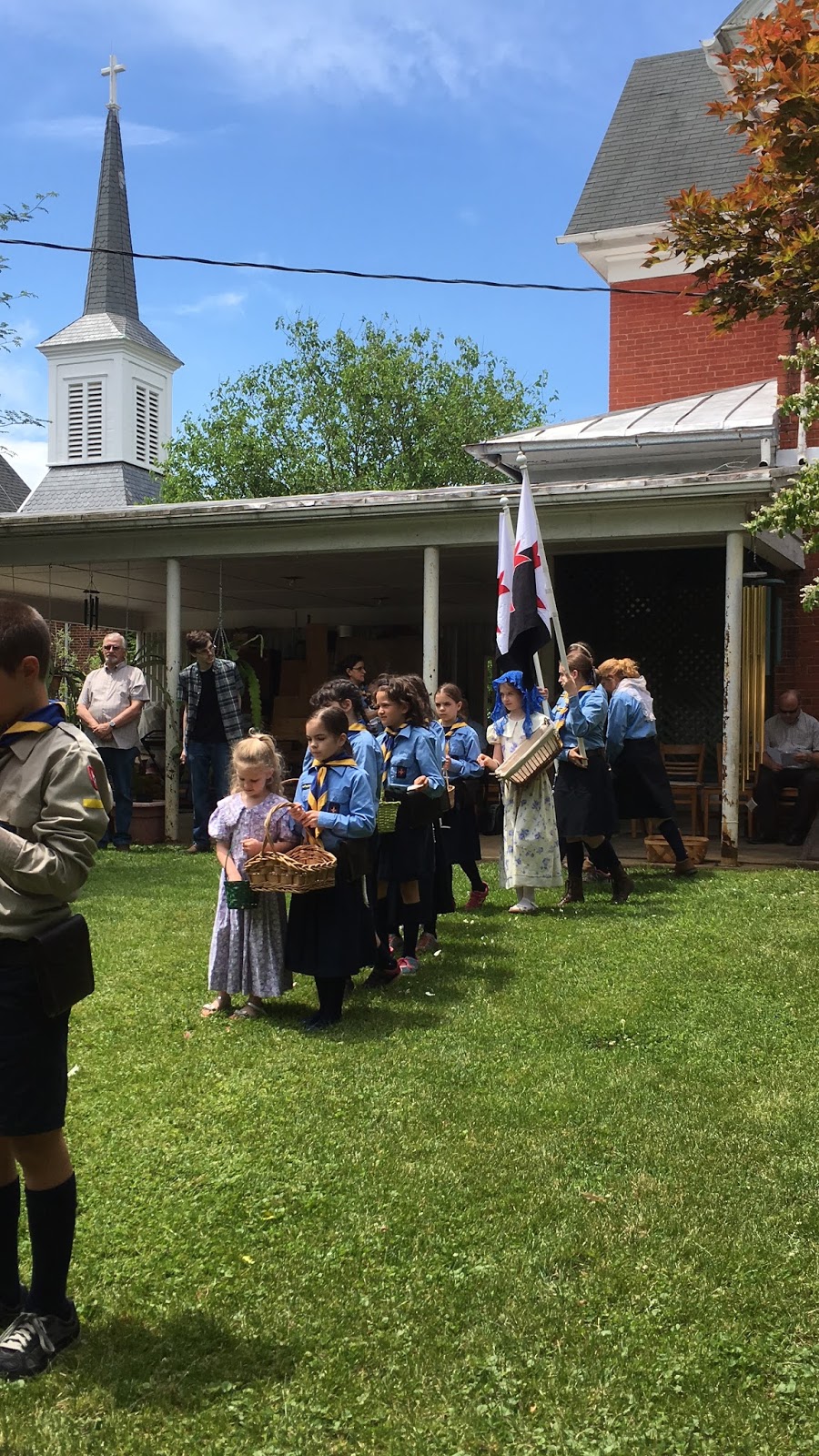
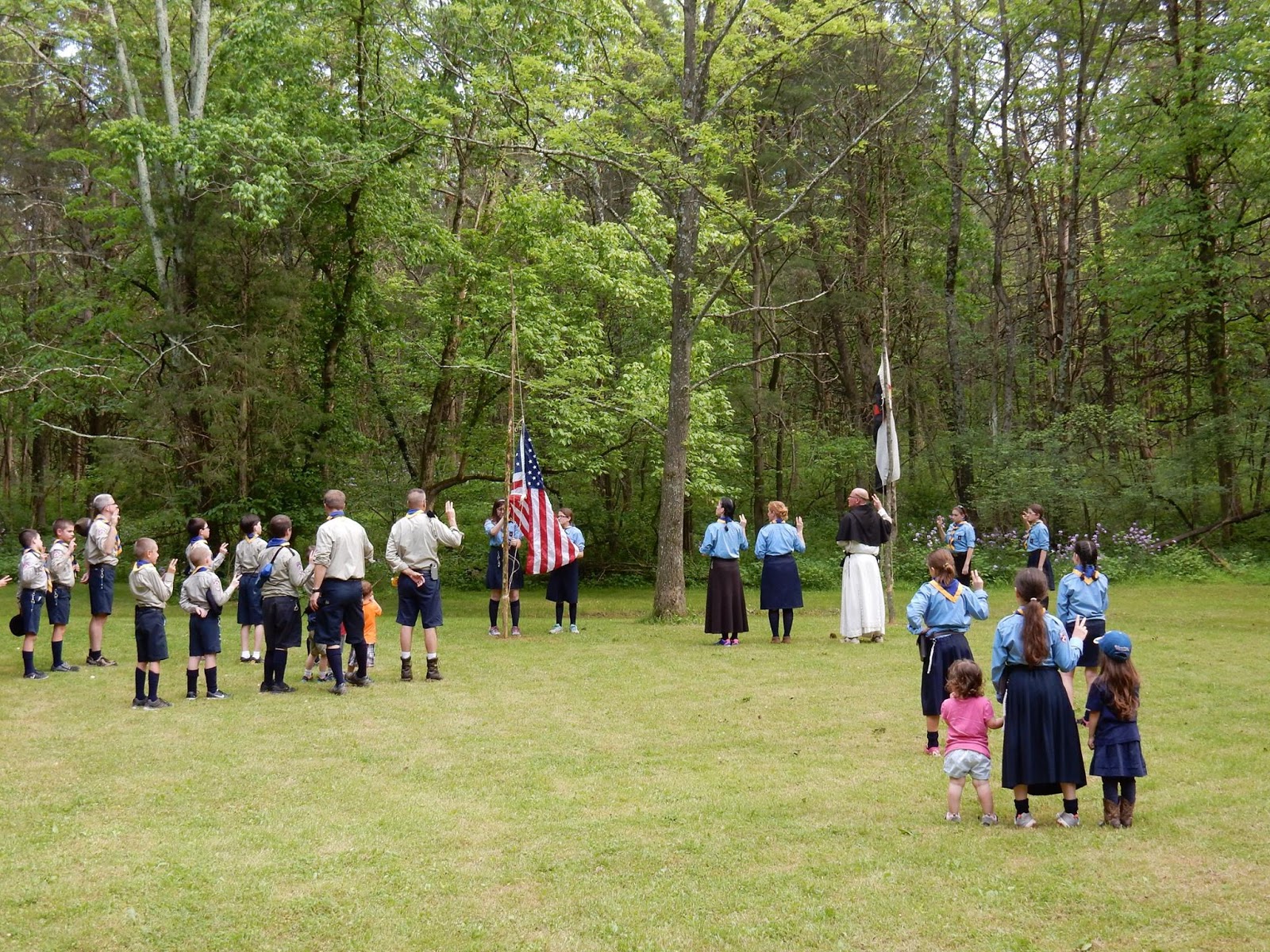
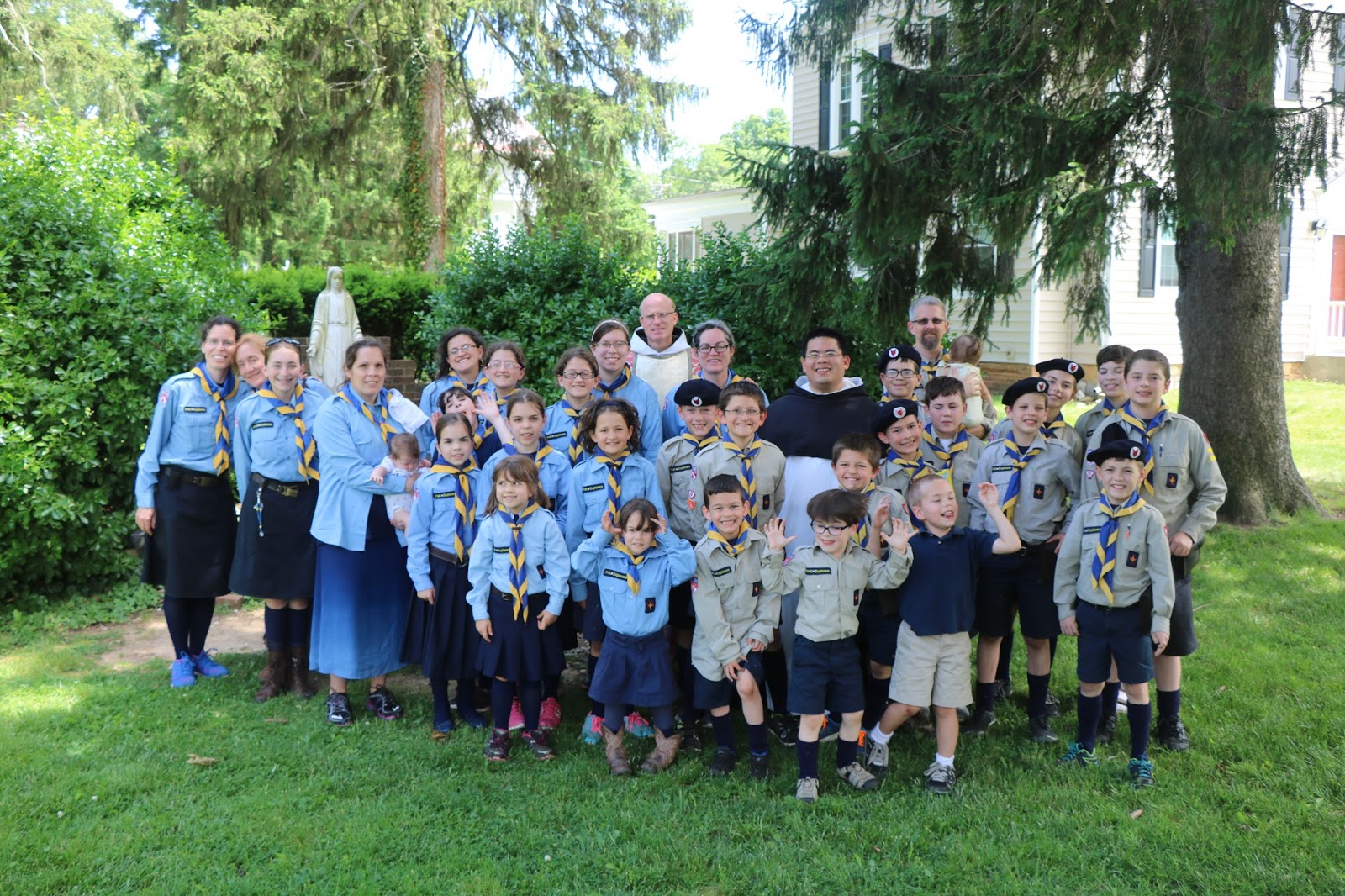
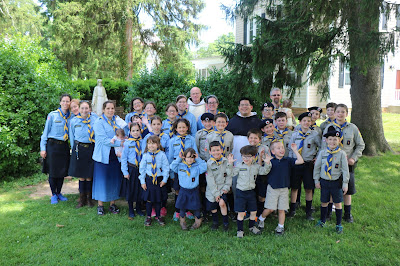
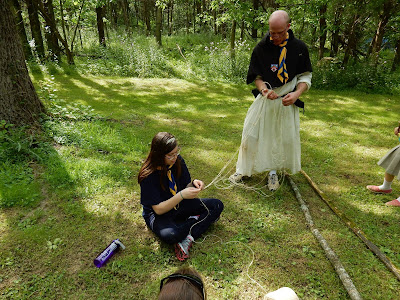
Indeed, many of the children helped with the Eucharistic Procession, and did so in the uniform of the Federation of North American Explorers (FNE). A word about the FNE: they are the American branch of the International Union of Guides and Scouts of Europe, which is a Vatican-approved private lay association of Pontifical right. This group, which has a distinctive French influence, believes that through traditional Scouting (or ‘Scoutisme‘) according to the insights of both Baden-Powell and the Venerable Fr Jacques Sevin SJ, Catholic children are formed in virtue and in the Faith. In Europe, ‘Scoutisme‘ is hugely successful and many will have seen French Catholic Scouts assisting at the annual Chartres Pilgrimage; Scoutisme accounts for many religious and priestly vocations in a scale that is disproportionate to the numbers involved. In North America, the Scouts of Europe go by the name of North American Explorers and, having begun in Canada, they are currently expanding rapidly in the USA. If any Catholic parent and pastor is looking for a vibrant Faith-based alternative to the mainstream Scouting and Guiding movements, do investigate the FNE which has a proven track-record. This year the movement in Europe celebrates its 60th anniversary. The FNE group attached to the CRNJ in Charles Town, WV is one of the first groups in the USA, and the canons are instrumental in its development.
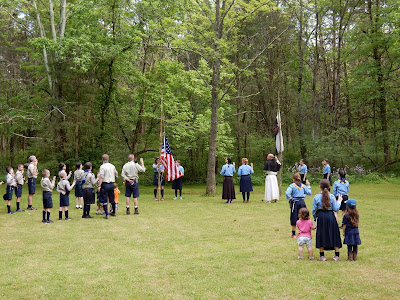
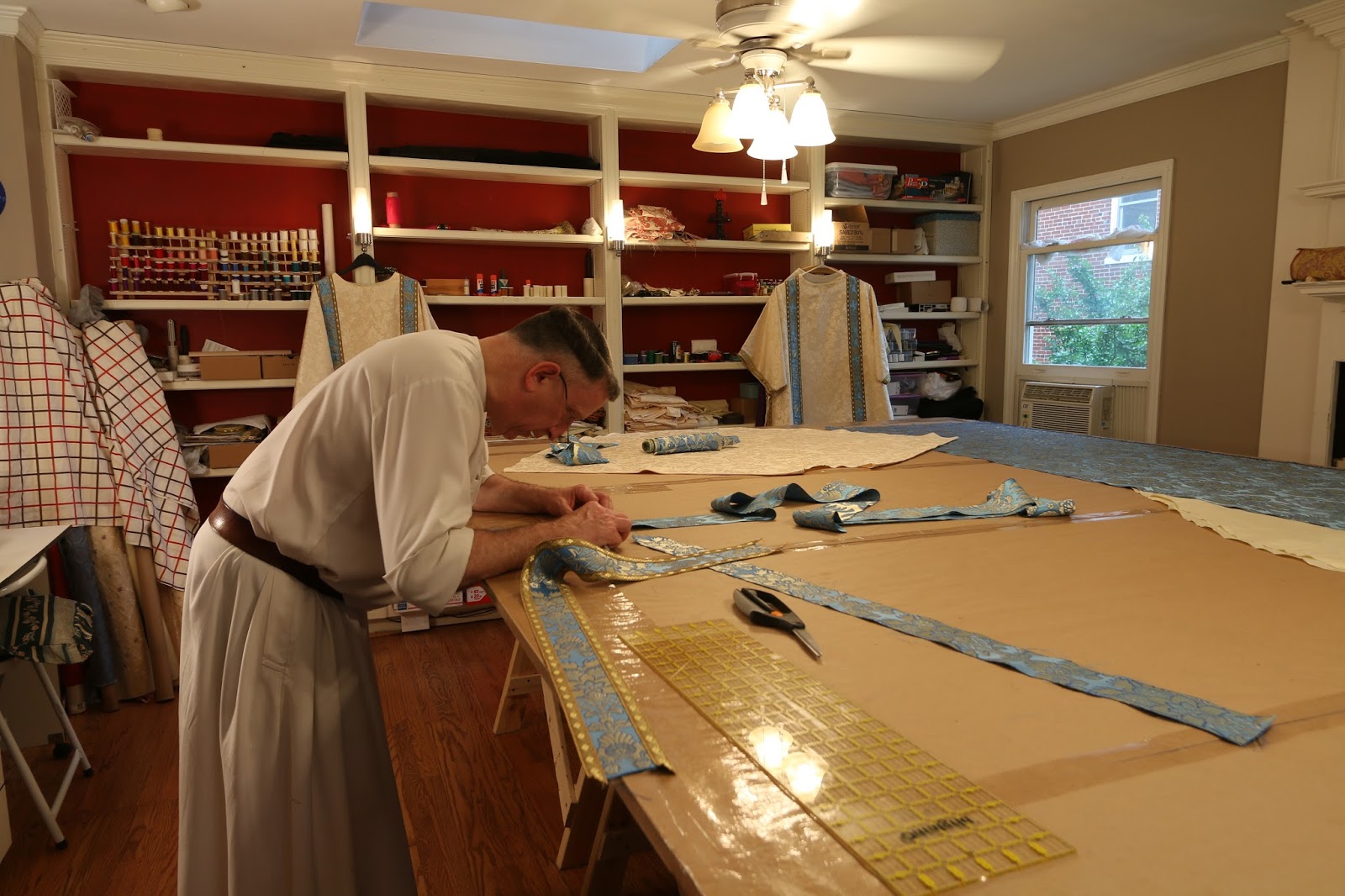
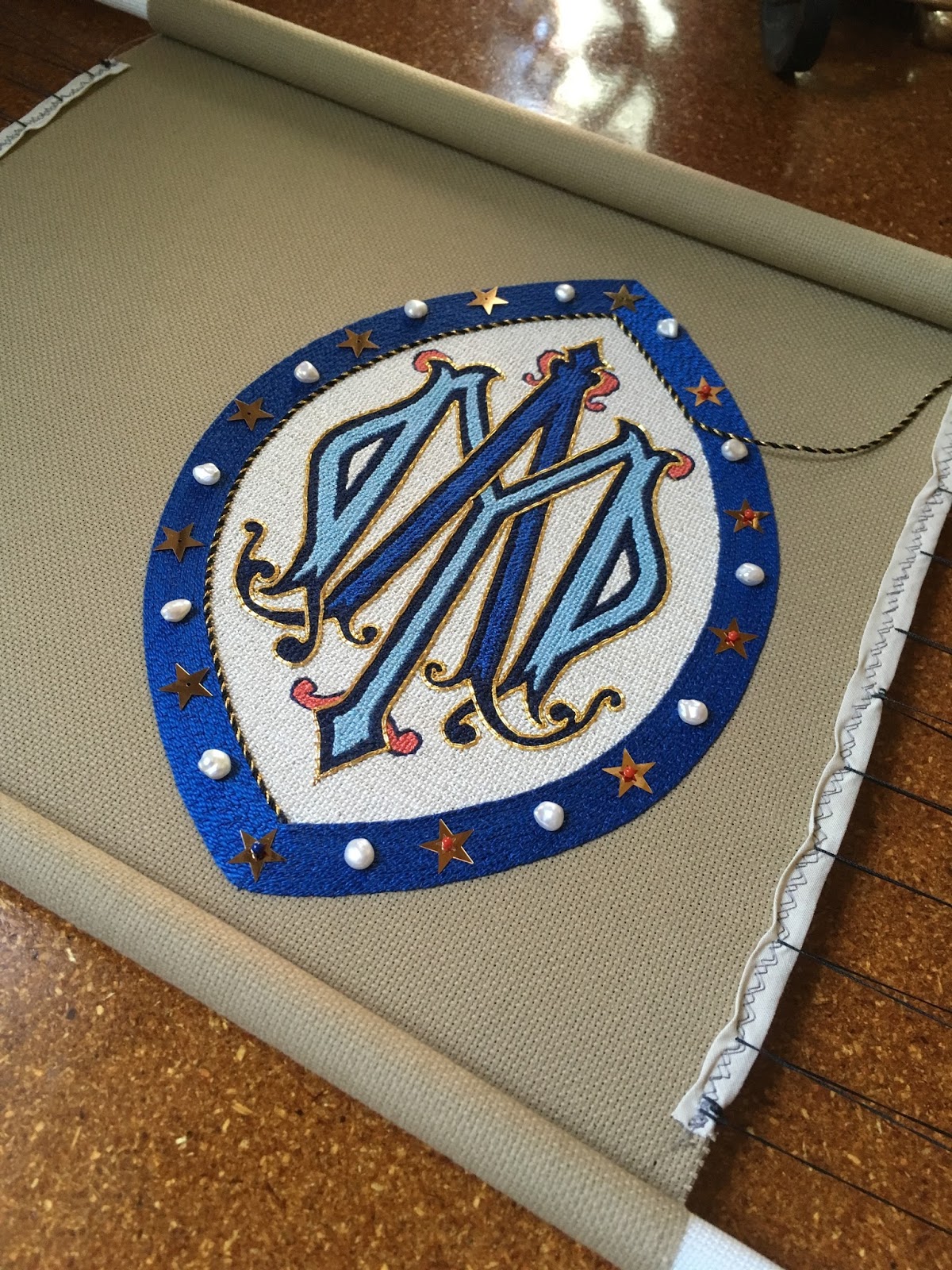
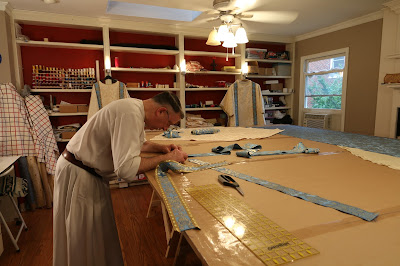
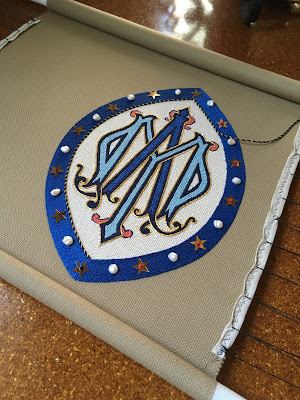
In addition to the above, the canons are currently in the process of opening a coffee shop, just a block away on the main street of Charles Town. It will be called ‘Mad Monks Coffee Shop’, and it will be staffed by friends of the community although the canons will also be on hand when their schedule allows, and they will provide some of the baked goods for this shop. It seems to me that this is a development with good apostolic promise; a chance to witness to the joy of the Gospel. Finally, I had a chance to visit a house near the Priory which serves as an art studio. Here, the Prior, Dom Daniel Augustine, makes impressively beautiful hand-crafted vestments with the help of long-standing friends of the community. Dom Daniel Augustine is currently making a High Mass set for an ordinand of the diocese, and he is open to receiving orders for new vestments.
What I discovered this past weekend, then, was a thriving and inspiring community gathered around the Canons Regular of the New Jerusalem, who are committed to the Church’s living Tradition – not as a showpiece nor because of ‘nostalgia’ nor with any combative sense, as such, but because this Tradition sustained the Faith of many, and formed countless souls in holiness. One such person, indeed, became the sainted founder of the Order of Preachers.
Currently the CRNJ numbers three: Dom Daniel Augustine, Dom John Berchmans, and Dom Alban. However, if so much can be accomplished by three, imagine what more could be done if their number were to double. So, I would encourage young men who are thinking of a religious vocation, and who are committed to the traditional Liturgy, to consider the Canons Regular of the New Jerusalem; do go and visit them. At the very least, you’d have a good retreat and some soul-refreshing days of beautiful worship and prayer – I know I did!
For inquiries about vestments, or for more information about the CRNJ community and vocation, please contact the Prior, Very Rev. Dom Daniel Augustine Oppenheimer. Address: Priory of the Annunciation of the Blessed Virgin Mary, 219 South George Street, Charles Town, WV 25414. Or email: information@canonsregular.com
Some of the photos in this post are used courtesy of Mr Joe Kline, and of the Priest Field Pastoral Center.
by William A. Torchia, Esq.
First Friday, June 3, A.D. 2016, Traditional Latin Mass (TLM) will be offered by Fr. Gerald Carey, Parochial Vicar of Our Lady of Perpetual Help Roman Catholic Church, at the Rectory Chapel of St. Albert The Great Parish at 7:00 p.m., preceded by Confession at 6:30 p.m. This TLM will The Mass of The Sacred Heart, offered in Reparation to The Sacred Heart of Jesus.  White Vestments.
First Saturday, June 4, A.D. 2016, Traditional Latin Mass (TLM) will be offered by Fr. Harold B. Mc Kale, Parish Vicar of Our Lady of Mount Carmel Roman Catholic Church at the Rectory Chapel of St. Albert The Great Parish at 9:00 a.m., preceded by Confession at 8:30 a.m. This TLM will be a Votive Mass of The Immaculate Heart of Mary, offered in Reparation to The Immaculate Heart of Mary. White Vestments.
St. Albert The Great Parish is located at 212 Welsh Road, Huntingdon Valley, PA 19006, (T) 215-947-3500. The Rectory Chapel is in The Parish Center, behind the main Church which fronts on Welsh Road.
Mark Matthews
by William A. Torchia, Esq.
David Clayton from NLM
Fr Peter Stravinskas, the Executive Director of the
Catholic Education Foundation, has asked me to make people aware of a three-day seminar for bishops, priests and seminarians on
The Role of the Priest in Today’s Catholic School.
It will take place at the St Charles Borromeo Seminary in Philadelphia from July 19-21. Topics discussed range from a clear articulation of the ideals set out by the Magisterium to an account of the history of Catholic education in the United States, along with more mundane and practical matters,such as considerations of PR, finances, governance and best practice.
The Catholic Education Foundation is a national, grass-roots effort to preserve and expand an extremely important asset that is in danger of disappearing, namely, the genuinely Catholic secondary school. Archbishop Chaput of Philadelphia, whose diocese is hosting the event, is on the advisory board of the CEF.
For more information go to the Catholic Education Website: catholiceducationfoundation.com
by William A. Torchia, Esq.
Priest: Rev. Fr. Gerald Carey
Mass Intention: Antonina Kyc (RIP) req. by Bianco Family
*****************
Regrettably, today Sunday, May 29 will be our last Mass together here at St. Edmond. As you no doubt know, attendance and consequently, finances have been steadily declining since the beginning of 2014 and have not abated. It is no longer possible to sustain. You are free of course to go where you wish. Fr. Kulczynski will still continue to maintain the website www.latinmassphila.org so if there is anything going on you can still find it there.
As you know, I formed a non-profit 503 c3 corporation. According to the IRS regulations, any monies left must be used for the same purpose as the corporation, which I listed as to support and promote the TLM. While I doubt any monies will be left after all the bills are paid, should there be anything left it will be given to Our Lady of Lourdes, whose pastor, Fr. Michael Rock has certified in writing that he would use those monies exclusively for the TLM.
Our time here is at an end; Fr. Gill intends to continue the holyday Masses at the cathedral. My role, if any, is as yet undetermined. For my part, I will continue to promote the TLM in whatever way God provides and I hope that you will as well. To all of you who worked so hard to further this apostolate, you have my gratitude, and more importantly, God will bless you for your sacrifices.
May God bless you all.
Fr. McKale
******************
Mass Intentions: If anyone still has unfulfilled Mass intentions, Fr. McKale can pass them on to a priest that will satisfy the intention by offering a TLM or Divine Liturgy (Byzantine). Before sending anything, please e-mail Fr. McKale first at tlmcommunityofphila@gmail.com .