John XXIII in His Own Words (2): The Mass and the Priesthood
by Peter Kwasniewski
A reader of Pope John XXIII’s writings will often find him quoting or paraphrasing the text of the Holy Mass—in the only form in which he knew it, of course: the traditional Latin Mass, that inexhaustible nourishment of the saints. I will bring together here a few poignant examples.
In Pope John’s inaugural encyclical Ad Petri Cathedram—a majestic exposition of the truth, peace, and unity that are found in and through the Catholic Church alone, to which the Pope graciously invites all mankind and especially Christians not in full communion with the Church (no wishy-washy ecumenism here)—we find a succinct treatment of the Church’s “unity of worship,†a reality that was at that time very perceptible across the world.
74. As for unity of worship, the Catholic Church has had seven sacraments, neither more nor less, from her beginning right down to the present day. Jesus Christ left her these sacraments as a sacred legacy, and she had never ceased to administer them throughout the Catholic world and thus to feed and foster the supernatural life of the faithful.
75. All this is common knowledge, and it is also common knowledge that only one sacrifice is offered in the Church. In this Eucharistic sacrifice Christ Himself, our Salvation and our Redeemer, immolates Himself each day for all of us and mercifully pours out on us the countless riches of His grace. No blood is shed, but the sacrifice is real, just as real as when Christ hung from a cross of Calvary.
76. And so Saint Cyprian had good reason to remark: “It would be impossible to set up another altar or to create a new priesthood over and above this one altar and this one priesthood.â€
77. Obviously, of course, this fact does not prevent the presence in the Catholic Church of a variety of approved rites, which simply enhance her beauty. Like a king’s daughter, the Church wears robes of rich embroidery.
78. All men are to have part in this true unity; and so, when a Catholic priest offers the Eucharistic Sacrifice, he presents our merciful God with a spotless Victim and prays to Him especially “for Thy holy Catholic Church, that it may please Thee to grant her peace, to protect, unite, and govern her throughout the world, together with Thy servant our Pope, and all who truly believe and profess the Catholic and Apostolic faith.â€
Pope John seemed especially drawn to the Offertory prayers of the Roman Missal, which were abolished by his successor in 1969. Here are two passages from his diaries in which he spontaneously expresses himself in the words of the offering of the chalice.
My failings and incapacities, and my “countless sins, offences and negligences†for which I offer my daily Mass, are a cause of constant interior mortification, which prevents me from indulging in any kind of self-glorification but does not weaken my confidence and trust in God, whose caressing hand I feel upon me, sustaining and encouraging. Nor do I ever feel tempted to vanity or complacency. “What little I know about myself is enough to make me feel ashamed.†What a fine saying that is, which Manzoni put in the mouth of Cardinal Federico [in The Betrothed, ch. 26]. (p. 301; between 27 Nov. and 3 Dec. 1960)
First of all: “I confess to Almighty God.â€
During my whole life I have kept faithful to my practice of weekly confession. Several times during my life I have renewed my general confession. So now I content myself with a more general examination, without precise details, but in the words of the offertory prayer of my daily Mass: thinking of my “countless sins, offences and negligences,†all of which have already been confessed in their turn but are still mourned and detested. …
The vivid memory of the failings of my life, eighty years long, and of my “countless sins, offences and negligences†was the general matter for my holy confession which I renewed this morning to my spiritual director, Mgr. Alfredo Cavagna, here in my bedroom where my predecessors Pius XI and Pius XII slept, and where in fact Pius XII died on 9 October, 1958, until now the only pope to die here at Castel Gandolfo, in the summer residence.
Lord Jesus, as you assure me of your great and eternal forgiveness, so continue to have pity on me. (pp. 304-5, 11 August 1961).
The Priest and the Eucharistic Sacrifice
The most outstanding public testament to Pope John’s deep and abiding love of the Mass is his encyclical on the priesthood, Sacerdotii Nostri Primordia, of August 1, 1959, for the centenary of the death of St. John Vianney.
The devotion to prayer of St. John Mary Vianney, who was to spend almost the whole of the last thirty years of his life in Church caring for the crowds of penitents who flocked to him, had one special characteristic—it was specially directed toward the Eucharist.
It is almost unbelievable how ardent his devotion to Christ hidden beneath the veils of the Eucharist really was. “He is the one,†he said, “Who has loved us so much; why shouldn’t we love Him in return?†He was devoted to the adorable Sacrament of the altar with a burning charity and his soul was drawn to the sacred Tabernacle by a heavenly force that could not be resisted.
This is how he taught his faithful to pray: “You do not need many words when you pray. We believe on faith that the good and gracious God is there in the tabernacle; we open our souls to Him; and feel happy that He allows us to come before Him; this is the best way to pray.†He did everything that there was to be done to stir up the reverence and love of the faithful for Christ hidden in the Sacrament of the Eucharist and to bring them to share in the riches of the divine Synaxis; the example of his devotion was ever before them. “To be convinced of thisâ€â€”witnesses tell us—“all that was necessary was to see him carrying out the sacred ceremonies or simply to see him genuflect when he passed the tabernacle.â€
As Our predecessor of immortal memory, Pius XII, has said: “The wonderful example of St. John Mary Vianney retains all of its force for our times.†For the lengthy prayer of a priest before the adorable Sacrament of the Altar has a dignity and an effectiveness that cannot be found elsewhere nor be replaced. And so when the priest adores Christ Our Lord and gives thanks to Him, or offers satisfaction for his own sins and those of others, or finally when he prays constantly that God keep special watch over the causes committed to his care, he is inflamed with a more ardent love for the Divine Redeemer to whom he has sworn allegiance and for those to whom he is devoting his pastoral care. And a devotion to the Eucharist that is ardent, constant and that carries over into works also has the effect of nourishing and fostering the inner perfection of his soul and assuring him, as he carries out his apostolic duties, of an abundance of the supernatural powers that the strongest workers for Christ must have. …
If it is obviously true that a priest receives his priesthood so as to serve at the altar and that he enters upon this office by offering the Eucharistic Sacrifice, then it is equally true that for as long as he lives as God’s minister, the Eucharistic Sacrifice will be the source and origin of the holiness that he attains and of the apostolic activity to which he devotes himself. All of these things came to pass in the fullest possible way in the case of St. John Vianney.
For, if you give careful consideration to all of the activity of a priest, what is the main point of his apostolate if not seeing to it that wherever the Church lives, a people who are joined by the bonds of faith, regenerated by holy Baptism and cleansed of their faults will be gathered together around the sacred altar? It is then that the priest, using the sacred power he has received, offers the divine Sacrifice in which Jesus Christ renews the unique immolation which He completed on Calvary for the redemption of mankind and for the glory of His heavenly Father. It is then that the Christians who have gathered together, acting through the ministry of the priest, present the divine Victim and offer themselves to the supreme and eternal God as a “sacrifice, living, holy, pleasing to God†(Rom 12:1). There it is that the people of God are taught the doctrines and precepts of faith and are nourished with the Body of Christ, and there it is that they find a means to gain supernatural life, to grow in it, and if need be to regain unity. And there besides, the Mystical Body of Christ, which is the Church, grows with spiritual increase throughout the world down to the end of time. …
Speaking as a Father, We urge Our beloved priests to set aside a time to examine themselves on how they celebrate the divine mysteries, what their dispositions of soul and external attitude are as they ascend the altar and what fruit they are trying to gain from it. . . .
When We gaze from this height of the Supreme Pontificate to which We have been raised by the secret counsels of Divine Providence and turn Our mind to what souls are hoping for and expecting, or to the many areas of the earth that have not yet been brightened by the light of the Gospel, or last of all to the many needs of the Christian people, the figure of the priest is always before Our eyes. If there were no priests or if they were not doing their daily work, what use would all these apostolic undertakings be, even those which seem best suited to the present age? Of what use would be the laymen who work so zealously and generously to help in the activities of the apostolate? (nn. 45-48, 52-53, 59, 98-99).
We see here a Pope whose Eucharistic theology and piety are utterly traditional, at one with the Church Fathers, St. Thomas Aquinas, the Council of Trent, and all that is best in the medieval and early modern periods. What we do not catch sight of, ever, in his diaries or in his papal writings is that querulous modernist spirit that downplays, relativizes, or even denies outright the sacrificial character of the Mass, the real presence of Our Lord in the Blessed Sacrament, the value of Eucharistic Adoration, the fittingness of solemnity, reverence, and beauty in the carrying out of the liturgy, and—to sum it up handily—all that Pius XII authoritatively taught in his 1947 encyclical Mediator Dei, of which, not surprisingly, John XXIII has this to say:
It is not Our intention at this time [in Sacerdotii Nostri Primordia] to enter upon a lengthy treatment of the Church’s teaching on the priesthood and on the Eucharistic Sacrifice as it has been handed down from antiquity. Our predecessors Pius XI and Pius XII have done this in clear and important documents [Ad Catholici Sacerdotii; Menti Nostri; Mediator Dei] and We urge you to take pains to see to it that the priests and faithful entrusted to your care are very familiar with them. This will clear up the doubts of some; and correct the more daring statements that have sometimes been made in discussing these matters.
I cannot help thinking that it was just such doctrinal convictions and sentiments that prompted John XXIII to push back against the excessive influence of Fr. Annibale Bugnini under Pius XII. Bugnini had been secretary of the preconciliar commission on the liturgy, but in October 1962 Pope John appointed Fr. Ferdinando Antonelli secretary of the conciliar commission on the liturgy instead, and demoted Bugnini to the position of a peritus. At the same time, Bugnini was removed from the professorship of Liturgy at the Pontifical Lateran University in Rome “because his liturgical ideas were seen as too progressive” (says his close collaborator, Piero Marini, in A Challenging Reform). Would that Bugnini’s fortunes had dwindled away to nothing and the later work of the Consilium had been nipped in the bud! It was already far too late by the time Paul VI, thoroughly disenchanted, exiled Bugnini to Iran.
One more reason to rise up and call John XXIII blessed: he knew well the teaching of Holy Mother Church, and he told the faithful again and again to adhere to it as to an unfailing rule. He wanted to find new ways to proclaim the Faith to modern man, but the content was always to be the very same ancient Faith that he knew modern man needed—there was to be no innovation or compromise about that. In this respect John XXIII was very different from many ecclesiastical rulers we have seen since the Council, and therefore stands as a reproach to them.
April 15, 2014 No Comments
Mater Ecclesiae’s Holy Week and Sacred Triduum Schedule
Please click on the link on the right for Mater Ecclesiae’s Holy Week and Sacred Triduum Schedule. Note Mater Ecclesiae has Tenebrae.
April 10, 2014 No Comments
Sacred Triduum in the Extraordinary Form at Holy Trinity Church
The Sacred Triduum will be celebrated in the Extraordinary Form at Holy Trinity Roman Catholic Church in Philadelphia, with the Holy Thursday Liturgy on April 17 at 7 p.m., the Good Friday Liturgy on April 18 at 5:00 p.m. and the Holy Saturday Liturgy (the Easter Vigil) on April 19 at 5:00 p.m. Holy Trinity is the only church in the Archdiocese of Philadelphia where the Sacred Triduum will be celebrated in the Extraordinary Form.
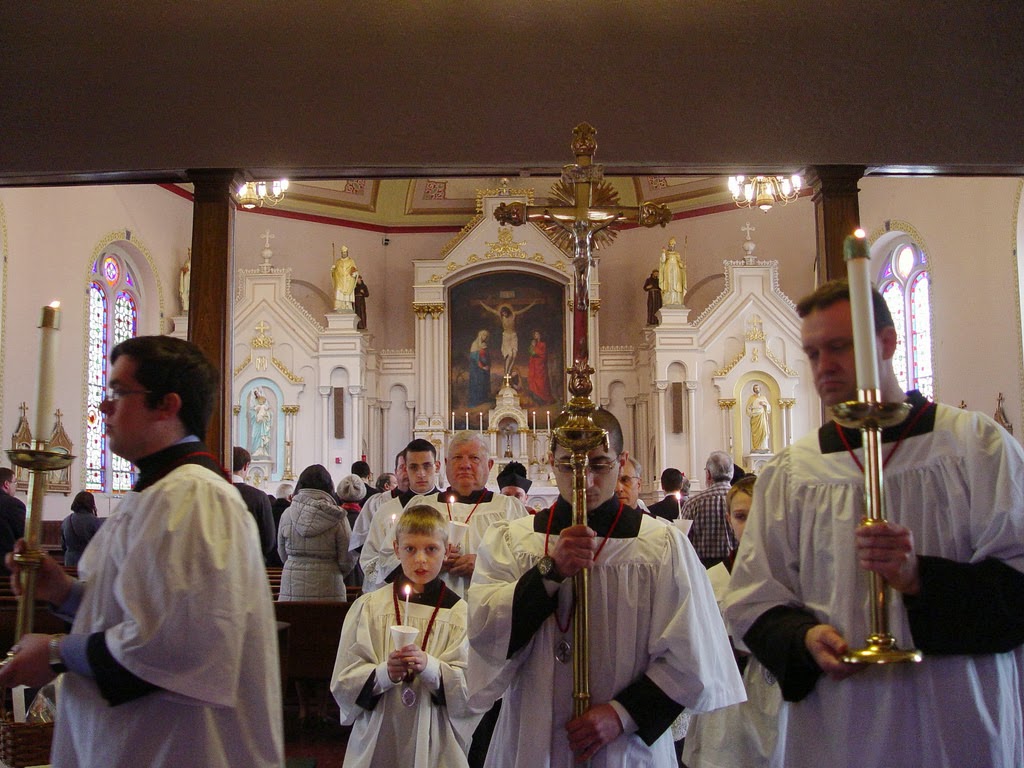
Holy Trinity Church has been designated as the permanent worship site for the Extraordinary Form in Center City Philadelphia by His Grace, Charles Chaput, O.F.M Cap., Archbishop of Philadelphia. A Missa Cantata is celebrated every Sunday at noon, preceded by confession and public recitation of the rosary at 11:30 a.m. All are welcome.
Holy Trinity Church is located at the corner of 6th and Spruce Sts., Philadelphia, PA 19106. Free on-street parking is available on Sundays and for the Triduum with a parking placard, which may be obtained at the church. The on-street parking is available on the opposite side of Sixth Street from Pine Street to Washington Square, and on the opposite side of Spruce Street from Fifth Street to Seventh Streets.
The parking relaxations for the Triduum on Holy Thursday is 6-10 p.m., 
Good Friday 4-9 p.m., 
and Holy Saturday 4-9 p.m.
The Reverend Ronald W. Check is the Chaplain and Coordinator for the Traditional Latin Mass Community. He and a rota of diocesan priests celebrate the Sunday and feast day Masses. Music is provided by the Schola Cantorum under the direction of Michael Lawrence, organist and director of music. Music for Mass includes congregational hymns, the Gregorian propers and a polyphonic setting of the ordinary, which are taken from the traditional repertoire, with motets and additional music for organ.
Historic Holy Trinity Church was established in 1784 and is the third oldest Catholic church in Philadelphia. The church’s equally historic Hook and Hastings pipe organ was installed in 1892 and continues to be used.
The Philadelphia Chapter of the Latin Liturgy Association extends its thanks to the New Liturgical Movement for publicizing the Easter Triduum at Holy Trinity Church
April 7, 2014 1 Comment
First Friday and First Saturday TLM’s
From Mark Matthews, Advisory Council
First Friday, April 4, A.D. 2014, Traditional Latin Mass (TLM) will be offered by Fr. Gerald P. Carey of Our Lady of Perpetual Help Roman Catholic Church, at the Rectory Chapel of St. Albert The Great Parish, 212 Welsh Road, Huntingdon Valley, PA 19006, (T) 215-947-3500, at 7 p.m. preceded by Confessions at 6:30 p.m. This TLM will be offered in Reparation to The Sacred Heart of Jesus and will be the Mass of Friday in the Fourth Week of Lent
Purple Vestments
Missa “Meditátio cordis mei”
First Saturday, April 5, A.D. 2014 TLM will be offered by Fr. Harold B. Mc Kale, Parochial Vicar of Nativity B.V.M. Roman Catholic Church, at the Rectory Chapel of St. Albert The Great Parish at 9 a.m., preceded by Confessions at 8:30 a.m.
This TLM will be offered in Reparation to The Immaculate Heart of Mary and will be the Mass of
Saturday in the Fourth Week of Lent
Purple Vestments
Missa “Sitiéntes”
The St. Albert The Great Rectory, also known as the Parish Center, is behind the Church, which fronts on Welsh Road.
Thank you for publicizing these Traditional Latin Masses.
April 4, 2014 No Comments
Remarriage, Divorce and Communion: Patristic Light on a Recent Problem
From Zenit:
Philosophy Professor John Rist Critiques Cardinal Kasper’s Consistory Speech
On 20th February last, Cardinal Kasper gave an address, “The Gospel of the Familyâ€, to the Extraordinary Consistory on the Family called by the Holy Father, much of it concerned with outlining current difficulties – massive mobility, immigration, costs of childrearing, aging populations, individualism, alienation of urban life, civil divorce, etc . – faced by Catholics entering the married state.
A married Catholic such as myself might suppose that these prevailing circumstances suggest, rather than a relaxation of the rules debarring from Communion the divorced and “re-marriedâ€, that promulgating from Rome requirements for far more serious marriage-instruction to be given to couples, by priests (or others) cognizant of these difficulties of marriage in contemporary society, would be a first obvious step towards solving, or at least diminishing the problem and easing the strain on marriage-tribunals. Yet the Cardinal proposes that the rule about Communion be liberalized for two groups of divorced-and-remarried Catholics: those who genuinely believe (or may even know) that they originally entered on a Church wedding with no firm intention, or inadequate understanding, as to the rules about validity; secondly those who have contracted a civil second-marriage because their Catholic marriage has failed “irretrievably†– with emphasis on a “probably very small group†of these last as especially worthy of relaxation of the rules.
However, it is not my intent to trespass upon the Cardinal’s preserve in matter of teaching about marriage, but rather to handle that within my competency: the teaching of the Fathers of the Church. For while Cardinal Kasper admits that we cannot simply go back to ancient teachings, he does claim – at the same time suggesting an imprecise parallel with developing doctrines of penance for apostasy – that evidence from antiquity is sufficiently uncertain for a more relaxed approach to find patristic support. To show how weak is this claim, let me address the few texts the Cardinal offers in support of his position – limiting myself to the period before the sixth century, since with Justinian an encroaching Caesaro-papism engenders in the East a contorting of earlier evidence in favour of a more relaxed approach.
Though others have put forward “early†– though non-existent – evidence for his position, the Cardinal wisely offers nothing from the first hundred-and-fifty-odd years of Christianity, presumably accepting that marriage-rules were then still strict and apostolically based. The first text he cites, from the mid-third century, is Origen (Commentary on Matthew 14. 23-24) reporting that bishops of certain local churches “not without reason†allow communion to those divorced-and-remarried. Yet Origen also says – not once but three times – that this practice is contrary to the Scriptures: hardly endorsement, nor even toleration from so biblical a theologian! Councils apart (I shall come to them), Kasper offers further evidence only from the fourth century, observing that Basil (letters 188 and 199), Gregory of Nazienzen (Oratio 37) and Augustine are aware of the same practice occurring; what he omits to notice is that there is no indication of any of them concurring in what plainly contravenes their ordinary teaching.
Moving beyond “private†theologians, Kasper claims that a more pastoral attitude is evidenced by the Council of Nicaea (325) – presumably by Canon 8 which (so he and others tell us) “confirmed†the more relaxed approach. Though this has occasionally been read into the text, yet its virtually certain intent is to permit Communion not to the divorced-and-remarried but to the widowed-and-remarried; for we need to bear in mind that a Christian’s marrying twice in any circumstances – including widowhood – was much debated, giving reason for the Council to address this uncertainty. Nor is Cardinal Kasper’s case strengthened by misapplying the Pauline notion of metanoia and going on to presume that the Fathers would consider “repentance†of the failure of a first marriage to justify entering into a second.
To conclude, upon examination the Cardinal’s case depends on misinterpreting a tiny number of texts while neglecting numerous others which contradict them. How can this have happened? To my mind we have here an example of a procedure all too frequent in academia, more especially when work may be motivated by convenience or ideology: there is an overwhelming amount of evidence in one direction and one or two texts which might conceivably be read otherwise; from which is derived the desired conclusion, or at least that the matter is open. Perhaps Cardinal Kasper has more texts to cite; certainly he will be able to name some few scholars whose lead he has followed. But multiple exemplars of misleading academic practice ought logically to be no more convincing than one!
Dr John Rist is the Fr Kurt Pritzl OP Chair of Philosophy at the Catholic University of America. He was Professor of Classics at the University of Toronto for 30 years and currently teaches at the Augustinianum, the Patristic Institute in Rome. He is widely published in the field of ancient philosophy, patristics and moral philosophy. He is married and both a father and a grandfather.
April 2, 2014 No Comments
Remembering the Real John XXIII
From NLM
by Peter Kwasniewski
As we turn the corner into April 2014, when Pope Francis will canonize both John XXIII and John Paul II on Low Sunday/Divine Mercy Sunday, it behooves us to ask whether we have adequately grasped the spiritual profile of each one of the beati in question. With John Paul II still fresh in our memories, perhaps the question does not apply so much to him, but we may surely wonder how well the faithful actually know John XXIII and his teaching, more than fifty years after his death.
For some decades, there has been in the Church a curious phenomenon that one might call “the conciliar caricature,†part of which is a tendency to speak as if Angelo Roncalli (1881–1963) came from outer space to bring deliverance and freshness to an antiquated Church that was serving out the stale bread of yesteryear. On the contrary, Pope John XXIII, elected supreme pontiff on October 28, 1958, was in many ways utterly traditional—arguably more so than his more philosophically adventurous and intellectually wide-ranging predecessor Pius XII. One need only read Blessed John’s beautiful diary, later published as Journal of a Soul and still in print, to discover the simple, hardy, and thoroughly traditional Catholic piety that nourished this man in the entire journey of his life.
To his dying day John was convinced that the Church was possessed of a greater vitality than ever; that this vitality demanded of her a tremendous missionary effort for the leavening and transformation of the world; and that the Second Vatican Council he convened was going to bring about a deepened commitment to the religious life, a more forceful presentation of doctrinal truth, a more inspiring appeal to live the demands of the Gospel (see the Bull of Convocation of the Council, Humanae Salutis of December 25, 1961, and the address to the opening of the Council, Gaudet Mater Ecclesia of October 11, 1962). He was convinced, in short, that he was setting in motion the greatest missionary thrust since the age of the Apostles.
That he would have been sorely distressed by the aftermath is unquestionable. A pope who, in the face of many demands for vernacularization, issued the apostolic constitution Veterum Sapientia (February 22, 1962) unequivocally reaffirming the centrality and permanence of the Latin language in the Church’s life and liturgy, or who in an apostolic letter shared with the world his consuming devotion to the Precious Blood of Jesus (June 30, 1960), was not the kind of man who was ready to throw out tradition.
Probably the best way to appreciate how profound a lover of Jesus Christ and His Church was “good Pope John†is to read again his now largely forgotten encyclicals, several of which are truly outstanding for their rhetorical power, comprehensive approach, and sound pastoral wisdom. There were eight in toto, beginning with Ad Petri Cathedram (June 29, 1959), subtitled “On Truth, Unity, and Peace in a Spirit of Charity,†and ending with Pacem in Terris (April 11, 1963), over which the ailing pope labored tirelessly, so great was his desire to see it promulgated before his death. Here I wish to draw attention to five of the eight.
A pope’s inaugural encyclical is always important (recall John Paul II’s Redemptor Hominis or Benedict XVI’s Deus Caritas Est). It says much about the way its author perceives his pastoral office and his role in the Church at that time. Pope John XXIII’s words near the start of Ad Petri Cathedram sound like an anticipation of Vatican II: “The Catholic Church is forever young and is indeed a standard raised before the nations. From her come a pervading light and a gentle love which reach all men†(n. 2). He announces his main plans: to summon an ecumenical council and a Roman synod; to revise the Code of Canon Law and to “issue a Code of Canon Law for the Church of the Oriental Rite†(n. 3).
John XXIII immediately states his fundamental conviction, so contrary to the rampant relativism already characteristic of his time: “All the evils which poison men and nations and trouble so many hearts have a single cause and a single source: ignorance of the truth—and at times even more than ignorance, a contempt for truth and a reckless rejection of it. Thus arise all manner of errors, which enter the recesses of men’s hearts and the bloodstream of human society as would a plague. These errors turn everything upside down: they menace individuals and society itself†(n. 6).
Yet, the pope goes on to say, God has made it possible for man to know truth, both by the light of his reason and by the light of faith. If we do not embrace the truth God grants us to know, we are rejecting the highest good and losing our sanity. If we reject the Gospel, we reject “the very foundations of truth, goodness, and civilization†(n. 8). These are sobering words, a wake-up call for a drowsy world.
The remainder of the encyclical has the same tone. The sheer vehemence of style is reminiscent of Leo XIII, who is frequently cited with warm approval. John XXIII speaks of men who have “wandered pathetically far from the teaching of Christ†(n. 10), of the truth-attacker who “engages in an altogether despicable business’ (n. 11), of the movies and television programs that lead people into “loose morality and ignoble behavior, to treacherous error and perilous vice†(n. 14). He says we must fight with “weapons of truth†against these “weapons of evil†(n. 15) and error. The first error he castigates is the idea that “one religion is just as good as another†(n. 17). Not long after, he is critiquing the cult of progress and technology (n. 19) and underlining the duty of politicians to embrace the cause of truth if they wish to see any true peace and prosperity in their communities (nn. 21–22).
The entire document sounds the note of rallying around the See of Peter for the fearless proclamation of the Faith. What is perhaps most surprising, in light of the “Roncalli myth,†is the uncompromising apologetic in which John XXIII engages on behalf of the unity and unicity of the Church, refuting Protestant and other errors and pleading with separated Christians to reunite themselves to the Church founded by Jesus Christ. No milquetoast minister he: the duty of every non-Catholic to convert and join the one true Church is emphasized again and again (see nn. 59–91).
Sacerdotii Nostri Primordia (August 1, 1959), following hot on the heels of the inaugural encyclical, reveals the deepest yearning of John XXIII’s heart—building up the sanctity of the clergy, enkindling their zeal. He quotes St. Pius X: “Nothing is more needed to promote the kingdom of Jesus Christ in the world than the holiness of churchmen.†The encyclical is a beautiful recounting of the life and virtues of St. John Vianney on the occasion of the centennary of his death, interwoven with reflections and exhortations concerning the priesthood. While addressed, as custom dictated, to the bishops, it is clear that the pope had in mind each and every one of his priestly sons, whom he beckons to the heights of perfection, as well as young men discerning a vocation. This wonderful meditation on priestly life should be obligatory reading for the ordained or those aspiring to ordination.
The two mighty social encyclicals Mater et Magistra (May 15, 1961) and Pacem in Terris (April 11, 1963) would require little comment, if there had not been in the past forty years a serious neglect of the full scope and depth of Catholic social teaching—a neglect manifested by a narrow and superficial conception of the subjects it concerns, not to mention a Judas-like willingness to set aside major elements of this teaching whenever it becomes inconvenient or uncomfortable. In continuity with Leo XIII, a pope he dearly loved, Pope John XXIII recognized that the ultimate root of many economic injustices was a skewed understanding and perverted practice of politics. That is, the only viable solution to the “social problem†was the reconstitution of governments according to Catholic wisdom.
Even if some particular descriptions or proposals in these two encyclicals seem dated to us in 2014—hardly surprising given the mutability of human affairs—their sound principles, systematic analysis, and biting critiques remain perfectly relevant to our day and age, and well deserving of our study. This pair of encyclicals simply must not be left unread by any Catholic who is concerned about doing his part to promote justice and peace.
Then there is Aeterna Dei Sapientia (November 11, 1961), the encyclical with which John XXIII commemorated the fifteenth centenary of Pope St. Leo the Great’s death in 461. After recounting St. Leo’s doctrine and holiness, Pope John XXIII turns again, as he did in his first encyclical, to the subject of Church unity, and gives us a brief and compelling treatise on the true Church of Jesus Christ and the ineradicable, irreducible role the papacy plays therein. The Pope then states his hopes for the approaching Council: “We are fully confident that this solemn assembly of the Catholic hierarchy will not only reinforce that unity in faith, worship, and discipline which is a distinguishing mark of Christ’s true Church, but will also attract the gaze of the great majority of Christians of every denomination, and induce them to gather around ‘the great Pastor of the sheep’ who entrusted His flock to the unfailing guardianship of Peter and his successors†(n. 62).
A pattern has thus emerged: in spite of his failings—of which no pope, or no Christian whatsoever, can be completely free in this life—John XXIII ought to be remembered above all for his fearless and articulate defense of all that is distinctively Catholic, as well as for his persuasive and positive way of presenting it. We would do well to return to these sources of sound doctrine; we might even promote the encyclicals mentioned above as readings in parish groups or among friends. It would be a small but effective step towards appropriating the legacy of a pope whose real teaching and real sanctity have been largely forgotten.
[A different version of this article appeared in the May-June 2007 issue of Lay Witness.]
April 1, 2014 No Comments
Extraordinary Faith TV on EWTN – Debut Episode April 14
From NLM
by Jennifer Donelson
We are happy to bring you some exciting news from a new show launching on EWTN called “Extraordinary Faith TV.”
Extraordinary Faith is pleased to announce the debut of a new, self-titled, 30-minute television series for the Eternal Word Television Network (EWTN) that showcases the beauty of classic Catholic sacred art, architecture, liturgy, and music. Special emphasis is given to the Traditional Latin Mass, also known as the Extraordinary Form or Tridentine Mass. This historic form of Catholic worship has enjoyed a resurgence in popularity in recent years, especially among the young, and is a rich source of vocations to the priesthood and religious life.
Extraordinary Faith is an independently-produced and funded effort to introduce the world of Sacred Tradition to Catholics and non-Catholics who have little or no experience of it. It combines a rich visual travelogue format with human interest stories taken from burgeoning traditional Catholic communities around the world. Each episode of Extraordinary Faith will visit a different locale, to tour historic churches and interview clergy and laypeople behind the restoration of classic Catholicism. The program avoids heavy theology and seeks to show how Catholic tradition is relevant to modern life.
Over two years in the making, Extraordinary Faith was co-founded by two veteran promoters of traditional liturgy: Executive Producer, Writer, and Host Alex Begin, a long-time organizer of Latin Masses in the Archdiocese of Detroit, Michigan and the Diocese of London, Ontario, Canada; and London, England-based journalist Mary O’Regan, who served as Writer, Producer, and Co-Host on the first two episodes.
To ensure that the message reverberates with contemporary audiences, the founders committed to the highest possible production standards. A team of experienced Los Angeles-based television professionals has been assembled to oversee the technical aspects of the production. Key personnel include veteran film and television producer James Brooke, Emmy-nominated cinematographer Jim Whitney, editor Andy Charlton, who worked on Hawaii Five-O and Pushing Daisies, and Edd Kalehoff, composer of the theme music for The Price Is Right and ABC World News Tonight. Volunteers from the St. Benedict Tridentine Community at Assumption Church in Windsor, Ontario, Canada (www.windsorlatinmass.org) are assisting with numerous background details on the project.
At 5:00 PM U.S. Eastern time on Monday, April 7, a web site supporting the program will go live at www.extraordinaryfaith.tv. A preview video for the series and for each episode will be posted there. A Facebook page will offer a discussion forum for subjects pertinent to the program and for those who have questions about Catholic tradition in general, at www.facebook.com/ExtraordinaryFaith.
The web site will include a list of resources for those interested in learning more about traditional liturgy. Each episode will have its own page, with links to provide more information about the people and places visited.
To further help promote Sacred Tradition, members of the Extraordinary Faith team will also offer on-site training for priests, servers, and musicians who wish to learn the Tridentine Mass. No fee will be charged for the instruction or travel costs involved, but parishes who take advantage of this service will be required to commit to offering the Extraordinary Form at least once per month. Details about this service will be posted on the web site.
Eight episodes have been shot thus far. Episode 1, filmed at California’s historic Mission San Juan Capistrano, will debut on EWTN on Monday, April 14, 2014 at 4:30 AM U.S. Eastern time. It will be repeated on Good Friday, April 18, at 2:00 AM U.S. Eastern time. Further re-runs are possible, according to the network. One month after each episode debuts on EWTN, it will be viewable on the Extraordinary Faith web site. Episode 1 will be posted on-line beginning on Wednesday, May 14.
For further information, please contact Executive Producer Alex Begin at (248) 952-8190 or e-mail: abegin@extraordinaryfaith.tv.
Having worked with the crew of EFTV on episodes about sacred music and the Latin Mass scene in Miami, I’m delighted to see the launch of this show on EWTN. I hope you’ll be able to tune in to the broadcast, as well as view the episodes on their website after airing. Support from viewers will likely go a long way in securing a better time slot, as well as the production of more episodes.
April 1, 2014 No Comments
A Traditional Missal for Young Catholics
From NLM (Go to NLM to see photos referenced in this article)
by Peter Kwasniewski
A few years ago, I noticed that my children were ready to follow the real prayers of the traditional Latin Mass—they had long outgrown “baby missals” that have photos of the priest at the Introit accompanied by a text in big letters, like “Watch Father ascend the steps: he is going to pray to God for us,” etc.—but they were also not ready to deal with a full 2,000-page missal like the Baronius or the Angelus Press.
Not being able to find anything that served this intermediate purpose, I decided to create the resource and try it out. My children used copies of it for a good while, and versions of it were passed around to families in the local community. The feedback was that it served its purpose well and should be made more widely available. I am happy to announce that A Traditional Missal for Young Catholics can be purchased from Lulu, and to help you get a better sense of what it’s like, I’ve appended a bunch of photos.
The book is decorated throughout with beautiful artwork to help inspire and focus a child’s easily wandering attention. The artwork is drawn from a wide range of masters and chosen to match the meaning of the text, so that it can stir up piety and prayer. It offers to a child something worthwhile to ponder in the extended periods of silence during the Mass, thus forming the imagination as well as the intellect.
The booklet contains, in easy-to-read print, the fixed and unchanging parts of the Mass. It prepares the young reader for the eventual use of an adult daily missal. Many features—such as the clear indications of when the proper prayers and readings take place, so that a child, if he or she wants, may consult a parent or sibling next to them for the proper—assist the reader to follow the Holy Mass more easily and come to a deeper understanding of both its unchanging and its changeable parts. This book serves as a tool to help the parents, as the first teachers of their children in the school of the Faith, to be inspired in passing on knowledge and love of the traditional Latin Mass, as so many Catholics have done through the centuries.
Having made this book for love of the Mass and to help out parents, I’ve set the price as low as Lulu will allow. The relatively high cost of the book ($18.87) is entirely due to its being in full color on every page, with a total of 47 artwork reproductions.
The “Mass of the Ages†is a sign of order, beauty, sacredness, and holiness to children in the midst of our rather confused world. This booklet will help children to begin their quest of understanding the mysteries that the Church offers to them in her sacred rites. It would make a lovely Easter gift!
April 1, 2014 2 Comments
A Bishop of Rome Celebrates Laetare Sunday with the FSSP
From the NLM
by Gregory DiPippo
The Fraternity of St Peter’s Roman parish, Santissima Trinità dei Pellegrini, was very honored to welcome as the celebrant of the Mass for Laetare Sunday His Excellency Matteo Zuppi, the Auxiliary Bishop of Rome responsible for the pastoral care of the city center, including Trinità dei Pellegrini. This was the first time that an auxiliary of Rome durante munere has celebrated Mass in the Extraordinary Form in a Roman parish since the post-Conciliar liturgical reforms began, and the whole parish community was very glad to accede to His Excellency’s request to say the Mass.
As Fr. Joseph Kramer, the parish priest, stated when welcoming the bishop before the beginning of the Mass, “Monsignor Zuppi’s presence here today represents the union in law, but also in affection, which exists between this parish and the diocese of Rome. As pastor, together with all the members of the parish, we are happy to be united today with our bishop. … We are very grateful to (him) that he wished to demonstrate that the Extraordinary Form has become part of the normal life of the Church, in the manner desired by Pope Benedict XVI in his moto proprio Summorum Pontificum. … For our parish, it is very encouraging, Your Excellency, to have you with us today as a concrete and visible sign of your pastoral care for us.†NLM joins Fr Kramer, the parish and the FSSP in thanking Monsignor Zuppi for his pastoral solicitude towards the faithful who follow the Extraordinary Form, and all the faithful of the city of Rome. (Those who have followed our friend Agnese’s pictures of the Station Masses have seen that His Excellency has celebrated several of them.) Thanks also to the parish for making these photos available.
“ ‘Rejoice Jerusalem, and all ye that love her, exult with her; rejoice, ye that were sad, exult, and be filled with her consolations.’ This is the invitation of this Sunday, Laetare. Let us rejoice, because we see the light of Easter drawing near, because salvation is not far from our life, because we experience joy, even in the midst of our Lenten journey. (speaking of the multiplication of the loaves and fishes in the day’s Gospel, John 6, 1-15) He took (the bread), gave thanks, offered; so it is in the Eucharist .. Jesus Himself takes the bread and distributes it. He is the servant, Who teaches us to give and to serve. … All were satisfied, with as much as they wanted. It is a foretaste of Paradise. Lord, always give us this Bread, which alone can satisfy us, which satisfies the soul, this Bread of love which teaches us to feed the hunger of all in abundance. Amen.†(from Bishop Zuppi’s homily)
April 1, 2014 No Comments
The Prophetic Church?
From Rorate Caeli
Editorial: Radicati nella fede, April 2014
Newsletter of the Catholic community of
Domodossola and Vocogno, Diocese of Novara, Italy
When you say you want to return to the Tradition of the Church or to promote the traditional liturgy to get out of the present terrible crisis in Christian practice, in order that souls can find once again the heart of prayer; when you work for the diffusion of perennial Christian Doctrine against the present immoral decline, you will always find many inside the Church who fight you fiercely in the name of “the prophetic churchâ€: “Stop dreaming about the past – they tell us – you are pathetic, the Church must look to the future, must envisage the future and must be prophetic!â€
But what is this prophetic church? What is this prophetic church made of?
Now regarding this prophetic church, you normally hear that it is a church projected entirely into an indefinite future, where everything that was certain in the past may be changed. A church which, while embracing all of man’s expectations, is reprogrammed into a gigantic effort to welcome everything and everyone, condemning no-one – except, of course, the notorious “traditionalistsâ€!
They tell you: before, the Church condemned – now She welcomes. Before, She taught from “on highâ€, now She accompanies man along with great humility in his ‘search’. Before, She was concerned that everyone be baptized and receive the grace of the sacraments, now She recognizes that God acts also outside of the sacraments. Before, She wanted all men to return to the fold, now She realizes that salvation also exists outside Christianity.
This prophetic Church is made up of prophetic priests and surrounded by a prophetic laity: all of whom are occupied on the latest front line of social-work, concerned about the poor, while also being fixtures of radical and fashionable circles. Obviously, since the rich and the snobs like this prophetic Church quite a lot. That is to say, those who are weary of their wealth and are concerned that the Church be concerned with the poor.
Over the past years at a national and local level, television has welcomed only priests like these – prophetic priests, of the [late] Don Gallo variety to be precise, the ones always on the borderlines of obedience to the Church, the innovative and revolutionary ones, since according to them, this is being prophetic. The television has given programmes to these priests and they, in turn, inserted into the latest revolution of the future, have bombarded spectators with false doctrines, so much so that spectators now believe that the Church is actually this permanent revolution.
Furthermore, over the years the majority of bishops have feigned “keeping a eye†on the advance of these priests and their lay-followers; they have feigned it because deep down they have always supported them, have given them everything and practically beatified them at their deaths. Officially they have warned them to be prudent, but have basically always allowed them to go about their work, that is widespread and destructive for the presence of Christianity in society, to the point now that it appears impossible to stem it. They are allowed to do it, primarily not because they are concerned about the poor, but rather because they are filled with the illusion of recuperating a place of honour in a modern world which is now pagan – and it is so precisely because of these prophetic priests: this is a true and real cultural subjection to modernity. Behaving so, they have deceived souls, by spreading moral destruction and weakening the Faith.
This prophetic church, these prophetic priests and these prophetic laymen have nothing at all to do with true prophecy!
True prophets, the ones in the Bible, spoke in the name of God to the people, the kings and priests, reminding them, at times fiercely, of the consequences of sin. In the prophets there is always an accusation of sin, an admonishment to penance and a return to God; you have abandoned God, for this a chastisement has fallen upon you; return to God and He will liberate you.
Have you ever heard this admonishment from the so-called prophetic church? No. This church lives on in the revolutionary schema: it accuses the Church of the past of being myopic and old-fashioned, so that it may program a new church which will finally respond to the needs of men. We have arrived at unadulterated heresy! It is even a dim-witted heresy because it has been picked up from the radical and fashionable circles!
This is a bourgeois church, not a Church of the people. The people, as a result of the hammering of the mass-media these past years, had to succumb to this prophetic church, for fear of being left with nothing. It is in truth the bourgeois church which, being satiated, has to be distracted by feeling useful to others. The poor have no time for this; the poor know the fatigue of life and look toward Heaven.
So this bourgeois church must hinder the places that are springing up where the Church’s Tradition is being revived; they must hinder it, otherwise the people – i.e. the ones who still have a scrap of sensus fidei – will recognize these places of Grace. As a result, when these places of Grace in the Traditional Church exist, they are subjected to calumny by the bourgeois church which says: be careful, they are traditionalists… they are not the true church – [the true church] is the one we have planned for the future!
True novelty instead is not in the future, but in the past, because it is Christ and His Grace. Moreover, the real poor are not those of the television talk-shows and of fund-raising events, but are those who humbly seek God.
[Translation: Contributor Francesca Romana]
April 1, 2014 No Comments