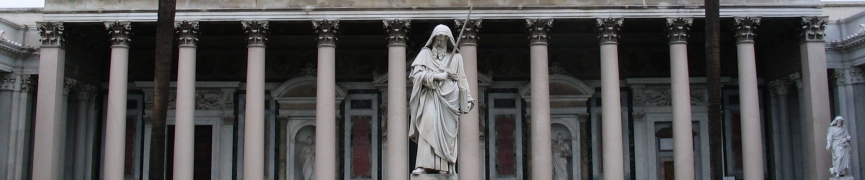
St John XXIII Asks the Faithful Not to Applaud in Church

St. John XXIII doesn’t like it when you clap in church. So STOP it!
translation of the Italian:
The fourth Sunday of Lent, John XXIII was once again among the crowd, at Ostia. (about 15 miles to the south-west of Rome.) Thousands of people were waiting for him along the street, in the piazza, in the church. They wanted to see him, to applaud him. They did not know that afterwards, he would rebuke them, in a good-natured way, in his simple , spontaneous, familiar way of speaking.
“I am very glad to have come here. But if I must express a wish, it is that in church you not shout out, that you not clap your hands, and that you not greet even the Pope, because ‘templum Dei, templum Dei.’ (‘The temple of God is the temple of God.’)
Now, if you are pleased to be in this beautiful church, you must know that the Pope is also pleased to see his children. But as soon as he sees his good children, he certainly does not clap his hands in their faces. And the one who stands before you is the Successor of St. Peter.
August 1, 2014 No Comments
August First Friday and First Saturday TLM’s
First Friday, August 1, A.D. 2014, Traditional Latin Mass (TLM) will be offered by Fr. David Spencer, Parochial Vicar of Our Lady of Lourdes Roman Catholic Church, at the Rectory Chapel of St. Albert The Great Parish, 212 Welsh Road, Huntingdon Valley, PA 19006, (T) 215-947-3500, at 7 p.m. preceded by Confessions at 6:30 p.m.
This TLM will be a Votive Mass of The Sacred Heart of Jesus offered in Reparation to The Sacred Heart of Jesus.
First Saturday, August 1, A.D. 2014 TLM will be offered by Fr. Gerald Carey, Parochial Vicar of Our Lady of Perpetual Help Roman Catholic Church, at the Rectory Chapel of St. Albert The Great Parish, at 9 a.m., preceded by Confessions at 8:30 a.m.
This TLM will be the Mass of Saint Alphonsus de Liguori, offered in Reparation to The Immaculate Heart of Mary.
The St. Albert The Great Rectory, also known as the Parish Center, is behind the Church, which fronts on Welsh Road.
July 29, 2014 No Comments
Revised 1st Friday & 1st Saturday TLM’s at St. Albert The Great.
Please NOTE temporary change in First Friday schedule due to the 4th of July secular holiday!!!
First Friday, July 4, A.D. 2014, Traditional Latin Mass (TLM) will be offered by Fr. Harold B. Mc Kale, Parochial Vicar of Nativity of the Blessed Virgin Mary Roman Catholic Church, at the Rectory Chapel of St. Albert The Great Parish, 212 Welsh Road, Huntingdon Valley, PA 19006, (T) 215-947-3500, at 9 a.m. preceded by Confessions at 8:30 a.m. Due to the 4th of July secular holiday, this First Friday TLM and Confession will be as if it were a First Saturday TLM morning schedule.
This TLM will be offered in Reparation to The Sacred Heart of Jesus and will be a Ferial Mass.
First Saturday, July 5, A.D. 2014 TLM will be offered by Fr. Gerald Carey, Parochial Vicar of Our Lady Help of Christians Roman Catholic Church, at the Rectory Chapel of St. Albert The Great Parish, at 9 a.m., preceded by Confessions at 8:30 a.m.
This TLM will be a Votive Mass of the Blessed Virgin Mary with a Commemoration of Saint Anthony Mary Zaccaria, offered in Reparation to The Immaculate Heart of Mary.
The St. Albert The Great Rectory, also known as the Parish Center, is behind the Church, which fronts on Welsh Road.
(T
July 4, 2014 No Comments
THE FEAST OF OF SS. PETER AND PAUL, APOSTLES. [June 29.]
Rev. Fr. Leonard Goffine’s
The Church’s Year
PETER, formerly called Simon, from Bethsaida in Galilee, was a son of Jonas and a brother of Andrew, by whom he was brought to Christ. After the great draught of fishes, when our Lord said to him and Andrew: Follow me, and I will make you fishers of men, Peter followed the Saviour constantly, from whom he received the most tender proofs of love. Peter was present when Christ appeared in His glory on Mount Thabor, when He raised the daughter of Jairus to life, and when He sweat blood in the agony on Mount Olivet. Peter was also present at the miraculous draught of fishes, which was a figure of the multitudes which he was to bring, by means of the holy Gospel, to the kingdom of God, for Christ called him a fisher of men, and afterwards, because Peter recognized and professed Him to be the Son of the living God, Christ named him Peter, made him the head of the apostles and of the entire Church, made him His vicar and visible representative upon earth, promising to build His Church upon him as upon a rock, gave him the keys of the kingdom of heaven, and commanded him to feed His lambs and His sheep. Peter loved our Lord above all things; because of his love he wished to remain with Christ upon Mount Thabor to prevent Him from suffering, and in his love desired to die with Christ. He certainly showed the greatest courage when Christ was taken, following Him even into the house of Caiphas. But alas, the instability of man! There Peter three times denied the Lord. But the look of forgiving love which Jesus .east upon him, forced from him tears of the deepest contrition. He atoned for his denial by suffering much for Christ. Under the Emperor Nero he was crucified for his faith at Rome, and by his own request with his head downwards, because he did not consider himself worthy to die like Christ.
Oh! that all sinners would seek by such penance to turn their evil into good!
PRAYER TO ST. PETER. O God, who from a poor fisherman hast made St. Peter prince of the apostles and head of Thy Church, we beseech Thee through his intercession to make us true lambs of Thy flock. Grant, that we may hear his voice, follow his doctrine, and walk in his steps, until we reach that happy pasture where the Good Shepherd, Thine only-begotten Son, Jesus Christ, whom St. Peter represented on earth, reigns with Thee and the Holy Ghost forever. Amen.
SKETCH OF THE LIFE OF ST. PAUL
PAUL, before his conversion called Saul, of the tribe of Benjamin, was born at Tarsus in Cilicia, and was a pupil of Gamaliel. As he had the most zealous attachment for the Jewish law, he was exasperated against the Christians. However, when hastening to Damascus to persecute them, he was converted by the Lord on the way and called to be an apostle. [See the Feast of the Conversion of St. Paul.] His unwearied labors in the vineyard of the Lord after his conversion, the sufferings which he endured upon his apostolic journeys, and the dangers and persecutions through which he passed in different countries, cannot be described. The zeal and constancy with which he confessed and preached the faith, though in chains and fetters, though scourged and beaten, in hunger and thirst, and through innumerable dangers, are almost incredible. He was so humble that he regarded himself as the least of the apostles, and thanked God fervently that He considered him worthy to suffer for His sake. After he had fought a good fight and finished his course, having everywhere zealously preached the faith, and still more zealously practiced it, he wpn the crown of justice. On the same day and at the same place in Rome, in which Peter was crucified, he was beheaded, by command of the Emperor Nero. Thus God tries and rewards true virtue. Paul in his life, as after death, worked numberless miracles; even his handkerchief, like St. Peter’s shadow, healed sickness and expelled devils. He had so deeply impressed the name of Jesus in his heart, that it was almost continually on his lips, for “out of the fulness of the heart, the mouth speaketh.”
Would that we loved Jesus as St. Paul loved Him, then we would, like St. Paul, be ready to do and suffer much for Him.
PRAYER TO ST. PAUL. O St. Paul, chosen vessel of the Lord, who didst carry the name of Jesus to kings and heathens, who didst suffer so much for Christ, and wast never allured from the love of Him: like a brave soldier of Christ, thou hast fought a good battle, a zealous teacher, thou hast preached far and wide the true faith, and the just and merciful God has, therefore, rewarded thee with the crown of justice: pray to God for me, that I who because of my sins am an instrument of wrath, may become an instrument of honor, adorned with the Christian virtues, with which thou art already decorated. Through Jesus Christ our Lord.
The Introit of the Mass consists of Peter’s words, spoken after his deliverance from the prison at Jerusalem: Now I know in very deed that the Lord hath sent his angel, and hath delivered me out of the hand of Herod, and from all the expectation of the people of the Jews. (Acts xii. 11.) Lord, Thou hast proved me, and known me: Thou hast known my sitting down and my rising up. (Ps. cxxxviii.) Glory be to the Father, &c.
COLLECT O God, who hast sanctified this day by the martyrdom of Thy blessed Apostles Peter and Paul: grant unto Thy Church, that as from them it received the first teachings of religion, so it may in all things follow their holy precepts. Thro’. &c.
EPISTLE (Acts xii. 1 — 11.) in those days, Herod the king stretched forth his hands to afflict some of the Church: and he killed James the brother of John with the sword. And seeing that it pleased the Jews, he proceeded to take up Peter also. Now it was in the days of the azymes. And when he had apprehended him, he cast him into prison, delivering him to four files of soldiers to be kept, intending after the pasch to bring him forth to the people. Peter therefore was kept in prison. But prayer was made without ceasing by the Church unto God for him. And when Herod would have brought him forth, the same night Peter was sleeping between two soldiers, bound with two chains: and the keepers before the door kept the ^prison. And behold, an angel of the Lord stood by him, and a light shined in the room: and he striking Peter on the side, raised him up, saying: Arise quickly. And the chains fell off from his hands. And the angel said to him: Gird thyself, and put on thy sandals. And he did so. And he said to him: Cast thy garment about thee, and follow me. And going out, he followed him, and he knew not that it was true which was done by the angel: but he thought he saw a vision. And passing through the first and the second ward, they came to the iron gate that leadeth to the city: which of itself opened to them. And going out, they passed on through one street, and immediately the angel departed from him. And Peter coming to himself, said: Now I know in very deed that the Lord hath sent his angel, and hath delivered me out of the hand of Herod, and from all the expectation of the people of the Jews.
EXPLANATION I This Herod, a grandson of Herod the Great,, under whom Christ was born, and who murdered the holy Innocents, was a zealous Jew, and to please the Jews persecuted the Christians. He caused Peter to be imprisoned with the intention of having him publicly executed after Easter, for the amusement of the people. — How shameful it is to do wrong, to murder a man in order to amuse others! See how deeply the desire to please can lead into error! Take care to commit no sin for the sake of pleasing others; for he who seeks to please men cannot be a servant of Christ, says the Apostle Paul. II. The Church, that is, the priests and the faithful, prayed to God continually for the liberation of St. Peter, and their prayers were heard. — Let us pray for one another, especially for sinners, that God may free them from the chains of the evil one. III. Peter slept quietly in prison, for his conscience was at peace, and he confided himself to God’s protection. — The innocent are calm in every peril and need, the bad alone have no peace. IV. God sent an angel to Peter, who told him to rise quickly, gird himself, put on his sandals, and follow him. — If thy guardian angel warns thee to rise from the sleep of sin, do so at once, return to thyself, like the prodigal son, break the bonds that bind thee to sin, gird thyself with the strong resolution to sin no more, put on thy shoes, that is, make the firm purpose to follow Christ.
(The Gospel as on the Feast of St. Peter’s Chair at Rome.)
June 29, 2014 No Comments
To Believe a Lie
Written by Susan Claire Potts
DISCLAIMER: This opinion piece does not necessarily reflect the opinion of the LLA or its members.
Ideo mittit illis Deus operationem erroris ut credant mendacio
There is a shadow over the world. It darkens societies and snuffs the candles in the sanctuary. It creeps around corners and billows over houses. Good people see it, but they don’t know what to do. How do you fight a shadow? How do you crush a phantasm? There’s no substance there, nothing to push or shove. Nothing works.
So what is this strange amorphous thing, this Mystery of Iniquity? How can we understand it?
Sometimes, the most complex, inexplicable things are not so hard to understand once the blinders are off. I’m a counseling psychologist—no theologian or scientist—but, like all who hold the Catholic Faith, I have eyes to see. After nearly forty years of studying the human mind, analyzing the root of emotional conflict, moral perversions, and intellectual error, this is how it looks to me:
Quite simply, the darkness is the result of a thought process disorder. Masquerading as philosophy and science, the disorientation has spread through the Church from top to bottom, corrupting minds and shaking the intellectual and philosophical foundations of Western civilization.
A new religion has the world in its grip.
The closest thing to it was the fourth-century Arian crisis, when the whole world groaned and found itself Arian. But at least then people knew what the argument was. The point of debate was clear. It was one thing or the other: Was Christ the co-eternal Son of the Father or not?
But this Shadow is more than heresy. It is the reinterpretation of Truth—which is no interpretation at all, but a denial and repudiation. People say it is Modernism, but horrid as that synthesis of all heresies, is, the nebulous New Religion is worse because it’s not a heresy. Rather, it is systemic apostasy, a total renunciation of the Deposit of Faith, a “standing off†from Revelation. It is the substitution of a lie for the Truth. Like all evil things, it has no life of its own, but it has attached itself like a blood-sucking leech to the Mystical Body of Christ.
An historical perspective is in order here. The birth of the New Faith predates Vatican II by nearly fifty years. Materialism flattened the ground; naturalism destroyed the sense of awe and wonder. Modernism sowed the seeds of doubt.
It was all so mechanical and boring. There had to be something more. People were itching for change. Science was in the ascendency.
That’s when everyone—especially the priests and religious—should have clung fast to the Faith of Our Fathers, when they should have studied the miracles and the marvelous Heavenly apparitions. When they should have insisted the Supernatural was Real and that Revelation was true. When they should have handed down what was given to them.
But so many didn’t. Although they wouldn’t admit it openly, they no longer believed in the truths of their religion. Theoretical science had brought them beyond the catechism and Creed. Misled by speculation, they became evolutionists.
They started right at the beginning. The first thing they denied was the existence of Adam and Eve. The “creation story,†as they call it, was too much to swallow. They refused to see the Omnipotent Hand of God in the creation of one man and one woman, from whom all people would be born.[1]
Following the materialists, they clung instead to the grotesquerie of man’s upward ascent from the ape in a progression of hideous creatures of their own imagination. They declared that some family of apes called hylobatidae split into hominidae—as if that explained anything at all. They came up with neo-Latin names to deceive and impress: Australopithecus, Homo erectus, Homo Heidelbergensis, Homo rhodesiensis, Homo denisova, and finally, the familiar, Homo neanderthalenis—the Neanderthal.
They presented those creatures of their imagination as scientific fact. It didn’t matter that they had no more ‘evidence’ than a jawbone here, a skull, there, and various bone fragments that they labelled and pronounced pre-human.
They spun their fairy tales from fossils and taught polygenesis as truth.
But look what happens when you start with a false premise. The logic can be unassailable, but the conclusions are still false. The lie grows more blatant and the thought disorder more severe with every assertion. Let’s follow the line of reasoning in the usual if…then…form.
If Adam and Eve weren’t real, the Faith gets ripped to shreds. There would be no Original Sin and, therefore, no need of Redemption. If there was no Redemption, there was no Redeemer. If there was no Redeemer, then there was no such thing as salvation. If there is no salvation, heaven, hell, and purgatory are simply mental constructs. Did God even exist?
It was pretty bleak, no religion at all. They needed to come up with a new spirituality, a new theology, fit for the superior post-modern mind. Something to fill the emptiness. They believed themselves Christians, after all. There was such a thing as spirit. It just had to be reinterpreted and made new again.
It didn’t take them long to find a champion.
He was Fr. Teilhard de Chardin, the Jesuit priest-paleontologist. In 1917, he wrote Le prêtre, (The Priest), laying the theological foundation of a substitute faith. The New Religion has one principal doctrine, from which all his errors flow: The universe is evolving from matter to Humanity and Humanity is evolving into Christ.
The book wasn’t published. His superiors forbade it, but mimeographed copies circulated among the intelligentsia, taking hold of jaded minds, minds tired of the Reality of the Catholic Faith, bored with her teaching, disdainful of the certainty of her pronouncements.
The pedants loved the new ideas. They were thrilled with the “new spirituality.†Subsequently, everything would be examined through this distorted lens. Nothing would, could ever be the same again.
A new spirit, born of speculative evolutionism and the worship of science, had been let loose. The underground circulation continued unabated. Teilhard died, but in 1957, another of his books, Le phénomène humain, was published in France. It was more deeply philosophical, more tendentious in its assertions
Three years later, in 1960, all hell broke loose. The English edition of The Phenomenon of Man, was published, followed by The Divine Milieu.
The ideas he developed were bizarre. There were all sorts of strange new words like noetic and noosophere, anthropogenesis and hominization. To Teilhard, there was no separate supernatural realm. Everyone and everything were involved in the “transformation of consciousness.â€
Listen to his words on the nature of Nature: It is a “benevolent universe evolving in the unconditional love of a benevolent and all-forgiving God.â€
So God sets no conditions?[2] He forgives everything and everybody? Both here and in Eternity? Does He not judge?
I read closer. How can the universe be benevolent?
For this the Teilhardians have an answer. It’s not just matter, you see. Not at all. There is no distinction between matter and spirit. The universe is alive, evolving, transforming until someday, the whole beautiful thing will be Christ.
Come on. Are these people serious? Rocks and minerals and inert gasses are going to be Christ?
Totally awesome, dude!
They go on. The living universe will be divinized. We will all together, not singly, not individually, but indivisibly reach the Omega Point.
And what is that?
Christ.
Not Jesus of Nazareth. Oh, no. The Cosmic Christ. Christ is huge, they say. He is a continually evolving being as big as the universe.
There was no condemnation from Rome. The Monitum disappeared. Teilhard slipped by the authorities by writing as a “scientist,†and not a theologian or even a philosopher. It was like Galileo all over again, and I guess they didn’t want to look stupid in the eyes of the world.
So the ideas spread. The Spirit of Darkness flew over the Vatican.
It was a new philosophy, a new religion for intellectuals, those tired of doctrine and rules, those who sought the transformation of humanity. Like some sort of mystical avatar pointing the way to divinization, they prided themselves on being forerunners of a New Creation.
Lest anyone notice and protest, Henri (Cardinal!) de Lubac reassured the devotees: “We need not concern ourselves with a number of detractors of Teilhard in whom emotion has blurred intelligence.â€
So, people, protest all you want, you’re not thinking rationally. You’ve been overcome by emotion. You’re just dumb.
The Teilhardians pushed on. In 2009, Vatican spokesman, Fr. Federico Lombardi, was reported to have said with obvious satisfaction, if not triumphant glee: “By now, no one would dream of saying that Teilhard is a heterodox author who shouldn’t be studied.â€
Sorry, Father. I not only dream of saying it, I will shout it from the housetops. Teilhard de Chardin is not just “heterodox.†He has undermined Catholic philosophy and theology. He is not some misunderstood paleontologist, nor is he a doctor of the Church on the level of St. Thomas Aquinas as some boldly profess.
Not at all. This Jesuit—exiled for a time to China and forbidden to publish by superiors who still professed the Catholic Faith—is an arch-heresiarch, the founder of a false religion, spiritual father of the New Age.
There’s no “hermeneutics of continuity†here. His are the lies beneath the ambiguities which plague us now.
Teilhard teaches that the universe is becoming Christ. The apostasy is blatant. The diabolical disorientation is manifest. The air is torn with the cry of the Serpent who proclaims again what he promised Eve in the Garden of Eden: Ye shall be as gods.
But he can roar all he wants. We won’t listen.
As St. Paul tells us: “Therefore God shall send them the operation of error, to believe lying, that all may be judged who have not believed the truth but have consented to iniquity. But we ought to give thanks to God always for you, brethren, beloved of God, for that God hath chosen you first fruits unto salvation, in sanctification of the spirit and truth.â€[3]
And now we also have the promise of the Blessed Mother: But in the end, my Immaculate Heart will triumph…
Make no mistake, God will have the last word.
[1] Recent research has demonstrated that all human beings descend from one mother. And the truth is right there in the book of Genesis: Eve’s name means, after all, the Mother of the All the Living. But that’s another article.
[2] It sounds like the concept of “unconditional positive regard†developed later by Carl Rogers, father of the Humanistic School of Psychology.
[3] 2 Thessalonians 2 11-13.
June 23, 2014 No Comments
INSTRUCTION ON THE FESTIVAL OF PENTECOST
Rev. Fr. Leonard Goffine’s
The Church’s Year
What festival is this?
It is the day on which the Holy Ghost descended in the form of fiery tongues, upon the apostles and disciples, who with Mary, the Mother of Jesus, were assembled in prayer in a house at Jerusalem. (Acts II.)
Why is this day called Pentecost?
The word “Pentecost” is taken from the Greek, and signifies fifty. As St. Jerome explains it, this was the last of the fifty days, commencing with Easter, which the early Christians celebrated as days of rejoicing at the resurrection of the Lord.
Why is this day observed so solemnly?
Because on this day the Holy Ghost, having descended upon the apostles, the law of grace, of purification from sin, and the sanctification of mankind, was for the first time announced to the world; because on this day the apostles, being filled with the Holy Ghost, commenced the work of purifying and sanctifying mankind, by baptizing three thousand persons who were converted by the sermon of St. Peter; and because on this day the Church of Jesus became visible as a community to the world, and publicly professed her faith in her crucified Saviour.
Why did the Holy Ghost descend on the Jewish Pentecost?
Because on their Pentecost the Jews celebrated the anniversary of the giving of the law on Mount Sinai, and God would show by sending the Holy Ghost on this days that the Old Law had ceased and the New Law commenced. God also chose this time, that the Jews who on this day came together from all countries to Jerusalem to celebrate the Pentecost, might be witnesses of the miracle, and hear the New Law announced by the apostles.
Why is the baptismal font blessed an the vigil of Pentecost, as on Holy Saturday?
Because the Holy Ghost is the Author of all sanctity and the Fountain of baptismal grace, and because in the Acts (i. 5.) the descent of the Holy Ghost itself is called a baptism.
In the Introit of the Mass the Church rejoices at the descent of the Holy Ghost and sings:
INTROIT The Spirit of the Lord hath filled the whole earth, allel.; and that which containeth all things hath knowledge of the voice, Allel., allel., allel. (Wisd. I.7.) Let God arise, and his enemies be scattered: and let them that hate him, fly before his face. (Ps. 67.) Glory etc.
COLLECT God, who on this day didst instruct the hearts of the faithful by the light of the Holy Spirit: grant us in the same spirit to relish what is right, and ever to rejoice in His consolation. Thro’. — in the unity of the same, etc.
LESSON (Acts II. I-II.) When the days of Pentecost were accomplished, they were all together in one place; and suddenly there came a sound from heaven, as of a mighty wind coming, and it filled the whole house where they were sitting. And there appeared to them parted tongues as it were of fire, and it sat upon every one of them:. and they were all filled with the Holy Ghost, and they began to speak with divers tongues, according as the Holy Ghost gave them to speak. Now there were. dwelling at Jerusalem, Jews, devout men, of every nation under heaven. And when this was noised abroad, the multitude came together, and were confounded in mind, because that every man heard them speak in his own tongue: and they were all amazed, and wondered, saying: Behold, are not all these that speak Galileans? And how have we heard every man our own tongue wherein we were born? Parthians, and Medes, and Elamites, and inhabitants of Mesopotamia, Judea, and Cappadocia, Pontus, and Asia, Phrygia, and Pamphilia, Egypt, and the parts of Lybia about Cyrene, and strangers of Rome, Jews also and Proselytes, Cretes and Arabians: we have heard them speak in our own tongues the wonderful works of God.
Why did the Holy Ghost come upon the apostles in the form of fiery tongues?
The appearance of fiery tongues indicated the gift of language imparted to the apostles by the Holy Ghost, and inflamed their hearts and the hearts of the faithful with the love of God and their neighbor.
Why did a mighty wind accompany the descent?
To direct the attention of the people to the descent of the Holy Ghost, and to assemble them to hear the sermon of the Apostle Peter.
What special effects did the Holy Ghost produce in the apostles?
He freed them from all doubt and fear; gave them His light for the perfect knowledge of truth; inflamed their hearts with the most ardent love, and incited in them the fiery zeal for the propagation of the kingdom of God, strengthened them to bear all sufferings and persecutions, (Acts V. 41.) and gave them the gift of speaking in various languages, and of discerning spirits.
GOSPEL (John XIV. 23-31,) At that time, Jesus said to his disciples: If any one love me, he will keep my word, and my Father will love him, and we will come to him, and will make our abode with him. He that loveth me not, keepeth not my words: and the word which you have heard is not mine, but the Father’s, who sent me. These things have I spoken to you, abiding with you: but the Paraclete, the Holy Ghost, whom the Father will send in my name, he will teach you all things, and bring all things to your mind, whatsoever I shall have said to you. Peace I leave with you, my peace I give unto you: not as the world giveth, do I give unto you. Let not your heart be troubled, nor let it be afraid. You have heard that I said to you, I go away, and I come unto you. If you loved me, you would indeed be glad, because I go to the Father; for the Father is greater than I. And now I have ;told you before it came to pass, that when it shall come to pass you may believe. I will not now speak many things with you; for the prince of this world cometh, and in me he hath not anything. But that the world may know that I love the Father, and as the Father hath givers me commandment, so do I.
Why is the Holy Ghost expressly called “Holy,” since this attribute is due to each of the divine persons?
Because He is the Author of inward sanctity and of all supernatural gifts and graces, and therefore to Him is especially ascribed the work of man’s sanctification.
What does the Holy Ghost effect in man?
He enlightens him that he may know the truths of religion and salvation, and the beauty of virtue; He moves him to desire, to aim after and to love these things; He renews his heart by cleansing it from sin, and imparts to him the supernatural gifts and graces by which he can become sanctified, and He brings forth in him wonderful fruits of holiness.
What are the gifts of the Holy Ghost?
According to the Prophet Isaias they are seven: 1.The gift of wisdom, which enables us to know God, to esteem spiritual more than temporal advantages, and to delight only in divine things. 2. The gift of understanding, by which we know and understand that which our faith proposes to our belief; children and adults should pray fervently for this gift, especially before sermons and instructions in the catechism. 3.The gift of counsel, which gives us the knowledge necessary to direct ourselves and others when in doubt, a gift particularly necessary for superiors, for those about choosing their state of life, and for married people who live unhappily, and do not know how to help themselves. 4. The gift of fortitude, which strengthens us to endure and courageously overcome all adversities and persecutions for virtue’s sake. 5. The gift of knowledge, by which we know ourselves, our duties, and how to discharge them in a manner pleasing to God. 6. The gift of piety, which induces us to have God in view in all our actions, and infuses love in our hearts for His service. 7. The gift of the fear of the Lord, by which we not only fear the just punishment, but even His displeasure at every sin, more than all other things in the world.
Which are the fruits of the Holy Ghost?
As St. Paul (Gal. V.. 22-23.) enumerates them, they are twelve: 1. Charity. 2. Joy. 3. Peace. 4. Patience. 5. Benignity. 6. Goodness. 7. Longanimity. 8. Mildness. 9. Faith. 10. Modesty. 11. Continency. 12. Chastity. To obtain these fruits as well as the gifts of the Holy Ghost, we should daily say the prayer: “Come, O Holy Ghost, etc.”
Why does Christ say: The Father is greater than I?
Christ as God is in all things equal to His Father, but as Christ was at the same time Man, the Father was certainly greater than the Man-Christ.
Why does Christ say: I will not now speak many things with you?
Christ spoke these words a short time before His passion, and by them He wished to say that the time was near at hand when Satan, by his instruments, the wicked Jews, would put Him to death, not because Satan had this power over Him, but because He Himself wished to die in obedience to the will of His Father.
June 6, 2014 No Comments
First Friday and First Saturday TLM’s
These Masses will be held as usual at the Rectory Chapel of St. Albert the Great Parish. Times remain the same.
June 6, 2014 No Comments
Hey, trads! Take these words to heart! (Despite how we may be treated by others).
From Fr. Z’s Site
You are wandering through a city filled with historical landmarks. You enter a beautiful church that you had never seen before. As you admire the interior, the priest sees you kneeling, and comes to invite you to a little gathering they are having in an adjoining hall.
“But Father,†you say, “I’m just someone passing by, I don’t want to bother you.†“No,†he says, “you must come! Must I force you?â€
The gathering is quite nice, sandwiches and beignets done by women of the community, in honor of a group of people who help in the church. Father makes sure you eat something. He also gives you a booklet on the building. “It’s a gift, take it.â€
You tell him, “Father, I’d never received this kind of welcome in a church before.†“Good,†he says, “now we have a new friend.â€
This old Franciscan friar had just celebrated a Paul VI mass, just before you entered the church. “Why,†you think to yourself, “have I never seen anything even resembling this level of welcoming of a complete and utter stranger in a traditional community, even after visiting so many around the world? Why does it seem, at least in my experience, that we can’t make the effort to be kinder, gentler, and more welcoming?†Now, one may be well aware that this kind of experience is very rare in Paul VI settings as well, but that is not the point. The point is that those who try to excel in the liturgical worship of God and in the dispensation of traditional doctrine must also try to excel in the charitable welcoming of all.
Thank you, Mother Help of Christians, for this wonderful experience. Please, Mother Most Holy, teach kindness, gentleness, and true mercy to your children in this vale of tears. Each one can begin this small yet significant job in our own communities, with the help of the Lord and the Gentle Lady.
May 26, 2014 No Comments
In The Heart of Every Traditionalist Lies A Schismatic
by Pat Archbold Thursday, May 22,
National Catholic Register
Just because you are paranoid, doesn’t mean they are not out to get you.
When it comes to traditionalists in the Church, the hits just keep on coming. We have now the regretful news that the Franciscan Sisters of the Immaculate will join their brethren in the deepest fog and fire of purgatory.
The Franciscan Friars of the Immaculate have suffered under the draconian rule of of their imposed commissioner under the direction of His Eminence João Braz de Aviz Prefect of the Congregation for Institutes of Consecrated Life and Societies of Apostolic Life for the crime of crypto-lefebvrianism and justified by supposed internal dissent.
I regret to hear the news that that Cardinal Braz de Aviz has now placed under visitation the Franciscan Sisters of the Immaculate. Although, with no clear signs of internal dissent, one can assume that merely crypto-lefebvrianism is again the grounds for indictment.
I have detailed the disproportionate and draconian penalties imposed on the friars, so I will not detail them again.
I have suspected for some time that at the root of this ecclesiastical McCarthyism lies the deep suspicion of the Congregation that in the heart of every traditionalist lies a schismatic in pretend communion. I think this is amply demonstrated by Commissioner Fr. Volpi’s public letter in which he described the reason for the visitation as a “crypto-lefebvrian and definitely traditionalist drift.”
So sure are the Order’s inquisitors of the schism in the hearts of traditionalists that any measure, no matter how disproportionate, that might drive these hidden schismatics into the open is justified.
So it is that I have suspected that the penalties imposed on the FFI are designed to do exactly that, to drive some portion of the FI, no matter how small, into the arms of the SSPX so that their suspicions and actions will seem justified. See!! We told you so!! I see now that Roberto de Mattei has the same suspicion.
So far, the FI have thwarted these plans by remaining faithful and obedient, which I suppose shows how nefarious is their crypto intent. Word came this past week that some significant portion of the Friars have petitioned Rome to be released from their pontifical vows and to be placed under diocesan bishops. Dang it, why won’t these schismatics just schism already?
Since it seems that the Friars will not be pushed into disobedience or schism, a fresh new class of crypto-lefebvrians is needed to keep the campaign afloat. Now it is the Sister’s turn. I fully expect a similar failure.
I suspect in the end, as the FI and other traditionalists have been sold to the Egyptians and their colored cloak soaked in blood as proof of their demise, one day the Church will be very thankful that these traditionalists endured and preserved treasure for use during the famine.
May 25, 2014 No Comments
How traditionalists are treated by priests and bishops
Excerpt from Father Z’s blog:
“..you need to assert that you belong to the Church as fully as any other community. You have found a home here, largely through your own hard work and perseverence: no good shepherd could dispossess you of your home without providing safety and good pasture elsewhere. Parishioners of a Novus ordo parish closure might easily find another ‘home’ nearby; but what of you? You have a right to find the Mass (and not only on Sundays); and not only the Mass, but the other sacraments and rites of the Church. Closing this parish is more akin to closing a linguistic parish or a Oriental rite parish. What becomes of you?”

May 23, 2014 No Comments