INSTRUCTION OF THE FEAST OF THE EXALTATION OF THE HOLY CROSS (September 14)
Rev. Fr. Leonard Goffine’s
The Church’s Year
From what does this feast derive its name?
From the yearly commemoration of the erection of the holy cross, at Jerusalem, by Constantine the Great, son of St. Helena.
When was this festival celebrated with especial solemnity?
When the Cross which Cosroes, King of the Persians, had captured at the conquest of Jerusalem, and had for forty years in his power, was recaptured by the Emperor Heraclius, who carried it himself on his own shoulders to Mount Calvary into the Church of the Holy Cross.
What miracle occurred on this occasion?
When the emperor wished to carry the Cross on his own shoulders to Jerusalem, at the entrance of the city he stopped suddenly, finding it impossible to proceed. The patriarch Zachary suggested to him to lay aside his imÂperial garments which did not accord with the humble apÂpearance which Christ made when He bore His cross through the streets of that city. Hereupon the emperor laid aside his purple, crown and shoes, and devoutly proceeded with the cross to its appointed place.
Let us learn from this, how the divine Saviour dislikes extravagance in dress, and how in all humility and poverty we should follow Him who was poor and humble.
[For further Instruction on the Holy Cross, as also the Epistle of this day, see the Festival of the Finding of the Holy Cross.]
COLLECT O God, who dost gladden us this day with the yearly solemnity of the exaltation of the Holy Cross: grant, we beseech Thee, that as we have learnt to know its mystery on earth, so we may merit to taste in Heaven the reward of its redemption. Thro.’ &c.
GOSPEL (John XII. 31-36) AT THAT TIME, Jesus said to the multitudes of the Jews: Now is the judgÂment of the world: now shall the prince of this world be cast out. And I, if I be lifted up from the earth, will draw all things to myself. (Now this he said, signifying what death he should die.) The multitude answered him: We have heard out of the law, that Christ abideth for ever: and how sayest thou: The Son of man must be lifted up? Who is this Son of man? Jesus therefore said to them: Yet a little while, the light is among you. Walk whilst you have the light, that the darkness overtake you not: and he that walketh in darkness knoweth not whither he goeth. Whilst you have the light, believe in the light, that you may be the children of light.
SHORT INSTRUCTION ON THE WAY OF THE CROSS
What is meant by the Way of the Cross?
THE Way of the Cross is a devotion, approved by the Pope, by which we meditate upon the passion and death of Christ, and especially upon His last way of sorÂrow to Mount Calvary.
How did this devotion originate?
The pathway which our Lord Jesus Christ had to folÂlow from Jerusalem to Mount Calvary, was the real Way of the Cross. His holy Mother, and other pious women, as also the beloved disciple St. John, followed Him on this painful journey; (Matt, XXVII. 56. John XIX. 25, 26.) and the apostles and early Christians animated by veneration for these places, made sacred by the sufferings and death of Jesus, often traversed the same pathway. In the same spirit, in later times, many came from the most distant countries to Jerusalem to visit these sacred places to inÂcrease their devotion. In time, pictures, representing different scenes of the sufferings of our Lord, were erected along this route, and were called Stations; when the SarÂacens conquered the Holy Land, in consequence of which visits to it became dangerous, almost impossible, the Roman pontiffs permitted the erection of stations of the cross in other countries. The first to erect stations in their churches were members of the Franciscan Order, and by degrees this devotion, supÂported by the Roman pontiffs and favored by indulgences, spread throughout the entire Church. A pathway was sought which led to elevated ground; this elevation was called the Mount of the Cross or Mount Calvary, and along the route pictures representing our Lord’s sufferings, as related by the evangelists, or made known by tradition, were erected, or else the pictures were hung in churches, and the place where they stood, or the pictures themselves, were called stations; of these there are fourteen.
Is the practice of this devotion of the Way of the Cross of great value?
Next to the holy Sacrifice of the Mass, and holy ComÂmunion, there is certainly no devotion which represents better to us the sufferings and death of Christ than the Way of the Cross. St. Albertus Magnus says: “A simple remembrance of Christ’s sufferings is worth more than fastÂing on bread and water every Friday for a year, and scourgÂing one’s self unto blood.” St. Bernard gives us the reason of this, when he says: “Who can consider the sufferings of Christ and be so void of religion as to remain unÂtouched; so proud that he will not humble himself; so vinÂdictive that he will not forgive; so fond of pleasure that he will not abstain from it; so hard-hearted that he will not repent of his sins?” And St. Augustine says: “What pride, what avarice, what anger can be cured otherwise than by the humility, the poverty, the patience of the Son of God? All these virtues are found in carefully medÂitating on that way of pain which our Saviour went, and along which we should follow Him.” On this account sevÂeral of the Popes, among others Clement XII. and BeneÂdict XIV., have granted many indulgences to the performÂance of this devotion; indulgences which may be applied to the suffering souls in purgatory.
[For the manner of meditating on the sufferings of Christ, see the InÂstruction on Good Friday.]
September 14, 2014 No Comments
Low Mass Friday Sept 12 at Nativity BVM Port Richmond
This Friday at 7:00PM, the Traditional Latin Mass, with hymns, will be offered in the upper church for the feast day of Most Holy Name of Mary. There will be a social afterwards at St. Paul’s House, next to the rectory. Please join us in prayer and afterwards for refreshments and fellowship. If you wish to bring a food or drink item, please drop those items off at St. Paul’s house before Mass at the front door.
Click here for Additional information

September 10, 2014 No Comments
September First Friday and First Saturday TLM’s
First Friday, September 5, A.D. 2014, Traditional Latin Mass (TLM) will be offered by Fr. Harold B. Mc Kale, Parochial Vicar of Nativity of the Blessed Virgin Mary Roman Catholic Church, at the Rectory Chapel of St. Albert The Great Parish, 212 Welsh Road, Huntingdon Valley, PA 19006, (T) 215-947-3500, at 7 p.m. preceded by Confessions at 6:30 p.m. This TLM will be that of St. Lawrence Justinian, offered in Reparation to The Sacred Heart of Jesus.
First Saturday, September 6, A.D. 2014 TLM will also be offered by Fr. Harold B. Mc Kale, at the Rectory Chapel of St. Albert The Great Parish, at 9 a.m., preceded by Confessions at 8:30 a.m. This TLM will be a Votive Mass of the Most Blessed Virgin Mary (V), offered in Reparation to The Immaculate Heart of Mary.
The St. Albert The Great Rectory, also known as the Parish Center, is behind the Church, which fronts on Welsh Road.
September 6, 2014 No Comments
Sunday Vespers & Benediction at Our Lady of Lourdes for the persecuted Church
The parish of Our Lady of Lourdes in Overbrook invites you to join them on Sunday evenings for a Holy Hour with vespers and Benediction, praying for the persecuted Church in the Middle East and especially in Iraq, through September 21. Please join them at 5:15 p.m. and pray for our brothers and sisters suffering for their faith in Christ.

August 31, 2014 1 Comment
Current Issue: Special Report Special Report 101 Finding What Should Never Have Been Lost: Priests and the Extraordinary Form
From “The Catholic World Report,” by James Graves
After Pope Paul VI introduced the Novus Ordo Mass in 1969, the older form of the Roman rite—sometimes known as the Tridentine Mass, the Old Mass, the Traditional Latin Mass, and, more recently, the Extraordinary Form—virtually disappeared from many dioceses. Its celebration was severely restricted, if not banned outright, and became a source of controversy.
A yearning among some for the older form of the Mass, coupled with decisions by Popes John Paul II and Benedict XVI, led to its wider use and to a de-stigmatizing of its celebration over the years. The most significant of these decisions was Pope Benedict’s 2007 motu proprio Summorum Pontificum, which declared that any priest may celebrate the older form of the Mass on his own without special permission from a bishop. Today, attendees of Extraordinary Form Masses are often younger Catholics, as the number of older Catholics who remained devoted to the pre-1969 Mass dwindles.
Catholic World Report spoke to four priests who regularly celebrate the Extraordinary Form of the Mass, each of whom has spent most of his life attending, and most of his priesthood celebrating, the Novus Ordo.
“Both forms can coexistâ€
Father Mark Mazza served for many years as pastor of Star of the Sea Church, near the Golden Gate Bridge in the Archdiocese of San Francisco, and as chaplain for the Traditional Latin Mass Society of San Francisco. He recently began a six-month medical leave.
Ordained a priest in 1980, Father Mazza had celebrated the Novus Ordo for more than 30 years when San Francisco Archbishop Salvatore Cordileone asked him to begin a regular Extraordinary Form Mass at the parish in 2012. He agreed, and spent several months learning its precise rubrics.
From an early age, Father Mazza lamented the end of the celebration of the older form of the Mass in many dioceses after the Second Vatican Council. “I always thought it was a great loss, even when I was a child,†he said. “We had celebrated it for so many centuries, and it went into eclipse. It’s a beautiful part of our faith life that we never should have lost.â€
He’s quickly become comfortable celebrating the Extraordinary Form, and plans to continue celebrating it privately while on medical leave. “I really like it,†he explains. “It has a mystical, contemplative, and mysterious quality, with its use of Latin, the gestures, the position of the altar, and the prayers, which are more ornate than we have today. I find myself saying the traditional Mass more often than the Ordinary Form.â€
Father Mazza noted that according to Pope Benedict, the “Old Mass†is not a separate rite, but part of a single rite with two forms, the Ordinary and the Extraordinary. “I believe it doesn’t have to be either-or, but that both forms can coexist together,†he says.
The Extraordinary Form Mass at Star of the Sea draws as many as 200 attendees on weekends, of all ethnic groups. The high cost of living in San Francisco has been a drawback, Father Mazza noted, as few young families can afford city life. He said, “We have a lot of churches in the city but we need people to fill them.â€
The reaction of Father Mazza’s fellow clergy in the city to his promotion of the Extraordinary Form has been mixed. Many are supportive, he says, but others oppose it as “contrary to the Second Vatican Council.†“They’d like to see it banned,â€Â he says. Archbishop Cordileone has been a big supporter, he noted, and will come to the parish on September 14 to celebrate a Pontifical High Mass.
Two priests of the Oratory of St. Philip Neri now staff the parish and have pledged to continue offering Mass in the Extraordinary Form.
Father Mazza is grateful for the opportunity to learn and regularly celebrate the older form of the Mass, which he finds “refreshing.â€Â “I never get tired of it,†he says. “I look forward to going to the altar and celebrating it every day. In fact, saying Mass is the highlight of my day.â€
More baptisms than funerals
Father Paul Beach is pastor of St. Martin of Tours Church in Louisville, Kentucky. The parish was founded in 1853, and served a German immigrant community. It is a beautiful, historic church in a tough downtown neighborhood that has experienced a bit of a revival in recent years. The parish was first permitted to revive the celebration of the “Old Mass†in 1988. Today, it is one of three parishes in the archdiocese that regularly offers the Extraordinary Form Mass.
Father Beach, age 38, is quick to point out that he celebrates the older form of the Mass by choice, not out of a sense of nostalgia. “I was born 10 years after the end of the Second Vatican Council, and several years after the liturgical changes were implemented,†he says. “My only memory is of the Ordinary Form, beginning in the late 1970s into the 80s.â€
He was born in Louisville, and attended a Xaverian Brothers high school. The all-boys school required students to take a foreign language; choices typically were Spanish, German, and French. Latin was offered, but out of a class of 350 students, only Father Beach and six other boys chose Latin. No one on the staff taught Latin, so 83-year-old Brother John Joseph, who was living in a Xaverian Brothers retirement community, agreed to teach the class. “It was an influential experience for all of us,†Father Beach recalls.
Brother John Joseph used texts from the Old Mass in his instruction. Father Beach unwittingly learned the prayers of the Old Mass before even realizing where the prayers were from.
In 1988, the pastor at St. Martin of Tours, Father Vernon Robertson, joined with parishioners to ask Louisville Archbishop Thomas Kelly to allow the return of the Tridentine Mass to the parish. The archbishop agreed. Brother John Joseph took the future Father Beach and his teenage classmates to the St. Martin’s Tridentine Mass. Father Beach recalled, “I was a lifelong Catholic, and I’d never experienced the Mass in that way. I didn’t imagine such a Mass existed. I was enthralled by it.â€
He founded himself attracted by the peaceful, meditative atmosphere of the older form of the Mass. He liked its “God-centeredness,†and that it was ad orientem (with the priest facing East, in the same direction as the people). “The prayers are oriented to God, with the priest speaking on behalf of the people,†he explained.
For Father Beach, celebrating Mass ad orientem was the single biggest difference between the two forms. He says celebrating ad orientem resulted in a diminished focus on the priest. “When I celebrate the Mass, it has less to do with me, the priest, and is more about God,†he says. “The cross is the image we see, which gives it a sacrificial feel as we approach the hill of Calvary.â€
Father Beach asked his parents to take him to St. Martin’s regularly, and he began serving at the Tridentine Mass. At age 17, he entered the seminary, and he was ordained at age 25 in 2001. During his time in seminary, he noted, he had to deemphasize his interest in the Latin Mass, as demonstrating too strong of an attachment to it could have become an impediment to ordination.
A rotation of older priests celebrated the St. Martin’s Tridentine Mass, but over time only one such priest remained. Father Beach asked Archbishop Kelly in 2005 if he could celebrate the St. Martin’s Mass. The archbishop agreed, eventually Father Beach was made pastor at St. Martin’s.
He had to learn to celebrate the older form of the Mass on his own, he noted, as before Summorum Pontificum there were no training workshops, such as can be found today. Having served at the Old Mass as a teenager and being familiar with Latin helped him, he noted.
Today, the majority of the Masses Father Beach celebrates are in the Ordinary Form, and he celebrates the Extraordinary Form on weekends. About 250 attend the St. Martin’s Extraordinary Form Mass regularly, and most of these are his age or younger. “People are surprised that we attract so many young people,†he says. “They mistakenly think people are coming to the Extraordinary Form for nostalgic reasons.â€
He does far more baptisms and weddings than funerals at the parish, he noted, “with lots of screaming babies.â€
St. Martin’s is one of the archdiocese’s most beautiful parishes. Interior features include a magnificent marble center altar, colorful stained glass windows, traditional statuary, and relics of St. Magnus and St. Bonosa. The church is open 24 hours a day, with security guards on duty. There are seven hospitals located within the parish boundaries, Father Beach said, so someone can be found praying in the church at all hours of the day.
Archbishop Joseph Kurtz has led the Louisville archdiocese since 2007. One of the nation’s higher-profile bishops, he is also president of the United States Conference of Catholic Bishops. Although Archbishop Kurtz does not celebrate the Extraordinary Form Mass himself, he has been a good friend to the parish, Father Beach said. He’s visited multiple times, and has been supportive of his priests who wish to learn the Extraordinary Form.
Father Beach believes some of the tension that once surrounded the celebration of the Old Mass has eased. Among his brother priests in the archdiocese, in fact, he’s observed an interest by priests his age and younger in celebrating it.
“Catholics who wanted Mass in the Extraordinary Form were once looked at askance; they were viewed as being schismatic or not accepting the Vatican II teachings,†he said. “But there has been a normalization of the Extraordinary Form, a recognition that is a part of the richness of our Church tradition.â€
A sacrifice, not just a memorial
Father Peter Carota is associate pastor of St. Catherine of Siena Parish in Phoenix, Arizona. He celebrates both forms of the Mass at the poor, mostly Hispanic parish.
“The Tridentine Mass has changed me,†he said. “I like its reverence, and it’s helped me see the Mass as a sacrifice, not just a memorial.â€
Father Carota grew up near Santa Cruz, in northern California. He is one of 19 children, 13 of whom were adopted. The family attended the “extremely progressive†Resurrection Parish in Aptos, California, and much of his Catholicism had a “social justice focus.â€Â “We’d have wild liturgies,†he remembers. “You’d see women up at the altar, breaking the consecrated Host.â€
Father Carota says he was “very liberal†in his youth, including being “pro-choice†on the issue of abortion. He wanted to be a priest when he was a boy, “but the world sucked me away.†He became a successful real estate broker, but maintained an active interest in the Catholic Church. For nine years he operated the St. Francis Catholic Kitchen, which fed the homeless.
He read extensively, and eventually “converted†to traditional Catholicism. Ultimately, he decided to sell the properties he’d acquired and enter seminary for the Diocese of Stockton, California.
When he became pastor of St. Patrick Church in Ripon, a small rural parish in the Stockton diocese, Father Carota would spend his day off studying books on liturgy, Vatican II, and related topics he says he “had never known anything about.â€Â He began celebrating the Tridentine Mass at St. Patrick’s.
With the support of his bishop, Father Carota came to Phoenix in 2013 to assist a priest-friend, Father Alonso Saenz, pastor of St. Catherine Parish. Father Saenz wanted a priest willing to celebrate Mass ad orientam, and Father Carota wanted to regularly celebrate the Extraordinary Form Mass and offer the sacraments in the older liturgical form.
Father Carota hopes to found a new community named for Pope Pius V, which would foster “the beauty of the Latin Mass, the beauty of the sacraments the way they were previously celebrated, and the beautiful art that is part of our Catholic tradition.â€
“Ninety percent of Catholics today have had no experience of the Church before Vatican II,†he explained. “They don’t know about its traditional art, architecture, or liturgy. I want to start an order to spread our wonderful tradition throughout the world.â€
Most in his Latin Mass community are poor Mexican immigrants, he said, who have been receptive to the “Old Mass†and his traditional perspective. He devotes two-to-three hours daily to his blog, www.traditionalcatholicpriest.com.
Among his acquaintances was Fraternity of St. Peter priest Father Kenneth Walker, who was stationed at a nearby parish and murdered by an intruder on June 11. Father Walker would celebrate the Extraordinary Form Mass at St. Catherine’s when Father Carota was away.
Father Carota admits it was hard for him to leave the beautiful Northern California landscape for an inner city parish environment that is “ugly, noisy, and filled with drug addicts and prostitutes,†but “I’ve found that serving this parish has given me great joy,†he says.
From Christian rock music to the Latin Mass
Carmelite Father Mark Kristy resides at the Oakville Carmelite House of Prayer in the Diocese of Santa Rosa, California. He celebrates the Extraordinary Form Mass at the Carmelite House of Prayer and other locations in Northern California.
Father Kristy grew up in Whittier in Southern California. In the 1970s, he was a drummer for the Christian rock band Shalom, which provided music for Novus Ordo Masses. He met a Carmelite priest who suggested he consider joining the Carmelites. Around the same time he read Dark Night of the Soul by St. John of the Cross, a Carmelite friar, which also influenced him to enter the Carmelites.
“I visited the Carmelite community in Oakville, and decided to enter,†Father Kristy said.
He was ordained a priest in 1985, and became a psychotherapist. He worked in parishes in Tucson and the Los Angeles archdiocese before going to Oakville. He still offers counseling to clients professionally.
While in Northern California he attended a Latin Mass offered by Father John Rizzo of the Priestly Fraternity of St. Peter, whose members celebrate the older form of the sacraments exclusively. Father Kristy recalled, “After seeing him celebrate it, I loved the Latin Mass. He asked me, ‘Why don’t you learn it?’â€
Father Rizzo trained him, and Father Kristy has been saying Mass in the older form for the past decade. “The traditional Mass is directed to God the Father through his Son Jesus Christ,†Father Kristy said. “It also has an emphasis on the sacrifice of Jesus Christ.â€
Some of Father Kristy’s fellow Carmelites don’t understand his attachment to the Old Mass, he says, but the support he’s received from his superiors has allowed him to continue saying it daily at the Carmelite House of Prayer. Much has changed in the Church in the past 50 years, he said, “But one thing has refused to change, and that is the Latin Mass.â€
August 22, 2014 No Comments
Friday 8/22/14 Low Mass – Feast of the Immaculate Heart of Mary
On Friday August 22, 2014 at 7PM, a Low Mass will be offered at Nativity BVM Church in the Port Richmond section of Philadelphia for the feast of the Immaculate Heart of Mary. Mass will be offered in the air conditioned lower church.
August 18, 2014 No Comments
THE FEAST OF THE ASSUMPTION OF THE BLESSED VIRGIN MARY (August 15.)
Rev. Fr. Leonard Goffine’s
The Church’s Year
| Why is this feast so called?
Because on this day the Blessed Virgin was taken up into heaven. Why are plants and fruits blessed on this day? The Church does this to manifest her joy at the glorious victory which Mary achieved over death, the world and the devil, and at her splendid triumph when she, adorned with virtues as with so many flowers, entered heaven; and that God may so sanctify and bless the plants and fruits, that their use may serve to our welfare. At the Introit of the Mass, the Church invites us to universal joy by singing: Let us all rejoice in the Lord, celebrating a festal day in honor of the Blessed Virgin Mary, for whose Assumption the angels rejoice, and give praise to the Son of God. My heart hath uttered a good word: I speak my works to the King. (Ps. XLIV.) Glory &c. COLLECT Pardon, Lord, we beseech Thee, the transgressions of Thy servants: that we, who by our own deeds are unable to please Thee, may be saved by the intercession of the Mother of Thy Son our Lord. Through the same &c. EPISTLE (Ecclus. XXIV. 11 — 20.) In all things I sought rest, and I shall abide in the inheritance of the Lord. Then the creator of all things commanded, and said to me; and he that made me rested in my tabernacle, and said to me: Let thy dwelling be in Jacob, and thy inheritance in Israel, and take root in my elect. And so was I established in Sion, and in the holy city likewise I rested, and my power was in Jerusalem. And I took root in an honorable people, and in the portion of my God his inheritance, and my abode is in the full assembly of saints. I was exalted like a cedar in Libanus, and as a cypress-tree on Mount Sion. I was exalted like a palm-tree in Cades, and as a rose-plant in Jericho. As a fair olive-tree in the plains, and as a plane-tree by the water in the streets was I exalted. I gave a sweet smell like cinnamon and aromatic balm: I yielded a sweet odor like the best myrrh. EXPLANATION The Holy Ghost uses these words in praise of eternal wisdom, but the Church applies them to Mary also, to describe the glory and splendor of her assumption. Mary found her rest only in God, the Creator of all things, who created her, and preserved her from, original sin, and lived in her womb as in a tabernacle. On this day God seems to say to her: “Possess the abode destined for thee from all eternity, and the inheritance designed for thee as the first of the elect.” Thus Mary is exalted as Queen of the saints and angels in the heavenly Sion; and now in this holy city, she enjoys an undisturbed peace with God, shares His happiness with Him, and is second only to Him in power and glory; there she shines in the most radiant garments, like the ever-blooming rose of Jericho, from there she lets flow upon the wretched children of Adam the oil of her mercy as from a fair olive-tree, shades them with her protection like a plane-tree, and refreshes them with the sweet fragrance of her virtue and grace. GOSPEL (Luke x. 38—42.) AT THAT TIME, Jesus entered into a certain town: and a certain woman named Martha received him into her house: and she had a sister called Mary, who sitting also at the Lord’s feet heard his word. But Martha was busy about much serving: who stood and said: Lord, hast thou no care that my sister hath left me alone to serve? Speak to her, therefore, that she help me. And the Lord answering, said to her: Martha, Martha, thou art careful, and art troubled about many things. But, one thing is necessary. Mary hath chosen the best part, which shall not be taken away from her. Why does the Church cause this gospel to be read today? Because it can be well applied to Mary, who more worthily and tenderly even than Martha, received, nourished and served the Son of God, and more fervently and attentively than even Martha’s sister, listened to His words, preserved them in her heart and sought to fulfil them. In both ways has she chosen the best of all parts, because in both she walked in perfection, and so gained the greatest of rewards which can never be taken from her. What may we learn from these two sisters? That like Martha, who is a type of active, stirring life, we should be energetic in performing the duties of our vocation, but not on that account forget to practice good works, to do all for the love of God, seeking in all things His pleasure, and, since we can no longer administer to Christ in a material way, we should serve the poor, of whom He says that whatever we do to the least of them, He will consider and reward as if done to Himself. We are also like Mary who represents the contemplative life, to be fervent in prayer, in listening and meditating upon the word of God, upon the divine Majesty, its perfections and our frailty, thus to sanctify ourselves and to become more worthy of eternal happiness. This contemplative life Christ calls the better part, but does not, therefore, set aside the active life. We can easily unite both, but must never lose sight of the better part. Why does Jesus reproach Martha? Because she was uneasy and distracted by her over-carefulness and anxiety, and forgot to hear the divine word. — Thus do many Christians who find no time to work for the salvation of their soul, and even during divine service and the sermon are thinking of their domestic affairs, and so leave the church without having gained anything for their soul. What is the one thing necessary? To seek the glory of God and the salvation of our soul. He who attends to this; attends to all his duties, he is busy and active, but not uneasy and disturbed, and calmly directs his mind to God in all his labors, offers his every step to Him, and draws His grace upon himself. PETITION. Would that I had better attended to the one thing necessary! Unhappy hours which I have squandered for the world, its vanities and pleasures! Where are you now? What shall I have from you in eternity but sorrow and desolation? Could I but call back my wasted life? But since that cannot be, give me Thy grace, I beseech Thee, O most beneficent God, to pass the remaining years of my life wholly in Thy service, and work above all and only for the affairs of my soul.
ON this day the glorified Virgin entered heaven and crowned by her presence the holy pleasures of its inhabitants. But what mind can conceive the glory with which the arrival of the Queen of the world was celebrated by the brilliant heavenly hosts, their advance to greet her, their chanting as they led her to the magnificent throne? Who can fancy the tender gaze, the loving countenance, the divine caresses with which she was received by her Son and placed over all created beings, honored as became such a mother, with the glory that became such a Son? What lips can describe the assumption of Mary? As upon earth she, before all others, received special grace, so in heaven she, before all others, receives special glory. If eye hath not seen, nor ear heard, nor hath it entered into the heart of man to know the delights that God has prepared for those that love Him, who shall say what is prepared for her who bore Him and loved Him more than all! O blessed art thou, Mary! Most blessed wert thou, when thou didst receive the Saviour; most blessed art thou, when the Saviour receives thee!
We accompany thee, on this day, with our most ardent wishes to thy Son, O glorious Virgin, Queen of heaven! and follow thee from afar, O happy Virgin! Give thy mildness to the world, give of the grace thou hast found with God. Obtain by thy blessed intercession, grace for the guilty, recovery for the sick, strength for the faint-hearted, aid for those in peril! Dispense to us thy servants, who on this glorious festival-day invoke thy sweetest name, O gentlest Queen, the grace of Jesus Christ, thy Son, our Lord and God, to whom be glory forever. Amen. |
August 15, 2014 No Comments
Promoting the Latin Mass in Port Richmond, Philadelphia
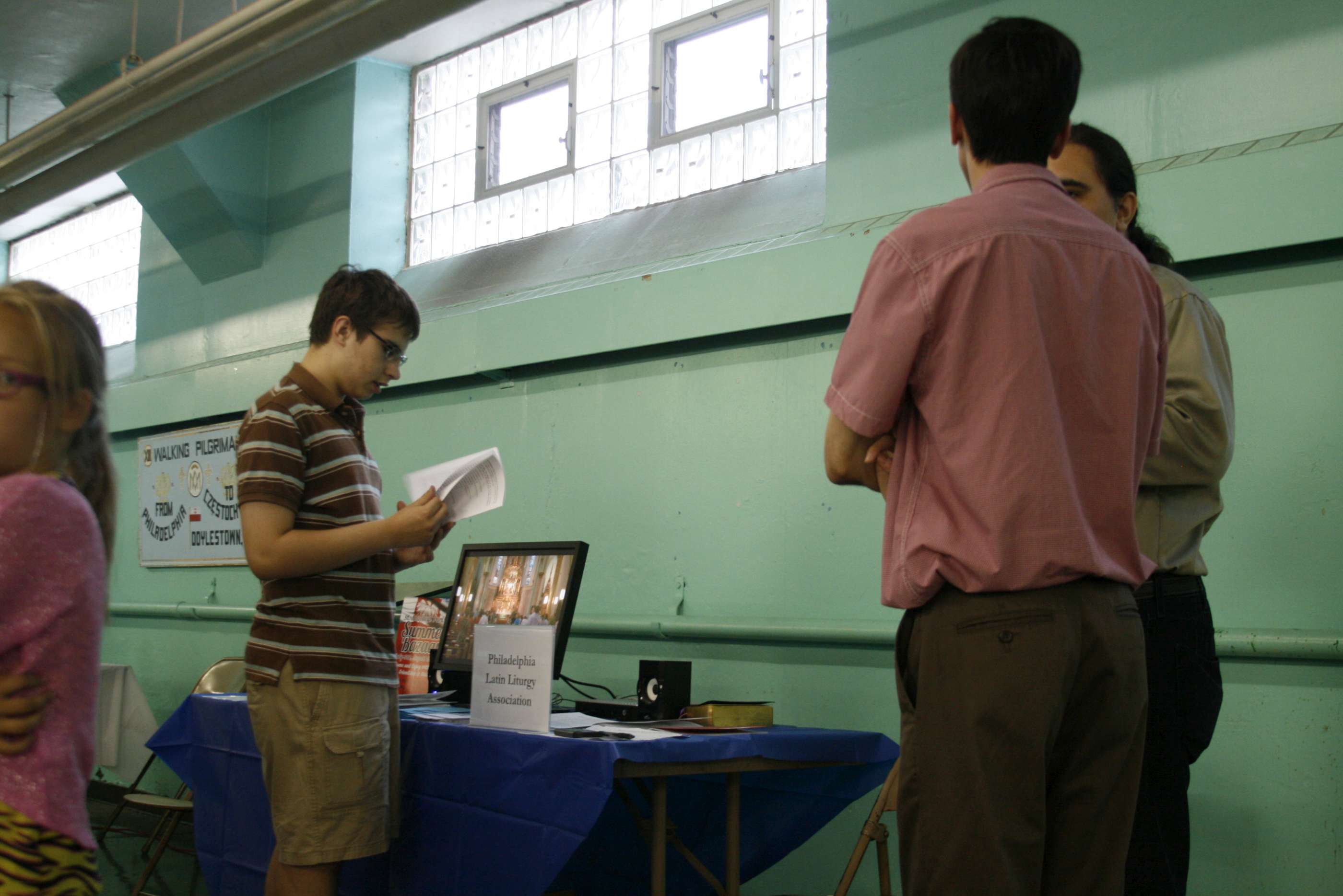
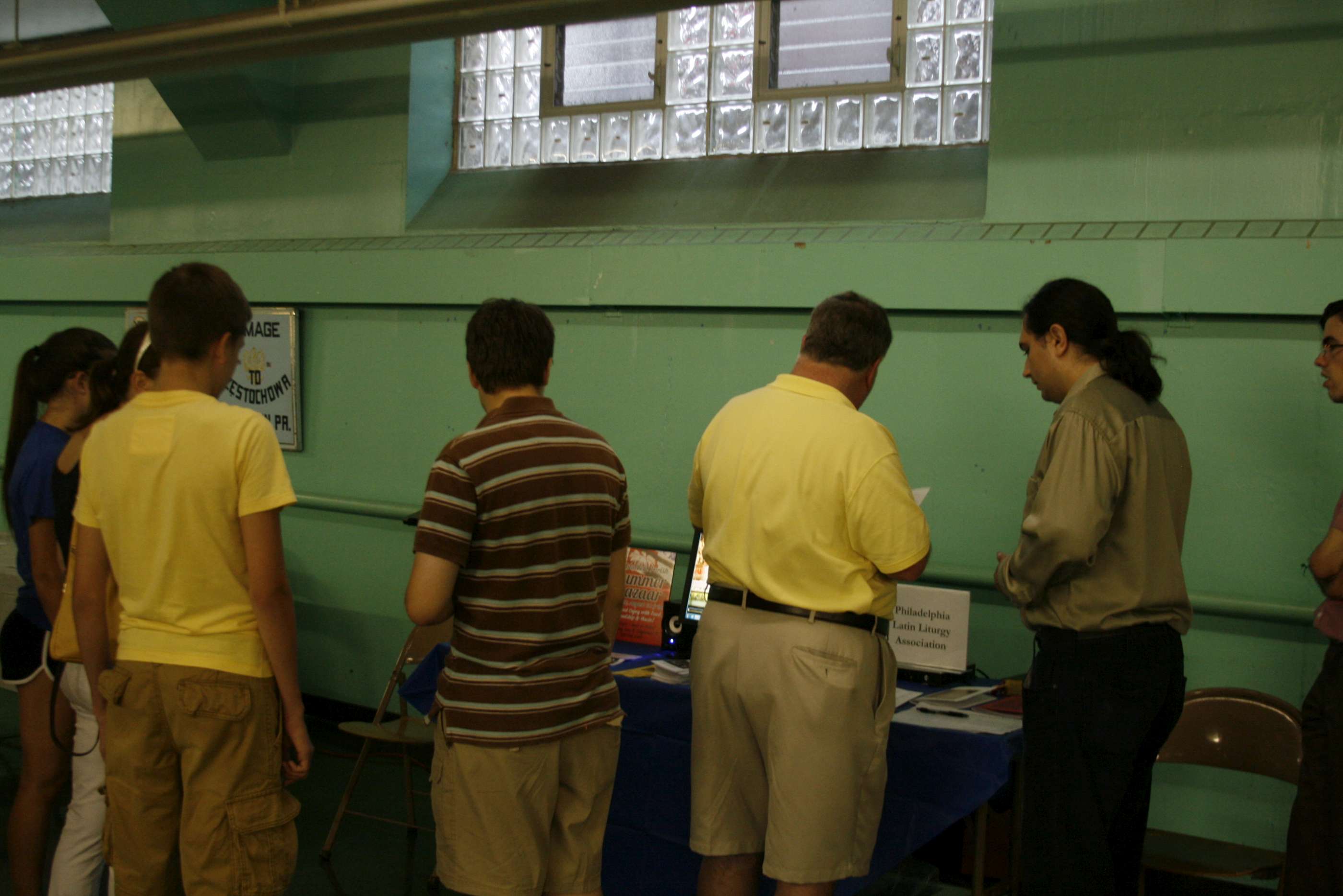
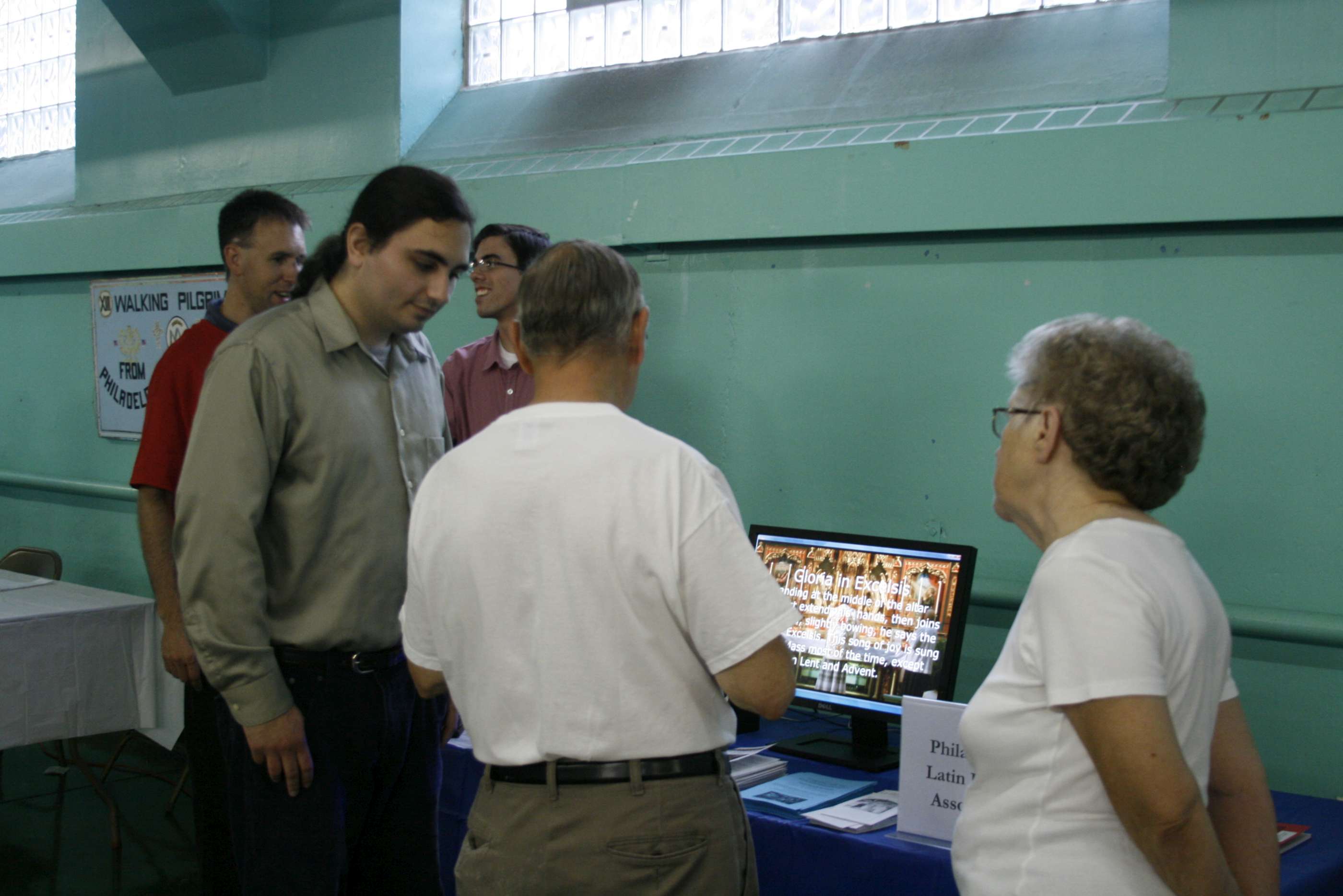
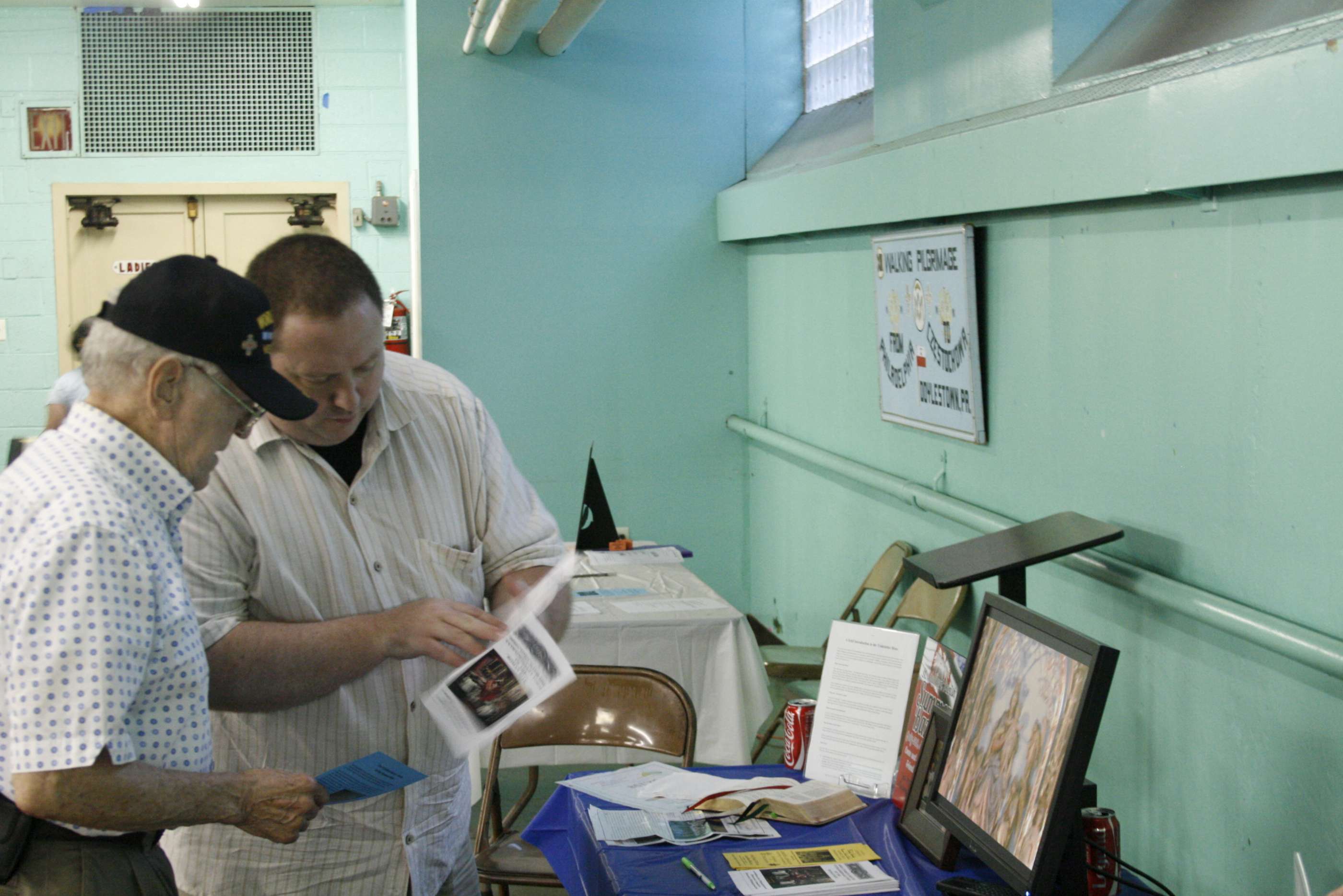
During the first weekend in August, volunteers were invited to set up an information booth at Saint Adalbert’s Parish Bazaar, in the Port Richmond section of Philadelphia, traditionally held over the first Thursday, Friday and Saturday of August.
The “Latin Mass” booth proved to be a fruitful opportunity for those who attend the Novus Ordo and had a minimal awareness of the liturgical treasure of the Catholic Church. Volunteers provided literature about the importance of the Latin Mass, locations of regularly scheduled Masses in Philadelphia, which helped make easy discussion with interested parties who approached the table. Many from all walks of life expressed interest in the revival of the Latin Mass and learned about one of the many Latin-Mass apostolates at Holy Trinity Church in Center City. The Latin Mass table included a video presentation of the first High Mass at Saint Adalbert’s Parish for the first time since the close of Vatican II, which was offered June 27 on the Feast of the Sacred Heart of Jesus.
The Latin Liturgy Association wishes to express it’s gratitude to the volunteers who operated the table over those three days, and to the pastor of Saint Adalbert’s for inviting the LLA to promote the Latin Mass in Port Richmond.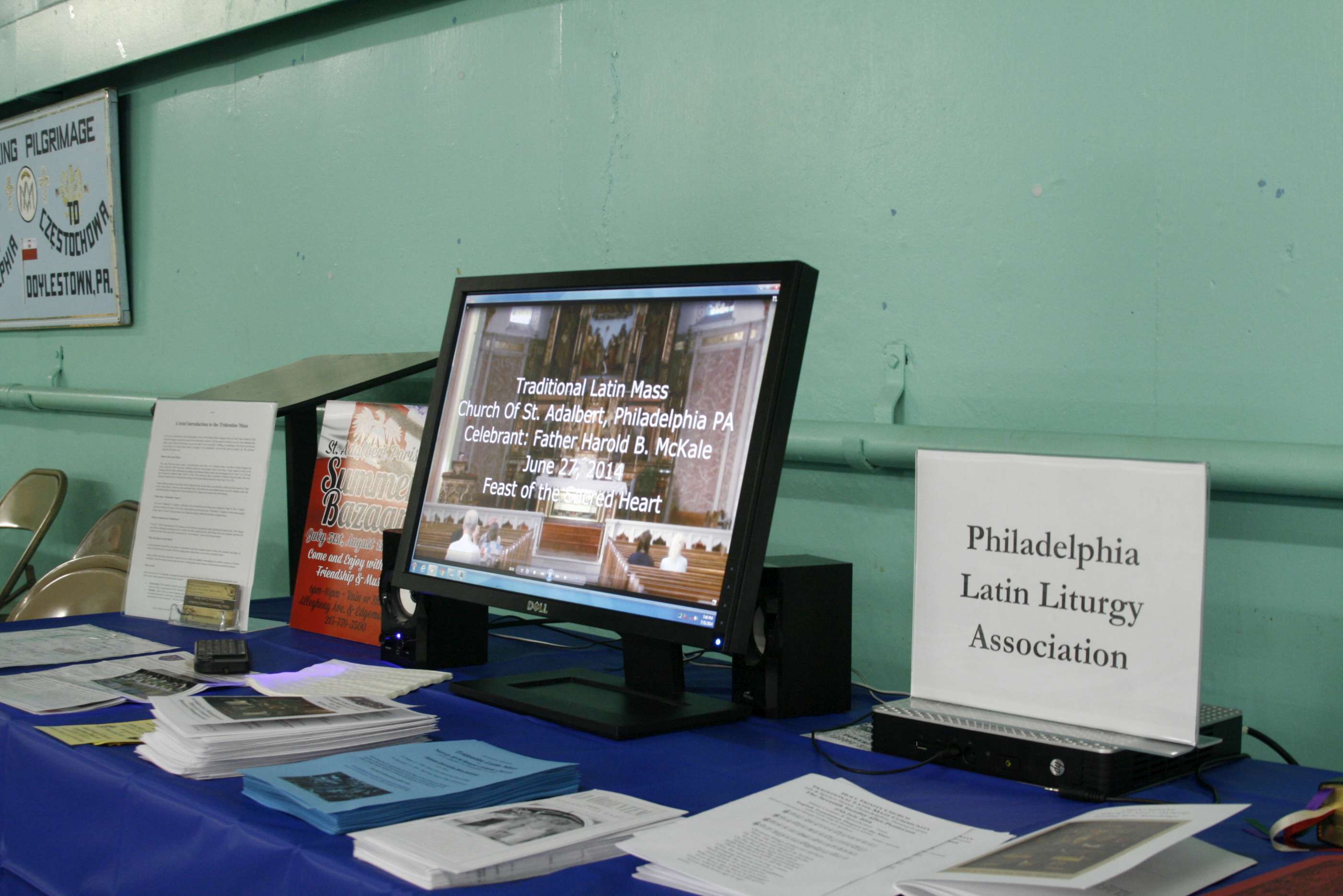
August 11, 2014 No Comments
Mass of the Assumption
2014 Mass of the Assumption
Fr. Robert C Pasley, KCHS, Rector of Mater
Ecclesiae Roman Catholic Church, Berlin, NJ,
Diocese of Camden, invites all to Mater Ecclesiae’s
14th Annual Assumption Mass. The Choral High Mass
in the Extraordinary Form will take place on
Friday, August 15, at 7 p.m., at the Cathedral
Basilica of Saints Peter and Paul, 18th St. and the
Benjamin Franklin Pkwy in Philadelphia. There is
parking in the lot next to the Cathedral and there
is an underground garage at the Sheraton Hotel on
17th Street.
The Celebrant of the Mass, who will also deliver
the sermon, is Monsignor Andrew Wadsworth. Msgr.
Wadsworth, originally a priest of the Diocese of
Westminster, London, is now the superior of the
Oratorian Community of St Philip Neri, an oratory
in formation in the Archdiocese of Washington.
Since 2009, he has been Executive Director of the
International Commission for English in the Liturgy
(ICEL), responsible for the proposal of English
translations of Latin liturgical texts for use in
places where the liturgy is celebrated in English.
Msgr. Wadsworth has written and lectured widely on
both forms of the Roman Rite and the ‘ars
celebrandi’.
Mater Ecclesiae’s High Choral Mass of the
Assumption was begun fourteen years ago to thank
and honor Our Lady for the establishment of Mater
Ecclesiae, the first diocesan owned and staffed
Traditional Latin Mass parish in the United Sates.
“We wanted to feature some of the greatest works of
orchestral/choral music ever written for the Sacred
Liturgy,†Father Pasley said.
The setting of the Ordinary of the Mass will be
the “Missa in Angustiis,†or “Lord Nelson Mass,†by
Franz Joseph Haydn sung with full Orchestra. Other
works include the motets “Salve Regina†by Antonio
Salieri (1750-1825), “Salutatio D.N.I.C.†by Ludwig
Senfl (1486-1543), “Beata Viscera†by Gregor
Aichinger (1565 – 1628), the “Adagio†from Concerto
for 2 Oboes in G Major, by Tomaso Albinoni
(1671-1751), The “Hodie Maria Virgo†by Luca
Marenzio (1553-1599), the Tantum Ergo†by W.A.
Mozaert (1756-1791) and a Postlude, “Concerto for 2
trumpets in D Major,†by Giuseppe Maria Jacchini
(1663-1727). The traditional hymns, “O Sanctissima
and Hail Holy Queen,†arranged by the Music
Director, Dr. Timothy McDonnell, will also be
sung.
Father Pasley said “We wish to thank His
Excellency, Archbishop Chaput, as well as the
rector of the Cathedral, Father Dennis Gill, for
this great privilege. Please spread the word about
this most grand celebration of Our Lady’s
Assumption.â€
————————————————————————
Brought to you by CatholicWeb.com
Please visit us online at http://www.CatholicWeb.com
————————————————————————
August 5, 2014 No Comments
Francis Altiere’s First Solemn Mass
Dear Mr Torchia,
This is just a quick note to let you know that, following my ordination on August 5th, I will be returning briefly to Philadelphia and I will be celebrating my first Solemn Mass on Saturday August 16th at Holy Saviour Church in Norristown at 12 noon. The Mass is naturally open to anyone who may wish to attend.
Yours sincerely,
Deacon Francis Altiere
August 5, 2014 No Comments