RORATE MASS – at St. Peter’s Church, Merchantville NJ
On Saturday, December 13, at 6:00 AM at St. Peter’s Church. 43 W Maple Ave, Merchantville NJ,, Fr Anthony Manuppella will celebrate a sung TLM to continue the unique European tradition of the Rorate Mass. The church will be illuminated only with candlelight. The anticipation of the approaching dawn with its light is a powerful symbol of the coming of Christ. If you can, please attend this most beautiful Advent Mass. It’s something you won’t soon forget.

December 3, 2014 No Comments
Review of Treasure and Tradition: The Ultimate Guide to the Latin Mass
by Peter Kwasniewski, of the New Liturgical Movement
Having recently received a review copy of this remarkable new book from its author, Lisa Bergman, I must say that I am dazzled and overwhelmed by what she and her friends at St. Augustine Academy Press have accomplished. It became clear to me that a complete and detailed review of such a packed book would take me so long that it might never see the light of day, and I would vastly prefer that Catholics know about this book and begin obtaining copies before the great feast of Christmas is upon us.
Here is how the publisher describes the 120-page full-color hardcover book:
Have you ever:
* Considered attending a Latin Mass, but found it too intimidating?
* Struggled to jump back and forth between the pages of a Latin-English Missal?
* Wondered what all those people are doing at the altar during High Mass?
* Wished for an effective way to help children to understand and follow along with the Mass?
* Wanted to know more about the history of the Mass and how it came to be the way it is?
* Been puzzled by things like Septuagesima, Rogation Days, and other unfamiliar terms, feasts and practices?
* This Guide is just what you’ve been waiting for!
Whether you’ve been attending the Extraordinary Form of the Mass for years, or are merely curious about it, this guide is designed to open up the riches contained within the Mass to all. Inside, you will find a word-for-word English translation of the Latin text of the Mass, together with photos, diagrams, notes and explanations that will help you not only to follow along, but also to understand the history and significance of the ceremonies in which you are taking part. In addition, you will find sections explaining the main differences between the Ordinary and Extraordinary Forms, a discussion comparing the development of the Mass with that of its sister liturgy, the Divine Office, an exploration of the English translations of the Bible, a full glossary, and finally, recommended prayers intended to help you prepare when receiving the sacraments of Penance and the Holy Eucharist.
The advance reading copy I received adds on the back cover: “The Ultimate Guide is designed to introduce its readers to the many layers of mystery which lend this liturgy its solemn beauty, while breaking down the barriers to understanding that can often be intimidating to newcomers.” That is exactly what the book successfully does–in wonderfully clear and apt language, it explains the many layers of mystery, the connections to the Old Testament, the historical development of certain parts of the Mass, the applications to our spiritual life, always with a view to deepening one’s participation in the sacred liturgy and receiving its fruits.
While this book is manifestly ideal for children and young adults, it would function no less well as a text for a Catholic of any age who is getting to know the old Mass for the first time or who, being somewhat familiar with it, seeks more knowledge about it. It would serve well for parish catechesis or a discussion group. Homeschooling families could build a whole semester’s introduction to the sacred liturgy upon and around this resource. There is a palpable spirit of faith and love in these pages that makes the reading of the book more than an academic exercise; it serves as a prayerful catechesis of the Mass from which I was able to think about many familiar things from a new angle or with a new appreciation.
Without exaggeration, I can say that this is one of the most stunningly beautiful and most informative introductions to the traditional Latin Mass that I have ever seen. For anyone who needs or wants a crash-course in the theology and spirituality of the classical Roman Rite, and a tour of just about everything connected with it, this is your book at last. If I could wave a magic wand, I’d have copies of Treasure and Tradition suddenly appear in every church, chapel, and Catholic family in the English-speaking world. The next best thing is to have all of you good readers obtain your own copies and start spreading the word among priests, teachers, catechists, families, and converts of your acquaintance. May God bless Lisa Bergman and the good people of St. Augustine Academy Press for their immense and fruitful labors!
More information is available and you can purchase the book at this link: http://staugustineacademypress.com/epages/b9279dcf-f5d4-4322-8442-90642f0120ca.sf/en_US/?ObjectPath=/Shops/b9279dcf-f5d4-4322-8442-90642f0120ca/Products/639366
November 24, 2014 No Comments
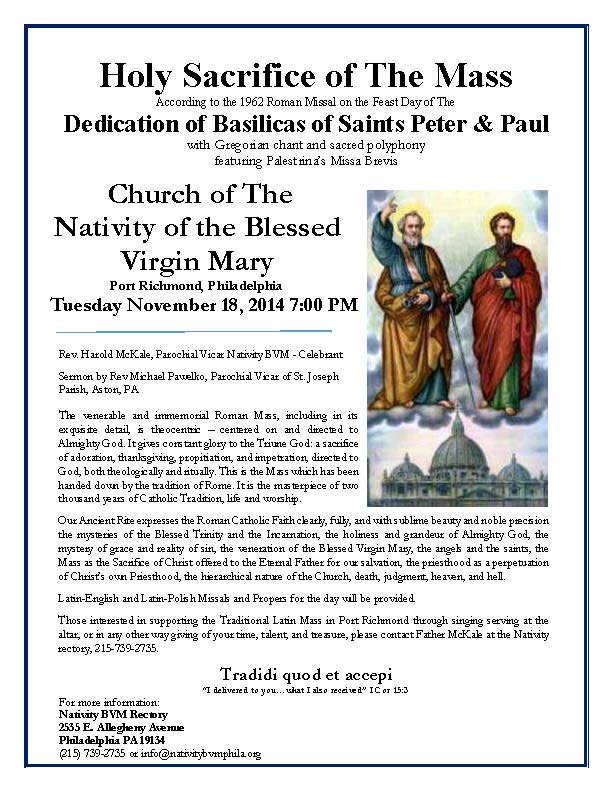
Missa Cantata for The Feast of the Dedication of Basilicas of Sts. Peter & Paul at Nativity BVM, Port Richmond
A sung High Mass will be offered on Tuesday November 18, 2014 at the Church of the Nativity of the Blessed Virgin Mary in Port Richmond, Philadelphia at 7:00PM.
Mass with Gregorian chant and sacred polyphony featuring Palestrina’s Missa Brevis will be offered by Father Harold McKale, Parochial Vicar and the sermon will be given by Father Michael Pawelko, Parochial Vicar of St. Joseph Parish in Aston, Delaware County.
Those interested in supporting the Traditional Latin Mass at Nativity BVM through singing, serving at the altar, or in any other way giving of your time, talent, and treasure, please contact Father McKale at the Nativity rectory, 215-739-2735.
For more information, please visit www.nativitybvmphila.org.

November 8, 2014 No Comments
Twenty-fifth Sunday After Pentecost, (Text of Sixth Sunday After Epiphany)
Rev. Fr. Leonard Goffine’s
The Church’s Year
[For the Introit of this day’s Mass see the Introit of the third Sunday after Epiphany.]
COLLECT Grant, we beseech Thee, Almighty God, that ever fixing our thoughts on such things as are reasonable, we may both in our words and works do what is pleasing in Thy sight. Through our Lord Jesus Christ, etc.
EPISTLE (I. Thess. I. 2-10.) Brethren, we give thanks to God for you all, making a remembrance of you in our prayers without ceasing; being mindful of the work of your faith, and labor, and charity, and of the enduring of the hope of our Lord Jesus Christ before God and our Father: knowing, brethren, beloved of God, your election: for our gospel hath not been unto you in word only, but in power also, and in the Holy Ghost, and in much fullness, as you know what manner of men we have been among you for your sakes. And you became followers of us and of the Lord, receiving the word in much tribulation, with joy of the Holy Ghost: so that you were made a pattern to all that believe, in Macedonia and in Achaia. For from you was spread abroad the word of the Lord, not only in Macedonia and in Achaia, but also in every place, your faith, which is towards God, is gone forth; so that we need not to speak anything. For they themselves relate of us what manner of entering in we had unto you; and how ye turned, to God from idols, to serve the living and true God, and to wait for his Son from heaven (whom he raised from the dead), Jesus, who both delivered us from the wrath to come.
EXPLANATION The apostle gives thanks to God in prayer for those inhabitants of Thessalonia, who have been converted to Christianity by his words, and declares to them his joy at their Christian life which they prove by their good works and their perseverance, even through all trials, in expectation of eternal reward through Christ. He assures them also of their salvation, (election) because God had caused the preaching of His gospel, which they so willingly received, to produce in them such extraordinary fruit. He praises them not only for having listened to the gospel and abandoned idolatry, but for having regulated their lives in accordance with the faith, and having become a model to distant nations, for the report of their faith had spread far, and everywhere their zealous reception of the gospel was spoken of. Would that the same could be said of all Christians!
GOSPEL (Matt. XIII. 31-35.) At that time, Jesus spoke this parable to the multitudes: The kingdom of heaven is like to a grain of mustard-seed, which a man took and sowed in his field: which is the least indeed of all seeds; but when it is grown up, it is greater than all herbs, and becometh a tree, so that the birds of the air come, and dwell in the branches thereof. Another parable he spoke to them: The kingdom of heaven is like to leaven, which a woman took and hid in three measures of meal, until the whole was leavened. All these things Jesus spoke in parables to the multitude, and without parables he did not speak to them, that it might be fulfilled which was spoken by the prophet, saying: I will open my mouth in parables, I will utter things hidden from the foundation of the world.
What is here understood by the kingdom of heaven?
The Church and the doctrine of Christ.
Why is the Church compared to a grain of mustard-seed?
Because there is a great similarity between them. The mustard-seed, though so small, grows in Palestine so high and so rapidly, that it becomes a broad tree, in which birds can build their nests. In like manner the Church of Christ was in the beginning very small like the mustard-seed, but it soon spread so wide that numberless people, even great philosophers and princes, came to find peace and protection under its branches.
Why is Christ’s doctrine compared to leaven?
Because like the leaven, which quickly penetrates the flour, and makes it palatable bread, the doctrine of Christ, spreading with surprising swiftness over the then known parts of the globe, gave the Gentiles a taste for divine things and for heavenly wisdom. Thus Christ’s doctrine penetrates him who receives it, sanctifies all his thoughts, words, and deeds, and makes him pleasing to God.
By what means, in particular, was the Church of Christ propagated?
By the omnipotence of God and the miracles which He so frequently wrought to prove the truth and divinity of the Christian religion; the courageous faith, and the pure moral life of the early Christians, which led many pagan minds to accept the doctrine of Christ; and the persecution of Christianity, for, as Tertullian says: “The blood of the martyrs was the seed of the Church.” The false doctrine of Mahomet, the erroneous teachings of Luther, Calvin, and earlier and later heretics have, it is true, also spread quickly far and wide; but this is not to be wondered at, for it is easy to lead people to a doctrine that encourages sensuality, and to which they are carried by their evil inclinations, as was the case with the doctrine of the impostor Mahomet, and three hundred years ago with the heresy of Luther; but to spread a doctrine which demands the subduing of the carnal, earthly inclinations, and to bend the will to the yoke of obedience to faith, something more than human eloquence is required. Thus, the Chancellor of England, Thomas More, who gave his blood for the true doctrine of Christ, wrote to Luther, who was boasting of the rapid increase of his sect: “It is easy to descend; seducing the people to a bad life is nothing more marvellous than that a heavy stone should fall of its own accord to the ground;” and Melanchton, a friend of Luther, in answer to his mother’s question, whether she should remain a Catholic or receive Luther’s doctrine, wrote : “In this religion it is easy to live, in the Catholic it is easy to die.”
Why did Christ always speak in parables?
That His teaching by being simple might be more easily understood, and better remembered. He who is called upon to teach others, should, as did Christ, always speak to them according to their ability to understand, and by no means seek his own honor, but the honor of God, and the benefit of those who hear him.
PRAYER O most benign Jesus. How much do we give Thee thanks that Thou hast permitted us to be born in Thy holy Church, and instructed in Thy holy doctrine, which, like the mustard-seed, has grown to be a large tree, spreading over the whole earth. Grant that under the shadow of this tree, in Thy holy Church, we may ever rest securely, cling to her faithfully, and penetrated, as by leaven, with her doctrine may bring Thee pleasing fruits of faith and virtue. Amen.
November 8, 2014 No Comments
November First Friday TLM
First Friday, November 7, A.D. 2014, Traditional Latin Mass (TLM) will be offered by Fr. Harold B. Mc Kale, Parochial Vicar of Nativity of the Blessed Virgin Mary Roman Catholic Church, at the Rectory Chapel of St. Albert The Great Parish, 212 Welsh Road, Huntingdon Valley, PA 19006, (T) 215-947-3500, at 7 p.m. preceded by Confessions at 6:30 p.m.
This TLM will be a Votive Mass of The Sacred Heart, offered in Reparation to The Sacred Heart of Jesus.
The St. Albert The Great Rectory, also known as the Parish Center, is behind the Church, which fronts on Welsh Road.
Mark Matthews
2617 Huntingdon Pike
Huntingdon Valley, PA
19006-5109
(T) 215-947-6555
(F) 215-947-4949
November 6, 2014 No Comments
Holy Innocents Spared In ArchNY Closings
Amid a lot of bad news for a lot of parishes, one bright spot. Holy Innocents in Manhattan, originally on the list to be closed, has been spared the axe.
Cardinal Timothy M. Dolan announced on Sunday the largest reorganization in the history of the Roman Catholic archdiocese of New York, with 55 parishes from Staten Island to the Catskills to merge with neighboring parishes.
In 31 of those mergers, all Masses and other sacraments such as weddings and funerals will cease to be celebrated on a regular basis at one of the churches being merged. In the remaining 24 mergers, both churches will remain open for the regular celebration of Masses and other events.
Of the churches that will essentially be closed on a weekly basis for worship purposes, nine are in Manhattan, six in Westchester, six in the Bronx, four in Staten Island and six are in Rockland, Sullivan, Ulster, or Dutchess counties.
…
Some churches that had been recommended for mergers by an advisory panel earlier this year were spared, at least for now, after parishioners raised objections. Among them are Holy Innocents Church in Midtown Manhattan, the only church in New York where the Latin Mass is celebrated daily, and St. John’s Church in Piermont.
November 2, 2014 No Comments
ALL SAINTS’ DAY is FIRST SATURDAY TLM at St. Albert The Great.
ALL SAINTS’ DAY is First Saturday, November 1, A.D. 2014 and this TLM will be offered by Fr. Harold B. Mc Kale, Parochial Vicar of Nativity of the Blessed Virgin Mary Roman Catholic Church, at the Rectory Chapel of St. Albert The Great Parish, 212 Welsh Road, Huntingdon Valley, PA 19006, (T) 215-947-3500, at 9 a.m., preceded by Confessions at 8:30 a.m.
This ALL SAINTS’ DAY-FIRST SATURDAY TLM will be offered in Reparation to The Immaculate Heart of Mary.
The St. Albert The Great Rectory, also known as the Parish Center, is behind the Church, which fronts on Welsh Road.
October 31, 2014 No Comments
October First Friday and First Saturday TLM’s
First Friday, October 3, A.D. 2014, Traditional Latin Mass (TLM) will be offered by Fr. Harold B. McKale, Parochial Vicar of Nativity of the Blessed Virgin Mary Roman Catholic Church, at the Rectory Chapel of St. Albert The Great Parish, 212 Welsh Road, Huntingdon Valley, PA 19006, (T) 215-947-3500, at 7 p.m. preceded by Confessions at 6:30 p.m. This TLM will be that of St. Therese of the Child Jesus (Saint Therese of Lisieux, The Little Flower: Virgin, Religious, Doctor of The Church, Patroness of all foreign Missions) offered in Reparation to The Sacred Heart of Jesus.
First Saturday, October 4, A.D. 2014 TLM will also be offered by Fr. Harold B. McKale, at the Rectory Chapel of St. Albert The Great Parish, at 9 a.m., preceded by Confessions at 8:30 a.m. This TLM will be that of Saint Francis of Assisi, Confessor, and Founder of The Franciscans and Poor Clares, offered in Reparation to The Immaculate Heart of Mary.
The St. Albert The Great Rectory, also known as the Parish Center, is behind the Church, which fronts on Welsh Road.
October 1, 2014 No Comments
Winning Converts (article from the ’40s)
Acknowledgments:
Passed on by “SaintSebastian” from “Fisheaters.”
This article is excerpted from the book Winning Converts edited by Fr. John A. O’Brien. It is available form Catholic Answers.
© Catholic Answers, Inc.
This item 4318 digitally provided courtesy of CatholicCulture.org
“The Ordinary Ways Of Convert Making,”
by Fr. John T. McGinn, C.S.P., of CatholicCulture.org
The American clergy are vividly aware of the necessity of a more systematic and energetic apostolate to the non-Catholic of our country. What they often seek is a handy outline of the rudimentary precepts that will guide them in their daily ministry among our separated brethren. Convert making, like any other activity, has its basic principles. The following pages are an attempt to sketch briefly some of the indispensable requisites for success in the apostolate to Christ’s “other sheep.”
Step One: A Proper Point Of View
Our frame of mind regarding any individual or group will affect our relations with them. The man who speaks of papists betrays the presuppositions that act as a barrier to a proper understanding of Catholics. While convert work can be a consoling and fascinating labor, it requires generous reserves of zeal, patience, and unfailing kindness. If a priest’s primary assumptions regarding non-Catholics are awry, he will vitiate much of the good he hopes to accomplish even when he does not abandon the work as hopeless.
The phrase separated brethren goes a long way toward indicating the manner in which we should regard the non-Catholics of our parishes. They were fashioned by the same Creator and stem from the same father, Adam. They are involved with us in original sin and in its consequences. They share with us the same destiny,and it was for them as for ourselves that Christ died and established his Church. Furthermore, many of them are validly baptized.
Unfortunately, the tragic differences that cause them now to be outside the Church of Christ are many and far-reaching. But what should dominate our outlook is the fact that so many souls, once of the household of the faith, are now denied the fullness of Christ’s grace and truth.
Regarding non-Catholics as our “separated brethren” cannot but stir us to sympathy and to a vigorous apostolate among them. It will prepare us to encourage any slight tendency on their part to look to their Father’s house and to be alert for any small opportunity to facilitate their return. And it will purify the spirit in which we exercise our zeal.
Step Two: Enlisting Prayers For Conversions
The longer we engage in convert work the more we realize the need of fervent and continuous prayer for conversions. Not many will forget that faith is a free gift of God, but actual experience among non-Catholics brings this truth home to us with ever-increasing clarity.
The extent of religious ignorance, the plausibility of half-truth, the deep-rooted prejudices of many, the vitality of error, the weight of past habit, the costly sacrifices, and the painful journey required of many before they come to the light — these and deeper considerations soon persuade us of the paramount necessity of grace.
The wise convert maker will spare himself many unnecessary disappointments if he enlists a crusade of prayer that will precede, accompany, and fructify his own efforts. Unfortunately, the Catholic laity are not fully aware of this need. They do tend to pray for sinners and for the poor souls [in purgatory], but they seldom pray for the conversion of their non-Catholic neighbors. By frequent instructions and exhortations the people can be easily led to widen their spiritual generosity to include the needs of non-Catholics.
Step Three: Sowing The Seed Of Truth
There are many cases of instantaneous conversion, but ordinarily it is a gradual process: “I have planted, Apollos watered, but God gave the increase” (1 Cor. 3:6). Missionaries from the beginning have recognized three separate stages in the spiritual history of their catechumens: the initial attraction to Catholicism, a growing interest in the Church and in her teachings, and the final decision to become a Catholic. At these three stages, missionaries have corresponding duties: sowing the seed, nurturing the tender plant, and reaping the harvest. It is with the first of these that we are immediately concerned.
Much of the effort of a priest in reaching for converts must be devoted to the essential, preliminary task of making himself accessible to the non-Catholics of his locality and winning their esteem and goodwill. No two parishes will offer precisely the same opportunities for this indispensable preparatory work. Nevertheless, no locality will be so barren as not to offer numerous occasions to improve the dispositions of its non-Catholic citizens. Personal experience and observation of the methods of successful convert makers indicate some fruitful approaches that prepare the way for implanting the first inklings of Catholic truth.
1. Casual contacts. Each day a priest meets a number of non-Catholics. He should regard every one of them as a potential friend, an influential ally, and a possible convert. If the priest is approachable, affable, and helpful, he will win their friendship, and they will speak well of him to their associates.
2. Mixed marriages. They are often disastrous, but they can be the occasion of conversion. Many non-Catholics are more or less concerned about their lack of religion, and association with an exemplary Catholic often deepens their interest in the Church. Where the local priest keeps in touch with them and is generous with his time, they may often be persuaded to take a full course of instruction.
3. Use the mail. Priests are notoriously poor at letter writing. Yet there are times when people are especially susceptible to the thoughtfulness of those who drop them only a few lines. A word of congratulation on an anniversary, or a note to one who is honored for some achievement, or the expression of condolence in bereavement has often helped to transform a bigot into a friend. I once knew a man whose son was kidnapped. Afterward he remarked, “I remember every solitary soul who spoke or wrote a kind word to me that dreadful day.”
4. Cultivate community groups. Numerous capable convert makers take a page from the book of public relations experts. They work on the principle that one of the shortcuts to friendly contact with any community is through the organizations that are the rendezvous for large sections of the population. These include the Red Cross, luncheon and professional men’s clubs, and associations that represent labor, veterans, farmers, cooperatives, and the like. Indiscriminate cooperation with them on the part of a priest is not to be recommended. But association with them is often the door to many private discussions on religion and wins invitations to address larger groups who never enter a Catholic church.
5. Preaching. “Faith comes by hearing” (Rom. 10:17). At funerals, weddings, parish anniversaries, and at Easter and Christmas, there are usually non-Catholics present at Catholic services. If a warm greeting is extended and an invitation to return, and if the sermon is one that gives immediate spiritual help and solid instruction, an immense amount of good can be accomplished. An effort should be made to bring non-Catholics to our missions, novenas, and parish retreats. Many of them will come if we encourage the laity to invite and accompany them.
6. Catholic literature. It is regrettable that only a small segment of Catholic printed matter ever reaches the hands of non-Catholics. Yet the channels of wide circulation are near at hand. The pamphlet rack in church and in public places, the parochial library, placing Catholic books and periodicals in public libraries, remailing Catholic periodicals, sending pamphlets, papers, or magazines to a selected list of good prospects — all are techniques that have proved their effectiveness.
No priest will be able to supply all these instruments nor will any one of these suggestions prove successful in every case. But the cumulative effect of applying as many as seems feasible will usually produce beneficial results.
Of course, no priest can be satisfied merely to create good will and to establish friendly contacts. He should aspire to win neophytes for instruction. But catechumens will come more readily and in greater numbers where the Church is respected and where the local pastor has cultivated cordial relations.
Step Four: Enlisting The Laity
However energetic and resourceful a priest may be, there will be many non-Catholics who remain inaccessible to his immediate influence. But his Catholic parishioners are in daily contact with most of these souls. The Catholic laity are present when the non-Catholic asks questions concerning religion, gives voices to his spiritual perplexities, and discusses the problems of the day, most of which have moral or spiritual implications.
Much depends on the manner in which the laity conduct themselves in these discussions. If they are well-informed religiously, tactful, and zealous, they may remove prejudice, create interest in the Catholic outlook, and pave the way for formal instruction by a priest. On such occasions they should invite the non-Catholic to attend Catholic services or an inquiry class. Catholics engaged or married to non-Catholics, and Catholic relatives, friends, and neighbors of well-disposed non-Catholics, have exceptional opportunities to win candidates for instruction.
It is a mistake to rely exclusively on a few faithful “stand-bys” among the laity. The full momentum of the entire parish is required if best results are to be achieved. Even the lukewarm Catholic may be acquainted with non-Catholics who are ripe for conversion. Frequent instructions and announcements on the apostolic duties and opportunities of the laity especially on the three Sundays preceding a new inquiry class will awaken and strengthen their ardor. I know four laymen each of whom has been the means of directing twenty-five people to the Catholic Church.
Step Five: The Inquiry Class
It is becoming customary for the well-organized parish to include an inquiry class among its activities. Some form of group instruction for converts was always practiced in the Church. The modern inquiry class is nothing more than an adaptation of the ancient catechumenate.
To begin with, the class creates the conditions under which moderately curious or interested non-Catholics may be successfully persuaded to study the Catholic religion. Despite widespread prejudice or indifference, increasing numbers of non-Catholics are more or less attracted to the Church, but their concern is not deep enough to induce them to assume the initiative and to apply for a formal course of individual instruction. Where there is no methodical technique designed to aid and encourage them, they remain friendly but seldom advance.
The group instruction plan capitalizes on their good dispositions, removes their hesitations, and facilitates their instruction. It welcomes all comers, no matter what their motive or however slight their interest. It demands no intention of joining the Church. People are assured that they may come to one or to all the lessons as they choose. Since the class meets twice a week at a definite time and place, they are certain that our invitation is sincere and cordial and that every effort has been made to suit their convenience. Because it is continuous, they know they can begin the course at any time. These and other considerations combine to reduce to a minimum the difficulty of persuading them to consider the full case for Catholicism.
The second great merit of the class is that it saves the clergy time. It permits an ambitious parochial campaign for converts on a scale more commensurate with our obligations and opportunities. While the clergy recognize the necessity of a plan that will embrace large numbers of inquirers, they are deterred by the many other duties they must fulfill. Yet most priests can arrange to devote two evenings a week to this activity.
I have found the following devices most efficacious: Sunday Mass announcements, announcements in cooperating parishes, the parish bulletin, ads in the diocesan paper and in the daily press along with occasional news items in both, handbills, a poster in the vestibule of the church, and one placed on the lawn. Some of these attracted non-Catholics directly, and others reached Catholics who in turn invited non-Catholics to attend. The zealous Catholic laity are unquestionably the most fruitful source of catechumens.
Conducting the class. The first meeting may not attract an overflow crowd, but persistent application will increase attendance gradually. I once began with a group of ten inquirers that grew to one hundred. The initial gathering is of exceptional importance, since many will come with misgivings. But if the instructor is cordial and affable, he will soon establish a relationship of confidence and friendliness.
The director should explain that his purpose is to present, objectively, the teachings and practices of the Catholic Church, that there will be no charge for the course, and that no intention of joining the Church is required. He ought to stress the need of God’s grace, to encourage prayer, and invite all to participate in the few prayers that open and conclude each class. He promises to explain one fundamental topic each evening and invites questions on that subject.
Some individual instruction will be required in every case. Each person will have is special problems that he may be reluctant to reveal or discuss in public. Some will miss lectures unavoidably, and these must be made up, while others will need special attention on matters that are no problem to the remainder of the class. It is advisable for the priest to make it a practice to be in attendance a half-hour before and after each lecture. He can thus keep in close personal touch with his neophytes and may then arrange for longer, personal interviews when necessary.
It is my experience that considerably over half of those who complete the instructions enter the Church immediately, even though many may not have foreseen this when they started. Others may delay for a while because of indecision or the opposition of their associates. Some may lack the gift of faith, but if the priest offers continued assistance, they may still be won. I know five priests who have each received on thousand converts into the Church, and every one of them is an ardent advocate of the inquiry class.
Step Six: Instructing Converts
Two lessons a week for a period of three months is the ordinary practice. Any more would cause undue delay, and, excepting extraordinary cases; any less would be insufficient to assimilate the basic teachings of the Church. An excellent text is A Catechism for Inquirers by Joseph I. Malloy, C.S.P. Additional reading in books and pamphlets should be provided according to the needs, leisure, and capacity of the catechumen. A pattern to help the instructor to assemble and present his material ought to include the following elements:
1. Doctrine. Love and service of God depend upon accurate knowledge of God. If a man’s convictions about God are wrong, as in the case of pagans and heretics, he cannot really love and serve God as he intended. Hence there should be a solid core of doctrine at the heart of every instruction. The widespread ignorance of the fundamental teachings of Christ makes this ever more imperative today. The tragic penalties among converts for insufficient doctrinal instruction are superficiality, sentimentality, a religion of mere external practice, and sometimes defection from the Church.
2. Clarity. The Catechism [for Inquirers] deals in baffling mysteries with brevity and often in a highly technical language. In reality, it is a digest of what the catechumen is expected to know at the completion of the course. Few books clamor so loudly for an accurate, lucid interpreter who has learned how to make profound truths intelligible. Some aids to clarity that deserve special mention are explaining unfamiliar terms, concentrating on the essentials in each lesson rather than preoccupation with those problems which may well be left to the erudite, and the liberal use of stories, illustrations, and comparisons.
3. Relevancy Most inquirers share the secularist heresy that regards Catholic dogma as an academic matter that has little or no bearing on the insistent problems of the day. In our time it is not sufficient to say: “This is what Catholics believe.” We must go on from there to explain: “And this is what the doctrine means to you, your family, your nation, and the world.” To neglect this aspect of each lesson is to leave unanswered the widest and most persistent of modern difficulties regarding the faith.
We might ask ourselves on of two questions: (1) What enduring question of mankind does this catechism chapter answer? (2) What help does it hold out to needy, troubled men? Thus, the chapter on the Trinity is the Catholic answer to the question, “What is God like?” The chapter on confession is the Catholic answer to the question, “Is there any sure release from the burden of sin?”
4. Spirituality. An inquirer must acquire facility in the “how” of Catholicism as well as in the “what” and “why” of it. While conversion is primarily a change of religious conviction, it is not complete until the moral and religious aspects of his personality undergo a similar transformation. It is a mistake to wait until actual reception before urging him to begin to lead the Catholic life. Most non-Catholics are unaccustomed to any regular religious practice and must be gradually habituated to the moral habits and devotional practices of Catholics. This must be done tactfully, and no one should be pressed to undertake religious exercises that he cannot perform with sincerity. But most inquirers can be persuaded to pray, genuflect, and attend Mass and Benediction. A tour through the church, an explanation of the Mass, and an acquaintance with the prayer book and missal are essential. Suggested reading should include books or pamphlets on the spiritual life, the saints, and reading of the four Gospels.
Step Seven: The Follow-Up
It is obvious that the convert will be in need of aftercare following his reception into the Church. It is impossible to convey in twenty lessons the abounding riches of Catholic truth and grace. The convert’s grasp of Catholic dogma and morality must increase so that he will possess a truly Catholic outlook. His devotional and spiritual life should expand. His docility to his pastor, bishop, and to the pope should deepen. Yet the habits of a lifetime will often militate against this, his relatives and associates may throw obstacles in his path, and the secular atmosphere in which he lives will not be conducive to growth in the faith.
Priests, nuns, and the laity must all understand the needs of our newly converted brethren and be alert to come to their aid when opportunity or necessity arises. There will be a more or less awkward period of adjustment wherein the convert gradually grows accustomed to his new surroundings, becomes less and less uncomfortable and self-conscious, and comes to conduct himself as a Catholic “to the manner born.” Then should follow a period of rich spiritual development wherein all the powers of his personality will expand, strengthen, and grow. If this does not continue, he may become a kind of associate member of the Church, censorious and only half-converted. Certainly, if he is to persevere until death, he must eventually learn self-reliance. He cannot be forever coddled. But his early days in the fold are critical, and he has a right to our understanding and support.
Much can be accomplished if the laity are coached as to their duties and opportunities in this matter. Many former Protestants have been accustomed to a strong social bond among the members of a religious congregation. Other converts lack facility in making acquaintances. But if lay Catholics are quick to offer their friendship and to assist the convert with tact and generosity, many difficulties will be surmounted.
It would be fantastic, humanly speaking, to say that America can be easily or swiftly converted. But a wide mission experience convinces me that every parish has a surprisingly large number of non-Catholics who are extremely close to Catholicism. If the clergy were to apply themselves, prayerfully and perseveringly, to the ordinary ways of convert making, we would soon multiply the number of converts now received. Once convert work becomes one of the ordinary, customary activities of each or our priests, the conversion of our country will be well under way.
September 24, 2014 No Comments
What Does Opposition to the Traditional Mass Really Signify?
From New Liturgical Movement
by Peter Kwasniewski
In the post-Summorum world, the ancient Roman Rite can no longer be considered forbidden, dubious, marginal, or obsolete. It enjoys equal rights of citizenship with the Novus Ordo: two forms of the Roman Rite—one called Ordinary because most recently promulgated and more widely used, the other called Extraordinary, the usus antiquior, deserving respect for its venerable use—with each able to be freely celebrated by any priest of the Roman Rite, no special permission needed. One would think that, as a gesture of reconciliation at the heart of the Church, the two forms would be flourishing side by side, with Catholics everywhere privileged to experience both of them offered reverently and beautifully.
But this is still far from the reality, and, sadly, there are still far too many bishops and priests who oppose the traditional Mass, tether it with burdensome conditions, or resort to power politics to ensure that its supporters are duly warned and penalized for their rash embrace of our Catholic heritage.
As we commemorate today the seventh anniversary of the implementation of Summorum Pontificum, whose provisions went into effect on September 14, 2007, it will be both edifying and sobering to consider the meaning Joseph Ratzinger himself attached to opposition to the traditional Mass. What does it mean when someone opposes this Mass, or those who celebrate it, or those who cherish it as a form of prayer dear to them?
In the book-length interview Salt of the Earth, published in 1997, Ratzinger said:
I am of the opinion, to be sure, that the old rite should be granted much more generously to all those who desire it. It’s impossible to see what could be dangerous or unacceptable about that. A community is calling its very being into question when it suddenly declares that what until now was its holiest and highest possession is strictly forbidden, and when it makes the longing for it seem downright indecent. Can it be trusted any more about anything else? Won’t it proscribe tomorrow what it prescribes today? (176-77)
Ten years prior to Summorum, he was placing his finger on the crux of the matter. If the liturgy that was the Church’s holiest and highest possession for centuries, the object of total reverence and honor, the means of sanctification for countless Catholics, is suddenly forbidden, and if the desire to worship as our forefathers did is treated as wrong, what does that say about the Church herself, about her past, her tradition, her very saints? Truly, her credibility vanishes entirely, her proclamations become arbitrary diktats. Was there something fatally flawed, all this time, with our central act of worship? Were all the popes of the past who lovingly cultivated this liturgy mistaken, were all the missionaries who brought it around the globe misguided? Could they say, in the words of Gatherer, son of Vomiter, “I have not learned wisdom, and have not known the science of saints� (Prov 30:1, 3, Douay).
In God and the World (2002), another of those splendidly insightful and doctrinally robust interviews which now, in retrospect, make for such wistful reading, Ratzinger returned to the point:
For fostering a true consciousness in liturgical matters, it is also important that the proscription against the form of liturgy in valid use up to 1970 should be lifted. Anyone who nowadays advocates the continuing existence of this liturgy or takes part in it is treated like a leper; all tolerance ends here. There has never been anything like this in history; in doing this we are despising and proscribing the Church’s whole past. How can one trust her present if things are that way? I must say, quite openly, that I don’t understand why so many of my episcopal brethren have to a great extent submitted to this rule of intolerance, which for no apparent reason is opposed to making the necessary inner reconciliations within the Church. (416)
Here we have language strikingly akin to what we will find five years later in Pope Benedict’s Letter to the Bishops that accompanied Summorum Pontificum. Once again, we find the telltale insistence on possessing the right attitude towards the undying and life-giving heritage of the Church. The liturgical rites that arise from apostolic seeds in the Church’s sojourn through history are the fruits of Him who is the Lord and Giver of Life, and they cannot, in themselves, either die or bring death—nor can they be legitimately prohibited.
This would explain why Pope Benedict XVI, in Summorum Pontificum, says that the traditional Latin Mass “must be given due honor for its venerable and ancient usage†and, in the Letter to the Bishops, adds:
What earlier generations held as sacred remains sacred and great for us too, and it cannot be all of a sudden entirely forbidden or even considered harmful. It behooves all of us to preserve the riches which have developed in the Church’s faith and prayer, and to give them their proper place.
The giving of due honor, which translates into the actual celebration of the rite, is not an optional matter, and this is why we should politely refuse to allow ourselves or our fellow Catholics to be categorized as people with certain “preferencesâ€: “Oh, you prefer the old and I prefer the new.†No, it goes beyond preferences to the very structure of the Catholic Faith: those things that are venerable and ancient must be given due honor; what earlier generations held as sacred must be sacred—and great!—for us, too; it is incumbent on us to preserve these riches and to make sure that they occupy their proper place in the life of the Church today.
Again, a sign that we are reading Pope Benedict correctly is that the clarifying instruction Universae Ecclesiae goes out of its way to emphasize these points. In fact, section 8 of this document is striking in its uncompromising simplicity, its total lack of hedging qualifications or loopholes:
The Motu Proprio Summorum Pontificum constitutes an important expression of the Magisterium of the Roman Pontiff and of his munus of regulating and ordering the Church’s Sacred Liturgy. The Motu Proprio manifests his solicitude as Vicar of Christ and Supreme Pastor of the Universal Church, and has the aim of: (a) offering to all the faithful the Roman Liturgy in the Usus Antiquior, considered as a precious treasure to be preserved; (b) effectively guaranteeing and ensuring the use of the forma extraordinaria for all who ask for it, given that the use of the 1962 Roman Liturgy is a faculty generously granted for the good of the faithful and therefore is to be interpreted in a sense favorable to the faithful who are its principal addressees; (c) promoting reconciliation at the heart of the Church.
At the ordination of priests dedicated to the usus antiquior:
Bishop James Conley, June 14, 2014
With these points established, we can readily see why any move to obstruct or diminish the presence of the usus antiquior in the Church today would only cause great harm and long-term damage.
First, it would be an act and a symptom of disobedience, which is never blessed by God and always punished by Him. More specifically, it would constitute disobedience to Pope Benedict XVI’s legal provisions in Summorum Pontificum (and their clarifications in Universae Ecclesiae), as well as to St. John Paul II’s well-known statement that “respect must everywhere be shown for the feelings of all those who are attached to the Latin liturgical tradition, by a wide and generous application of the directives already issued some time ago by the Apostolic See for the use of the Roman Missal according to the typical edition of 1962.†As has been demonstrated above, it is not enough to refrain from bad mouthing the traditional sacramental rites; they must be known and loved, re-introduced and promoted, studied in seminaries, offered generously to the faithful as a precious treasure.
Second, and more profoundly, divine worship goes to the heart of a person’s spiritual life, that which is most intimate and cherished. Any refusal to share the treasures of the Church, any heavy-handed restrictions on what is already available (or should be available), can only provoke anger, disappointment, and mistrust, hurting the Church’s unity, which is a fragile good of enormous value. Certain bishops, priests, and laymen may have no great love for the Extraordinary Form themselves, but they ought to recognize and respect the sizeable minority of Catholics who do, and appreciate that depriving them of it, or begrudging it to them, is pretty nearly the most offensive thing that could be done—rather like slapping a man’s wife, mother, or grandmother. To be blunt, those who sincerely want peace and mutual understanding had better act generously or they may end up with another ecclesiastical Cold War on their hands. Who wants that?
It does not require a degree in nuclear physics to see that a significant and growing number of Catholics are flocking to parishes and chapels where the traditional Mass is being celebrated, and with their (on average) very large families and strong commitment to homeschooling, the future belongs to them. In 1988 there were about 20 weekly Sunday TLMs; today there are over 500. There is no reason to fight this movement, and every reason to support it.
In spite of the anxieties of some who find it difficult to give peace and mutual coexistence a chance, the Extraordinary Form is not a problem for the Church, and, as Ratzinger/Benedict helps us to see, never could be a problem in and of itself. Instead, one may encounter unfortunate traditionalist attitudes that alienate or provoke—and, to be quite fair, this cuts both ways, since the promoters of the Novus Ordo frequently exhibit offensive attitudes of their own, such as a peculiar fusion of theoretical liberalism and practical totalitarianism. The thing to do is not jealously to limit and control the usus antiquior as if it were a dangerous addictive substance, an approach that only fuels those unfortunate attitudes, but to teach and model a right attitude, receiving with open arms, with humility and childlike simplicity, all that the Church herself gives, so that it becomes something normal and natural, not something forbidden (and thus, perhaps, more alluring?), controversial, or divisive.
Let us give the final word to Pope Benedict, from his Letter to the Bishops of July 7, 2007:
I think of a sentence in the Second Letter to the Corinthians, where Paul writes: “Our mouth is open to you, Corinthians; our heart is wide. You are not restricted by us, but you are restricted in your own affections. In return … widen your hearts also!†(2 Cor 6:11-13). Paul was certainly speaking in another context, but his exhortation can and must touch us too, precisely on this subject. Let us generously open our hearts and make room for everything that the faith itself allows.
September 15, 2014 No Comments