April 27, 2016
All vested, all wheeled: the Biking Mass, celebrated by the Archbishop of Palermo, Corrado Lorefice, part of the Jubilee for Sportsmen celebrated in the Cathedral.
(Tip: Le Forum Catholique)



United with Our Lady at the foot of the Cross, the Benedictines of Mary, Queen of Apostles seek above all else, a life of union with God in prayer as guided by the Rule of St. Benedict.
Totally consecrated to the Queen of Apostles, we take Our Lady’s hidden life at Ephesus as an inspiration for our own. We seek to be what she was for the early Church: a loving and prayerful support to the Apostles, the first priests, and daily offer prayer and sacrifice for the sake of her spiritual sons.
 We cannot preach the Gospel to the nations nor bring the Lord to our tabernacles, but we can be “Love in the heart of the Church” with firm adherence to her teaching, loyalty to the Holy Father, and deep-seated love of the traditional liturgy.
In the company of Our Lady we contemplate the great High Priest, interceding for the sacred priesthood.
Aside from the maintenance of the community, all other works of our hands are directed toward the glory of the altar in the making of vestments and altar linens.
Customary Benedictine hospitality is an integral part of our life. Particular attentiveness is given to welcoming priests, the apostles of our day, and our retreat quarters are principally intended for them. Our hope is that they will find what the Apostles found at Our Lady’s home at Ephesus: encouragement, and a spiritual haven conducive to rest and prayer.
We have been richly blessed by God thus far with vocations, zealous young women imbued with the call to offer their lives to Jesus, through Mary, on behalf of all priests.
Please pray that God Who has begun His work in us may bring it to fulfillment.

May 2, 2016 No Comments

April 30, 2016 1 Comment
Announcements for Sunday, May 1, 2016
Priest: Rev. Fr. James Bartoloma
Mass Intention: Mr. & Mrs. Thomas & Mary Mensch (RIP) req. by Mark Matthews
*****************
Luncheon Today in the Rectory immediately following Mass. Please join us by entering through the aisle by the BVM side altar following it through the sacristy into the rectory dining room.
*****************
A Seminarian’s Request…
Upcoming Masses:
A Solemn High Mass for Ascension Thursday, a holy day of obligation, May 5, 2016 at 7PM at the Cathedral Basilica of Ss. Peter & Paul, Philadelphia, PA
Celebrant: Rev. Fr. Harold B. McKale, Parochial Vicar of Our Lady of Mount Carmel Parish, Doylestown, PA & Chaplain, Traditional Latin Mass Community of Philadelphia; Deacon: Rev. Fr. James Bartoloma, Chancellor of the Diocese of Camden; Subdeacon: Rev. Fr. Sean Loomis, Parochial Vicar, St. Bede Parish, Holland, PA
* * * * * * *
A Solemn High Mass for Corpus Christi, Thursday, May 26, 2016 at 7 PM at the Cathedral Basilica of Ss. Peter & Paul, Philadelphia, PA
Celebrant: Rev. Msgr. Charles Sangermano, Pastor of Holy Savior Parish, Norristown, PA; Deacon: Rev. Fr. Gerald Carey, Parochial Vicar, our Lady of Perpetual Help, Morton, PA; Subdeacon: Rev. Fr. Harold B. McKale, Parochial Vicar of Our Lady of Mount Carmel Parish, Doylestown, PA & Chaplain, Traditional Latin Mass Community of Philadelphia
Events: If anyone has pertinent information that would be appropriate for our bulletin, please e-mail it to Fr. McKale at tlmcommunityofphila@gmail.com.
Mass Intentions: If anyone still has unfulfilled Mass intentions, Fr. McKale can pass them on to a priest that will satisfy the intention by offering a TLM or Divine Liturgy (Byzantine). Please specify if you have a preference. The donation is $10. If you would like a Mass card, please include an extra $5 for the card.
April 30, 2016 No Comments
of New Liturgical Movement

Recently some new videos of a number of pieces in the collection have been put up at YouTube, and we are happy to share them with NLM readers. We have also decided to add this title to the sidebar of recommended books, in the category Other Liturgical Books, along with his Missal for Young Catholics, and the reprints of Roman Guardini’s Sacred Signs, and the Cantus Mariales about which he wrote on Monday. Here are the videos:
(From the Preface): This volume gathers together choral compositions from 1990 to the present. The vast majority are from recent years; many have been sung by the Wyoming Catholic College Choir. A large part of this volume consists of “service music,†that is, music prescribed by the liturgy itself. Examples would be the Mass settings, Gospel acclamations, doxologies (which might be linked, on a special occasion, to the chanting of the Entrance or Communion antiphon), the O Salutaris Hostia, the Tantum ergo, Psalm responses for Palm Sunday and Pentecost, the Mandatum antiphons for Holy Thursday, the Reproaches for Good Friday (of which there are three complete settings), the Vidi Aquam for Paschaltide, and the Requiem Introit. The remaining works are motets and hymns—the motets intended as Offertory or Communion meditations when time permits, the vernacular hymns and carols as pieces that could be sung congregationally or used in the manner of motets. When not directly taken from Scripture or the liturgy, the texts utilized in the motets, hymns, and carols are orthodox in doctrine and traditional in piety.
The motets and hymns fall into two broad categories: those that would be suitable for use at any time during the Church’s year (Motets for General Use, Eucharistic Motets, Marian Motets & Hymns, and a number of other hymns) and those meant for a particular season such as Christmas or a particular day such as Holy Thursday. The scores have, accordingly, been arranged liturgically and thematically, as indicated in the table of contents, although the back cover provides an alphabetical index for quick lo-cation of pieces “on the job.â€
Most of the compositions assume an SATB choir. There are a few works for equal voices (SSA/SAA or TTB/TBB): the Missa Brevis; the first stand-alone setting of the Kyrie; the sixth setting of the Tantum ergo; and the Introit of the Mass for the Dead. The Miserere Refrain and several Lenten acclamations are scored for SAB choir.

April 29, 2016 No Comments
Priest: Rev. Fr. Harold McKale
Mass Intention: Donald J. Snyder, Jr. (RIP) req. by John Castiello
*****************
Upcoming Masses:
A Solemn High Mass for Ascension Thursday, May 5, 2016 at 7PM at the Cathedral Basilica of Ss. Peter & Paul, Philadelphia, PA
Celebrant: Rev. Fr. Harold B. McKale, Parochial Vicar of Our Lady of Mount Carmel Parish, Doylestown, PA & Chaplain, Traditional Latin Mass Community of Philadelphia; Deacon: Rev. Fr. James Bartoloma, Chancellor of the Diocese of Camden; Subdeacon: Rev. Fr. Sean Loomis, Parochial Vicar, St. Bede Parish, Holland, PA; Sermon: Rev. Fr. Michael Pawelko, Parochial Vicar, St. Joseph Parish, Aston, PA
A Solemn High Mass for Corpus Christi, Thursday, May 26, 2016 at 7PM at the Cathedral Basilica of Ss. Peter & Paul, Philadelphia, PA
Celebrant: Rev. Msgr. Charles Sangermano, Pastor of Holy Savior Parish, Norristown, PA; Deacon: Rev. Fr. Gerald Carey, Parochial Vicar, our Lady of Perpetual Help, Morton, PA; Subdeacon: Rev. Fr. Harold B. McKale, Parochial Vicar of Our Lady of Mount Carmel Parish, Doylestown, PA & Chaplain, Traditional Latin Mass Community of Philadelphia
Events: If anyone has pertinent information that would be appropriate for our bulletin, please e-mail it to Fr. McKale @ tlmcommunityofphila@gmail.com.
Mass Intentions: If anyone still has unfulfilled Mass intentions, Fr. McKale can pass them on to a priest that will satisfy the intention by offering a TLM or Divine Liturgy (Byzantine). Please specify if you have a preference. The donation is $10. If you would like a Mass card, please include an extra $5 for the card.
April 23, 2016 No Comments
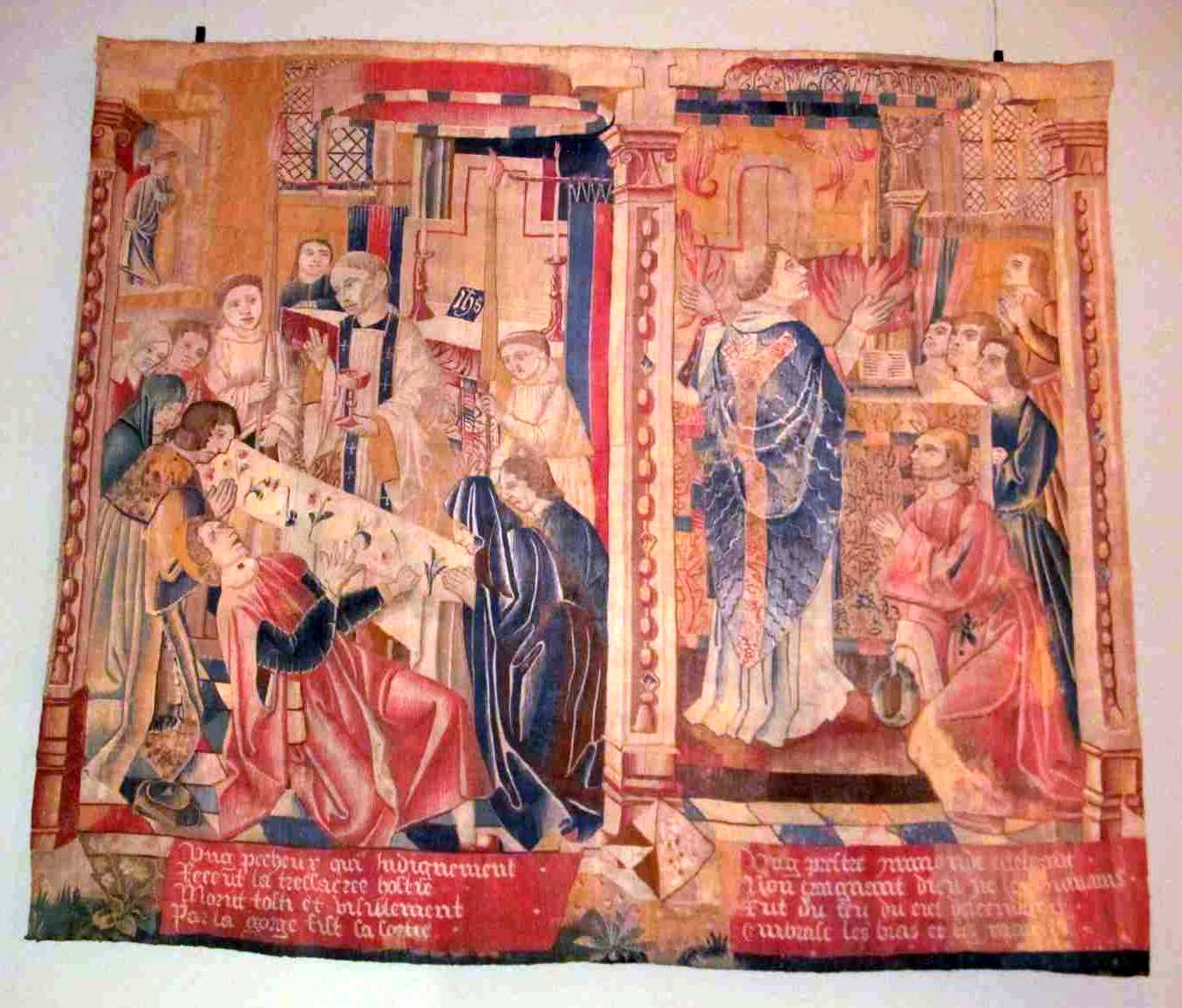 |
| Two Miracles of the Host (tapestry, French?, between 1505 and 1518) |
Our forebears in the Faith thought it was crucial to reinforce St. Paul’s warning. The early 16th-century tapestry above, hanging in one of the innumerable galleries of the Louvre,[1] depicts two miracles — not miracles of healing or salvation, but miracles of dire punishment of unworthy communicants. The left panel tells the story of a man who received the Eucharist in a state of mortal sin, and it burned a hole through his neck. The right panel tells the story of a priest who was celebrating Mass in a state of mortal sin, and his hands burst into flames.
A modern Christian may smile at such “medieval fantasies” and reassure himself that God does not act so harshly. Perhaps we have forgotten the story of Ananias and Sapphira in the Acts of the Apostles (5:1-11), where God strikes two Christians dead for telling lies about their donation of wealth.[2] St. Paul tells us, in 1 Corinthians 11:30, that due to unworthy communions some have become sick and others have died. Is that a superstitious view, or did St. Paul know something we have forgotten?
It is true, nevertheless, that in the ordinary course of His Providence, God does not punish sinners immediately; we know this from Scripture, from history, and from experience. The vast majority of unworthy communicants or celebrants do not erupt into flames. This does not, however, mean that their communions are not unworthy; it means that the Lord has refrained from punishing them on the spot, in view of their possible repentance, conversion, and restoration to His divine friendship by the gift of sanctifying grace. All the same, each and every Catholic is under a serious obligation to examine his or her conscience prior to approaching the sacred banquet, in order to avoid offending God and incurring further guilt.
In our tradition we find great preachers who took seriously their obligation to prepare the faithful for Holy Communion by, on the one hand, extolling the joy, peace, and glory that come to us through grace-filled communions, and, on the other hand, by warning, in no uncertain terms, of the destruction of soul that results from a wicked communion. An exemplary preacher in both of these respects is the Curé of Ars, St. John Vianney, whose meditations on the Holy Eucharist are magnificent and worthy of much study by today’s clergy.

Since the positive side of the message is just about the only thing one hears nowadays, as if the negative side did not even exist, it will be more beneficial in our present situation to have some excerpts from his “Sermon on Unworthy Communion,” in tome IV of his Sermons inédits.
Unworthy Communions are frequent. How many have the temerity to approach the holy table with sins hidden and disguised in confession! How many have not that sorrow which the good God wants from them, and preserve a secret willingness to fall back into sin, and do not put forth all their exertions to amend! How many do not avoid the occasions of sin when they can, or preserve enmity in their hearts even at the holy table! If you have ever been in these dispositions in approaching Holy Communion, you have committed a sacrilege — that horrible crime, on the malice of which we are going to meditate.
1. It outrages God more than all other mortal sins. It attacks the Person of Jesus Christ himself, instead of scorning only his commandments, like other mortal sins.
2. Whoever communicates unworthily crucifies Jesus Christ in his heart. He submits him to a death more ignominious and humiliating than that of the Cross. On the Cross, indeed, Jesus Christ died voluntarily and for our redemption: but here it is no longer so: he dies in spite of himself, and his death, far from being to our advantage, as it was the first time, turns to our woe by bringing upon us all kinds of chastisements both in this world and the next. The death of Jesus Christ on Calvary was violent and painful, but at least all nature seemed to bear witness to his pain. The least sensible of creatures appeared to be affected by it, and thus wishful to share the Saviour’s sufferings. Here there is nothing of this: Jesus is insulted, outraged by a vile nothingness, and all keeps silence; everything appears insensible to his humiliations. May not this God of goodness justly complain, as on the tree of the Cross, that he is forsaken? My God, how can a Christian have the heart to go to the holy table with sin in his soul, there to put Jesus Christ to death?
3. Unworthy Communion is a more criminal profanation than that of the holy places. A pagan emperor, in hatred of Jesus Christ, placed infamous idols on Calvary and the holy sepulchre, and he believed that in doing this he could not carry further his fury against Jesus Christ. Ah! great God! Was that anything to be compared with the unworthy communicant? No, no! It is no longer among dumb and senseless idols that he sets his God, but in the midst, alas!, of infamous living passions, which are so many executioners who crucify his Saviour. Alas! What shall I say? That poor wretch unites the Holy of Holies to a prostitute soul, and sells him to iniquity. Yes, that poor wretch plunges his God into a raging hell. Is it possible to conceive anything more dreadful?
4. Unworthy Communion is in certain respects a greater crime than the deicide of the Jews. St. Paul tells us that if the Jews had known Jesus Christ as the Saviour they would never have put him to suffering or death; but can you, my friend, be ignorant of him whom you are going to receive? If you do not bear it in mind, listen to the priest who cries aloud to you: “Behold the Lamb of God; behold him that taketh away the sins of the world.†He is holy and pure. If you are guilty, unhappy man, do not draw near; or else tremble, lest the thunders of heaven be hurled upon your criminal head to punish you and cast your soul into hell.
5. Unworthy Communion imitates and renews the crime of Judas. The traitor, by a kiss of peace, delivered Jesus Christ to his enemies, but the unworthy communicant carries his cruel duplicity yet further. Having lied to the Holy Ghost in the tribunal of penance by hiding or disguising some sin, he dares, this wretch, to go with a hypocritical reverence on his face, and place himself among the faithful destined to eat this Bread. Ah! no, nothing stops this monster of ingratitude; he comes forward and is about to consummate his reprobation. In vain that tender Saviour, seeing that he is coming to him, cries from his tabernacle, as to the perfidious Judas: “Friend, whereto art thou come? What, thou art about to betray thy God and Saviour by a sign of peace? Stop, stop, my son; I pray thee spare me!†Neither the remorse of his conscience nor the tender reproaches made him by his God can stop his criminal steps. He steps forward. He is going to stab his God and Saviour. O heavens! what a horror! Can you indeed behold this wretched murderer of your Creator without trembling?[3]
Thus St. John Vianney, who, like St. John Chrysostom, did not flinch when it came to calling out evils and urging their amendment. Now, if someone were to ask: Why am I posting such sobering, fear-inspiring reflections?, here is how I would answer:
NOTES
[1] Deux Miracles de l’Hostie de la tenture L’Histoire du saint Sacrement, aux armes d’Isabelle de La Jaille, abbesse de 1505 à 1518 de l’abbaye du Ronceray, près d’Angers. France (?), between 1505 and 1518. Tapestry, linen.
[2] Acts 5:1-11 is found neither in the old lectionary nor in the new. The difference, of course, is that the old lectionary includes very little of Acts, whereas the new includes vast swathes of it, which makes the skipping of these verses more interesting.
[3] Quoted in Eucharistic Meditations: Extracts from the Writings and Instructions of St. John Vianney, by Abbé H. Convert, trans. Sr. Mary Benvenuta (Wheathampstead: Anthony Clarke Books, 1923, repr. 1964), 92–96.
[4] We find the healthy Catholic attitude in a short story by Msgr. Robert Hugh Benson, where a priest is getting ready his holy oils and pyx for a sick call to a Catholic woman who was a public sinner and who had not set foot in a church for over a decade: “I know very well she is out of grace, and I know what will be the end of her if I do not come.†The Supernatural Stories of Monsignor Robert H. Benson (Landisville, PA: Coachwhip Publications, 2010), 207.
April 18, 2016 No Comments
Priest: Rev. Fr. Gerald Carey.
Mass Intention: Happy Repose of Souls of Leo & Agnes
Burrows req. by Mary Uhlman.
*****************
Priesthood in Film, Thursday, April 21, 2016: Throughout 2016, on the third Thursday of each month, the International Institute for Culture 6331 Lancaster Avenue, Philadelphia, PA 19151 will be showing a film in Ivy Hall’s ballroom featuring a different cinematic portrayal of a priest. You’re invited to join us as we explore these various portrayals and discuss, during the social period following each film, the good, the bad, and the ugly of Hollywood’s depictions of the Catholic Church in general and the priesthood in particular. Roland Joffe’s The Mission (1986): 18th century Spanish Jesuits try to protect a remote South American Indian tribe in danger of falling under the rule of pro-slavery Portugal. Starring: Robert DeNiro, Jeremy Irons, and Ray McNalley.
NOTES ABOUT THIS EVENT:•Doors will open at 6:30 PM; film at 7:00 PM. Suggested donation is $5.00. Popcorn will be provided, and the events are BYOB. A social period for discussion and fellowship will follow each film.
Feel free to bring your own favorite lawn chair, camping chair, bean-bag lounge, or other portable furniture to make yourself comfortable during the movie! (Aluminum folding chairs will be provided for all guests, but it’s good to be able to curl up in a favorite and familiar piece of furniture while enjoying a good film.) For further information, see www.iiculture.org or call (215) 877-9910 .
Upcoming Masses:
A Solemn High Mass for Ascension Thursday, May 5, 2016 at 7PM at the Cathedral Basilica of Ss. Peter & Paul, Philadelphia, PA. Celebrant: Rev. Fr. Harold B. McKale, Parochial Vicar of Our Lady of Mount Carmel Parish, Doylestown, PA & Chaplain, Traditional Latin Mass Community of Philadelphia; Deacon: Rev. Fr. James Bartoloma, Chancellor of the Diocese of Camden; Subdeacon: Rev. Fr. Sean Loomis, Parochial Vicar, St. Bede Parish, Holland, PA; Sermon: Rev. Fr. Michael Pawelko, Parochial Vicar, St. Joseph Parish, Aston, PA.
A Solemn High Mass for Corpus Christi, Thursday, May 26, 2016 at 7PM at the Cathedral Basilica of Ss. Peter & Paul, Philadelphia, PA. Celebrant: Rev. Msgr. Charles Sangermano, Pastor of Holy Savior Parish, Norristown, PA; Deacon: Rev. Fr. Gerald Carey, Parochial Vicar, our Lady of Perpetual Help, Morton, PA; Subdeacon: Rev. Fr. Harold B. McKale, Parochial Vicar of Our Lady of Mount Carmel Parish, Doylestown, PA & Chaplain, Traditional Latin Mass Community of Philadelphia
Events: If anyone has pertinent information that would be appropriate for our bulletin, please e-mail it to Fr. McKale at tlmcommunityofphila@gmail.com.
Mass Intentions: If anyone still has unfulfilled Mass intentions, Fr. McKale can pass them on to a priest that will satisfy the intention by offering a TLM or Divine Liturgy (Byzantine). Please specify if you have a preference. The donation is $10. If you would like a Mass card, please include an extra $5 for the card.
April 17, 2016 No Comments
It is St. Paul who first and most clearly teaches us this truth:
Therefore whosoever shall eat this bread, or drink of the chalice of the Lord unworthily, shall be guilty of the Body and of the Blood of the Lord. But let a man prove himself; and so let him eat of that bread, and drink of the chalice. For he that eatheth and drinketh unworthily, eateth and drinketh judgment to himself, not discerning the Body of the Lord. (1 Cor 11:27–29).
In his final encyclical, Ecclesia de Eucharistia, Pope John Paul II quotes St. John Chrysostom:
I too raise my voice, I beseech, beg and implore that no one draw near to this sacred table with a sullied and corrupt conscience. Such an act, in fact, can never be called “communion,†not even were we to touch the Lord’s body a thousand times over, but “condemnation,†“torment,†and “increase of punishment.â€[1]
John Paul II explains the reason why:
The celebration of the Eucharist … cannot be the starting-point for communion; it presupposes that communion already exists, a communion which it seeks to consolidate and bring to perfection. … Invisible communion, though by its nature always growing, presupposes the life of grace, by which we become “partakers of the divine nature†(2 Peter 1:4), and the practice of the virtues of faith, hope and love. … Keeping these invisible bonds intact is a specific moral duty incumbent upon Christians who wish to participate fully in the Eucharist by receiving the body and blood of Christ. The Apostle Paul appeals to this duty when he warns: “Let a man examine himself, and so eat of the bread and drink of the cup†(1 Cor 11:28). … I therefore desire to reaffirm that in the Church there remains in force, now and in the future, the rule by which the Council of Trent gave concrete expression to the Apostle Paul’s stern warning when it affirmed that, in order to receive the Eucharist in a worthy manner, “one must first confess one’s sins, when one is aware of mortal sin.†… Christ is the truth and he bears witness to the truth (cf. Jn 14:6; 18:37); the sacrament of his body and blood does not permit duplicity.[2]
There is no way around it: Catholics are obliged to pay careful heed to “stern warning†of St. Paul in 1 Corinthians 11:27–29.
Now, in the traditional Latin Mass, the message of these verses is heard at least three times every year: once on Holy Thursday (where the Epistle is 1 Cor 11:20–32),[3] and twice on Corpus Christi (where the Epistle is 1 Cor 11:23–29, and the Communion antiphon is 1 Cor 11:26-27). Catholics who preferentially attend the usus antiquior will never fail to have St. Paul’s challenging words placed before their consciences.[4]
Instead, in keeping with a programmatic decision to avoid what they considered “difficult†biblical texts,[5] the revised Lectionary altogether omits 1 Corinthians 11:27–29. St. Paul’s “sterm warning†against receiving the Body and Blood of the Lord unworthily, that is, unto one’s damnation, has not been read at any Ordinary Form Mass for almost half a century.[6]
Let us be frank: the concept of an unworthy communion has disappeared from the general Catholic consciousness, at least in the affluent, self-satisfied West. I recall the surprise of more than a few commentators when the Synod fathers were debating whether anyone should refrain from receiving communion. Surely, doesn’t everyone — almost without exception — go forward at communion time?[7]
It might be thought that I am exaggerating the gravity of the problem. In that case, listen not to me, but to the words of the Curé of Ars, St. John Vianney, patron of parish priests:
A pagan emperor, in hatred of Jesus Christ, placed infamous idols on Calvary and the holy sepulchre, and he believed that in doing this he could not carry further his fury against Jesus Christ. Ah! great God! Was that anything to be compared with the unworthy communicant? No, no! It is no longer among dumb and senseless idols that he sets his God, but in the midst, alas!, of infamous living passions, which are so many executioners who crucify his Saviour. Alas! What shall I say? That poor wretch unites the Holy of Holies to a prostitute soul, and sells him to iniquity. Yes, that poor wretch plunges his God into a raging hell. Is it possible to conceive anything more dreadful?[8]
Next week I will post more excerpts from St. John Vianney on this subject.
Summorum Pontificum has provided to the Church an urgent medicine in this era of misunderstood mercy and forgotten dogma. Pope Benedict XVI recognized that the usus antiquior is a treasure for the entire Church, one that must be given its due place for the benefit of all. One of the most valuable contributions it makes, together with the culture of piety it sustains, is to keep alive the integral teaching of Scripture and Tradition precisely on matters that are “difficult†for modern man.
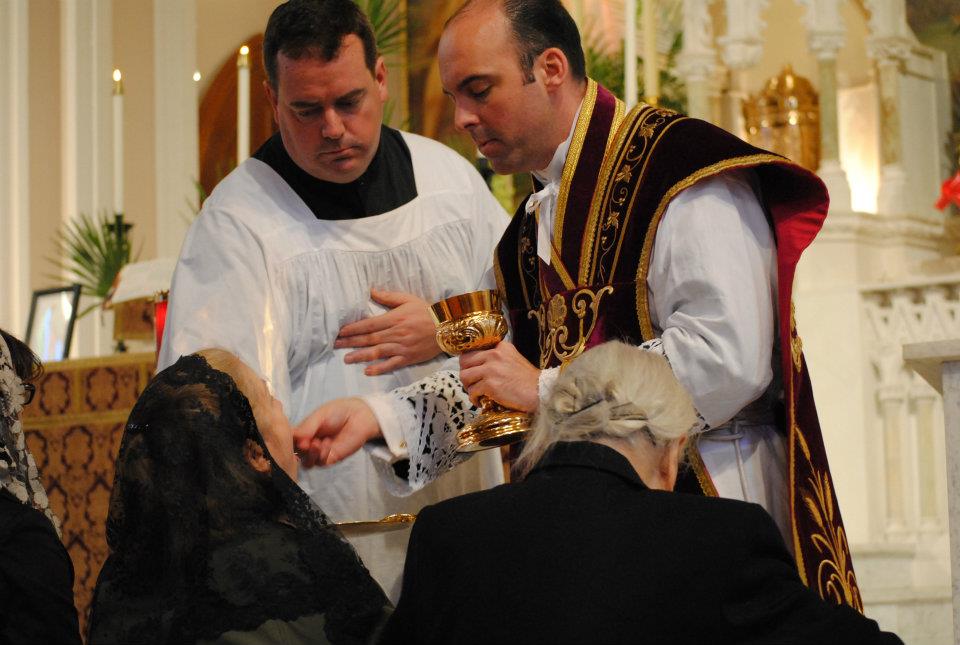
In the ambit of the traditional Mass, one often finds that the faithful are well aware of the requirement to examine their consciences, and, if they are aware of any mortal sin, they will go to confession first — something rendered far easier by the ready availability of confession before (and sometimes during) Mass, particularly on Sundays. At communion time, it simply does not happen that everyone goes up, row after row. A number of people remain in the pews; as a result, those who, for whatever reason, cannot receive the Eucharist do not feel oddly isolated or uncomfortably noticed. Finally, the faithful who wish to receive the Body, Blood, Soul, and Divinity of our Lord Jesus Christ  — and who are not conscious of any unrepented and unconfessed mortal sin — step forward, kneel down in adoring reverence, and receive the King of Kings and Lord of Lords on their tongues, from the consecrated hand of the priest. It is all done in a manner proper, just, and right. Man comes before God and begs to receive the awesome gift of His divine life, of which, as creatures and sinners, we will always be unworthy: Domine, non sum dignus, ut intres sub tectum meum, sed tantum dic verbo, et sanabitur anima mea.
NOTES
[1] Homiliae in Isaiam, 6, 3: PG 56, 139; cf. Ecclesia de Eucharistia 36.
[2] Ecclesia de Eucharistia 35–36. The pope goes on to speak of the inseparable relationship between the sacraments of Eucharist and Penance. We are dealing here with doctrine that stretches from St. Paul to the present Magisterium in an uninterrupted crescendo of unambiguous affirmation.
[3] On Holy Thursday in the Novus Ordo, the second reading is 1 Cor 11:23–26, simply narrating the institution of the Eucharist. The longer reader found in the usus antiquior provides the full context for what St. Paul is saying and makes clearer the connection between the institution of the Holy Eucharist and the present gathering of Christians for the celebration of the Mass.
[4] If the faithful happen to attend a votive Mass of the Blessed Sacrament — a popular choice among usus antiquior votive Masses — they will encounter these verses yet again. Moreover, 1 Corinthians 11:27-29 is part of the ninth reading of Tenebrae on Maundy Thursday and the third reading of Matins on Corpus Christi.
[5] See General Introduction to the Lectionary 76; for commentary, see Anthony Cekada, Work of Human Hands: A Theological Critique of the Mass of Paul VI (West Chester, OH: Philothea Press, 2010), 265–72.
[6] Consider the following comparison: in any place where the usus antiquior has been celebrated since the introduction of the new Lectionary 46 years ago, 1 Corinthians 11:27-29 (or vv. 26-27, which deliver the same message) has been required reading 138 times. In the same period, it has been required to be read zero times in the sphere of the Ordinary Form. How could this not make a difference in the formation of the faithful, clergy and laity alike? The same Pauline passage has, moreover, been altogether removed from the Liturgy of the Hours, where it once appeared twice (see note 4 and here).
I have noticed in recent years a growing awareness of this glaring lacuna and others like it, but the entire problem deserves to be much more widely known, so that we can begin (or continue) to ask difficult questions in earnest. The work will now be rendered significantly easier on account of a scholarly resource that has just come out:Â Index Lectionum: A Comparative Table of Readings for the Ordinary and Extraordinary Forms of the Roman Rite by Matthew P. Hazell. NLM will review this book in a future post.
[7] Joseph Ratzinger addressed this problem head on: “It is one of the happy features of worship in the wake of the Council that more and more people participate fully in the Eucharist by receiving the body of the Lord, communicating with him and, in him, with the whole Church of God. Yet do we not feel a slight uneasiness at times in the face of an entire congregation coming to communion? Paul urgently insisted that the Corinthians should ‘discern’ the Lord’s body (1 Cor 11:29): is this still happening? Occasionally one has the feeling that ‘communion’ is regarded as part of the ritual—that it goes on automatically and is simply an expression of the community’s identity. We need to regain a much stronger awareness that the Eucharist does not lose all its meaning where people do not communicate. By going to Communion without ‘discernment,’ we fail to reach the heights of what is taking place in Communion; we reduce the Lord’s gift to the level of everyday ordinariness and manipulation. The Eucharist is not a ritual meal; it is the shared prayer of the Church, in which the Lord prays together with us and gives us himself. Therefore it remains something great and precious, it remains a true gift, even when we cannot communicate. If we understood this better and hence had a more correct view of the Eucharist itself, many pastoral problems — the position of the divorced and remarried in the Church, for instance — would cease to be such a burden†(The Feast of Faith, trans. Graham Harrison [San Francisco: Ignatius Press, 1986], 151–52).
[8] From Sermon sur la Communion indigne, quoted in Eucharistic Meditations: Extracts from the Writings and Instructions of St. John Vianney, by Abbé H. Convert, trans. Sr. Mary Benvenuta (Wheathampstead: Anthony Clarke Books, 1923, repr. 1964), 94–95.
April 11, 2016 No Comments
Priest: Rev. Fr. Dennis Carbonaro.
Mass Intention: Antonina Kyc (RIP) req. by Bianco Family.
*****************
Concerts at the Cathedral:
visit https://cathedralphilaconcerts.org/ for more information.
1. Williamson Voices , Westminster Choir College, Princeton, NJ on Sunday, April 10 2016 at 3:00 PM — 4:30 PM.
2. Chanticleer, a Grammy Award-Winning All Male A Capella Ensemble on Monday, April 11 2016 at 8:00 PM — 9:30 PM
Cathedral Basilica of Saints Peter and Paul
18th and Benjamin Franklin Parkway, Philadelphia, PA 19103.
Upcoming Masses:
A Solemn High Mass for Ascension Thursday, May 5, 2016 at 7PM at the Cathedral Basilica of Ss. Peter & Paul, Philadelphia, PA.
Celebrant: Rev. Fr. Harold B. McKale, Parochial Vicar of Our Lady of Mount Carmel Parish, Doylestown, PA & Chaplain, Traditional Latin Mass Community of Philadelphia; Deacon: Rev. Fr. James Bartoloma, Chancellor of the Diocese of Camden; Subdeacon: Rev. Fr. Sean Loomis, Parochial Vicar, St. Bede Parish, Holland, PA; Sermon: Rev. Fr. Michael Pawelko, Parochial Vicar, St. Joseph Parish, Aston, PA.
A Solemn High Mass for Corpus Christi, Thursday, May 26, 2016 at 7PM at the Cathedral Basilica of Ss. Peter & Paul, Philadelphia, PA.
Celebrant: Rev. Msgr. Charles Sangermano, Pastor of Holy Savior Parish, Norristown, PA; Deacon: Rev. Fr. Gerald Carey, Parochial Vicar, our Lady of Perpetual Help, Morton, PA; Subdeacon: Rev. Fr. Harold B. McKale, Parochial Vicar of Our Lady of Mount Carmel Parish, Doylestown, PA & Chaplain, Traditional Latin Mass Community of Philadelphia.
Events: If anyone has pertinent information that would be appropriate for our bulletin, please e-mail it to Fr. McKale at tlmcommunityofphila@gmail.com.
Mass Intentions: If anyone still has unfulfilled Mass intentions, Fr. McKale can pass them on to a priest that will satisfy the intention by offering a TLM or Divine Liturgy (Byzantine). Please specify if you have a preference. The donation is $10. If you would like a Mass card, please include an extra $5 for the card.
April 9, 2016 No Comments
By Dr. of NLM

No, this article is not a plea for bending and breaking the Church’s matrimonial rules. In fact, it has almost nothing to do with the subject of marriage — except perhaps in a sense to which I will return at the end.
The irregularity to which I refer is none other than the many beautiful differences that characterize the various seasons of the liturgical year in the usus antiquior. The traditional rubrics, texts, and chants of Lent and Easter bring the contrasting characters of their seasons strongly to the fore: in Lent we suppress the Alleluia while in Paschaltide we sing it repeatedly; the Gloria disappears and then returns with exultation; the Gloria Patri drops away in Passiontide and enters the liturgy anew with Easter. There are many such elements and structures of differentiation, and while the Ordinary Form retains some of them, many, even most, were abandoned.
The traditional Latin Mass and Divine Office display a plethora of differences between seasons as well as on certain special days of the year, be it Ember Days, Rogation Days, All Souls, Candlemas, or what have you. These irregularities or deliberate departures from the “standard†approach magnify the psychological power of the rites and augment their spiritual impact. They also help worshipers enter more deeply into particular mysteries, seasons, or feasts by, on the one hand, startling them out of rote habit, and, on the other hand, building up over the years subliminal associations that reinforce the particular graces besought by the Church at that time.
Three of my favorite distinctive marks take place in Masses around and after Easter. First, there is the use of the Gradual Haec dies during the entire Octave, albeit with changing verses for each day.[1] The constant refrain in the Mass (and in the Office, too) of “THIS is the day that the Lord has made†strongly reinforces the idea of the Octave as one gigantic celebration, and therefore paves the way to experiencing it thus. Moreover, the liturgy preserves the important formulation: “exultemus et laetemur in ea,†let us rejoice and be glad in it, that is, in this wonderful Day of the Lord, the Dayspring from on high, the New Song, the Risen Christ Himself. The postconciliar translation “Let us rejoice and be glad,†period, sounds like a generic exhortation to be happy. “Let us rejoice and be glad in it†points us to the object of our rejoicing, the cause of our gladness, which is none other than the Easter mystery itself, in the Person of the ever-living Christ. While the Haec dies is an option for every day of Easter Week in the Ordinary Form (simply consult the Graduale Romanum of 1974), it is almost never met with in the wild. When the responsorial psalm of year-round familiarity is chosen, an opportunity is lost — from a textual and structural point of view — for emphasizing the differentness, uniqueness, and unity of the Octave by means of the interlectional psalm.
This brings me to a third distinctive mark of the ancient Roman liturgy in Easter season, and my personal favorite: the use of a double Alleluia before the Gospel during the weeks of Paschaltide. When the priest or subdeacon finishes chanting the Epistle, the Schola begins to sing — not a Gradual as throughout the year, nor a Tract as in Lent, but a special Alleluia with a verse of its own, followed by another Alleluia and verse, both drawing more heavily than usual upon New Testament texts (e.g., Mt 28:7 and Jn 20:26 on Low Sunday, Lk 24:35 on Good Shepherd Sunday, Lk 24:46 on the Third Sunday after Easter, etc.). The chanted alleluias for the Sundays  after Pentecost are already lavish in their contemplative splendor; add another of the same character, and you are starting to swim in the shallows of the Eighth Day. There is a kind of suspension of time and place in these great Paschal alleluias, as if one would wish to linger forever in the more-than-mortal joy of the Resurrection, in the sober inebriation of the Spirit, remembering and resting in the victory of our King, before resuming the fight against the world, the flesh, and the devil.
Traditionally, the Gradual, Tract, and Alleluia are all fairly lengthy interlectional chants, written in a melismatic style for the sake of meditating on the Word of God, allowing it to soak in, and preparing the ground for the Gospel as by the application of a long, slow dripline. Although the twin chanted Alleluias are an option in the Ordinary Form (see once more the Graduale Romanum of 1974), they are rarely used, for two simple reasons. First, in the reformed liturgy, the Responsorial Psalm was introduced as an opportunity for verbal participation and the Alleluia changed into a short and easily-repeatable acclamation that rouses people to stand for the Gospel. In this way the historic character and liturgical function of the interlectional chants were fundamentally altered, and with them, the requisite aesthetic forms. If the expectation is that people will speak or sing the psalm and the alleluia (and stand up for the latter), it is obvious that two melismatic Alleluias back to back will not serve the purpose. Of course, this is not to say that Alleluia acclamations cannot be done beautifully—my own choir, when assisting at the Ordinary Form, sings either a Bach setting or a Mozart setting at this juncture, either of which comes across nobly—but we must recognize that we are dealing with a different thing from what the Alleluia had been for most of the history of the liturgy.[2]
I said at the start that this post had little to do with marriage, but there is one parallel worth pointing out. In a healthy marriage, the spouses make an effort to do things that are out of the ordinary for one another. On special occasions like anniversaries or birthdays, flowers or chocolates may enter the home, or the couple may go out on a date. Married people do this sort of thing because they know that a uniform monotonous routine, which takes too much for granted, is a recipe for mental and emotional stagnation. They know, in other words, that sometimes the best rule is to have a certain irregularity. Christ’s beautiful Bride, the Church, has known and lived the same secret: her liturgical traditions are the evidence. It will be wise for us to know and live this secret, too.
NOTES
[1] The Roman liturgy is fairly austere and reserved in its Easter celebrations as compared with the Eastern rites or even the other medieval Western rites (as Gregory DiPippo recently discussed in connection with Vespers), and yet it still has its own treasures that must not be allowed to vanish owing to the pressure of “market forces.” An example would be the distinctive sections of the Roman Canon for Easter week, which, of course, are printed in the OF altar missal, but will be heard only by those fortunate enough to have a priest who chooses the venerable Roman Canon during the Octave.
[2] For discussion of the meaning and importance of interlectional chants, see William Mahrt’s The Musical Shape of the Liturgy.
April 4, 2016 No Comments