One might have assumed, as a matter of course, that when Coetus XI of the Consilium devised a new vastly expanded Lectionary spanning three years of Sundays and two years of weekdays, they would certainly have included
all of the readings already found in the traditional Roman liturgy (as per
Sacrosanctum Concilium 23 and 50), and that, in the wide scope allotted to New Testament books, no key passages would be omitted.
Instead, in keeping with a programmatic decision to avoid what they considered “difficult†biblical texts,[5] the revised Lectionary altogether omits 1 Corinthians 11:27–29. St. Paul’s “sterm warning†against receiving the Body and Blood of the Lord unworthily, that is, unto one’s damnation, has not been read at any Ordinary Form Mass for almost half a century.[6]
Let us be frank: the concept of an unworthy communion has disappeared from the general Catholic consciousness, at least in the affluent, self-satisfied West. I recall the surprise of more than a few commentators when the Synod fathers were debating whether anyone should refrain from receiving communion. Surely, doesn’t everyone — almost without exception — go forward at communion time?[7]
It might be thought that I am exaggerating the gravity of the problem. In that case, listen not to me, but to the words of the Curé of Ars, St. John Vianney, patron of parish priests:
A pagan emperor, in hatred of Jesus Christ, placed infamous idols on Calvary and the holy sepulchre, and he believed that in doing this he could not carry further his fury against Jesus Christ. Ah! great God! Was that anything to be compared with the unworthy communicant? No, no! It is no longer among dumb and senseless idols that he sets his God, but in the midst, alas!, of infamous living passions, which are so many executioners who crucify his Saviour. Alas! What shall I say? That poor wretch unites the Holy of Holies to a prostitute soul, and sells him to iniquity. Yes, that poor wretch plunges his God into a raging hell. Is it possible to conceive anything more dreadful?[8]
Next week I will post more excerpts from St. John Vianney on this subject.
Summorum Pontificum has provided to the Church an urgent medicine in this era of misunderstood mercy and forgotten dogma. Pope Benedict XVI recognized that the usus antiquior is a treasure for the entire Church, one that must be given its due place for the benefit of all. One of the most valuable contributions it makes, together with the culture of piety it sustains, is to keep alive the integral teaching of Scripture and Tradition precisely on matters that are “difficult†for modern man.
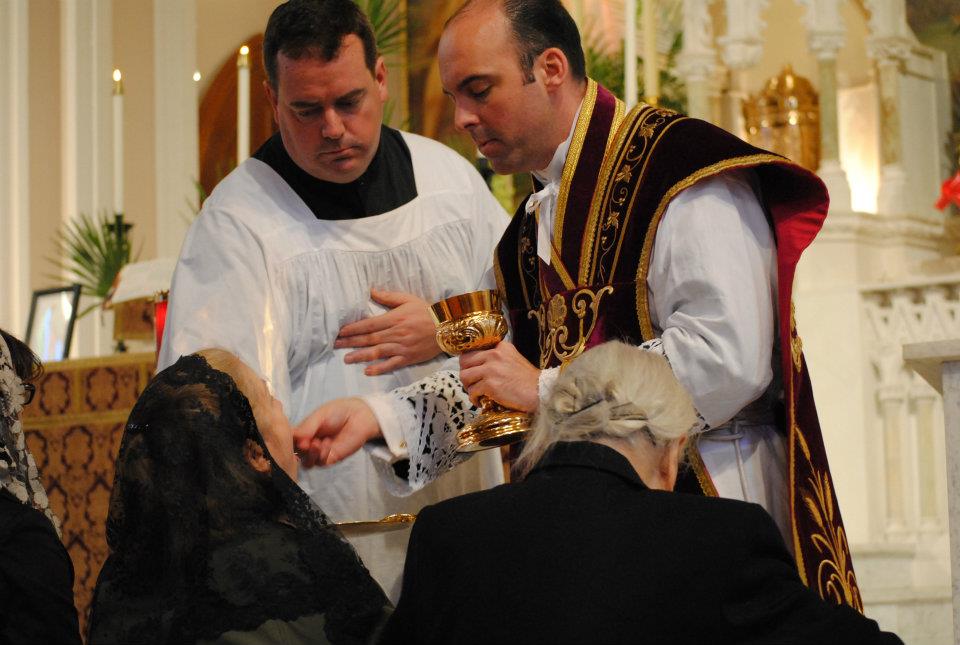
In the ambit of the traditional Mass, one often finds that the faithful are well aware of the requirement to examine their consciences, and, if they are aware of any mortal sin, they will go to confession first — something rendered far easier by the ready availability of confession before (and sometimes during) Mass, particularly on Sundays. At communion time, it simply does not happen that everyone goes up, row after row. A number of people remain in the pews; as a result, those who, for whatever reason, cannot receive the Eucharist do not feel oddly isolated or uncomfortably noticed. Finally, the faithful who wish to receive the Body, Blood, Soul, and Divinity of our Lord Jesus Christ  — and who are not conscious of any unrepented and unconfessed mortal sin — step forward, kneel down in adoring reverence, and receive the King of Kings and Lord of Lords on their tongues, from the consecrated hand of the priest. It is all done in a manner proper, just, and right. Man comes before God and begs to receive the awesome gift of His divine life, of which, as creatures and sinners, we will always be unworthy: Domine, non sum dignus, ut intres sub tectum meum, sed tantum dic verbo, et sanabitur anima mea.
NOTES
[1] Homiliae in Isaiam, 6, 3: PG 56, 139; cf. Ecclesia de Eucharistia 36.
[2] Ecclesia de Eucharistia 35–36. The pope goes on to speak of the inseparable relationship between the sacraments of Eucharist and Penance. We are dealing here with doctrine that stretches from St. Paul to the present Magisterium in an uninterrupted crescendo of unambiguous affirmation.
[3] On Holy Thursday in the Novus Ordo, the second reading is 1 Cor 11:23–26, simply narrating the institution of the Eucharist. The longer reader found in the usus antiquior provides the full context for what St. Paul is saying and makes clearer the connection between the institution of the Holy Eucharist and the present gathering of Christians for the celebration of the Mass.
[4] If the faithful happen to attend a votive Mass of the Blessed Sacrament — a popular choice among usus antiquior votive Masses — they will encounter these verses yet again. Moreover, 1 Corinthians 11:27-29 is part of the ninth reading of Tenebrae on Maundy Thursday and the third reading of Matins on Corpus Christi.
[5] See General Introduction to the Lectionary 76; for commentary, see Anthony Cekada, Work of Human Hands: A Theological Critique of the Mass of Paul VI (West Chester, OH: Philothea Press, 2010), 265–72.
[6] Consider the following comparison: in any place where the usus antiquior has been celebrated since the introduction of the new Lectionary 46 years ago, 1 Corinthians 11:27-29 (or vv. 26-27, which deliver the same message) has been required reading 138 times. In the same period, it has been required to be read zero times in the sphere of the Ordinary Form. How could this not make a difference in the formation of the faithful, clergy and laity alike? The same Pauline passage has, moreover, been altogether removed from the Liturgy of the Hours, where it once appeared twice (see note 4 and here).
I have noticed in recent years a growing awareness of this glaring lacuna and others like it, but the entire problem deserves to be much more widely known, so that we can begin (or continue) to ask difficult questions in earnest. The work will now be rendered significantly easier on account of a scholarly resource that has just come out:Â Index Lectionum: A Comparative Table of Readings for the Ordinary and Extraordinary Forms of the Roman Rite by Matthew P. Hazell. NLM will review this book in a future post.
[7] Joseph Ratzinger addressed this problem head on: “It is one of the happy features of worship in the wake of the Council that more and more people participate fully in the Eucharist by receiving the body of the Lord, communicating with him and, in him, with the whole Church of God. Yet do we not feel a slight uneasiness at times in the face of an entire congregation coming to communion? Paul urgently insisted that the Corinthians should ‘discern’ the Lord’s body (1 Cor 11:29): is this still happening? Occasionally one has the feeling that ‘communion’ is regarded as part of the ritual—that it goes on automatically and is simply an expression of the community’s identity. We need to regain a much stronger awareness that the Eucharist does not lose all its meaning where people do not communicate. By going to Communion without ‘discernment,’ we fail to reach the heights of what is taking place in Communion; we reduce the Lord’s gift to the level of everyday ordinariness and manipulation. The Eucharist is not a ritual meal; it is the shared prayer of the Church, in which the Lord prays together with us and gives us himself. Therefore it remains something great and precious, it remains a true gift, even when we cannot communicate. If we understood this better and hence had a more correct view of the Eucharist itself, many pastoral problems — the position of the divorced and remarried in the Church, for instance — would cease to be such a burden†(The Feast of Faith, trans. Graham Harrison [San Francisco: Ignatius Press, 1986], 151–52).
[8] From Sermon sur la Communion indigne, quoted in Eucharistic Meditations: Extracts from the Writings and Instructions of St. John Vianney, by Abbé H. Convert, trans. Sr. Mary Benvenuta (Wheathampstead: Anthony Clarke Books, 1923, repr. 1964), 94–95.


0 comments
Kick things off by filling out the form below.
Leave a Comment