by William A. Torchia, Esq.
Fr. Robert C. Pasley, KCHS, Pastor of Mater Ecclesiae
For the 16th consecutive year, at Mater Ecclesiae, where the Extraordinary Form is celebrated exclusively every day, there will be a Solemn Mass and Procession for the Feast of Corpus Christi on Thursday, May 26 at 7:30 PM. There is plenty of parking. Come join us for this “Feast of God.”
by William A. Torchia, Esq.
Gregory DiPippo of NLM
The Cathedral Basilica of Ss Peter and Paul, located at 1732 Race St. in Philadelphia, will have an EF Mass tomorrow for the feast of Corpus Christ, starting at 7 pm, and followed by a Eucharist Procession and Benediction.
by William A. Torchia, Esq.
Rev. Fr. Leonard Goffine’s
The Church’s Year
This festival is celebrated on the Sunday after Pentecost, because as soon as the apostles were instructed and consoled by the Holy Ghost, they began to preach openly that which Christ had taught them.
Why do we celebrate this festival?
That we may openly profess our faith in the doctrine of the Holy Trinity, which is the first of Christian truths, the foundation of the Christian religion, and the most sublime of all mysteries; and that we may render thanks, to the Father for having created us, to the Son for having redeemed us, and to the Holy Ghost for having sanctified us.
In praise and honor of the most Holy Trinity, the Church sings at the Introit of this day’s Mass:
INTROIT Blessed be the holy Trinity and undivided Unity: we will give glory to him, because he hath shown his mercy to us: (Tob. XII.) O Lord, our Lord, how wonderful is thy name in all the earth! (Ps. VIII. 1.) Glory be to the Father, etc.
COLLECT Almighty, everlasting God, who hast granted to Thy servants, in the confession of the true faith, to acknowledge the glory of the eternal Trinity, and in the power of Thy, majesty, to adore the Unity: grant that, by steadfastness in the same faith, we may ever be defended from all adversities. Thro’.
EPISTLE (ROM XI. 33-36.) O the depth of the riches of the wisdom and of the knowledge of God! How incomprehensible are his judgments, and how unsearchable his ways! For who hath known the mind of the Lord? Or who hath been his counsellor? Or who hath first given to him, and recompense shall be made him? For of him, and by him, and in him, are all things: to him be glory forever. Amen.
EXPLANATION St. Paul’s exclamations, in this epistle, are caused by the inscrutable judgment of God in rejecting the Jews and calling the Gentiles. The Church makes use of these words to express her admiration for the incomprehensible mystery of the most Holy Trinity, which surpasses our understanding, and yet is the worthy object of our faith, hope and love. Although neither angels nor men can fathom this mystery, it cannot be difficult for the sound human intellect to believe it, since it is indubitably and evidently revealed by God, arid we, in many natural and human things, accept for true and certain much that we cannot comprehend. Let us submit our intellect, there fore, and yield ourselves up to faith; as there was indeed a time when men were martyred, when even persons of all ages and conditions preferred to die rather than to abandon this faith, so let us rather wait until our faith is changed to contemplation, until we see the Triune God, face to face, as He is, and in the sight of that countenance become eternally happy. Thither should all our hopes, wishes,’ and desires be directed, and we should cease all fruitless investigations, endeavoring by humble faith and active love, to prove worthy of the beatific vision; for if we do not love Him who is our all, our last end and aim, and lovingly desire Him, we will have to hope of one day possessing Him.
ASPIRATION O incomprehensible, Triune God! O Abyss of wisdom, power, and goodness! To Thee all glory and adoration! In Thee I lose myself; I cannot contain Thee, do Thou, contain me. I believe in Thee, though I cannot comprehend Thee; do Thou increase my faith; I hope in. Thee, for Thou art the source of all good; do Thou enliven my hope; I love Thee, because Thou art worthy, of all love; do Thou inflame ever more my love, that in Thy love I may live and die. Amen.
GOSPEL (Matt. XXVIII. 18-20.) At that time Jesus said to His disciples: All power is given to me in heaven and in earth. Going, therefore; teach ye all nations, baptizing them in the name of the Father, and of the Son, and of the Holy Ghost; teaching them to observe all things whatsoever I have commanded you. And behold, I am with you all days, even to the consummation of the world.
EXPLANATION Christ being God had from all eternity the same power that His Father had; being man, He had this same power by the union of His divinity with His humanity, and on account of the infinite merits of His passion. In virtue of this power, He said to His apostles, before the ascension, that, as His Heavenly Father had sent Him, even so He sent them to all nations, without exception, to teach all that He had commanded, and to receive them, by means of baptism, into the Church; at the same time He promised to be with them to the end of the world, that is, that He would console them in suffering, strengthen them in persecution, preserve them from error, and always protect them and their successors, the bishops and priests, even unto the consummation of the world.
(See Instruction on the doctrine of the infallibility of the Church for the first Sunday after Easter.)
ASPIRATION Be with us, O Lord, for without Thee our pastors cannot produce fruit, nor their hearers profit anything from their words. Be with us always, for we always need Thy help. All power is given to Thee, Thou bast then the right to command, and we are bound to obey Thy commands which by Thy Church Thou bast made known to us. This we have promised in baptism, and now before Thee we renew those vows. Grant now that those promises which without Thee we could not have made, and without Thee cannot keep, may be fulfilled in our actions. Leave us not to ourselves, but be Thou with us, and make us obedient to Thee, that by cheerful submission to Thee true may receive happiness.
INSTRUCTION ON THE HOLY SACRAMENT OF BAPTISM
Going, therefore, teach ye all nations, baptizing them in the name of the Father, and of the Son, and of the Holy Ghost (Matt. XXVIII. 19.)
Is baptism a Sacrament?
Yes because in it the baptized person receives the grace of God by means of an external sign, instituted by Christ.
What is this external sign?
The immersion, or the pouring of water, accompanied by the words: “I baptize thee in the name of the Father, and of the Son, and of the Holy ghost:”
What does the baptismal grace effect?
It removes original and actual sin; causing ,man to be spiritually born again, made a new creature, a child of God, and joint heir with Christ.
How many kinds of baptism are there?
There are three kinds: The baptism of desire, which consists in a heartfelt desire for the baptism of water, joined with a perfect love of God, or a perfect sorrow for sins committed, and with the purpose to obey all God’s commands; the baptism of blood, which is received by those who suffer martyrdom for the true faith, without having received the baptism of water; the baptism of water, which is the Sacrament of Baptism.
What do the deferent ceremonies of this Sacrament signify?
They are the external signs of the effects which baptism produces inwardly upon the soul, and should impress us with deep reverence for this Sacrament.
Why is it customary to have a godfather or godmother?
That there may be a witness that the child has received baptism; that in case of the death of the parents, the sponsors may assume their place, and have the child instructed in the truths of religion. St. Augustine speaking of the duties of sponsors, very beautifully says: “They should use all care, often to admonish in true love their godchildren that they may strive to lead a pure life; they should warn them against all detraction, all improper songs, and keep them from pride, envy, anger, and revenge; they should watch over them that they may preserve the Catholic faith, attend the church services, listen to the word of God, and obey their parents and their pastors.” Sponsors must therefore be true believers, and of unquestionable morality. No one, unless a Catholic can be chosen for a sponsor, because one who is not a Catholic would not instruct the child in the Catholic faith, or see that others do it; but would be more likely, as experience shows, to draw the child over to error.
What results from this sponsorship?
In baptism, as in confirmation, a spiritual affinity originates between, the sponsors, the one who baptizes or confirms, with the one baptized or confirmed, and with the parents, so that, by a decision of the Church a godfather or godmother cannot contract marriage with any of these parties, unless the impediment is removed by dispensation, that is, by a special permission received from a spiritual superior. But the sponsors have no spiritual relationship to each other.
Why has the Church instituted this spiritual relation?
From reverence for these holy Sacraments, and that by this spiritual bond the sponsors may be more closely connected with their godchildren, and be incited earnestly to discharge their obligation.
Why must the person to be baptized wait at the entrance of the church?
To indicate that until he has thrown off the yoke of sin, and submitted to Christ, and His authority, he is unworthy to enter, because baptism is the door of God’s grace, to the kingdom of heaven, and the communion of saints.
Why does the person receive a saint’s name?
That by this name he may be enrolled, through baptism, into the number of Christians whom St. Paul calls saints; that he may have a patron and intercessor, and that the saint, whose name he bears, may be his model and example, by which he may regulate his own life.
Why does the priest breathe in the face of the one to be baptized?
In imitation of Christ who breathed on His apostles when He gave them the Holy Ghost. (John XX. 22.) St. Chrysostom says that in baptism supernatural life is given to the soul as God imparted natural life to Adam by breathing on him.
Why does the priest impose his hand so many times upon the head of the person to be baptized?
To show that he is now the property of God and is under His protection.
What do the many exorcisms signify?
That the evil spirit who previous to baptism holds the person in bondage is now commanded in the name of God to depart, that a dwelling?place may be prepared for the Holy Ghost.
Why is the person so often signed with the sign of the cross?
To signify that through the power of Christ’s merits and of His death on the cross, baptism washes away original sin; that the person is to be henceforth a follower of Christ the Crucified, and as such must fight valiantly under the banner of the cross, against the enemies of his salvation, and must follow Christ on the way of the cross even unto death.
What does the salt signify which is put into the person’s mouth?
It is an emblem of Christian wisdom and of preservation from the corruption of sin.
Why are his ears and nose touched with spittle?
That as Christ put spittle on the eyes. of the man born blind, thus restoring his sight, so by baptism, the spiritual blindness of the soul is removed, and his mind receives light to behold heavenly wisdom. Also, as St. Ambrose says, the candidate is thus instructed to open his ears to priestly, admonitions, and become a sweet odor of Christ.
Why does the priest ask: “Dust thou renounce the devil; and all his works, and all his pomps?”
That the Christian may know that his vocation requires him to renounce and combat the devil, his works, suggtions and pomps. Thus St. Ambrose very beautifully addresses a person just baptized: “When the priest asked: `Dust thou renounce the devil and all his works,’ what didst thou reply? `I renounce them.’ `Dost thou renounce the world, its lusts and its pomps?’ `I renounce them.’ Think of these promises, and let them never depart from thy mind. Thou host given thy hand?writing to the priest,, who stands for Christ; when thou host given thy note to a man, a thou art bound to him. Now thy word is not on earth but preserved in heaven; say not thou knowest nothing of this promise; this exculpates thee no better than the excuse of a soldier who in time of battle should say he knew not that by becoming a soldier he would have to fight.”
Why is the person anointed on the shoulder and breast with holy oil?
As SS. Ambrose and Chrysostom explain this is done to strengthen him to fight bravely for Christ; as the combatants of old anointed themselves with oil before they entered the arena, so is he anointed, on the breast, that he may gain courage and force, bravely to combat the world, the flesh, and the devil, and on the shoulder, that he may be strong to bear constantly and untiringly, the yoke of Christ’s commands, and persue the toilsome course of life in unwavering. fidelity to God and His holy law.
Why are, the Lord’s Prayer, and the Apostles’ Creed said at baptism?
That, when the child is a grown person an acknowledgment of faith may by this means be made m the face of the Church; when children are baptized, these prayers are said by the sponsors who are thus reminded to see that their godchildren are well instructed in these as in all other Christian truths.
Why does the priest expressly ask the person if he will be baptized?
Because as man, through Adam, of his own free will obeyed the devil, so now when he would be received among the number of Christ’s children, he must, to obtain salvation, of his own free will obey the precepts of God.
Why is water poured three times upon the person’s head?
This is done, as St. Gregory the Great writes, in token that man after this thrice-repeated ablution rises from the death of sin, as Christ, after His three days’ burial, rose from the dead. (Rom. VI. 4.5.) In early times the candidate for baptism was immersed three times in the water. For many ‘reasons this custom has been abolished.
Why is the person anointed on the top of the head with chrism?
This anointing is, so to speak, the crown of the young Christian. As in the Old Law the kings were anointed, (I Kings X. 1.) as Jesus is the Anointed One, and as the Apostle St. Peter calls the Christians a chosen race, a kingly priesthood, a holy people, (I Peter II. 9.) so the baptized by means of this unction is embodied in Christ, the Anointed One, and participates in His priesthood and kingly dignity. What an exalted position is the Christian’s! He is the anointed one of the Lord, and in a spiritual sense a priest, because he constantly brings himself to the Lord God as a pleasing sacrifice in prayer, mortification, &c. He is king when he rules over his inclinations, submits them to reason, and reason to the Lord. Besides this he is king by the claims which, through baptism, he possesses to the kingdom of heaven. Through the chrism he becomes the blessed temple of the Holy Ghost, the sacred vessel which in time, through communion, will contain the precious body and blood of Christ. How does he desecrate this temple when, by grievous sin, he tramples this exalted dignity under his feet and. stains the temple of the Holy Ghost, his soul!
What does the white robe signify?
The holy Fathers teach that this represents the glory to which by baptism we are born again; the purity and beauty with which the soul, having been washed from sin in the Sacrament of baptism, is adorned, and the innocence which the baptized should preserve through his whole life.
Why is a lighted candle placed in his hand?
It is an emblem of the Christian doctrine which preserves the baptized from the darkness of error, ignorance, and sin, illumines his understanding, and leads him safely in the way of virtue; it represents the flame of. love for God and our neighbor which the baptized should henceforth continually carry, like the five prudent virgins, (Matt. XXV. 13.) on the path to meet the Lord, that when his life is ended he may be admitted to the eternal wedding feast; it signifies also the light of good example which he should keep ever burning.
Who is the minister of this sacrament?
The ordinary minister is the priest of the Church; but in case of necessity any layman or woman, even the father or mother can baptize. Parents, however, should not baptize their own child unless no other Catholic can be procured. The reason why lay persons are permitted to baptize is that no one may be deprived of salvation.
What must be observed particularly in private baptism?
The person who baptizes must be careful to use only natural water, which must be poured on the child’s head saying at the same time the words: I baptize thee in the name of the Father, and of the Son, and of the Holy Ghost; having at the same time the intention of baptizing as the Church does, in the manner required by Christ.
INSTRUCTION ON THE RENEWAL OF BAPTISMAL VOWS
All the graces and dignities which we receive in baptism, God secures to us for the future, only on condition that we keep our baptismal vows. Every Christian in baptism makes a bond with God through the meditation of Christ who has sealed it with His blood. This bond consists, on man’s part, in the promise to renounce forever the devil, all his works and all his pomps, that is, constantly to suppress the threefold lust of the eyes, the flesh and the pride of life, by which the devil leads us to sin, and to believe all that God has revealed, and all that His holy Church proposes to our belief, and diligently and properly to make use of all the means of salvation. On the part of God this bond consists in cleansing us from all sin, in bestowing the gifts of the Holy Ghost, in adopting us as His children, and. in the assurance to the inheritance of heaven. This bond will never be broken by God who is infinitely true and faithful, but it is often violated by weak and fickle man. In compliance with the desire of the Church we should often reflect upon it, and from time to time renew it in the sight of God. This should be done particularly before receiving the holy Sacrament of Confirmation, before first Communion, on the vigils of Easter and Pentecost, at the blessing of baptismal water, on the anniversaries of our baptism and confirmation, before making any solemn vow, before entering into matrimony and when in danger of death. This renewal of baptismal vows can be made in the following manner: Placing ourselves in the presence of God, we kneel down, fold our hands, and say with fervent devotion:
I believe in God the Father Almighty, Creator of heaven and earth.
I believe in Jesus Christ, His only Son, our Lord, who was born and suffered for us.
I believe in the Holy Ghost, the holy Catholic Church, the communion of saints, the forgiveness of sins, the resurrection of the body, and life everlasting.
I renounce the devil; all his works and all his pomps.
Christ Jesus ! With Thee I am united, to Thee alone I cling, Thee only will I follow, for Thee I desire to live and die. In the name of the Father, and of the Son, and of the Holy Ghost. Amen.
DOCTRINE ON THE HOLY TRINITY
What is God?
GOD is the most perfect being, the highest, best Good, who exists, from all eternity, by whom heaven and earth are create, and from whom all things derive and hold life and existence, for of Him, and by Him, and in Him are all things. (Rom. XI. 36.)
What is the Blessed Trinity?
The Blessed Trinity is this one God who is one in nature and threefold in person, the Father, the Son, and the Holy Ghost.
Is each of these three persons God?
Yes, because each of them has the divine nature and substance.
Are they not three Gods?
No, because all three of these persons have one and the same divine nature and substance.
Is any one of these three persons older, mightier, or greater than the other?
By, no means, they are all three from eternity entirely equal to each .other in divine omnipotence greatness and majesty, and must, therefore, be equally adored and venerated.
Ought one to give himself up to the investigation of the most Blessed Trinity?
No; “For,” says the saintly Bishop Martin, “the mystery of the Trinity cannot be comprehended by the human intellect, no one however eloquent can exhaust it; if entire books were written about it, so that the whole world were filled with them, yet the unspeakable wisdom of God would not be expressed. God who is indescribable, can in no way be described. When the human mind ceases to speak of Him, then it but begins to speak.” Therefore the true Christian throws his intellect under the feet of faith, not seeking to understand that which the human mind can as little comprehend, as a tiny hole in the sand can contain the immeasurable sea. An humble and active faith will make us worthy some day in the other world, to see with ‘ the greatest bliss this mystery as it is, for in this consists eternal life, that by a pious life we may glorify and know the only true God, Christ Jesus His Son, and the Holy Ghost.
by William A. Torchia, Esq.
Priest: Rev. Fr. Harold McKale
Mass Intention: Ida Fernandez (RIP) req. by John Castiello
*****************
Newly Ordained: We congratulate our newly ordained priests: Rev. Fr. Matthew Biedrzycki, Rev. Fr. Mark Cavara, Rev. Fr. Thomas O’Donald and Rev. Fr. Matthew Windle. AD MULTOS ANNOS!!!
A Solemn High Mass for Corpus Christi, Thursday, May 26, 2016 at 7PM at the Cathedral Basilica of Ss. Peter & Paul, Philadelphia, PA
Celebrant: Rev. Msgr. Charles Sangermano, Pastor of Holy Savior Parish, Norristown.
International Institute of Culture: Knighthood and Chivalry: Then and Now, August 6 to 16, 2016 Bavaria Germany. This is summer, from August 6th to 16th, the International
Institute for Culture is offering a unique opportunity to reflect upon and celebrate the legacy and ever-inspiring spirit of Knighthood. Participants in the program will enter into a world in which the ancient code of chivalry still exists in persons and locales in Bavaria and Austria. Daily visits to castles and fortresses will be joined with lectures on the themes of knighthood and chivalry, “past and presentâ€. For more information, visit www.iiculture.org or call 215-877-9910.
Mass Intentions: If anyone still has unfulfilled Mass intentions, Fr. McKale can pass them on to a priest that will satisfy the intention by offering a TLM or Divine Liturgy (Byzantine). Please specify if you have a preference. The donation is $10. If you would like a Mass card, please include an extra $5 for the card. No announced Masses are presently available.
by William A. Torchia, Esq.
Fr. John A. Hardon, S.J.
One of the most memorable experiences that I ever had was with the Miraculous Medal! It changed my life.
In the fall of 1948, the year after my ordination, I was in what we call the Tertianship. This is a third year of Novitiate before taking final vows.
In October of that year, a Vincentian priest came to speak to us young Jesuit priests. He encouraged us to obtain faculties, as they are called, to enroll people in the Confraternity of the Miraculous Medal. Among other things, he said, “Fathers, the Miraculous Medal works. Miracles have been performed by Our Lady through the Miraculous Medal.”
I was not impressed by what the Vincentian priest was telling. I was not the medal-wearing kind of person and I certainly did not have a Miraculous Medal. But I thought to myself, “It does not cost anything.” So I put my name down to get a four page leaflet from the Vincentians, with the then-Latin formula for blessing Miraculous Medals and enrolling people in the Confraternity of the Miraculous Medal. About two weeks later, I got the leaflet for blessing and enrollment, put it into my office book and forgot about it.
In February of the next year, I was sent to assist the chaplain of St. Alexis Hospital in Cleveland, Ohio. I was to be there helping the regular chaplain for two weeks.
Each morning I received a list of all the patients admitted into the hospital that day. There were so many Catholics admitted that I could not visit them all as soon as they came.
Among the patients admitted was a boy about nine years old. He had been sled-riding down hill, lost control of the sled and ran into a tree head-on. He fractured his skull and X-rays showed he had suffered severe brain damage.
When I finally got to visit his room at the hospital, he had been in a coma for ten days, no speech, no voluntary movements of the body. His condition was such that the only question was whether he would live. There was no question of recovering from what was diagnosed as permanent and inoperble brain damage.
After blessing the boy and consoling his parents, I was about to leave his hospital room. But then a thought came to me. “That Vincentian priest. He said, ‘The Miraculous Medal works.’ Now this will be a test of its alleged miraculous powers!”
I didn’t have a Miraculous Medal of my own. And everyone I asked at the hospital also did not have one. But I persisted, and finally one of the nursing sisters on night duty found a Miraculous Medal.
What I found out was that you don’t just bless the medal, you have to put it around a person’s neck on a chain or ribbon. So the sister-nurse found a blue ribbon for the medal, which made me feel silly. What was I doing with medals and blue ribbons.
However, I blessed the medal and had the father hold the leaflet for investing a person in the Confraternity of the Miraculous Medal. I proceeded to recite the words of investiture. No sooner did I finish the prayer of enrolling the boy in the Confraternity than he opened his eyes for the first time in two weeks. He saw his mother and said, “Ma, I want some ice cream.” He had been given only intravenous feeding.
This Experience Changed My Life
Then he proceeded to talk to his father and mother. After a few minutes of stunned silence, a doctor was called. The doctor examined the boy and told the parents they could give him something to eat.
The next day began a series of tests on the boy’s condition. X-rays showed the brain damage was gone.
Then still more tests. After three days, when all examinations showed there was complete restoration to health, the boy was released from the hospital.
This experience so changed my life that I have not been the same since. My faith in God, faith in His power to work miracles, was strengthened beyond description.
Since then, of course, I have been promoting devotion to Our Lady and the use of the Miraculous Medal. The wonders she performs, provided we believe, are extraordinary.
In teaching theology over the years, I have many semesters taught the theology of miracles. And I have an unpublished book manuscript on “The History and Theology of Miracles.” My hope is to publish the manuscript in the near future.
by William A. Torchia, Esq.
Rev. Fr. Leonard Goffine’s
The Church’s Year
What festival is this?
It is the day on which the Holy Ghost descended in the form of fiery tongues, upon the apostles and disciples, who with Mary, the Mother of Jesus, were assembled in prayer in a house at Jerusalem. (Acts II.)
Why is this day called Pentecost?
The word “Pentecost” is taken from the Greek, and signifies fifty. As St. Jerome explains it, this was the last of the fifty days, commencing with Easter, which the early Christians celebrated as days of rejoicing at the resurrection of the Lord.
Why is this day observed so solemnly?
Because on this day the Holy Ghost, having descended upon the apostles, the law of grace, of purification from sin, and the sanctification of mankind, was for the first time announced to the world; because on this day the apostles, being filled with the Holy Ghost, commenced the work of purifying and sanctifying mankind, by baptizing three thousand persons who were converted by the sermon of St. Peter; and because on this day the Church of Jesus became visible as a community to the world, and publicly professed her faith in her crucified Saviour.
Why did the Holy Ghost descend on the Jewish Pentecost?
Because on their Pentecost the Jews celebrated the anniversary of the giving of the law on Mount Sinai, and God would show by sending the Holy Ghost on this days that the Old Law had ceased and the New Law commenced. God also chose this time, that the Jews who on this day came together from all countries to Jerusalem to celebrate the Pentecost, might be witnesses of the miracle, and hear the New Law announced by the apostles.
Why is the baptismal font blessed an the vigil of Pentecost, as on Holy Saturday?
Because the Holy Ghost is the Author of all sanctity and the Fountain of baptismal grace, and because in the Acts (i. 5.) the descent of the Holy Ghost itself is called a baptism.
In the Introit of the Mass the Church rejoices at the descent of the Holy Ghost and sings:
INTROIT The Spirit of the Lord hath filled the whole earth, allel.; and that which containeth all things hath knowledge of the voice, Allel., allel., allel. (Wisd. I.7.) Let God arise, and his enemies be scattered: and let them that hate him, fly before his face. (Ps. 67.) Glory etc.
COLLECT God, who on this day didst instruct the hearts of the faithful by the light of the Holy Spirit: grant us in the same spirit to relish what is right, and ever to rejoice in His consolation. Thro’. — in the unity of the same, etc.
LESSON (Acts II. I-II.) When the days of Pentecost were accomplished, they were all together in one place; and suddenly there came a sound from heaven, as of a mighty wind coming, and it filled the whole house where they were sitting. And there appeared to them parted tongues as it were of fire, and it sat upon every one of them:. and they were all filled with the Holy Ghost, and they began to speak with divers tongues, according as the Holy Ghost gave them to speak. Now there were. dwelling at Jerusalem, Jews, devout men, of every nation under heaven. And when this was noised abroad, the multitude came together, and were confounded in mind, because that every man heard them speak in his own tongue: and they were all amazed, and wondered, saying: Behold, are not all these that speak Galileans? And how have we heard every man our own tongue wherein we were born? Parthians, and Medes, and Elamites, and inhabitants of Mesopotamia, Judea, and Cappadocia, Pontus, and Asia, Phrygia, and Pamphilia, Egypt, and the parts of Lybia about Cyrene, and strangers of Rome, Jews also and Proselytes, Cretes and Arabians: we have heard them speak in our own tongues the wonderful works of God.
Why did the Holy Ghost come upon the apostles in the form of fiery tongues?
The appearance of fiery tongues indicated the gift of language imparted to the apostles by the Holy Ghost, and inflamed their hearts and the hearts of the faithful with the love of God and their neighbor.
Why did a mighty wind accompany the descent?
To direct the attention of the people to the descent of the Holy Ghost, and to assemble them to hear the sermon of the Apostle Peter.
What special effects did the Holy Ghost produce in the apostles?
He freed them from all doubt and fear; gave them His light for the perfect knowledge of truth; inflamed their hearts with the most ardent love, and incited in them the fiery zeal for the propagation of the kingdom of God, strengthened them to bear all sufferings and persecutions, (Acts V. 41.) and gave them the gift of speaking in various languages, and of discerning spirits.
GOSPEL (John XIV. 23-31,) At that time, Jesus said to his disciples: If any one love me, he will keep my word, and my Father will love him, and we will come to him, and will make our abode with him. He that loveth me not, keepeth not my words: and the word which you have heard is not mine, but the Father’s, who sent me. These things have I spoken to you, abiding with you: but the Paraclete, the Holy Ghost, whom the Father will send in my name, he will teach you all things, and bring all things to your mind, whatsoever I shall have said to you. Peace I leave with you, my peace I give unto you: not as the world giveth, do I give unto you. Let not your heart be troubled, nor let it be afraid. You have heard that I said to you, I go away, and I come unto you. If you loved me, you would indeed be glad, because I go to the Father; for the Father is greater than I. And now I have ;told you before it came to pass, that when it shall come to pass you may believe. I will not now speak many things with you; for the prince of this world cometh, and in me he hath not anything. But that the world may know that I love the Father, and as the Father hath givers me commandment, so do I.
Why is the Holy Ghost expressly called “Holy,” since this attribute is due to each of the divine persons?
Because He is the Author of inward sanctity and of all supernatural gifts and graces, and therefore to Him is especially ascribed the work of man’s sanctification.
What does the Holy Ghost effect in man?
He enlightens him that he may know the truths of religion and salvation, and the beauty of virtue; He moves him to desire, to aim after and to love these things; He renews his heart by cleansing it from sin, and imparts to him the supernatural gifts and graces by which he can become sanctified, and He brings forth in him wonderful fruits of holiness.
What are the gifts of the Holy Ghost?
According to the Prophet Isaias they are seven: 1.The gift of wisdom, which enables us to know God, to esteem spiritual more than temporal advantages, and to delight only in divine things. 2. The gift of understanding, by which we know and understand that which our faith proposes to our belief; children and adults should pray fervently for this gift, especially before sermons and instructions in the catechism. 3.The gift of counsel, which gives us the knowledge necessary to direct ourselves and others when in doubt, a gift particularly necessary for superiors, for those about choosing their state of life, and for married people who live unhappily, and do not know how to help themselves. 4. The gift of fortitude, which strengthens us to endure and courageously overcome all adversities and persecutions for virtue’s sake. 5. The gift of knowledge, by which we know ourselves, our duties, and how to discharge them in a manner pleasing to God. 6. The gift of piety, which induces us to have God in view in all our actions, and infuses love in our hearts for His service. 7. The gift of the fear of the Lord, by which we not only fear the just punishment, but even His displeasure at every sin, more than all other things in the world.
Which are the fruits of the Holy Ghost?
As St. Paul (Gal. V.. 22-23.) enumerates them, they are twelve: 1. Charity. 2. Joy. 3. Peace. 4. Patience. 5. Benignity. 6. Goodness. 7. Longanimity. 8. Mildness. 9. Faith. 10. Modesty. 11. Continency. 12. Chastity. To obtain these fruits as well as the gifts of the Holy Ghost, we should daily say the prayer: “Come, O Holy Ghost, etc.”
Why does Christ say: The Father is greater than I?
Christ as God is in all things equal to His Father, but as Christ was at the same time Man, the Father was certainly greater than the Man-Christ.
Why does Christ say: I will not now speak many things with you?
Christ spoke these words a short time before His passion, and by them He wished to say that the time was near at hand when Satan, by his instruments, the wicked Jews, would put Him to death, not because Satan had this power over Him, but because He Himself wished to die in obedience to the will of His Father.
by William A. Torchia, Esq.
By Dr. Peter Kwasniewski of the New Liturgical Movement
Modern thinkers — Charles Taylor particularly comes to mind — often write with a sort of melancholy fatalism about how modern man is irremediably cut off from his ancient and medieval roots. They write about how we have won great material and political gains at the expense of our spiritual and cultural life (it sounds, I must admit, like a devil’s bargain). Most of all, they speak as if we are doomed to the prison of the present, for, no matter what our desires and aspirations may be, and no matter how much they seem to harmonize with those of the great tradition that precedes us, “we cannot go back.â€[1] It is as if the uncrossable abyss between Lazarus in Abraham’s bosom and the suffering rich man were transferred into the domain of history and culture.
This, I submit, is a form of discouragement, and discouragement, as St. Thérèse of Lisieux teaches, is a form of pride. It is the language of those who are proud, not those who are humble. As G. K. Chesterton nicely puts it: “This wrong is, I say, that we will go forward because we dare not go back . . . to repent and return; the only step forward is the step backward.â€[2] Dennis McInerny develops the same thought:
Let us say that, with regard to this or that matter, where we presently find ourselves is not where we really should be. Somewhere in the past, distant or proximate, we took a wrong turn, and ended up on a road which led us to a rather bad situation.… We would need to retrace our steps, go back to that fork in the road where we took the wrong turn . . . .To continue to follow a road which has brought us to an admittedly bad situation would be only to bring us eventually to even worse situations.… There are times in life when the only responsible and rational way we can go forward is by going back, returning to the point where we became disoriented and started going in the wrong direction.[3]
One cannot go back in the sense of re-living or re-creating the past as past, but one can and must always be reaching into the past for inspiration, for tried and true models, for a trustworthy way of life. One looks to the past in order to bring something of its fire and spirit into the present moment and into every future generation. To think that we are uniquely stranded in our age, cut off from the beneficent and fertilizing influence of tradition, is a peculiarly modern form of pride and even, perhaps, a subtle form of vanity. We want to view ourselves as different from every former age and therefore as freed from our obligations to our predecessors — the fundamental obligation of grateful receptivity that every Christian generation owes to its inheritance. To think that we must forge ahead on a new path that is not in continuity with the past is a pernicious error, actually a denial of our creaturely dependence on all the causes that made us what we are and continue to make us what we are.
A certain vision of modernity becomes a kind of excuse for giving up on the arduous labor of preserving, cultivating, and faithfully passing on tradition. No doubt we are facing new challenges, new levels and degrees of rupture with our cultural and religious past. No doubt there are new human elements in the grand mixture of our times that require attentive judgment and a ready adaptability. Nevertheless, the basic ingredients of the Christian life are still those furnished by our common human nature, the apostolic deposit of faith, age-old theological discourse, ecclesiastical monuments, the capacity of reason in man to resonate with the truth wherever and whenever it is found, and, most of all, the yearning of the heart to belong to a family that has, and knows, its own proud history. Some of these ingredients can be held in contempt by some people for some time, but together they continue to exert their force, which is inherent in them, and always susceptible to awakening. It is the role of poets, philosophers, and priests, among others, to stir up this inherent force, to keep it brightly awake so that we can live truly human and divinized lives. Without a lively and ardent connection to the givens of our historical and metaphysical journey, individuals will be lost, wandering, perishing, seeking water where there is only wasteland.
It is not without significance that, throughout the history of the Church, reform movements always look back: they look to the apostolic age (as when religious orders conscientiously model their way of life after the blueprint given in the Acts of the Apostles); they look back to the origins of monasticism in the desert or the wilderness; they look back to the spirit and rule of their founders; they appeal to the Church Fathers, the Councils, the annals of the saints. It is part of the very essence of Christianity to be looking both backwards and forwards — indeed, paradoxically, to look to the future only through the past. This is what is meant by “the binding force of Tradition,†which liberates those it binds from the fads and fashions of their own particular age and its blind spots or prejudices. For a genuine Catholic, it could never be legitimate to lay aside vast portions of inherited tradition—be it artistic, intellectual, liturgical, or what have you.
Yes, it is possible to enhance the vast treasury we inherit, but we do so by augmenting it, not by suppressing, dismantling, or destroying its contents, or considering them impossibly distant and irrecoverable. There may be times when some component of our Christian life needs to be modified, but this will be done rarely, reverently, and conservatively. New things will emerge out of old things, in a manner that is gentle and organic, not violent or mechanistic or self-punishing.
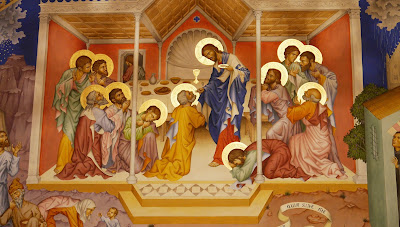
In my last visit to a certain Benedictine monastery in Italy, I saw a remarkable example of this peaceful and fruitful continuity with past tradition — such that it becomes vibrantly present anew in our midst, as our own and yet not merely our own. Living with the monks is a professional painter who is systematically painting the walls and ceilings of the monastic refectory, for the benefit of the monks and their table guests. His work is exquisite, as if the gap of centuries between us and the age of Giotto or Fra Angelico had dropped away by a miracle, and yet all the iconography in his work was requested by the community itself and appears nowhere else in just this combination of Old Testament, New Testament, and Benedictine narratives. The old, the new, the traditional and the unique come together harmoniously, as they are intended to do. Here are two photos of this artist’s just-completed work:

To problematize tradition, to imagine that our relationship with it has to be complicated, torturous, self-doubting, anxious and agonized — as if we have to make apologies or find excuses or plausible reasons to love it — is one of the gravest symptoms of modern man’s disease. He problematizes tradition to the extent that he wants it to be a problem, because he somehow thinks this will “free†him to live a more “authentic†life of his own. It is, in other words, a thirst for autonomy, for being free of precisely those bonds that perfect us as social and spiritual beings. Modern Western man often lives according to the opinion and feeling that “it’s all up to us.†But the beauty of tradition is that, fundamentally, it’s not up to us. We are in the position of receivers, not inventors or fabricators. And while we have to use our free will to receive, we can freely exercise humility and gratitude by choosing, again and again, to make good use of the treasures of theology, spirituality, and liturgy that have been handed down to us.[4] As educator Michael Platt says:
Revolutions in manners and morals often start with just one or two or a few persons saying “no†to something. Human things are often like an army in flight that will never turn until one soldier stands and fights. It is sometimes said “you can’t bring back the pastâ€, but you can, and strong ages, such as the Renaissance and the Reformation, do precisely that, revive and renew something lost, forgotten, and good.[5]
In every genuine Christian society, the spiritual aristocracy of the saints, not the technocracy of the latest experts, will be in the ruling position. This is no less true of the Church of God and her sacred liturgy.
NOTES
[1] For more thoughts along these lines, see my post: “Backwards vs. Forwardsâ€â€”What Does It Mean?
[2] What’s Wrong with the World, ch. 3.
[3] The full article is available here.
[4] Or that should have been handed down to us; we might need to practice the asceticism of finding buried treasures, because they are beautiful and because they actually do belong to us by right of inheritance. Just as it is a lack of humility and gratitude to receive from our tradition, so it is a serious dereliction of duty to fail to pass on the content of that tradition. It, too, can stem only from inflated pride and a habit of ingratitude.
[5] From his essay “A Different Drummer,” available here. I don’t know if Platt is saying that the Reformation, as such, revived and renewed good things, but certainly the age in which it took place was notable for having the strength to look to the past with confidence, although obviously, from a Roman Catholic point of view, not every attempted recovery was intelligently or appropriately done.
by William A. Torchia, Esq.
Priest: Rev. Fr. James Bartoloma
Mass Intention: Deceased Members of the Brennan Family req. by Mark Matthews
*****************
March 2016 Finances:
March 6 Income $365 Attendance: 39
March 13 Income $648 Attendance: 35
March 20 Income $251 Attendance: 39
March 27 Income $603 Attendance: 52 (36 in the pews)
Expenses: Clergy $525; Musicians $1,600; Rent $400; Candles $136.59
NET LOSS $394.59
April 2016 Finances:
April 3 Income: $274 Attendance: 36
April 10 Income: $313 Attendance: 36
April 17 Income: $212 Attendance: 32 (22 in the pews)
April 24 Income: $801 (N.B. $500 came from a single donor) Attendance: 45
Expenses: Clergy $525; Musicians $1,500; Rent $400
NET LOSS $825
**************************
A Seminarian’s Request: If anyone would like Ian’s full letter, email Fr. McKale at tlmcommunityofphila@gmail.com.
Laudetur Iesus Christus! In saecula! Amen.
My name is Ian McNally. You may recognize me as the fellow who serve at Saint Edmond’s and attends various celebrations of the traditional Mass in the greater Philadelphia area. I am excited to share a wonderful announcement with you.
Following a year and a half of visits to various oratories and conversations with numerous priests from around the world, I have been accepted into the Institute of Christ the King Sovereign Priest as a candidate for priestly formation.
Since the age of fourteen I have discerned a vocation to the priesthood and now at last I have decided to begin my formation. Last autumn, after I was concluding my travels to different seminaries across the nation, I decided to apply to the Institute. In January I received a phone call from the provincial superior. He confirmed my letter of assignment would be mailed to me in June and that it was my responsibility to search for benefactors to provide financial support for my formation.
For American seminarians, the first year of formation occurs at the oratories located in Chicago, Saint Louis, and Wausau, with each oratory receiving three to four candidates. From the second year to the seventh year seminarians reside at the International Seminary of Saint Philip Neri in Gricigliano in Tuscany. Tuition is $10,000 per year, which does not include airfare, insurance, or pocket money.
To afford the tuition of high school and university my family sacrificed more than words can describe and now it is my duty to finance my seminary education.
What I desire is to become the epitome of the priest every Catholic needs, not wants. “I give myself to God. Here is my body. Take it. Here is my blood. Take it,” says the Venerable Archbishop Fulton J. Sheen. I seek for nothing other than to contribute, however miniscule, to the exultation of the true faith over all errors, ancient and modern, and to, in the words of Institute’s motto, veritatem facientes in caritate — live the truth in charity.
If you, anyone you are acquainted with, or any organization you are familiar with would be willing adopt me financially, I would be most grateful for the support. If two hundred people were to donate fifty dollars each, one whole year would be paid for. You can find more information under the “Vocations” tab on the Institute’s website or call for assistance.
If you wish to donate, please write a personal cheque payable to the Institute of Christ the King Sovereign Priest, but do not insert my name in the memo field. Instead, on a separate piece of paper specify the cheque is for Ian McNally’s formation. Address the cheque with the accompanying note to the United States Provincial Headquarters in Chicago, the location of which can be found on the ICRSS’s website. Do not mail your check prior to mid-June. I will send out a notification should the location of my assignment alter the postal destination for personal cheques. You can call for assistance if necessary or e-mail me at McN1316@gmail.com.
Above all, please pray to Saints Benedict, Thomas Aquinas, and Francis de Sales for my soul that I might receive the graces to do the will of the heavenly Father and to die to self.
Sincerely yours in Jesus and Mary,
Ian McNally
Upcoming Masses:
A Solemn High Mass for Corpus Christi, Thursday, May 26, 2016 at 7 p.m. at the Cathedral Basilica of Ss. Peter & Paul, Philadelphia, PA;
Celebrant: Rev. Msgr. Charles Sangermano, Pastor of Holy Savior Parish, Norristown, PA; Deacon: Rev. Fr. Gerald Carey, Parochial Vicar, our Lady of Perpetual Help, Morton, PA; Subdeacon: Rev. Fr. Harold B. McKale, Parochial Vicar of Our Lady of Mount Carmel Parish, Doylestown, PA & Chaplain, Traditional Latin Mass Community of Philadelphia.
Mass Intentions:
If anyone still has unfulfilled Mass intentions, Fr. McKale can pass them on to a priest that will satisfy the intention by offering a TLM or Divine Liturgy (Byzantine). Please specify if you have a preference. The donation is $10. If you would like a Mass card, please include an extra $5 for the card. No announced Masses are presently available.
by William A. Torchia, Esq.
First Friday, May 6, A.D. 2016, Traditional Latin Mass (TLM) will be offered by Fr. Gerald Carey, Parochial Vicar of Our Lady of Perpetual Help Roman Catholic Church, at the Rectory Chapel of St. Albert The Great Parish at 7:00 p.m., preceded by Confession at 6:30 p.m. This TLM will be a Votive Mass of The Sacred Heart, offered in Reparation to The Sacred Heart of Jesus.  White Vestments.
First Saturday, May 7, A.D. 2016, Traditional Latin Mass (TLM) will be offered by Fr. James Bartoloma, Chancellor, Roman Catholic Diocese of Camden, New Jersey, at the Rectory Chapel of St. Albert The Great Parish at 9:00 a.m., preceded by Confession at 8:30 a.m. This TLM will be the Mass of Saint Stanislaus of Cracow, Bishop, Martyr, and Patron Saint of Poland, offered in Reparation to The Immaculate Heart of Mary. Red Vestments.
St. Albert The Great Parish is located at 212 Welsh Road, Huntingdon Valley, PA 19006, (T) 215-947-3500. The Rectory Chapel is in The Parish Center, behind the main Church which fronts on Welsh Road.
Mark Matthews
by William A. Torchia, Esq.
By Dr. Peter Kwasniewski of the New Liturgical Movement
 |
| Caspar David Friedrich, The Wanderer |
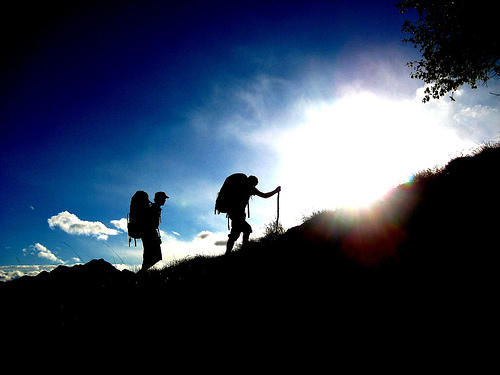
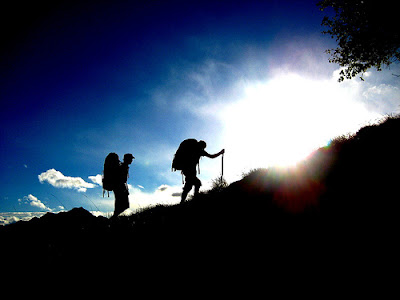
It feels easier to walk downhill than to walk uphill, but it’s much harder on the knees. It feels harder to climb uphill, but the beautiful view at the top is always worth the effort.
As hikers often experience, you will be walking along on a narrow trail, perhaps in the midst of crowded trees, thinking the small thoughts that go with one step after another, and you turn a bend and suddenly the whole world opens up in a breathtaking vista that almost makes you feel dizzy, as if the beauty might subvert your muscles. That beauty was put there by God, not by you, and yet it took your effort to reach it. We make the trails, we walk on them, but the beauty is from above; it was there before we existed and it will long outlast our mortality.
The same is true of the liturgical tradition: it is God’s gift to us, it comes before us and goes beyond us, but we must work hard to preserve it and to be worthy of it. What we absolutely must not do is think that it would be better to create an alternative “tradition†and attempt to rejoice in it — that would be like planting a giant flat screen at the end of the trail and looking at a filmed sunset.
The notion that we need to make ourselves worthy of our liturgical tradition is one that is, I’m afraid, quite unfamiliar today, because of the decades-long bad habits induced by reformers, revisers, translators, and other committee members who place themselves over and above the tradition as its superiors, its judges, its improvers, its improvisers. This is not and cannot be the attitude of one who, conscious of his own limitations and of the narrowness of any age, people, or culture in and of itself, gratefully and humbly receives a noble inheritance, rejoices in its prayer-saturated beauty and stability, and delivers it integrally to his successors — perhaps embellished with additional signs of reverence and devotion, if he has been prompted to originate them.
A Catholic who is aware of himself, who senses the smallness of his vision and the greatness of the tradition that precedes and carries him, is, in fact, relieved that he does not have to make things up as he goes along; he need not second-guess the river along which he floats. He lets himself be the ready instrument of a far greater actor, the mouth through which the same word continues to sound, the hand or foot that executes the head’s bidding. He does not fear messing up that which was whole and safe and salvific before he even came to be and which will continue long after he is gone.
Nevertheless, there is something very important that the individual, the bishop, the priest, the deacon, the religious, the layman, must contribute in order that the tradition will not die out or shrivel up. True, he does not have to invent the tradition, but neither can he ignore it or treat it lightly. He must embrace it or else it will cease to exist.[1] In a famous interview published in The Latin Mass magazine, Alice von Hildebrand addressed this issue head on:
TLM: I cannot end the interview without asking your reaction to a well-worn canard. There are those critics of the ancient Latin Mass who point out that the crisis in the Church developed at a time when the Mass was offered throughout the world. Why should we then think its revival is intrinsic to the solution?
AVH: The devil hates the ancient Mass. He hates it because it is the most perfect reformulation of all the teachings of the Church. It was my husband who gave me this insight about the Mass. The problem that ushered in the present crisis was not the traditional Mass. The problem was that priests who offered it had already lost the sense of the supernatural and the transcendent. They rushed through the prayers, they mumbled and didn’t enunciate them. That is a sign that they had brought to the Mass their growing secularism. The ancient Mass does not abide irreverence, and that was why so many priests were just as happy to see it go.[2]
The law of entropy states that, left to itself, any system will lose order, will devolve or unwind. The tendency of the material world is towards unraveling. If order cannot somehow be re-introduced, decay is unavoidable.[3]
In the little universe of the liturgy, that necessary principle of order is reverence for traditional texts, music, rubrics, and decorum, sustained by Church authority properly exercised. These things can be contributed only by living human beings who correspond with the grace of the Holy Spirit. As long as they are supplied, and where they are present, the liturgy thrives and continues along its way, undiminished. Without them, however, it is doomed to disintegration.
Liturgical decadence, deviation, and disorder are, like the natural tendency of entropy, a downhill walk for fallen man. Left to himself, left without the guidance of the tradition willed by the Holy Spirit and the example of many saints who have shown us how to walk the often grueling uphill path of fidelity, fallen man will make liturgy conform to his own whims and wants, his own programs and purposes — something easier and more damaging. It is the uphill climb that leads to the magnificent vista, the glimpse of a vast and humbling beauty that can only come from the mind of the Creator.
NOTES
[1] Along these lines, see the superb article of Joseph Shaw, “Does Tradition preserve us, or we the Tradition?”
[2] For the full text, see here; for some highlights, see here.
[3] I am aware that there is a lot more to the concept than this simplistic layman’s version of it: see here. But in the popular imagination, entropy means a continuing decrease in order, and that is the rough sense in which I am using it.