Rev. Fr. Leonard Goffine’s The Church’s Year, Available from Angelus Press
On this day and the ensuing eight days, the Catholic Church celebrates with special solemnity the Immaculate Conception of the Blessed Virgin Mary.
What does the Catholic Church understand by the Immaculate Conception?
By the Immaculate Conception she does not understand that great grace by which Mary preserved herself pure from every, even the least, actual sin; for, as concerns this, the Church has long since declared that Mary never sinned: nor does she understand by it her continual virginity, for it has been for a long time a doctrine of faith that both before and after the birth of her divine Son Mary remained a pure virgin; nor yet that she was sanctified before birth; as were the Prophets Jeremias and John the Baptist, who were both conceived in sin, but by a special grace of God were released from it before their birth; neither does she understand by it the conception of Christ from the Holy Ghost, that is, that Mary unstained conceived the Son of God of the Holy Ghost; and without the assistance of man, for this was always the unalterable doctrine of the Church: she does understand by it that exalted favor, that unshared privilege, by which the Blessed Virgin Mary, in the first moments of her conception, by a special grace and favor on the part of God in reference to the merits of Jesus, our Saviour, was preserved from every stain of original sin.
What has until now been held by the Church in regard to this privilege?
The Catholic Church has always been of the pious opinion that Mary, the blessed Mother of the Redeemer, was conceived immaculate, that her most pure soul had never from the first moment of her existence the least shadow of sin. This doctrine was embraced by all the saints, the most learned and most faithful children of the Church. We have testimony of this, as far back as the times of the apostles, in a document concerning the sufferings of St. Andrew, in which it is said: “As the first man was created from the spotless earth, so was it necessary that the perfect man (Christ Jesus) should be born of an immaculate virgin.” St. Justin, who died a martyr in the year 167 after Christ, compares the Blessed Virgin to Eve, before she sinned and while she was still a virgin. St. Amphilochus says: “He who created the first Eve free from shame, created the second without spot or stain.” Origen, one of the Fathers of the Church, writes that she was neither surprised by the personated serpent, nor infected by his poison, and calls her a pure and immaculate mother. St. Ephrem calls her the undefiled, the strong, the inviolate, the most chaste virgin, far removed from all spot and stain. The Abbot St. Sabbas says of Mary: “On thee who never took part in any guile, I place my hope. No one but thou, O Lady, is without fault, and besides’thee no one is unsullied and spotless.” St. Ambrose calls Mary a virgin who by the grace of God remained always free from all shadow of sin. St. Augustine says: “When there is mention made of sin, the Virgin of whom on account of our Lord no question is to be asked, must be excepted.” St. Proclus says, “that the holy Mother of God was made by the purest God free from all stain.” St. Fulgentius says: “The wife of the first man was led astray and her soul soiled toy the malice of sin, but in the mother of the second (Christ) the grace of God preserved the soul as well as the body inviolate.” St. Paschasius Radbertus testifies: “It is certain that Mary was free from original sin;” and St. Peter Barman says: “The flesh of the Virgin taken from Adam, would not submit to the stain of Adam,” and before him the pious Doctor Alcuin wrote of Mary: “Thou art beautiful as the moon and free from all spot and every shadow of changeableness!” And St. Ildephonsus says: “It is certain that Mary was free from original sin.” An immense number of saintly men and theologians maintained the same. Many of them argued with the greatest keenness and the most indefatigable zeal the part of the Blessed Virgin; the teachers at the universities of Paris, Salamanca, Coimbra, Naples, Cologne, Mayence, Ingolstadt, &c., made it their duty by vows to inculcate this great privilege of the most favored Virgin, and to defend it by speech and by writings. Celebrated orders of monks, especially the orders of St. Benedict, St. Francis and St. Ignatius, made it their duty to advance this pious faith of the Immaculate Conception among the people. A great number of popes and bishops also honored the Immaculate Conception, and forbade the contrary doctrine to be taught. Even kings, princes and emperors counted it a great honor to pay homage to the Immaculate Conception of the Queen of Heaven. Finally, the Catholic Church gave definite expression to this universal belief, by declaring in the Council of Trent, that in the resolutions relating to original sin, the Virgin Mary was not included, and she confirmed the festival of the Immaculate Conception, introduced in the tenth century by St. Anselm, the worthy son of the great St. Benedict, and since that time observed in all the Churches.
This veneration for the Immaculate Conception, this pious view held by the whole Catholic Church was not yet a matter of faith, that is, the Catholic Church had not yet laid down this great privilege of the Mother of God as a dogma. We were not commanded to believe it, although to preach or teach against it was forbidden. But when, in the course of time, a large number of the faithful, among whom were archbishops, bishops, whole religious orders, as well as great monarchs, besought the pope as head of the Church to pronounce concerning the Immaculate Conception of the Blessed Virgin, that is, to elevate the belief so widely spread throughout the Catholic Church to a dogma, the pope could no longer hesitate to raise his voice in regard to this most important affair.
What did the supreme pastor of the Church, the pope, then do in regard to the Immaculate Conception of the Blessed Virgin?
Pope Pius IX. who, as he himself testified, had in many ways experienced the assistance of the great Queen of Heaven, was urged by his love and childlike veneration for the Blessed Mother of our Lord, to set the last brilliant diamond in her crown of glory by declaring the Immaculate Conception an article of faith. Not wishing to be precipitate, he first addressed a circular to all the primates, patriarchs, archbishops and bishops, of the whole Catholic world, February 2, 1849, requesting them to send him reports of the devotion of their clergy and the faithful concerning the Immaculate Conception, and the extent of their desire in the matter, that the case might be decided by the Apostolic See; at the same time he urged them to pray with him that God would give him the necessary enlightenment, and to call upon the clergy and the faithful for their prayers. When this was done, five hundred bishops in different parts of the world declared that they and their flocks firmly believed that Mary, the most favored Virgin, was preserved from every stain of original sin, and that they earnestly desired that the pope might raise this pious opinion to a dogma of the Church. Then the holy father, filled with delight, invited the bishops of the different countries to Rome, to consult with him upon the matter. About one hundred and fifty bishops, and a large number of learned men and superiors of spiritual orders, met at Rome and the whole subject was once more maturely examined; and at last, the 8th of December, 1854, the day on which the Church celebrates the feast of the Immaculate Conception, was appointed as the day on which the pope, the supreme head of the Church, the mouth of the apostles, should solemnly announce the dogma of the Immaculate Conception.
On this day the holy father ascended the Apostolic Chair in the splendid Church of St. Peter at Rome, and surrounded by the assembled cardinals, archbishops, and bishops, the clergy and the people he once more invoked the light of the Holy Ghost, and amid the perfect silence which reigned in that immense church, the holy father in a loud voice and with the most profound reverence and emotion read the decree by which he solemnly pronounced and established, that:
“It is an article of faith that the Blessed Virgin Mary by a special grace and privilege of God, on account of the merits of Jesus Christ, the Redeemer of mankind, was from the first instant of her conception protected and preserved from every stain of original sin.”
Thus has the head of Catholic Christianity drawn aside the veil, which until then obscured the full glory of the Queen of Heaven, which now shines in stainless loveliness radiant over the whole world. The truth that the Blessed Virgin Mary was conceived immaculate is no longer a pious opinion, but an article of faith which every Catholic who wishes to remain a child of the Church, must profess with heart and with lips.
But, perhaps the decision of the pope concerning the Immaculate Conception is a new doctrine?
By no means; it is an old belief, established upon the holy Scriptures and laid down in the bosom of the Church, but not solemnly pronounced and made public previously. The pope cannot make a new article of faith, but he can and must announce that, as a revealed truth, which is established by the holy Scriptures and has been everywhere and at all times believed as a revealed truth by all true Christians. But if there is a truth founded on the holy Scriptures and tradition, of which the pope, the representative of Christ on earth, speaks officially, then every Catholic is bound to believe and openly to acknowledge the same. As we have already seen, the doctrine of the Immaculate Conception has been believed since the time of the apostles, and it is also established by the Scriptures. In the oldest of the sacred Books, in the Book of Genesis, (iii. 15.) is one of the most weighty passages on this subject which reads: I will put enmities between thee and the woman, and thy seed and her seed; she shall crush thy head, and thou shalt lie in wait for her heel. After the fall of the first man, God spoke to the serpent, Satan, announcing that a woman would come and crush his head, that is, destroy his power; and all Catholic interpreters and holy Fathers agree that this woman is the Blessed Virgin. Mary is, therefore, placed by God Himself as Satan’s enemy, and must have been free from original sin from the first moment of her conception, otherwise she would have been, as St. Paul, the Apostle, says, a child of God’s wrath and under the power of Satan. In the gospel of St. Luke, (i. 28.) it is further said: And the Angel being come in, said unto her: Hail full of grace: the Lord is with thee: blessed art thou amongst women. The angel, by the direction of God, called Mary full of grace, that is, more than any of the just endowed with God’s sanctifying grace, as the holy Fathers agree. But would Mary be full of sanctifying and all other graces, had she for one moment of her life been without grace and burdened with sin? Would God have permitted the Blessed Mother of His only begotten Son, from whom He received flesh, to be touched by sin, even though for an instant, and be in the power of Satan? No; God’s hand preserved her; by His grace and by the infinite merits of her divine Son she remained free from every stain of sin, and the Church most justly applies to her the words of holy Scripture: Thou art all fair, O my love, and there is not a spot in thee. (Cant. iv. 7.)
What instructive meaning has the Immaculate Conception of the Blessed Virgin for every Catholic?
The Immaculate Conception teaches Catholics to know in some measure the infinite sanctity of the holy Trinity which makes sin so hateful and detestable to Him. The Heavenly Father could not see His beloved daughter for one moment stained by sin. The Divine Son could not ‘ wish to choose for His mother a virgin upon whose soul there was a vestige of sin. The Holy Ghost whose most pure bride Mary is, was not willing that her heart, His dwelling-place, should ever be for one instant soiled by sin. Behold how God detests sin! The Immaculate Conception also teaches us the inestimable treasure of sanctifying grace. Mary received this priceless treasure from God even in the first moment of her conception, without it she would never have become the Mother of the Saviour. Thou, my Christian, hadst not this treasure at thy conception, it is true, but thou didst receive it in holy baptism; there God’s hand arrayed thee in the white garment of innocence; there He sanctified thy soul, and the Holy Ghost selected it for His dwelling-place. Mary preserved this inestimable treasure until death, she was always blooming as a pure lily, the breath of sin never soiled her loveliness. Ask thyself: Do I still possess this treasure, which was given to me in holy baptism; have I preserved my soul’s beauty from the poison of sin, have I soiled it, destroyed it, lost it? Oh, if thou hast lost this precious gift, how unhappy art thou! if thou hast had this great misfortune to have stained thy garment of baptismal innocence by sin, Mary, the peerless virgin, has borne for thee the Saviour whose precious blood cleanses from every sin, whose infinite merits will restore to thee sanctifying grace, if thou art contrite and dost confess thy sin. But for the Saviour this treasure would be forever lost to thee, and thy soul forever forfeited. But for this Saviour Mary would not have been preserved from original sin, would not have received sanctifying grace at her conception. We can here learn the necessity cf salvation through Christ, gratefully thank God who has given it to us, and praise Mary who had the grace to conceive and give birth to Him. In the Immaculate Conception, O Christian, thou canst learn to know something of the priceless value of virginity. Jesus chose a pure and immaculate virgin for His mother, who should be the mirror of all virginal souls, her most pure and immaculate image should be continually presented to the corrupted world to show how virginity is esteemed in the eyes of our Lord.
INTROIT I will greatly rejoice in the Lord, and my soul shall be joyful in my God: for He hath clothed me with the garments of salvation: and with the robe of justice He hath covered me, as a bride adorned with her jewels. (Isai. Ixi. 10.) I will extol Thee, O Lord, for Thou hast upheld me: and hast not made my Enemies to rejoice over me. f/fr.xxix.) Glory ect.
COLLECT O God, who by the Immaculate Conception of the Virgin, didst prepare a worthy habitation for Thy Son: we beseech Thee, that as Thou didst through the foreseen death of Thy same Son, preserve her from all stain, so Thou wilt also grant that we may reach Thee cleansed through her intercession. Through the same Jesus etc.
LESSON (Prov. viii. 22—35.) The Lord possessed me in the beginning of his ways, before he made any thing, from the beginning. I was set up from eternity, and of old, before the earth was made. The depths were not as yet, and I was already conceived: neither had the fountains of waters as yet sprung out: the mountains with their huge bulk had not as yet been established: before the hills I was brought forth: he had not yet made the earth, nor the rivers, nor the poles of the world. When he prepared the heavens, I was present; when, with a certain law and compass, he enclosed the depths; when he established the sky above, and poised the fountains of waters; when he compassed the sea with its bounds, and set a law to the waters, that they should not pass their limits; when he balanced the foundations of the earth. I was with him, forming all things, and was delighted every day, playing before him at all times, playing in the world; and my delights were to be with the children of men. Now, therefore, ye children, hear me: Blessed are they that keep my ways. Hear instruction, and be wise, and refuse it not. Blessed is the man that heareth me, and that watcheth daily at my gates, and waiteth at the posts of my door. He that shall find me shall find life, and shall have salvation from the Lord.
EXPLANATION AND APPLICATION This lesson is first a panegyric on the divine, uncreated Wisdom, the eternal Son of God, who at all times and before all things was with God and in God, by whom was made everything that was made, ordered and preserved; who rejoices in His works, loves them, and who admonishes man to love and imitate Him, and promises him eternal and temporal happiness. The Church causes this lesson to be read on this day, because the greater part of it can be applied to Mary; for it can truly be said of her, that she, as the most holy and excellent of all creatures, possessed the first place in the heart of God. For this reason the Church applies to her the words of the wise man: I came out of the mouth of the most High, the first-born before all creatures. (Ecclus. xxiv. 5.) For, as St. Richard says, she is the most worthy of all; no one has received so full a measure of purity, and of all supernatural gifts; in no creature are the marvels of divine goodness so visible as in her. Admire, devout soul, this master-piece of Almighty God, and make frequent use of the words of St. Chrysostom:
“Hail Mother of God and our Mother! Hail O Heaven in which God Himself dwells! O Throne of grace from which the Lord distributes His graces! Pray always to Jesus for us, that on the Day of Judgment we may receive forgiveness and eternal salvation.” GOSPEL. (Luke i. 26—28.) at that time, The angel Gabriel was sent from God into a city of Galilee, called Nazareth, to a virgin espoused to a man whose name was Joseph, of the house of David, and the virgin’s name was Mary. And the Angel being come in, said unto her: Hail, full of grace, the Lord is with thee; blessed art thou amongst women.
Why is this gospel read today?
Because it has a significant relation to the Immaculate Conception, and proclaims the great honor shown to the Blessed Virgin by these words: Hail, full of grace, the Lord is with thee; blessed art thou amongst women.
Why did the angel call Mary full of grace?
Because Mary was filled with grace, even before she came into this world; because she always increased in grace; because she was to bear the Author of all grace; that we may consider how Mary obtains for us the treasures of divine grace.
Mary was filled with grace even before her birth. As we are all conceived in sin, being children of a sinful ancestor, we are, therefore, burdened by sin before our birth. Mary was free by the privilege of the Immaculate Conception from all sin; her soul, pure and adorned with sanctifying grace, came forth from the hands of the Creator, and without the least prejudice to its purity and sanctity was united to her most pure body, from which the Saviour was to take His humanity. She could not from the first instant of her existence be wanting in that original sanctity and justice, which were the most beautiful adornments of our natural ancestress, Eve.
But Mary from the first moment of her conception was not only in grace but full of grace, because God appointed her for the highest dignity, of being the Mother of His only-begotten Son, and had consequently endowed her with the full measure of corresponding plenitude of graces and gifts of the Holy Ghost; according to the opinion of many learned men, the measure of grace which the Blessed Virgin received at her Immaculate Conception, was greater than that which all the angels and blessed possess now in glory. Mary ever increased in grace: But the path of the just, as a shining light, goeth forward and increaseth even to perfect day. (Prov. iv. 18.) These words of the Holy Ghost are verified especially in the life of the Blessed Virgin. What abundance of grace did she not receive, when the Holy Ghost overshadowed her, and the divine Son, who is Himself the infinite plenitude of grace, was conceived in her most pure body! Above all this, there yet came that rich supply of grace by which her zealous, constant, perfect and faithful cooperation made Mary increase every moment in grace. Thus St. Bonaventure says: “As all the waters meet in the sea, so all the graces were united in Mary.”
Why did the angel say to Mary: The Lord is with thee?
Because God is with the Blessed Virgin in an extraordinary manner. It is well to notice particularly, that the archangel Gabriel did not say to Mary as the angel did to Gideon: The Lord be with thee, (Judges vi. 12.) but: The Lord is with thee. These words are not, therefore, the wish that the favor, the blessing, the protection of God may be with Mary, but the positive declaration that the Lord really is with her, not simply because of His omnipotence and omnipresence by which He is with all His creatures, nor merely because of His goodness, love and intimacy by which He is with all the just. He is with her in a peculiar manner, since she by her dignity of being the Mother of God came into such close relationship with the Triune God that our intellect can conceive nothing nearer. She became the chosen Mother of the Son of God, the dearest, the most favored daughter of the Heavenly Father, and the pure, beloved bride of the Holy Ghost. “God the Father was with her,” says St. Bonaventure, “as with His most noble Daughter; God the Son was with her as with His most worthy Mother; God the Holy Ghost was with her as with His most pure Bride.”
Why did the angel say to Mary: Blessed art thou amongst women?
Because he desired to honor her as the most blessed of her sex, since she alone was chosen of all the others to be the Mother of God; because the first woman brought the curse, but Mary, the salvation of the world.
Mary, Mother of God! An honor, indeed, which in its exaltation is second only to divinity. Mary, the Virgin Mother of God! Mother and Virgin at the same time, what a wonderful prerogative! Though the greatest and most glorious of all mothers, she is the purest and most spotless of virgins, the queen of virgins.
But not only on account of her double glory as Mother of God and as a Virgin, Mary is the most blessed of her sex, but because it was given to her to mediate for us and for the whole world. She is that woman, promised to our first and sinful parents in Paradise, who would crush the serpent’s head; she gave to her Son the body with which He, by His death on the cross, accomplished the great work of salvation.
ACT OF PRAISE “Praised and blessed be the holy and Immaculate Conception of the Blessed Virgin Mary!”
(Pope Pius VI. granted an indulgence of one hundred days to those who, with contrition and devotion repeat the above act of praise.)
Friday, December 6th and Saturday, December 7th at:
Â
Church of the Immaculate Conception of the Blessed Virgin Mary
602 West Avenue
Jenkintown, PA 19046
(215) 887-1501
Confession and Mass will be upstairs both Friday and Saturday.
Â
First Friday, December 6th
Priest: Rev. Harold B. Mc Kale (Parish Vicar, Our Lady of Mount Carmel Roman Catholic Church)
Location:Â Church of the Immaculate Conception, Main Church
Time: 7:00Â p.m., preceded by Confessions upstairs at 6:30Â p.m.
This Traditional Latin Mass will be the Mass of the Sacred Heart of Jesus with a Commemoration of St. Nicholas, offered in Reparation to The Sacred Heart of Jesus.
First Saturday, December 7th
Priest: Rev. Harold B. Mc Kale (Parish Vicar, Our Lady of Mount Carmel Roman Catholic Church)
Location:Â Â Church of the Immaculate Conception, Main Church
Time: 9:00 a.m., preceded by Confessions upstairs at 8:30 a.m.
This Traditional Latin Mass will be the Mass of the Immaculate Heart of Mary with a Commemoration of St. Ambrose, offered in Reparation to The Immaculate Heart of Mary.
A certain Zita Ballinger Fletcher, writing in the National ‘Catholic’ Reporter (a notoriously not-very-Catholic publication) has written an unintentionally hilarious article attacking the traditional Mass. It alternates between statements of the obvious, presented as though they were horrifying revelations — the Latin Mass is said in Latin! The priest celebrates facing away from the people! — with bizarre non sequiturs: this form of the Mass is sexist, oppressive, and clericalist.
And worst of all, people aren’t allowed to wear red.
Fletcher is worried about division in the Church — at least, this is presumably the point of talking about the Latin Mass creating ‘sects’ — but it is she, not Catholics attached to the ancient liturgical tradition, who is causing divisions with this article. Her embittered and rather personal attack contrasts very much with the attitude of her victims. Traditional Catholics do not fill their leisure hours attacking the character of Catholics who attend the ‘Ordinary Form’. They commonly share churches and parishes with them, nearly always as the junior partner, and want nothing but to live in peace and charity. We can have theological discussions without thinking our opponents are bad people, but this is a trick Fletcher doesn’t seem to have mastered.
Although the article is itself absurd in many ways, the link Fletcher strives to establish between the traditional Latin Mass and clericalism is a familiar enough theme to warrant a response. I leave aside the question of sexism, which seems more an angry accusation against the women who attend the traditional Mass than against the men. Fletcher seems scared of the ladies wearing veils in church and writes of a female friend: ‘I still don’t understand why she wanted to associate with that group, or why she decided to give in to oppression.’ Shrieking at women that they are self-hating misogynists is a really bad look.
Fletcher does not actually explain the connection between the ancient Latin Mass and clericalism; it seems to come down to an association of ideas. The priest wears nice vestments, he has his back to the people, he prays in Latin, and — whoosh! — he has somehow acquired power. This liturgy ‘places all power in the hands of the priest’; it is used to ‘wield control over believers’. Is it a magic spell? It certainly sounds like it. The altar rail, Fletcher tells us, is ‘a barrier that gives him privileges’. How does it do that? Like a magic wand?
At one point she writes that ‘the priest is at the centre of the spectacle’. Perhaps this is how she thinks it works. But isn’t the priest at the centre of any celebration of Mass? It has often been pointed out that the fact that, after the liturgical reform, the priest can look at the people and engage with them, with eye-contact, ex tempore prayers, and informal asides, means that the Ordinary Form is far more affected by the personality of the priest than the Extraordinary Form. Pope Benedict made this point about the celebration of Mass facing the people in his The Spirit of the Liturgy. The temptation for a priest who has personal charisma to use that to draw people in can be powerful in the context of the Novus Ordo. This is problematic because the priest’s personality can obscure the message of the liturgy itself. It could even, in extreme cases, be part of a personality cult. A priest who celebrates anonymously, using only the words of the liturgy, facing away from the congregation, and wearing formal vestments that any other priest in the parish might wear is in less danger here.
Many of Fletcher’s claims are comical. She says that when they receive Holy Communion, the people kneel at the priest’s feet. To whom, then, does the priest kneel when he genuflects before so much as picking up the Consecrated Host in the Traditional Mass? To whom, again, does he make repeated confession of his sinfulness, a far more prominent feature of the older Mass than of the newer? It is not a human being who is worshipped in the Mass, but God.
Even her observation about people kneeling at Mass is bizarre. She asserts, with apparent horror, ‘all the people inside the church are expected to kneel on cue at various points’. Are there not rubrics for the laity in the Ordinary Form? As a matter of fact, these are more formalised and demanding than those in the Traditional Mass, which are no more than local customs. People are far more likely to find themselves being corralled into actions with which they are not entirely comfortable, whether it be shaking hands with an overly friendly neighbour or going up to Communion, at the Ordinary Form.
And what is this about not being allowed to wear red at Mass? I confess I am completely baffled. The most charitable interpretation I can give is that with this Fletcher has, as with so many things, got the wrong end of the stick, but of what could have been the source of this particular misconception I have no idea.
ROME, November 6, 2019 (LifeSiteNews) — Archbishop Carlo Maria Viganò is urging the re-consecration of St. Peter’s Basilica, in light of what he calls “the appalling idolatrous profanations†that have been committed in its walls through the veneration of the Pachamama statue.
In a new interview on the Amazon Synod with LifeSiteNews, Archbishop Viganò has said: “The abomination of idolatrous rites has entered the sanctuary of God and has given rise to a new form of apostasy whose seeds, which have been active for a long time, are growing with renewed vigor and effectiveness.â€
He continues: “The process of the internal mutation of the faith, which has been taking place in the Catholic Church for several decades, has seen with this Synod a dramatic acceleration towards the foundation of a new creed, summed up in a new kind of worship [cultus]. In the name of inculturation, pagan elements are infesting divine worship so as to transform it into an idolatrous cult.â€
Clergy and laity alike “cannot remain indifferent to the idolatrous acts that we witnessed,†the archbishop insists. “It is urgent that we rediscover the meaning of prayer, reparation and penance, of fasting, of ‘little sacrifices, of the little flowers, and above all of silent and prolonged adoration before the Blessed Sacrament.â€
In this in-depth interview (see full text below), we discuss with Archbishop Viganò what the “Pachamama sagaâ€Â reveals about the state of the Church and how it is the logical consequence of other “aberrant†declarations made under the current pontificate. We also talk about the synod’s final document, which he calls a “head-on strike against the divine edifice†of the Church; what the Amazon Synod reveals about “synodalityâ€; and what its organizers have accomplished.
According to Archbishop Viganò, the “Amazon paradigm†is aimed at fundamentally “transforming†the Catholic Church, is aligned with a “globalist†agenda, and “serves as a catwalk to ferry what remains of the Catholic edifice towards an indistinct universal religion.â€
“For all of us Catholics, the landscape in the Holy Church is becoming darker by the day,†he says. “If this satanic plan is successful, Catholics who adhere to it will in fact change religion, and the immense flock of Our Lord Jesus Christ will be reduced to a minority.â€
“This minority will likely have much to suffer … but with him it will conquer,†he says, concluding his remarks with the provocative, prophetic and timely words of the 14th century mystic and saint, Bridget of Sweden.
Here below is our interview on the Amazon Synod with Archbishop Carlo Maria Viganò.
LifeSiteNews: Your Excellency, how would you characterize the arc of the synod narrative? Is there an image that aptly summarizes it?
Archbishop Viganò: The barque of the Church is in the grip of a raging storm. To quell the tempest, those Successors of the Apostles who have tried to leave Jesus on the shore, and who no longer perceive His presence, have begun to invoke the Pachamama!
Jesus prophesied: “When you see the desecrating sacrilege … there will be a great tribulation, such as has not been from the beginning of the world until now, no, and never will be†(Mt 24:15;21).
The abomination of idolatrous rites has entered the sanctuary of God and has given rise to a new form of apostasy, whose seeds — which have been active for a long time — are growing with renewed vigor and effectiveness. The process of the internal mutation of the faith, which has been taking place in the Catholic Church for several decades, has seen with this Synod a dramatic acceleration towards the foundation of a new creed, summed up in a new kind of worship [cultus]. In the name of inculturation, pagan elements are infesting divine worship in order to transform it into an idolatrous cult.
What do you think is the most concerning or problematic part of the Amazon Synod’s final document?
The strategy of the entire Amazon Synod operation is deception, the preferred weapon of the devil: telling half-truths to achieve a perverse end. A lack of priests: they therefore say it is necessary to open up to married priests and to a women’s diaconate in order to destroy celibacy, first in the Amazon and then in the entire Church. On what continent was the Catholic Church’s first evangelization ever carried out by married priests? The missions in Africa, Asia, and Latin America were carried out primarily by the Latin Church, and only to a very small extent by the Eastern Churches with married clergy.
The final document of this shamefully manipulated assembly, whose agenda and results have been planned for a long time, is a head-on strike against the divine edifice of the Church, attacking the sanctity of the Catholic priesthood, and pushing for the abolition of ecclesiastical celibacy and a female diaconate.
What did the Pachamama saga reveal? And what ought to be done in response?
In Abu Dhabi, Pope Francis stated in writing that God “wills†all religions. Despite the fraternal correction offered to him in person and in writing by Bishop Athanasius Schneider, Pope Francis has ordered that his heretical declaration be taught in pontifical universities and that a special Commission be created to spread this grave doctrinal error.
Consistent with this aberrant doctrine, it’s not surprising that paganism and idolatry should also be included among the religions willed by God. The Pope has shown us this and has implemented it personally, profaning the Vatican gardens and the Church of Santa Maria in Traspontina, and desecrating St. Peter’s Basilica and the synod’s closing Mass by placing on the altar of the Confession that idolatrous “plant†that is closely connected with the Pachamama.
According to the tradition of the Church, the Church of Santa Maria in Traspontina and St. Peter’s Basilica must be re-consecrated in light of the appalling idolatrous profanations that have been committed in them.
The Pachamama saga revealed a blatant and very serious violation of the First Commandment, as well as the drift towards idolatry in a “Church with an Amazonian face.†That rite, which took place in the heart of Christianity, and which Bergoglio attended, assumes the value of an initiatory rite of the new religion. Veneration of the Pachamama is the poisonous fruit of “inculturation†at any price, and a fanatical expression of “Indian Theology.†The Synod offered a launching pad for this new syncretistic, neo-pagan church, which is dedicated to the cult of Mother Earth, to the naturalist myth of the “good savage,†and to the rejection of the Western model and lifestyle of advanced societies.
Idolatry seals apostasy. It is the fruit of the denial of the true faith. It is born of mistrust in God and degenerates into protest and rebellion. Fr. Serafino Lanzetta recently said:
To worship an idol is to worship oneself in place of God… it is to worship the anti-god who seduces and separates us from God, i.e. the devil, as can clearly be seen from the words of Jesus to the tempter in the desert (cf. Mt 4:8-10). Man cannot but adore, but he must choose whom he will adore. In tolerating the presence of idols— the Pachamama in our present context — alongside faith, it is said that religion is basically what satisfies man’s desires. Idols are always enticing because one adores what one wants and, above all, one doesn’t have to endure many moral headaches. On the contrary, idols for the most part are the sublimation of all human instincts. The real headache, however, comes when moral corruption spreads and infests the Church. An “abandonment of God†for impurity, to become prostitutes to other gods by exchanging God’s truth with lies, and by worshipping and serving creatures instead of the Creator (cf. Rom 1:24-25). It seems that St. Paul is speaking to us today. The root of this sad and tragic story is dogmatic and moral collapse.
We cannot remain indifferent to the idolatrous acts that we have witnessed and left us dumbfounded. These assaults against the holiness of our Mother Church demand from us a just and generous reparation. It is urgent that we rediscover the meaning of prayer, reparation and penance, of fasting, of the “little sacrifices, of the little flowers,†and above all of silent and prolonged adoration before the Blessed Sacrament.
Let us beg the Lord to return and speak to the heart of his Beloved Bride, drawing her back to Himself in the grace of her first and irrevocable love, after making the mistake of surrendering herself to the world and its prostitution.
What has the Amazon Synod shown us about the nature of “synodality�
The Church is not a democracy. The Synod of Bishops, since Paul VI established it with the Motu Proprio Apostolica Sollicitudo on September 15, 1965, has always dealt with problems concerning the universal Church, and has granted bishops representing all episcopal conferences wordwide the right to participate. The Synod for the Amazon did not respect this criterion.
The Church in the Amazon certainly has major problems of its own, which therefore need to be addressed at the local level. To resolve them it would have been sufficient for the Latin American bishops to have followed the recommendations that Pope Benedict XVI made to them on the occasion of his visit to Aparecida in 2007. They did not do so. Indeed, for decades many of them have allowed if not encouraged adherents of liberation theology and ideologies of largely Germanic origin, with the Jesuits on the front line, to continue to refuse to proclaim Christ as the only Savior.
“Beware of false prophets, who come to you in sheep’s clothing, but inwardly are ravenous wolves†(Mt 7:15). The situation in part of the Church in the Amazon has been a failure, partly because of the apostolic nuncios in Brazil, such as the current Secretary General of the Synod of Bishops, who proposed candidates for the episcopate such as those we saw at the Amazon Synod. By holding a Synod in Rome, instead of holding a local synod, and by inviting bishops selected from among the blindest ones to guide other blind men, was there an attempt to export and spread the disease to the universal Church?
Pope Francis uses “synodality†in a highly contradictory and minimally synodal way! “Synodality†is one of the “mantras†of the current pontificate, the magical solution to all the problems affecting the life of the Church. The much acclaimed “synodal conversion†has supplanted conversion to Christ. This is precisely why “synodality†is not the solution but the problem.
Moreover, Pope Francis seems to conceive of synodality as a one-way street: the actors, content and results are planned and directed in a targeted and unambiguous way. As a result, the synodal institution is seriously de-legitimized, and the faithful’s adherence to it is undermined.
One also has the impression that synodality is being seized and used as an instrument to break free from Tradition and from what the Church has always taught. How can true synodality exist where absolute fidelity to doctrine is absent?
Speaking at the Angelus about the recently concluded assembly, Francis said: “We walked looking into each other’s eyes and listening to one another with sincerity, without hiding the difficulties.†These words speak of a synodality exercised from below, not from Christ the Lord nor from listening to his eternal Truth. They reflect a sociological and worldly synodality that serves a merely human, ideological project.
Do you have any thoughts on how the Vatican media apparatus handled the synod? Critics say it has lost all credibility.
During the Synod we witnessed a Soviet-style communication management, with the imposition of an “official version†that almost never coincided with reality. When the evidence of lies or ambiguity was brought to light by so many courageous journalists, they denied it or denounced conspiracy.
Garments were rent, to the point of filing an official complaint, over the goddess mothers Pachamama being thrown into the miry Tiber! Then there were the usual epithets: conservative and fanatical Catholics, retrogrades who don’t believe in dialogue, people who ignore the history of the Church, according to an editorial published in Vatican News, complete with a quotation from St. John-Henry Cardinal Newman, and was favorable to the statues. Yet the Newman quote, according to which the elements of pagan origin are sanctified by their adoption into the Church, not only testifies to the bad faith of the person who used it but also backfires against him.
The Newman quote in fact highlights the substantial difference between the wise practice of Christ’s Church and the methods of the modernist apostasy. Indeed, the Roman Church, which destroyed the tyranny of demonic idols (think of the demolition of the temples of Apollo by St. Benedict or the sacred oak by St. Boniface) and established the kingdom of Christ, adopts forms of ancient pagan religion and baptizes them. The new modernists, on the other hand, who believe that God positively wills the diversity of religions, happily surrender themselves to syncretism and idolatry.
What specifically about the Church and her Faith has been put at risk or threatened by the Amazon Synod?
The Amazon Synod is part of a process that aims at nothing less than changing the Church. The pontificate of Pope Francis is studded with sensational acts aimed at undermining doctrines, practices and structures that until now have been considered consubstantial with the Catholic Church. He himself has defined this process as a “paradigm shift,†i.e., a clear break with the Church that preceded him.
With the Amazonian Synod, the utopia of a new tribalist and ecologist church has emerged on the horizon. It is the old project of that Latin American progressivism that was already confronted by John Paul II and then-Cardinal Ratzinger but never really eradicated — and now it is being promoted by the top of the Catholic hierarchy. The aim of this Synod is to move towards the definitive consecration of liberation theology in its “green†and “tribal†version.
With this Synod, as on other occasions, the Catholic Church appears to be aligned with the strategies that dominate the globalist scene and are supported by powerful forces and finance. These strategies are radically anti-human and intrinsically anti-Christian. The agenda even includes the promotion of abortion, gender ideology, and homosexualism, and it dogmatizes the theory of anthropogenic global warming.
For all of us Catholics, the landscape in the Holy Church is becoming darker by the day. The ongoing progressive offensive portends a real revolution, not only in the way the Church is understood, but also in the apocalyptic images it gives to the whole world order. With deep sadness, we see the present pontificate marked by unusual facts, disconcerting behavior and statements that contradict traditional doctrine, and which sow a general doubt in souls about what the Catholic Church is and what her true and immutable principles are. It feels as though we are in the grip of a religious chaos of gigantic proportion. If this satanic plan is successful, Catholics who adhere to it will in fact change religion, and the immense flock of Our Lord Jesus Christ will be reduced to a minority. This minority will likely have much to suffer. But it will be sustained by Our Lord’s promise that the gates of hell will not prevail against the Church, and with Him it will conquer in the Triumph of the Immaculate Heart of Mary promised by Our Lady at Fatima.
What do you think synod organizers have accomplished from their point of view? What advances have they made in their agenda?
The organizers and protagonists of the Synod have certainly achieved one of their objectives: to make the Church more Amazonian and the Amazon less Catholic. The Amazonian paradigm is therefore not the end of the transformation process at which the “pastoral-revolution†promoted by the current papal magisterium aims. It serves as a catwalk to ferry what remains of the Catholic edifice towards an indistinct Universal Religion.
The Amazonian paradigm, with its pantheistic veneration of Mother Earth and utopian interconnection between all the elements of nature, should enable (according to the theological speculations developed in the Germanic regions) the overcoming of the traditional Catholic religion through a Worldwide and Stateless Pantheon. The recent Synod has been successful in the sense of creating an Amazonian church constituted by a set of beliefs, worship, pagan-sacramental practices, liturgies that are inculturated in communion with Nature, and many married Indian clergy, with a view towards ordaining women. It is an aberrant and truly significant step in the agenda of an “out-going Church†that is busy in the process of the Great Substitution of Catholicism with Another Religion, that which glorifies Man in the place of God.
You are the former apostolic nuncio to the United States. What would you think of the laity flooding the Vatican and Apostolic Nunciatures with letters?
“The kingdom of heaven has suffered violence and men of violence take it by force.†(Mt 11:12). As Professor Roberto De Mattei invites us: “We must militarize our hearts and transform them into an Acies Ordinata. The Church is not afraid of her enemies and always wins when Christians fight. Our adversaries are united by their hatred of the good, we must unite in love for good and truth. This is not an ordinary battle but a war! It is urgent that the Catholic resistance be strongly united and visible in the face of the ongoing process of the Church’s self-demolition, also by overcoming “the many misunderstandings that often divide the field of the good and seek among these forces a unity of purpose and action, while maintaining their different legitimate identities†(De Mattei).
In this gravest of hours, the laity are certainly the spearhead of the resistance. By their courage, they must appeal to us shepherds and encourage us to come forward, with more courage and determination, to defend the Bride of Christ. The warning of Saint Catherine of Siena is addressed to us shepherds: “Open your eyes and look at the perversity of death that has come into the world, and especially into the Body of the Holy Church. Alas, may your hearts and souls burst at seeing so many offenses against God! Alas, enough silence! shout with a hundred thousand tongues. I see that, through silence, the world is dead, the Bride of Christ is pale.â€
Is there anything you wish you add?
Let us give the last word to St. Bridget of Sweden, co-patroness of Europe:
The Father spoke, while the whole host of heaven was listening, and he said:
“Before you I state my complaint that I gave my daughter to a man who torments her terribly and binds her feet to a wooden stake so that the marrow has all gone out of her feet.â€
The Son answered him: “Father, I redeemed her with my blood and betrothed her to myself, but now she has been seized by force.â€
The Father exclaimed: “My son, I share your lament, your word is mine, your works are mine. You are in me and I in you. May your will be done.â€
Then the Mother spoke, saying: “You are my God and my Lord. My body bore the limbs of your blessed Son, who is your true Son and my true Son. I refused him nothing on earth. For the sake of my prayers, have mercy on your daughter, the Church!â€
The Father replied: “Since you refused me nothing on earth, I do not want to refuse you anything in heaven. May your will be done.â€
After this, the angels spoke, saying: “You are our Lord, In you we possess every good thing, and we need nothing but you. When you chose this Bride, we all rejoiced; by now we have reason to be sad, because she has been given over into the hands of the worst of men who offends her with all kinds of insults and abuse. So have mercy on her according to your great mercy, and there is no one to console and free her but you, Lord, God Almighty.â€
Then he said to the angels: “You are my friends and the flame of your love burns in my heart. I will have mercy on my daughter, my Church, for love of your prayers.†(Revelations, Book I, Chapter 24).
Again, let us allow St. Bridget to speak:
“Know that if any pope grants priests the permission to contract carnal matrimony, he will be spiritually condemned by God … God would completely deprive that same pope of spiritual vision and hearing as well as of spiritual words and deeds. All his spiritual wisdom would become altogether frozen. Then, after his death, his soul would be thrown into hell to be tormented forever, there to become the food of demons eternally and without end. Yes, even if Pope St. Gregory himself had decreed this, he would never have obtained God’s pardon from that sentence, unless he had humbly revoked it before death†(Revelations, Book VII, 10).
Lord, have mercy on your Church, for love of our prayers and afflictions!
It is the day set apart by the Catholic Church for the special devout commemoration of all those souls who have departed this life in the grace and friendship of God, for whom we pray, that they may soon be released by God from the prison of purgatory.
What is purgatory?
Purgatory is a middle state of souls, suffering for a time on account of their sins. St. Paul writes to the Corinthians: And the fire shall try every man’s work, of what sort it is. If any man’s work abide, which he hath built there upon, he shall receive a reward. If any man’s work burn, he shall suffer loss; but he himself shall be saved, yet so as by fire. (i. Cor. in. 13-15.) “And when St. Paul,” says St. Ambrose (Serm. 20. in Ps. cxviii.) “says, yet so as by fire, he shows that such a man indeed becomes happy, having suffered the punishment of fire, but not, like the wicked, continually tormented in eternal fire.” St. Paul’s words, then, can only be understood to refer to the fire of purification, as the infallible Church has always explained them.
Are the heretics right in denying that there is such a place of purification as purgatory?
By no means, for by such denial they oppose the holy Scriptures, tradition and reason. The holy Scriptures teach that there is a purgatory: it is related in the Second Book of Machabees, that Judas Machabeus sent twelve thousand drachms of silver to Jerusalem, to be used in the temple, to obtain prayers for those who fell in battle, for he believed it a good and wholesome thought to pray for the dead, that they may be loosed from their sins. But for what dead shall we pray? Those in heaven do not require our prayers; to those in hell they are of no avail; we must then pray for those who are in the place of purification. Christ speaks of a prison in the future life, from which no man comes out until he has paid the last farthing. (Matt. v. 25, 26.) This prison cannot be hell, because from hell there is never any release; it must be then a place of purification. Again Christ speaks of sin which shall be forgiven neither in this world nor in the next, (Matt. xii. 32.) from which it follows that there is a remittance of some sins in the next world; but this can be neither in heaven nor in hell, consequently in purgatory. As the council of Trent says, (Sess. 6. c. 30.) the Church has always taught, according to the old tradition of the Fathers, in all her councils, that there is a purgatory, and every century gives proofs of the continual belief of all true Christians in a purgatory. Finally, man’s unblinded reason must accept a purgatory; for how many depart this earth before having accomplished the great work of their own purification? They cannot enter heaven, for St. John tells us: There shall not enter into it any thing defiled. (Apoc. xxi. 27.) The simple separation of the soul from the body does not make it pure, yet God cannot reject it as He does the soul of the hardened sinner in hell; there must then be a middle place, a purgatory, where those who have departed not free from stain, must be purified. See how the doctrine of the Church, reason and the holy Scriptures all agree, and do not let yourself be led away by false arguments from those who not only believe in no purgatory, but even in no hell, so that they may sin with so much more impunity.
For what, how much, and for how long must -we suffer in purgatory?
Concerning this the Church has made no decision, though much has been written by the Fathers of the Church on the subject. Concerning the severity of the punishment in purgatory, St. Augustine writes: “This fire is more painful than any that man can suffer in this life.” This should urge us to continual sanctification and atonement, so that we may escape the fearful judgment of God.
How can -we aid the suffering souls in purgatory?
St. Augustine writes: “It is not to be doubted that we can aid the souls of the departed by the prayers of the Church, by the holy Sacrifice of the Mass, and by the alms which we offer for them.” The Church has always taught that prayers for the faithful departed are useful and good, and she has always offered Masses for them.
What should urge us to aid the suffering souls in purgatory?
1. The consideration of the belief of the Church in the communion of saints, by which all the members of the Church upon earth, in heaven, and in purgatory are united by the bonds of love, like the members of one body, and as the healthy members of a body sympathize with the suffering members, seeking to aid them, so should we assist our suffering brethren in purgatory. 2. The remembrance that it is God’s will that we should practice charity towards one another, and that fearful judgments are threatened those who show no charity to a brother in need, together with the recollection of God’s love which desires that all men should be happy in heaven. 3. We should be urged to it by love for ourselves, for if we should be condemned to the pains of purification, we would assuredly desire our living brethren to pray for us and perform good works for our sake, while the souls who have found redemption, perhaps through our prayers, will not fail to reward us by interceding for us.
Can we aid the souls in purgatory by gaining indulgences?
Yes, for indulgences, (as explained in the Instruction on the eighteenth Sunday after Pentecost,) are a complete or a partial remittance of the temporal punishment due to sin, bestowed by the Church to penitent sinners from the treasury of the merits of Christ and His saints. If we gain such a remittance, we can apply it to the souls in purgatory. Such an indulgence, however, can be transferred only to one soul.
For which souls should we pray?
We should, on this day especially, offer prayers and good works for all the faithful departed, but particularly for our parents, relations, friends and benefactors; for those who are most acceptable to God; for those who have suffered the longest, or who have the longest yet to suffer; for those who are most painfully tormented; for those who are the most forsaken; for those who are nearest redemption ; for those who are suffering on our account; for those who hope in our prayers; for those who during life have injured us, or been injured by us; and for our spiritual brethren.
When and by what means was this yearly commemoration of the departed introduced into the Church?
The precise time of its introduction is not known. Tertullian (A. D. 160) writes that the early Christians held a yearly commemoration of the faithful departed. Towards the end of the 10th century St. Odilo, Abbot of the Benedictines at Cluny, directed that the yearly commemoration of the faithful departed should be observed on the 2nd of November with prayers, alms and the Sacrifice of the Mass, which time and manner of celebration spread through various dioceses, and was officially confirmed by Pope John XIX. This day was appointed that, having the day previously rejoiced at the glory of the saints in heaven, we might on this day most properly pray for those who are yet doing penance for their sins and sigh in purgatory for their redemption.
The Introit of this day’s Mass as of all Masses for the dead reads: Eternal rest give to them, O Lord: and let perpetual light shine upon them. A hymn, O God, becometh Thee in Sion; and a vow shall be paid to Thee in Jerusalem: hear my prayer; all flesh shall come to Thee. Eternal rest give to them, O Lord: and let perpetual light shine upon them.
COLLECTO God, the Creator and Redeemer of all the faithful, grant to the souls of Thy servants departed the remission of all their sins: that through pious supplications they may obtain the pardon which they have always desired. ! Who, livest &c.
EPISTLE(i. Cor. xv. 51-57.) BRETHREN, behold, I tell you a mystery: we shall all indeed rise again, but we shall not all be changed. In a moment, in the twinkling of an eye, at the last trumpet: for the trumpet shall sound, and the dead shall rise again incorruptible: and , we shall be changed. For this corruptible must put on incorruption, and this mortal must put on immortality. And when this mortal hath put on immortality, then shall come to pass the saying that is written: Death is swallowed up in victory. O death, where is thy victory? O death, where is thy sting? Now the sting of death is sin: and the strength of sin is the law. But thanks be to God, who hath given us the victory through our Lord Jesus Christ.
GOSPEL(John v. 25-29.) At that time, Jesus said to the multitudes of the Jews: Amen, amen, I say unto you, that the hour cometh, and now is, when the dead shall hear the voice of the Son of God: and they that hear shall live. For as the Father hath life in himself, so he hath given to the Son also to have life in himself: and he hath given him power to do judgment, because he is the Son of man. Wonder not at this, for the hour cometh wherein all that are in the graves shall hear the voice of the Son of God: and they that have done good things shall come forth unto the resurrection of life: but they that have done evil, unto the resurrection of judgment.
The Epistle and Gospel of this day speak of the resurrection of all men and of the judgment, when every one according as he has lived, sinful and impenitent, or pure and innocent, will receive an eternally miserable or an eternally happy life. Purgatory will then end and there will be only heaven and hell. It remains with us to choose which of these two we shall possess.
At the Offertory of the Mass the priest prays:
O Lord Jesus Christ, King of Glory, deliver the souls of all the faithful departed from the pains of hell and from the deep pit: deliver them from the mouth of the lion, that hell may not swallow them up, and they may not fall into darkness: but may the holy standard-bearer, Michael, introduce them to the holy light: which Thou didst promise of old to Abraham and to his seed. We offer to Thee, O Lord, sacrifices and prayers: do Thou receive them in behalf of those souls whom we commemorate this day. Grant them, O Lord, to pass from death to that life which Thou didst promise of old to Abraham and to his seed.
We may profitably and devoutly repeat the following as often as we pass a graveyard.
V. From the gates of hell, R. Deliver their souls, O Lord. V. Eternal rest give to them, O Lord, R. And let perpetual light shine upon them. V. May they rest in peace, R. Amen. V. May the souls of all the faithful departed through the mercy of God rest in peace, R. Amen.
I sent our announcement early this month, and so wanted to remind you that we will be having the Traditional Latin Mass on Friday evening at 7:00 p.m. and on Saturday morning at 9:00 a.m. at Immaculate Conception in Jenkintown.
Â
Friday’s Mass will be in the Church; there has been a change of plans for Saturday, and Mass will be held in the Chapel downstairs.  Confessions will be held upstairs both days, 30 minutes before Mass.
First Friday & First Saturday Traditional Latin Masses for Philadelphia.
Please remember that Mater Ecclesiae Roman Catholic Church in Berlin, N.J. also has these Masses, and for some is closer than Jenkintown. Check their site for specific information: http://www.materecclesiae.org/
Mass Schedule for October 2019:
The Traditional Latin Mass will be offered on
Friday, October 4th and Saturday, October 5th
at:
Church of the Immaculate ConceptionÂ
of the Blessed Virgin Mary
602 West Avenue
Jenkintown, PA 19046
(215) 887-1501
Confession and Mass will be upstairs both Friday and Saturday.
First Friday, October 4th
Priest: Rev. Harold B. Mc Kale (Parish Vicar, Our Lady of Mount Carmel Roman Catholic Church
Location:Â Church of the Immaculate Conception, Main Church
Time: 7:00Â p.m., preceded by Confessions upstairs at 6:30Â p.m.
This Traditional Latin Mass will be the Mass of the Sacred Heart of Jesus, with a Commemoration of St. Francis of Assisi, offered in Reparation to The Sacred Heart of Jesus.
First Saturday, October 5th
Priest: Rev. Harold B. Mc Kale (Parish Vicar, Our Lady of Mount Carmel Roman Catholic Church
Location:Â Â Church of the Immaculate Conception, Main Church
Time: 9:00 a.m., preceded by Confessions upstairs at 8:30 a.m.
This Traditional Latin Mass will be the Mass of the Immaculate Heart of Mary, with a Commemoration of St. Placidus and His Companions, offered in Reparation to The Immaculate Heart of Mary.
For further information, contact Mark Matthews or Pamela Maran at (215) 947-6555.
The traditional title of today’s feast is “The Dedication of St Michael the Archangelâ€, a term already found in the 8th century Lectionary of Wurzburg, the oldest of the Roman Rite that survives, and in the ancient sacramentaries. The Martyrology erroneously refers this feast to the dedication of the famous shrine of St Michael on Mt Gargano in the Italian region of Puglia, following a medieval tradition attested by William Durandus at the end of the 13th century. In reality, the title comes from the dedication of a church off the via Salaria, about seven miles from the gates of Rome, sometime before the 7th century, and remained in use long after the basilica itself fell completely to ruin. The traditional Ambrosian liturgy, which borrowed the feast from Rome, has in a certain sense actually preserved the memory of its origin better than the Roman Rite itself; not only does it use the Roman name, but it also takes several of the Mass chants, as well as the Epistle and Gospel, from the common Mass for the dedication of a church.
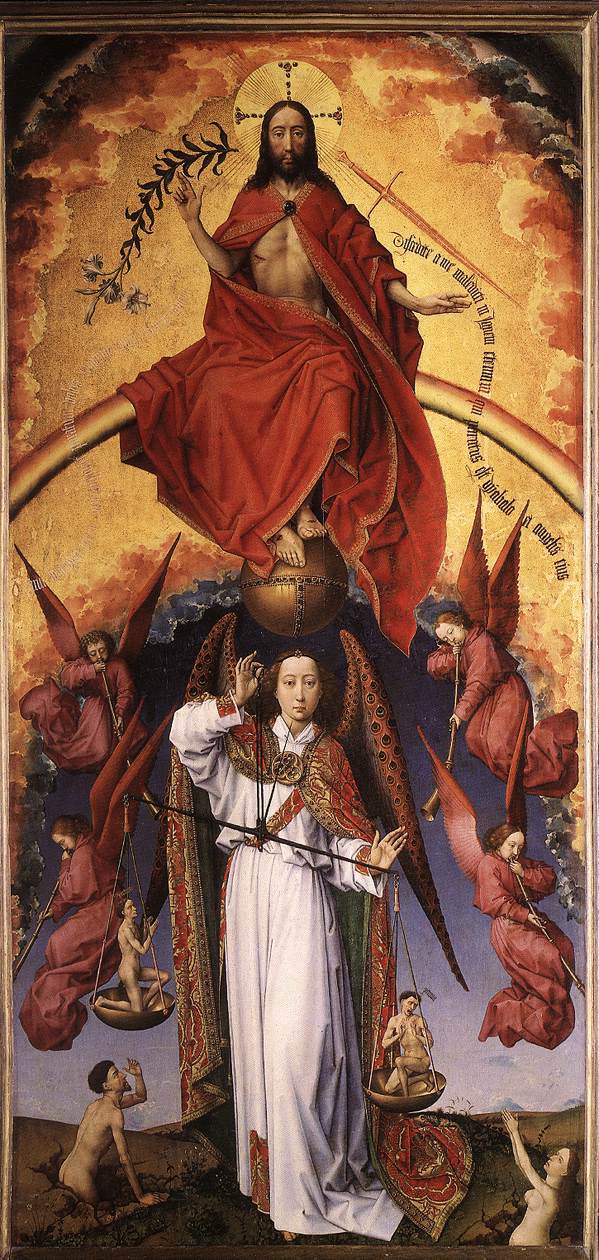
The central panel of The Last Judgment, by Rogier van der Weyden, 1446-52, showing Christ above, and below, St Michael weighing the souls of the dead.
Despite the fact that the feast’s title refers specifically only to St Michael, September 29th is really the feast of all the Angels, as stated repeatedly in the texts of both the Office and Mass. The Introit is taken from Psalm 102, “Bless the Lord, all ye his angels: you that are mighty in strength, and execute his word, hearkening to the voice of his orders.â€
This text is repeated in part in the Gradual.
The Communion is taken from the Old Latin version of the canticle Benedicite, “Bless the Lord, ye angels of the Lord: sing a hymn, and exalt him above all forever.â€
The collect of the Mass makes no reference to St Michael at all: “O God, who in wondrous order assign the duties of Angels and of men: mercifully grant that our life on earth be guarded by those who continually stand in Thy presence and minister to Thee in heaven.â€
The Lauds hymn of the Office speaks in its first stanza of all the Angels, and in the following three of Ss Michael, Gabriel and Raphael, the only Archangels specifically named in the Bible. In the Greek version of the book of Tobias, however, St Raphael refers to himself as “one of the seven holy Angels, who present the prayers of the saints, and who go in before the glory of the Holy One.†(12, 15); this gave rise to a Byzantine custom of depicting seven Archangels standing together around the Lord. Many icons of this motif give names to the remaining four from various apocryphal sources; one is called Uriel, who is mentioned several times in the Book of Enoch which St Jude quotes in his epistle (verses 14-15). The names of the remaining three are not the same in all sources; in the 19th century Russian icon seen below, they are given as Jegudiel, Selaphiel and Barachiel.
In the Middle Ages, many places imitated the Roman custom of celebrating a second feast of St Michael, commemorating the famous apparition which lead to the building of the shrine on Mt Gargano. In northern Europe, however, we find instead the feast of “St Michael on Mount Tumbaâ€, the Latin name of the celebrated Mont-St-Michel, as for example in the Use of Sarum. A votive Mass of all the Angels was already in use in the early ninth century, as attested by Alcuin of York, and is present among the votive Masses in every medieval missal. However, only very rarely does one find a feast of St Gabriel or of the Guardian Angels in the pre-Tridentine period; a Mass of St Raphael is sometimes found among the votive Masses especially to be said for the sick, but I have seen no reference to an actual feast day for him in the Medieval period.
In the year 1670, Pope Clement X added to the general Calendar of the Roman Rite a feast of the Guardian Angels, which had been granted to the Austrian Empire by Paul V at the beginning of the century. The feast was kept in some places on the first Sunday of September, but the common date, October 2, was chosen as the first free day after the feast of St Michael.
The Three Archangels and Tobias, by Francesco Botticini, 1470
Pope Benedict XV, who reigned from 1914 to 1922, took a particular interest in devotion to the Angels. At the end of 1917, he raised the feast of St Michael to the highest grade, double of the first class, along with the March 19 feast of St Joseph. In 1921, he added the feasts of Ss Gabriel and Raphael to the general Calendar, the former on the day before the Annunciation, the latter on October 24 for no readily apparent reason. The feast of St Michael’s Apparition was removed from the General Calendar in 1960; in the post-Conciliar liturgical reform, Ss Gabriel and Raphael have been added to September 29th, and their proper feasts suppressed.