What Bugnini Was Thinking When He Destroyed the Catholic Mass
by Dr. Peter Kwasniewski
In G.K. Chesterton’s story “The Queer Feet,†Father Brown says:
A crime is like any other work of art. Don’t look surprised; crimes are by no means the only works of art that come from an infernal workshop. But every work of art, divine or diabolic, has one indispensable mark — I mean, that the centre of it is simple, however much the fulfilment may be complicated. Thus, in Hamlet, let us say, the grotesqueness of the grave-digger, the flowers of the mad girl, the fantastic finery of Osric, the pallor of the ghost and the grin of the skull are all oddities in a sort of tangled wreath round one plain tragic figure of a man in black. [i]
This passage came to my mind when reading the newly translated recent biography Annibale Bugnini: Reformer of the Liturgy (Angelico Press, 2018) by the prolific and well respected French historian Yves Chiron. The wide-ranging liturgical reform that took place in the Catholic Church predominantly between the years 1950 and 1975 was, indeed, like Hamlet, a complicated business, involving hundreds of bishops and experts, several popes, an ecumenical council, and countless publications, but at the center of it stood “one plain tragic figure of a man in black†— or perhaps we might say black with red piping: Msgr. (later Archbishop) Annibale Bugnini, a Vincentian priest who was one of the few men who had a hand in this quarter-century reform from its beginning nearly to its end.
Those who have heard of Annibale Bugnini (1912–1982) tend to think of him either as an evil schemer bent on the destruction of the Catholic Faith or as a talented bureaucrat who smoothly guided a complex liturgical reform to its happy conclusion. This book, which is well researched yet mercifully compact for a modern biography, portrays a more complex and human figure. That he was totally convinced of and consistently acted upon various rationalist and pastoral theories about how liturgy “ought to be†is indisputable, and this book provides copious documentation of it, but not all of his ideas were welcomed by those in authority, and he did eventually run afoul of the pope to whose itching ear and promulgating pen he had enjoyed such uninhibited access.
Through Chiron’s book we become acquainted with the life of a man who was singularly influential in marshaling the forces necessary for an unprecedented revision of Roman Catholic worship. One sees how it came about, step by step, pope by pope, committee by committee, book by book. It is truly one of the most astonishing stories in the history of Catholicism, and one about which Henry Sire rightly quips: “The story of how the liturgical revolution was put through is one that hampers the historian by its very enormity; he would wish, for his own sake, to have a less unbelievable tale to tell.â€[ii] With Chiron patiently taking the reader through the phases of Bugnini’s life and activity, the tale becomes a little less unbelievable, albeit no less an enormity, as each daring maneuver leads to a new opening, a new opportunity, and new changes [iii].
Was Bugnini a mastermind, one of those rare Faustian individuals who singlehandedly change the course of history, or was he a small-minded ideologue and opportunist? The evidence presented in this biography tends to support the latter. Additional evidence not discussed by Chiron lends support to the same interpretation. In a memorable address in Montreal, Canada in 1982, Archbishop Lefebvre shared the story of a meeting he attended with other superiors general in Rome in the mid-1960s:
I had the occasion to see for myself what influence Fr. Bugnini had. One wonders how such a thing as this could have happened at Rome. At that time immediately after the Council, I was Superior General of the Congregation of the Fathers of the Holy Ghost and we had a meeting of the Superiors General at Rome. We had asked Fr. Bugnini to explain to us what his New Mass was, for this was not at all a small event. Immediately after the Council talk was heard of the ‘Normative Mass’, the ‘New Mass’, the ‘Novus Ordo’. What did all this mean? …
Fr. Bugnini, with much confidence, explained what the Normative Mass would be; this will be changed, that will be changed and we will put in place another Offertory. We will be able to reduce the communion prayers. We will be able to have several different formats for the beginning of Mass. We will be able to say the Mass in the vernacular tongue. …
Personally I was myself so stunned that I remained mute, although I generally speak freely when it is a question of opposing those with whom I am not in agreement. I could not utter a word. How could it be possible for this man before me to be entrusted with the entire reform of the Catholic Liturgy, the entire reform of the Holy Sacrifice of the Mass, of the sacraments, of the Breviary, and of all our prayers? Where are we going? Where is the Church going?
Two Superiors General had the courage to speak out. One of them asked Fr. Bugnini: “Is this an active participation, that is a bodily participation, that is to say with vocal prayers, or is it a spiritual participation? In any case you have spoken so much of the participation of the faithful that it seems you can no longer justify Mass celebrated without the faithful. Your entire Mass has been fabricated around the participation of the faithful. We Benedictines celebrate our Masses without the assistance of the faithful. Does this mean that we must discontinue our private Masses, since we do not have faithful to participate in them?â€
I repeat to you exactly that which Fr. Bugnini said. I have it still in my ears, so much did it strike me: “To speak truthfully, we didn’t think of that,†he said!
Afterwards another arose and said: “Reverend Father, you have said that we will suppress this and we will suppress that, that we will replace this thing by that and always by shorter prayers. I have the impression that your new Mass could be said in ten or twelve minutes or at the most a quarter of an hour. This is not reasonable. This is not respectful towards such an act of the Church.†Well, this is what he replied: “We can always add something.†Is this for real? I heard it myself. If somebody had told me the story I would perhaps have doubted it, but I heard it myself. [iv]
When we read an account like this, we are tempted to think it an exaggeration. Chiron’s careful, almost surgical examination of original documents proves that it is nothing of the kind. While studiously avoiding romanticization or caricature, Chiron paints a portrait of his protagonist that harmonizes with such accounts as Lefebvre’s, or that of Bouyer in his Memoirs. Bugnini was indeed an adroit manager, manipulator, massager, and messenger. He knew how to gather an “all-star†team that would work in the direction he thought best. He knew how to win over the pope to his ideas. He knew when to speak up and when to keep silent. To take one example, he urged the preconciliar preparatory commission on liturgy not to put forth too many radical ideas lest their entire project of reform be shot down; it was enough, Bugnini said, to offer general innocuous-sounding indications and to fill out the details later in committee work.
The term “Machiavellian†might have to be excluded only because there is no smoking-gun evidence of malice. Rather, Bugnini is that oddest of odd figures: the seemingly well intentioned Machiavellian who stifles his opponents because they are obviously wrong and he is obviously right.
In his delightful novella Rasselas, Samuel Johnson places on the lips of one of his characters advice that could have been custom-made for Bugnini: “Do not therefore, in thy administration of the year, indulge thy pride by innovation; do not please thyself with thinking that thou canst make thyself renowned to all future ages by disordering the seasons. The memory of mischief is no desirable fame.â€
In this swift-moving biography, which is rich with details but never gets bogged down in minutiae, Chiron shows us what made Bugnini “tickâ€: a one-track obsession with “active participation,†understood as rational comprehension of verbal data, and, as a corollary, the need for a radical simplification of liturgical forms to meet the straightforward, efficient modern Western man. To this goal, everything else was to be subordinated: all ecclesiastical traditions were so much flotsam and jetsam compared to the pastoral urgency of immediate conveyance of Vatican II-flavored content. This explains why Latin had to give way to vernacular, why complex language had to be broken down into bite-sized chunks, why elaborate prayers and ceremonies had to be abbreviated or abolished, why the priest should interact familiarly with the people rather than fulfilling a distinct hieratic role, why Gregorian chant had to be sidelined in favor of popular songs, and so forth.
In a way, it all “makes sense,†just as Cartesianism “makes sense†to one who rejects the possibility of knowing any reality other than the mind, or as Freudianism “makes sense†to one who is already disposed to evaluating situations for their sexual exploitability, or as deconstructionism “makes sense†to one who rejects the possibility of meaning.
How very different, indeed contrary, to the postconciliar project of building the first liturgy of moderns, by moderns, for moderns, is the attitude we meet in the memoirs of Cardinal Ratzinger, speaking of his youthful discovery of the riches of the liturgy:
It was a riveting adventure to move by degrees into the mysterious world of the liturgy, which was being enacted before us and for us there on the altar. It was becoming more and more clear to me that here I was encountering a reality that no one had simply thought up, a reality that no official authority or great individual had created. This mysterious fabric of texts and actions had grown from the faith of the Church over the centuries. It bore the whole weight of history within itself, and yet, at the same time, it was much more than the product of human history. Every century had left its mark upon it. … Not everything was logical. Things sometimes got complicated, and it was not always easy to find one’s way. But precisely this is what made the whole edifice wonderful, like one’s own home. [v]
* * *
I would like to comment here on the conspiracy theory that will forever cling to Bugnini — namely, that he was a Freemason, and that the liturgical reform was a Masonic plot to undermine the Church from within. With the patient precision of the historian, Chiron looks at every piece of available evidence and reaches the conclusion that it is impossible to say with certainty whether Bugnini was or was not a Freemason; evidence adequate to a conviction is wanting. He mentions that the accusation arose from someone “highly placed†in the Church’s hierarchy; he quotes Bugnini’s indignant testimonies that he never had, nor dreamt of having, anything to do with a secret society, and there it stands, a classic case of contrary assertions with no way (yet) of proving one side or the other right [vi]. Some readers will, perhaps, be disappointed, as they might have expected research to return a definite verdict. But there are two things to be said about this matter.
First, in the intriguing foreword, we learn of a 1996 interview in which Dom Alcuin Reid asked Cardinal Stickler if he believed that Bugnini was a Freemason and if this was the reason Paul VI dismissed him. “No,†the cardinal replied, “it was something far worse.†But His Eminence declined to reveal what the “far worse†was — and, frankly, the concept of something “far worse†than a Freemason opens frightening vistas of imagination.
Second, let us assume for the sake of argument that Bugnini was just who he said he was, and just as he appears from the historical record — a “lover and cultivator of the liturgy,†as it seemed to him. In some ways, this is the most depressing of all scenarios. One might almost have more respect for Bugnini if he had operated by some grand plan to demolish the liturgy of the ages and replace it with a mechanism brilliantly contrived to undermine Catholicism, if he had been an apostate infiltrator whose only goal was wreaking havoc on the central nervous system of the Church. We are looking for a Professor Moriarty who orchestrates the underworld. But if it turns out that he was an earnest, hardworking, small-minded man, won over by the rhetoric of the Liturgical Movement, incapable of self-doubt in the wee hours of the night, utterly blind to the world-shifting implications of what he was doing, a diligent functionary with half-baked ideas and the stubbornness to push them along at every opportunity, then we enter into the soulless gray world of Hannah Arendt’s “banality of evil†[vii]. We are looking at the equivalent of the SS officer who killed Jews in concentration camps because it seemed like the conscientious fulfillment of his duty to the State, under lawful commands from above.
Perhaps, in the end, the irrepressible urge to make Bugnini a Freemason, with or without sufficient evidence (“surely he must have been…â€), is a defense mechanism against having to face up to the possibility that he was sincerely service-oriented as he went about dismantling twenty centuries of organically developed liturgy. That is not to say he always used pure means; he was adroit and clever at getting his way and willing to bend the truth. But he always felt he was in the right, that such a great and difficult end justified whatever means it took to reach it, and that someday everyone would come around to his point of view.
Few managers in the history of bureaucracies have ever been so mistaken. Baptized Catholics today fall into three groups: the majority, who are fallen away and attend no liturgy, or who would lightly skip a Mass to attend sonny’s soccer game; practicing Catholics, who, aware of no alternative, dutifully attend the Bugnini Mass, taking the scraps that fall from the table of plenty; and a sizeable minority who, despite differences among themselves, adhere energetically to the traditional Roman Catholic liturgy. This is not the future Bugnini dreamt of — if, indeed, he permitted himself the luxury of dreaming, in the midst of journals, conferences, meetings, audiences, and correspondence.
A clever poet has written:
In Rome they should have known him by his name:
the enemy descending with his brutes.
But to our guardians’ eternal shame,
the harried faithful know him by his fruits. [viii]
When I finished Chiron’s Bugnini, I leaned back in my chair and thought wistfully about the momentous period its pages brought before my eyes — how outdated, how stale, how empty it all seems today, when it lives on in a legacy that stimulates about the same level of enthusiasm as Victorian sentimental kitsch. Bugnini’s life had been spent in a sleepless effort to bring the Church “up to date,†to make her an equal partner with modernity at last, in a bid to conquer the culture — and now look at the smoking remains, the boarded up churches, the indifferent and ignorant laity, the infant-slaying Cuomos and Pelosis, the liturgy that bores to tears, the pope afflicted with heretical logorrhea. It is not the Church that engaged modernity, but modernity that colonized the Church, reducing her to a state of vassalage. Without explicitly intending to do so in this book, Chiron helps us to see why Catholic traditionalism (or traditional Catholicism, if you prefer) is, in fact, the only way forward out of this pit of despair.
What the modern liturgists who fawn on Bugnini don’t get — and really need to have spelled out for them like little children — is this:
We do not welcome the postconciliar liturgical reforms, and we will never sing their praises. You cannot force us to like them; you cannot even force us to celebrate them. We think they were the project of an insane arrogance, acting on faulty principles and yielding shameful results. We distrust the people who ran the Consilium, especially Bugnini, and no matter how many purple-faced prelates stand up and haughtily proclaim: “It was the will of the Holy Spirit†or “It was the dictate of the Second Vatican Council†or “It was promulgated by Paul VI,†we will always hold to the great liturgical tradition that developed organically from St. Peter, St. Damasus, St. Gregory the Great to the twentieth century, and our numbers will continue to grow, even as dioceses consolidate parishes, sell off churches, and bleed out legal damages. The enthusiastic liturgists of the ’60s and ’70s are the aging nostalgics of today, as the Church increasingly splits into those who take established dogma, tradition, and liturgy seriously and those who would modernize them to the point of dissipation.
Readers are in Chiron’s debt — and readers of English, in John Pepino’s debt — for such a polished and professional biography of a key figure in the corporate remodeling of the Church of Today. This biography does not temper our instinctive revulsion, but rather feeds and focuses it.
To Bugnini, we say again, Bugni-no.
[i] G. K. Chesterton, “The Queer Feet,†in The Complete Father Brown (New York: Penguin, 1981), 51.
[ii] H. J. A. Sire, Phoenix from the Ashes (Kettering, OH: Angelico Press, 2015), 251. I have said it before and I will say it again: the chapter “The Destruction of the Mass†in this book, pp. 226–86, is simply the best concise account I have seen anywhere of what was done to the Mass in the liturgical reform, why, and how.
[iii]Â In my opinion, the one who comes off as the worst villain in the story is Paul VI. Chiron has written a biography of Paul VI, too, which is currently being translated into English.
[iv]Â From a conference given by Archbishop Lefebvre in 1982. The full text may be found at https://www.sspxasia.com/Documents/Archbishop-Lefebvre/The-Infiltration-of-Modernism-in-the-Church.htm.
[v] Milestones: Memoirs 1927–1977, trans. Erasmo Leiva-Merikakis (San Francisco: Ignatius Press, 1998), 19–20.
[vi] Chiron notes that there are some private journals and papers that are still jealously guarded by Bugnini’s literary executors. One wonders if such texts will ever come to light.
[vii] Arendt says this about Eichmann: “Despite all the efforts of the prosecution, everybody could see that this man was not a ‘monster,’ but it was difficult indeed not to suspect that he was a clown. And since this suspicion would have been fatal to the entire enterprise [of his trial], and was also rather hard to sustain in view of the sufferings he and his like had caused to millions of people, his worst clowneries were hardly noticed and almost never reported†(Eichmann in Jerusalem: A Report on the Banality of Evil [New York: Penguin Classics, 2006], 54).
[viii]Â Mark Amorose, City under Siege: Sonnets and Other Verse (Kettering, OH: Angelico Press, 2017), 34. This little book of lovely and witty poems deserves to be better known.
Dr. Peter Kwasniewski, Thomistic theologian, liturgical scholar, and choral composer, is a graduate of Thomas Aquinas College and The Catholic University of America. He has taught at the International Theological Institute in Austria; the Franciscan University of Steubenville’s Austria Program; and Wyoming Catholic College, which he helped establish in 2006. Today he is a full-time writer and speaker on traditional Catholicism, writing regularly for OnePeterFive, New Liturgical Movement, LifeSiteNews, and other websites and print publications. He has published eight books, the most recent being John Henry Newman on Worship, Reverence, and Ritual (Os Justi Press, 2019). Visit his website at www.peterkwasniewski.com.
May 4, 2020 No Comments
Why the “Reform of the Reform†Is Doomed
The question may reasonably be asked: why, after fifty years in which the Novus Ordo has been given ample opportunity to “prove its worth†and has singularly failed to do so — years in which a minority of strong-willed priests, attempting to turn the tide against banality and irreverence, have for their pains been sent to the boondocks, if not the shrink’s couch — why are there still liturgically minded people defending the Novus Ordo or promoting its “redemption†through Ratzingerian improvements?
One can understand a pessimistic pragmatist who believes there’s no other show on the road (even if he would be mistaken in this post-Summorum world, where thinking outside the box has become legal — not that it could ever fail to be legal by natural and divine justice), but it is harder to understand the optimistic idealist who believes that this particular song-and-dance routine deserves to run another fifty years, with careful tweaks to the casting and the pit orchestra.
Perhaps we are dealing here with the final fumes of the conservative attitude or mentality, which I would characterize as follows: “Whatever the Church gives us must be the best for us — or, at very least, adequate for us, and what we need at this time in history.â€
But this is quite incorrect.
- What the Church gives us is, and can only be, her tradition. Violence done by churchmen working overtime to suppress or blenderize Catholic tradition is another story. What churchmen have given us in the liturgical reform is clearly not the best for us — neither in how it was produced nor in what it contains and presents, nor in how it was rolled out and implemented. There was massive rupture in all of these ways. There is almost no one left at this point who would defend the view, redolent of Woodstock, that, thanks to Paul VI, we have entered or will enter a liturgical Age of Aquarius.
- Is the Novus Ordo “adequate†or “good enough� That is never the way the Church has thought about divine worship. God deserves all that we can give, the best, the holiest, the purest, the noblest — but even more than that, He has a right to receive back from us that which He Himself has inspired among us over many centuries of liturgical prayer. The liturgy developed in depth and amplitude over many centuries under His beneficent divine causality, by His providential care for the Mystical Body. We therefore owe it to Him in justice to make use of the gifts He has given us. To strip away much of the content of our liturgy that nourished countless Christians and then offer Him a weird combination of reinterpreted bits of antiquity combined with rootless novelties is at best a surprising way to beseech His continued blessings and, at worst, an insult to His generosity and kindness.
- Are the reformed rites “what we need at this time in history� Sociology, psychology, anthropology, theology, stand in formidable array to voice their negative answer.
Beyond these points, we should consider the ways in which the “Reform of the Reform†(ROTR) at this juncture in the Church’s history, and to the extent that it has survived the resignation of its principal patron, is harmful to the cause of liturgical renewal.
First and foremost, it harms the cause by reinforcing one of the basic errors of the Novus Ordo: that instead of the content and manner of worship being predetermined by a tradition to which all are equally subject, it requires repeated, deliberate, and somewhat arbitrary determinations on the part of the celebrant. A “beautiful, reverent†Novus Ordo is as much a product of the choices of its celebrant as is a bongo-drum clown Mass or a suburban talk show with a bevy of EMHCs.
The only way around this problem would be if the celebrant made a private vow “always to do the better thing†— that is, to choose always and only what is either traditional or closer to tradition — e.g., always saying “the Lord be with you†and “Kyrie eleison,†always using the Roman Canon, always standing ad orientem, always giving Communion on the tongue, and so forth. However, this would create a world of difficulties for his conscience: what is the better thing in this or that case? Discernments and decisions would still have to be made, sometimes on the spur of the moment, that are foreign to the spirit of the liturgy, which implies receipt of a gift and adherence to a rule. Attempting to act upon such a vow would, sooner or later, trigger some of the parishioners, inaugurating a series of unwelcome phone calls or letters from the local chancery.
A seminarian correspondent put it as succinctly as I’ve ever seen it put:
While we’re out there actively trying to conform the Novus Ordo to tradition, these guys [FSSP, ICRSS, etc.] are simply letting the tradition form them. Seen that way, the NO restorationist, no matter how closely he adheres to traditional beliefs and practices, is still engaged in a self-contradictory project: to be truly traditional, one has to become smaller and smaller; to conform the Novus Ordo to tradition, one has to become bigger and bigger.
Moreover, the ROTR prolongs the agony of the Church and of the people of God. Just as one does not give more alcohol to someone already drunk, or more of a drug to someone whose only hope of survival is quitting the drug, so one must not continue to use, even with the best of intentions, the very rite that marked a rupture with Catholic tradition and perpetuates that rupture. Even if, after many decades, something more like the Tridentine rite could be reassembled within the context of the Novus Ordo, would it not have been simpler, safer, and better for the faithful and for the priest to have taken up the gold standard from the start and left aside a rite so defective? Why pursue the ROTR if each step brings us closer to the authentic liturgy we already had and still have? I am reminded of a painfully true metaphor I saw online:

Thus, for example, one hears of priests celebrating the Novus Ordo who recite Psalm 42 during the procession from the sacristy, recite the “Aufer a nobis†on the way to kissing the altar, quietly mutter some of the old Offertory prayers during a silent preparation of the gifts, choose the Roman Canon and say it in a somewhat lower voice, hold thumb and forefinger together until the ablutions, and so forth. I used to be totally sympathetic to this kind of “enrichment†— until I saw that it reinserts, by an act of private volition, elements that were deliberately removed by papal absolutism. It fights one abuse by another of the same sort, as if they will cancel out algebraically.
Adding “smellz-n-bellz†is good and important, as far as it goes, even as toppings on a pizza make it more appetizing and probably more filling; but if there is something wrong with the dough, or if the sauce is missing or the cheese is low-quality, something more basic needs to be done. Heaping on more pepperoni is not the solution.
A sign that this is really how things are is that no one, at the end of the day, is really satisfied with the ROTR Novus Ordo. Those who are already well acquainted with traditional liturgy cannot help but find it inadequate compared to the “real McCoyâ€: it is just so lacking in its texts and ceremonies. Yet the same attempt at an ROTR Mass often sorely troubles and irritates laymen who are accustomed to the reformed liturgy. The unexpected “traditional elements†cut against strong and universal expectations about the “goods†that the Novus Ordo is supposed to deliver, especially the direct and easy comprehension of words and a certain modern sensibility. Joseph Shaw has called this problem “falling between two stoolsâ€: it’s not traditional enough for some, and way too traditional for others. The liturgy becomes, once again, a battlefield when it is supposed to be a haven of peace and unity. The TLM cannot be blamed for being what it must be; you take all of it or none of it, inflexibly, stably, and…peacefully.
A priest friend of mine who belongs to a religious order whose priests normatively celebrate the TLM but on rarest occasions will do the NO (if requested) once said to me: “Being accustomed as I am to the old Roman missal, I find it unbearable to use the Roman Canon when I say the new Mass. So much of the liturgy is different that it seems bizarre, even irreverent, to take up this great ancient prayer at the heart of the old missal, which perhaps more than anything else shouts Tridentine Mass.â€
That may seem slightly perverse, but I understand perfectly why he is saying it. If the priest were to celebrate the new Mass “in continuity,†he would be fostering an illusion of continuity that largely does not exist, whether one views it euchologically, ceremonially, or phenomenologically; he would be artificially extending the lifespan of an entity that is better off dying. Yet if the same priest were to celebrate the new Mass “in discontinuity,†letting it “be itself,†he would thereby contribute to the breakdown of Catholicism’s internal identity and the custodianship of its inheritance. In short: damned if you do, damned if you don’t.
* * *
One will sometimes hear a person say that the Novus Ordo is “traditional†because it has been around for 50 years. Someone recently wrote to me: “You should stop calling it ‘the new Mass’ because it’s not new anymore.†But age makes no difference in the theory of Enlightenment rationalism. The United States of America will soon be 250 years old, but its genesis in an 18th-century blend of social compact theory, Deism, Freemasonry, and Protestantism abstracts from and precludes incarnational culture and tradition-based rationality, so the USA might as well be yesterday’s lovechild or an embalmed Pharaoh.
Similarly, the Novus Ordo has neither a natural birth nor a natural lifespan, just as a machine has no birthday, infancy, childhood, youth, and maturity. It simply ages the way a rock or a piece of metal ages. Catholic tradition, in contrast, is something alive in the practice of the Faith and in the continuity of paradosis or handing down from generation to generation, therefore its venerable wisdom is directly proportional to its length of days. It has diachronic vigor rather than chronic lethargy.
When, later in life, John Henry Newman looked back on his youth as a highly principled and nobly minded Anglican, he had only these sobering words to say:
I looked at her [the Catholic Church]; — at her rites, her ceremonial, and her precepts; and I said, “This is a religionâ€; and then, when I looked back upon the poor Anglican Church, for which I had laboured so hard, and upon all that appertained to it, and thought of our various attempts to dress it up doctrinally and aesthetically, it seemed to me to be the veriest of nonentities. (Apologia Pro Vita Sua, Appendix)
How similar is the experience of so many Catholics — especially music directors, catechism teachers, and others who have a more direct involvement in typical parishes — when they shift from the NO to the TLM. “I looked at the classic Roman Mass, its rites, ceremonial, and precepts, and I said: ‘This is worship’; and then, when I looked back on the poor Novus Ordo, for which I had labored so hard, and though of our attempts to dress it up, it seemed to me to be the veriest of nonentities.â€
When Newman was a young preacher at Oxford, the Anglican establishment had already existed for about 300 years (1534–1830s/40s). This is six times longer than the Novus Ordo has lasted — and in spite of that duration, which is pretty impressive by human standards, Newman describes the Anglican Church as “poor … the veriest of nonentities.†So it is, and so it shall remain, no matter how many more centuries it may endure. The same is true of the Roman Consilium Rite.
History never repeats itself — but it rhymes again and again.
As I was reading Roy Peachey’s 50 Books for Life: A Concise Guide to Catholic Literature — you know, one of those books about books that a person reads in order to feel a little less illiterate — I came across a passage on the poet Richard Crashaw (c. 1613–1649) that startlingly reminded me of the well intentioned but doomed spirit of the ROTR and the contemporaneous revival of the TLM:
A significant minority in the Church of England, including William Laud, who became Archbishop of Canterbury in 1633, had become disillusioned with mainstream Protestantism and were searching for a way to restore “the beauty of holiness†to the Church without having to burn their bridges entirely by returning to Rome. After becoming a fellow of Peterhouse, Cambridge in 1635, Crashaw quickly emerged as an important figure in this High Church movement, restoring what were widely felt to be Catholic devotional objects to Little St Mary’s, the church next door to Peterhouse, when he became curate there. (58)
This might be rewritten by analogy: “A significant minority in the Catholic Church had become disillusioned with the Bugnini liturgy and were searching for a way to restore ‘the beauty of holiness’ to the Church without having to burn their bridges entirely by returning to the traditional Roman rite.†(A certain former Anglican blogger might even come to mind, bent on “restoring what were widely felt to be Catholic devotional objects.â€)
But then the inevitable backlash came:
He didn’t get away with his actions for long. With the start of the Civil War raising tensions, Laudian Cambridge became a target. Parliamentary commissioners ransacked Little St Mary’s in 1643, tearing down crucifixes and other objects of devotion. Crashaw was forced out of Cambridge and shortly afterwards left the country, emerging in Paris three years later, by which time he had converted to Catholicism. Traveling to Italy, he became canon at the Santa Casa di Loreto, which enshrines the house where Our Lady was said to have been born and received the Annunciation. He died a few months later at the age of 36. (Ibid.)
The parliamentary commissioners who ransacked Crashaw’s Little St Mary’s are reminiscent of the papal commissioners tasked with suppressing traditional and even conservative religious communities, often the only sign of vibrant Catholicism in their dioceses or regions (the latest one here). Soon the Laudian curate fled to a truly Catholic country, embraced the faith of the ages, and died in communion with tradition.
It may seem that stepping from the Novus Ordo to the TLM is less momentous, less radical, than stepping from Anglicanism to Catholicism. In important ways, that is true. But those who have delved deeply into the liturgy know from intimate experience that the classic Roman rite and the modern Roman rite look, sound, and feel very much like expressions of two different religions. It is no exaggeration to say a conversion is necessary — a conversion from the novelty of rupture to the integrity of tradition. Even as Newman called liberalism a halfway house between Catholicism and atheism, we may say the same of the Reform of the Reform: it is a halfway house between full tradition and liturgical relativism.
Dr. Peter Kwasniewski, Thomistic theologian, liturgical scholar, and choral composer, is a graduate of Thomas Aquinas College and The Catholic University of America. He has taught at the International Theological Institute in Austria; the Franciscan University of Steubenville’s Austria Program; and Wyoming Catholic College, which he helped establish in 2006. Today he is a full-time writer and speaker on traditional Catholicism, writing regularly for OnePeterFive, New Liturgical Movement, LifeSiteNews, and other websites and print publications. He has published eight books, the most recent being John Henry Newman on Worship, Reverence, and Ritual (Os Justi Press, 2019). Visit his website at www.peterkwasniewski.com.
April 26, 2020 No Comments
FIRST FRIDAY AND FIRST SATURDAY TLM’S FOR MARCH, 2020
The Traditional Latin Masswill be offered on Friday, March 6th and Saturday, March 7thÂ
at:
Time: 7:00Â p.m., preceded by Confessions upstairs at 6:30Â p.m.
This Traditional Latin Mass will be the Mass of the Friday after the First Sunday in Lent (Ember Friday), with a Commemoration of Ss. Perpetua and Felicitas, offered in Reparation to The Sacred Heart of Jesus. (Purple Vestments)
Time: 9:00 a.m., preceded by Confessions upstairs at 8:30 a.m.

March 6, 2020 No Comments
God’s Now Warning From Akita
Anne M. Wilson
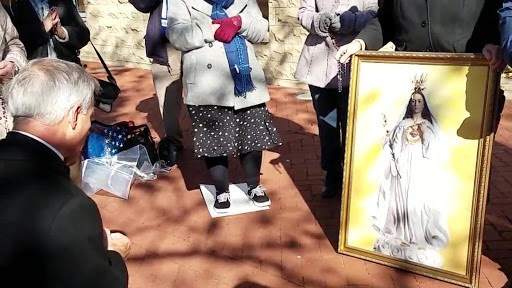
Bishop Strickland, our speaker on April 4th at the Conference on Holiness
in the Cathedral mentioned in this article, praying before image of Our Lady
of America. Cardinal Burke, our other speaker also connected to Our Lady
of America as he gave the devotion his imprimatur. What a beautiful
coincidence!
|
|||||
|
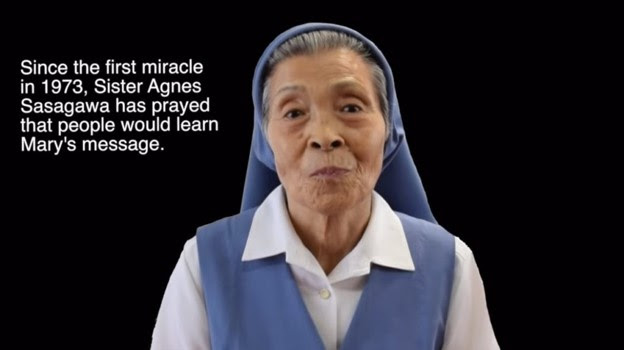
46 years later, on October 6, 2019, at 3:30 A.M., Sister Agnes received a new warning message at Akita from an angel. The message was similar to the prophet Jonah’s message of warning to the idol worshiping Ninevites to repent or be destroyed. Providentially, that message was today’s Old Testament Mass Reading. Jonah’s message was, “Forty more days and Nineveh will be overthrown.†(Jonah 3:4).
“The Ninevites believed God. A fast was proclaimed, and all of them, from the greatest to the least, put on sackcloth.†(Jonah 3:5). When the King of Nineveh heard about the message he got up from his throne, removed his robe, covered himself with sackcloth, and sat in ashes. “When God saw what they did and how they turned from their evil ways, he relented and did not bring on them the destruction he had threatened. (Jonah 3:10). May we imitate the good example of the pagan Ninevites who worshiped idols!
Sister Agnes received the new warning message on October 6, the same day that Pope Francis inaugurated the Amazon Synod where he allowed the display of idols that some people venerated, like the Ninevites did in the past, in St. Peter’s Basilica, St. Santamaria church and in the Vatican gardens. For the full story of idols at the Amazon Synod see my article here.
This is the first public message that Sister Agnes has received in the last 46 years. She is now 88 years old. Signs and wonders accompanied Sister Agnes’ original message, including the weeping of her statue of Our Lady of Akita 101 times. Scientific examination proved that they were human tears.
In 1992, I was one of the leaders of Dr. Rosalie Turton’s 101 Foundation Peace Pilgrimage, named after the 101 times that the statute wept. We had approximately 1000 pilgrims in two 747 jumbo jets. I was part of a very small group that privately visited the sick Sister Agnes and prayed at her bedside in her convent.
We also attended a private conference for our pilgrimage at which Bishop Ito, Sister Agnes’s Bishop, told us that he had approved all of her messages. In June 1988, Joseph Cardinal Ratzinger (later Pope Emeritus Benedict XVI), Prefect of the Congregation for the Doctrine of the Faith, gave a definitive judgment on the Akita events and messages as reliable and worthy of belief.
This is the Now Warning message that Sister Agnes received on October 6, 2019, “Cover in ashes and please pray the Penitential Rosary every day. You [Sister Agnes] become like a child and every day please give sacrifice.â€
The warning was short and to the point, as was the warning to the Ninevites. May we respond to it now as they did!
I believe that the phrase, “Cover in ashes,â€Â is metaphorical and does not mean that God wants us to literally cover ourselves in ashes, as did the Ninevites, but rather it means that we should assume a penitential attitude, as we should now be doing in Lent.
The translators of the message from Japanese to English were not theologians. The first translation was “pray for a repentant rosary every day.†The second translation was “pray the Penitential Rosary every day.†The second translation used a proper name that some people believed referred to a particular form of the Rosary. However, I believe that the proper translation should be “pray a penitential Rosary every day.â€
A penitential Rosary is a Rosary that is prayed with contrition and in sorrow for one’s own sins or the sins of others and for their conversion. It is offered in atonement and reparation to our merciful God who is so horribly offended by the sins of the modern world. Let us fervently pray the Rosary daily for the conversion of all people who are lost in sin and have not come to know the love of the one true God.
There is also a formal Penitential Rosary that Jesus dictated to Maria Concepcion Zuniga Lopez on December 26, 1970. It can be found here.
I was very skeptical when I first read Sister Agnes’s new message of warning on the Internet last Fall. The only source that I could find was a very small radio station and that was not enough for me. But Our Lady kept nudging me to dig deeper. At that time, I was working with Mary Ann Harold, a friend of mine for over 15 years. She is a Guardian of our Visitation Image of Our Lady of America and hosts many Holy Hours with Our Lady of America for Life, Purity and Protection.
In November, after Mary Ann had received the new warning message from Sister Agnes, she took the Image to the hotel that hosted the United States Bishops’ Conference in Baltimore, Maryland. She led a group to their hotel and they remained outside in prayer. Later, 3 bishops joined them, notably Bishop Joseph Strickland from Tyler, Texas, who knelt in prayer before the image.
March 6, 2020 No Comments
After US bishops debate downplaying abortion, Bp. Strickland leads rosary outside | News | LifeSite
From our friend and supporter Anne Wilson:
N.B. It is very important that we members of the LLA and promoters of the Traditional Latin Mass support and help such outstanding Catholics as Anne Wilson, who is working very hard from her vantage point to restore the Traditional Catholic Faith to the Church. I urge as many LLA members as possible to support Anne and attend the Holy Day that she is sponsoring at the Cathedral Basilica of Sts. Peter and Paul on April 4, 2020.
Dear Will,
So good to talk to you today and certainly hope you can come to this unusually beautiful and uplifting day with three saintly priests, you will not regret it! Here is the article about Bishop Strickland about him saying a rosary of reparation for abortion on his knees outside the hotel where 69 Bishops voted against Life as the preeminent issue for them to address. It is said that those praying with the Bishop (and our own local Bishop Joseph Coffey) saw the Miracle of the Sun. I would not be surprised. Also, Bishop Strickland revealed recently that in prayer it was revealed to him that he would be a red martyr.
We hope that the Latin Mass community realized that Cardinal Burke needs their support and they can always go to the Latin Mass the next day. Cardinal Burke knows that Father Gill will have a very reverent Mass planned. The patron of our conference is Father John Hardon, S.J., our old and dear friend who spoke for us many times.
The link to our website where you can see the details of the day, see the speakers’ pictures and bios and download the flyer and registration form is:
Registration is also available on Eventbrite. Would you like me to send you any flyers to give out to friends? Many thanks for anything you can do to help us get a good turnout for these two warrior bishops and outstanding priest in our Church today.
God bless,
Anne Wilson
215-247-2585
March 6, 2020 No Comments
ACTION ALERT: Ask your bishop to STOP CRS’s Condom-Promotion

|
||
|
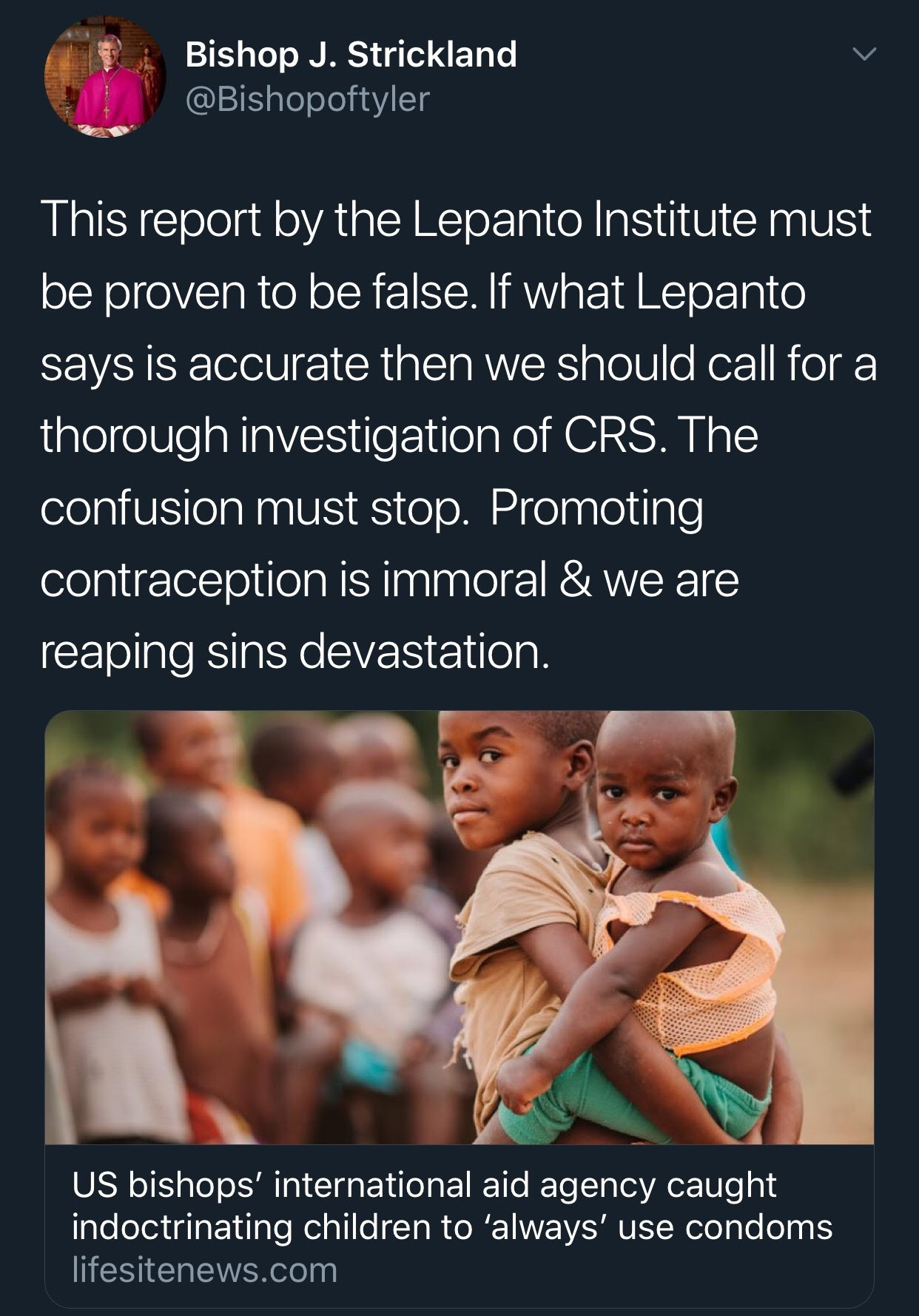
Let’s all ask our own bishops to join Bp. Strickland’s call for a complete investigation of CRS. Please sign the petition to send a message to your bishop! Just click the button.

We’re working hard on the next segment to be released next week. If you’re pleased with our progress and would like to help moving forward, please consider a $35, $50, or $100, tax-deductible donation!
Christus Vincit!
Michael Hichborn
President
Lepanto Institute
March 6, 2020 No Comments
First Friday and First Saturday TLM’s for February 2020
Church of the Immaculate ConceptionÂ
February 6, 2020 No Comments
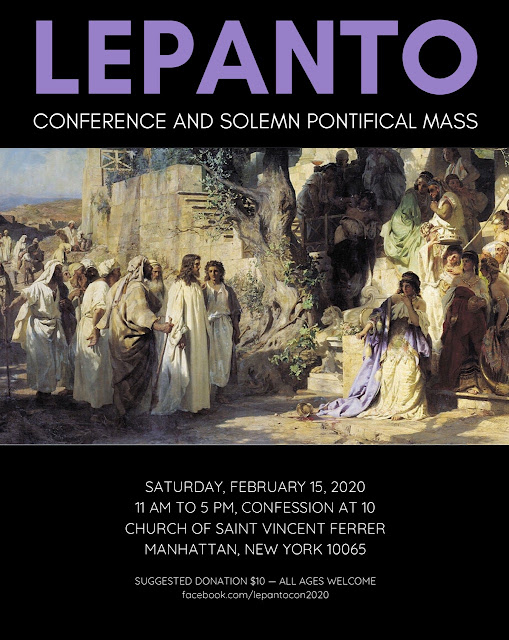
Events: Third Annual Lepanto Conference, New York City, February 15, with Cardinal Zen
January 19, 2020 No Comments
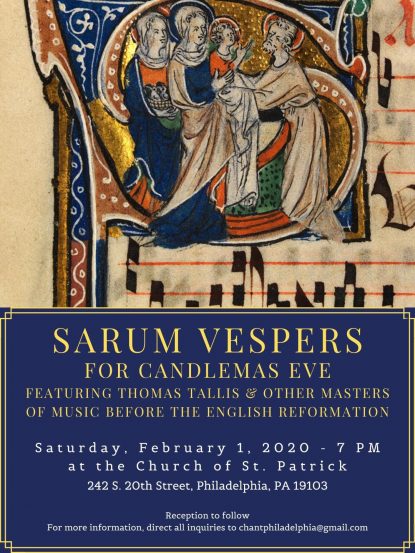
Sarum Vespers for Candlemas Eve
January 17, 2020 No Comments
First Friday & First Saturday Traditional Latin Mass Mass Schedule for January 2020
January 3, 2020 No Comments