Transmitting What We Have Received: An Interview with the SSPX Superior General, September 17, 2019, Source: fsspx.news

Interview with Father Davide Pagliarani Superior General of the Fraternity of St. Pius X
Thus, the liturgical reform was only the culmination of an experimental development that dated back to the interwar period and had already penetrated a large part of the clergy. Closer to home, under this pontificate, Amoris lætitia was the ratification of a practice that unfortunately already exists in the Church, especially with regard to the possibility of communion for people who live in a state of public sin. Today, the situation seems to be ripe for further excessively serious reforms.
Can you clarify your judgment on the apostolic exhortation Amoris lætitia three years after its publication?
Amoris lætitia represents, in the history of the Church in recent years, what the atomic bombs of Hiroshima and Nagasaki are in the modern history of Japan: humanly speaking, the damage is irreparable. It is undoubtedly the most revolutionary act of Pope Francis and, at the same time, the most contested – even outside Tradition – because it directly affects marital morality, which has enabled many clerics and faithful to detect the presence of serious errors. This catastrophic document was wrongly presented as the work of an eccentric and provocative personality – what some want to see in the current pope. This is not true, and it is inappropriate to simplify the question in this way.
You seem to be implying that this consequence was inevitable. Why are you reluctant to define the current Pope as an original person?
In fact, Amoris laetitia is one of the results that, sooner or later, was to occur as a result of the principles laid down by the Council. Cardinal Walter Kasper had already admitted and stressed that a new ecclesiology, that of the Council, corresponds to a new conception of the Christian family.1
Indeed, the Council is first and foremost ecclesiological, that is, it proposes in its documents a new conception of the Church. The Church founded by Our Lord would simply no longer correspond to the Catholic Church. It is broader: it includes other Christian denominations. As a result, Orthodox or Protestant communities would have “ecclesiality” by virtue of baptism. In other words, the great ecclesiological novelty of the Council is the possibility of belonging to the Church founded by Our Lord in different ways and to different degrees. Hence the modern notion of “full†or “partial†communion, “with variable geometry,” one might say. The Church has become structurally open and flexible. The new modality of belonging to the Church, which is extremely elastic and variable, according to which all Christians are united in the same Church of Christ, is at the origin of the present ecumenical chaos.
Let us not think that these theological innovations are abstract, they have repercussions on the concrete life of the faithful. All the dogmatic errors that affect the Church sooner or later have an effect on the Christian family, because the union of Christian spouses is the image of the union between Christ and His Church. An ecumenical, flexible and pan-Christian church corresponds to a notion of the family in which the commitments of marriage no longer have the same value, in which the bonds between spouses, between a man and a woman, are no longer perceived or defined in the same way: they too become flexible.
A Pope Consistent with Vatican II’s Principles
Could you be more specific?
In concrete terms, just as the Church of Christ “pan-Christian†would have good and positive elements outside Catholic unity, so would there be good and positive elements for the faithful also outside sacramental marriage, in a civil marriage, and also in any union. Just as there is no longer any distinction between a “true” Church and “false” Churches – because non-Catholic Churches are good although imperfect – all unions become good, because there is always something good in them, if only love.
This means that in a “good” civil marriage – especially when it is concluded between believers – some elements of sacramental Christian marriage can be found. Not that the two should be put on an equal footing; however, civil union is not bad in itself, but simply less good! Until now we have been talking about good or bad deeds, life in grace or mortal sin. Now there are only good or less good actions left. To sum up, an ecumenical Church is an ecumenical family, that is, a family that is recomposed or “recomposable,” according to needs and sensitivities.
Before the Second Vatican Council, the Church taught that non-Catholic Christian confessions were outside the fold of the true Church, and therefore not part of the Church of Jesus Christ. The doctrine of the Dogmatic Constitution on the Church, Lumen gentium (n. 8), opens a way to recognize them as partial realisations of the Church of Christ. The consequences of these errors are incalculable and still in full development.
Amoris lætitia is the inevitable result of the new ecclesiology taught by Lumen gentium, and also of the mad openness to the world advocated by the Pastoral Constitution on the Church In Today’s World, Gaudium et spes.2 And in fact, with Amoris lætitia, Christian marriage is more and more like marriage as modernity conceives it and profanes it.
Thus, Pope Francis’ objectively confusing teaching is not a strange aberration, but rather the logical consequence of the principles laid down at the Council. He takes these principles to their ultimate conclusions… for the moment.
Has this new doctrine on the Church manifested itself in a particular theological concept?
After the Council, the notion of the People of God replaced that of the Mystical Body of Christ. It is omnipresent in the new Code of Canon Law published in 1983. But a change occurred in 1985. It appeared that the term “People of God” was becoming cumbersome, because it allowed drifts towards liberation theology and Marxism. It has been replaced by another notion, also drawn from the Council: the ecclesiology of communion, which allows an extremely elastic belonging to the Church so that all Christians are united in the same Church of Christ, but more or less, which means that ecumenical dialogue has become like a conversation in Babel, as in the meeting in Assisi in 1986. Like the polyhedron that Pope Francis loves: “a geometric figure that has many different facets. The polyhedron reflects the confluence of all the diversities that, in it, preserve their originality. Nothing dissolves, nothing is destroyed, nothing dominates anything.”3
Do you see this same ecclesiological root at the origin of the reforms announced in the Instrumentum laboris of the next Synod on the Amazon, or in the project of reform of the Roman Curia?
Everything comes down, directly or indirectly, to a false notion of the Church. Once again, Pope Francis is only drawing the final conclusions from the principles laid down at the Council. In concrete terms, its reforms always presuppose a Church that listens, a Synodal Church, a Church that is attentive to the culture of peoples, their expectations and demands, especially human and natural affairs, specific to our time and always changing. The Faith, the liturgy, the government of the Church, must adapt to all this, and be the result of it.
The Synodal Church, which is always attentive, is the latest evolution of the Collegial Church, advocated by Vatican II. To give a concrete example, according to the Instrumentum laboris, the Church must be able to assume to itself elements such as local traditions on spirit-worship and Amazonian traditional medicines, which resemble so-called “exorcisms.” As these indigenous traditions are rooted in a soil that has a history, it follows that this “territory is a theological place, it is a particular source of God’s revelation.” This is why we must recognize the richness of these indigenous cultures, because “the non-sincere openness to the other, as well as a corporatist attitude, which reserves salvation only for one’s own faith, destroys this same faith”. It seems that instead of fighting paganism, the current hierarchy wants to assume it and incorporate its values. And the craftsmen of the next synod refer to these things as “signs of the times” – an expression dear to John XXIII – which must be examined as signs of the Holy Spirit.
The Church of Christ Is Not a Forum
And more specifically, what about the Curia?
For its part, the Curia’s reform project advocates a Church that resembles much more a human enterprise than a divine, hierarchical society, depositary of supernatural Revelation, with the infallible charism of guarding and teaching the eternal Truth to humanity until the end of time. As the text of the draft expressly states, it is a question of “updating (aggiornamento) the Curia,” “on the basis of the ecclesiology of Vatican II.” It is therefore hardly surprising to read from the pen of the group of cardinals in charge of this reform: “The Curia acts as a kind of platform and forum for communication between particular Churches and Bishops’ Conferences. The Curia gathers the experiences of the universal Church and, from these, encourages the particular Churches and the Bishops’ Conferences… This life of communion given to the Church is the face of synodality… The people of faith, the Episcopal College, the Bishop of Rome are all listening to each other, and they are all listening to the Holy Spirit… This reform is established in the spirit of ‘healthy decentralization’… The Synodal Church is ‘the People of God walking together’… The service provided by the Curia to the mission of the bishops and to the communio is not one of vigilance or control, neither one of decision-making as a higher authority[.]”4
Platform, forum, synodality, and decentralization: all this only confirms the ecclesiological root of all modern errors. In this amorphous magma, there is no longer any higher authority. It is the dissolution of the Church as Our Lord has established it. In founding his Church, Christ did not open a forum for communication or a platform for exchange; he entrusted Peter and his Apostles with the task of feeding his flock, of being columns of truth and holiness to lead souls to Heaven.
How can this ecclesiological error be characterized in relation to the divine constitution of the Church founded by Jesus Christ?
The question is vast, but Archbishop Lefebvre provides us with an answer. He said that the structure of the new Mass corresponded to a democratic Church, and no longer hierarchical and monarchical one. The synodal church of the Franciscan dream is truly democratic. He himself gave the image he had of it: that of an inverted pyramid. Could there be a clearer manifestation of what he meant by synodality? It is a Church that has been turned on its head. But let us insist, this is only a development of the seeds already planted at the Council.
Do you not think you are forcing your reading of the current reality, wanting to bring everything back to the principles of the Second Vatican Council, held more than 50 years ago?
It is one of Pope Francis’s closest collaborators who gives us the answer: Cardinal Maradiaga, Archbishop of Tegucigalpa and coordinator of the “C6†group of cardinals. He says that, “After the Second Vatican Council, the methods and content of evangelization and Christian education change. The liturgy is changing… The missionary perspective changes: the missionary must establish an evangelizing dialogue… Social action changes, it is no longer only charity and the development of services, but also the struggle for justice, human rights and liberation… Everything changes in the Church according to the renewed pastoral model.” And he adds the following, to show in what spirit these transformations are being accomplished: “The Pope wants to bring the renewal of the Church to a point where it will become irreversible. The wind that pushes the sails of the Church towards the high seas of her profound and total renewal is mercy.”5
However, it cannot be denied that many voices have been raised against these reforms and it is reasonable to assume that this will continue in the coming months. How do you rate these reactions?
One can only rejoice at such reactions and at a progressive awareness on the part of many of the faithful and some prelates that the Church is approaching a new catastrophe. These reactions have the advantage and merit of showing that the voice that advocates these errors cannot be that of Christ, nor that of the Magisterium of the Church. This is extremely important and, despite the tragic context, encouraging. The Society of Saint Pius X has a duty to be very attentive to these reactions, and at the same time to try to avoid misguidedness and failure to achieve anything.

Conciliar Pluralism Renders Opposition Structurally Ineffective
What do you mean by that?
First of all, it should be noted that these reactions systematically come up against a brick wall and one must have the courage to ask why. To give an example, four cardinals had expressed their dubia about Amoris lætitia. This reaction had been noticed by many and hailed as the beginning of a reaction that would produce lasting results. In fact, the Vatican’s silence has left this criticism unanswered. In the meantime, two of these cardinals have died and Pope Francis has moved on to the other reform projects we have just mentioned. This means that attention is shifting to new subjects, leaving, by necessity, the battle over Amoris lætitia in the background, forgotten, and the content of this exhortation seems accepted de facto.
To understand the silence of the Pope, we must not forget that the Church that emerged from the Council is pluralistic. It is a Church that is no longer based on an eternal and revealed Truth, taught from above by Authority. We have before us a Church that is listening and therefore necessarily listening to voices that may differ from each other. To make a comparison, in a democratic system, there is always a place – at least apparent – for opposition. They are part of the system because they show that we can discuss, have a different opinion, that there is room for everyone. This, of course, can promote democratic dialogue, but not the restoration of an absolute and universal Truth and an eternal moral law. Thus, error can be taught freely alongside a real but structurally ineffective opposition which is unable to replace the errors with truth. It is therefore from the pluralist system itself that we must emerge, and this system has as its cause, the Second Vatican Council.
In your opinion, what should these prelates and faithful do who have at heart the future of the Church?
First of all, they should have the lucidity and courage to recognize that there is a continuity between the teachings of the Council, the popes of the post-conciliar era, and the current pontificate. Citing the magisterium of “Saint” John Paul II, for example, to oppose Pope Francis’s innovations is a very bad remedy, one that is doomed to failure from the outset. A good doctor cannot simply use a few stitches to close a wound without first evacuating the infection inside the wound. Far from despising these efforts, it is a matter of charity to indicate where the root of the problems lies.
To give a concrete example of this contradiction, it is sufficient to mention one name among others: that of Cardinal Müller. He is presently the most virulent opponent of Amoris lætitia, the Instrumentum laboris, and the Curia’s reform project. He uses very strong language, even talking about “breaking with Tradition.” And yet, this cardinal who has the fortitude to publicly denounce these errors is the same one who wanted to impose the acceptance of the whole Council and the post-conciliar magisterium on the Society of Saint Pius X (in continuity with his predecessors and successors at the Congregation for the Doctrine of the Faith). Regardless of the Society and its positions, Cardinal Müller’s criticism, which focuses only on the symptoms without going back to their cause, gives rise to a most damaging and illogical situation.
The Charity of Transmitting What We Have Received
It is often objected that the Society only knows how to criticize. What does it propose positively?
The Society does not criticize systematically or a priori. She is not a professional misanthrope. She has a freedom of speech that allows her to speak openly, without fear of losing benefits she does not have… This freedom is essential in the current circumstances.
The Society has above all a love for the Church and souls. The present crisis is not only doctrinal: seminaries are closing, churches are emptying, frequentation of the sacraments is falling dramatically. We cannot remain spectators, arms folded, and say to ourselves: “All this proves that Tradition is right.” Tradition has the duty of coming to the aid of souls with the means given to it by Divine Providence. We are not driven by pride, but by charity to “transmit what we have received” (1 Cor. 15:3). This is what we humbly strive to do through our daily Apostolic work. And, it is in the course of this work that we denounce the evils that afflict the Church as being necessary to protect the flock abandoned and dispersed by bad pastors.
What does the Society expect from the prelates and faithful who are beginning to see clearly, in order to give a positive and effective follow-up to their positions?
It is necessary for them to have the courage to recognize that even a sound doctrinal position will not suffice if it is not accompanied by a pastoral, spiritual and liturgical life consistent with the principles to be defended, because the Council has inaugurated a new way of conceiving the Christian life, consistent with its new doctrine.
If true Catholic doctrine is reaffirmed in all its rights, one must begin to live a real Catholic life in conformity with what one professes. Otherwise, this or that declaration will remain only a media event, limited to a few months, even a few weeks… In concrete terms, one must exclusively embrace the Tridentine Mass and all that it means; one must exclusively embrace the Catholic Mass and draw all the consequences from it; one must exclusively embrace the non-ecumenical Mass, the Mass of all time and let this Mass regenerate the lives of the faithful, communities, seminaries, and especially let it transform priests. It is not a question of simply restoring the Tridentine Mass because it is the best theoretical option; it is a question of restoring it, living it, and defending it until martyrdom, because only the Cross of Our Lord can rescue the Church from the catastrophic situation in which it finds itself.
Portæ inferi non prævalebunt adversus eam!
The gates of hell will not prevail against her!
Father Davide Pagliarani, Superior General
Menzingen, September 12, 2019, Feast of the Holy Name of Mary
September 19, 2019 No Comments
First Friday and First Saturday TLM’s for September

The Traditional Latin Mass will be offered on
at:
Time: 7:00Â p.m., preceded by Confessions upstairs at 6:30Â p.m.
Time: 9:00 a.m., preceded by Confessions upstairs at 8:30 a.m.
September 5, 2019 No Comments
Doctor of the priesthood

Marcel Lefebvre, an associate pastor, missionary bishop, papal delegate, and superior general of a missionary congregation, was a man of action. His intellect, without being very speculative, was nevertheless imbued with doctrine. In forming priests, he taught the profound nature of the Catholic priesthood and spread its spirit and virtues.
Testimony of Fr. Victor-Alain Berto, the private theologian of Archbishop Lefebvre at the Second Vatican Council:
I say this in the presence of God: I had the very great and undeserved honor of being his theologian. Sworn confidentiality prevents me from speaking about the work that I did under him, but I betray no secret by telling you that Archbishop Lefebvre is a theologian, and by far superior to his own theologian, and God grant that all the [Council] Fathers might be theologians to the same degree as he is! He has a perfectly sure and refined theological habitus, to which his very great devotion to the Holy See adds that connaturality that allows him, even before discursive thinking intervenes, to discern intuitively what is and what is not compatible with the prerogatives of the Rock of the Church.
He in no way resembles those [Council] Fathers who, as one of them had the gall to boast publicly, used to take from the hands of a peritus [expert], in the car that was bringing them to St. Peter’s, the ‘ready-made’ text of their intervention in aula [in the Council Hall]. Not once did I submit to him a memorandum, a note, or an outline, without him reviewing, recasting, rethinking and sometimes rewriting them from start to finish, by his own personal, diligent work. I did not ‘collaborate’ with him; if the word were English I would say that I really ‘sublaborated’ with him [i.e., worked under his supervision], in keeping with my status as a private theologian and his honor and dignity as a Father of an Ecumenical Council, a Judge and Doctor of the Faith together with the Roman Pontiff.†(January 3, 1964)
August 21, 2019 No Comments
The Society of St. Pius X, a Work of the Church at the Service of the Truth

We mustn’t be surprised that we are unable to get along with Rome. It will be impossible so long as Rome does not return to the Faith in the Kingship of Our Lord Jesus Christ, so long as she gives the impression that all religions are good. We disagree on a point of the Catholic Faith, as Cardinal Bea and Cardinal Ottaviani disagreed, and as all the Popes disagreed with liberalism.
Archbishop Lefebvre, Conference in Sierre (Switzerland) on November 27, 1988, quoted in L’Eglise infiltrée par le modernisme, Fideliter, 1993, p. 70-71.
“The problem will remain so long as the Society of St. Pius X does not adhere to the doctrinal declaration approved by Pope Francis and presented by the Congregation for the Doctrine of the Faith.â€[1] After quoting these words by Archbishop Pozzo[2], we remarked in our article that “the problem, therefore, is indeed, first and foremost, a doctrinal problem,†and that “in Rome’s own eyes, the canonical recognition depends on the resolution of this problem.â€
Coming from Rome, this is nothing new. Archbishop Pozzo had already clearly voiced the same opinion in the beginning of the year 2017. “The reconciliation,†he said, “will occur when Monsignor Fellay formally adheres to the doctrinal declaration that the Holy See presented to him. This is also the necessary condition to then proceed to the institutional regularization with the creation of a personal prelature.â€[3] These declarations, authorized on the whole, provide an opportunity to show exactly where the fundamental problem between the Holy See and the bishops and priests of the Society of St. Pius X lies. The explanation is simple: it is the Rome of today’s divergence from the Rome of all times and this divergence has to do with the way of understanding and presenting the doctrine revealed by God. That is why this problem can in no way be explained by the attitude adopted so far by Archbishop Lefebvre and the Society of St. Pius X towards the Rome of today. Let us be clear, at the risk of provoking astonishment and incomprehension from more than a few in the Holy Church of God: the problem is not the Society of St. Pius X, it is the Rome of today, the Rome “of neo-Protestant and neo-Modernist tendenciesâ€, as His Excellency Archbishop Marcel Lefebvre liked to say, in somewhat convoluted terms. The problem today is the Rome of today, because in Rome the current members of the hierarchy, the Pope and the bishops, have adopted this new Protestant and Modernist tendency, and in so doing have broken away from eternal Rome. And this happened with Vatican Council II.
In the eyes of many who, despite their numbers, are not among the most clearsighted, the problem would at first sight seem to be that the Society of St. Pius X does not have a regular situation in the Church. To quote the exact words used by Archbishop Pozzo, the problem is supposedly that the priests and bishops of the Society of St. Pius X exercise their ministry “illicitly and illegitimatelyâ€. Consequently, the problem would come from the Society and its members, the Society first and not the Rome of today. But in reality, by the secretary of the Pontifical Ecclesia Dei Commission’s own admission, this supposed illegitimacy is but a consequence, and the fundamental problem lies in the doctrinal divergence that opposes the Society to the current representatives of the hierarchy, precisely because the latter claim to adhere to Vatican Council II. This divergence is therefore the cause, and the supposed illegitimacy but one of its possible effects. And as far as this divergence is concerned, the problem comes from the Rome of today. The Society’s situation is but the consequent effect. If the Society can potentially and apparently present a problem canonically or ecclesiastically speaking, this is first of all because the Rome of today presents a problem doctrinally speaking. For the effect proceeds from its cause. The Church being a supernatural society, the unity of Faith is necessarily at the principle and foundation of the unity of government[4] and that is why any divergence on the former level causes a divergence on the latter level. The supposed canonical irregularity is the effect that follows from the doctrinal divergence.
As for all effects, this one is to be judged in the light of its cause. This is an absolutely necessary principle that allows for no exception in any domain, for it is a metaphysical principle. If we wish to understand why, in the eyes of the Rome of today, the Society of St. Pius X remains in what they call an “illegitimate†situation, we have to start by understanding why this Rome of today is herself in rupture with the Rome of all times. This rupture is doctrinal. And the fundamental problem, of which the supposed illegitimacy of the Society is but a consequence on the canonical or ecclesial level, is the Rome of today’s acceptance on the doctrinal level of the reforms undertaken by Vatican Council II. The problem is not that the Society refuses the Council, for to remain Catholic and in the Church, one has no choice but to refuse such a Council. The problem is that the Rome of today accepts it, with no heed for her bimillenary Tradition. If we had to resort (with all the necessary precautions) to the eloquent and picturesque terms of a metaphor, we would say that the Society is in good health, and the Rome of today is sick. And when a sick man is in denial about his own illness, he almost inevitably accuses those in good health of being sick. But let’s move on.
The problem, therefore, is not, on the Society of St. Pius X’s side, what we might today call a problem of “ecclesialityâ€. The Society is and remains a work of the Church, a society that is fully part of the Church, so fully and so completely that it even represents one of the healthiest parts in the Church. Indeed, the Society is defined by goal and this goal is (Statutes, II, 1) “the priesthood†and therefore (Statutes III, 1) the works of priestly formation, which “will carefully avoid the modern errors, especially liberalism and all its substitutes.†The Society’s attitude towards the Rome of today follows immediately from this principle: to protect the Catholic priesthood from the modern errors and to protect also the Faith of the Church that it is the priesthood’s mission to preach for the sanctification of souls. This attitude – or this role – of the Society is absolutely vital since in the Holy Church the priesthood represents not only an indispensable principle, but a first principle. The priesthood is the very principle of the Church, for without it, the Church would cease to be what she is. The corruption of the first principle is the worst thing possible, and the defense of it is the most necessary and most urgent need. Insofar as the Rome of today is infected with these modern errors that corrupt the priesthood and the Church, it is the Society’s duty to act with regards to this present-day Rome in such a way as to neutralize these errors. This should be the profound explanation of the entire combat of the Faith waged by the Society so far. And the entire attitude of the Rome of today (ever since the Council) that considers the Society’s action illegitimate is but the other side of this combat being fought by the Society, the side of the men of the Church who currently hold the power in Rome. If the light disperses the shadows, the shadows try to smother the light, but never succeed. This defense of the Catholic priesthood that is the first principle and the common good of the entire Church, is a properly ecclesial goal, which makes the Society a work of the Church. The ecclesiality of the Society comes from this: it comes from the finis operis, the proper and specific object of the society founded by Archbishop Lefebvre and duly recognized as such by Bishop Charrière in 1970. No dent has since been made in this ecclesiality by the conciliar authorities, for no dent could be made. It is rather the ecclesiality of the members of the hierarchy that has become increasingly problematic since Vatican II and modernism that are destroying the current authorities.
The Society should therefore not set up as its absolutely first goal, that is, its principle of action, to seek to obtain canonical legitimacy that would supposedly remedy a lack of ecclesiality.[5] The question of the Society’s ecclesiality does not exist in reality. It only exists in the minds of some, who are not members or faithful of the Society in the Church, and who believe in good faith that the Society is “against the Pope†or “schismatic†or “not in full communion†or “not in a legitimate situationâ€. To express these things in the technical language of scholastic logic, we would say that the question does not arise of itself but accidentally. Some people make the mistake of believing that this question arises in reality and of itself; other make the diametrically opposite mistake of believing that it does not arise at all, not even in the minds of some and accidentally. The solution is to say that the question arises not in reality or of itself but in the minds of some and accidentally. This means that the Society does not need to have a guilt complex, or to suffer or make excuses for not being in the Church, (besides, “he who excuses himself, accuses himselfâ€, as the French saying goes); it should rather maintain and assert that it is right and at the same time denounce the wrongs of the modernists; and it should do so in a pastoral and prudent way, taking into account the weakness of the ignorant, according the precept of the Apostle: “We that are stronger, ought to bear the infirmities of the weak, and not to please ourselves†(Rom. 15:1).
The Society is perfectly legitimate and regular, for it is in the Church and of the Church, and that is absolutely certain and beyond doubt. Coming from the Rome of today, a canonical legitimation would add nothing, from this viewpoint, to the intrinsic goodness of the Society. It could only add a certain extrinsic goodness, to the extent that in the minds of many, it would put an end to a false and unjust opinion that is being encouraged to the detriment of the Society. The full importance of this should not be forgotten, but it is a different question, a secondary question in the eyes of the Society of St. Pius X’s founder. “What interests us first of all,†he used to say, “is to keep the Catholic Faith. That is our fight. So the canonical question that is purely exterior and public in the Church is secondary. What is important is that we remain in the Church… in the Church, that is to say, in the Catholic Faith of all times and in the true priesthood, and in the true Mass, and in the true sacraments, in the catechism of all times, with the Bible of all times. That is what interests us. That is what the Church is. Being recognized publicly is secondary. So we must not seek after what is secondary while losing that which is primary, that which is the first object of our fight.â€[6] The full importance of this question, we repeat, must not be forgotten, and “secondary†does not mean “insignificantâ€; but to be answered fittingly, this significant question must remain in its proper place, that is, dependent upon the essential goal. And what we wish to do here is to show what the absolutely first goal of the Society is: the preservation of the Catholic priesthood, with as its necessary consequence the neutralization of all the harmful errors that are today causing its generalized corruption. Generalized corruption, for it is the corruption of the first principle of the Church, her hierarchical priesthood. These errors are serious in themselves, as are all errors, because they are a denial of divine truth; but they are even more harmful for the unprecedented reason that they are being spread to the entire Church by the hierarchy that has been won over to these errors and corrupted by them. Introduced with Vatican Council II into the ordinary preaching of the men of the Church, these errors have given birth to a new way of thinking and living that has progressively spread to all the members of the Church. The expression “conciliar Church†is meant to express this new situation as in a metaphorical ellipsis.[7]
We now speak of a “conciliar Church†as we have hitherto spoken of the “Rome of todayâ€, and we could very well speak of a “conciliar Romeâ€. For, for the time being, we can no longer speak of the Church and Rome without distinctions.[8] The Church as God willed her is a supernatural society, that is to say, the ordered congregation of the baptized faithful who profess the same Faith and practice the same cult under the direction of the same hierarchy. The particular and complex situation in which we are living is that within this ordered congregation there is now another disordered congregation that is endangering the Catholic Faith and cult and using the bad influence of the members of the hierarchy to do so. If we spoke simply of the Church and Rome, we would be saying too little; if we spoke of two Churches or two Romes, we would be saying too much. The Church is one and there is one Rome, but at present there is a generalized cancer in Rome and in the Church. We speak of the conciliar Church and the Rome of today, distinguishing them from the Catholic Church and the Rome of all times, as a way of expressing this unprecedented situation in which the men of the Church are working from within to destroy the Church, working against her own living forces. Such is the mystery that appears for now as that of an “occupied Church†and consequently also of an “operation survival of Traditionâ€, the necessity and legitimacy of the latter coming from the reality of the former.
Let us return, then, to Archbishop Pozzo’s initial declaration: “The problem will remain so long as the Society of St. Pius X does not adhere to the doctrinal declaration approved by Pope Francis and presented by the Congregation for the Doctrine of the Faith.†The secretary of the Pontifical Ecclesia Dei Commission gives in this phrase the profound reason for which the problem is ongoing: it will remain precisely as long as the Rome of today seeks to oblige the Society to adhere to Vatican Council II, and therefore it is the Rome of today that is the cause of the problem. For initially, the problem was not the refusal but rather the obligation to adhere: the obligation to adhere to errors that go against the truths revealed by God and already condemned by the Rome of all times.
Fr. Jean-Michel Gleize
[1] “Il problemi rimangono fintanto que la Fraternita San Pio X non adherera a la dichiarazione dottrinale approvata dal papa Francesco et presentata dalla Congregazione per la dottrina de la fede.â€
[2] Cf. the article “Neither Schismatic nor Excommunicatedâ€, in the July-August 2018 issue of Courrier de Rome.
[3] Cf. the article “For a Doctrinal Agreement†in the May 2017 issue of Courrier de Rome.
[4] Cf. the article “Unity or Legality?†in the May 2017 issue of Courrier de Rome.
[5] Cf. the article “For a Doctrinal Agreement†in the May 2017 issue of Courrier de Rome.
[6] Archbishop Lefebvre, Spiritual Conference in Econe, December 21, 1984. See the article “40 Years Earlier†in the December 2014 issue of Courrier de Rome.
[7] See the articles “Can We Speak of a Conciliar Church?†in the February 2013 issue of Courrier de Rome and “Unity and Unicity of the Church†in the September 2013 issue of Courrier de Rome.
[8] See the article “An Official Church?†in the May 2017 issue of Courrier de Rome.
August 21, 2019 No Comments
Dominican Nuns in Tuscany vs. the Vatican, with Help from the Locals
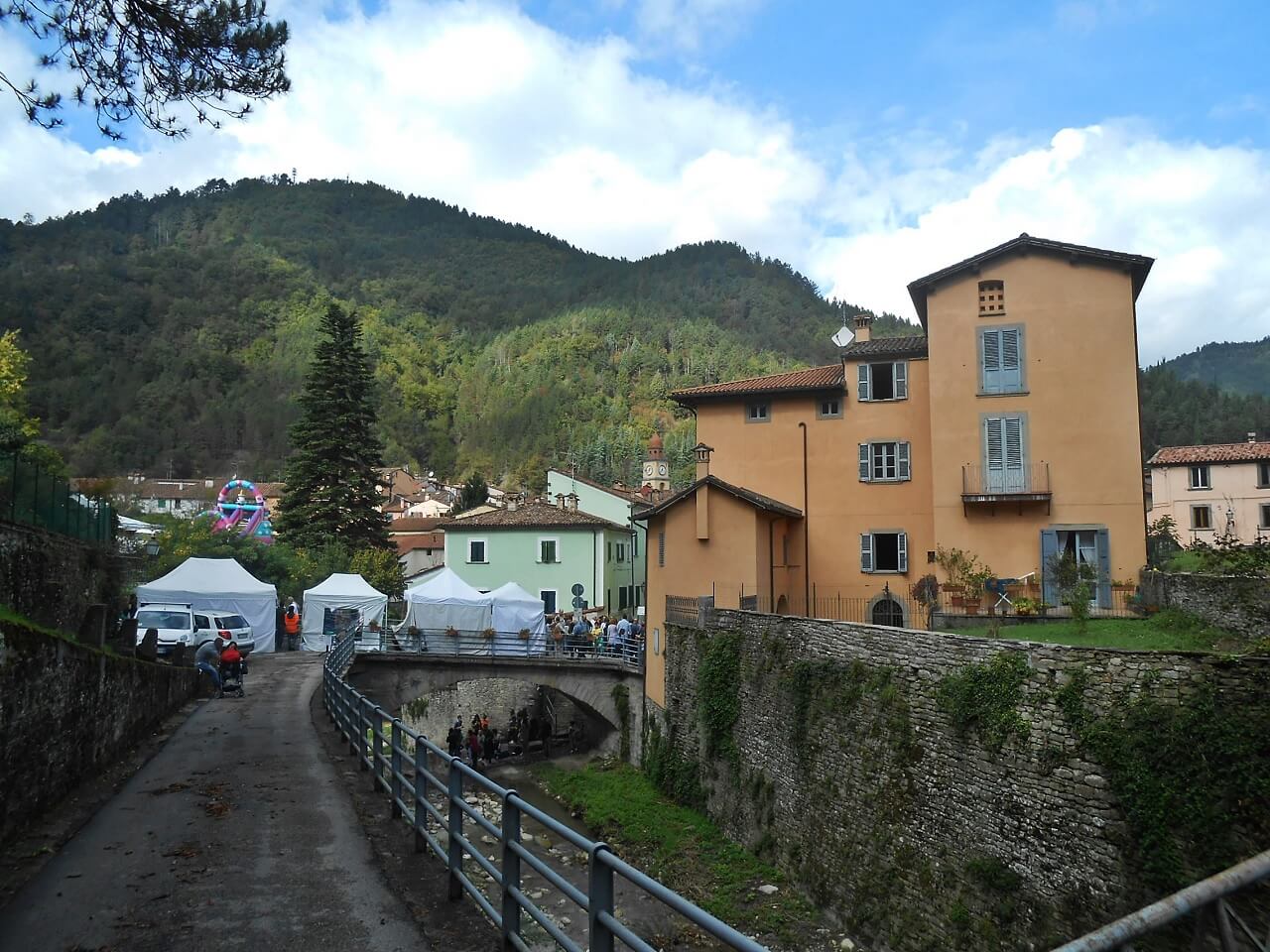
by Hilary White
a village on the edge of Tuscany that yet another religious house with the wrong sort of mindset was facing the now dreaded prospect of a Vatican “visitator.†The contemplative Dominican monastery of Marradi, the spiritual heart of the little mountain town for over four centuries, is threatened with forced closure by the Vatican, ostensibly because their numbers recently dropped below the Vatican’s prescribed minimum for “alive and vital autonomy.â€
Local people, however, believe that this is a pretext, and the real reason is that the community has long withstood the general “liberal†trends that so dominate religious life in Italy and are now being aggressively imposed from Rome. A report from the ground says the superior elected by the community, Sister Maria Domenica, has already been removed from office by the Vatican’s visitators, who are currently trying to find a way to “take charge of the assets and business of the convent†and have demanded the handing over of documents detailing the monastery’s real estate assets.
The Dominican Monastery of the Holy Annunciation — occupying prime Tuscan real estate in the quaint medieval town — was built at local expense and has never been reliant either on the diocese or the Dominican Order for its maintenance.
Barbara Betti, a classical musician, friend of the nuns, and longtime resident of the town, wrote in an open letter addressed to the Vatican that Marradi was not going to sit still for the summary closure of its beloved monastery. Her letter appeared in the local Marradi newspaper and was picked up by the Italian traditional Mass website, Messa in Latino. She wrote: “Yesterday the ‘coadjutors’ arrived to take charge of the assets of the convent: and to forcibly remove the old nuns from their home and throw them in a nursing home — is this Christian?â€
Betti described the Dominican Monastery of the Holy Annunciation as “the last bastion left in defense of our historical identity, of our Christian roots and of our morals.†The monastery was built at the expense of local people, she wrote, “for the perpetual spiritual protection of this community.â€
Referring to the mass suppression of monastic life by Freemasonic governments through the whole of the 19th century, Betti warns that what these “failed to accomplish is now being done through recent Vatican decrees.â€
Prior attempts to affiliate with a sympathetic community in another town have been nixed by Rome, and now “everything is moving with extreme speed to reach the closure of this convent.†But the Roman congregation — and their lawyers — may have bitten off a bigger mouthful than they can chew this time, with local residents making ready to fight Rome for their nuns.
Of great concern is the possible fate of two of the five nuns who are elderly and would have no choice but to be sent to a nursing home to be cared for by strangers, after a lifetime of religious devotion. “To take away the house, in the name of a vow of obedience to which the church itself no longer bears respect, is it moral? In a world where old means useless, are we still or are we no longer the defenders of the sacredness of the family?â€
Betti writes, “Our silent sisters reside legally [1] in the municipality of Marradi; this is their residence and will be until the day they are recalled to the Father’s house. The commitment [establishing the monastery as a legal entity in the town] signed in 1898 states that only when the last of the sisters are gone will the building move to another owner.†In order to be able legally to seize the property, therefore, the Vatican officials must force the nuns to leave.
“Those who decided that this real estate should no longer belong to them took it for granted that nobody here, in Marradi, cared about them,†Betti adds.
She points out that the attempt by the Francis Vatican to evict the nuns from their legal home can succeed only if the nuns themselves cooperate with it. The dicastery pursuing such actions so far has expected — and in many cases has been getting — docile, nunny compliance in the destruction of their own religious life. But Betti writes that resistance, in this case, is not futile: “They cannot take them away against their will, which would be kidnapping, but they can scare them with the weight of failing in the obligation of obedience.â€
She asks why the Romans are in “such a hurry.†Perhaps, she says, it is because the community has recently received two requests from Australia from potential candidates, meaning the pretext of the community being too small or not “viable†will soon not be applicable.
“Our monastery is not an empty shell spreading over the remains of a tradition and a historical identity this society wants to destroy. It is a living and active body.â€
The Marradi convent is financially self-supporting with revenue from rents of properties acquired over the centuries as gifts and donations. Betti states, therefore, that the people of Marradi have a right to know what will happen to their monastery and “why the planimetric maps of this monastery have been requested and for what purpose.â€
In 2015, the community celebrated its 440th anniversary with the public presentation to “a large crowd†of a book chronicling its history. Far from displaying a moribund resignation to their imminent extinction, the nuns recently launched a new website to appeal for vocations. Built at the expense of a local noble family, the monastery was started in 1575 by two Dominican nuns who came from Pratovecchio, Arezzo, a grassroots initiative that would be impossible today under the Vatican’s new rules.
The community has a history of considerable staying-power. Astonishingly, though the nuns were forced for a time to return to their families during the French invasions of Italy in the Revolutionary period, the community weathered the Napoleonic suppressions and those of his ideological successors in the Kingdom of Italy. After the monastic suppressions of 1866, the anti-Catholic, Freemasonic government of Italy seized part of their monastery, forcing the nuns to live in small quarters. The community avoided suppression – that was at first applied only to “useless†contemplatives — by teaching in the elementary school the government forcibly built on their property. The nuns endured and the community survived world wars, earthquakes, and other setbacks through the first half of the 20th century.
There are few left on any side of our Catholic debates who would maintain that the structures of the Church as we have known them are not under direct assault in the current pontificate. But while many are rightly worried about the coming attack on the priesthood at the Amazon Synod, little attention has been paid to the ongoing assault on female contemplative religious life.
These started immediately after the election of Pope Francis with the attack on the Franciscans of the Immaculate, and have culminated in the duo of documents by the pope and the Congregation for Religious [2], Vultus dei quaerere (July 2016) and its legislative sidekick Cor orans (April 2018). The situation in Marradi is another demonstration of the power granted to the Roman Curia by these two documents to either force compliance with the Bergoglian “New Paradigm†or dissolve any community that resists.
Aimed specifically at contemplative nuns, the two documents represent a significant rewriting of the basic premises behind the contemplative life, particularly in the areas of autonomy and self-governance, control of their own finances and assets, formation of novices and enclosure. It allows summary deposing of superiors, forcible imposition of new external governance who can forbid a community under its power to receive new candidates.
As Vultus dei quaerere itself puts it, those houses of contemplative nuns that survived the devastation of the post-Vatican II period, are to follow “the intense and fruitful path taken by the Church in the last decades, in the light of the teachings of [Vatican II] and considering the changed socio-cultural conditions.†And Cor orans is the muscle that will force the stragglers to do it.
At the end of July, a traditionalist Italian Catholic, “C†(whose name cannot, for the moment, be shared), who promotes traditional religious life, contacted the Marradi nuns about their situation. The sisters, C said, having seen what is going on, are not ready to lie down and accept the demise of their community and are open to receiving assistance from traditionalist friends and supporters.
C spoke to one local Marradesi who said there was openness in the monastery to the traditional rites of the Mass and Divine Office and that the bishop would likely not place any obstacles. “La Signora made very clear that the people of Marradi want the monastery to continue for centuries more as a place of prayer and nothing else.†Thus, despite the imminent threat from Rome, women — those with a little fighting courage — interested in contemplative religious life, including those attached to the “extraordinary form†of the liturgy, are indeed still encouraged to contact the sisters [3].
The publicity of Barbara Betti’s letter, C says, has “stirred up hornet’s nest of ecclesiatics,†but the community’s friends are “very ready to wage war to keep them not only off their own monastery but all the monasteries because they are destroying the Church.â€
“La Signora†confirmed to C that the axe has fallen on the Marradi Dominicans not randomly, but comes directly from the upper leadership of the Dominican Order who delated the community to the Vatican, knowing the results. Like that of the French community of sisters recently dissolved by Rome, it confirms that Cor orans, as critics have predicted, is being used as a weapon by ecclesiastics in power machinations and to gain control of monastic assets.
In the case of the Little Sisters of Marie, Mother of the Redeemer, based in Toulouse, the bishop started the assault as retaliation when the sisters resisted his efforts to gain control over their nursing homes. Using the pretext of an “authoritarian†superior and the sisters’ restoration of a more “classical†form of habit, the bishop contacted the Congregation for Religious in Rome.
The un-habited religious imposed by Rome on the Little Sisters as superior — an academic and author of the book “Migrants, Francis, and us†— accused the sisters of “praying too much†and generally being too attached to previous forms of religious life. After two years of struggle, 34 of the order’s 39 sisters requested exclaustration — to be released from their vows and return to lay life.
In Marradi, having watched the assaults by Rome on the Franciscans of the Immaculate; the Little Sisters of Marie, Mother of the Redeemer; and a number of others, the local people are ready to fight. C writes, “The nuns are being well defended by the community. They have a lawyer and two good, hefty priests that have no qualms, it seems, about giving a dusting up to meanly intentioned persons.â€
C particularly wanted the story of the community’s “defense committee†to be told to the world outside Italy. “It would be a very great service to all Christendom to add to this story how a community is defending their nuns! Catholic communities around the world need to know that they can and must help the poor religious that are getting dragged off by jackals and hyenas.â€
The fight for the Marradi monastery might soon go international. C relates that, though no further details can be made public at the moment, we can report that a solution may be coming from “a contemplative order, based solely on the Latin Mass, (no Novus Ordo), which is presently in a neighboring E.U. nation but which seeks to have a base in Italy.â€
“The nuns and their faithful defenders of Marradi would have no problem at all accommodating the Latin Mass. It has been re-iterated to me multiple times now that they (nuns and faithful) want one thing only: that their monastery remain a place full of holy praying,†C concluded.
[1] “Residenza†is an Italian legal concept that doesn’t really exist in the Anglo nations, but once established, it means that a person has an uncontestable legal right of abode in a particular municipality.
[2] Full name: Congregation for Institutes of Consecrated Life and Societies of Apostolic Life.
[3] N.B.: The sisters do not at this time have any upper age limit.
Image: Zebra48bo via Wikimedia Commons.


After two dream-like years living in Norcia, the cradle of Western Monasticism, Hilary moved unexpectedly with her three cats to the area near Perugia, where she gardens a great deal and tries not to worry too much.
August 21, 2019 No Comments
Solemn High Traditional Latin Mass for the Feast of the Assumption, August 15, 2019
August 13, 2019 No Comments
First Friday & First Saturday TLM’s for August
The Traditional Latin Mass will be offered on
at:
Time: 7:00Â p.m., preceded by Confessions upstairs at 6:30Â p.m.
Time: 9:00 a.m., preceded by Confessions upstairs at 8:30 a.m.
August 2, 2019 No Comments
FEAST OF THE HOLY TRINITY

Rev. Fr. Leonard Goffine’s
The Church’s Year
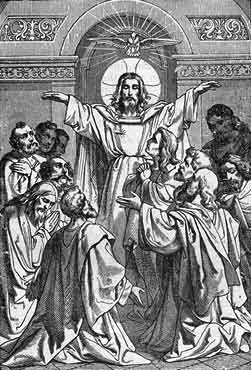
| This festival is celebrated on the Sunday after Pentecost, because as soon as the apostles were instructed and consoled by the Holy Ghost, they began to preach openly that which Christ had taught them.
Why do we celebrate this festival? That we may openly profess our faith in the doctrine of the Holy Trinity, which is the first of Christian truths, the foundation of the Christian religion, and the most sublime of all mysteries; and that we may render thanks, to the Father for having created us, to the Son for having redeemed us, and to the Holy Ghost for having sanctified us. In praise and honor of the most Holy Trinity, the Church sings at the Introit of this day’s Mass: INTROIT Blessed be the holy Trinity and undivided Unity: we will give glory to him, because he hath shown his mercy to us: (Tob. XII.) O Lord, our Lord, how wonderful is thy name in all the earth! (Ps. VIII. 1.) Glory be to the Father, etc. COLLECT Almighty, everlasting God, who hast granted to Thy servants, in the confession of the true faith, to acknowledge the glory of the eternal Trinity, and in the power of Thy, majesty, to adore the Unity: grant that, by steadfastness in the same faith, we may ever be defended from all adversities. Thro’. EPISTLE (ROM XI. 33-36.) O the depth of the riches of the wisdom and of the knowledge of God! How incomprehensible are his judgments, and how unsearchable his ways! For who hath known the mind of the Lord? Or who hath been his counsellor? Or who hath first given to him, and recompense shall be made him? For of him, and by him, and in him, are all things: to him be glory forever. Amen. EXPLANATION St. Paul’s exclamations, in this epistle, are caused by the inscrutable judgment of God in rejecting the Jews and calling the Gentiles. The Church makes use of these words to express her admiration for the incomprehensible mystery of the most Holy Trinity, which surpasses our understanding, and yet is the worthy object of our faith, hope and love. Although neither angels nor men can fathom this mystery, it cannot be difficult for the sound human intellect to believe it, since it is indubitably and evidently revealed by God, arid we, in many natural and human things, accept for true and certain much that we cannot comprehend. Let us submit our intellect, there fore, and yield ourselves up to faith; as there was indeed a time when men were martyred, when even persons of all ages and conditions preferred to die rather than to abandon this faith, so let us rather wait until our faith is changed to contemplation, until we see the Triune God, face to face, as He is, and in the sight of that countenance become eternally happy. Thither should all our hopes, wishes,’ and desires be directed, and we should cease all fruitless investigations, endeavoring by humble faith and active love, to prove worthy of the beatific vision; for if we do not love Him who is our all, our last end and aim, and lovingly desire Him, we will have to hope of one day possessing Him. ASPIRATION O incomprehensible, Triune God! O Abyss of wisdom, power, and goodness! To Thee all glory and adoration! In Thee I lose myself; I cannot contain Thee, do Thou, contain me. I believe in Thee, though I cannot comprehend Thee; do Thou increase my faith; I hope in. Thee, for Thou art the source of all good; do Thou enliven my hope; I love Thee, because Thou art worthy, of all love; do Thou inflame ever more my love, that in Thy love I may live and die. Amen.
EXPLANATION Christ being God had from all eternity the same power that His Father had; being man, He had this same power by the union of His divinity with His humanity, and on account of the infinite merits of His passion. In virtue of this power, He said to His apostles, before the ascension, that, as His Heavenly Father had sent Him, even so He sent them to all nations, without exception, to teach all that He had commanded, and to receive them, by means of baptism, into the Church; at the same time He promised to be with them to the end of the world, that is, that He would console them in suffering, strengthen them in persecution, preserve them from error, and always protect them and their successors, the bishops and priests, even unto the consummation of the world. (See Instruction on the doctrine of the infallibility of the Church for the first Sunday after Easter.) ASPIRATION Be with us, O Lord, for without Thee our pastors cannot produce fruit, nor their hearers profit anything from their words. Be with us always, for we always need Thy help. All power is given to Thee, Thou bast then the right to command, and we are bound to obey Thy commands which by Thy Church Thou bast made known to us. This we have promised in baptism, and now before Thee we renew those vows. Grant now that those promises which without Thee we could not have made, and without Thee cannot keep, may be fulfilled in our actions. Leave us not to ourselves, but be Thou with us, and make us obedient to Thee, that by cheerful submission to Thee true may receive happiness. INSTRUCTION ON THE HOLY SACRAMENT OF BAPTISM Going, therefore, teach ye all nations, baptizing them in the name of the Father, and of the Son, and of the Holy Ghost (Matt. XXVIII. 19.) Is baptism a Sacrament? Yes because in it the baptized person receives the grace of God by means of an external sign, instituted by Christ. What is this external sign? The immersion, or the pouring of water, accompanied by the words: “I baptize thee in the name of the Father, and of the Son, and of the Holy ghost:” What does the baptismal grace effect? It removes original and actual sin; causing ,man to be spiritually born again, made a new creature, a child of God, and joint heir with Christ. How many kinds of baptism are there? There are three kinds: The baptism of desire, which consists in a heartfelt desire for the baptism of water, joined with a perfect love of God, or a perfect sorrow for sins committed, and with the purpose to obey all God’s commands; the baptism of blood, which is received by those who suffer martyrdom for the true faith, without having received the baptism of water; the baptism of water, which is the Sacrament of Baptism. What do the deferent ceremonies of this Sacrament signify? They are the external signs of the effects which baptism produces inwardly upon the soul, and should impress us with deep reverence for this Sacrament. Why is it customary to have a godfather or godmother? That there may be a witness that the child has received baptism; that in case of the death of the parents, the sponsors may assume their place, and have the child instructed in the truths of religion. St. Augustine speaking of the duties of sponsors, very beautifully says: “They should use all care, often to admonish in true love their godchildren that they may strive to lead a pure life; they should warn them against all detraction, all improper songs, and keep them from pride, envy, anger, and revenge; they should watch over them that they may preserve the Catholic faith, attend the church services, listen to the word of God, and obey their parents and their pastors.” Sponsors must therefore be true believers, and of unquestionable morality. No one, unless a Catholic can be chosen for a sponsor, because one who is not a Catholic would not instruct the child in the Catholic faith, or see that others do it; but would be more likely, as experience shows, to draw the child over to error. What results from this sponsorship? In baptism, as in confirmation, a spiritual affinity originates between, the sponsors, the one who baptizes or confirms, with the one baptized or confirmed, and with the parents, so that, by a decision of the Church a godfather or godmother cannot contract marriage with any of these parties, unless the impediment is removed by dispensation, that is, by a special permission received from a spiritual superior. But the sponsors have no spiritual relationship to each other. Why has the Church instituted this spiritual relation? From reverence for these holy Sacraments, and that by this spiritual bond the sponsors may be more closely connected with their godchildren, and be incited earnestly to discharge their obligation. Why must the person to be baptized wait at the entrance of the church? To indicate that until he has thrown off the yoke of sin, and submitted to Christ, and His authority, he is unworthy to enter, because baptism is the door of God’s grace, to the kingdom of heaven, and the communion of saints. Why does the person receive a saint’s name? That by this name he may be enrolled, through baptism, into the number of Christians whom St. Paul calls saints; that he may have a patron and intercessor, and that the saint, whose name he bears, may be his model and example, by which he may regulate his own life. Why does the priest breathe in the face of the one to be baptized? In imitation of Christ who breathed on His apostles when He gave them the Holy Ghost. (John XX. 22.) St. Chrysostom says that in baptism supernatural life is given to the soul as God imparted natural life to Adam by breathing on him. Why does the priest impose his hand so many times upon the head of the person to be baptized? To show that he is now the property of God and is under His protection. What do the many exorcisms signify? That the evil spirit who previous to baptism holds the person in bondage is now commanded in the name of God to depart, that a dwelling?place may be prepared for the Holy Ghost. Why is the person so often signed with the sign of the cross? To signify that through the power of Christ’s merits and of His death on the cross, baptism washes away original sin; that the person is to be henceforth a follower of Christ the Crucified, and as such must fight valiantly under the banner of the cross, against the enemies of his salvation, and must follow Christ on the way of the cross even unto death. What does the salt signify which is put into the person’s mouth? It is an emblem of Christian wisdom and of preservation from the corruption of sin. That as Christ put spittle on the eyes. of the man born blind, thus restoring his sight, so by baptism, the spiritual blindness of the soul is removed, and his mind receives light to behold heavenly wisdom. Also, as St. Ambrose says, the candidate is thus instructed to open his ears to priestly, admonitions, and become a sweet odor of Christ. Why does the priest ask: “Dust thou renounce the devil; and all his works, and all his pomps?” That the Christian may know that his vocation requires him to renounce and combat the devil, his works, suggtions and pomps. Thus St. Ambrose very beautifully addresses a person just baptized: “When the priest asked: `Dust thou renounce the devil and all his works,’ what didst thou reply? `I renounce them.’ `Dost thou renounce the world, its lusts and its pomps?’ `I renounce them.’ Think of these promises, and let them never depart from thy mind. Thou host given thy hand?writing to the priest,, who stands for Christ; when thou host given thy note to a man, a thou art bound to him. Now thy word is not on earth but preserved in heaven; say not thou knowest nothing of this promise; this exculpates thee no better than the excuse of a soldier who in time of battle should say he knew not that by becoming a soldier he would have to fight.” Why is the person anointed on the shoulder and breast with holy oil? As SS. Ambrose and Chrysostom explain this is done to strengthen him to fight bravely for Christ; as the combatants of old anointed themselves with oil before they entered the arena, so is he anointed, on the breast, that he may gain courage and force, bravely to combat the world, the flesh, and the devil, and on the shoulder, that he may be strong to bear constantly and untiringly, the yoke of Christ’s commands, and persue the toilsome course of life in unwavering. fidelity to God and His holy law. Why are, the Lord’s Prayer, and the Apostles’ Creed said at baptism? That, when the child is a grown person an acknowledgment of faith may by this means be made m the face of the Church; when children are baptized, these prayers are said by the sponsors who are thus reminded to see that their godchildren are well instructed in these as in all other Christian truths. Why does the priest expressly ask the person if he will be baptized? Because as man, through Adam, of his own free will obeyed the devil, so now when he would be received among the number of Christ’s children, he must, to obtain salvation, of his own free will obey the precepts of God. Why is water poured three times upon the person’s head? This is done, as St. Gregory the Great writes, in token that man after this thrice-repeated ablution rises from the death of sin, as Christ, after His three days’ burial, rose from the dead. (Rom. VI. 4.5.) In early times the candidate for baptism was immersed three times in the water. For many ‘reasons this custom has been abolished. Why is the person anointed on the top of the head with chrism? This anointing is, so to speak, the crown of the young Christian. As in the Old Law the kings were anointed, (I Kings X. 1.) as Jesus is the Anointed One, and as the Apostle St. Peter calls the Christians a chosen race, a kingly priesthood, a holy people, (I Peter II. 9.) so the baptized by means of this unction is embodied in Christ, the Anointed One, and participates in His priesthood and kingly dignity. What an exalted position is the Christian’s! He is the anointed one of the Lord, and in a spiritual sense a priest, because he constantly brings himself to the Lord God as a pleasing sacrifice in prayer, mortification, &c. He is king when he rules over his inclinations, submits them to reason, and reason to the Lord. Besides this he is king by the claims which, through baptism, he possesses to the kingdom of heaven. Through the chrism he becomes the blessed temple of the Holy Ghost, the sacred vessel which in time, through communion, will contain the precious body and blood of Christ. How does he desecrate this temple when, by grievous sin, he tramples this exalted dignity under his feet and. stains the temple of the Holy Ghost, his soul! What does the white robe signify? The holy Fathers teach that this represents the glory to which by baptism we are born again; the purity and beauty with which the soul, having been washed from sin in the Sacrament of baptism, is adorned, and the innocence which the baptized should preserve through his whole life. Why is a lighted candle placed in his hand? It is an emblem of the Christian doctrine which preserves the baptized from the darkness of error, ignorance, and sin, illumines his understanding, and leads him safely in the way of virtue; it represents the flame of. love for God and our neighbor which the baptized should henceforth continually carry, like the five prudent virgins, (Matt. XXV. 13.) on the path to meet the Lord, that when his life is ended he may be admitted to the eternal wedding feast; it signifies also the light of good example which he should keep ever burning. Who is the minister of this sacrament? The ordinary minister is the priest of the Church; but in case of necessity any layman or woman, even the father or mother can baptize. Parents, however, should not baptize their own child unless no other Catholic can be procured. The reason why lay persons are permitted to baptize is that no one may be deprived of salvation. What must be observed particularly in private baptism? The person who baptizes must be careful to use only natural water, which must be poured on the child’s head saying at the same time the words: I baptize thee in the name of the Father, and of the Son, and of the Holy Ghost; having at the same time the intention of baptizing as the Church does, in the manner required by Christ. INSTRUCTION ON THE RENEWAL OF BAPTISMAL VOWS All the graces and dignities which we receive in baptism, God secures to us for the future, only on condition that we keep our baptismal vows. Every Christian in baptism makes a bond with God through the meditation of Christ who has sealed it with His blood. This bond consists, on man’s part, in the promise to renounce forever the devil, all his works and all his pomps, that is, constantly to suppress the threefold lust of the eyes, the flesh and the pride of life, by which the devil leads us to sin, and to believe all that God has revealed, and all that His holy Church proposes to our belief, and diligently and properly to make use of all the means of salvation. On the part of God this bond consists in cleansing us from all sin, in bestowing the gifts of the Holy Ghost, in adopting us as His children, and. in the assurance to the inheritance of heaven. This bond will never be broken by God who is infinitely true and faithful, but it is often violated by weak and fickle man. In compliance with the desire of the Church we should often reflect upon it, and from time to time renew it in the sight of God. This should be done particularly before receiving the holy Sacrament of Confirmation, before first Communion, on the vigils of Easter and Pentecost, at the blessing of baptismal water, on the anniversaries of our baptism and confirmation, before making any solemn vow, before entering into matrimony and when in danger of death. This renewal of baptismal vows can be made in the following manner: Placing ourselves in the presence of God, we kneel down, fold our hands, and say with fervent devotion:
Christ Jesus ! With Thee I am united, to Thee alone I cling, Thee only will I follow, for Thee I desire to live and die. In the name of the Father, and of the Son, and of the Holy Ghost. Amen. DOCTRINE ON THE HOLY TRINITY What is God? GOD is the most perfect being, the highest, best Good, who exists, from all eternity, by whom heaven and earth are create, and from whom all things derive and hold life and existence, for of Him, and by Him, and in Him are all things. (Rom. XI. 36.) What is the Blessed Trinity? The Blessed Trinity is this one God who is one in nature and threefold in person, the Father, the Son, and the Holy Ghost. Is each of these three persons God? Yes, because each of them has the divine nature and substance. Are they not three Gods? No, because all three of these persons have one and the same divine nature and substance. Is any one of these three persons older, mightier, or greater than the other? By, no means, they are all three from eternity entirely equal to each .other in divine omnipotence greatness and majesty, and must, therefore, be equally adored and venerated. Ought one to give himself up to the investigation of the most Blessed Trinity? No; “For,” says the saintly Bishop Martin, “the mystery of the Trinity cannot be comprehended by the human intellect, no one however eloquent can exhaust it; if entire books were written about it, so that the whole world were filled with them, yet the unspeakable wisdom of God would not be expressed. God who is indescribable, can in no way be described. When the human mind ceases to speak of Him, then it but begins to speak.” Therefore the true Christian throws his intellect under the feet of faith, not seeking to understand that which the human mind can as little comprehend, as a tiny hole in the sand can contain the immeasurable sea. An humble and active faith will make us worthy some day in the other world, to see with ‘ the greatest bliss this mystery as it is, for in this consists eternal life, that by a pious life we may glorify and know the only true God, Christ Jesus His Son, and the Holy Ghost. |
June 15, 2019 No Comments
INSTRUCTION ON THE FESTIVAL OF PENTECOST
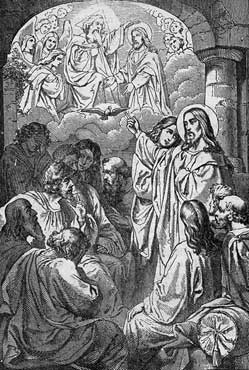
Rev. Fr. Leonard Goffine’s The Church’s Year, What festival is this? It is the day on which the Holy Ghost descended in the form of fiery tongues, upon the apostles and disciples, who with Mary, the Mother of Jesus, were assembled in prayer in a house at Jerusalem. (Acts II.) Why is this day called Pentecost? The word “Pentecost” is taken from the Greek, and signifies fifty. As St. Jerome explains it, this was the last of the fifty days, commencing with Easter, which the early Christians celebrated as days of rejoicing at the resurrection of the Lord. Why is this day observed so solemnly? Because on this day the Holy Ghost, having descended upon the apostles, the law of grace, of purification from sin, and the sanctification of mankind, was for the first time announced to the world; because on this day the apostles, being filled with the Holy Ghost, commenced the work of purifying and sanctifying mankind, by baptizing three thousand persons who were converted by the sermon of St. Peter; and because on this day the Church of Jesus became visible as a community to the world, and publicly professed her faith in her crucified Saviour. Why did the Holy Ghost descend on the Jewish Pentecost? Because on their Pentecost the Jews celebrated the anniversary of the giving of the law on Mount Sinai, and God would show by sending the Holy Ghost on this days that the Old Law had ceased and the New Law commenced. God also chose this time, that the Jews who on this day came together from all countries to Jerusalem to celebrate the Pentecost, might be witnesses of the miracle, and hear the New Law announced by the apostles. Why is the baptismal font blessed an the vigil of Pentecost, as on Holy Saturday? Because the Holy Ghost is the Author of all sanctity and the Fountain of baptismal grace, and because in the Acts (i. 5.) the descent of the Holy Ghost itself is called a baptism. In the Introit of the Mass the Church rejoices at the descent of the Holy Ghost and sings: INTROIT The Spirit of the Lord hath filled the whole earth, allel.; and that which containeth all things hath knowledge of the voice, Allel., allel., allel. (Wisd. I.7.) Let God arise, and his enemies be scattered: and let them that hate him, fly before his face. (Ps. 67.) Glory etc. COLLECT God, who on this day didst instruct the hearts of the faithful by the light of the Holy Spirit: grant us in the same spirit to relish what is right, and ever to rejoice in His consolation. Thro’. — in the unity of the same, etc. LESSON (Acts II. I-II.) When the days of Pentecost were accomplished, they were all together in one place; and suddenly there came a sound from heaven, as of a mighty wind coming, and it filled the whole house where they were sitting. And there appeared to them parted tongues as it were of fire, and it sat upon every one of them:. and they were all filled with the Holy Ghost, and they began to speak with divers tongues, according as the Holy Ghost gave them to speak. Now there were. dwelling at Jerusalem, Jews, devout men, of every nation under heaven. And when this was noised abroad, the multitude came together, and were confounded in mind, because that every man heard them speak in his own tongue: and they were all amazed, and wondered, saying: Behold, are not all these that speak Galileans? And how have we heard every man our own tongue wherein we were born? Parthians, and Medes, and Elamites, and inhabitants of Mesopotamia, Judea, and Cappadocia, Pontus, and Asia, Phrygia, and Pamphilia, Egypt, and the parts of Lybia about Cyrene, and strangers of Rome, Jews also and Proselytes, Cretes and Arabians: we have heard them speak in our own tongues the wonderful works of God. Why did the Holy Ghost come upon the apostles in the form of fiery tongues? The appearance of fiery tongues indicated the gift of language imparted to the apostles by the Holy Ghost, and inflamed their hearts and the hearts of the faithful with the love of God and their neighbor. Why did a mighty wind accompany the descent? To direct the attention of the people to the descent of the Holy Ghost, and to assemble them to hear the sermon of the Apostle Peter. What special effects did the Holy Ghost produce in the apostles? He freed them from all doubt and fear; gave them His light for the perfect knowledge of truth; inflamed their hearts with the most ardent love, and incited in them the fiery zeal for the propagation of the kingdom of God, strengthened them to bear all sufferings and persecutions, (Acts V. 41.) and gave them the gift of speaking in various languages, and of discerning spirits.
Why is the Holy Ghost expressly called “Holy,” since this attribute is due to each of the divine persons? Because He is the Author of inward sanctity and of all supernatural gifts and graces, and therefore to Him is especially ascribed the work of man’s sanctification. What does the Holy Ghost effect in man? He enlightens him that he may know the truths of religion and salvation, and the beauty of virtue; He moves him to desire, to aim after and to love these things; He renews his heart by cleansing it from sin, and imparts to him the supernatural gifts and graces by which he can become sanctified, and He brings forth in him wonderful fruits of holiness. What are the gifts of the Holy Ghost? According to the Prophet Isaias they are seven: 1.The gift of wisdom, which enables us to know God, to esteem spiritual more than temporal advantages, and to delight only in divine things. 2. The gift of understanding, by which we know and understand that which our faith proposes to our belief; children and adults should pray fervently for this gift, especially before sermons and instructions in the catechism. 3.The gift of counsel, which gives us the knowledge necessary to direct ourselves and others when in doubt, a gift particularly necessary for superiors, for those about choosing their state of life, and for married people who live unhappily, and do not know how to help themselves. 4. The gift of fortitude, which strengthens us to endure and courageously overcome all adversities and persecutions for virtue’s sake. 5. The gift of knowledge, by which we know ourselves, our duties, and how to discharge them in a manner pleasing to God. 6. The gift of piety, which induces us to have God in view in all our actions, and infuses love in our hearts for His service. 7. The gift of the fear of the Lord, by which we not only fear the just punishment, but even His displeasure at every sin, more than all other things in the world. Which are the fruits of the Holy Ghost? As St. Paul (Gal. V.. 22-23.) enumerates them, they are twelve: 1. Charity. 2. Joy. 3. Peace. 4. Patience. 5. Benignity. 6. Goodness. 7. Longanimity. 8. Mildness. 9. Faith. 10. Modesty. 11. Continency. 12. Chastity. To obtain these fruits as well as the gifts of the Holy Ghost, we should daily say the prayer: “Come, O Holy Ghost, etc.” Why does Christ say: The Father is greater than I? Christ as God is in all things equal to His Father, but as Christ was at the same time Man, the Father was certainly greater than the Man-Christ. Why does Christ say: I will not now speak many things with you? Christ spoke these words a short time before His passion, and by them He wished to say that the time was near at hand when Satan, by his instruments, the wicked Jews, would put Him to death, not because Satan had this power over Him, but because He Himself wished to die in obedience to the will of His Father. |

June 9, 2019 No Comments
First Friday & First Saturday Traditional Latin Masses for June, 2019
The Traditional Latin Mass will be offered on
at:
June 1, 2019 No Comments