
Seventeenth Sunday After Pentecost
Rev. Fr. Leonard Goffine’s
The Church’s Year
At the Introit of the Mass the justice and mercy of God are praised:
INTROIT Thou art just, O Lord, and thy judgment is right; deal with thy servant according to thy mercy. Blessed are the undefiled in the way; who walk in the law of the Lord. (Ps. CXVIII.) Glory etc.
COLLECT Grant to Thy people, we beseech Thee, O Lord, to avoid the defilements of the devil, and with a pure mind to follow Thee, the only God. Thro’.
EPISTLE (Ephes. IV. 1- 6.) Brethren, I, a prisoner in the Lord, beseech you that you walk worthy of the vocation in which you are called. With all humility and mildness, with patience, supporting one another in charity, careful to keep the unity of the spirit in the bond of peace. One body and one spirit, as you are called in one hope of your calling. One Lord, one faith, one baptism. One God, and Father of all, who is above all, and through all, and in us all. Who is blessed for ever and ever. Amen.
ADMONITION Implore God continually for grace to accomplish and make certain your vocation by practicing these virtues, recommended by St. Paul.
INSTRUCTION ON THE ONE ONLY SAVING FAITH
One Lord, one faith, one baptism, one God and Father of all. (Ephes. IV. 5. 6.)
These words of the great Apostle of the Gentiles show clearly, that it is not a matter of indifference, what faith or religion we profess. Yet in our times so poor in faith, we often hear the assertion from so-called enlightened men: “It is all the same to what religion we belong, we can be saved in any, if we only believe in God and live uprightly.” This assertion is impious! Consider, ..my dear Christian, there is but one God, and this one God has sent only one Redeemer; and this one Redeemer has preached but one doctrine, and has established but one Church. Had God wished that there should be more than one Church, then Christ would have founded them, nay, He would not have preached a new doctrine, established a new, Christian Church; for the Jews also believed in one God. But Jesus cast aside Paganism and Judaism, promulgated a new religion, and founded a new Church. Nowhere does He speak of Churches, but always of one Church. He says that we must hear this Church, and does not add, that if we will not hear this Church, we may hear some other. He speaks of only one shepherd, one flock, and one fold, into which all men are to be brought. In the same manner He speaks always of one kingdom upon earth, just as there is only one kingdom in heaven; of only one master of the house and one family, of one field and one vineyard, whereby He referred to His Church; of one rock, upon which He would build His Church. On the day before His death, He prayed fervently to His Heavenly Father, that all who believe in Him, might be and remain one, as He and the Father are one, and He gave His disciples the express command to preach His gospel to all nations, and to teach them all things, whatsoever He had commanded them. This command the apostles carried out exactly. Everywhere they preached one and the same doctrine, establishing in all places Christian communities, which were all united by the bond of the same faith. Their principal care was to prevent schisms in faith, they warned the faithful against heresy, commanded all originators of such to be avoided, and anathematized those who preached a gospel different from theirs. As the apostles, so did their successors. All the holy Fathers speak with burning love of the necessary unity of faith, and deny those all claim to salvation who remain knowingly in schism and separation from the true Church of Christ.
Learn hence, dear Christian, that there can be but one true Church; if there is but one true Church, it naturally follows that in her alone salvation can be obtained, and the assertion that we can be saved by professing any creed, is false and impious. Jesus who is the Way, the Truth, and the Life , speaks of but one Church , which we must hear, if we wish to be saved. He who does not hear the Church, He says, should be considered as a heathen and publican. He speaks furthermore of one fold, and He promises eternal life only to those sheep who belong to this fold, obey the voice of the shepherd and feed in His pasture. The apostles were also convinced that only the one, true Church could guide us to salvation. Without faith it is impossible to please God, writes St. Paul to the Hebrews, (XI. 6.) and this faith is only one, he teaches the Ephesians. (IV. 5.) If the apostles had believed that we could be saved in any religion, they would certainly not have contended so strenuously for unity, they would not have declared so solemnly, that we should not belong to any other than to Christ alone, and that we must receive and obey His doctrine. As the apostles taught so did their successors and all the Fathers agree that there is no salvation outside of the true Church. St. Cyprian writes: “If any one outside Noah’s ark could find safety, then also will one outside the Church find salvation.” (De unit. eccl. c. 7.) From all this it follows, that there is only one true Church which insures salvation, out of which no one can be saved.
But which is this Church? The Roman Catholic, Apostolic Church, for she alone was founded, by Christ, she alone was watered with the blood of the apostles and of thousands of holy martyrs, she alone has the marks of the true Church of Christ, [see the Instruction for the first Sunday after Easter] against which He has promised that the powers of hell shall not prevail. Those who fell away from the Church three hundred years ago do, indeed contend that the Church fell into error and no longer possessed the true, pure gospel of Jesus. Were they right, Jesus might be blamed, for He established this Church, promising to remain with her and guide her through the Holy Ghost until the end of the world. He would, therefore, have broken His word, or He was not powerful enough to keep it. But who dare say this? On the contrary, she has existed for eighteen hundred years, whilst the greatest and most powerful kingdoms have been overthrown, and the firmest thrones crumbled away. If she were not the only true and saving Church, founded by Christ, how could she have existed so long, since Jesus Himself said: Every plant which my heavenly Father hath not planted, shall be rooted up. (Matt. XV. 13.) If she were not the Church of Christ, she would have been destroyed long ago, but she still stands today, whilst her enemies’ who battled against her have disappeared, and will continue to disappear; for the gates of hell shall not prevail against her, says our Lord. He has kept His promise and will keep it, notwithstanding all the oppositions and calumnies of her implacable enemies.
You see, therefore, my dear Christian, that the Catholic Church is the only true, the only saving Church; be not deceived by those who are neither cold nor warm, and who say: “We can be saved in any religion, if we only believe in God and live uprightly,” and who wish to rob you of your holy faith, and precipitate you into the sea of doubt, error, and falsehood. Outside of the Catholic Church there is no salvation; hold this firmly, for it is the teaching of Jesus, His apostles, and all the Fathers; for this doctrine the apostles and a countless host .of ‘the faithful have shed their blood. Obey the teaching of this Church, follow her laws, make use of her help and assistance, and often raise your hands and heart to heaven to thank God for the priceless grace of belonging to this one, true Church; forget not to pray for your erring brethren, who are still outside of the Church that the Lord may lead them into her, that His promise may be fulfilled: There will be one fold, and one shepherd.
GOSPEL (Matt XXII. 35-46.) At that time, The Pharisees came to Jesus, and one of them, a doctor of the law, asked him, tempting him: Master, which is the great commandment of the law? Jesus said to him: Thou shaft love the Lord thy God with thy whole heart, and with thy whole soul, and with thy whole mind.
This is the greatest and the first commandment. And the second is like to this: Thou shalt love thy neighbor as thyself. On these two commandments dependeth the whole law and the prophets. And the Pharisees being gathered together, Jesus asked them, saying: What think you of Christ; whose son is he? They say to him: David’s. He saith to them: How then doth David in spirit call him Lord; saying: The Lord said to my Lord, Sit on my right hand, until I make thy enemies thy footstool? If David then call him Lord, how is he his son? And no man was able to answer him a word: neither durst any man from that day forth ask him any more questions.
What is meant by loving god?
It means to find one’s pleasure, happiness and joy in God, because He is he highest and most perfect Good; to rejoice in His infinite majesty and glory; to direct one’s thoughts, words, and actions towards Him as our only end: to do His will in all things, an be prepared always rather to lose everything, even life itself, than His friendship.
What is meant by loving God with our whole heart, our whole soul, etc. ?
These different expressions all properly mean the same thing, namely, that we should cling to God with a true, sincere and heartfelt love, but by our heart our will may be understood, that power by which we wish God all glory, and desire nothing more than that He be known, loved, and honored by all men. The soul signifies the intellect by means of which we should endeavor to arrive at the knowledge and love of God, praise and glorify Him above all things. The mind may signify our memory, with Which we continually remember God and the innumerable benefits bestowed on us by Him, praise Him for them, thank Him, and always walk irreproachably before Him. Finally, we love God with all our strength, if we employ all the powers and faculties of our body in His service, and direct all our actions to Him as to our last end.
Is it true love, if we love God only because He is good to us?
This is grateful love, which is good and praiseworthy, but it is not perfect love, because the motive is self-love and self-interest.
What, therefore, is perfect love?
When we love God only because He is in Himself the highest Good, and most worthy of all love. In this manner we should endeavor to love Him; not through self-interest not through hope of reward, not through fear of punishment, but only because He, as the greatest Good, contains all goodness and, therefore, deserves to be loved only on account of Himself. Such love had St. Francis Xavier, which he very beautifully expressed in the following canticle, composed by himself:
O God, I give my love to Thee,
Not for the heaven Thou’st made for me,
Nor yet because who love not Thee
Will burn in hell eternally.
In dying throes on Calvary,
My Jesus, Thou didst think of me,
Didst bear the lance, the nails, the tree,
Rude scoffs, contempt and infamy,
And pangs untold, all lovingly, –
The scourge, the sweat the agony,
And death itself, -all, all for me,
A sinner and Thy enemy.
Why therefore, should not I love Thee,
O Jesus, dead for love of me?
Not that I may in heaven be,
Not that from hell I may be free;
Not urged by dread of endless pain,
Not lured by prize of endless gain,
But as Thou, Lord, didst first love me,
So do I love and will love Thee.
To Thee, my King, I give my heart,
For this alone t hat God Thou art.
Can fear exist with love?
Servile fear cannot, but filial fear may. Servile fear is rather a fear of punishment than a fear of offending God. Where such fear exists, love cannot dwell; for in love, writes St. Augustine, (in Joann. Tr. 9.) there is no fear, for perfect love casteth out fear. ( I John IV. 18.) Filial fear, on the contrary, is the fear of offending God. This fear leads to love and is also an effect of love; it is the beginning of wisdom. (Eccles. I. 16.) Let us cherish this fear, for it will drive away sin, as sentinels expel thieves; (Ecclus. I 16.) it will replenish us with joy, and gladness, and obtain for us in our last moments divine blessings and a holy death. (Ecclus.. I. 27.)
How may we obtain a perfect love of God?
By meditating on His infinite, divine perfections, such as His almighty power, His wisdom, His splendor, His beauty, etc.; by contemplating His boundless love for us, in the incarnation, sufferings, and death of His only-begotten Son; by frequently practicing this virtue; by fervent prayer; and by making acts of love, such as are found in good prayer-books.
When should we practice the virtue of love of God?
As soon as we have arrived at the age of reason; when the world, the devil and the flesh, endeavor to withdraw us from God, by their apparent goods and pleasures; when we have separated ourselves from God by mortal sin; when we receive the holy Sacraments, particularly holy Communion; when we receive a particular grace from God; when we use food and drink and other lawful enjoyments; when we contemplate God’s creatures; often during the day.; and especially in the hour of death.
[Concerning the love of our neighbor , see the twelfth Sunday after Pentecost].
Why is the commandment to’ love God and our neighbor’ called the greatest commandment?
Because in it are contained all the other commandments, for Christ says, in it consists the whole law. He who loves God with his whole heart, does not separate himself from God by infidelity, does not practice public or private superstition and idolatry; he does not murmur against God, does not desecrate the name of God by cursing and swearing; he does not profane the Sabbath, because he knows that all this is displeasing to God. On the contrary, he hopes in God, keeps Sundays and days of obligation holy, and observes all the commandments of the Church, because God wishes that we hear the Church; he honors his parents, inflicts no evil upon his neighbor; does not commit adultery, doe’s not steal, calumniates no one, does not bear false witness, does not judge rashly, is not envious, malicious or cruel, but rather practices the corporal and spiritual works of mercy; and all this, because he loves God and his neighbor.
What is the meaning of the question What think you of Christ?
Christ asked the Pharisees this question in order to convince them, from their own answer, that He was not only the Son of David, but that He as the only-begotten Son of God was the Lord of David and of all men from eternity. (Fs. II. 7.) , Unhappily, even today there are men who like the Pharisees deny the divinity of Christ, the Son of the living God, consider Him merely a very wise and virtuous man, and do not receive His doctrine, confirmed by so many miracles. Beware, my dear Christian, of these men who rob you of the peace of the soul, and the consoling hope of a future resurrection and eternal life, together with faith in Christ, the divine Redeemer. But if you believe Christ to be the Son of God and our Lord, LawÂgiver, Instructor, and Redeemer, follow His teaching, and do not contradict indeed what you profess with your lips.
PRAYER O most amiable Jesus! who hast admonished us so affectionately to love God an& our neighbor, pour the fire of Thy love into our hearts, that all our deeds and actions, x,11 our thoughts and words may begin and end with Thy love. Grant, that we may love Thee with all the powers of our body and. soul, ,and thereby be so united to Thee, that, like St. Paul, no temptation, no tribulation, no danger, not even death, may be able to separate us from Thee. Grant us also, that we may love our neighbors, friends, and enemies as ourselves for Thy sake, and thus be made worthy to possess Thee as our Redeemer and merciful judge.
September 14, 2013 No Comments
A teen talks about the Traditional Latin Mass
September 13, 2013 No Comments
A History of the Time After Pentecost
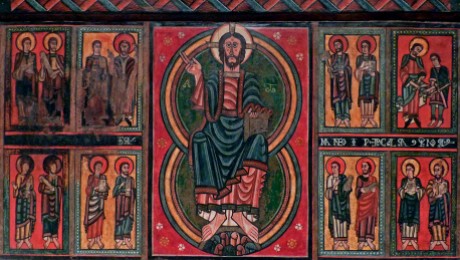
Excerpt from The Liturgical Year by Dom Prosper Gueranger.
The solemnity of Pentecost and its octave are over, and the progress of the Liturgical Year introduces us into a new period, which is altogether different from those we have hitherto spent.
From the very beginning of Advent, which is the prelude to the Christmas festival, right up to the anniversary of the descent of the Holy Ghost, we have witnessed the entire series of the mysteries of our Redemption; all have been unfolded to us.
The sequel of seasons and feasts made up a sublime drama, which absorbed our very existence; we have but just come from the final celebration, which was the consummation of the whole. And yet, we have got through but one half of the year.
This does not imply that the period we have still to live is devoid of its own special mysteries; but, instead of keeping our attention by the ceaseless interest of one plan hurrying on its completion, the sacred liturgy is about to put before us an almost unbroken succession of varied episodes, of which some are brilliant with glory, and others exquisite in loveliness, but each one of them bringing its special tribute towards either the development of the dogmas of faith, or the furtherance of the Christian life.
That year’s cycle will thus be filled up; it will disappear; a new one will take its place, bringing before us the same divine facts, and pouring forth the same graces on Christ’s Mystical Body.
This section of the liturgical year, which comprises a little more or a little less than six months, according as Easter is early or late, has always had the character it holds at present. But, although it only admits detached solemnities and feasts, the influence of the moveable portion of the cycle is still observable.
It may have as many as twenty-eight, or as few as twenty-three weeks. This variation depends not only upon the feast of Easter, which may occur on any of the days between the 2nd of March and 25th of April, inclusively; but, also, on the date of the First Sunday of Advent, the opening of a new ecclesiastical year, and which is always the Sunday nearest the Kalends [i.e., the month’s first day] of December.
In the Roman liturgy, the Sundays of this series go under the name of “Sundays after Pentecostâ€. As we shall show in the next chapter, that title is the most suitable that could have been given, and is found in the oldest Sacramentaries and Antiphonaries; but it was not universally adopted by even all those churches which followed the Roman Rite; in progress of time, however, that title was the general one.
To mention some of the previous early names:
in the “Comes” of Alcuin, which takes us back to the 8th century, we find the first section of these Sundays called “Sundays after Pentecostâ€;
the second is named “Weeks after the Feast of the Apostles†(post Natale Apostolorum);
the third goes under the title of “Weeks after St. Laurence†(post Sanctum Laurentium);
the fourth has the appellation of “Weeks of the Seventh Month†(September);
and, lastly, the fifth is termed “Weeks after St. Michael†(post Sanctum Angelum), and lasts till Advent.
As late as the 16th century, many missals of the Western Church gave us these several sections of the Time after Pentecost, but some of the titles varied according to the special saints honored in the respective dioceses, and which were taken as the date-marks of this period of the year.
The Roman Missal, published by order of St. Pius V, has gradually been adopted in all our Latin churches, and has restored the ancient denomination to the ecclesiastical season we have just entered upon; so that the only name under which it is now known amongst us is, the “Time after Pentecost†(post Pentecosten).
September 13, 2013 No Comments
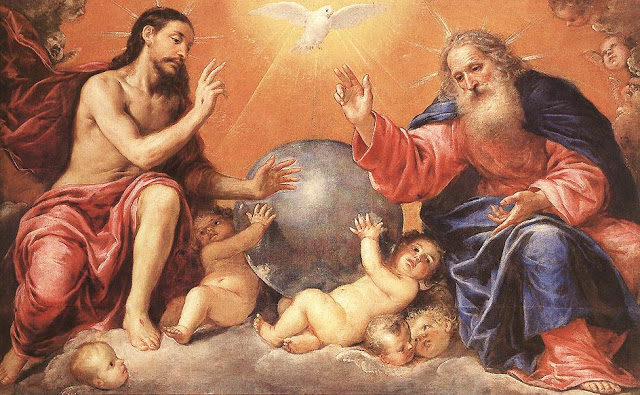
The Holy Trinity by Antonio de Pereda, circa 1650
September 13, 2013 3 Comments
Thursday, September 12, 2013, The Most Holy Name of Mary
All the rich among the people shall entreat Thy countenance: after her shall virgins be brought to the King: her neighbours shall be brought to thee in gladness and rejoicing.
(From the introit of the day’s Mass, Ps. 44. 13, 15, 16)
From The Liturgical Year
by Dom Guéranger, O.S.B.
“’And the Virgin’s name was Mary’ (Luke I. 21). Let us speak a little about this name, which signifies star of the sea, and which so well befits the Virgin Mother. Rightly is she likened to a star: for as a star emits its ray without being dimmed so the Virgin brought forth her Son without receiving any injury; the ray takes nought from the brightness of the star, nor the Son from His Mother’s integrity. This the noble star risen out of Jacob, whose ray illumines the whole world, whose splendour shines in the heavens, penetrates the abyss, and, traversing the whole earth, gives warmth rather to souls than to bodies, cherishing virtues, withering vices. Mary, I say, is that bright and incomparable star, whom we need to see raised above this vast sea, shining by her merits, and giving us light by her example.
“Oh, whosoever thou art that seest thyself, amid the tides of this world, tossed about by storms and tempests rather than walking on the land, turn not thine eyes away from the shining of this star if thou wouldst not be overwhelmed by the hurricane! If squalls of temptations arise, or thou fall upon the rocks of tribulation, look to the star, call upon Mary. If thou art tossed by the waves of pride or ambition, detraction or envy, look to the star, call upon Mary. If anger or avarice or the desires of the flesh dash against the ship of thy soul, turn thine eyes towards Mary. If, troubled by the enormity of thy crimes, ashamed of thy guilty conscience, terrified by dread of the judgment, thou beginnest to sink into the gulf of sadness or the abyss of despair, think of Mary. In dangers, in anguish, in doubt, think of Mary, call upon Mary. Let her be ever on thy lips, ever in thy heart; and the better to obtain the help of her prayers, imitate the example of her life. Following her, thou strayest not; invoking her, thou despairest not; thinking of her, thou wanderest not; upheld by her, thou fallest not; shielded by her, thou fearest not; guided by her, thou growest not weary; favoured by her, thou reachest the goal. And thus dost thou experience in thyself how good is that saying: And the Virgin’s name was Mary.â€
Thus speaks the devout St. Bernard, in the name of the church. But his pious explanation does not exhaust the meanings of this blessed name of Mary. St. Peter Chrysologus adds in this same night Office: “Mary in Hebrew signifies lady or sovereign: and truly the authority of her Son, who is the Lord of the world, constituted her Queen, both in fact and in name, from her very birth.â€
Our Lady: such is the title which befits her in every way, as that of Our Lord beseems her Son; it is the doctrinal basis of that worship of hyperdulia which belongs to her alone. She is below her Son, whom she adores as we do; but above all God’s servants, both angels and men, inasmuch as she is His Mother. At the name of Jesus every knee is bent; at the name of Mary every head is bowed. And although the former is the only name whereby we may be saved; yet, as the Son can never be separated from His Mother, heaven unites their two names in its hymns of praise, earth in its confidence, hell in its fear and hatred.
It was therefore in the order of divine Providence that devotion to the most holy name of Mary should spread simultaneously with the cultus of the adorable name of Jesus, of which St. Bernard of Siena was the apostle in the fifteenth century. In 1513 the Church of Cuenca in Spain was the first to celebrate, with the approbation of the holy See, a special feast in honour of the name of Mary, while the Franciscan Order had not yet succeeded in obtaining a like privilege for the adorable name of Jesus. The reason of this is that the memory of that sacred name included in the feast of the Circumcision, seemed to the prudence of the Pontiffs to suffice. From the same motive we find the feast of the most holy name of Mary extended to the universal Church in the year 1683, and that of the most holy name of Jesus not until 1721.
Our Lady justified her beautiful title by partaking in the warlike exploits of the King of kings her Son. The city of Vienna having been delivered by her, contrary to all hope, from the power of the Crescent, the venerable Innocent XI made this feast the memorial of universal gratitude to the liberatrix of the west.
September 12, 2013 No Comments
Tuesday, September 10, 2013 Collect of the Day: St. Nicholas of Tolentino Posted by David Werling, from Ars Orandi
St. Nicholas of Tolentino
Confessor
It is good to give praise to the Lord: and to sing to Thy name, O Most High.
(From the introit of the day’s Mass, Ps. 91. 14)
Collect of the Day
Adésto, Dómine, supplicatiónibus nostris, quas in beáti Nicolái Confessóris tui solemnitáte deférimus: ut, qui nostræ justÃtiæ fidúciam non habémus, ejus qui tibi plácuit, précibus adjuvémur. Per Dóminum…
Assist us mercifully, O Lord, in these our supplications which we make before thee on the feast of blessed Nicholas, thy holy Confessor: that we, who put not our trust in our own righteousness, may be succoured by the prayers of him that found favour in thy sight. Through…
Epistle – 1 Corinthians, 4. 9-14 / Gospel – St. Luke, 12. 32-34
From The Liturgical Year
by Dom Guéranger, O.S.B.
Today the infant Mary smiles upon the lily offered her in her cradle by the representative of a great Order. The hermits of St. Augustine were being grouped and organized by the Vicar of Christ, when Nicholas was admitted into their family, of which he was soon to become the thaumaturgus. When he died, in 1305, the Roman Pontiffs were beginning their exile at Avignon; and his canonization, deferred for nearly a century and a half through the troubles of the period, marked the close of the lamentable dissensions which followed that exile.
Peace so long lost; peace, of which even the wisest despaired—such was the ardent prayer, the solemn adjuration of Eugenius IV, when, towards the close of his laborious pontificate, he committed the cause of the Church to the humble servant of God placed by him upon her altars. According to the testimony of Sixtus V, the obtaining of this peace was the greatest of Nicholas’s miracles; a miracle which moved the latter Pontiff to order the celebration of the saint’s feast as a double, at a time when days that rank were much rarer on the calendar than now.
Let us read the legend, which is as simple as the saint’s life itself.
This Nicholas is called Nicholas of Tolentino, because he lived in that town for most part of his life. He was born at St Angelo, a place near Fermo, in the March of Ancona, about the year 1245. His parents were godly people, and in their desire to have children, vowed and made a pilgrimage to the shrine of St Nicholas at Bari, where they were assured of their wish, and therefore gave the name of Nicholas to the son whom they received. From his childhood the lad gave many good signs, but especially as regarded abstinence. In his seventh year, in imitation of his blessed name-sake, he began to fast upon several days in the week, which custom he always kept, and was content with only bread and water.
After he reached man’s estate, he enlisted himself in the army of the clergy, and was preferred to a Canonry. One day he chanced to hear a sermon upon contempt of the world delivered by a preacher of the Order of Hermits of St Austin, and was so moved by it that he forthwith entered that Order. As a Friar he was most strictly observant of that way of life. He subdued his body with rough clothing, stripes, and an iron chain. He never ate meat, and seldom any relish to his meals. And he was a burning and shining light of love, lowliness, long-suffering, and all other graces.
He persisted in constant and earnest prayer, notwithstanding many troubles from the assaults of Satan, who sometimes even flogged him. Every night for six months before his death he heard Angels singing with such sweetness, that it was a foretaste of the happiness of heaven, and he would often repeat the words of the Apostle I have a desire to depart and to be with Christ (Phil. i. 23). Lastly, he foretold to his brethren the day of his death, which was the 10th day of September 1306. After his death also he was famous for miracles, and when due investigation had been made thereof, Pope Eugenius IV enrolled his name among those of the Saints.
Good and faithful servant, thou hast entered into the joy of thy Lord. He has broken thy bonds; and from heaven, where thou art now reigning, thou repeatest to us those words which determined the sanctity of thy life on earth: “Love neither the world nor the things that are in the world. For the world passeth away, and the concupiscence thereof.†How much a man thus forgetful of earth can do for his fellow-men, is evinced by the gift thou didst receive of solacing all the miseries around thee, and succoring the souls in purgatory. The successor of St. Peter was not deceived, when, in raking thee among the saints, he counted on thy power in heaven to bring back society from its long continued state of disturbance to the paths of peace. May that word of the beloved disciple which thou hast just echoed to us, sink into our souls as a seed of salvation, and there yield the fruits that it produced in thee; detachment from all temporal things and a longing for eternal realities; that humble simplicity of the soul’s eye which makes life a peaceful journey towards God; and lastly, that purity, which made thee the friend of angels and the favourite of Mary.
September 10, 2013 No Comments
INSTRUCTION ON THE SIXTEENTH SUNDAY AFTER PENTECOST, by Rev. Fr. Leonard Goffine’s “The Church’s Year”
At the Introit of the Mass implore with great confidence the mercy of God in the words of Ps. LXXXV.:
INTROIT Have mercy on me, O Lord, for I have cried to thee all the day; for thou, O Lord, art sweet and mild, and plenteous in mercy to all that call upon thee.
Bow down thy ear to me, O Lord, and hear me, for I am needy and poor. Glory be to the Father, etc.
COLLECT Let Thy grace, we beseech Thee, O Lord, ever precede and follow us, and make us continually intent upon good works. Through etc.
EPISTLE (Ephes. III. 13-21) Brethren, I pray you not to faint at my tribulations for you, which are your glory. For this cause I bow my knees. to the Father of our Lord Jesus Christ, of whom all paternity in heaven and earth is named, that he would grant you, according to the riches of his glory, to be strengthened by his Spirit with might unto the inward man, that Christ may dwell by faith in your hearts: that being rooted and founded in charity, you may be able to comprehend with all the saints what is the breadth, and length, and height, and depth:, to know also the charity of Christ, which surpasseth all knowledge, that you may be filled unto all the fulness of God. Now to him who is able to do all things more abundantly than we desire or understand, according to the power that worketh in us: to him be glory in the Church and in Christ Jesus, unto all generations, world without end. Amen.
EXPLANATION In the epistle of the following Sunday St. Paul tells us, that he was at the time of writing this letter in prison at Rome, whither he was brought’ upon the false accusations of the Jews. From prison he wrote to the Ephesians, whom he had converted to Christianity, and who zealously obeyed his counsels, in order to confirm them in their zeal and to console them in their grief on account of his sufferings which he bore for Christ’s sake. These sufferings which I bear, he writes, redound to your honor, since I, your spiritual father, am considered by God worthy to suffer like His Son; yes, I thank the Father of our Lord Jesus for it, and beg Him on my knees, that He vouchsafe to strengthen you with His Holy Spirit, so that you overcome, your evil inclinations and passions, cleanse your hearts more and more, and sanctify your souls, that if you live thus according to your faith, you may be made the habitations of Christ. He begs God also to. give them a well-grounded charity, which not only loves God on account of the reward, but also on account of our sufferings, thus to become like to Christ, the Crucified. By this constant love for Jesus, even in adversities, we only comprehend with the saints the greatness of the love of Jesus, the Crucified; its breadth, since all the members of His body, all the powers of His soul were tormented with all sorts of tortures, on account of the sins of all men; the length, since He had all these sufferings for thirty-three years before His eyes, and bore them in His soul; the depth, since these tortures surpassed in intensity all which men ever suffered or will suffer; the height, since Christ on the cross saw, with the most perfect knowledge, the malice of each single sin, and the terrible insult offered to the sublime Majesty of God, and He bore the punishment for them in Himself and did penance for them. Other holy Fathers say that by these words the w hole mystery of our, redemption is to be understood, and, indeed, the breadth thereof is, that it is for all men; the length, that it lasts for all centuries and reaches into eternity; the height, that its contemplation takes us away from earth and raises us to heaven; the depth, that it even penetrates. the kingdom of the dead. By contemplating these mysteries we learn to know the infinite love of God, to love Him more and more, and thus make ourselves partakers of His graces. – Obey the teaching of this holy apostle, contemplate the suffering Saviour and His love, endeavor to become like to Him by suffering, and when you see how the Church, her ministers, ,the bishops and priests, are persecuted and in tribulation, be not disheartened, but consider that the discipleship of Jesus consists particularly in suffering, that therefore, the Church and her ministers -must suffer, since their Head, Jesus, has suffered. The holy Church has borne the crown of thorns of Jesus for eighteen hundred years and drank from His chalice; but like Jesus, her Head, she will triumph over all her enemies, and whilst these are hastening to destruction, she will continually live victorious until the end of time and will triumph eternally in heaven.
GOSPEL (Luke XIV. 1-11.) At that time, When Jesus went into the house of one of the chiefs of the Pharisees on the Sabbath-day to eat bread, they watched him. And behold there was a certain man before him that had the dropsy. And Jesus answering, spoke to the lawyers and Pharisees, saying: Is it lawful to heal on the Sabbath-day? But they held their peace: but he taking him, healed him, and sent him away. And answering them, he said: Which of you shall have an ass or an ox fall into, a pit, and, will not immediately draw him out on, the Sabbath-day? And they could not answer him to these things. And he spoke a parable also to them that were invited, marking how they chose the first seats at the table, saying to them When thou art invited to a wedding, sit not down in the first place, lest perhaps one more honorable than thou be invited by him; and he that invited thee and him come and say to thee: Give this man place: and then thou begin with shame to take the lowest place: But when thou art invited, go, sit down in the lowest place: that when he who invited thee cometh he may say to thee: Friend, go up higher. Then shalt thou have glory before them that sit at the table with thee; because every one that exalteth himself shall be humbled, and he that humbleth himself shall be exalted.
Why did Jesus eat with the Pharisees?
To take occasion, as St. Cyril says, to instruct them that it is allowed to heal the sick on the Sabbath, and to show how those who give invitations to a supper, and those who are invited, should conduct themselves. The Pharisees’ invitation to Jesus was not actuated by kindness, but by the desire to find something in His actions which they might criticise; Jesus; however, approaches them with meekness and endeavors to inspire them with a better intention. Beware of the spirit of criticisms and like Jesus make use of every occasion to do good, even to your enemies.
Who may be understood by the dropsical man?
The debauchees and misers; for the more a dropsical person drinks the more his thirst increases, so the debauchee never succeeds in satisfying his shameful lusts; the same is the case with the miser. And just as the dropsical are hard to cure, so the debauchee and miser are difficult to convert.
Why is covetousness classed among the seven deadly sins?
Because it is the root of many evils, (I Tim. VI. 10.) for it leads to usury, theft, ,to the employment of false weights and measures, to the suppression of justice in courts, to perjury, to the oppression of widows and orphans, nay, even to the denial of faith, as was the case with Judas. Therefore the apostle says: They that will become rich, fall into temptation, and into the snare of the devil, and into many unprofitable and hurtful desires, which drown men into destruction and perdition; and admonishes us: to fly these things: and pursue justice, godliness, faith, charity, patience, mildness. (I Tim. VI. 9, 11 .)
A powerful remedy against avarice is to consider that we are not owners of what .we possess, and can take nothing with us in death, but must render a strict account of the use we made of our riches. (I Tim. VI. 7.)
INSTRUCTION ON KEEPING SUNDAY HOLY
Is it lawful to heal on the Sabbath-day? (Luke XIV. 3.)
Why did Christ put this question?
Because the Jews, particularly the Pharisees, were so very superstitious in keeping the Sabbath, they would not recognize Jesus as the Messiah, while He healed on the Sabbath, which was really a good work. But, if the Jews were so conscientious, through superstition and hypocrisy, and considered the performing of an external good work on this day as a sin, some Christians, on the contrary, blinded by avarice and worldly pleasure, place themselves heedlessly, nay, insolently above the commandment to observe the Sabbath, and do not consider those things as wrong which are sometimes very grievous sins.
Consider, my dear Christian, you serve your body the whole week, you use all your powers for temporal business, to support yourself and your family, and God blesses you, if you work with a good intention. Now God chose one day in the week, Sunday, and in the year several other holidays, which you should devote to His service and the salvation of your soul; is it not, therefore, the greatest ingratitude to steal these days from God and your soul, and employ them to gain a transient good, or to indulge in vain, sinful pleasures? At certain times man gives rest to irrational animals, and you give the powers of your body and soul none of the rest they would and should find in quiet devotion, in prayer and meditation, in attending divine service, in receiving the holy Sacraments, &c. If you inquire whence come these shameful violations of Sundays and holidays, you will find that there is no other reason than love of gain and avarice, sinful love of pleasure, and often complete want of faith and confidence in God’s providence. We wish to become rich by all means, and we do not reflect that. this will not happen without the blessing of God, and that wealth is a net, in which thousands entangle themselves to their eternal, perdition. We wish to live merrily and enjoy ourselves, but we do not consider that our life is only a time of penance, to attain that eternally blissful rest, of which Sunday is an emblem. We spend Sundays and holydays in idleness, vain conversations, buying and selling, servile work, or in still worse things, without experiencing the slightest scruple. But God will cover the violators of His sacred days with confusion and shame, (Malach. II. 3.) and permit many temporal evils to come upon them, as proved by daily experience. The blessing of God can never rest upon those who never care for it, but rather make themselves unworthy to receive it, by violating days consecrated to God. Let this be a warning to you.
PRAYER O good Saviour! how manifest are meekness, and wisdom in all Thy words and actions! O, grant, that we may regulate all our actions in such a manner, that they may be acceptable to Thee and tend to the edification of our neighbor. Give us the grace to employ all the days, consecrated to Thee, for Thy honor and our salvation, that we may never raise ourselves above others, but follow Thee in all humility.
September 6, 2013 No Comments
Fraternity of St. Peter Superior Offers Solemn High Mass at New FSSP Parish in Minneapolis
By Michael J. Matt
On Sunday August 11, 2013, some 400 Catholics from the St. Paul/Minneapolis Archdiocese packed the Church of All Saints in Northeast Minneapolis for a solemn high Mass offered by the superior general of the Fraternity of St. Peter, the Very Rev. John Berg—a Minnesota native. There was standing room only in the old church, which until only recently had been selected to close its doors forever due to a dramatic decline in the number of parishioners. With the arrival of the FSSP, of course, that decision was rescinded.
Father Berg was assisted by the new pastor of All Saints, Fr. Peter Bauknecht, FSSP, and his assistant, Fr. Simon Harkins, FSSP, two young priests who have been laboring to get the new parish off the ground ever since they arrived in mid-July.
So far, so good. The Mass was well attended, obviously, but what was so striking was the high number of children and large families on hand, which is evidently the main reason there is already talk of initiating a home-school co-op this fall and starting a choir and catechism classes, along with the full Mass and Sacraments schedule.
Of course, the usual boo birds are already out on the blogosphere firing up the crepehangers with horror stories about how All Saints will be “bi-ritualâ€, since the Archdiocese is still providing a priest to come in and offer the New Mass once a week.
Let’s set the record straight. Father Bauknecht is a capable and charitable young priest. The Church of All Saints has a few remaining parishioners who are not traditionalists, and Father has no intention of throwing them out on their ear. He’s working with the Archdiocese to care for these souls until other arrangements can be made. This, of course, is exactly what the virtue of Christian charity requires of a good priest, as he explores the ways and means of making the transition to an exclusively traditional parish. He himself is NOT offering the New Mass (and never has offered it!) nor is his assistant.
My own father used to say this: “When the Latin Mass comes back we must be sure never to do to the Novus Catholics what was done to us.†The priests of the FSSP here in Minneapolis have a similar concern. They are not bi-ritual, they are not making false compromises, and All Saints is for all practical purposes already a traditional Mass parish. I myself have been in contact with some of the Novus Ordo Catholics from All Saints, trying to do what I can to help them find a solution.
The priests of the Fraternity of St. Peter have come to St. Paul/Minneapolis because they were invited in by the large traditionalist community here. They did not accept that invitation as part of some nefarious plot to help shut down our thriving SSPX chapel, for example. In fact, the only traditional Mass centers that may feel a pinch since the arrival of the FSSP are the others in the area that are diocesan-approved. In other words, the Traditional Mass is very popular here in St. Paul/Minneapolis with some six churches now offering the Traditional Latin Mass just in the metro area. The FSSP was invited into this diocese because the demand for the Latin Mass is just that high.
In other words, this is all good news. There is no anti-SSPX conspiracy afoot. In fact, I believe we may finally be moving past all that, not only here in St. Paul but all across the country. And this with good reason. People are frightened by the way things are going in our brave new world, and they’re seeing the need to unify wherever possible. The internecine squabbling among traditionalists is for the most part dying down as Catholics brace for persecution.
Personally, I’m grateful to God to live in a town where the SSPX is strong, where we have courageous diocesan priests who are fighting the good fight and offering the Latin Mass, and where the Fraternity of St. Peter has established a thriving traditional Mass center that can only benefit souls and the common good. From a traditional Catholic point of view, the Twin Cites are fast becoming the place to be.
For Remnant TV, we did a special report on the FSSP Mass last Sunday which included sidewalk interviews after Mass. I was struck by the number of Catholics new to Tradition in attendance and overwhelmed by the Mass they’d just witnessed. With tears in their eyes, some of them expressed great joy at discovering the Mass of all time—and these are folks who never in a million years would have walked into a chapel of the SSPX.
In other words, God is good and the winds of change are still blowing in the direction of Tradition. We need to do everything possible to promote the Latin Mass. Period! If you prefer the SSPX for good and important reasons, fine! Carry on. If you prefer the FSSP, you’ll get no argument here. We can and should discuss our opinions of approved vs. unapproved Mass centers behind closed doors and amongst ourselves. These are important issues, but they need not be publicly debated at every opportunity. In public, traditionalists must remain outspoken advocates of the Latin Mass and the traditional Catholic restoration. That’s what matters most. God in His grace and good time will see to the rest.
It is the old Latin Mass that matters. If that Mass and the thought of three fine young FSSP priests celebrating it at All Saints in Minneapolis—a church due to be shuttered forever just months earlier—doesn’t stir your Catholic soul then someone has already achieved remarkable success in robbing you of your sensus Catholicus.
If you hate the very sight of that Mass you have become at least to a degree, a self-loathing Catholic with a semi-Protestant worldview.
If you know nothing about that Mass, you must understand that it is the Mass of the saints, martyrs, virgins and doctors of the Church. It is the Mass of your grandmother and hers and hers. It is your liturgical patrimony; it is your Catholic birthright; it is the great jewel of Christendom and the most beautiful thing this side of heaven. If you don’t know that Mass then you don’t yet know what it means to be truly Catholic because through no fault of your own, you have been separated from your Catholic roots by the very thing which should be the touchstone of the Catholic Faith: The Mass
Restore this Mass and Catholic identity will be restored along with it. Learn this Mass, love this Mass, and your faith will not fail you in the days and nights to come. As the Catholics of the Western Uprising in England cried out over and over again as they gave their lives for this Mass—â€It’s the Mass that matters!â€
Anti-Catholic revolutionaries have always hated this Mass. Freemasons, tyrants and heretics outlawed it in 16th century England, deformed it in 17th century Germany, banned it in 18th century France, and crushed it in 20th century Mexico. Modernists even tried to abrogate it from the very heart of the Catholic Church after Vatican II. But they failed.
The old Mass has survived and is now available to millions, even as the whole world prepares for yet another persecution of all things Catholic. Pope Benedict XVI restored this Mass, and changed the course of history. Over our dead bodies will it be taken away from us and our children again. The future of the world and the salvation of our souls depend on the survival of the ancient Latin Mass of the Catholic Church. Why? Because lex orandi lex credendi. The law of prayer is the law of belief. How we pray is how we believe. And everywhere where this Mass is celebrated no more the Faith is dying.
As the late William F. Buckley wrote of the Mass back in 1979, “As a Catholic, I have abandoned hope for the liturgy, which, in the typical American church, is as ugly and as maladroit as if it had been composed by Robert Ingersoll and H.L. Menchen for the purpose of driving people away. Incidentally, the modern liturgists are doing a remarkably good job, attendance at Catholic Mass on Sunday having dropped sharply in the 10 years since a few well-meaning cretins got hold of the power to vernacularize the Mass, and the money to scour the earth in search of the most unmusical men and women to preside over the translation. The next liturgical ceremony conducted primarily for my benefit, since I have no plans to be beatified or remarried, will be my own funeral; and it is a source of great consolation to me that, at my funeral, I shall be quite dead, and will not need to listen to the accepted replacement for the noble old Latin liturgy. Meanwhile, I am practicing Yoga, so that, at church on Sundays, I can develop the power to tune out everything I hear, while attempting, athwart the general calisthenics, to commune with my Maker, and ask Him first to forgive me my own sins, and implore him, second, not to forgive the people who ruined the Mass.â€
Indeed, and let us see to it that their spiritual sons will not do so again.
Long live the Traditional Latin Mass of our fathers!
September 4, 2013 No Comments
Angelus Press Releases Documentary Demanding New Look at Controversial Archbishop
Fifty years after the opening of the Second Vatican Council, the story of one archbishop’s life may be more important than ever for Catholics who wish to understand and know the life of the Church in the 20th Century.
Kansas City, MO (PRWEB) August 27, 2013
Angelus Press will officially release the English-language version of Archbishop Lefebvre: A Documentary starting in October of this year. This documentary, the work of an international team of scholars, filmmakers, journalists, and consultants, tells the story of Archbishop Lefebvre in a comprehensive manner, seeking to examine the life of a bishop whose influence upon the Church is larger than ever over twenty years after his death.
As opposed to certain prior accounts of Lefebvre’s life, the filmmakers attempted to tell the story in its entirety without any preconceived decisions or angles. “This is what is so unique about this film, and what interested us so much in this project,†said the editor of Angelus Press, James Vogel. “It tells the full story, which almost no one knows. From his years as an African missionary, to being an Apostolic Delegate for Pope Pius XII, Superior General of the Holy Ghost Fathers, a Council Father at Vatican II, and of course founder of the Society of St. Pius X, it tells the whole story of this influential bishop.â€
The film itself begins with the story of Lefebvre’s childhood, and follows him through his days as an African missionary, and through these to the bishop’s palace of Dakar, and the Apostolic Delegation to French-speaking Africa. It then considers the life of the Archbishop through his involvement with the Preparatory Commission of the Second Vatican Council, as Superior General of the Holy Ghost Fathers, and during the Council itself. Finally, it considers that for which Lefebvre is perhaps best known: his work in the post-conciliar era, including the foundation of the Society of St. Pius X, and the consecration of four bishops, which led to a declaration of automatic excommunication by Pope John Paul II.
The 103-minute documentary offers the viewer a comprehensive and objective look at his life. It includes rare archival footage, and features extensive interviews by the bishops, priests, family members, and friends who knew him, as well as academics and journalists who are experts of the period. This, says Vogel, helps further set the film apart from other stories of Archbishop Lefebvre. “When you have a film that relies heavily on these independent interviews, whether of his own family, or the testimony of priests who studied under him in Gabon or Dakar, who worked with him when he was head of the Holy Ghost Fathers, you’re talking about a groundbreaking project.”
The documentary will be shown in private screenings throughout the country beginning with a special inaugural launch at Angelus Press’s 2013 Conference for Catholic Tradition, on Sunday, October 13, and will continue to be shown in select locations into November. The DVD will be released in time for Christmas of this year. More information can be found at http://www.lefebvrethemovie.org/.
About Angelus Press
Angelus Press is a Catholic publisher which aims to promote the immemorial traditions of the Catholic Faith and the traditional Roman Mass with an unswerving commitment to orthodoxy and the Magisterium of the Roman Catholic Church. In addition to the regular publication of books on subjects of Catholic interest, it produces a bi-monthly magazine, The Angelus.
Angelus Press
PO Box 217
Saint Mary’s, KS 66536
http://www.angeluspress.org
800-966-7337
September 4, 2013 No Comments
Pope Saint Pius X (The only Pope canonized in the 20th century, by Pope Pius XII) – From the Roman Breviary
Pope Pius X, whose name previously was Joseph Sarto, was born in the village of Riese in the Venetian province, to humble parents remarkable for their godliness and piety. He enrolled among the students in the seminary of Padua, where he exhibited such piety and learning that he was both an example to his fellow students and the admiration of his teachers. Upon his ordination to the priesthood, he laboured for several years first as curate in the town of Tombolo, then as pastor at Salzano. He applied himself to his duties with such a constant flow of charity and such priestly zeal, and was so distinguished by the holiness of his life, that the Bishop of Treviso appointed him as a canon of the cathedral church and and made him the chancellor of the bishop’s curia, as well as spiritual director of the diocesan seminary. His performance in these duties was so outstanding and so highly impressed Leo XIII, that he made him bishop of the Church of Mantua.
Lacking in nothing that maketh a good pastor, he laboured particularly to teach young men called to the priesthood, as well as fostering the growth of devout associations and the beauty and dignity of divine worship. He would ever affirm and promote the laws upon which Christian civilisation depend, and while leading himself a life of poverty, never missed the opportunity to alleviate the burden of poverty in others. Because of his great merits, he was made a cardinal and created Patriarch of Venice. After the death of Pope Leo XIII, when the votes of the College of Cardinals began to increase in his favour, he tried in vain with supplications and tears to be relieved of so heavy a burden. Finally he ceded to their persuasions, saying I accept the cross. Thus he accepted the crown of the supreme pontificate as a cross, offering himself to God, with a resigned but steadfast spirit.
Placed upon the chair of Peter, he gave up nothing of his former way of life. He shone especially in humility, simplicity and poverty, so that he was able to write in his last testament : I was born in poverty, I lived in poverty, and I wish to die in poverty. His humility, however, nourished his soul with strength, when it concerned the glory of God, the liberty of Holy Church, and the salvation of souls. A man of passionate temperament and of firm purpose, he ruled the Church firmly as it entered into the twentieth century, and adorned it with brilliant teachings. He restored the sacred musick to its pristine glory and dignity ; he established Rome as the principal centre for the study of the Holy Bible ; he ordered the reform of the Roman Curia with great wisdom ; he restored the laws concerning the faithful for the instruction of the catechism ; he introduced the custom of more frequent and even daily reception of the Holy Eucharist, as well as permitting its reception by children as soon as they reach the age of reason ; he zealously promoted the growth of Catholic action ; he provided for the sound education of clericks and increased the number of seminaries in their divers regions ; he encouraged every priest in the practice of the interior life ; he brought the laws of the Church together into one body ; he condemned and suppressed those most pernicious errors known collectively as Modernism ; he suppressed the custom of civil veto at the election of a Supreme Pontiff. Finally worn out with his labours and overcome with grief at the European war which had just begun, he went to his heavenly reward on the twentieth day of August in the year 1914. Renowned throughout all the world for the fame of his holiness and miracles, Pope Pius XII, with the approbation of the whole world, numbered him among the Saints.
September 4, 2013 No Comments