
Twenty-Second Sunday After Pentecost
Rev. Fr. Leonard Goffine’s
The Church’s Year
At the Introit of the Mass pray with the priest for the forgiveness of your sins: If thou shalt observe iniquities O Lord: Lord, who shall endure? for with thee is propitiation, O God of Israel. From the depths I have cried to thee, O Lord: Lord, hear my voice. (Ps. CXXIX.) Glory etc.
COLLECT O God, our refuge and strength, who art the author of all goodness, hear, we beseech Thee, the devout prayers of Thy Church, and grant that what we faithfully ask we may effectually obtain. Thro’.
EPISTLE (Philipp. I. 6-II.) Brethren, We are confident in the Lord Jesus, that he who hath begun a good work in you will perfect it unto the day of Christ Jesus. As it is meet for me to think this for you all, for that I have you in my heart, and that in my bands, and in the defence and confirmation of the gospel, you are all partakers of my joy. For God is my witness, how I long after you all in the bowels of Jesus Christ. And this I pray, that your charity may more and more abound in knowledge and in all understanding: that you may approve the better things; that you may be sincere and without offence unto the day of Christ, filled with the fruit of justice, through Jesus Christ, unto the glory and praise of God.
EXPLANATION This epistle was written by St. Paul at Rome, where he was imprisoned for the faith, to the inhabitants of Philippi in Macedonia whom he had converted to the true faith. He congratulates them that they so willingly received and conscientiouly obeyed the gospel which he had preached to the, and he says, he trusts in God to complete the good work which He has commenced, and to give them perseverance until the day of Christ, that is, until death.
GOSPEL (Matt. XXII. 15-21.) At that time, The Pharisees went and consulted among themselves how to ensnare Jesus in his speech. And they send to him their disciples, with the Herodians, saying: Master, we know that thou art a true speaker, and teachest the way of God in truth, neither carest thou for any man, for thou dost not regard the person of men: tell us, therefore, what dost thou think? Is it lawful to give tribute to Caesar or not? But Jesus knowing their wickedness, said: Why do you tempt me, ye hypocrites? Show me the coin of the tribute. And they offered him a penny. And Jesus saith to them: Whose image and inscription is this? They say to him: Caesar’s. Then he saith to them: Render therefore to Caesar the things that are Caesar’s, and to God the things that are God’s.
Why did the Pharisees try to ensnare Jesus in His speech?
In order to find some reason to accuse Him before tho emperor, or to make Him hated by the Jews; for had He denied tribute to Caesar, they would have accused Him before the emperor as guilty of high treason; had He, on the contrary made it obligatory to pay tribute, then they would have denounced Him as a destroyer of the liberty of the people, who considered themselves a free nation owing allegiance only to God. Like the Pharisees are all those who, under the appearance of friendship, only cause vexation and misfortune to their neighbor.
Who are really hypocrites?
Those who in order to cheat their neighbor, appear outwardly pious and holy, whilst inward they are full of malice; those who have honey on the tongue, but gall in the heart, and sting like scorpions, when we least expect it. Because there are so many vices connected with hypocrisy, (Matt. XXIII.) therefore Christ has denounced no sin more emphatically than this one. Hypocrites are brethren of Cain, Joab, and Judas, of whom the first killed his brother, the second his cousin and the third betrayed his divine Master with a kiss. Such false men are cursed by God. (Mal, I. 14.) I hate a mouth with a double tongue. (Prov. VIII. 13.) “The devil silently possesses the hearts of hypocrites and quietly sleeps in them, whilst he gives them no peace,” says St. Gregory; and St. Jerome writes: “Pretended holiness is double malice.” Better is an open enemy, before whom we can be on our guard, than a hypocritical friend of whom we have no suspicion, because we look upon him as a friend. Beware, therefore, my dear Christian, of the vice of hypocrisy, which is so hateful to God; endeavor always to be sincere with God, thyself and thy neighbor, and to walk in-true humility before God, then mayst thou carry His image within thee.
PRAYER Help me, O Lord, for the number of the saints is decreasing and truth is becoming rare among men. They speak vain things each with his neighbor: their lips are deceitful, and they speak with double hearts. Let the Lord destroy all those who say: We will magnify our tongue; our lips are our own; who is Lord over us? O Lord, deliver my soul from wicked lips and deceitful tongues give me grace to preserve Thy image in my soul, by piety and virtue. Direct my heart to justice and keep it from avarice, that I may give to each his own.
INSTRUCTION ON THE FOLLY OF HUMAN RESPECT
Thou art a true speaker ‘ neither carest thou or any man, for thou dost not regard the person of men. (Matt. XXII. 16.)
In this Christians ought especially to follow the Saviour, and not permit themselves to be deterred from piety, and the practice of virtue by fear or human respect. What matters it, what people think and say of us, if we only please God? He alone can truly benefit or injure us; therefore he alone is to be feared, as Christ says: Fear ye not them that kill the body, and are not able to kill the soul: but rather fear him that can destroy both soul and body in hell. (Matt. X. 28.)
How foolishly, therefore, do those act who through fear of displeasing certain people, are afraid to serve God and practice piety; who even go so far as to commit sin; who in order to be pleasing to others, oppress innocent, poor and forsaken people; who adopt the latest and most scandalous fashions and customs; those who eat meat on days of abstinence, or give it to others; those who sing sinful songs, or what is still worse, do not hesitate to ridicule sacred things to give others occasion to laugh, or in order to be considered strong-minded. Implore God daily and sincerely, that He may take from you this vain fear of men and give you instead the fear of the Lord, which is the beginning of wisdom.
INSTRUCTION ON THE VALUE AND DIGNITY OF THE SOUL
Whose image is this? (Matt. XXII. 20.)
Thus we should often ask ourselves with respect to our soul, particularly when we are tempted to stain and rain it by sin, Whose image is this? We should then say to ourselves, “Is it not the likeness of God, a likeness painted with the blood of Jesus, an image for which the Saviour gave His life? Should I defile and deform this by sin and voluptuousness? God forbid!” For in truth, what among all created things, except the angels, is more beautiful and more precious than a -human soul, which is in the state of grace? “Could we,” says St. Catherine of Sienna, “behold with our corporal eyes a soul in the state of grace, we would see with astonishment that it surpasses in splendor all flowers) all stars, the whole world, and there is probably no one who would not wish to die for such beauty.” It is a dwelling of the Blessed Trinity! Christ did not give His life for all the goods and treasures of this earth, but for the human soul. And yet many estimate their soul at such little value that they sell it for a momentary pleasure, for a present not worth a penny! For shame! The body we estimate so highly that we take all pains to decorate it and keep it alive, and the soul the image and likeness of God, we take no pains to keep in the state of grace, and adorn with virtues! What folly!
INSTRUCTION ON THE OBLIGATION TO PAY TAXES OR TRIBUTE TO THE GOVERNMENT
Render to Caesar the things that are Caesar’s, and to God the things that are God’s. (Matt. XXII. 21.)
To pay tribute to the lawful government is a duty of justice which the Spirit of God Himself commands us faithfully to fulfil. (Rom. XIII. 6, 7.) Christ Himself paid the customary didrachma for Himself and St. Peter; (Matt. XVII. 23.) “and if the Son of God Himself paid duty and tax,” says St. Ambrose, “who art thou, O man, that thou wouldst free thyself from it?” The government must watch lest the life of its subjects be at hazard, that their property be not endangered or stolen, that there be security on the highways, that peace, harmony and order be preserved among the citizens, that their temporal welfare be promoted; that science and art flourish, etc. For this, teachers, judges, officers and soldiers are necessary, for whose support care must be taken, and whose trouble must be rewarded. Besides this the government must care for the security of the country, for public streets and bridges, and institutions necessary for the common good; to enable the government to perform these duties, taxes are necessary and lawfully assessed. If you oppose these laws, you oppose God, for by Him princes rule, and the mighty degree justice. (Prov. VIII. 16.) Let the payment of duties be done willingly, because you pay them for love of God, and resigned to His holy will as the early Christians did, who even served their heathenish government with pleasure, in all that was not contrary to God’s will, and cheerfully paid the duties.
October 18, 2013 No Comments
First Daily TLM (ad experimentum) in the Archdiocese of Philadelphia
With much prayer (and fasting) from those new to the fight and old, we
petitioned our pastor here at Our Lady of Lourdes in Philadelphia for a
daily TLM.
He discussed with the Archbishop and it was decided that for Advent (as a
“test”), we will have a daily 6:30pm Low Mass. It will not be celebrated on
Saturdays or any Holy Days that are on the calendar.
God is good!
Pax,
Michael D. Harris
October 15, 2013 3 Comments
Poem by Joyce Kilmer
I take my leave, with sorrow, of Him I love so well;
I look my last upon His small and radiant prison-cell;
O happy lamp! to serve Him with never ceasing light!
O happy flame! to tremble forever in His sight!
I leave the holy quiet for the loudly human train,
And my heart that He has breathed upon is filled with lonely pain.
O King, O Friend, O Lover! What sorer grief can be
In all the reddest depths of Hell than banishment from Thee?
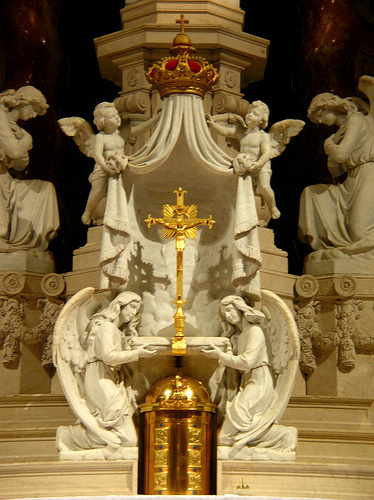
But from my window as I speed across the sleeping land
I see the towns and villages wherein His houses stand.
Above the roofs I see a cross outlined against the night,
And I know that there my Lover dwells in His sacramental might.
Dominions kneel before Him, and Powers kiss His feet,
Yet for me He keeps His weary watch in the turmoil of the street:
The King of Kings awaits me, wherever I may go,
O who am I that He should deign to love and serve me so?
October 8, 2013 1 Comment
First Friday and First Saturday TLM’s for October, at St. Albert the Great R. C. Church
Will:
First Friday, October 4, A.D. 2013, Traditional Latin Mass (TLM) will be offered by Fr. Gerald Carey of Our Lady of Perpetual Help Roman Catholic Church at the Rectory Chapel of St. Albert The Great Parish, 212 Welsh Road, Huntingdon Valley, PA 19006, (T) 215-947-3500 at 7 p.m. preceded by Confessions at 6:30 p.m. Fr. Carey will be offering The Mass of St. Francis of Assisi in Reparation to The Sacred Heart of Jesus.
First Saturday, October 5, A.D. 2013, TLM will be offered by Fr. Dominick Finn, O.S.F.S. also at the Rectory Chapel of St. Albert The Great Parish, 212 Welsh Road, Huntingdon Valley, PA 19006, (T) 215-947-3500 at 9:15 a.m. preceded by Confessions at 8:45 a.m. Fr. Finn will be offering a Votive Mass in Reparation to The Immaculate Heart of Mary.
The Rectory, also known as the Parish Center, is behind the Church, which fronts on Welsh Road.
Thank you for publicizing these Traditional Latin Masses.
Mark Matthews
October 1, 2013 No Comments
Dreher: “Pope Francis only confirms my decision to leave†the Catholic Church. A HARD look at where we are.
Posted on 30 September 2013 by Fr. John Zuhlsdorf
There is an intense piece by Rod Dreher over at TIME. The whole thing is worth a close look, but here are some longish samples.
NB: While I disagree with Dreher’s decision to leave the Catholic Church, I sure understand how he got to that point and I have to agree with a great deal of what he says about the squishy, formless pabulum Catholics have been fed for decades. Dreher, offering a salutary warning, also makes a connection between the destructive “spirit of Vatican II†and its potential replacement, a “spirit of Francisâ€.
There has been both lavish (nearly irrational) praise of Pope Francis and there has been harsh (nearly irrational) criticism of Pope Francis. I don’t agree with everything that Dreher wrote here (of course… I usually only agree entirely with myself), but I haven’t seen the points he makes put so eloquently.
While Dreher’s look at The Francis Effectâ„¢ may make you squirm a little, will any of you be willing to disagree with his vivisection of the American Church? When he talks about the effects of the “spirit of Vatican IIâ€, doesn’t he hit the nail square on?
We need this kind of hard-nosed, cool introspection.
I’m Still Not Going Back to the Catholic Church
Pope Francis only confirms my decision to leave
By Rod Dreher
It’s not hard to understand why people are so excited about Pope Francis. Since his sensational interview last week, many have said that with his personal warmth and determination to put doctrine in the background, Francis is just the man to bring a lot of fallen-away Catholics back into the church.
Maybe. But I’m an ex-Catholic whose decision to leave the Catholic Church is not challenged by Francis’s words, but rather confirmed.
Just over two decades ago, when I began the process to enter the Roman Catholic Church as an adult convert, I chose to receive instruction at a university parish, figuring that the quality of teaching would be more rigorous. After three months of guided meditations and endless God is love lectures, I dropped out. [I thank God that I discovered the Church where and how I did.]
[…]
What I was told, in effect, in that university Catholic parish was that God loved me just as I was — true — but that I didn’t need to do anything else. It dawned on me one day that at the end of this process, all of us in the class would end up as Catholics, but have no idea what the Catholic Church taught. I bolted, and a year later, I was received into the Church in another parish. [Sounds about right.]
If you only know about the Catholic Church from reading the papers, you are in for a shock once you come inside. The image of American Catholicism shown by the media is of a church preoccupied with sex and abortion. It’s not remotely true. [Exactly! Where are all these priests and bishops who are “obsessed” with sex and abortion? Do you know any?] I was a faithful mass-going Catholic for 13 years, attending a number of parishes in five cities in different parts of the country. I could count on one hand the number of homilies I heard that addressed abortion or sexuality in any way. Rather, the homilies were wholly therapeutic, almost always some saccharine variation of God is love. [All you need is luv.]
Well, yes, He is, but Sunday School simplicities only get you so far. Classical Catholic theology dwells on the paradox of God’s love and God’s justice. As Dante shows in the Divine Comedy, God’s love is God’s justice poured out on those who reject Him. In the Gospels, Jesus offers compassion to sinners rejected by religious rigorists, but he also tells them to reform their lives, to “go forth and sin no more.â€
Was I frustrated because the priests wouldn’t preach God’s judgment instead of God’s mercy? By no means. I was frustrated because they wouldn’t preach God’s judgment at all, which is to say, they preached Christ without the Cross. [Ain’t it the truth.] I knew the depths of the sins from which I was being delivered, and it felt wrong to treat His amazing grace like it was a common courtesy. Like the reggae song says, “Everybody wants to get to heaven, but nobody wants to die.â€
[Here we go!] The contemporary era of global Catholicism began in 1959, when the newly elected Pope John XXIII sought to “open the windows†of the fusty old Church to the modern world by calling the Second Vatican Council. Three years later, in his opening address to the council, the charismatic and avuncular pope called for “a new enthusiasm, a new joy and serenity of mind in the unreserved acceptance by all of the entire Christian faith,†without compromising on doctrine. A fierce spirit of the age blasted through those newly-opened windows, scouring nearly everything in its path. The coming decades would see a collapse in Catholic catechesis and Catholic discipline. The so-called “spirit of Vatican II†— a perversion of the Council’s actual teaching — justified many subsequent outrages. [I am tempted to memorize that paragraph.]
[… skipping stuff about the abuse crisis and how it was handled…]
All this put the moral unseriousness of the American church in a certain light. As the scandal raged, one Ash Wednesday, I attended mass at my comfortable suburban parish and heard the priest deliver a sermon describing Lent as a time when we should all come to love ourselves more. [ARGH!]
[…]
It wasn’t safe to raise my children in this church, I thought — not because they would be at risk of predators, but because the entire ethos of the American church, like the ethos of the decadent post-Christian society in which it lives, is not that we should die to ourselves so that we can live in Christ, as the new testament demands, but that we should learn to love ourselves more.
Flannery O’Connor, one of my Catholic heroes, famously said, “Push back against the age as hard as it pushes against you. What people don’t realize is how much religion costs. They think faith is a big electric blanket, when of course it is the cross.†American Catholicism was not pushing back against the hostile age at all. Rather, it had become a pushover. [Pathe-tic.] God is love was not a proclamation that liberated us captives from our sin and despair, but rather a bromide and a platitude that allowed us to believe that, and to behave as if, our lust, greed, malice and so forth – sins that I struggled with every day — weren’t to be despised and cast out, but rather shellacked by a river of treacle.
I finally broke. Losing my Catholic faith was the most painful thing that ever happened to me. Today, as much as I admire Pope Francis and understand the enthusiasm among Catholics for him, his interview makes me realize that the good, if incomplete, work that John Paul II and Benedict XVI did to restore the Church after the violence of the revolution stands to be undone. [Exactly! And you can feel the erosion happening under our feet even now, like a massive sinkhole at work.] Though I agree with nearly everything the pope said last week in his interview, and cheer inwardly when he chastises rigorist knotheads who would deny the healing medicine of the Church to anyone, [On the other hand, how many of those idiots are there?] I fear his merciful words will be received not as love, but license. [HERE is a money quote…] The “spirit of Pope Francis†will replace the “spirit of Vatican II†as the rationalization people will use to ignore the difficult teachings of the faith. If so, this pope will turn out to be like his predecessor John XXIII: a dear man, but a tragic figure.
In his interview, the pope used a metaphor for the Church that is often employed by Eastern Orthodox Christianity: he called it a “field hospital†where the walking wounded can receive treatment. He’s right, but it’s important to discern the nature of the cure on offer. Anesthesia is a kind of medicine that masks the pain, but it’s not the kind of medicine that heals the underlying sickness.
There is, of course, no such thing as the perfect church, but in Orthodoxy, which radically resists the moralistic therapeutic deism that characterizes so much American Christianity, I found a soul-healing balance. In my Russian Orthodox country mission parish this past Sunday, the priest preached about love, joy, repentance, and forgiveness – in all its dimensions. Addressing parents in the congregation, he exhorted us to be merciful, kind, and forgiving toward our children. But he also warned against thinking of love as giving our children what they want, as opposed to what they need.
“Giving them what they want may make it easier for us,†he said, “but we must love our children enough to teach them the hard lessons, and compel them toward the good.†[The Book of Proverbs comments in this way, too.]
True, that. And I cherish this pastor because he loves his people enough to teach us the hard lessons, and to compel us past mediocrity, and toward the good. Catholic priests of the same mind and orientation as my Orthodox pastor – and I know many of them – are telling me that the Holy Father, by signaling to his American flock that God is love, and the rest doesn’t really matter, just made their mission a lot more difficult. [Damn right it is!] But that is no longer my problem. [No, Rod, it is still your problem. Dogmatic Constitution Lumen gentium, 14: “They could not be saved who, knowing that the Catholic Church was founded as necessary by God through Christ, would refuse either to enter it, or to remain in it.”]
While it might be tempting to discuss Dreher’s own “faith journeyâ€, the real meat here is in his view of the state of the Church and the direction he guesses it is going.
September 30, 2013 No Comments
Nineteenth Sunday After Pentecost
Rev. Fr. Leonard Goffine’s
The Church’s Year
INTROIT I am the salvation of the people, saith the Lord: in whatever tribulation they shall cry to me, I will hear them: and I will be their Lord for ever. Attend, O my people, to my law: incline your ears to the words of my mouth. (Ps. LXXVII.) Glory etc.
COLLECT Almighty and merciful God, graciously keep us from all things that are hurtful; that we, being set free both in mind and body, may with ready minds accomplish whatever is Thine. Thro’.
EPISTLE (Ephes. IV. 23-28.) Brethren, Be reÂnewed in the spirit of your mind, and put on the new man, who according to God is created in justice and holiness of truth. Wherefore, putting, away lying, speak ye the truth every man with his neighbor, for we are members one of another. Be angry, and sin not. Let not the sun go down upon your anger. Give not place to the devil. He that stole, let him now steal no more; but rather let him labor, workÂing with his hands the thing which is good, that he may have something to give to him that suffereth need.
EXPLANATION St. Paul admonishes the Ephesians to lay aside the- old man, like a worn out garment, and put on the new man, that is, to renew their internal and external life. This renewal according to his teaching takes place, when we by a true repentance put away our vices, shun all lies, anger, injustice, &c., and adorn our soul with virtues, and zealously seek after Christian justice and perfection. We have, perhaps, already sought to change our manner of living, for which a jubilee or some other particular solemnity of the Church gave us occasion, and at that time, perhaps, purified our soul by a general confession, making the firm resolution to live for God, and work out our salvation, we appeared converted, and to have become other men: but how long did this conversion last? Ah, how soon did we fall back into the old, sinful ways. And why? Because we lived in too great, deceitful security. We thought everything accomplished by the general confession; we were satisfied, and omitted to employ the means of remaining in the state of grace. We did not thank God for the grace of conversion; we did not ask Him for the grace of perseverance; we frequented evil company, and did not avoid dangerous occasions; we indulged in idleness and pleasures as before. How can it appear strange, if such a conversion is fruitless? Ah, we should remain in wholesome fear even after the remission of our sins. (Ecclus. V. 5.) Even if we could say that we have done everything, nevertheless we cannot be certain, whether we be worthy of hatred or love. (Ecclus. IX. 1.) We should, therefore, work out our salvation according to the advice of St. Paul (Philipp. II. 12.) in fear and trembling, and thus not fall into the old life of sin, losing the hope of a new conversion.
GOSPEL (Matt. XXII. 1-14.) At that time, Jesus spoke to the chief priests and the Pharisees in parables, saying: The kingdom of heaven is likened to a king, who made a marriage for his son. And he sent his servants, to call them that were invited to the marriage, and they would not come. Again he sent other servants, saying: Tell them that were invited, Behold I have prepared my dinner; my beeves and fatlings are killed, and all things are ready: come ye to the marriage. But they neglected: and went their, ways, one to his farm, and another to his merÂchandise: and the rest laid hands on his servants, and having treated them contumeliously, put them to death. But when the king had heard, of it; he was angry: and sending his armies, he destroyed those murderers, and burnt their city. Then he saith to his servants: The marriage indeed is ready; but they, that were invited were not worthy. Go ye therefore into the highways, and as many as you shall find, call to the marriage. And his servants going forth into the ways, gathered together, all that they found, both bad and good; and the marriage was filled with guests. And the king went in to see the guests; and he saw there a man who had not on a wedding garment: and he saith to him: Friend, how camest thou in hither, not having on a wedding garment? But he was silent. Then the king said to the waiters: Bind his hands and feet, and cast him into the exterior darkness: there shall be weeping and gnashing of teeth. For many are called, but few are chosen.
REMARK Thir parable agrees in many respects with that for the second Sunday after Pentecost, and has the same meaning. See, therefore, the explanation of that gospel, as also of the feast of SR Catherine, to which may be added the following:
EXPLANATION In this parable the king is our Heavenly Father who has espoused His only-begotten Son to the Church, and on this occasion prepares the most sumptuous marriage-feast by giving the evangelical doctrine, the holy Sacraments, and the heavenly joys. The servants sent to invite the guests are the prophets, apostles and disciples of Christ. Those invited are the Jews who despised the honor and grace of the divine King, destined for them, abused and killed His servants, and were, therefore, cast aside and with their city Jerusalem, destroyed by the armies of their enemies, as a just punishment; in their stead the heathens and all those nations were called, who were on the broad road to destruction, and who now occupy the places of the unfortunate Jews at the marriage feast of the Church, and shall also occupy them in heaven. In the Jews to whom Christ addressed this parable, is verified that many of them, nay, all are called, but few chosen, because they would not heed the invitation.
APPLICATION We have the honor not only to be invited to this marriage-feast, but are in reality guests at it, because we are members of the Church of Christ by faith. “But the Christian,” says St. Gregory, “who is a member of the Church by faith, but has not charity, is like to a man who comes to the marriage-feast without the wedding garment.” With this garment which is charity, Christ was vested, when He came to celebrate the nuptials with His spouse, the Church, and by the bond of charity the Son of God also unites Himself with His elect. He clearly lets us know that charity is the wedding garment which should vest us. Those, therefore, who believe and are in the communion of the Church, but who do not preserve the grace of charity, are indeed in the wedding-chamber, but they are not adorned with the wedding garment. They are dead members of the Church, and shall not be admitted without this garment into the celestial marriage-feast in the triumphant Church, but rather be cast like that unforÂtunate guest into exterior darkness. This guest was silent, when asked by the king, why he had not .the wedding garÂment. By this we see, that no one can excuse himself to God for not having charity, because every one can have it, if he asks it from God, and, as St. Augustine says, our heart is the workshop of charity, and every one who has a heart can practice it.
PRAYER I thank Thee, O Jesus, that Thou didst call me to the marriage-feast in Thy Church; give me the wedding garment of charity that I may be present at the celestial marriage-feat, and not be cast into exterior darkness.
INSTRUCTION CONCERNING HELL
Cast him into the exterior darkness. (Matt, XXII. 13.)
What is hell?
Hell is that place where the damned must suffer eternal punishment.
Is there a hell?
Yes; reason, holy Scripture and the Church teach us that there is a hell. Reason tells us that there is a just God who will punish sin. It is evident that all sins are not punished in this world; there must, therefore, be a place, where every mortal sin, not atoned for by sorrow and penance, will be punished, and this place is – hell. All nations from the beginning of the world, even those who had not the light of revelation, believed this.
But clearer still is the existence of hell shown by holy Scripture: The pious Job, (X. 22.) speaks of a region of misery and darkness, where the shadows of death and no order, but where eternal terror dwells. The Prophet Isaias (XXX. 33.) says that hell is deep and wide, and that the fire burning in it, is like a stream of sulphur, ignited by the breath of the Lord. Our Saviour expressly says that those who have done evil, shall go to everlasting torment, (Matt. XXV. 46.) that they shall be tortured by everlasting fire. (Matt. XXV. 41.) He makes mention of hell, and says that an inextinguishable fire burns there, and a worm which never dies, plagues the wicked. (Mark IX. 42. 43; Matt. X. 28.) All the Fathers of the Church teach and testify to the same doctrine. St. Augustine, among many others, says: “The infinite wisdom of God tells us that there is a hell, and the illimitable power of God it is that punishes the damÂned in a wonderful, but real manner.”
Wherein do the pains of hell consist?
Sacred Scripture and the Church teach concerning the pains, of the reprobate in hell, that the damned burn there in an inextinguishable fire. (Mark IX. 45.) The holy doctors of the Church say, that this fire is never extinguished, and its smoke ascends or rises from century to century, “I see this fire,” says St. Gregory, “as if it were gifted with reason; it make a distinction between the guilty, and tortures the damned according to the nature of their sins.” This fire burns, but never consumes its victims; it commuÂnicates, as Cassiodorus says, immortality to the reprobate and lets them suffer pain, which preserves them, like salt which penetrates the flesh and keeps it from corruption, as Jesus says: Every one shall be salted with fire. (Mark IX. q.8.) This fire does not shine, it leaves the reprobate in darkness, (Matt. VIII. 12.) and with this fire a never dying worm continually torments the damned. This worm is not only a bad conscience, say the holy Fathers, but particuÂlarly the privation of the Beatific Vision. Eternally will the thought torment the damned: I have lost God, the only true and highest Good, I have lost Him through my fault, I have lost Him for a brief pleasure, I have lost Him forever. In hell eternity devours all time; and if after millions and millions of years a damned soul wailingly asks his companion in misery: What time is it? he receives the answer: Eternity.
Who would not fear hell, and avoid sin which incurs eternal punishment, when he reflects upon this! Arid yet there are many, , upon whom the truth of the existence of a hell makes no impression, who even deny that there is such a place, and who say: God is love, He can have no pleasure in the torments of His creatures, He cannot eterÂnally punish a sin which was committed in so short a time as is the life of man.” But those who speak thus, forget that God is just, that His love and mercy are indeed always ready to forgive the contrite and penitent, but that His justice must also be satisfied, when the sinner continually rejects the merciful love of God; they forget, that every grievous sin which man commits voluntarily and knowingly is an infinite, eternal insult, offered to God, which can only be atoned for by an eternal punishment. For the perverted and malicious will of a man, who dies in mortal sin, remains perverted and malicious forever, therefore he must also be punished eternally.
O my dear Christian, do not listen to such deceivers; for just on account of their sinful life, they fear hell and therefore they endeavor to free themselves from this fear by denying the existence of hell; but they cannot succeed; for Jesus, the Truth, has told us that there is a hell, and His word remains for all eternity. Endeavor rather by a pious life to escape hell, descend there in spirit frequently according to the advice of a saint, contemplate the torments of the damned, and let this reflection urge you to imitate Christ, who has promised the joys of heaven to all His faithful followers.
CONSOLING DOCTRINE ON THE JOYS OF HEAVEN
The kingdom of heaven is likened to a king, who made a marriage for his son. (Matt. XXII. 2.)
Heaven is compared by Christ to a marriage-feast because we will there enjoy all imaginable pleasures in the most perfect union with God. In what these joys consist, fit. Paul could not describe, although he was wrapt into the third heaven and tasted these pleasures; he only said: Eye hath not seen, nor ear heard, neither hath it entered into the heart of man, what things God hath prepared for them that love him. (I Cor. II. 9.) Holy Writ, indeed, gives us many descriptions of the celestial joys, by comparing heaven to a paradise of bliss, sometimes to a precious pearl, or a treasure which neither rust nor moth consumes, nor thieves steal; again it represents heaven under the picture of a kingdom, a throne, a crown, whereby we are raised to the highest honor; at another time to the picture of a city which is built of gold, precious stones and pearls, lighted by the splendor of God, filled with magnificence and glory, and where the inhabitants enjoy undisturbed peace and security. These are only images or similitudes, which are taken from the most beautiful, most precious, and magnificent things of the earth, to teach us that heaven is as beautiful and pleasant a place, as we can wish and represent to ourselves, and that all possible beauty, agreeableness and joy may be found there in the highest and most perfect manner, free from evil, anxiety, disgust and fear of losing them.. In heaven we will possess God Himself, the source of all joy and bliss, and will enjoy His own happiness for all eternity. More is needed to give us the highest conception of heaven.
Who would not willingly despise the vain, short and imÂperfect pleasures of this earth, whilst contemplating this indescribable bliss? Who would not willingly bear all the misfortunes. and misery of this world, when considering that the more miserable we have been in this life the happier will we be hereafter. What would it avail us to have enjoyed all the pleasures of this world, if deprived of the pleasures of heaven, in, eternity!
ASPIRATION How lovely are Thy tabernacles, O Lord, of hosts! my soul longeth and fainteth for the courts of the Lord. My heart and my flesh have rejoiced in the living God. (Ps. LXXXIII. 2-3.) How do I loathe the world, when I contemplate heaven.
(St. Ignatius Loyola.)
September 27, 2013 No Comments
The Priestly Vocation and the Traditional Latin Mass – Faith and Tradition Series
Series by Jennifer Donelson of the New Liturgical Movement
Story by Rev. Richard G. Cipolla
To say that discovering and learning the traditional Roman Mass (I shall avoid the problematic term “Extraordinary Formâ€) saved my priesthood may be too dramatic to begin this personal account of the importance of the Traditional Mass in my life as a Catholic priest. Although I cannot say with any certainty what would have become of my priesthood had I not encountered the Traditional Mass, I can certainly say that that encounter had such a radical effect on me as a priest that I cannot imagine my priesthood without the real presence of the Traditional Mass in my life.
I am a convert from the Episcopal Church, having functioned as an Episcopal minister for nearly eleven years before deciding to enter the Catholic Church. I was always associated with the Anglo-Catholic wing of the Episcopal Church, so the Mass was always at the center of my faith, and I always understood the role of beauty in the celebration of Mass. When the post-Vatican II liturgical changes came in the late 1960s, we adopted most of the changes including the free standing altar and facing the people. I remember so well when facing the people my feeling of being “ultra-cool†and dismissing the protests of the parishoners against the changes with “Father knows best†because “Roma locuta est, causa finita est.â€
The proximate reason why I left the Episcopal Church was because of developments within that body that departed from the Catholic understanding of the Church. But the deeper reason was that, after much study, learning and prayer, I saw, like Newman, that the Catholic Church is the Church that Christ founded and that once one understood this, one had the moral obligation to become part of that Church. The impetus for becoming Catholic was Blessed John Paul’s formation of the Pastoral Provision in the 1980s that made possible for former Episcopal priests who were married to be considered for the Catholic priesthood. I was received into the Church in 1982 and ordained priest in 1984.
I became a Catholic at a time during which there was continuing liturgical abuse, when Catholic music seemed to no longer exist in parishes and in its place saccharine sacro-pop prevailed, a time when Mass seemed more like a high school assembly than the awesome Sacrifice, a time when it seemed as if there was a deliberate forgetting, a mass amnesia, of the Tradition of the Mass. As a Pastoral Provision priest I had the option of being an Anglican Use priest, but I decided against this quite vehemently, for I wanted to be an ordinary Catholic priest at this particular time in the Church’s history. No nostalgia for me, no hankering after the good old days—the Novus Ordo defined the Mass in this present time, and I knew that I must submit to this and do my best to celebrate what the Church had given to me.
This background is necessary to understand the profound effect that learning and celebrating the Traditional Mass had on me. The first ten years of my priesthood were not easy but were a source of grace. But I always felt an incompleteness, that there was something missing, something I should have known but did not. And this sense of incompleteness was always associated with the celebration of Mass. It was at this time that my bishop asked if I would learn the Traditional Mass, because one of the priests who celebrated the two Indult Masses in the diocese had died. I was asked because of my strong background in Latin. I initially refused. My refusal was based on my fear that this would be seen by my fellow priests as a reversion to my old “high-church†(a damnable term) days as an Anglican.
But the bishop prevailed. I learned the Mass at the hands of one of the great mentors of so many priests who have learned the Traditional Mass, Mr. William Riccio of New Haven. He, quite rightly, taught me Solemn Mass first, rather than Low Mass. I remember, more than my ordination, my first Solemn Mass at Sacred Heart Church in New Haven under the sponsorship of the St. Gregory Society, which in the dark days of the Indult, supported the Traditional Mass in an important and heroic way. As I walked up the aisle at my first Mass, I was terrified, frightened that I would forget what I was supposed to be doing. Suddenly I was overwhelmed with the thought of remembering all the gestures, the order of things. But I knew Bill was by my side as the MC and that gave me comfort. I got through the Mass through the Offertory without any disasters. And so I started the Canon. I cannot write this except with great emotion, for the moment is so etched into my memory. I came to the consecration and said those words that are at the very heart of Catholic faith and worship. It was then, during the Unde et memores, that suddenly, while saying the words silently, that I realized in a flash of insight, that this was what was missing, this is what I was meant to do as a Catholic priest, this is what joined me to the Tradition of the Church. That was a moment of healing, a moment of grace-ful surprise, surprised by joy, and the joy of that moment changed me as a priest, and in the very real trials of being a priest in the Church at this time in history this moment of joy has never left me.
I am blessed with being a priest in a parish where the main Sunday Mass is the Traditional Roman rite Solemn Mass. This Mass has been a great blessing to our priests and to our parishioners, for its beauty and its depth overflows to the celebrations of the Novus Ordo Mass in both English and Spanish. I am convinced that the presence of the Traditional Mass in every Catholic parish in the world would be a key to that re-evangelization of the Western world that must happen before we can evangelize the world. Hoc est opus nostrum, hoc est labor. May God give us the strength to do what needs to be done.
September 26, 2013 No Comments
A Priest’s Heroic Dedication – Faith and Tradition Series
Series by Jennifer Donelson of New Liturgical Movement
The Power of the Old Mass
By Fr. “Fidelisâ€
I have been celebrating the Extraordinary Form of the Roman Rite for over 30 years now… Ordained in the mid-1970s in the reformed ceremonies of the Roman Rite following Vatican Council II, out of frustration with the New Form I began to celebrate the old liturgy privately sometime in 1981. It was a moving experience, one that brought me back to my childhood. It was an awkward experience at first, since I had been trained in a liturgical style completely opposite to the Old Rite.
But it was compelling. It involved me in praying the Mass in an intense and concentrated way. I celebrated this Mass mostly over a period of 15 years or so from that point, without a congregation since my Bishop had forbidden that, and it was only in the mid-1990s that I was asked to pastorally care for a congregation of Catholics who had achieved permission to celebrate this liturgy in our diocese.
At this point, a whole new world opened up for me. I was able to learn how this Mass, the Mass of the Ages, affected other people, and not simply people who had some special liturgical awareness, but all sorts of people whose religious inclinations were very different.
Still, I have been, over and over again, reminded of the spiritual power of the Traditional Mass. My Bishop assigned me to hospital ministry in a non-Catholic hospital, and it is there that I have spent countless hours over the last 17 years. Hospital ministry is demanding; it is spiritually rewarding in the most profound way, but it is often physically and emotionally exhausting in the extreme. Nights get mixed with days, moments of joy get mixed with the most heart-rending tragedies, many times one feel s completely helpless and is tempted to be angry with God, who seems to place horrible demands upon people’s sense of trust and faith.
Because for so many years I was the only chaplain in my hospital and the only one who offered Mass in our small chapel, I chose to celebrate in the Old Rite, which was for me most satisfying. Interestingly, this met with the approval of our Protestant department head, who regarded this as something “special†and a sort of attraction to the spiritual opportunities afforded by our hospital’s pastoral care department. Wonder of wonders! A Protestant defending the Old Mass! A sort of following developed for this liturgy—people who started coming to the hospital Mass simply because it was there.
But most memorable for me, though, were the times when someone would sort of stumble into our little chapel by accident, when Mass was going on, and I would hear weeping behind me. Oft-times, I would have no server, and sometimes no congregation when I started the Mass, so I would simply be unaware that anyone had come in to the chapel. Until I turned around for the “Ecce Agnus Dei†at the people’s Communion, I did not know whose sobs I had been hearing. After Mass, the explanation of these impromptu visitors was almost always the same: “Father, I haven’t seen this Mass in thirty (or forty) years. I have forgotten how beautiful it is.†This was a Low Mass, without any of the grandeur of the Sung Mass or the Solemn High Mass. But people remembered how intensely God-centered it was, how awesome it presented the Mercy of God and the call to holiness—how it invited one to such humility before the omnipotence of God.
I heard the same thing from visitors to our Sunday liturgies, but over the years something dramatic has begun to happen.
One now hears these things from people who have no experience of the old liturgy at all from their earlier years.
The same thing is at work: The beauty of the chant, the lingering odor of incense, which permeates one’s clothing and reminds one that they’ve been to Mass, the dignity and beauty and the color of vestments and altar furnishings, the “littleness†of kneeling to receive the Lord on one’s knees at Communion time—all these things tell of something great.
The Old Mass changes hearts.
Years ago, the Traditional Latin Mass was disparaged as being something yearned for by people out of a sense of “nostalgia.â€
But there can be no nostalgia for something which one cannot remember. The real answer is that God calls us to something greater—an intimate surrender of our hearts and minds to His lasting truth. The old Mass does that.
It demands more, it takes more energy and self-discipline, it requires more preparation and attention in every way, but it brings us closer to God. It challenges us to love one another more closely and be more attentive to their needs.
It is the real call to holiness and to evangelization, so that people everywhere can come to know God’s love.
Fr. “Fidelis”
8/30/2013
St. Rose of Lima
September 26, 2013 No Comments
An Atheist’s Conversion to Catholicism, the Traditional Liturgy, and Young Adults – Faith and Tradition Series
Series by Jennifer Donelson, on New Liturgical Movement
Story by Zita Mirzakhani
I am blessed to say that I am a convert to the Catholic faith from atheism. I proclaimed my atheistic beliefs as early as 10 years of age; following years in darkness, however, and after my last year of college, I spontaneously decided to trek the journey of a renowned pilgrimage, El Camino de Santiago, the Road of St. James. It was on the third day of the Camino that I decided to become Catholic, and I have had an undying fidelity to Christ’s bride since that day of providence. Before flying back to the states from London, I was obliged to visit Oxford where my favorite authors who helped lead me to my conversion lived and taught. It was here where I first experienced the Mass in Latin. It was a solemn high Mass, and it was perhaps the most beautiful experience I have ever had. Though now I know the liturgy, understand what is happening upon the altar, and am familiar with the replies in Latin, in my ignorance on that happy day in Oxford I was able to experience that Mass as a blind child, imagining the angels singing from on high, as I was too embarrassed in this foreign place to turn my head back to get a glimpse of the choir loft.
Upon returning to Miami I immediately began hunting down a suitable RCIA program. The moment I walked into Miami’s historic Jesuit parish, I knew I had found my home. Though the smell of incense penetrates the walls of Gesu, and the old high altar still stands in all its glory within its sanctuary the extraordinary form of the liturgy isn’t celebrated there on a regular basis.
But I was fortunate to learn about the Latin Mass offered at the Mission of St. Francis and St. Clare early on in my faith. I would only visit occasionally, for I considered the place I was baptized in as my home parish, and to be honest, nine a.m. for a young adult is quite early on a Sunday. Nevertheless, about a year ago I began attending the Sunday Latin Mass more regularly, and the more I attended, the more painful it was to miss a Sunday. I had become addicted to the Mass in the Extraordinary form of the Roman rite.
There is an unsurpassed solemnity that the “old†rite carries. I am living proof that you do not need to be an expert in Latin to understand that something holy is happening; quite the contrary, it appears that wider use of this form of the Mass may be necessary today to regain the belief in the holy Eucharist and our Catholic identity.
Though I had become “hooked†onto the Latin Mass, there was something else that drew me to this little mission’s church. It was the youth. Not just because there were young people, but young people I could call my dear friends. You see, I was quite isolated my first two years as a Catholic young woman, since my family is from Iran and very secular, and the rest of my friends and colleagues who surrounded me were either Protestant or of the world; I felt alone in the faith. Gesu, due to its location, is predominantly composed of elderly parishioners—I sacrificed youth in friendship for beauty in my house of worship. But upon becoming a regular at St. Francis and St. Clare, I have found my calendar full, and my social life dizzying. I prayed for friends my first year as a Catholic; then my prayers were answered once I forgot what I was praying for in the first place. The young adults at this little mission’s church in Miami always go to brunch after socializing some over coffee with everyone after Mass. This tradition is the highlight of my week. I look forward to this day, like most adults look forward to happy hour on Fridays after a long week. We talk for hours, and never wary; when we have social outings aside from our Sundays we find much joy and revelry in one another’s company, each and every one of us. We never grow tired of topics of conversation, even if they repeat sometimes (Lord of the Rings, the liturgy, history, our love for the Pope, the modern world, super heroes and the like…)
In terms of evangelization, the beauty of the Mass is of course very effective, but I have also found that the social events of our young adult group can be so as well. For one, those that are near to me have now discovered that I’m not the only “crazy†Catholic. Yet, there is still something more to be said about the Extraordinary form of the Mass. Once, when someone accepted my invitation to come to Mass, she was late and afterwards told me, “I felt like I had stepped into another world.†Isn’t that how the Mass should feel? Otherworldly? Another young person, who is completely ignorant of Catholicism, and who had just attended her first Mass about a week prior to coming to St. Francis and St. Clare told me afterwards that “it was only after I attended Mass with you there that I truly got a sense that something holy was going onâ€.
I do not like being labeled as a traditionalist, or “traddyâ€, for I am Catholic; I believe being traditional is already implied. It reminds me of a scene from Brideshead Revisited when Sebastian Flyte is describing his family and off-handedly makes a remark about Catholics. Charles replies that Catholics “seem just like other people,†and Sebastian declares, “My dear Charles, that’s exactly what they’re not—particularly in this country, where they’re so few. It’s not just that they’re a clique…but they’ve got an entirely different outlook on life; everything they think important is different from other people. They try and hide it as much as they can, but it comes out all the time.†Perhaps we have been trying to hide “it†for too long. With my new found friends at St. Francis and St. Clare I’ve had to get used to the fact that I don’t have to be wayward and defensive any longer, I can simply be who I have become and better flourish in this beautiful faith that we live.
September 26, 2013 No Comments
Eighteenth Sunday After Pentecost
Rev. Fr. Leonard Goffine’s
The Church’s Year
At the Introit of the Mass the Church prays for the peace which God has promised by His prophets:
INTROIT Give peace, O Lord, to them that patiently wait for thee, that thy prophets may be found faithful: hear the prayers of thy servant, and of thy people Israel. (Ecclus. XXXVI. 18.) I rejoiced at the things that were said to me: we shall go into the house of the Lord. (Ps. CXXI. 1.) Glory etc.
COLLECT O Lord, inasmuch as without Thee we are not able to please Thee, let Thy merciful pity rule and direct our hearts, we beseech Thee. Thro’.
EPISTLE (I Cor. I. 4-8.) Brethren, I give thanks to my God always for you, for the grace of God that is given you in Christ Jesus, that in all things you are made rich in him, in all utterance and in all knowledge: as the testimony of Christ was confirmed in you, so that nothing is wanting to you in any grace, waiting for the manifestation of our Lord Jesus Christ who also will confirm you into the end without crime, in the day of the coming of our Lord Jesus Christ.
EXPLANATION: St. Paul shows in this epistle that he possesses true love for his neighbor, because he rejoices and thanks God that he enriched the Corinthians with different graces and gifts, thus confirming the testimony of Christ in them, so that they could without fear expect His arrival for judgment. – Do thou also rejoice, with St. Paul, for the graces given to thy neighbor, for this is a mark of true charity.
GOSPEL (Matt. IX. 1-8.) At that time, Jesus entering into a boat, passed over the water, and came into his own city. And behold, they brought to him one sick of the palsy lying in a bed. And Jesus seeing their faith, said to the man sick of the palsy: Be of good heart, son; thy sins are forgiven thee. And behold, some of the Scribes said within themselves: He blasphemeth. And Jesus seeing their thoughts, said: Why do you think evil in your hearts? whether it is easier to say, Thy sins are forgiven thee; or to say, Arise, and walk? But that you may know that the Son of man hath power on earth to forgive sins (then said he to the man sick of the palsy): Arise, take up thy bed, and go into thy house. And he arose, and went into his house. And the multitude seeing it feared, and glorified God who had given such power to men.
EXPLANATIONS
I. Those who brought this sick man to Christ, give us a touching example of how we should take care of the sick and help them according to our ability. Christ was so well pleased with their faith and charity, that He cured the man sick of the palsy, and forgave him his sins. Hence we learn how we might assist many who are diseased in their soul, if we would lead them to God by confiding prayer, by urgent admonitions, or by good example.
II. Christ did not heal the man sick of the palsy until He had forgiven him his sins, by this He wished to teach us, that sins are often the cause of sicknesses and other evils, by which we are visited, and which God would remove from us if we were truly repentant. This doctrine Jesus confirmed, when He said to the man, who had been sick for thirty-eight years: Sin no more, lest some worse thing happen to thee. (John V. 14.) Would that this were considered by those who so often impetuously demand of God to be freed from their evils, but do not intend to free themselves from their sins, which are the cause of these evils, by a sincere repentance.
III. “He blasphemeth.” Thus thought the Jews, in their perverted hearts, of Christ, because they believed that He in remitting the sins of the sick man, usurped the rights of God and thus did Him a great injury; for it is blasphemy to think, say, or do any thing insulting to God or His saints. But these Jews did not consider that they by their rash judgment calumniated God, since they blasphemed Christ who by healing the sick man, and by numerous other works had clearly proved His God-head. If Christ so severely reprimanded the Jews, who would not recognize Him as God, for a blasphemous thought against Him, what will He do with those Christians who, though they wish to be adorers of God and His Son, nevertheless, utter blasphemies, curses, and profanations of the holy Sacraments?
IV. When Jesus saw their thoughts, He said: Why do you think evil in your hearts? This may be taken to heart by those who think that thoughts are free from scrutiny, and who never think to confess their evil and shameful thoughts. God; the most Holy and most just, will, nevertheless, not leave a voluntary unchaste, proud, angry, revengeful, envious thought unpunished, any more than an idle word. (Matt, XII. 36.) The best remedy against evil thoughts would be the recollection that God who searches the heart sees them, and will punish them.
PRAYER How great, O Jesus! is Thy love and mercy towards poor sinners, since Thou not only forgavest the sins of the man sick of palsy, but calling him son, didst console and heal him! This Thy love encourages me to beg of Thee the grace, that we may rise from our bed of sins by true penance, amend our life, and through the ways of Thy commandments enter the house of eternal happiness.
INSTRUCTION ON INDULGENCES
Be of good heart, son, thy sins are forgiven thee. (Matt. IX. 2.)
The same that Christ says to the man sick of the palsy, the priest says to every contrite sinner in the confessional, and thus remits the crime or the guilt of his sins, and the eternal punishment, by virtue of the authority given him by God. But since sins not only bring with them guilt and eternal punishment, but also temporal1 and indeed spiritual or supernatural punishment, such as, painful conditions of the soul, as well in this world as in purgatory, and natural ones, as: poverty, disease, all sorts of adversities and accidents, we should endeavor to liberate ourselves from them by means of indulgences.
What is an indulgence?
It is a total or partial remission of the temporal punishment which man would have to suffer either in this or the next life, after the sins have been remitted.
How do we know that after the remission of the sins there still remains temporal punishment?
From holy Scripture; for our first parents after the forgiveness of their sin, were still afflicted with temporal punishment. (Gen. III.) God likewise forgave the sins of the children of Israel, who murmured so often against Him in the desert, but not their punishment, for He excluded them from the Promised Land, and caused them to die in the desert. (Num. XIV.) Moses and Aaron experienced the same, on account of a slight want of confidence in God. (Num. XX. 12., Deut. XXXII. 51. 52.) David, indeed, received pardon from God through the Prophet Nathan for adultery and murder, (II Kings XII.) still he had to endure heavy temporal punishment. Finally, faith teaches us, that we are tortured in purgatory for our sins, until we have paid the last farthing. (Matt. V. 26.)
Did the Church always agree with this doctrine of Scripture?
Yes; for she always taught, that by the Sacrament of Penance the guilt and eternal punishment, due to sin, are indeed forgiven for the sake of the infinite merits of Jesus, but that temporal punishment still remains, for which the sinner must do penance. Even in the earliest ages she imposed great penances upon sinners for their sins which were already forgiven. For instance, murder or adultery was punished by a penance of twenty years; perjury, eleven; fornication, denial of faith or fortune-telling, by seven years of severe penance with fasting, etc. During this time it was not allowed to travel, except on foot, to be present at the holy Sacrifice of the Mass, or to receive the holy Eucharist. If the penitents showed a great zeal for penance and sincere amendment, or if distinguished members of the Church, particularly martyrs, interceded for them, the bishops granted them an indulgence, that is, they remitted the remaining punishment either totally or partially. In our days, on account of the weakness of the faithful, the Church is lenient. Besides the ecclesiastical, the spiritual punishments which would have to be suffered either here or in purgatory for the taking away of sins, are shortened and mitigated by indulgences through he treasure of the communion of saints.
Has the Church the power to remit temporal punishments, or to grant indulgences?
The Council of Trent expressly states, that the Church has power to grant indulgences, (Sess. 25.) and this statement it supports by the words of Christ. For as Christ protests: Amen, I say to you, whatsoever you shall bind upon earth, shall be bound also in heaven; so He also promised, that whatever the Church looses upon earth, is ratified and loosed in heaven. Whatsoever you shall loose upon earth, shall be loosed also in heaven. (Matt. XVIII. 18.) Even an apostle granted an indulgence. In the person and by the power of Christ, that his spirit might be saved in the day of our Lord Jesus Christ, (II Cor. II. 10.; I Cor. V. 4. 5.) St. Paul forgave the incestuous Corinthian, upon whom he had imposed a heavy punishment.
What is meant by saying, indulgences are granted out of the treasury of the saints or of the Church?
By this is meant that God, by the Church, remits the temporal punishment due to sin for the sake of the merits of Christ and the saints, and supplies, as it were, by these merits what is still wanting in our satisfaction.
What kinds of indulgences are there?
Two; plenary and partial indulgences. A plenary indulgence, if rightly gained, remits all ecclesiastical and temporal punishment, which we would otherwise have to expiate by penance. A partial indulgence, however, remits only so many days or years of the temporal punishment, as, according to the penitential code of the primitive ages of the Church; the sinner would have been obliged to spend in severe penance. Hence the name forty day’s indulgence, etc.
What is a Jubilee?
It is a plenary indulgence, which the pope grants to the faithful of the entire world, whereby all the temporal punishments of sin, even in cases reserved to the pope or the bishops, are remitted, and forgiven in the name of God, if the sinner confesses contritely and receives the holy Eucharist and has a firm purpose of doing penance.
What is required to gain an indulgence?
First, that we should be in the state of grace, and have already obtained, by true repentance, forgiveness of those sins, the temporal punishment of which is to be remitted by the indulgence; and secondly, that we should exactly perform the good works prescribed for the gaining of the indulgence.
Do indulgences free us from performing works of penance?
By no means: for there are few in the proper state to receive a plenary indulgence in its fulness, since not only purity of soul is necessary but also the inclination to sin must be rooted out, it therefore cannot be the intention of the Church to free us from all works of penance by granting us indulgences. She cannot act contrary to the word of Jesus: Unless you do penance, you shall all likewise perish. Luke XIII. 3.) She rather wishes to assist our weakness, to supply our inability to do the required penance, and to contribute what is wanting in our penance, by applying the satisfaction of Christ and the saints to us by indulgences. If we, therefore, do not wish to do penance for our own sins, we shall have no part in the merits of others by indulgences.
Can indulgences be gained for the souls of the faithful departed?
Yes, by way of suffrage, so far as we comply with the required conditions, and thus beg of God, for the merits of His Son and the saints, to release the souls in purgatory. Whether God receive this petition or not, remains with Him, He will act only according to the condition of the deceased. We must, therefore, not depend upon the indulgences and good works which may be performed for us after death, but rather endeavor, during our life-time, to secure our salvation by leading a pious life; by our own good works and by the gaining of indulgences.
What follows from the doctrine of the Church concerning indulgences?
That an indulgence is no grant or license to commit sin, as the enemies of the Church falsely assert; that an indulgence grants no forgiveness of sins past or future, much less is permission given to commit sin; that no Catholic can believe that by gaming indulgences he is released from penance, or other good works, free from the fight with his evil inclinations, passions and habits, from compensating for injuries, repairing scandals, from retrieving neglected good, and glorifying God by works and sufferings; but that indulgences give nothing else than partial or total remission of temporal punishment; that they remind us of our weakness and lukewarmness which is great when compared with the zeal and fervor of the early Christians; that they impel us to satisfy the justice of God according to our ability. Finally, they remind us to thank God continually that He gave the Church a means in the inexhaustible treasure of the merits of Christ and His saints, to help our weakness and to supply what is wanting in our penance.
1. See Instruction on Satisfaction on the fourth Sunday in Advent.
2. The word jubilee signifies deliverance, remittance. With the Jews every fiftieth year was so called, and all the prisoners and slaves were to be set free in this year, according to the command of God, the inheritances which had been sold, restored to their masters, the debts cancelled, and the earth left untilled. This was a year of grace and rest for the Jews. This Jubilee of the Jews is a figure of the Catholic jubilee, in which the captives of sin and Satan are liberated, the debt of sin remitted, and the inheritance of heaven, which the sinner had sold to Satan, is restored to him.
September 21, 2013 No Comments