SOLEMN HIGH MASS FOR FEAST OF ST. JOSEPH, MARCH 19TH AT OUR LADY OF THE ASSUMPTION PARISH IN STRAFFORD, PA
From Fr. Carbonaro
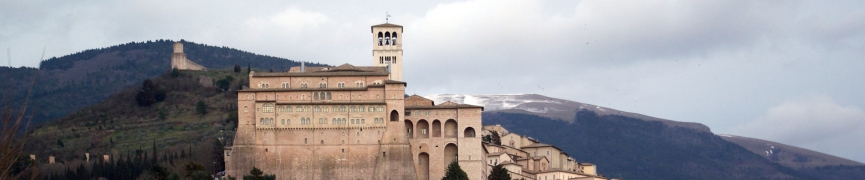
A Solemn High Mass in the Extraordinary Form will be celebrated for the Solemnity of Saint Joseph, Wednesday March 19, 2014, at Our Lady of the Assumption Parish, Strafford, Pa. Rosary will be prayed beginning at 6:40 p.m., with Mass to follow at 7:00 p.m. Celebrant will be Father Dennis J. Carbonaro, Pastor of Our Lady of the Assumption, and Homilist will be Msgr. Charles L. Sangermano, Pastor, Holy Saviour, Norristown. Following Mass a reception will be held in the Parish Hall. A collection will be taken up to help defray some of the expenses incurred for this celebration.
P.S. Let’s all show our support and appreciation of Fr. Carbonaro. We all remember him as a regular celebratant of the Missa Cantata at St. Paul’s.
March 10, 2014 1 Comment
The Theology of the Offertory – Part 3: A Different Theology?
From NLM: by Gregory DiPippo
As mentioned previously, this series of articles is a reply to the contentions of a pseudonymous blogger “Consolamini†about the sacrifice of the Mass and the Offertory. Fr. Anthony Ruff, the principal author and moderator of PrayTell, recently commended one of Consolamini’s articles to his readers’ attention because, as he states, it “shows why for so many of us there can’t be a going back to the old rite – no way, no how.†In the first article, I examined the claim that the Offertory of the Missal of St Pius V was intended to offer a different sacrifice from that of the Canon of the Mass, and in the second, the idea of the priesthood which Consolamini claims to find within it.
Here I shall deal with the claim that the Missal of Paul VI, by removing the Offertory and replacing it with a “Preparation of the Giftsâ€, makes a “break with the past,†and that the two forms of the Roman Rite “have very different theologies of Eucharistic Sacrifice.â€
Consolamini himself clearly believes this to be a good thing, since “it is very clear to (him) that it is the 1570 Missal, not the 1970 Rite, that deviates from the Apostolic (and patristic) Tradition.†(As I have noted previously, he attributes this deviation specifically to the Scholastic theologians of the 13th and following centuries, even though the liturgical texts and ideas of the Offertory all predate the Scholastics by at least a century and half.)
In the liturgical reforms of Paul VI …, the Mass was radically restructured to take away any pretense of this second sacrifice. (purportedly in the Offertory) There is no “offertory†of bread and wine, but rather a “preparation of the gifts†in which the bread and wine are prepared for the Eucharist. The only sacrifice is the sharing in the One Eternal Sacrifice of Calvary as we “proclaim the Death of the Lord until he comes in glory.â€
… There is a clear break here with the 1962 and earlier Missals that follow the 1570 liturgical revisions of Pius V, and indeed many of the medieval rites that had developed and on which Pius V based his reforms after the Council of Trent. And this is precisely where we see claims to a “hermeneutic of continuity†in the liturgy to be unsupported by fact. I agree with those who claim that the Novus Ordo represents a break with the past:…
As a first principal, I will take it for granted that liturgical texts must be understood according to the sense in which the Church gives them to us. Furthermore, I take this to be true, even when another sense at variance with the Faith may be plausibly found within them. To give an example: the Pentecost hymn Veni, Creator Spiritus at one point calls the Holy Spirit, “digitus paternae dexterae – a finger of the Father’s right hand.†Taken out of context, these words are strongly suggestive of subordinationism, the belief that the Son and Holy Spirit are lesser beings and servants of God the Father. This is, however, clearly not the sense in which the Church has received them and uses them in the liturgy, and it would be absolutely false to say that by them, She professes a subordinationist belief.
It may be objected that the circumstances in which the Veni, Creator Spiritus came into liturgical use are very different from those which gave us the Novus Ordo, and with it the Preparation of the Gifts in place of the Offertory. I shall therefore give another example, one which forms part of the modern liturgical reform.
Several years ago, I read an article by a Protestant clergyman who contended that it was no longer possible, or even desirable, to claim that the whole of the Scriptures are inspired by God, and wished his church to accept that parts of it are merely the words of men. He then cited the practice of various churches in not reading the whole of Scripture in worship as a tacit acknowledgement of this idea. As an example, he noted that during World War I, some English churches began omitting certain verses from the Psalms, such as the end of Psalm 142, “And of thy mercy cut off mine enemies, and destroy all them that afflict my soulâ€, lest they be seen as an incitement to hatred of the Germans.
In the post-Conciliar Liturgy of the Hours, the Psalter has (for the first time in the history of Catholic liturgy, both East and West) been edited on similar lines. The three so-called Imprecatory Psalms (57, 82 and 108) are omitted entirely, and several psalms and canticles have been “censoredâ€, so to speak, including the line of Psalm 142 cited above.
Now one may certainly debate the advisability of censoring the psalms in this fashion; indeed, one even may do so on the grounds that the practice is suggestive of an heretical idea of Biblical inspiration. But one may not claim that the Pope or the Church has given official sanction to an heretical idea of Biblical inspiration by promulgating a censored Psalter, since no such sanction is anywhere stated or implied in the new Office’s decree of promulgation or its praenotanda. Furthermore, this would still hold true even if the person who did the actual censoring did so to express belief in a new theology of Biblical inspiration, since that belief was not in any way officially taken up by the Church. (I say this in a purely hypothetical manner, since there is in fact reason to believe exactly the contrary.)
In this context, it would serve no purpose to discuss either the persons or the circumstances which created the Preparation of the Gifts as a rite to substitute the traditional Offertory. Even if they had intended by doing so to bring into the Church a different theology of the Eucharistic sacrifice, or bring back an older one, they could not do so. The only thing which counts in this regard is the stated intention of the authority that actually promulgated the post-Conciliar reform of the Missal. Let us therefore do the Pope the courtesy which we owe him as sons of the Catholic Church, and take him at his own words in describing his own actions.
The Missal of Pope Paul VI was officially promulgated with the Apostolic Constitution Missale Romanum on April 3, 1969. Apart from the notes incorporated in the text, and the legal formulae at the end, it comprises 1169 words in the official Latin version. Of these, more than half (just over 600) are dedicated to describing the various changes to the Missal, such as the increased number of prefaces and Eucharistic prayers, the revision of the orations, the expanded lectionary etc. Not a word is dedicated to the new Preparation of the Gifts. It seems reasonable to assume that if the Pope intended to change, or (as Consolamini would have it) change back the theology of the Eucharistic sacrifice to something “very different†by changing the Offertory, this would be the place to say so.
In point of fact, nowhere does the Constitution declare any kind of break with the theology of the Tridentine Missal. Indeed, it begins with the statement, “Everyone acknowledges that the Roman Missal, promulgated by Our Predecessor St Pius V in the year 1570, by a decree of the Council of Trent, must be counted among the many and wonderful useful fruits that flowed forth from that same most holy Synod to the universal Church of Christ.â€
In the Missal itself, this Constitution is followed by the “Institutio Generalis†or “General Instructionâ€, commonly known in English by the unfortunate acronym GIRM. Its second section is entitled “Witness to An Unchanged Faith.â€
The sacrificial nature of the Mass, solemnly asserted by the Council of Trent, in agreement with the universal tradition of the Church, was again declared by the Second Vatican Council. Concerning the Mass it pronounced these important words: “Our Savior at the Last Supper instituted the Eucharistic sacrifice of His Body and Blood, by which He might render perpetual the sacrifice of the Cross unto the ages, until He come, and indeed entrust to His beloved Spouse the Church the memorial of His death and resurrection.†… Thus in the new Missal the Church’s law of praying corresponds to Her perennial law of belief, by which we are reminded that the Sacrifice of the Cross and the sacramental renewal (renovationem) thereof are one and the same, only the manner of offering being different; which (manner) the Lord instituted at the Last Supper Christ, and commanded the Apostles that it be done in His memory; and accordingly, (we are reminded) that the Mass is at once a sacrifice of praise and thanksgiving, propitiatory and satisfactory. (i.e., that makes satisfaction for sins.)
These words are essentially a paraphrase of the second chapter of the Council of Trent’s Twenty-Second Session, and the words “only the manner of offering being different†are almost identical in both Trent and the Latin version of the GIRM.
One last note is called for as to the place of the old Offertory and the new Preparation of the Gifts in liturgical history. As Fr. Ruff noted in his article introducing his readers to Consolamini, the latter describes himself as one “…thoroughly committed to the program of the Second Vatican Council as it was promulgated in 1965, as contrasted with how it has been reinterpreted, in some cases almost out of existence by both self-appointed and divinely anointed authorities over the last thirty-some years.†I do not think I am being overly cynical to ask whether this “program†includes the letter and spirit of Sacrosanctum Concilium, which does not even mention the Offertory, much less call for it to be radically overhauled.
March 10, 2014 No Comments
Port Richmond Welcomes Latin Mass at Nativity BVM
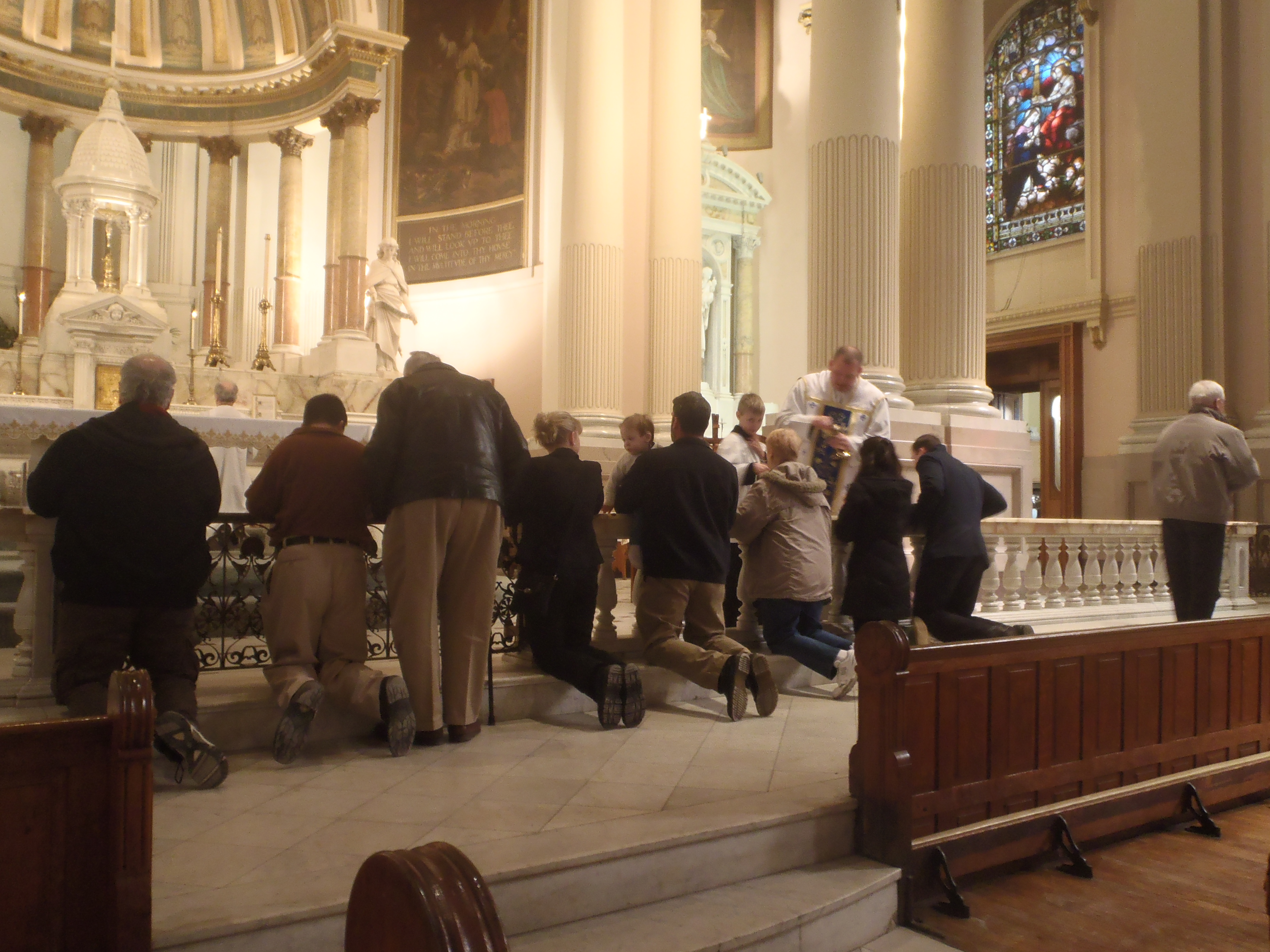
The Latin Liturgy Association wishes to extend its thanks to Father Dennis Fedak, pastor of Nativity BVM in the Port Richmond section of Philadelphia, for granting the first Traditional Latin Mass at the church since the Second Vatican Council. The First Saturday Mass was held at 11:30am and was celebrated by Father Harold McKale, resident at Nativity BVM. The Mass was attended by an estimated 90 people, roughly half of that were from one of the local parishes in Port Richmond and had not attended a Latin Mass since the council.
We wish to make one important note here: While the Archdiocese has been generous in granting several sites for the TLM on a regular basis, many of the local residents who attended this Mass are unable to reach the other sites because they lack a car and public transportation is not a viable option. In this particular case, the high attendance at Mass demonstrates the potential for planting the seeds of a new TLM site if resources became available, and to reinvigorate the faith in a community that has seen a widespread decline in Mass attendance since Vatican II. In 2015, the Archdiocese will be conducting a study of this cluster and take recommendations for consolidation or closure of parishes, including the beautiful Nativity BVM Church. The Association hopes this first TLM at Nativity BVM will serve as an opportunity to reverse the decline in a once stronghold of Catholicism.
Future announcements regarding Latin Masses at Nativity BVM will be posted on this website.


March 6, 2014 No Comments
The Sacred Triduum of Holy Week in the Extraordinary Form To Be Celebrated in Philadelphia
From Anthony Corvaia, Advisory Council
The Sacred Triduum of Holy Week will be celebrated in the Extraordinary Form at Holy Trinity Roman Catholic Church in Philadelphia, with the Holy Thursday Liturgy on April 17 at 7 p.m., the Good Friday Liturgy on April 18 at 5:00 p.m. and the Holy Saturday Liturgy (the Easter Vigil) on April 19 at 5:00 p.m. Holy Trinity is the only church in the Archdiocese of Philadelphia where the Sacred Triduum will be celebrated in the Extraordinary Form.
Holy Trinity Church has been designated as the permanent worship site for the Extraordinary Form in Center City Philadelphia by His Grace, Archbishop Charles Chaput, O.F.M Cap., Archbishop of Philadelphia. A Missa Cantata is celebrated every Sunday at noon, preceded by confession and public recitation of the rosary at 11:30 a.m. All are welcome.
Holy Trinity Church is located at the corner of 6th and Spruce Sts., Philadelphia, Pa. 19106. Free on-street parking is available on Sundays and for the Triduum with a parking placard, which may be obtained at the church. The on-street parking is available on the opposite side of Sixth Street from Pine Street to Washington Square, and on the opposite side of Spruce Street from Fifth Street to Seventh Streets.
The Reverend Ronald W.Check is the Chaplain and Coordinator for the Traditional Latin Mass Community. He and a rota of diocesan priests celebrate the Sunday and feast day Masses. Music is provided by the Schola Cantorum under the direction of Michael Lawrence, organist and director of music. Music for Mass includes congregational hymns, the Gregorian propers and a polyphonic setting of the ordinary, which are taken from the traditional repertoire, with motets and additional music for organ.
Historic Holy Trinity Church was established in 1784 and is the third oldest Catholic church in Philadelphia. The church’s equally historic Hook and Hastings pipe organ was installed in 1892 and continues to be used.
For more information about the Traditional Latin Mass Community at Holy Trinity, please visit holytrinitytlm.org.
The parking relaxations for the Triduum are as follows:
Holy Thursday 6-10pm
Good Friday 4-9pm
Holy Saturday 4-9pm
March 6, 2014 No Comments
DAILY TLM DURING LENT, MONDAY THROUGH FRIDAY
From a Reader:
Our Lady of Lourdes will have a daily Mass in the Extraordinary Form at 7 a.m. Monday through Friday of Lent.

March 3, 2014 No Comments
BREAKING NEWS: Latin Mass Under Attack in Fort Worth, Texas – Bishop Bans Fisher More College from offering Traditional Latin Mass to students
Source: Rorate Caeli

In a stunning and breathtaking letter, the Most Rev. Michael Olson, the newly-ordained bishop of the Fort Worth Diocese and the second-youngest bishop in the United States, has fully and totally banned the offering of the Traditional Latin Mass in the chapel of Fisher More College, where it has been offered for the last three years on a daily basis by chaplains all approved by his predecessor bishop according to the college.
This blow comes after the students of the college raised $300,000 in about a week to keep the school open for the spring semester.

Rorate has exclusively obtained — through a source who has requested anonymity — a copy of the letter sent last week by the bishop after a personal meeting with the college’s president, Michael King. Even more striking, the letter from Bishop Olson states that he’s doing this “for your own soul,” addressing Mr. King, apparently saying in some twisted way the offering of the Mass in the Extraordinary Form is a danger to Mr.King’s soul.
When asked by Rorate for a response to the letter from Bishop Olson, the school declined to comment.
NB: The only option Bishop Olson offers to the students to assist at the Traditional Latin Mass is in a parish where it is offered only on Sundays, at 5:30 p.m. This parish in turn is the only place in the whole diocese where the TLM is now available under diocesan authority.
Nothing in the morning on Sunday, nothing on Saturday, nothing during the week. Students who have traveled across the country to attend this school, surely due in part to its daily Traditional Mass and sacraments, should now simply have next to nothing, according to the bishop.
Rorate will be following this closely, and we not only permit, but urge other blogs and mainstream media to do the same. We will also be offering deeper analysis in the days and weeks to come. For now, some initial reactions:

1): We have already seen the clampdown, ordered by Pope Francis, on the Franciscans of the Immaculate (FI) and have covered it in depth. At least, with the FI, there were — albeit ridiculous — scenarios listed by Fr. Volpi about extremism in the order, giving them — again, ridiculous — reasons to ban the Traditional Mass, as if the Mass of the saints could cause negative extremism. However, in this letter, there are no scenarios like this — it’s just a complete ban on the Mass, a naked power grab by a young bishop who clearly has a lot to learn about the politics of abusing authority.Why not just ask them to offer the Novus Ordo along with the TLM? Not that they should have to, but he would have at least come off, to some, as a bit less heavy handed and somewhat more compassionate towards the students.We fully expect him to come up with some other “evidence” once he feels the heat this is sure to bring.
2): This is, along with the FI, another important test case, this time on the availability of the TLM in Catholic schools, already a severely under-served sector despite the best efforts of Pope Benedict and his Motu Proprio Summorum Pontificum.
3): This extremism, regrettably, involves a very young bishop (47) — which just goes to show that younger prelates do not automatically represent a “biological solution” that will solve the problem of hierarchical opposition to Tradition or outright modernism. (This comes in the wake of the “example” given by the young and outspokenly modernist bishop Stephen Ackermann in Germany, with regards to sexual morality.)
4.): There are so many problems with Catholic higher education as presently available in hundreds of colleges and universities like Notre Dame and Georgetown, yet, what gets the sledgehammer from a bishop is one of the few loyal and orthodox colleges where the students simply want to live their faith and accept all the demands of that faith by the Church.
5.): We believe the outrage of this action will not only resonate with traditional Catholics, but conservative Catholics as well, who may not attend or even like the TLM but surely understand the direct wishes of Pope Benedict expressed in Summorum Pontificum regardless of whether schools were specifically named in the still-binding document. However, we fully expect some Catholics who purposely and poorly disguise themselves as orthodox to justify this case in regards to the action of Bishop Olson, and to dismiss the very obvious “Effect” of at least a perception of the new Pontificate that is taking root around the world and spreading rapidly among priests and prelates.
Creative Minority Report weighs in with further important points:
“I will also note that the Bishop made this decision just over 3 weeks into his tenure in the Diocese. Hardly enough time to address any underlying issues fairly with the college. As such, this seems directed at the TLM only.
“Whether beyond his authority under Summorum Pontificum or not, this draconian action with minimal justification directed at something so ancient and sacred, reverberates far beyond the confines of campus. This is reminiscent of other recent actions directed against the TLM with minimal justification and will likely be seen as very chilling by traditionalists within the Church, increasing that very dangerous sense of isolation.”
Follow @RorateCaeli on Twitter for more commentary & developments
Rorate has also reached out to our long-time partners at the Canon Law Centre for their review of Bishop Olson’s action. Their strong response follows:
CALL TO ACTION: Please, dear readers, blog about this grave injustice. Email this to your families and friends. Tweet it on Twitter, including retweeting our Tweets which you will see on the right-hand side of this page. Send it to the media. We must do everything in our power to spread the word and help this school and students regain their God-given patrimony. Don’t think for a second this starts and stops with this college. If we don’t act now, we will surely regret it later.
MEDIA: for your reporting purposes, you may accurately refer to Rorate Caeli as the most-read international traditional Catholic blog on the Internet.
March 3, 2014 1 Comment
“I want the old way. Just like straight up, just Mass Mass.” – Jimmy Fallon
From the Remnant
Jimmy Fallon is the comedian/actor who recently took over for Jay Leno as host of NBC’s The Tonight Show— a variety show made culturally iconic by the late Johnny Carson. Jimmy Fallon was born and raised Roman Catholic. When he was young he wanted to be a priest. He loved to serve Mass. The son of a Catholic Vietnam War veteran, Fallon is of German/Irish descent and grew up in Brooklyn, New York. He was educated at St. Mary of the Snow Roman Catholic school and attended the College of St. Rose in Albany.
Jimmy Fallon is also a fallen away Catholic whose Fresh Air interview from some time ago will be of renewed interest to readers of The Remnant, especially in light of Bishop of Rome Francis’s recent comment that the Traditional Latin Mass is a mere fashion—an unfortunate papal gaffe that provides context for the Fallon interview, excerpts of which appear below and were lifted from NPR.org.
First, Pope Francis: According to a Rorate Caeli report, Archbishop Jan Graubner of the Czech Republic told Vatican Radio that Pope Francis has:
….made a quite strong statement when he said that he understands when the old generation returns to what it experienced, but that he cannot understand the younger generation wishing to return to it. “When I search more thoroughly – the Pope said – I find that it is rather a kind of fashion. And if it is a fashion, therefore it is a matter that does not need that much attention. It is just necessary to show some patience and kindness to people who are addicted to a certain fashion. But I consider greatly important to go deep into things, because if we do not go deep, no liturgical form, this or that one, can save us.â€
Tell that to Jimmy Fallon, Your Holiness, and to the millions just like him who have left the Church largely because the “fashionable†New Mass was just that—a fleeting fashion which has already become passé and embarrassingly irrelevant to millions of young Catholics. Fallon commented on exactly that, as well as his Catholic upbringing in general, during the NPR interview. “I grew up in an Irish Catholic family…†he said, which eventually prompted host Terri Gross to press him a bit further:
GROSS: So you went to Catholic school when you were young.
Mr. FALLON: Oh yeah.
GROSS: Did you have…
Mr. FALLON: I wanted to be a priest.
GROSS: Did you really?
Mr. FALLON: Yeah. I loved it.
GROSS: Why?
Mr. FALLON: I just, I loved the church. I loved the idea of it. I loved the smell of the incense. I loved the feeling you get when you left church. I loved like how this priest can make people feel this good. I just thought it was – I loved the whole idea of it. My grandfather was very religious, so I used to go to Mass with him at like 6:45 in the morning, serve Mass. And then you made money, too, if you did weddings and funerals. You’d get like five bucks. And so I go ‘Okay, I can make money too.’ I go, ‘This could be a good deal for me.’ I thought I had the calling…
GROSS: Do you still go to church?
Mr. FALLON: I don’t go to – I tried to go back. When I was out in L.A. and I was kind of struggling for a bit. I went to church for a while, but it’s kind of, it’s gotten gigantic now for me. It’s like too… There’s a band. There’s a band there now, and you got to, you have to hold hands with people through the whole Mass now, and I don’t like doing that…Now, I’m holding hands – now I’m lifting people. Like Simba. [Laughter] I’m holding them [Singing] ha nah hey nah ho.
I’m doing too much. I don’t want – there’s Frisbees being thrown, there’s beach balls going around, people waving lighters, and I go, ‘This is too much for me.’ I want the old way. I want to hang out with the, you know, with the nuns, you know, that was my favorite type of Mass, and the grotto, and just like straight up, just Mass Mass.
He’s a comedian. I get it. But his sensus Catholicus is still right there, transforming him into yet another lost and disenfranchised Catholic. Who’s responsible for the spiritual carnage left in the wake of the New Springtime of Vatican II? The ubiquitous Jimmy Fallons of the world? Please! They’re just collateral damage…the casualties of a self-loathing war against Catholic Tradition, waged from within. And now they’ve all left the Church. Do you blame them? Really?
Jimmy Fallon is a bit younger than I am, and there but for the grace of God go I—along with entire generations of our Catholic brothers who were given stones to eat when they needed bread. And now whose fault is that!
God help them. God help us all!
February 28, 2014 No Comments
Temporary change: First Sat. TLM; First Fri TLM-same.
From Mark Matthews:
First Saturday, March 1, A.D. 2014 TLM will be temporarily transferred to Nativity B.V.M. Parish, 2535 Allegheny Ave, Philadelphia, PA 19134 and will be offered by Fr. Harold B. Mc Kale, Parochial Vicar of this Parish, at 11:30 a.m.
(T) 215-739-2735; (Fax) 215-739-2748. Nativity B.V.M. Parish is conveniently located by turning onto the Allegheny Avenue Exit from the I-95 Southbound lanes. The Church is a few blocks past St. Adalbert Roman Catholic Church on the right-hand side.
Subsequent First Saturday TLM’s for April and successive months of this year are scheduled to return to the Rectory Chapel of St. Albert The Great Parish, Huntingdon Valley, PA 19006.
First Friday, March 7, A.D. 2014, Traditional Latin Mass (TLM) will be offered by Fr. Harold B. Mc Kale of Nativity B.V.M. Roman Catholic Church, at the Rectory Chapel of St. Albert The Great Parish, 212 Welsh Road, Huntingdon Valley, PA 19006, (T) 215-947-3500, at 7 p.m. preceded by Confessions at 6:30 p.m. This TLM will be offered in Reparation to The Sacred Heart of Jesus.
The St. Albert The Great Rectory, also known as the Parish Center, is behind this Church, which fronts on Welsh Road.
Thank you for publicizing these Traditional Latin Masses.
February 26, 2014 No Comments
Home from the Liturgical Thirty Years’ War
From the Site Vultus Christi, Sunday, 23 February
Slowly but Inexorably
A few people have asked me if my personal assessment of “the reform of the reform†means that, somehow, I have decided to shun the vast majority of Catholics who continue to worship using the rites and texts in the current reformed liturgical books. Nothing could be further from my mind and heart. I am well aware that in dioceses and parishes all over the globe an immediate reviviscence of the older liturgical forms is not realistic. It will, I think, happen slowly but inexorably, as new generations discover, here and there, thriving centres of traditional Catholic worship in which, as Joseph Ratzinger once said, “beauty is at homeâ€, and in which the mysteries of the faith are transmitted with integrity, with serenity, and with profound humility. Such centres will, I believe, over time, exercise an attractive, not a coercive, force over parishes and other religious communities, drawing them freely to re–engage with the Church’s traditional liturgical rites.
The Privilege of Liminality
I write, of course, as a monk and not as a parish priest. Monasteries take root, flower, and bear fruit in a liminal territory that begins where the secular city ends and that stretches into the uncharted vastness of the desert. The immerited privilege of this sacred liminality allows monks the space and the freedom to reclaim, preserve, and transmit elements of the liturgical tradition that may, for the time being, remain remote and inaccessible to ranks upon ranks of generous priests engaged in the care of souls.
A Weary Veteran Lately Come Home
After having devoted nearly forty years to a worthy “reform of the reformâ€; after having taught and defended the Novus Ordo Missae to the best of my ability; after having composed — to a certain acclaim, even from a dean of the Pontifical Institute of Sacred Liturgy — an entire monastic antiphonal in modal plainchant for the French liturgical texts; after having composed hundreds of plainchant settings for the Proper of the Mass in the vernacular; after having fought mightily for the restoration of the Proper Chants of the Mass; after having argued to the point of exhaustion for an intelligent obedience to the Institutio Generalis Missalis Romani; after having poured myself out in lectures and in preaching to priests, seminarians, and religious, I am obliged to conclude that I could have better spent my time and my energy humbly carrying out the traditional liturgy such as I discovered it — and such as I so loved it — in the joy of my youth. I say this not with bitterness but with the seasoned resignation of a weary veteran lately come home from an honourable defeat in the liturgical Thirty Years’ War.
Good Neighbours All the Same
I respect those priests and layfolk who continue to believe in “the reform of the reformâ€. I honour their devotion and perseverance but, from where I stand and at this point in my life, I think their energy misplaced. Life is short. I can no longer advise others to devote the most productive years of their life to patching up a building that was, manifestly, put up with haste during a boom in frenzied construction; it has shifting foundations, poor insulation, defective fixtures, and a leaky roof. Right next door, there is another old house, comely, solidly built, and in good repair. It may need a minor adjustment here or there, but it is a house in which one feels at home and in which it is good to live, and it is there that I choose to live out my days. If others choose to live in the “fix–up†next door, I can only wish them well, confident that we can live as good neighbours all the same, with frequent chats over the fence in the back garden, exchanging insights, and perhaps even learning something from one another.
Thomas Merton
One the things I have learned over the past forty years, and this amidst the taedium of much dura et aspera, is that monks (and nuns) who profess the contemplative life gained nothing from changing the forms, content, and language of the sacred liturgy. Liturgical change swept through monasteries like a hurricane, leaving the most pitiful destruction in its wake. Did the so–called liturgical renewal in monasteries give rise to an increase in vocations? Did it generate a more generous commitment to the touchstones of sound monastic observance? Did it foster a greater zeal for the Opus Dei? Few monasteries have recovered from the ensuing decades of liturgical unrest. Even Thomas Merton, when first he caught wind of imminent liturgical changes, warned of the the danger menacing the enclosed contemplative life. In 1964 he wrote to Dom Ignace Gillet, then Abbot General of the Cistercians of the Strict Observance:
This is what I think about the Latin and the chant: They are masterpieces, which offer us an irreplaceable monastic and Christian experience. They have a force, an energy, a depth without equal. All the proposed English offices are very much impoverished in comparison–besides, it is not at all impossible to make such things understood and appreciated. Generally I succeed quite well in this, in the novitiate, with some exceptions, naturally, who did not understand well. But I must add something more serious. As you know, I have many friends in the world who are artists, poets, authors, editors, etc. Now they are well able to appreciate our chant and even our Latin. But they are all, without exception, scandalized and grieved when I tell them that probably this Office, this Mass will no longer be here in ten years. And that is the worst. The monks cannot understand this treasure they possess, and they throw it out to look for something else, when seculars, who for the most part are not even Christians, are able to love this incomparable art.
Bare Ruin’d Choirs
The liturgical reforms of the 1960s and 70s wrenched the interior of life of more than one monk off its axis. The blessed monotony of the psalter, repeated week after week in familiar accents borne aloft on a plainsong at once sturdy and lightsome, gave way to distributions of a vernacular psalter over two, three, and even four weeks, in flagrant violation both of the Rule of Saint Benedict and even of the objective laws of anthropology. I shall never forget the anguish generated by trying to invent new psalm tones suited to the vernacular, all the while clinging desperately in my heart to the chants of the Antiphonale Monasticum that had taken root there. Memories of the traditional liturgy persisted, through the winter of my discontent, like the lovely blossoms of the crocus, in trying to pierce the frozen crust that had been laid over my hortus conclusus. The “bare ruin’d choirs†of so many abbeys today attest, sadly, to the inward wreckage wrought by liturgical innovation, even when carried out, as it usually was, with the best intentions, and out of a skewed notion of uncritical obedience to what was misrepresented as “the mind of the Churchâ€.
Paul VI
I say misrepresented because, although Pope Paul VI wavered on liturgical questions, sided, in some matters, with the most iconoclastic reformists, and even authorised the most dubious innovations, Sacrosanctum Concilium itself, (particularly when read through the lens of Mediator Dei, as it must be in order to be understood correctly) and certain of the same Pontiff’s more personal pronouncements called for something quite different from what became the order of the day. For instance, Pope Paul VI, in writing Sacrificium Laudis to the superiors of clerical religious of men in August 1966, did not shrink from calling them to obedience in matter close to his own heart:
In present conditions, what words or melodies could replace the forms of Catholic devotion which you have used until now? You should reflect and carefully consider whether things would not be worse, should this fine inheritance be discarded. It is to be feared that the choral office would turn into a mere bland recitation, suffering from poverty and begetting weariness, as you yourselves would perhaps be the first to experience. One can also wonder whether men would come in such numbers to your churches in quest of the sacred prayer, if its ancient and native tongue, joined to a chant full of grave beauty, resounded no more within your walls. We therefore ask all those to whom it pertains, to ponder what they wish to give up, and not to let that spring run dry from which, until the present, they have themselves drunk deep.
Of course, the Latin language presents some difficulties, and perhaps not inconsiderable ones, for the new recruits to your holy ranks. But such difficulties, as you know, should not be reckoned insuperable. This is especially true for you, who can more easily give yourselves to study, being more set apart from the business and bother of the world. Moreover, those prayers, with their antiquity, their excellence, their noble majesty, will continue to draw to you young men and women, called to the inheritance of our Lord. On the other hand, that choir from which is removed this language of wondrous spiritual power, transcending the boundaries of the nations, and from which is removed this melody proceeding from the inmost sanctuary of the soul, where faith dwells and charity burns – We speak of Gregorian chant – such a choir will be like to a snuffed candle, which gives light no more, no more attracts the eyes and minds of men.
In any case, beloved Sons, the requests mentioned above concern such grave matters that We are unable to grant them, or to derogate now from the norms of the Council and of the Instructions noted above. Therefore we earnestly beseech you that you would consider this complex question under all its aspects. From the good will which we have toward you, and from the good opinion which we have of you, We are unwilling to allow that which could make your situation worse, and which could well bring you no slight loss, and which would certainly bring a sickness and sadness upon the whole Church of God. Allow Us to protect your interests, even against your own will. It is the same Church which has introduced the vernacular into the sacred liturgy for pastoral reasons, that is, for the sake of people who do not know Latin, which gives you the mandate of preserving the age-old solemnity, beauty and dignity of the choral office, in regard both to language, and to the chant.
Obey, then, these prescriptions sincerely and calmly. It is not an excessive love of old ways that prompts them. They derive, rather, from Our fatherly love for you, and from Our concern for divine worship.
The Old Passion for Things Once Loved
This compelling mandate met, not with filial obedience, but, in most quarters, with indifference and with a dismissive hubris. Even today, forty–eight years later, there are monasteries where the clear mandate of Sacrificium Laudis is utterly unknown. I no longer dream of making an active contribution, however humbly, to a restoration of the sacred liturgy. I am, for the most part, content to return quietly to my choir stall, day after day, and hour after hour, there to chant the changeless praises of the unchanging God. I am, it is true, bone–weary of bloody campaigns in the liturgical Thirty Years War; there are, nonetheless, moments when, to my own surprise, the old passion for things once loved, then lost, and now regained, blazes up and compels me to write.
February 23, 2014 No Comments
First Saturday TLM at Nativity BVM in Port Richmond
Second reminder:
The Philadelphia chapter of the Latin Liturgy Association is pleased to announce that the Tridentine Mass will be publicly offered in the upper church of Nativity BVM Parish in the Port Richmond section of Philadelphia on Saturday March 1, 2014, 11:30 AM. This will be a Low Mass offered by Father Harold McKale, Parochial Vicar at Nativity BVM, and will be the first time the Tridentine Mass has been publicly offered in almost 45 years.
Nativity BVM is located at 2535 E, Allegheny Avenue, Philadelphia, PA 19134 (Belgrade & Allegheny Ave) and is easily accessible from the Allegheny Avenue exit on I-95.
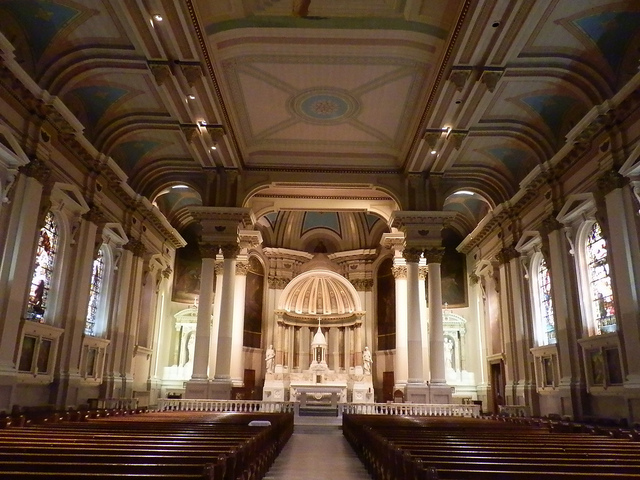
Main Sanctuary of Nativity BVM Catholic Church in Port Richmond, Philadelphia
Latin-English and Latin-Polish Missals and Propers for the day will be provided. For those not familiar with the 1962 Rite of Mass, introductory material regarding the Extraordinary Form of Mass
will be made available.
At this time, there are no plans to regularly offer the TLM at Nativity BVM, so please take advantage of this rare opportunity.
February 23, 2014 No Comments