Random header image... Refresh for more!

FEAST OF THE HOLY TRINITY

Rev. Fr. Leonard Goffine’s
The Church’s Year

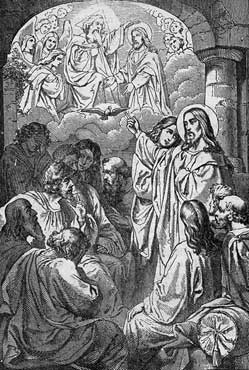
This festival is celebrated on the Sunday after Pentecost, because as soon as the apostles were instructed and consoled by the Holy Ghost, they began to preach openly that which Christ had taught them.

Why do we celebrate this festival?

That we may openly profess our faith in the doctrine of the Holy Trinity, which is the first of Christian truths, the foundation of the Christian religion, and the most sublime of all mysteries; and that we may render thanks, to the Father for having created us, to the Son for having redeemed us, and to the Holy Ghost for having sanctified us.

In praise and honor of the most Holy Trinity, the Church sings at the Introit of this day’s Mass:

INTROIT Blessed be the holy Trinity and undivided Unity: we will give glory to him, because he hath shown his mercy to us: (Tob. XII.) O Lord, our Lord, how wonderful is thy name in all the earth! (Ps. VIII. 1.) Glory be to the Father, etc.

COLLECT Almighty, everlasting God, who hast granted to Thy servants, in the confession of the true faith, to acknowledge the glory of the eternal Trinity, and in the power of Thy, majesty, to adore the Unity: grant that, by steadfastness in the same faith, we may ever be defended from all adversities. Thro’.

EPISTLE (ROM XI. 33-36.) O the depth of the riches of the wisdom and of the knowledge of God! How incomprehensible are his judgments, and how unsearchable his ways! For who hath known the mind of the Lord? Or who hath been his counsellor? Or who hath first given to him, and recompense shall be made him? For of him, and by him, and in him, are all things: to him be glory forever. Amen.

EXPLANATION St. Paul’s exclamations, in this epistle, are caused by the inscrutable judgment of God in rejecting the Jews and calling the Gentiles. The Church makes use of these words to express her admiration for the incomprehensible mystery of the most Holy Trinity, which surpasses our understanding, and yet is the worthy object of our faith, hope and love. Although neither angels nor men can fathom this mystery, it cannot be difficult for the sound human intellect to believe it, since it is indubitably and evidently revealed by God, arid we, in many natural and human things, accept for true and certain much that we cannot comprehend. Let us submit our intellect, there fore, and yield ourselves up to faith; as there was indeed a time when men were martyred, when even persons of all ages and conditions preferred to die rather than to abandon this faith, so let us rather wait until our faith is changed to contemplation, until we see the Triune God, face to face, as He is, and in the sight of that countenance become eternally happy. Thither should all our hopes, wishes,’ and desires be directed, and we should cease all fruitless investigations, endeavoring by humble faith and active love, to prove worthy of the beatific vision; for if we do not love Him who is our all, our last end and aim, and lovingly desire Him, we will have to hope of one day possessing Him.

ASPIRATION O incomprehensible, Triune God! O Abyss of wisdom, power, and goodness! To Thee all glory and adoration! In Thee I lose myself; I cannot contain Thee, do Thou, contain me. I believe in Thee, though I cannot comprehend Thee; do Thou increase my faith; I hope in. Thee, for Thou art the source of all good; do Thou enliven my hope; I love Thee, because Thou art worthy, of all love; do Thou inflame ever more my love, that in Thy love I may live and die. Amen.
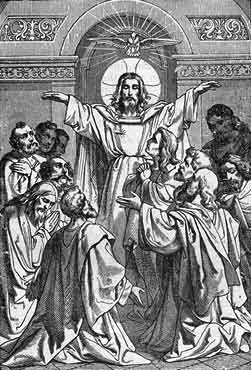
Feast of the Holy TrinityGOSPEL (Matt. XXVIII. 18-20.) At that time Jesus said to His disciples: All power is given to me in heaven and in earth. Going, therefore; teach ye all nations, baptizing them in the name of the Father, and of the Son, and of the Holy Ghost; teaching them to observe all things whatsoever I have commanded you. And behold, I am with you all days, even to the consummation of the world.

EXPLANATION Christ being God had from all eternity the same power that His Father had; being man, He had this same power by the union of His divinity with His humanity, and on account of the infinite merits of His passion. In virtue of this power, He said to His apostles, before the ascension, that, as His Heavenly Father had sent Him, even so He sent them to all nations, without exception, to teach all that He had commanded, and to receive them, by means of baptism, into the Church; at the same time He promised to be with them to the end of the world, that is, that He would console them in suffering, strengthen them in persecution, preserve them from error, and always protect them and their successors, the bishops and priests, even unto the consummation of the world.

(See Instruction on the doctrine of the infallibility of the Church for the first Sunday after Easter.)

ASPIRATION Be with us, O Lord, for without Thee our pastors cannot produce fruit, nor their hearers profit anything from their words. Be with us always, for we always need Thy help. All power is given to Thee, Thou bast then the right to command, and we are bound to obey Thy commands which by Thy Church Thou bast made known to us. This we have promised in baptism, and now before Thee we renew those vows. Grant now that those promises which without Thee we could not have made, and without Thee cannot keep, may be fulfilled in our actions. Leave us not to ourselves, but be Thou with us, and make us obedient to Thee, that by cheerful submission to Thee true may receive happiness.

INSTRUCTION ON THE HOLY SACRAMENT OF BAPTISM

Going, therefore, teach ye all nations, baptizing them in the name of the Father, and of the Son, and of the Holy Ghost (Matt. XXVIII. 19.)

Is baptism a Sacrament?

Yes because in it the baptized person receives the grace of God by means of an external sign, instituted by Christ.

What is this external sign?

The immersion, or the pouring of water, accompanied by the words: “I baptize thee in the name of the Father, and of the Son, and of the Holy ghost:”

What does the baptismal grace effect?

It removes original and actual sin; causing ,man to be spiritually born again, made a new creature, a child of God, and joint heir with Christ.

How many kinds of baptism are there?

There are three kinds: The baptism of desire, which consists in a heartfelt desire for the baptism of water, joined with a perfect love of God, or a perfect sorrow for sins committed, and with the purpose to obey all God’s commands; the baptism of blood, which is received by those who suffer martyrdom for the true faith, without having received the baptism of water; the baptism of water, which is the Sacrament of Baptism.

What do the deferent ceremonies of this Sacrament signify?

They are the external signs of the effects which baptism produces inwardly upon the soul, and should impress us with deep reverence for this Sacrament.

Why is it customary to have a godfather or godmother?

That there may be a witness that the child has received baptism; that in case of the death of the parents, the sponsors may assume their place, and have the child instructed in the truths of religion. St. Augustine speaking of the duties of sponsors, very beautifully says: “They should use all care, often to admonish in true love their godchildren that they may strive to lead a pure life; they should warn them against all detraction, all improper songs, and keep them from pride, envy, anger, and revenge; they should watch over them that they may preserve the Catholic faith, attend the church services, listen to the word of God, and obey their parents and their pastors.” Sponsors must therefore be true believers, and of unquestionable morality. No one, unless a Catholic can be chosen for a sponsor, because one who is not a Catholic would not instruct the child in the Catholic faith, or see that others do it; but would be more likely, as experience shows, to draw the child over to error.

What results from this sponsorship?

In baptism, as in confirmation, a spiritual affinity originates between, the sponsors, the one who baptizes or confirms, with the one baptized or confirmed, and with the parents, so that, by a decision of the Church a godfather or godmother cannot contract marriage with any of these parties, unless the impediment is removed by dispensation, that is, by a special permission received from a spiritual superior. But the sponsors have no spiritual relationship to each other.

Why has the Church instituted this spiritual relation?

From reverence for these holy Sacraments, and that by this spiritual bond the sponsors may be more closely connected with their godchildren, and be incited earnestly to discharge their obligation.

Why must the person to be baptized wait at the entrance of the church?

To indicate that until he has thrown off the yoke of sin, and submitted to Christ, and His authority, he is unworthy to enter, because baptism is the door of God’s grace, to the kingdom of heaven, and the communion of saints.

Why does the person receive a saint’s name?

That by this name he may be enrolled, through baptism, into the number of Christians whom St. Paul calls saints; that he may have a patron and intercessor, and that the saint, whose name he bears, may be his model and example, by which he may regulate his own life.

Why does the priest breathe in the face of the one to be baptized?

In imitation of Christ who breathed on His apostles when He gave them the Holy Ghost. (John XX. 22.) St. Chrysostom says that in baptism supernatural life is given to the soul as God imparted natural life to Adam by breathing on him.

Why does the priest impose his hand so many times upon the head of the person to be baptized?

To show that he is now the property of God and is under His protection.

What do the many exorcisms signify?

That the evil spirit who previous to baptism holds the person in bondage is now commanded in the name of God to depart, that a dwelling?place may be prepared for the Holy Ghost.

Why is the person so often signed with the sign of the cross?

To signify that through the power of Christ’s merits and of His death on the cross, baptism washes away original sin; that the person is to be henceforth a follower of Christ the Crucified, and as such must fight valiantly under the banner of the cross, against the enemies of his salvation, and must follow Christ on the way of the cross even unto death.

What does the salt signify which is put into the person’s mouth?

It is an emblem of Christian wisdom and of preservation from the corruption of sin.

Why are his ears and nose touched with spittle?

That as Christ put spittle on the eyes. of the man born blind, thus restoring his sight, so by baptism, the spiritual blindness of the soul is removed, and his mind receives light to behold heavenly wisdom. Also, as St. Ambrose says, the candidate is thus instructed to open his ears to priestly, admonitions, and become a sweet odor of Christ.

Why does the priest ask: “Dust thou renounce the devil; and all his works, and all his pomps?”

That the Christian may know that his vocation requires him to renounce and combat the devil, his works, suggtions and pomps. Thus St. Ambrose very beautifully addresses a person just baptized: “When the priest asked: `Dust thou renounce the devil and all his works,’ what didst thou reply? `I renounce them.’ `Dost thou renounce the world, its lusts and its pomps?’ `I renounce them.’ Think of these promises, and let them never depart from thy mind. Thou host given thy hand?writing to the priest,, who stands for Christ; when thou host given thy note to a man, a thou art bound to him. Now thy word is not on earth but preserved in heaven; say not thou knowest nothing of this promise; this exculpates thee no better than the excuse of a soldier who in time of battle should say he knew not that by becoming a soldier he would have to fight.”

Why is the person anointed on the shoulder and breast with holy oil?

As SS. Ambrose and Chrysostom explain this is done to strengthen him to fight bravely for Christ; as the combatants of old anointed themselves with oil before they entered the arena, so is he anointed, on the breast, that he may gain courage and force, bravely to combat the world, the flesh, and the devil, and on the shoulder, that he may be strong to bear constantly and untiringly, the yoke of Christ’s commands, and persue the toilsome course of life in unwavering. fidelity to God and His holy law.

Why are, the Lord’s Prayer, and the Apostles’ Creed said at baptism?

That, when the child is a grown person an acknowledgment of faith may by this means be made m the face of the Church; when children are baptized, these prayers are said by the sponsors who are thus reminded to see that their godchildren are well instructed in these as in all other Christian truths.

Why does the priest expressly ask the person if he will be baptized?

Because as man, through Adam, of his own free will obeyed the devil, so now when he would be received among the number of Christ’s children, he must, to obtain salvation, of his own free will obey the precepts of God.

Why is water poured three times upon the person’s head?

This is done, as St. Gregory the Great writes, in token that man after this thrice-repeated ablution rises from the death of sin, as Christ, after His three days’ burial, rose from the dead. (Rom. VI. 4.5.) In early times the candidate for baptism was immersed three times in the water. For many ‘reasons this custom has been abolished.

Why is the person anointed on the top of the head with chrism?

This anointing is, so to speak, the crown of the young Christian. As in the Old Law the kings were anointed, (I Kings X. 1.) as Jesus is the Anointed One, and as the Apostle St. Peter calls the Christians a chosen race, a kingly priesthood, a holy people, (I Peter II. 9.) so the baptized by means of this unction is embodied in Christ, the Anointed One, and participates in His priesthood and kingly dignity. What an exalted position is the Christian’s! He is the anointed one of the Lord, and in a spiritual sense a priest, because he constantly brings himself to the Lord God as a pleasing sacrifice in prayer, mortification, &c. He is king when he rules over his inclinations, submits them to reason, and reason to the Lord. Besides this he is king by the claims which, through baptism, he possesses to the kingdom of heaven. Through the chrism he becomes the blessed temple of the Holy Ghost, the sacred vessel which in time, through communion, will contain the precious body and blood of Christ. How does he desecrate this temple when, by grievous sin, he tramples this exalted dignity under his feet and. stains the temple of the Holy Ghost, his soul!

What does the white robe signify?

The holy Fathers teach that this represents the glory to which by baptism we are born again; the purity and beauty with which the soul, having been washed from sin in the Sacrament of baptism, is adorned, and the innocence which the baptized should preserve through his whole life.

Why is a lighted candle placed in his hand?

It is an emblem of the Christian doctrine which preserves the baptized from the darkness of error, ignorance, and sin, illumines his understanding, and leads him safely in the way of virtue; it represents the flame of. love for God and our neighbor which the baptized should henceforth continually carry, like the five prudent virgins, (Matt. XXV. 13.) on the path to meet the Lord, that when his life is ended he may be admitted to the eternal wedding feast; it signifies also the light of good example which he should keep ever burning.

Who is the minister of this sacrament?

The ordinary minister is the priest of the Church; but in case of necessity any layman or woman, even the father or mother can baptize. Parents, however, should not baptize their own child unless no other Catholic can be procured. The reason why lay persons are permitted to baptize is that no one may be deprived of salvation.

What must be observed particularly in private baptism?

The person who baptizes must be careful to use only natural water, which must be poured on the child’s head saying at the same time the words: I baptize thee in the name of the Father, and of the Son, and of the Holy Ghost; having at the same time the intention of baptizing as the Church does, in the manner required by Christ.

INSTRUCTION ON THE RENEWAL OF BAPTISMAL VOWS

All the graces and dignities which we receive in baptism, God secures to us for the future, only on condition that we keep our baptismal vows. Every Christian in baptism makes a bond with God through the meditation of Christ who has sealed it with His blood. This bond consists, on man’s part, in the promise to renounce forever the devil, all his works and all his pomps, that is, constantly to suppress the threefold lust of the eyes, the flesh and the pride of life, by which the devil leads us to sin, and to believe all that God has revealed, and all that His holy Church proposes to our belief, and diligently and properly to make use of all the means of salvation. On the part of God this bond consists in cleansing us from all sin, in bestowing the gifts of the Holy Ghost, in adopting us as His children, and. in the assurance to the inheritance of heaven. This bond will never be broken by God who is infinitely true and faithful, but it is often violated by weak and fickle man. In compliance with the desire of the Church we should often reflect upon it, and from time to time renew it in the sight of God. This should be done particularly before receiving the holy Sacrament of Confirmation, before first Communion, on the vigils of Easter and Pentecost, at the blessing of baptismal water, on the anniversaries of our baptism and confirmation, before making any solemn vow, before entering into matrimony and when in danger of death. This renewal of baptismal vows can be made in the following manner: Placing ourselves in the presence of God, we kneel down, fold our hands, and say with fervent devotion:

I believe in God the Father Almighty, Creator of heaven and earth.

I believe in Jesus Christ, His only Son, our Lord, who was born and suffered for us.

I believe in the Holy Ghost, the holy Catholic Church, the communion of saints, the forgiveness of sins, the resurrection of the body, and life everlasting.

I renounce the devil; all his works and all his pomps.

Christ Jesus ! With Thee I am united, to Thee alone I cling, Thee only will I follow, for Thee I desire to live and die. In the name of the Father, and of the Son, and of the Holy Ghost. Amen.

DOCTRINE ON THE HOLY TRINITY

What is God?

GOD is the most perfect being, the highest, best Good, who exists, from all eternity, by whom heaven and earth are create, and from whom all things derive and hold life and existence, for of Him, and by Him, and in Him are all things. (Rom. XI. 36.)

What is the Blessed Trinity?

The Blessed Trinity is this one God who is one in nature and threefold in person, the Father, the Son, and the Holy Ghost.

Is each of these three persons God?

Yes, because each of them has the divine nature and substance.

Are they not three Gods?

No, because all three of these persons have one and the same divine nature and substance.

Is any one of these three persons older, mightier, or greater than the other?

By, no means, they are all three from eternity entirely equal to each .other in divine omnipotence greatness and majesty, and must, therefore, be equally adored and venerated.

Ought one to give himself up to the investigation of the most Blessed Trinity?

No; “For,” says the saintly Bishop Martin, “the mystery of the Trinity cannot be comprehended by the human intellect, no one however eloquent can exhaust it; if entire books were written about it, so that the whole world were filled with them, yet the unspeakable wisdom of God would not be expressed. God who is indescribable, can in no way be described. When the human mind ceases to speak of Him, then it but begins to speak.” Therefore the true Christian throws his intellect under the feet of faith, not seeking to understand that which the human mind can as little comprehend, as a tiny hole in the sand can contain the immeasurable sea. An humble and active faith will make us worthy some day in the other world, to see with ‘ the greatest bliss this mystery as it is, for in this consists eternal life, that by a pious life we may glorify and know the only true God, Christ Jesus His Son, and the Holy Ghost.

June 9, 2017   No Comments

TRADITIONAL LATIN MASS MISSA SOLEMNIS (SOLEMN HIGH) for The Feast of the Most Sacred Heart of Jesus, at Our Lady of Mount Carmel Church, 235 East State Street, Doylestown, Pa.

With Consecration of the Human Race to the Most Sacred Heart of Jesus and Benediction with the Most Blessed Sacrament on Friday, June 23, 2017, at 7 p.m., Rev. Msgr. Charles Hagan, Pastor.

All are invited to attend this special celebration in Honor of the Most Sacred Heart of Jesus. Presuming Confession and Holy Communion, a plenary indulgence may be gained as the Consecration of the Human Race to the Most Sacred Heart of Jesus and the Litany of the Sacred Heart will be solemnly prayed before the exposed Most Blessed Sacrament.

Rev. Fr. Harold B. McKale, Parish Vicar at Our Lady of Mount Carmel Parish, Doylestown, Pa. will be offering the Mass. Rev. Fr. Gerald Carey, Parochial Vicar of Our Lady of Perpetual Help, Morton, Pa. will assist as Deacon. Rev. Fr. Phil Forlano, Pastoral Care, Hispanic Community at Our Lady of the Sacred Heart, Hilltown will assist as Sub-deacon. Rev. Fr. David Waters, Parochial Vicar of Our Lady of Perpetual Help, Morton, Pa. will preach the sermon.

All Reverend Clergy & Seminarians are welcome to attend in choir.

For more information contact Fr. McKale at tlmcommunityofphila@gmail.com

June 8, 2017   No Comments

A Pentecost Monday lesson: “And Paul VI wept.”

From Fr. Z’s Blog

Years ago I told this Pentecost Monday tale and it has made the rounds.  It has made the rounds everywhere, but I am the origin of the anecdote, which I published years ago in the pages of The Wanderer and also on the now defunct Catholic Online Forum in its Compuserve days.  (Remember Compuserve? I’ve been at this since 1992.) Lots of people have picked it up.

It bears repetition.

This stands as a lesson for what happens when we lose sight of continuity.

Take this for what it may be worth.

Some years ago … gosh, it was decades now… I was told this story by a retired Papal Ceremoniere (Master of Ceremonies) who, according to him, was present at the event about to be recounted.

You probably know that in the traditional Roman liturgical calendar the mighty feast of Pentecost had its own Octave.  Pentecost was/is a grand affair indeed, liturgically speaking.  It has a proper Communicantes and Hanc igitur, an Octave, a Sequence, etc. In some places in the world such as Germany and Austria Pentecost Monday, Whit Monday as the English call it, was a reason to have a civil holiday, as well as a religious observance.

The Novus Ordo went into force with Advent in 1969.

The Monday after Pentecost in 1970, His Holiness Pope Paul VI went to the chapel for Holy Mass. Instead of the red vestments, for the Octave everyone knows follows Pentecost, there were laid out for him vestments of green.

Paul queried the MC assigned for that day, “What on earth are these for?  This is the Octave of Pentecost!  Where are the red vestments?”

“Santità,” quoth the MC, “this is now Tempus ‘per annum’.  It is green, now. The Octave of Pentecost was abolished.”

“Green? That cannot be!”, said the Pope, “Who did that?”

“Holiness, you did.”

And Paul VI wept.

….

For more on that era check these PODCAzTs (perhaps some of the best I ever made):

093 09-11-16 40 years ago… Paul VI on the eve of the Novus Ordo
094 09-11-20 40 years ago… Paul VI on the eve of the Novus Ordo (Part II)
095 09-11-24 40 years ago… Paul VI on the eve of the Novus Ordo (Part III)

09-11-16 Paul VI’s General Audience on the eve of the Novus Ordo [ 40:11 ] Hide Player | Play in Popup | Download (9631)

09-11-20 Paul VI’s General Audience close to the Novus Ordo [ 39:49 ] Hide Player | Play in Popup | Download (5617)

09-11-24 Paul Vi Apostolic Const Missale Romanum [ 41:49 ] Hide Player | Play in Popup | Download (5047)

June 6, 2017   No Comments

INSTRUCTION ON THE FESTIVAL OF PENTECOST

Rev. Fr. Leonard Goffine’s
The Church’s Year

What festival is this?

It is the day on which the Holy Ghost descended in the form of fiery tongues, upon the apostles and disciples, who with Mary, the Mother of Jesus, were assembled in prayer in a house at Jerusalem. (Acts II.)

Why is this day called Pentecost?

The word “Pentecost” is taken from the Greek, and signifies fifty. As St. Jerome explains it, this was the last of the fifty days, commencing with Easter, which the early Christians celebrated as days of rejoicing at the resurrection of the Lord.

Why is this day observed so solemnly?

Because on this day the Holy Ghost, having descended upon the apostles, the law of grace, of purification from sin, and the sanctification of mankind, was for the first time announced to the world; because on this day the apostles, being filled with the Holy Ghost, commenced the work of purifying and sanctifying mankind, by baptizing three thousand persons who were converted by the sermon of St. Peter; and because on this day the Church of Jesus became visible as a community to the world, and publicly professed her faith in her crucified Saviour.

Why did the Holy Ghost descend on the Jewish Pentecost?

Because on their Pentecost the Jews celebrated the anniversary of the giving of the law on Mount Sinai, and God would show by sending the Holy Ghost on this days that the Old Law had ceased and the New Law commenced. God also chose this time, that the Jews who on this day came together from all countries to Jerusalem to celebrate the Pentecost, might be witnesses of the miracle, and hear the New Law announced by the apostles.

Why is the baptismal font blessed an the vigil of Pentecost, as on Holy Saturday?

Because the Holy Ghost is the Author of all sanctity and the Fountain of baptismal grace, and because in the Acts (i. 5.) the descent of the Holy Ghost itself is called a baptism.

In the Introit of the Mass the Church rejoices at the descent of the Holy Ghost and sings:

INTROIT The Spirit of the Lord hath filled the whole earth, allel.; and that which containeth all things hath knowledge of the voice, Allel., allel., allel. (Wisd. I.7.) Let God arise, and his enemies be scattered: and let them that hate him, fly before his face. (Ps. 67.) Glory etc.

COLLECT God, who on this day didst instruct the hearts of the faithful by the light of the Holy Spirit: grant us in the same spirit to relish what is right, and ever to rejoice in His consolation. Thro’. — in the unity of the same, etc.

LESSON (Acts II. I-II.) When the days of Pentecost were accomplished, they were all together in one place; and suddenly there came a sound from heaven, as of a mighty wind coming, and it filled the whole house where they were sitting. And there appeared to them parted tongues as it were of fire, and it sat upon every one of them:. and they were all filled with the Holy Ghost, and they began to speak with divers tongues, according as the Holy Ghost gave them to speak. Now there were. dwelling at Jerusalem, Jews, devout men, of every nation under heaven. And when this was noised abroad, the multitude came together, and were confounded in mind, because that every man heard them speak in his own tongue: and they were all amazed, and wondered, saying: Behold, are not all these that speak Galileans? And how have we heard every man our own tongue wherein we were born? Parthians, and Medes, and Elamites, and inhabitants of Mesopotamia, Judea, and Cappadocia, Pontus, and Asia, Phrygia, and Pamphilia, Egypt, and the parts of Lybia about Cyrene, and strangers of Rome, Jews also and Proselytes, Cretes and Arabians: we have heard them speak in our own tongues the wonderful works of God.

Why did the Holy Ghost come upon the apostles in the form of fiery tongues?

The appearance of fiery tongues indicated the gift of language imparted to the apostles by the Holy Ghost, and inflamed their hearts and the hearts of the faithful with the love of God and their neighbor.

Why did a mighty wind accompany the descent?

To direct the attention of the people to the descent of the Holy Ghost, and to assemble them to hear the sermon of the Apostle Peter.

What special effects did the Holy Ghost produce in the apostles?

He freed them from all doubt and fear; gave them His light for the perfect knowledge of truth; inflamed their hearts with the most ardent love, and incited in them the fiery zeal for the propagation of the kingdom of God, strengthened them to bear all sufferings and persecutions, (Acts V. 41.) and gave them the gift of speaking in various languages, and of discerning spirits.

Festival of PentecostGOSPEL (John XIV. 23-31,) At that time, Jesus said to his disciples: If any one love me, he will keep my word, and my Father will love him, and we will come to him, and will make our abode with him. He that loveth me not, keepeth not my words: and the word which you have heard is not mine, but the Father’s, who sent me. These things have I spoken to you, abiding with you: but the Paraclete, the Holy Ghost, whom the Father will send in my name, he will teach you all things, and bring all things to your mind, whatsoever I shall have said to you. Peace I leave with you, my peace I give unto you: not as the world giveth, do I give unto you. Let not your heart be troubled, nor let it be afraid. You have heard that I said to you, I go away, and I come unto you. If you loved me, you would indeed be glad, because I go to the Father; for the Father is greater than I. And now I have ;told you before it came to pass, that when it shall come to pass you may believe. I will not now speak many things with you; for the prince of this world cometh, and in me he hath not anything. But that the world may know that I love the Father, and as the Father hath givers me commandment, so do I.

Why is the Holy Ghost expressly called “Holy,” since this attribute is due to each of the divine persons?

Because He is the Author of inward sanctity and of all supernatural gifts and graces, and therefore to Him is especially ascribed the work of man’s sanctification.

What does the Holy Ghost effect in man?

He enlightens him that he may know the truths of religion and salvation, and the beauty of virtue; He moves him to desire, to aim after and to love these things; He renews his heart by cleansing it from sin, and imparts to him the supernatural gifts and graces by which he can become sanctified, and He brings forth in him wonderful fruits of holiness.

What are the gifts of the Holy Ghost?

According to the Prophet Isaias they are seven: 1.The gift of wisdom, which enables us to know God, to esteem spiritual more than temporal advantages, and to delight only in divine things. 2. The gift of understanding, by which we know and understand that which our faith proposes to our belief; children and adults should pray fervently for this gift, especially before sermons and instructions in the catechism. 3.The gift of counsel, which gives us the knowledge necessary to direct ourselves and others when in doubt, a gift particularly necessary for superiors, for those about choosing their state of life, and for married people who live unhappily, and do not know how to help themselves. 4. The gift of fortitude, which strengthens us to endure and courageously overcome all adversities and persecutions for virtue’s sake. 5. The gift of knowledge, by which we know ourselves, our duties, and how to discharge them in a manner pleasing to God. 6. The gift of piety, which induces us to have God in view in all our actions, and infuses love in our hearts for His service. 7. The gift of the fear of the Lord, by which we not only fear the just punishment, but even His displeasure at every sin, more than all other things in the world.

Which are the fruits of the Holy Ghost?

As St. Paul (Gal. V.. 22-23.) enumerates them, they are twelve: 1. Charity. 2. Joy. 3. Peace. 4. Patience. 5. Benignity. 6. Goodness. 7. Longanimity. 8. Mildness. 9. Faith. 10. Modesty. 11. Continency. 12. Chastity. To obtain these fruits as well as the gifts of the Holy Ghost, we should daily say the prayer: “Come, O Holy Ghost, etc.”

Why does Christ say: The Father is greater than I?

Christ as God is in all things equal to His Father, but as Christ was at the same time Man, the Father was certainly greater than the Man-Christ.

Why does Christ say: I will not now speak many things with you?

Christ spoke these words a short time before His passion, and by them He wished to say that the time was near at hand when Satan, by his instruments, the wicked Jews, would put Him to death, not because Satan had this power over Him, but because He Himself wished to die in obedience to the will of His Father.

June 2, 2017   No Comments

First Friday & First Saturday Traditional Latin Mass Community Mass Schedule – June 2017

First Friday & First Saturday Traditional Latin Mass Community
Mass Schedule – June 2017
CONTINUED CHANGE OF VENUE:  Due to ongoing renovation of the Rectory Chapel at St. Albert the Great, the Traditional Latin Mass will be offered on Friday, June 2nd and Saturday, June 3rd

at:

St. Hilary of Poitiers Parish
820 Susquehanna Road
Rydal, PA 19046
St. Hilary’s is 2.7 miles from St. Albert the Great; the drive time is between six and ten minutes, depending on traffic.  Mass will be offered in the main sanctuary.  Confessions will be heard at the rear of the church, and there is ample parking behind the church.  Entering through the school, make a right turn at the main hallway.
Please see below for directions and a map.
First Friday, June 2nd:
Priest: Rev. Harold B. Mc Kale (Parish Vicar, Our Lady of Mount Carmel Roman Catholic Church)
Location:  St. Hilary of Poitiers Parish (address above, directions and map below)
Time: 7:00 p.m., preceded by Confessions at 6:30 p.m.


This Traditional Latin Mass will be the Mass of The Sacred Heart with a Commemoration of Sts. Marcellinus and Peter, Martyrs and St. Erasmus, Bishop, Martyr offered in Reparation to The Sacred Heart of Jesus.  (White Vestments)
First Saturday, June 3rd:
Priest: Rev. Harold B. Mc Kale (Parish Vicar, Our Lady of Mount Carmel Roman Catholic Church)
Location:   St. Hilary of Poitiers Parish (address above, directions and map below)
Time: 9:00 a.m., preceded by Confessions at 8:30 a.m.


This Traditional Latin Mass will be the Mass of Vigil of Pentecost offered in Reparation to The Immaculate Heart of Mary.  (Red Vestments)
Map from St. Albert the Great Parish to St. Hilary of Poitiers Parish
pastedGraphic.png
Directions from St. Albert the Great Parish to St. Hilary of Poitiers Parish:
•Turn left out of the parking lot at St. Albert the Great onto Welsh Road (0.7 miles)
•Turn left onto Huntingdon Pike, PA-Rt. 232 South (1.7 miles)
•Turn right onto Susquehanna Road

The church is .3 miles from the corner of Huntington Pike and Susquehanna Road, and will be on your left.

 
For further information, contact Mark Matthews at (215) 947-6555.

May 31, 2017   No Comments

SACRED RELICS EXHIBIT & EVENING TALK THURSDAY, JUNE 1, 2017

St. Rose of Lima Catholic Church

428 S. Main Street, North Wales, PA 19454

Sacred Relics Exhibit: 10:00 a.m. – 7:30 p.m.

Evening Talk: 7:30 p.m.

Guest Speaker: Rev. Jason V. Kulczynski, Pastor, Holy Martyrs Church, Oreland, PA

Event: Exhibit of Sacred Relics and Evening Talk

Over 100 Sacred Relics will be on display on Thursday, June 1, 2017, at St. Rose of Lima Catholic Church, 428 S. Main Street, North Wales, PA 19454.

Relics will be on display in the Parish Center – Fr. Murphy Room (425 S. Pennsylvania Ave., North Wales, PA 19454) from 10:00 a.m. to 7:30 p.m., followed by a short talk by Rev. Jason Kulczynski pastor, Holy Martyrs Church in Oreland, PA. Father Kulczynski will speak about the history and veneration of relics, and there will be time for questions.

Included in the collection are the True Cross of our Lord, relics from Mount Calvary and the Birthplace of our Lord. Also included are relics of the Cloak of St. Joseph, St. John the Baptist, The Cave Shrine of St. Michael the Archangel, St. Anthony of Padua, St. John of the Cross, St. Francis of Assisi, St. John Neumann, St. Katharine Drexel, St. Teresa of Calcutta, St. John Paul II, Blessed Pier Giorgio Frassati, St. Damian of Molokai, St. Therese and her parents Louis and Zelie Martin, St. Therese Benedicta (Edith Stein), Venerable Fulton J. Sheen, Servant of God Fr. Walter Ciszek, and many others. All are welcome!

For information, contact Karen Haynie at mrshgarose@verizon,net or the Parish office 215-699-4617.

Reverend Jason V. Kulczynski, Pastor, 

                Holy Martyrs Catholic Church
                120 Allison Road
                Oreland, Pennsylvania 19075
                           215-884-8575

Celebrant, Traditional Latin Mass Community of Philadelphia:   www.latinmassphila.org

Host of AIM HIGH on Radio Maria:  http://radiomaria.us/aimhigh/    and   www.radiomaria.us

U. S. National Director of the Universal Archconfraternity of St. Philomena:  www.philomenafamilyusa.com

Faith, Joy, Optimism. But not the folly of closing your eyes to reality.

-St. Josemaria Escriva

May 30, 2017   No Comments

Solemn High Mass of the Ascension of the Lord

Thursday, May 25, 2017, at 7:00 p.m. at the Cathedral-Basilica of Sts. Peter and Paul in Philadelphia.

May 23, 2017   No Comments

Sacred Music, the Need for Beauty, and the Beatific Vision

By Dr. Peter

A few years ago, I had the privilege of hearing Fr. Jonathan Robinson of the Oratory deliver a lecture on beauty and the ars celebrandi in liturgy, with special reference to sacred music. Not one to spare his audience a pessimistic opening, Fr. Robinson argued that today the whole question of beauty has become increasingly irrelevant for many people. To Our Lord, Pilate cynically replied: “What is truth?”; today’s Christians could as easily say to their Master: “What is beauty?” Instead of being revered as an ancient witness to the awesome mysteries of Christ as well as their perennial adorable presence in our midst, liturgy is treated as a vehicle for acting out and celebrating a particular priest’s or community’s version of Christianity, usually in the form of moralistic therapeutic deism. Sincerity has replaced “making according to a rule” (the classical view of an art or skill). The results are plain for all to see and hear: verbosity, superficiality, sentimentalism, boredom, and randomness.

Art is a skilled performance; ars celebrandi refers to a skilled action done according to a true rule. No amount of distress for the poor, or openness to the world, or sincerity of opinion, can substitute for the lack of a true ars celebrandi, any more than a poet’s good will and winsome personality can substitute for the discipline of learning how to write verse in rhyme and meter. This is what makes a celebrant do his work and do it well, and without it, the liturgy, as a human exercise and experience, becomes something between an embarrassment and a mockery. Because the liturgy is an exercise of the virtue of religion through which we offer fitting worship to God, and because it gives expression to our faith, mere sacramental validity can never make up for defective liturgical rites or for the lack of art in performing them.

If we were looking to capture post-modernity in a single word, we might choose “pluralism.” In the universities, in the fine arts, in religious practice, in every aspect of culture, there is an ever-increasing multiplication of choices, ways of life, identities, now even “genders,” without any axis or center around which they revolve and to which they might be tethered. Pluralism in liturgy, too, is connected with the post-modern view that there is no greater reality outside ourselves to which we must submit, and to which an appropriate response must be made: the response of the creature to the Creator, of the sinner to the Savior, of the child to the Father, of the adorer to the Holy One.

In spite of this inhospitable environment, the beautiful retains certain special qualities of its own. Beauty points beyond itself to something which is not reducible to the “true” or the “good.” When we ask whether something is true, we want to know if it corresponds to reality; when we ask whether something is good, we want to know if it is an object of desire or love. But when we ask whether something is beautiful, we are looking to its immediate captivating quality, its radiance in our eyes, its resounding in our ears. Beauty is disinterested, existing for its own sake, and needs no further justification. We delight in it because it simply is delightful. That which is beautiful exists to be seen or heard, and we rejoice in it just because of its splendor. This is why beauty reflects God, who exists for His own sake, and whom to see is to be blessed. Without beauty, the good loses its very attractiveness. Beauty is like a mask that guards, veils, and presents the face of the true and the good. They cannot stand on their own feet. Whoever banishes beauty will end up no longer being able to pray, nor, finally, to love. The beautiful cannot be banished without drawing into exile, sooner or later, the true and the good.

Do men, generally speaking, fall in love with ugly women? No — unless they find an invisible beauty that calls to the heart in a different way. It is always the beautiful that appeals and attracts, that awakens desire, that causes one to stop thinking of oneself and to be preoccupied with the other. The same is true for “modern man” and the liturgy of the Church. If the liturgy is ugly, it will not attract us, awaken our desire, or cause us to go out of ourselves and be caught up in the divine, so that we may become a Christian who is ready to go out of himself for the sake of others. This is why bad liturgy is, sooner or later, always connected with bad ethics. Bad liturgy is the single greatest cause of the collapse of the Church’s missionary and charitable activities, in the same way that the sinking or rotting or shifting of a building’s foundations compromises the entire structure.

My experience with priests formed in the 1970s is that they consider music in a purely utilitarian way: it is just a means to some further end, usually “active participation” understood in a reductive sense. It has no intrinsic value; it is not a holy thing; it is not “a moving image of eternity.” It is just something you do in order to be doing something religious together. This is why the music does not have to be of a high artistic quality. In fact, music of such quality would tend rather to thwart the end of general involvement than to promote it.[1] The implicit lesson of utility music is that liturgy is a pragmatic service to oneself, rather than a losing of oneself in something higher, greater, stranger, more demanding, and ultimately more wonderful than anything we can invent out of our immediate resources.

On a final exam, a student of mine wrote these words: “Sacred music … does not convey life on earth, it takes us into the afterlife. It makes us focus on the things of God. We meditate on Christ’s Incarnation, his earthly life, and His Passion and Death. We are brought to the angels in heaven and have a brief glimpse of the idea of a beatific vision.” This student has captured a key truth with admirable directness and childlike candor. The beauty of sacred music is a foretaste of the beatific vision in which we will rest in the fullest possible activity of gazing on the unveiled face of God, in whom is all our delight, to whom we will rapturously submit ourselves in a freedom that knows no limits, and whom we will love with all the power of our being because He is all-lovable and all-beautiful. Good liturgy initiates us — step by step, symbol by symbol, veiled glimpse by veiled glimpse — into this fearful and fascinating, stirring and stilling vision.

Note
[1] Sacro-pop music cannot truthfully be said to have achieved that “We Are the World” level of cooperative singing that was its sole justification. Meanwhile, we have had to suffer battery and siege on our eardrums, while the Muses scurried away for cover. We can be consoled at least by the inevitable operation of a divinely revealed law: the fashion of this world is passing away, and all that is conformed to this world will also pass away.

May 23, 2017   No Comments

The Future of the Roman Liturgy & the Ordinariate Option

From another Traditional Blog
In his 2015 article The Silent Action of the Heart Cardinal Sarah wrote in L’Osservatore Romano that he would welcome a return to normative oriented worship in the fourth edition of the Pauline Roman Missal. “Liturgists” decried the cardinal’s assertion of orthopractic worship and let a more intriguing textual suggest slip by, that is, the desirous return of the Roman offertory prayers. Unlike the Canon Missae, offertory prayers originated in the Middle Ages and never enjoyed a universal text, so why reify such a narrow restoration? The old Roman offertory is now the most commonly used Sunday and festive option in the most recently approval Roman Mass books, the Missals for the various Ordinariate communities whose worship descends from Anglican rites. Has the Ordinariate Missal become a test run for the future of the Latin liturgy? No, but the future itself is less certain than it was just a few years ago.
The Ordinariate Liturgy
“Almighty God, unto Whom all hearts be open” are the first distinctively Anglican words at the Ordinariate Mass to an average Roman Catholic who attends either a Paul VI or pre-Conciliar Mass. In fact this prayer is not Anglican at all. It originated in pre-Reformation England and appears in several editions of the Sarum Missal’s prescribed clerical vesting prayers.
The Ordinariate Missal is not the Sarum Mass or the Tridentine Mass celebrated in English. It is an adaptation of Paul VI’s Mass to a manner of liturgical worship that originated in post-Reformation England and done in accordance to the Book of Common Prayer. Several features of the Prayer Book rites of Eucharist are inserted into the Mass at their appropriate times (the litany, the Comfortable Words, the Prayer of Humble Access) and numerous Anglican formularies appear along Roman greetings (“Christ our Passover is sacrificed”). The Missal renders the texts in an early modern-style English rather than the literal translation now in force for the Roman Missal and the heretical translation previously in force.
Paul VI’s Mass is more than a palimpsest for Prayer Book texts in the Ordinariate rite. The eventual outcome of the Ordinariate liturgy reflects Anglican tradition as much as it reflects the sort of Anglicans who took advantage of Benedict XVI’s generous offerings in Anglicanorum Coetibus. While many who have come over to the Church do so from a “high” American Anglican patrimony of sung Prayer Book Eucharist and Evensong services, a similar number of English extraction converts come from an “Anglo-Catholic” background, wherein some variation of the Tridentine Mass or English Missal was done in fiddleback vestments and Benediction followed Vespers. These celebrants and faithful come to the Ordinariate familiar with the prayers before the altar, the priest offering “a flawless victim” for the benefit “of all Christians living and dead,” the triple Domine non sum dignus, and the Johannine prologue. These prayers are medieval Roman prayers which are as proper to the spirituality of many in the Ordinariate as “Almighty and everliving God….” While they do not belong to the patrimony of William Laud they do belong to the patrimony of the Ordinariate.
Anyone who can attend an Ordinariate Mass, even if infrequently, should do so. The Mass captures the illative part of Catholic worship between reverent words spoken to God and the sweetness needed to move a Christian to devotion without delving into profundity. The parishes tend to exceed the average diocesan church in music; the propers are almost always sung as are motets and hymns. The now-cathedral in Houston even has a Rood Screen, an element of pre-Reformation liturgy if ever there was one. The Divine Worship Missal transposes much of what was good in post-Reformation Anglicanism into the contemporary Roman Mass for most excellent use by Ordinariate parishes.
A True Reform of the Pauline Mass?
Benedict XVI’s 2005 Christmas address to the Roman Curia brought the impossibly post-modern academic phrase “hermeneutic of continuity” into the vocabulary of liturgists and students of ecclesiology. A small collective of critics of the modern Church arose from Benedict’s pontificate. These men tended to have been ordained from the time of Paul VI and John Paul II, too young to remember the days before the Council and too old to be caught up in the post-Summorum traditionalist movement; the outlook on what went wrong always included the liturgy, although agreement on what was never universally agreed upon. The one consensus of their liturgical critiques was that the Mass of Paul VI had been misapplied, that those who brought “Pope Paul’s New Mass” into parishes did so with the “hermeneutic of rupture” rather than continuity. In Work of Human Hands: A Theological Critique of the Mass of Paul VI Anthony Cekada personifies this generation of priests as “Fr. Retreaux,” who believes the reformed liturgy requires an ars celebrandi as buttoned up as an Italian cassock.
During Benedict’s papacy a style of Mass emerged in a handful of parishes in every diocese called “Reform of the Reform.” Just as the hermeneuticists of continuity could not agree with what was defective in modern liturgy, they could not agree on a consistent fix. Several different reformed styles of celebrating the reformed Mass proliferated. They included Latin chants for the ordo Missae, use of the Roman Canon, fiddleback vestments, canonical digits, singing of the propers, male altar boys, birettas, six candles around a central crucifix atop the altar, and, when possible, Mass versus Deum.
These applications of the pre-Conciliar praxis to the new Mass reflect an outlook already held by English Oratorians since the 1970s, although the Oratorians’ independence allowed them to anticipate the Reform of the Reform more thoroughly than most diocesan ordinaries will permit their pastors.
Even before the election of Jorge Mario Bergoglio, interest in the Reform of the Reform waned. No one declared it dead or read its obituary at a CMAA conference, but there was a subtle realization that “Blessed are You, Lord God of the Universe” is a Seder Meal prayer, whether in Latin or Latvian. Moreover, the assertion that Paul VI meant for the reformed Missal to be celebrated like an Institute of Christ the King Mass has no basis in the historical record. The three trial run demonstrations put on for the 1967 synod of archbishops in the Sistine chapel were a low Mass, a low Mass with hymns, and some sort of “high Mass”, all on a free standing table. Paul VI celebrated a hybrid Mass in Italian and Latin versus populum the first day the law permitted in 1964 following the changes of Inter oecumenici.
The faithful welcomed or sought improved celebrations of the Mass of Paul VI, but by 2013 few were still extolling its inherently ceremonial character. If the election of Francis did not end the Reform of the Reform, time would have. The Oratorian celebration of the Pauline Mass can be an aesthetic apotheosis that few bishops would permit; it was easier to celebrate a 3PM indult Mass for the hundred people who want it than to celebrate an improved new Mass as the primary service of the day in full view of a thousand donating parishioners. With the election of Francis to the Petrine See and the conversion of several Reformers of the Reform (notably Thomas Kocik) to the old Mass the movement to celebrate the new liturgy as if it was the old lost momentum.
No broad movement has been born out of the publication of the finalized Ordinariate Missal, but significant anecdotal discussion has come out of it and what it might imply for the Roman rite said in 99% of parishes throughout the world. A celebratory change in the new Mass could only accomplish so much without becoming awkward and uncharacteristic of its intent. The Ordinariate Missal offered something Benedict’s outlook did not, the possibility of fundamental changes to the text in the post-Conciliar Missal. Few if any are interested in the uniquely English flavor of the translation, ceremonial movements, or the character of those for whom it was ratified, merely how it might prove a useful precedent for improving what people have to sit through one hour a week.
What did attract the attention of post-Benedictine Catholics were the Anglo-Catholic features of the Missal, namely the prayers before the altar with the double Confiteor, the Tridentine offertory, the restriction of Eucharistic prayers with an explicit preference for the Roman Canon, and the Johannine prologue at the end of the Mass. All traditional elements of Roman worship present in a ritus for former Anglicans and all absent in the Missal of Paul VI.
So the question arises, could the Mass of Papa Montini effectively remain as is in its lectionary and sacramentary, but find the eventual additions of certain elements from the old Mass, saved only by the miracle of the Ordinariate? Or, put another way, could the Ordinariate Mass, sans its many Anglican texts imported from the Prayer Book, be a template for how the new Mass might look in twenty or fifty years? Is the Ordinariate a typos of the general Roman Church’s future?
No, it is not, but the future is increasingly difficult to ascertain.
The Road Ahead
There are a few hundred traditionalist Mass centers, regular or irregular, in the United States. There is a similar figure in France, which comprises a significantly higher percentage of practicing Catholics in that country. Currently there are a humble 43 Ordinariate parishes in North America with similarly modest figures in England and Australia. Along the same vein various Oratories of Saint Philip Neri have appeared regularly in the Anglophonic world, always styled after their English counterparts rather than their Continental ancestors.
These groups collectively make up a fraction of a percent of the Roman Church throughout the world, yet discussion about the future of the Roman Church tangibly looks at little else if only because there are few other places to look. Countries which once propagated Catholic culture are now utterly bereft of it. The land of Ferdinand and Isabela championed gay marriage long before most European nations would touch the issue; 17% of Spaniards attend Mass. The Fraternity of St. Pius X has served a few Mass centers in Portugal for nearly five decades and has never had a vocation from that country; 19% of self-identified Catholics hear Mass on Sundays. The most stunning collapse of Christianity has transpired in Ireland, where, in the wake of institutional protection of pederast priests and an economic boom in the years after the birth of the Common Market, Mass attendance has dropped from 90% to below 30%; Maynooth seminary operates at 10% its intended capacity. Hardly any of those who still attend Mass go parishes staffed by Ordinariate priests, traditionalists, hermeneuticists of continuity, or reformers of the reform. Yet this topic must necessarily revolve around those very people.
The shortage of vocations to the priesthood in more troubling that the decay of Mass attendance, if only because it offers fewer opportunities for those weak in faith or who attend Mass for habitual reasons to remain somewhere near the bosom of the Church. Jansenism is for the devout, the Church is for all. While Rorate-Caeli could hardly suppress its Alleluias that every parish in Limerick, save for the Institute of Christ the King, will be without Mass every other Sunday, others understand that this marks the beginning of the end for a highly structural, NGO institutional Church that emerged after the 19th political revolutions and normalization of Catholicism in non-Catholic countries. There are enough faithful to justify a few Sunday Masses, but fewer and fewer priests to celebrate them.
Progressive relics from the ages of Paul VI and John Paul II, who for years yearned that the laity might have greater participation in the “ministries” of the Church, may finally get their hearts’ desire, the priestless parish. Meanwhile, the real battle should be over what emerges among those who do celebrate Mass, barring a drastic change in paradigm such as the normative ordination of married men in the West.
Among priest-filled parishes will emerge destination churches, the kinds of parishes people seek in preference to the nearest convenience. Traditional forms of Catholicism are not merely the fastest growing in vocational numbers, they are the only places where there is growth. These various expressions of traditionalist or conservative parish life invariably favor some brand of liturgical orthopraxy, numerous priests living together under one roof, and offer more programs than the average parish. These parishes appeal to a broad range of faithful, from aesthetes to families with children, the simple and the over-educated. Parishes like this currently struggle in bringing the middle of the Church through their doors, the weekly Mass and little-catechized people in suspect marriages. However, as clergy fade without replacement and the less anchored lamentably lapse, the “remnant” may not have much choice but to embrace these destination churches.
In France there are already less than a hundred priestly ordinations a year, between seventy and eighty when excluding the archdiocese of Paris. Various purveyors of “destination parishes”—FSSPX, FSSP, ICRSS, IBP, Communauté de Saint-Martin, the diocese of Fréjus-Toulon, and traditionalist monasteries—gradually occupy a larger and larger percentage of the declining total. A similar effect might eventually take root in less “integrist” lands where one off communities like Oratories or canonries become thriving focal points of dioceses, even if they do not make up a significant portion of priests. Destination parishes will never make up the majority of the Roman diocesan churches, but then again neither did the Dominicans, Franciscans, Oratorians, or Augustinian Canons. Movements are never effected by majorities, but vocal minorities whose vigor convinces a surplus to throw in with their cause or become amenable to their view.
The surplus in this case is whatever remains of the diocesan priesthood, men who survive seminary formation and who are spread thin like butter over too much bread in a cluster of parishes in France or alone in a rectory built for five in Ireland. Diocesan formation is as mediocre as it has been since the 1970s, save for a few reputable programs. The “JP2 generation”, however, does not share the political views of its antecedents and often not its liturgical views either. Anecdotally, diocesan seminarians are either friendly to traditional liturgy or indifferent on the matter with the former more resolute in its interest than the latter in its disinterest. This hardly constitutes a movement, but it does constitute a group of people who can be moved, especially if they already have something in common with more vibrant destination churches than they do with those where the weak continue to lapse.
The Growing Rift
The failure of the Reform of the Reform or improved celebrations of the Mass of Paul VI to take root originate in two distinct places, the nature of the new liturgy’s introduction and its regulation.
Conventionally, attempts at Tridentinizing, medievalizing, or simply making more reverent the common celebration of the Montinian Mass came from desire to continue a pre-existing liturgical maximalism in an age where the ceremonies and texts did not agree with symphonic Masses or Palestrina’s motets. This was certainly the case with Msgr. Schuler or the Brompton Oratory. The purpose to prolong a certain liturgical style characteristic to a parish did not apply to the majority of churches after 1970. More relevant today is without formation in the old liturgy few clerics feel compelled to sublimate its genius in the context of the new liturgy.
The other impediment to the various essays at “enriching” the new liturgy is that organic development is both unknown and illegal in the modern liturgy. The new Missal is without essential change since its introduction, not unlike the Roman liturgy from the time of Trent until the nineteen regrettable years of Pius XII. Celebrants follow an intuitive combination of what is in the book and what they have watched since childhood. The ritual imitation of the old rite once called Reform of the Reform comes across as stilted, misapplied, and out of place. It is even more difficult to imagine a textual enrichment of the new Mass from the old, or from other sources, in the current milieu. The books of the reformed liturgy are regulated and published by the Congregation for Divine Worship without the input or approval of local priests, who habitually follow its familiar gestures.
While the number of priests continues to contract and the number of more traditional (broadly understood) Masses proliferate, the very barriers to the long desired “mutual enrichment” remain, the barriers of inorganic formation and of the centralization around the new rite. Diocesan clergy who wish for more to their new rite Mass than the odd Latin Agnus Dei at Christmas may find it easier to throw in their lot with the “stable groups” who want an old Mass or with destination parish clergy who have adopted a different outlook altogether.
One might optimistically tend to think this would eventually effect a more traditional version of the new liturgy. It will not. Unlike diocesan clergy, bishops are selected abroad from among men whose dedication to the current causes of national conferences and Rome outweigh their sympathy for the interests of parish liturgy. As long as this remains true the new Missal will remain as is, without any mutual enrichment, Tridentinisms, or new developments of its own accord.
What might this mean in a world of fewer priests and less ecclesiastical structure to watch over those who remain in parishes rather than in the growing fraternal communities? Diocesan clergy who were interested in the old liturgy, in part or whole (a sizeable minority from purely anecdotal experience), but who were not interested in leaving their hometowns for ‘50s-ism or Nerian spirituality, may find themselves free to expand their offering of the old Missal rather than toy with what they know they may not change. As peculiar as it sounded ten years ago, traditionalist communities have expanded modestly, but diocesan Latin Masses have grown by a multiple. Many remain at odd times for small groups, but the growing normality of the [putative] 1962 Missal could well justify a liturgically-minded pastor’s expansion of his Mass schedule to include a Latin Mass at 11AM rather than at 2PM, especially if he is the only priest in a parish.
The danger in this emerging trend of traditionally minded seminarians, priests, and priests of what we have termed destination parishes is that the Roman Church’s internal divisions would become externally manifested by liturgical praxis. If the French trend continues and diocesan interest in the Latin Mass increases, a third of French clergy may be Tridentine Mass-saying integrists who support the National Front while the other two thirds wear golf shirts around town between celebrating one monthly Mass at each parish in their clusters. Bishops, again, almost always strangers to their own flock, will have less and less in common with a growing segment of their own clergy. What are they to do with such priests? Ghettoize them? Leave them be? Promote them to larger parishes on merit?
Reform or Return?
1982 might have been the optimal year to re-instate the pre-Conciliar Latin liturgy as the normative Mass in the Roman Church. John Paul II re-established a nominal orthodoxy regarding sex, the roles of the sexes, and basic doctrines that were ignored during the stagnant post-Conciliar days of Papa Montini. Regardless of his phenomenology the Polish Pope created an externally sound perception to the Church that hid the liturgical abuse so arrant to those inside. Liturgical experiment continued in some circles, but a general mediocrity, born in suburban American parishes, became the international standard. So why would 1982 have been the best year to return to the old Roman ways?
In that same year The Tablet published results of a poll of English Catholics concerning the liturgical reform. Over 40% desired a return to the old Mass; the next largest block were indifferent; only a quarter preferred the new Mass to the old. The new liturgy’s novelty factor had run its course during an age when the former ways were still within living memory of most priests and laity. A return would have been difficult, but far easier than either a return to the old rite or a revitalization of the new rite has proven today.
There also existed the issue of Archbishop Marcel Lefebvre, who, for what good he did, missed a grand opportunity at this juncture. He founded the Seminary of Saint Pius X in 1970 with permission of the diocesan bishop for the formation and ordination of priests. Doctrine concerned the French archbishop as did clerical education. Liturgy ranked lower on his list of priorities. Originally, the Seminary of Saint Pius X, and the associated priestly fraternity that governed it, was intended for the training of clergy who could return to their home dioceses for regular parish work; Cardinal Siri sent men to Econe in the early years and incardinated a few into his diocese, presumably celebrating the “illegal” Latin Mass until Paul VI noticed. If he had qualms about the new rite, then those qualms arose from what the new rite represented more than the integrity of the rites themselves; how could he celebrate the 1962 rite otherwise? After his 1976 suspension by Paul VI the “rebel archbishop” found himself the subject of religion segments in the newspapers and the topic of shorts in international news. During the same period a significant number of clergy in the United States and Europe, some retired and some forced into “independent” ministry, could have reverted to the old rite with the inspiration that a charismatic, orthodox figure could imbue. As a former missionary who baptized thousands of Africans, Msgr. Lefebvre should have been that very figure. The requisite inspiration never came, and the old Mass remained a symbol of opposition to Dignitatis humanae and French democracy. At the peak of his potential influence Lefebvre quietly began to work with the Vatican for a successor bishop and in the process forced the entire non-Francophonic populace of his Fraternity into adopting the 1962 liturgy over the pre-Pius XII book in force; it seems “pre-Vatican II” and “Latin” were more operative in the Fraternity’s liturgical outlook than “tradition.” Lefebvre never lawfully received his successor bishop; the June 30, 1988 consecrations and the following Vatican pseudo-liberation of the 1962 Mass in Ecclesia Dei adflicta all but ensured the old liturgy would stay in the realm of ghettos for those who could not move on.
Spiritual Health
While a wholesale return to the old liturgy remains an elusive dream, the prominent return of older rites in a larger portion of the Church remains more probable than a reform of the Pauline Mass along the lines of the Ordinariate Missal or a better practice of the current Novus Ordo liturgy. On its own, diverse rites cause little trouble; Lebanese Catholics attend rites based on whether they live in a Maronite village or Melkite village. However, liturgical diversity within narrow geographies, when the liturgical boundary is not also a national or cultural boundary, has a checkered history on a larger scale. Melkite Christians lost their original Antiochian liturgy and were compelled to adopt the Byzantine rite. Roman missionaries in Ethiopia attempted to foist the Roman rite on the locals and separate the priests from their wives. In a divided Church liturgy has historically been used as a symbolic weapon against those with a different idea of how to be a Catholic. Given the turbulence of the contemporary Roman Church the Pauline Mass, old Mass, and reformed new Mass—if the latter two gain sufficient “market share”—may provide visible markers of division between contrasting opinions of what constitutes a Catholic.
In a normatively Catholic world justice would demand those who believe themselves in the right to combat those in the wrong at the parish level as Athanasius did against the Arians and Augustine against the Donatists; even the Great Western Schism, which controverted the legitimacy of the rival popes more than any doctrine, was reduced to the local church with rival bishoprics. We do not live in a normatively Catholic society anymore, any further diversity risks creating an Anglican menagerie if the liturgy merely becomes a banner for other causes.
The broad mission of liturgical restoration must make inroads with seminarians and celebrants for diocesan churches in order to be anything other than a sect within a sect. Anything less than meeting Catholics where they are—poorly catechized, in dubious marriages, and agnostic to Latin—will only succeed in creating more minute groups dedicated to long dresses, home schooling, lace albs, and the National Front. The new liturgy has too little history and too much centralization to reform itself organically while the old is too different from the new to be introduced in a broad stroke; with these challenges, champions of reform—or, more accurately, restoration—would be wise to let reverent liturgy inform the culture of a parish rather than force an arbitrary culture on those who seek reverent liturgy.
Benedict Revisited: Felix Culpa?
Four weeks ago more Roman Catholics celebrated the traditional rites of Holy Week than at any other point since 1955. Deacons sanctified the Paschal candle by inserting blessed incense into the torch that burns with the uncreated light. During the blessing the Levite remembered God’s permitting the Fall of Adam: “O felix culpa quae talem et tantem meruit habere redemptorem.” God, wrote Saint Augustine when he coined the term felix culpa, does not create evil, but he does allow it if a greater good might prevail.
Never before have the futures of both the liturgy and the institutional structures of the Church been less certain. Past attempts to focus the reformed liturgy through the lens of tradition belong to extenuating circumstances in an era gone by, while current attempts, exemplified by the Ordinariate liturgy, are bound to be thwarted by the bureaucratic root of the contemporary Mass. Groups desiring more orthopractic liturgical forms have experienced modest growth, but the most startling numbers lay in the growth of vocations in these “destination” communities, which figure to make up a sizable minority of the shrinking institutional Church within a few generations. Those favoring older rites have a clearer path to influence than Reformers of the Reform, although they lack any clear route to the restoration they so desire unless they are willing to engage younger diocesan celebrants who are amenable to tradition and not weighed down by the baggage of post-Vatican II Traditionalism.
In a Church where some purport to speak for the Magisterium, some for God, some for Kasper, and all for Bergoglio, any liturgical revival threatens to become a battlefield for other conflicts that will make visible those divisions which have already insinuated the subterranean structures of Western Catholicism. Yet does not natural justice demand the right thing be done irrespective of circumstance? It does, and targeting strife within the Church is far apart from trying to survive it. Laity, unfortunately, suffer more than clergy amid disputes between Churchmen and their causes, as happened during the Great Western Schism, the Reformation, and the 20th century liturgical revolt.
Benedict XVI’s liberalization of the 1962 liturgy may well have been a felix culpa in clarifying competing factions and the struggle for the Church’s temporal future. More importantly Benedict’s motu proprio led to a dual effort to revive the ’62 rite and improve the new rite using its existing text. The abandonment of the Reform of the Reform and visible trend to pre-Pacellian rites among diocesan Traditionalists can only mean people have looked at the existing Roman liturgy in both “forms” and found it wanting. While the future is less certain than ever the current revival of the old rite and trend towards the un-revised Roman liturgy represent the first genuinely organic, non-committee driven liturgical movement in the Roman Catholic Church since the original Liturgical Movement a century and a half ago. A grassroots transition through an Ordinariate-style Missal would benefit the faithful, but there exists no viable channel for such a transition.

May 15, 2017   No Comments

Remembering Cardinal Domenico Bartolucci: Guest Article by Aurelio Porfiri

By of New Liturgical Movement

We are extremely grateful to Maestro Aurelio Porfiri for sharing with NLM this beautiful tribute to Domenico Cardinal Bartolucci, one of the leading lights of sacred music in the 20th century, on the centenary of his birth.

The year 2017 has been the occasion of many anniversaries in the Catholic world: the centenary of the apparitions at Fatima, the 90th birthday of Benedict XVI, the 10th anniversary of the motu proprio Summorum Pontificum, the 10th of Benedict XVI’s letter to Chinese Catholics, among others.

Today I would like to recall the one-hundredth year since the birth of the maestro and cardinal Domenico Bartolucci, significant to me not only because he was my teacher, but because I think he was an absolute genius, the greatest composer in the field of sacred music in the 20th century. Sooner or later, I believe this fact will be realized by specialists in musicology. I am writing a book about him using some unpublished material I have been fortunate to discover in various archives.

His Eminence Domenico Card. Bartolucci conducts the singing of the Creed during a Solemn Pontifical Mass in the Extraordinary Form celebrated in St Peter’s Basilica by H.E. Walter Card. Brandmüller on May 15, 2011. Photo courtesy of Orbis Catholicus Secundus.

Domenico Bartolucci was born in Borgo San Lorenzo, a tiny village near Florence, on May 7th, 1917. His mother was a farmer and his father was a workman, but also sang in church, though not as a professional. At that time, every village, no matter how small, had an extraordinary musical activity, with choirs, bands, lyrical companies, and of course, the musical activities connected with liturgy in the Catholic Church.

From the days of his youth, Domenico demonstrated a double vocation to music and to priesthood. As a baby he was immersed in the musical world of the Catholic Church, as he recalled in one place:

“When I was a boy I remember that the people used to sing in church. They sang at Vespers (all from memory: the antiphons, psalms and hymns); they sang at devotional functions (Way of the Cross, Marian devotions, etc.); they sang in processions (the Magnificat, Te Deum, Lauda Sion, and other hymns); they sang even at Solemn Mass sometimes. (When I was a boy, each Sunday at my little church there was a Solemn Mass, and on normal Sundays the people sang by themselves.) I used to sing too, either behind the altar with my father, who was the parish cantor, or with the people in the pews whenever there weren’t cantors behind the altar. The people sang: they sang in a loud voice, a song that centuries and centuries had handed down to them, a lusty song, severe and strong, that the children had learned from their elders, not at school desks or examination rooms but by constant habit, in the continuous practice of the Church. How can I recall without a still-living emotion the participation of all of people at the Liturgy of the Dead, and especially in the Obsequies? Everyone, I mean everyone, belted out the Libera me Domine and then the In Paradisum and then the De Profundis…! Everyone! And the music, that gorgeous music, attained an unmatchable power; the last, deep, hearty farewell to the dead as he left the church where countless times he had sung full-throatedly the praises of God! The people sang!”

After elementary school, in which he was permitted to skip several years because of the superior preparation he received at home, he entered the seminary of Florence, where he also dedicated himself to music, singing in the seminary’s boys’ choir. There he began his studies with the maestro of the seminary choir, Francesco Bagnoli. Studying the pianoforte in the seminary was not a simple matter: the young student even resorted to making a keyboard out of cardboard on which he could practice. At twelve years old, he composed a Mass and an Ave Verum for two voices. At sixteen he composed another Mass in a more mature style, and with very original musical themes. This Mass, originally for four mixed voices, would be reworked a few years later, expanded to five mixed voices and enriched by an orchestra. It became one of the most imposing of Domenico Bartolucci’s compositions, the Missa Assumptionis. At seventeen he produced one of his most beautiful and dramatic motets, the Super Flumina Babylonis for six mixed voices. He went on to be named organist and then director of the choir of the Duomo at Florence. Many professors of the Florence conservatory of music went to Mass on Sunday at eleven o’clock to hear the young musician improvise on the organ.

Before finishing his twentieth year, he began composing his most significant symphonic choral works: the Symphony Rustica and the oratorio La Tempesta sul Lago. In 1939, at the age of 22, he received his diploma in composition and orchestral direction with Vito Frazzi at the Florence conservatory. This diploma, too, demonstrated the uncommon gifts of the young maestro. In only two sessions, between July and October, he completed all the principal and complementary subjects to merit the diploma. The normal plan of study foresaw the completion of these subjects in a course of ten years. That same year, he was ordained a priest.

At the end of 1942, he was sent to Rome to perfect his craft and master the tradition of sacred music. There he became Vice-Maestro of the chapel of the Basilica of St John Lateran, the cathedral of Rome, but the Second World War would necessitate his return to his native village. In this difficult period were born other important works in the genre of choral symphony, such as the oratorio La Passione (1942) and the concerto for pianoforte and orchestra. Right after the war, he returned to Rome and obtained a diploma in specialized composition and choral direction at the Accademia di Santa Cecilia, under the guidance of Ildebrando Pizzetti. He also obtained the diploma in sacred composition at Rome’s Pontifical Institute of Sacred Music. In 1947 he became parish priest in a tiny village near Florence, but continued to dedicate himself to composition. The composition of the sacred poem Baptisma, for soloists, female choir and orchestra, dates to this period. In the same year he was recalled to Rome and appointed maestro of the Basilica of Santa Maria Maggiore and professor of composition, polyphonic direction and polyphonic music at the Pontifical Institute of Sacred Music, a position he kept until 1997. In 1952 he was named Vice Maestro of the Sistine Pontifical Chapel, in order to assist the principal director, Lorenzo Perosi, who had already been ill for some time.

Maestro Bartolucci with the Schola Puerorum, processing through the cloister of St John in the Lateran early 1960s. (Photo from the website of the Fondazione Domenico Bartolucci)

On the latter’s death in 1956, Pope Pius XII named him Perpetual Maestro Director of the Sistine Chapel, a post he retained until 1997. Domenico Bartolucci dedicated himself to restructuring the Pontifical Chapel, recruiting fresh talent and reorganizing the Schola Puerorum, the boys’ choir of the illustrious institution. This would be a long and laborious work, since he found the Sistine Chapel then in a state of extreme difficulty. Bartolucci obtained for the Chapel, from Pope John XXIII, an economic situation more adequate to sustaining the ancient vocal institution. He brought in treble voices for the high parts, entirely eliminating the falsettos, to the great displeasure of the latter. In the ’60s, the Sistine Chapel passed through a particularly successful period. But the same years would also see the changes introduced in the wake of the Second Vatican Council, changes that were often arbitrary and effectively against the norms of the Council, changes that did not respect a healthy principle of gradualism. It threw out the traditional repertoire to give place for “beat” music, conforming itself to the popular styles that came in vogue. The Maestro would always resist these developments with conviction, always maintaining the guiding role that the great classical repertoires deserved.

In 1965, Bartolucci was named a member of the Academy of Santa Cecilia, where he found himself in the company of the most important international figures in music. Besides regular liturgical services in the Sistine Chapel, the maestro held numerous concerts in Italy and elsewhere. The Sistine Chapel would also conduct two successful coast-to-coast tours of the United States in the ’70s.

After his retirement in 1997, the maestro continued a fervid activity as director and composer. In 2010 Benedict XVI, his great admirer, created him Cardinal Deacon of the Most Holy Name of Jesus and Maria in Via Lata. Cardinal Domenico Bartolucci died on November 11th, 2013.

Cardinal Bartolucci arriving to celebrate Mass at the Fraternity of St Peter’s Roman parish, Santissima Trinità dei Pellegrini, on the feast of the Immaculate Conception in 2010.

His catalogue of compositions is truly outstanding: more than forty books of collections of his compositions, motets, masses, oratorios, organ music, various symphonic choral works and instrumental pieces for the pianoforte, violin and pianoforte and for other instrumental ensembles.

Sacred music at the Chapel was certainly his most outstanding accomplishment, due to his decades of activity as director in the most prestigious Roman cappelle musicali. In his first book of motets, which comprises his Marian antiphons, we find already in evidence all the elements that characterize him as a composer and form the foundation of his poetic work: modal language, masterful handling of the choir, almost constant use of Gregorian themes, the lyricism of every polyphonic part, rejection of extreme dissonance, careful adherence to texts as they are found in the rite, the exaltation of the text in its most profound spiritual meaning, and the abhorrence of forced sentimental effects, which led to truer and more spiritual significance in his music. It would be difficult to comment here on the great many musical gems that fill his books, the fruit of the daily exercise of disciplined knowledge gain over the course of through decades, and which placed itself on the shoulders of the giants who proceeded him.

There are a few important characteristics of his production and activity:

1) A Roman Musician of the Church

Without hesitation we must say that he was a profoundly Christian musician, and one profoundly involved in the liturgical life of the Roman Catholic Church: “Venerable Maestro, you have always labored to strengthen sacred music and make it a vehicle of evangelization. Through the innumerable concerts it performed in Italy and abroad with the universal language of art, the Pontifical Chapel has, under your guidance, cooperated with the mission of the Popes, which is to spread the Christian message to the world” (Benedict XVI, 2006).

2) The Sacred Text

In order to fully understand his music, and for that matter all of Gregorian chant and polyphony, one has to realize the absolute importance that the text has in such music. It is not only something that is set to music, but becomes in a certain sense the very form of the composition. In modern music there are various musical elements that determine the criteria for the use of texts. In the liturgical music we are speaking about, the text is the master of the composition, deciding its points of expansion and rest, establishing the priorities. The text, together with the liturgical context, gives the form, accents, and meter of the composition.

3) Modality

The harmonic language Bartolucci chose ran entirely contrary to the artistic tendencies of the period. He chose to express himself in modal language, which is the language that uses the traditional ecclesiastical scales on which Gregorian chant, and thus renaissance polyphony, is based.

4) Lyricism Bartolucci’s harmonic language does not seek extreme dissonance. Above all it seeks intensity of spiritual emotion through the power of song. This is partly due to the nature of Italian lyricism, which tends to emphasize the expression of the singer as the protagonist, rather than his subordination to the needs of the mass chorus as is more typical in the splendid tradition of the English musical world.

5) Attention to Tradition

The Maestro had a deep reverence for tradition, that complex of usages and practices handed down from the past. But what is Tradition (with a big “T”)? More or less everyone claims the word, but I think few could define it if asked. Tradition is “to hand down”, to transmit. It is a bridge between yesterday and today, a gift the past makes to the future. Tradition is a victory over nothingness, the opposite of the annihilation of things and person in the flow of centuries. His concept of tradition is also tied to his concept of musical training, which is nothing other than that of the great Roman school. Music is learned through experience, by doing. Experience, what we call “practice”, is the most basic element of musical formation. Just as the painters labored in the workshop of a master and learned his secrets by working with him side by side, so musicians learned the secrets of the maestros’ arts in the choir loft, not with purely theoretical notions, but acquiring the art in the very act of doing.

It is precisely this fecundity of Tradition that gives more radiant life to the future.

The long and fertile artistic life of our author deserves to be more deeply studied and appreciated in the light of the historical and cultural context he lived through. Choirs can greatly benefit from singing his pieces, with have such masterful choral writing; every composer can learn fascinating secrets of polyphonic composition; every director has, in Bartolucci’s music, a certain and efficacious means to encourage in their faithful an intense meditation on the spiritual life.

– Aurelio Porfiri is an Italian composer, conductor, writer and educator whose music is published in Italy, France, Germany, the USA and China. He has published 23 books, including “I would like to meet a saint: A Spiritual Diary.” Together with Prof. Peter Kwasniewski he promoted the Declaration on Sacred Music on March 5, 2017. He is the chief editor of ALTARE DEI, a magazine on liturgy, sacred music and Catholic culture.

May 8, 2017   No Comments