by William A. Torchia, Esq.
N.B. We apologize that there will be no posting of the above-referenced Masses this month. We will return to their posting in September. We have, however, posted the Mass for Sunday, August 6, 2017, below.
by William A. Torchia, Esq.
by William A. Torchia, Esq.
From Rorate Caeli:
Coming from Archbishop Charles J. Chaput,Â
this is very big news for the Archdiocese of Philadelphia, Pennsylvania, in the U.S.:
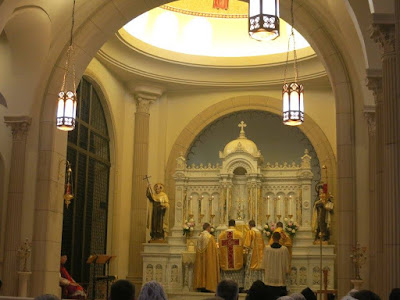
Dear Friends, I’m sharing some joyful news. Today, our Archdiocese welcomed six nuns from the Carmelite Monastery of Valparaiso, Nebraska, and four nuns from the Carmelite Monastery of Elysburg, Pennsylvania. They are transferring to the Carmelite Monastery of Saint Joseph and Saint Anne here in Philadelphia (The Discalced Carmelite Nuns of Philadelphia).As a result of these transfers, there is now a community of twelve nuns in the Philadelphia Carmel, which was founded in 1902. Since that time it has been home to generations of Discalced Carmelite nuns who have dedicated themselves to a cloistered life of contemplation and prayer for the good of us all. The Carmel is also welcoming a new chaplain, Father William Allen, FSSP.
Tomorrow, Wednesday, July 26th, the Feast of Saint…Anne, all are invited to a Solemn High Mass at the Carmel and welcome to greet the new sisters in the “speakroom†of the convent following the liturgy. Details are below.
Philadelphia Carmel
1400 66th Avenue
Philadelphia, PA 19126
Concert of Sacred Music at 6:15 p.m.
Solemn High Mass at 7:00 p.m.
Celebrant: Rev. William Allen, FSSP, Chaplain for the Philadelphia Carmel
Homilist: Most Reverend Michael J. Fitzgerald
For additional information on the Philadelphia Carmel, please visit http://www.discalcedcarmelitesphila.org/. Kindly consider sharing this invitation broadly with others and join in praying for the Carmelite community in Philadelphia.
May the Lord give you peace.
by William A. Torchia, Esq.
The interpretation of Vatican II and its connection with the current crisis of the Church
The current situation of the unprecedented crisis of the Church is comparable with the general crisis in the 4th century, when the Arianism had contaminated the overwhelming majority of the episcopacy, taking a dominant position in the life of the Church. We must seek to address this current situation on the one hand with realism and, on the other hand, with a supernatural spirit – with a profound love for the Church, our mother, who is suffering the Passion of Christ because of this tremendous and general doctrinal, liturgical and pastoral confusion.
We must renew our faith in believing that the Church is in the safe hands of Christ, and that He will always intervene to renew the Church in the moments in which the boat of the Church seems to capsize, as is the obvious case in our days.
As to the attitude towards the Second Vatican Council, we must avoid two extremes: a complete rejection (as do the sedevacantists and a part of the Society of St. Pius X (SSPX) or a “infallibilization†of everything the council spoke.
Vatican II was a legitimate assembly presided by the Popes and we must maintain towards this council a respectful attitude. Nevertheless, this does not mean that we are forbidden to express well-founded doubts or respectful improvement suggestions regarding some specific items, while doing so based on the entire tradition of the Church and on the constant Magisterium.
Traditional and constant doctrinal statements of the Magisterium during a centuries-old period have precedence and constitute a criterion of verification regarding the exactness of posterior magisterial statements. New statements of the Magisterium must, in principle, be more exact and clearer, but should never be ambiguous and apparently contrast with previous magisterial statements.
Those statements of Vatican II which are ambiguous must be read and interpreted according to the statements of the entire Tradition and of the constant Magisterium of the Church.
In case of doubt the statements of the constant Magisterium (the previous councils and the documents of the Popes, whose content demonstrates being a sure and repeated tradition during centuries in the same sense) prevail over those objectively ambiguous or new statements of the Vatican II, which difficultly concord with specific statements of the constant and previous Magisterium (e.g. the duty of the state to venerate publicly Christ, the King of all human societies, the true sense of the episcopal collegiality in relation to the Petrine primacy and the universal government of the Church, the noxiousness of all non-Catholic religions and their dangerousness for the eternal salvation of the souls).
Vatican II must be seen and received as it is and as it was really: a primarily pastoral council. This council had not the intention to propose new doctrines or to propose them in a definitive form. In its statements the council confirmed largely the traditional and constant doctrine of the Church.
Some of the new statements of Vatican II (e.g. collegiality, religious liberty, ecumenical and inter-religious dialogue, the attitude towards the world) have not a definitive character, and being apparently or truly non-concordant with the traditional and constant statements of the Magisterium, they must be complemented by more exact explications and by more precise supplements of a doctrinal character. A blind application of the principle of the “hermeneutics of continuity†does not help either, since thereby are created forced interpretations, which are not convincing and which are not helpful to arrive at a clearer understanding of the immutable truths of the Catholic faith and of its concrete application.
There have been cases in the history, where non-definitive statements of certain ecumenical councils were later – thanks to a serene theological debate – refined or tacitly corrected (e.g. the statements of the Council of Florence regarding the matter of the sacrament of Orders, i.e. that the matter were the handing-over of the instruments, whereas the more sure and constant tradition said that the imposition of the hands of the bishop were sufficient, a truth, which was ultimately confirmed by Pius XII in 1947). If after the Council of Florence the theologians would have blindly applied the principle of the “hermeneutics of the continuity†to this concrete statement of the Council of Florence (an objectively erroneous statement), defending the thesis that the handing-over of the instruments as the matter of the sacrament of Orders would concord with the constant Magisterium, probably there would not have been achieved the general consensus of the theologians regarding the truth which says that only the imposition of the hands of the bishop is the real matter of the sacrament of Orders.
There must be created in the Church a serene climate of a doctrinal discussion regarding those statements of Vatican II which are ambiguous or which have caused erroneous interpretations. In such a doctrinal discussion there is nothing scandalous, but on the contrary, it will be a contribution in order to maintain and explain in a more sure and integral manner the deposit of the immutable faith of the Church.
One must not highlight so much a certain council, absolutizing it or equating it in fact with the oral (Sacred Tradition) or written (Sacred Scripture) Word of God. Vatican II itself said rightly (cf. Verbum Dei, 10), that the Magisterium (Pope, Councils, ordinary and universal Magisterium) is not above the Word of God, but beneath it, subject to it, and being only the servant of it (of the oral Word of God = Sacred Tradition and of the written Word of God = Sacred Scripture).
From an objective point of view, the statements of the Magisterium (Popes and councils) of definitive character, have more value and more weight compared with the statements of pastoral character, which have naturally a changeable and temporary quality depending on historical circumstances or responding to pastoral situations of a certain period of time, as it is the case with the major part of the statements of Vatican II.
The original and valuable contribution of the Vatican II consists in the universal call to holiness of all members of the Church (chap. 5 of Lumen gentium), in the doctrine about the central role of Our Lady in the life of the Church (chap. 8 of Lumen gentium), in the importance of the lay faithful in maintaining, defending and promoting the Catholic faith and in their duty to evangelize and sanctify the temporal realities according to the perennial sense of the Church (chap. 4 of Lumen gentium), in the primacy of the adoration of God in the life of the Church and in the celebration of the liturgy (Sacrosanctum Concilium, nn. 2; 5-10). The rest one can consider to a certain extent secondary, temporary and, in the future, probably forgettable, as it was the case with some non-definitive, pastoral and disciplinary statements of various ecumenical councils in the past.
The following issues – Our Lady, sanctification of the personal life of the faithful with the sanctification of the world according to the perennial sense of the Church and the primacy of the adoration of God – are the most urgent aspects which have to be lived in our days. Therein Vatican II has a prophetical role which, unfortunately, is not yet realized in a satisfactory manner.
Instead of living these four aspects, a considerable part of the theological and administrative “nomenclature†in the life of the Church promoted for the past 50 years and still promotes ambiguous doctrinal, pastoral and liturgical issues, distorting thereby the original intention of the Council or abusing its less clear or ambiguous doctrinal statements in order to create another church – a church of a relativistic or Protestant type.
In our days, we are experiencing the culmination of this development.
The problem of the current crisis of the Church consists partly in the fact that some statements of Vatican II – which are objectively ambiguous or those few statements, which are difficultly concordant with the constant magisterial tradition of the Church – have been infallibilisized. In this way, a healthy debate with a necessarily implicit or tacit correction was blocked.
At the same time there was given the incentive in creating theological affirmations in contrast with the perennial tradition (e.g. regarding the new theory of an ordinary double supreme subject of the government of the Church, i.e. the Pope alone and the entire episcopal college together with the Pope, the doctrine of the neutrality of the state towards the public worship, which it must pay to the true God, who is Jesus Christ, the King also of each human and political society, the relativizing of the truth that the Catholic Church is the unique way of salvation, wanted and commanded by God).
We must free ourselves from the chains of the absolutization and of the total infallibilization of Vatican II. We must ask for a climate of a serene and respectful debate out of a sincere love for the Church and for the immutable faith of the Church.
We can see a positive indication in the fact that on August 2, 2012, Pope Benedict XVI wrote a preface to the volume regarding Vatican II in the edition of his Opera omnia. In this preface, Benedict XVI expresses his reservations regarding specific content in the documents Gaudium et spes and Nostra aetate. From the tenor of these words of Benedict XVI one can see that concrete defects in certain sections of the documents are not improvable by the “hermeneutics of the continuity.â€
An SSPX, canonically and fully integrated in the life of the Church, could also give a valuable contribution in this debate – as Archbishop Marcel Lefebvre desired. The fully canonical presence of the SSPX in the life of the Church of our days could also help to create a general climate of constructive debate, in order that that, which was believed always, everywhere and by all Catholics for 2,000 years, would be believed in a more clear and in a more sure manner in our days as well, realizing thereby the true pastoral intention of the Fathers of the Second Vatican Council.
The authentic pastoral intention aims towards the eternal salvation of the souls — a salvation which will be achieved only through the proclamation of the entire will of God (cf. Act 20: 7). The ambiguity in the doctrine of the faith and in its concrete application (in the liturgy and in the pastoral life) would menace the eternal salvation of the souls and would be consequently anti-pastoral, since the proclamation of the clarity and of the integrity of the Catholic faith and of its faithful concrete application is the explicit will of God.
Only the perfect obedience to the will of God — Who revealed us through Christ the Incarnate Word and through the Apostles the true faith, the faith interpreted and practiced constantly in the same sense by the Magisterium of the Church – will bring the salvation of souls.
+ Athanasius Schneider,
Auxiliary Bishop of the Archdiocese of Maria Santissima in Astana, Kazakhstan
by William A. Torchia, Esq.
July 15, 2017 (
LifeSiteNews) – Pope Benedict XVI sent a sobering message at the funeral of Cardinal Joachim Meisner today, saying he was moved at theÂ
dubia cardinal’s ability to “live out of a deep conviction that the Lord does not abandon His Church, even when the boat has taken on so much water as to be on the verge of capsizing.”
The Church “stands in particularly pressing need of convincing shepherds who can resist the dictatorship of the spirit of the age and who live and think the faith with determination,” Pope Benedict said in a message read by Archbishop Georg Gänswein, his personal secretary and head of the papal household. Because of this “pressing need,” Meisner “found it difficult to leave his post.”
“What moved me all the more was that, in this last period of his life, he learned to let go and to live out of a deep conviction that the Lord does not abandon His Church, even when the boat has taken on so much water as to be on the verge of capsizing,” the pope emeritus concluded.
AMDG
by William A. Torchia, Esq.

IN PRIMIS… Pope Benedict XVI, Cardinal Castrillon Hoyos, Archbishop Marcel Lefebvre, Bishop Castro Mayer: long may their memories live!
The beautiful words of that great French hero of the Traditional Mass, Jean Madiran (1920-2013: Rest in peace!), who lived to see the miracle, remembering the names of some who died in the battlefield:
“For thirty seven years, a whole generation of militant Catholics, religious or lay members of the Militant Church (a generation reaching from 7 to 97 years of age) suffered, without giving in, openly defying the arbitrary interdict on the Traditional Mass. We think of our dead: Cardinal Ottaviani, Father Calmel, Father Raymond Dulac, Monsignor Renato Pozzi, Monsignor Lefebvre, Father Guérard. And, among the laymen: Cristina Campo, Luce Quenette, Louis Salleron, Eric de Saventhem. The pontifical goodwill is for them as a light breeze, which sweetly brings peace to their tombs. Wherever they are now, they do not need it anymore. But it is their memory amongst us which is appeased and elevated.”
And also: Father
Gamber,
Michael Davies,
Tito Casini, and so many, many others (priests, laymen and laywomen- God knows their names!), each of whom placed his own brick, large or small, in the great dam built for decades against the tumultuous tides of the late twentieth century. Thank you, thank you, thank you dearly! The heat of the battle has caused so much personal attrition, exaggerations, and misunderstandings… Yet, justice cannot be denied: gratitude is owed to those who did not live to see, on this earth, the glorious date of
July 7, 2007.
by William A. Torchia, Esq.
By Dr. Peter Kwasniewski of the New Liturgical Movement

Let us attempt an Orwellian thought experiment. A new government has taken the reins of power and wishes to alter permanently the character of the people and even the range of their thoughts, the range of what is conceivable or desirable, the parameters of reality. What would be their most effective weapon? They would take a dictionary of the people’s language, cross out half of the words, and forbid anyone to use or teach those words. Initially, many would slip and fall, still inadvertently mouthing the forbidden vocables. Over time, however, with enough ruthless enforcement, the language would be successfully purged. After a few decades, what would have happened to public discourse? To poetry? To the entire culture? All would have been profoundly damaged, with the damage compounding for each subsequent generation.
This is no mere thought experiment when it comes to the Catholic Church on earth, for it is exactly what happened with the Church’s public discourse, her supreme lyrical and epic poem, her divine cultus: the sacred liturgy. An abridged, expurgated dictionary of worship was strenuously enforced. The whole field of discourse contracted and shriveled up, as clergy attempted to celebrate public rituals with an emaciated vocabulary. The range of our theological ideas and religious sentiments shrank in proportion to the paucity of means with which to express them. We went from Dante and Shakespeare to The Beatles and worse.
Man becomes rational through language. For the same reason, he loses the full range of rationality through the loss of language. In the 1960s and beyond, the Church was experiencing not the energetic advancement of childhood, as displayed in her acquisition of liturgical riches over the ages, but the retrogression of “second childhood,†characterized by an accelerating loss of memory and a weakening ability to communicate.
It is no wonder that those who have rediscovered the rich, arcane, archaic poetry, the luminous and varied sentiments of the Church’s traditional modes of prayer, become enraptured over what they find. These rebellious poets have gotten hold of the original dictionary, impressive in its heft, exotic in its nuances, dangerous in its implications. The explorers — for such they are, in spite of not having left a harbor for distant lands — discover that there are twice as many colors, sounds, and tastes than they had ever known before. One could say that they emerge from a black and white world into a colored world; they step from two dimensions into three.
The Novus Ordo Missae has horizontal and vertical dimensions, but what it lacks is precisely depth. The depth has to be brought to it from the outside — from the interior spirit of the celebrant, from the accidents of place and time, from the luck of options well-chosen and well-executed.[1] As it stands, the modern liturgy does not supply that depth in and of itself. It is utterly at the mercy of the ars celebrandi, the community, the authorities, the prevailing mores of society. Even as contemporary society is living off of the fumes of traditional morality, so too the contemporary liturgy, to the extent that it is sanctifying of men and glorifying of God, is living off of the fumes of traditional liturgy.
It is true, of course, that one must bring the right disposition to any liturgy, Eastern or Western, ancient or modern. However, the traditional liturgies of East and West are demanding “schools of prayer†that offer a complete ascetical-mystical formation to those who enroll in them and submit with docility to their curricula. One could derive the entire content of the Faith, in its dogmatic, moral, spiritual, and political doctrine, from the old Roman Missal and Pontifical. It is highly doubtful that one could do the same with the Novus Ordo books. One might, perhaps, extrapolate a shallow and inconsistent dogma, morality, spirituality, and politics, a message garbled and mingled with foreign elements. In any case, one would be reminded of a teacher who tells her pupils what they want to hear rather than what they need to hear.
True and lasting renewal in the Church begins with an unequivocal commitment to the great Catholic tradition of liturgy, devotions, theology, and catechetics, in all its colorfulness, depth, and complexity — not with the status quo, which lies shattered in a thousand plastic pieces. Thus, while it is not a bad thing to patch up a sinking vessel and keep it in operation, it is far better to invest time and energy in the strong and fast sailing of a nobler vessel that is more beautiful and deserves to carry more people to their goal.
Think of a comparison: you can pour money into an ugly, run-down tenement building complex from the 1960s/70s, or you can invest in the restoration and inhabitation of beautiful historic buildings that are more orderly, more stately, and more worthy of human persons. Which is the better use of limited capital? Eventually, the tenement will have to come down anyway, since it was poorly built to begin with, and looked ugly due to the Bauhaus functionalist philosophy of its designers. In contrast, the old building, if slightly dilapidated, remains beautiful and admirable in every age, from the time of its creation to the present. Most people recognize this sort of thing to be true in the realm of architecture, but is not the very same contrast found in the realm of liturgy, when we compare premodern liturgy to the Bauhaus constructs of the 1960s?
It is sobering to run through the “-isms†condemned in Leo XIII’s Libertas Praestantissimum and Testem Benevolentiae and in Pius X’s Pascendi Dominici Gregis. These “-isms†have their analogues in the modern liturgy, in contrast with a traditional liturgy that opposes them on every side. If the crisis in the Church is largely a crisis of her liturgy, as Joseph Ratzinger maintains (most recently in the Foreword he wrote for the Russian edition of his volume of writings on the liturgy), then the longed-for renewal of the Church will come primarily from a renewal of her liturgy. Concretely, this will mean the recovery of the beautiful and reverent liturgy that developed organically over the span of nearly 2,000 years, not the desperate maintenance of rites constructed by liberal and rationalistic clergy in the middle of the 20th century.
We can borrow a line from Psalm 19: Ipsi obligati sunt, et ceciderunt; nos autem surreximus, et erecti sumus. “They are entangled and brought low, but we rise up and stand erect.†They are entangled in this modern claptrap and brought low, but we rise up in the strength of tradition and stand erect.
Perhaps the most troubling aspect of being a traditional Catholic today is that we feel ourselves to be constantly at war, beleagured on all sides — wishing to be brothers with our coreligionists, who insist on being our sworn enemies. It may not be a consolation but it can at least preserve our sanity to know that serious disagreement is possible, even among saints: the Acts of the Apostles shows us a falling-out between St. Paul and St. Barnabas, and we learn in Galatians about a confrontation between St. Paul and St. Peter over a matter of no small importance. We should not be surprised that there are deep differences of opinion in the Church. We should not allow this fact to paralyze, confuse, or embitter us.
There have always been and will always be laymen, religious, and clerics who appear to be ignorant of the Catholic faith, who do not practice it consistently or care to transmit it, who even openly reject elements of it in formal heresy. This is all the more reason for us who do want to serve Our Lord with our whole mind, heart, soul, and strength to dedicate ourselves to knowing and living the great mysteries of our faith, to seek total consistency in our practice, and to pass on to others, in its full integrity, the gift we have received — the unabridged dictionary of Catholic life, thought, and culture.
NOTE
[1] A sign of the truth of this claim was the great need for, and runaway success of, Msgr. Peter J. Elliott’s pair of books from Ignatius Press, Ceremonies of the Modern Roman Rite and Ceremonies of the Liturgical Year, which actually create a somewhat coherent rubrical and ceremonial framework for the Modern Rite, based, of course, on older liturgical books.
Painting at the head of the article by Ephraim Rubenstein.
by William A. Torchia, Esq.
Mr. Torchia will be in Rome through July 10, after which postings will continue.
by William A. Torchia, Esq.
Due to continued ongoing renovation of the Rectory Chapel at St. Albert the Great, the Traditional Latin Mass will be offered on Saturday, July 1st and Friday, July 7th at:
Church of the Immaculate ConceptionÂ
of the Blessed Virgin Mary
602 West Avenue
Jenkintown, PA 19046
(215) 884-4022
Immaculate Conception is 4.4 miles (approximately 12 minutes) from St. Albert the Great. Parking is available in the church parking lot and on the street.
Please see below for a map and directions.
First Saturday, July 1st:
Priest: Rev. Thomas D. O’Donald (Parochial Vicar, St. Bede The Venerable Parish)
Location:Â Â Church of the Immaculate Conception (address above, directions below)
Time: 9:30 a.m., preceded by Confessions at 9:00 a.m.
This Traditional Latin Mass will be the Mass of the Most Precious Blood of Our Lord Jesus Christ, offered in Reparation to The Immaculate Heart of Mary. (Red Vestments)
First Friday, July 7th:
Priest: Rev. Harold B. Mc Kale (Parish Vicar, Our Lady of Mount Carmel Roman Catholic Church)
Location:Â Church of the Immaculate Conception (address above, directions below)
Time: 7:00Â p.m., preceded by Confessions at 6:30Â p.m.
This Traditional Latin Mass will be the Mass of The Sacred Heart of Jesus with a Commemoration of Sts. Cyril and Methodius, Bishops, Confessors, offered in Reparation to The Sacred Heart of Jesus. (White Vestments)
Map from St. Albert the Great Parish
to theÂ
Church of the Immaculate ConceptionÂ
of the Blessed Virgin Mary
Directions from St. Albert the Great Parish to Church of the Immaculate Conception:
•Turn left out of the parking lot at St. Albert the Great onto Welsh Road (0.7 miles)
•Turn left onto Huntingdon Pike, PA-Rt. 232 South and drive for 1.1 miles
•Turn right onto Meetinghouse Road; drive for 2 miles.
•Turn right onto Jenkintown Road and drive for .14 miles
•Jenkintown Road becomes Greenwood Avenue. Continue for .19 miles
•Turn left onto Washington Lane. Continue for .14 miles
•Turn left on West Avenue; drive for .08 miles.
The church is .08 miles from the corner of Washington Lane and West Avenue, and will be on your left.
by William A. Torchia, Esq.
By Andrew Guernsey from One Peter Five
In 1933, sixteen years after Our Lady’s apparitions at Fatim a, the future Pope Ven. Pius XII, then Cardinal Eugenio Pacelli, Secretary of State to Pope Pius XI, made prophetic remarks in confidence to his friend Count Enrico Pietro Galeazzi. Cardinal Pacelli stated that Our Lady of Fatima’s confidences to Sr. Lucia were a warning against the “suicide†of destruction of the liturgy and other dangers of altering the Faith. Pacelli made similar prophetic warnings in a subsequent conversation with a fellow curial cardinal.
While these Pacellian remarks have appeared in truncated form in various traditional Catholic publications over the years, in honor of the 100th anniversary of Fatima, the entirety of Pius XII’s prophetic remarks are printed here in a fresh English translation, as they appear in Pie XII devant l’Histoire [Pius XII Before History] (1972) by Msgr. Georges Roche & Philippe Saint Germain (See appendix for the full context):Â
Suppose, dear friend, that Communism is the most visible among the organs of subversion against the Church and the Tradition of Divine Revelation. Thus, we will witness the invasion of everything that is spiritual: philosophy, science, law, teaching, the arts, the media, literature, theater, and religion.
I am concerned about the confidences of the Virgin to the little Lucia of Fatima. This persistence of the Good Lady in face of the danger that threatens the Church is a divine warning against the suicide that the alteration of the Faith, in its liturgy, its theology, and its soul, would represent.
I hear around me innovators who wish to dismantle the Sacred Chapel, destroy the universal flame of the Church, reject her ornaments, and make her remorseful for her historical past. Well, my dear friend, I am convinced that the Church of Peter must affirm her past, or else she will dig her own grave.
I will fight this battle with the greatest energy on the inside of the Church, just as outside of it, even if the forces of evil may one day take advantage of my person, my actions, or my writings, as they try today to deform the history of the Church. All human heresies which alter the word of God are so that a greater light might appear.â€
[…]
These underdeveloped peoples will save the Church, Eminence. A day will come when the civilized world will deny its God, when the Church will doubt as Peter doubted. She will be tempted to believe that man has become God, that His Son is only a symbol, a philosophy like so many others. And in churches, Christians will search for the red lamp where Jesus awaits them, like the sinful woman crying out before the empty tomb: ‘Where have they taken Him?’
Then, priests will rise up from Africa, from Asia, from America, formed here in this seminary of the Missions, who will say and who will proclaim that the ‘bread of life’ is not ordinary bread, that the mother of the God-man is not a mother like others. And they will be cut to pieces to testify that Christianity is not a religion like others, since her head is the Son of God, and the Church is His Church.
Cardinal Pacelli’s Prophesies Coming True Today:Â
Cardinal Pacelli’s remarks are stunning prophesies of the current state of affairs in the Church, 84 years later. We are witnessing today that:
- Russia spreads her errors of communism and secularization throughout the world as Our Lady of Fatima warned. This happens even in the Church through doctrinal, moral, and liturgical relativism and secularization. The smoke of Satan has entered the sanctuary.
- The imposition of Paul VI’s “New Mass†after Vatican II has brought about widespread destruction of the Church’s sacred liturgy and beauty in church architecture. There is widespread grave liturgical irreverence, sometimes even causing the sacraments, including the Eucharist, to be invalid from certain priests using the new rites.
- There is mass apostasy in the Church and her bishops – “She will doubt as Peter doubted.â€
- She doubts exclusivity of salvation through the Catholic Church and the social kingship of Christ. This is evidenced by harmful ambiguities, compromise formulas, and omissions in the very texts of Vatican II (ex. Nostra Aetate, Lumen Gentium, and Dignitatis Humanae). She doubts that all peoples and nations must become subject to Christ’s rule or ought to convert to the Catholic faith, and favors secular governments and practices. Scandalous practices of ecumenism have led to a virtual abandonment of the Divine Commission in favor of a vacuous, open-ended “dialogueâ€.
- She doubts even the universal validity of the Divine Law as seen in the double synod on the family and Pope Francis’ justifications for adultery and of a false notion of conscience in Amoris Laetitia. Numerous bishops conferences are openly violating the Divine law by allowing the divorced and civilly remarried persons living more uxorio to receive Holy Communion.
- She doubts the eternity and reality of Hell, by devoting her energies to progressive terrestrial utopias under the guise of environmentalism, one-world-government, mass immigration, and wealth redistribution, rather than to the salvation of souls.
- The Church in Africa flourishes and holds fast to the Catholic Faith, especially on sexual ethics, while the Western Catholic Church is losing the faith and dying out.
- Faithful Catholics suffer at the hands of fellow Catholics (white martyrdom) and non-Catholics (sometimes red martyrdom) because they refuse to give in to the prevailing moral relativism and religious syncretism.
Implications for Fatima
Cardinal Pacelli’s words about Fatima are especially revealing. Pacelli states his belief that the warnings of Our Lady at Fatima are about primarily internal threats to the Church rather than external ones; namely, through the “suicide†of the “alteration of the Faith in its in its liturgy, its theology, and its soul.†This runs contrary to the narrative of those who argue that message of Fatima only speaks of individual conversion, and not warning of the crisis in the Church we are experiencing today since Vatican II.
As to the Third Secret and its possible unrevealed part about apostasy in the Church even touching the pope, it should be noted that Pius XII did not likely ever read Sr. Lucia’s letter containing the Third Secret. According to the testimonies of Cardinal Ottaviani and Monsignor Capovilla, Secretary of Pope John XXIII, the envelope containing the secret, which arrived in Rome on April 16, 1957, was still sealed when John XXIII opened it in 1959, one year after Pius XII’s death. However, having been made Secretary of State to Pius XI just twelve years after the Fatima apparitions, Pacelli was apparently informed and even gravely concerned by the yet unwritten “confidences of the Virgin to Sister Luciaâ€, which presumably warned of a crisis of faith in the Church.
Regarding the authenticity and reliability of Cardinal Pacelli’s comments
Private comments like Cardinal Pacelli’s, that are later revealed can only be rejected as inauthentic on two bases: if the comments conflict with known truth, or if the one who reveals them is untrustworthy.
On both counts, these Pacelli quotations stand up to scrutiny. They not only do not conflict with the truth, but rather, in fact, prophetically predict the state of the Church today. The credentials of Count Galeazzi, the source, and Msgr. Roche, the author of Pie XII devant l’histoire, moreover, are sound.
If the quotes were fabricated, surely Count Galeazzi (who died in 1986, 14 years after Pie XII devant l’histoire was first published) would have challenged the veracity of Msgr Roche’s account, and surely Msgr. Roche wouldn’t have dared to publish this account, in consultation with Galeazzi in the first place, if the passage were blatantly false, knowing that Galeazzi was alive and could easily debunk it. Both men were men of learning, reputation and proximity to the time, the events, the people, and the Pontiff Pius XII himself.
Msgr. Roche, moreover, was secretary and confidant for thirty years to the French Cardinal Eugène Tisserant (who himself was archivist and pro-prefect of the Vatican Library from 1930 to 1936), and whose archives are cited as the primary source of the book. It was reported upon Tisserant’s death that he bequeathed his personal files to Msgr Roche. Tisserant himself was consecrated by Cardinal Pacelli (Pius XII) and was respected so much that he was the first person after Pope Paul VI to sign each of the acts of the Vatican II.
It should be noted that Pie XII devant l’histoire was given a scathing review by liberal laicized ex-priest Emile Poulat at the time of its publication in “Archives des sciences sociales des religions†(1972, vol. 33, no. 33, p. 292-293). Poulat called the work as a whole “improbable, bearing little resemblance to the truth.†He criticized the authors for poor citations, bibliographies, and various errors, “all from the same fanciful ink.â€Â Poulat, however, had suspect motives for criticizing the book. Poulat was a Modernist priest who renounced the priesthood following Pius XII’s 1954 condemnation of the modernist worker-priest movement, of which Poulat was a member. It is more than reasonable to disregard Poulat’s critiques as that of a disgruntled ex-cleric with a modernist agenda, irrelevant to the question of the veracity of these particular quotes from Pacelli, which Poulat does not even address in his critique of the book.
Msgr. Roche’s Pie XII devant l’histoire is also cited by several historical biographies about the life of Pius XII, such as in Jacques Kornberg’s The Pope’s Dilemma, Neal Pease’s Rome’s Most Faithful Daughter, and Philippe Chenaux’s Paul VI: Le souverain éclairé.
The skeptical critic, therefore, must prove a documentary fraud on the part of close collaborators of Pius XII (with no clear motive), involving the invention of an entire conversation that never happened, and he must show how it is that an allegedly fabricated conversation turned out to be so full of accurate prophecies.
Conclusion
While some may rightly point out the Pope Pius XII’s controversial reforms of the Holy Week liturgy in 1955 and 1956, devised by the modernist Annibale Bugnini, began this process of the destruction of the liturgy that culminated in the New Mass, nevertheless, Cardinal Pacelli’s warnings about the “suicide†of altering the faith “in its liturgy†are chilling warnings for our time. Indeed, we have witnessed Pacelli’s warnings of an anthroprocentric Church come true through the harmful dealings of bishops and even popes in living memory and today, from Pope John XXIII and Paul VI to Pope Francis. Pacelli’s image of Mary Magdalene at the tomb is a powerful one for the sufferings of faithful Catholics in our own time in watching the events warned by Our Lady of Fatima unfold: “Christians will search for the red lamp where Jesus awaits them, like the sinful woman crying out before the empty tomb: ‘Where have they taken Him?â€
Cardinal Pacelli’s remarks, however, have two optimistic prophesies for traditional Catholics to take courage in, of how Christ will save His Church. The first is that, “All human heresies which alter the word of God are so that a greater light might appear.†Indeed, many have noted that the acute crisis in the Church, especially manifest in the papacy of Pope Francis, have unmasked many of the wolves in sheep’s clothing among bishops, priests, and career Catholic lay commentators. The current crisis has also effectively rendered the ultamontanism of Catholic neo-conservatism untenable, at last opening up a frank discussion of the sources of the crisis in what went wrong at Vatican II and the Pauline liturgical reforms. We may hope that “greater light†may appear for future successors of Pope Francis who will be tasked with the duty of restoring the Church from damage done not only by the papacy of Pope Francis but by Vatican II itself.
The second hopeful prophesy is that the “underdeveloped peoples†in Africa, Asia, etc “will save the Church.†Pacelli’s prediction brings to mind recent remarks by Cardinal Robert Sarah speaking of Africa’s strong stance in favor of the family at the synod on the family: “I have a conviction: It will be Africa, and therefore the Church, who will save the family… In this deep anthropological crisis, Africa, despite her poverty, and indeed because of this poverty, which is the poverty of Christ in the Gospel, can give to the Church her most precious treasure: fidelity to God and to the Gospel, her love of life and the family.†Soon Africa and other nations who were once the mission territory of Christianity may re-evangelize the post-Christian Western world that first brought them the Faith.
To conclude, we have no reason to doubt the authenticity of the prophetic confidences of Cardinal Pacelli in 1933. Indeed, they are worthy of prayerful meditation and widest dissemination by faithful Catholics during this, the 100th Anniversary of Our Lady of Fatima, so that we too can help end the suicidal crisis that the Church is undergoing today.