
Category — Uncategorized
EASTER SUNDAY: INSTRUCTION ON EASTER
Rev. Fr. Leonard Goffine’s
The Church’s Year, (Available from Angelus Press)
What is the festival of Easter?
Easter, in Latin Pascha, signifies passing over, and has the following historical origin: Under Pharao, King of Egypt, the Jews in that country groaned under intolerable bondage. God had mercy on His people, and the hour of deliverance came. By His comÂmand the first-born of all the Egyptians was killed by an angel. The Jews had been ordered by God to be ready for emigration, but first to kill a lamb, eat it in their houses in common, and sprinkle the doorÂposts with its blood. And the angel of death, by order of God, passed the doors sprinkled with the blood of the lamb, and did no harm to any child of the Israelites, whilst he slew all the first-born sons of the Egyptians. In grateful memory of this passing their doors, the Jews observed the festival of Easter, the Pasch, or Passover. After the death of Jesus, the apostles introduced the same festival into the Church in grateful remembrance of the day on which Jesus, the true Easter Lamb, took away our sins by His blood, freed us from the angel of eternal death, and passed us over to the freedom of the children of God.
Where, during this time, was Christ’s holy soul?
In Limbo, that is, the place where the souls of the just who died before Christ, and were yet in original sin, were awaiting their redemption.
What have we to expect from the resurrection of Christ?
That our bodies will rise again from death. (Rom. VIII. II) For if Christ our head is alive, then we His members must also become reanimated, because a living head cannot exist without living members.
What is meant by the Alleluia sung at Easter time?
In English Alleluia means Praise the Lord, and expresses the joy of the Church at the Resurrection of Christ, and the hope of eternal happiness which He has obtained for us.
Why does the Church on this day bless eggs, bread, and meat?
To remind the faithful that although the time of fasting is now ended, they should not indulge in gluttony, but thank God, and use their food simply for the necessary preservation of physical strength.
At the Introit the Church introduces Christ, her Head, as addressing His Heavenly Father in these words:
INTROIT I arose, and am still with thee, alleluia; thou hast laid thy hand upon me, alleluia: thy knowledge is become wonderful, allel., allel. Lord, thou hast proved me and known me: Thou bast known my sitting down arid my rising up. (Ps. CXXXVIII.) Glory be to the Father, etc.
COLLECT O God, who on this day, through Thine only-begotten Son, didst overcome death and open unto us the gate of everlasting life; as by Thy prompting grace Thou dost breathe on the desires of our hearts, so do Thou ever acÂcompany them with Thy help. Through &c.
EPISTLE (I Cor. V. 7-8.) Brethren, purge out the old leaven, that you may be a new paste, as you are unleavened: for Christ our pasch is sacrificed. Therefore let us feast, not with the old leaven, nor with the leaven of malice and wickedness, but with the unleavened bread of sincerity and truth.
EXPLANATION St. Paul here exhorts us that we should at this time remove by a good confession and true penance the leaven, that is, the sins we have committed, and partake of the Paschal lamb in holy Communion with a pure, sincere heart; as the Jews were on this day comÂmanded to eat the Paschal lamb with unleavened bread, abstaining on this day from the old leaven.
During the octave of this festival repeat often with the Church: “Alleluia! Praise to the Lord, for He is good, and His mercy endureth forever. Alleluia! This is the day the Lord has made, Alleluia! Let us rejoice therein, Alleluia! Our Paschal Lamb is Christ who sacrificed Himself for us, Alleluia!
GOSPEL (Mark XVI. 1-7.) At that time, Mary Magdalen, and Mary the mother of James and Salome, bought sweetspices, that, coming, they, might anoint Jesus. And very early in the morning, the first, day, of the week, they come to the sepulchre, the sun being now risen. And they said one to another: Who shall roll us back the stone from the door of the sepulchre? And looking, they saw the stone rolled back, for it was very great. And, entering into the sepulchre they saw a young man sitting on the right side, clothed with a white robe, and they were astonished. Who saith to them: Be not affrighted; you seek Jesus of Nazareth; who was crucified: he is risen, he is not here; behold the place where they laid him. But go, tell his disciples, and Peter, that he goeth before you into Galilee: there you shall see him, as he told you.
Why did the holy women desire to embalm the body of Jesus with slices?
Because it was the custom of the Jews to embalm the dead, and as the Sabbath was so near and the time so short that they could not do it before the burial, these pious women procured the spices, and immediately after the Sabbath, hurried in the early morning to the sepulchre, to perform this act of love. We are taught by their conduct, that true love is never indifferent or slow, and what is agreeable to God it does without hesitation.
Why did the angel send the women to the disciples, and especially to Peter?
Because the disciples were to announce the ResurrecÂtion of Christ to the whole world, and they were now much saddened, and disturbed because of His death. Peter was the head of the apostles, and on account of having three times denied our Lord, he was greatly dejected and faint of heart, and was, therefore, above all to be comforted.
What encouragement does the Resurrection of Christ give us?
It encourages us to rise spiritually with Him, and live henceforth a new life, (Rom. VI. 4.) which we do if we not only renounce sin, but also flee from. all its occasions, lay aside our bad habits, subdue our corrupt inclinations, and aim after virtue and heavenly things.
ASPIRATION I rejoice, O my Jesus, that Thou hast victoriously risen from death. By Thy triumph over death, hell and the devil, grant us the grace to subdue our evil inclinations, walk in a new life, and die to all earthly things. Amen.
INSTRUCTION It is certainly true that Christ, by His death on the cross and by His resurrection, has rendered perfect satisfaction; and effected man’s redemption; (Heb. IX. 12.) but we must not imagine that there is no further need of doing penance, or of working out our salvation. For, as the children of Israel, though freed from Pharao’s bondage, had to fight long and against many enemies in order to gain the Promised Land, so also must we, though freed by Christ from the servitude .of the devil, battle against our enemies to the end of our lives to obtain the promised, heavenly land, for no one is crowned unless he has propÂerly fought. (II Tim. II. 5.) We must apply the merits of the redemption and satisfaction of Christ to our soul by the frequent reception of the holy sacraments; by imitating His virtues; by patiently bearing our trials and sufferÂings, and by a penitential life. The pious Angelus Silesius very appropriately writes:
“God is a Lamb that avails yon not, my Christian,
If you become not also a lamb of God.
The cross on Golgotha redeems not from evil,
If it is not also erected in thee;
The dear Christ’s death aids you not, my Christian,
Until in Him and for Him you also have died:”
April 3, 2026 No Comments
PALM SUNDAY – DOMINICA in PALMIS
Rev. Fr. Leonard Goffine’s
The Church’s Year (available from Angelus Press)
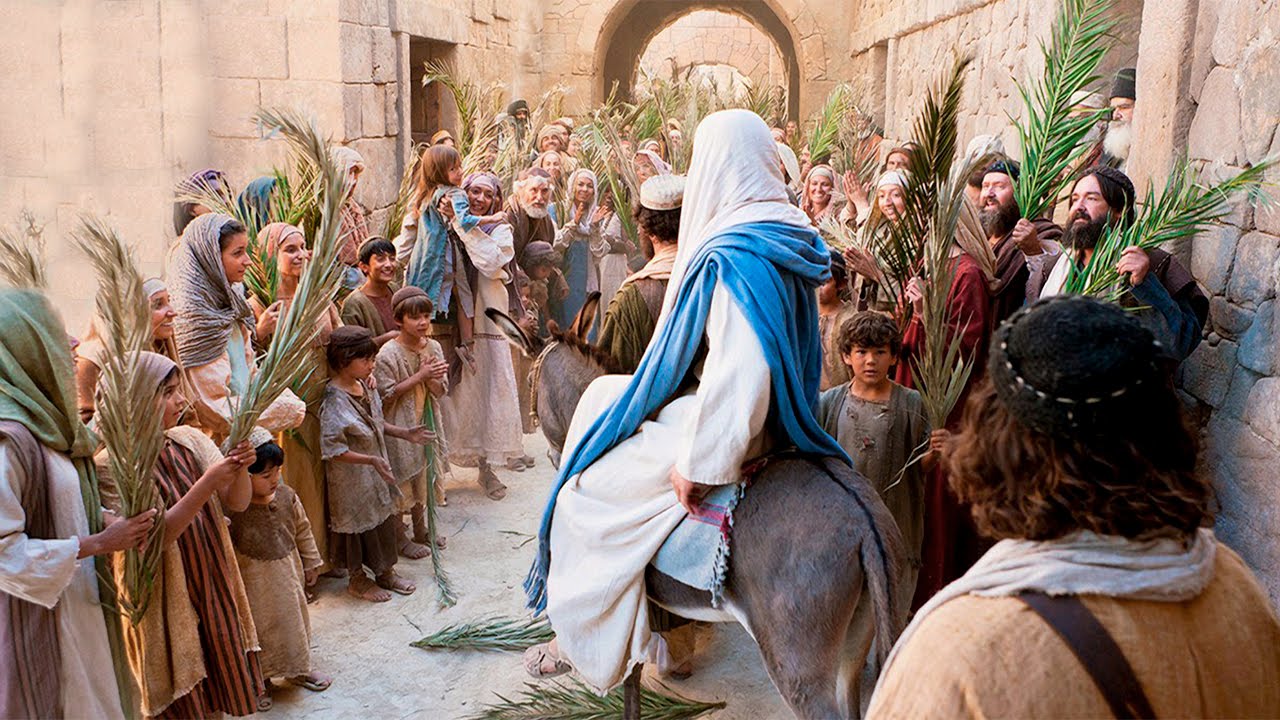
Why is this day called Palm Sunday?
In memory of our Saviour’s triumphant entry into Jerusalem, when the multitude strewed palm branches before Him, for which reason the Church, on this day, blesses palms, and carries them in procession.
Why are palms blessed?
That those who carry them with devotion, or keep them in their houses, may receive protection of soul and body, as prayed for in the blessing; that those who carry the palms may, by means of the prayers of the Church, adorn their souls with good works and thus, in spirit, meet the Saviour; that, through Christ whose members we are, we may conquer the kingdom of death and darkness, and be made worthy to share in His glorious resurrection and triumphant entrance into heaven. St. Augustine writes of the palms: “They are the emblem of praise, and sign of victory, because the Lord by death conquered death, and with the sign of victory, the cross, overcame the devil, the prince of death.” Therefore, preceded by the cross, we go in procession around the church singing hymns of praise; when we come to the church door, we find it locked; the priest knocks at it with the cross. Heaven was closed to us by the sin of Adam, and it is opened to us by reconciliation through Jesus on the cross.
To move us to compassion for the suffering Redeemer, the Church, in the person of Christ, cries in lamenting tones at the Introit:
INTROIT O Lord, remove not Thy help to a distance from me, look towards my defence: save me from the lion’s mouth, and my lowness from the horns of the unicorns. O God, my God! look on me, why hast Thou forsaken me? Far from my salvation are the words of my sins. O Lord! Remove not, &c. (Ps. XXI.)
COLLECT Almighty and everlasting God! who didst vouchsafe to send Thy Son, our Saviour, to take upon Him our flesh, and to suffer death upon the cross, to give mankind an example of humility; mercifully grant, that we may both follow the example of His patience, and be made partakers of His Resurrection. Through the same &c.
EPISTLE (Philip. II. 5-11.) Brethren, let this mind be in you, which was also in Christ Jesus: who being in the form of God, thought it not robbery himself to be equal to God; but debased himself, taking the form of a servant, being made to the likeness of men, and in shape found as a man. He humbled himself, becoming obedient unto death, even the death of the cross. Wherefore, God also hath exalted him, and hath given him a name, which is above every name: that in the name of Jesus every knee should bow, of those that are in heaven, on earth, and under the earth; and that every tongue should confess, that the Lord, Jesus Christ, is in the glory of God, the Father.
INSTRUCTION In this epistle, the apostle urges us in a special manner to humility by which we are made like to Christ, our Lord, who putting off the majesty of His divinity, became man, and humbled Himself in obedience to the ignominious death of the cross. “Would that all might hear,” exclaims St. Gregory, “that God resists the proud, and gives His grace to the humble! Would that all might hear: Thou dust and ashes, why dost thou exalt thyself? Would that all might hear the words of the Lord: Learn of me, because I am humble of heart. The only-begotten Son of God assumed the form of our weakness, suffered mockery, insult and torments for the purpose that the humble God might teach man not to be proud.”
ASPIRATION Ah, that my sentiments were as Throe, O my Lord, Jesus! who so humbled Thyself and writ obedient to the most ignominious death of the cross. Grant me, I beseech Thee, O my Redeemer, the grace. diligently to follow Thee in humility.
Instead of the gospel of the Passion, that is, the history of the sufferings of our Lord according to St. Matthew, (Chaps. XXVI. XXVII.) is read in this day’s Mass, and neither incense, nor lights are used, nor is the Dominus vobiscum said, thus signifying that Jesus, the Light of the world, was taken away by death, and that the faith and devotion of the apostles was shaken, and became almost extinct. When reading the History of the Passion at the words: and bowing his head, he gave up the ghost, the priest with all the congregation kneel and meditate for a short time on the great mystery of the death of Jesus, by which our redemption was effected.
THE PASSION OF OUR LORD JESUS CHRIST
ACCORDING TO ST. MATTHEW, CHAP. XXVI., XXVII: I-XVI
At that time, Jesus said to his disciples: You know that after two days shall be the Pasch, and the Son of Man shall be delivered up to be crucified. Then were gathered together the chief priests and the ancients of the people into the palace of the high-priest, who was called Caiphas. And they consulted together, that, by subtilty, they might apprehend Jesus and put him to death. But they said: Not on the festival day, lest there should be a tumult among the people. And when Jesus was in Bethania, in the house of Simon the leper, there came to him a woman having an alabaster-box of precious ointment, and poured it on his head, as he was at table. And the disciples seeing it, had indignation, saying: To what purpose is this waste? For this might have been sold for much, and given to the poor. And Jesus knowing it, said to them: Why do you trouble this woman? for she hath wrought a good work upon me. For the poor you have always with you: but me you have not always. For she, in pouring this ointment upon my body, hath done it for my burial. Amen, I say to you, wheresoever this gospel shall be preached in the whole world, that also which she bath done, shall be told for a memory of her.
Then went one of the twelve, who was called Judas Iscariot, to the chief priests, and said to them: What will you give me, and I will deliver him unto you? But they appointed for him thirty pieces of silver. And from thenceforth he sought opportunity to betray him.
And on the first day of the Azymes, the disciples came to Jesus, saying: Where wilt thou that we prepare for thee to eat the Pasch? But Jesus said: Go ye into the city to a certain man, and say to him: The master saith: my time is near at hand, I will keep the Pasch at thy house with my disciples. And the disciples did as Jesus had appointed them, and they prepared the Pasch. Now when it was evening, he sat down with his twelve disciples. And whilst they were eating, he said: Amen, I say to you, that one of you is about to betray me. And they being very much troubled, began everyone to say: Is it I, Lord? But he answering, said: He that dippeth his hand with me in the dish, the same shall betray me. The Son of Man indeed froeth as it is written of him; but woe to that man, by whom the Son of Man shall be betrayed: it were better for that man, if he had not been born. And Judas that betrayed him, answering, said: Is it I, Rabbi? He said to him: Thou hast said it. And whilst they were at supper, Jesus took bread, and blessed and broke, and gave to his disciples, and said: Take ye and eat: This is my body. And taking the chalice he gave thanks: and gave to them, saying: Drink ye all of this. For this is my blood of the new testament, which shall be shed for many for the remission of sins. And I say to you, I will not drink from henceforth of the fruit of the vine, until that day, when I shall drink it new with you in the kingdom of my Father. And when they had sung a hymn, they went out to Mount Olivet.
Then Jesus saith to them: All you shall be scandalized in me this night. For it is written: I will strike the shepherd, and the sheep of the flock shall be dispersed. But after I shall be risen again, I will go before you into Galilee. And Peter answering, said to him: Though all shall be scandalized in thee, I will never be scandalized. Jesus said to him: Amen, I say to thee, that in this night, before the cock crow, thou wilt deny me thrice. Peter saith to him: Though I should die with thee, I will not deny thee. And in like manner said all the disciples. Then Jesus came with them to a country place which is called Gethsemani, and he said to his disciples: Sit you here, till I go yonder, and pray. And taking with him Peter and the two sons of Zebedee, he began to grow sorrowful and to be sad.
Then he saith to them: My soul is sorrowful even unto death; stay you here, and watch with me. And going a little further he fell upon his face, praying, and saying: O my Father! if it is possible, let this chalice pass from me. Nevertheless not as I will, but as thou wilt. And he cometh to his disciples, and findeth them asleep; and he saith to Peter: What! could you not watch one hour with me? Watch ye, and pray that ye enter not into temptation. The spirit indeed is willing, but the flesh is weak. Again he went the second time, and prayed, saying: O my Father! if this chalice cannot pass away except I drink it, thy will be done. And he cometh again, and findeth them asleep; for their eyes were heavy. And leaving them, he went away again, and he prayed the third time, saying the same words. Then he cometh to his disciples, and with to them: Sleep on now, and take your rest: behold the hour is at hand, and the Son of Man shall be betrayed into the hands of sinners. Rise, let us go; behold, he is at hand that will betray me.
As he yet spoke, behold, Judas, one of the twelve, came, and with him a great multitude with swords and clubs, sent from the chief priests and the ancients of the people. And he that betrayed him, gave them a sign, saying: Whomsoever I shall kiss, that is he: hold him fast. And forthwith coming to Jesus, he said: Hail, rabbi! And he kissed him. And Jesus said to him: Friend! whereto art thou come? Then they came up and laid hands on Jesus, and held him. And behold one of them that were with Jesus, stretching forth his hand, drew out his sword; and striking the servant of the high-priest, cut off his ear. Then Jesus saith to him: Put up again thy sword into its place for all that take the sword shall perish by the sword. Thinkest thou that I cannot ask my Father, and he will give me presently more than twelve legions of Angels? How then shall the scriptures be fulfilled, that so it must be done? In that same hour Jesus said to the multitude: You are come out as against a robber, with swords and clubs to apprehend me. I sat daily with you teaching in the temple, and you laid not hands on me. Now all this was done, that the scriptures of the prophets might be fulfilled. Then the disciples all leaving him, fled away.
But they holding Jesus, led him to Caiphas, the high-priest, where the scribes and the ancients were assembled. But Peter followed him afar off to the high-priest’s palace. And going in, he sat with the servants, to see the end. Now the chief priests and whole council sought false witness against Jesus, that they might put him to death: and they found not, though many false witnesses had come in. And last of all, there came two false witnesses. And they said: This man said: I am able to destroy the temple of God, and in three days to rebuild it. And the high-priest rising up, said to him: Answerest thou nothing to the things which these witness against thee? But Jesus held his peace. And the high-priest said to him: I adjure thee by the living God, that thou tell us if thou be the Christ, the Son of God. Jesus saith to him: Thou hast said it. Nevertheless I say to you, hereafter you shall see the Son of Man, sitting on the right hand of the power of God, and coming in the clouds of heaven. Then the high-priest rent his garments, saying: He hath blasphemed, what further need have we of witnesses? Behold, now you have heard the blasphemy. What think you? But they answering, said: He is guilty of death.
Then they spit in his face, and buffetted him, and others struck his face with the palms of their hands, saying: Prophesy unto us, O Christ! who is he that struck thee? But Peter sat without in the palace, and there came to him a servant maid, saying: Thou also wast with Jesus the Galilean. But he denied before them all, saying: I know not what thou sayest. And as he went out of the gate, another maid saw him, and she saith to them that were there: This man also was with Jesus of Nazareth. And again he denied with an oath: I do not know the man. And after a little while, they that stood by came and said to Peter: Surely thou also art one of them: for even thy speech doth discover thee. Then he began to curse and to swear that he knew not the man.
And immediately the cock crew. And Peter remembered the word of Jesus which he had said: Before the cock crow, thou wilt deny me thrice. And going forth, he wept bitterly.
And when the morning was come, all the chief priests and ancients of the people held a council against Jesus, to put him to death. And they brought him bound, and delivered him to Pontius Pilate, the governor.
Then Judas, who betrayed him, seeing that he was condemned, repenting himself, brought back the thirty pieces of silver to the chief priests and the ancients, saying: I have sinned, in betraying innocent blood. But they said: What is that to us? look thou to it.
And casting down the pieces of silver in the temple, he departed: and went and hanged himself with a halter. But the chief priests having taken the pieces of silver, said: It is not lawful to put them into the corbona, because it is the price of blood. And having consulted together, they bought with them the potter’s field, to be a burying-place for strangers. Wherefore that field was called Haceldama, that is the field of blood, even to this day.
Then was fulfilled that which was spoken by Jeremias the prophet, saying: And they took the thirty pieces of silver, the price of him that was valued, whom they prized of the children of Israel. And they gave them unto the potter’s field, as the Lord appointed to me.
And Jesus stood before the governor, and the governor asked him, saying: Art thou the king of the Jews? Jesus saith to him: Thou sayest it. And when he was accused by the chief priests and ancients, he answered nothing. Then Pilate saith to him: Dost thou not hear how great testimonies they allege against thee?
And he answered him not to any word: so that the governor wondered exceedingly.
Now upon the solemn day the governor was accustomed to release to the people one prisoner, whom they would. And he had then a notorious prisoner, that was called Barabbas. They, therefore, being gathered together, Pilate said: Whom will you that I release to you, Barabbas, or Jesus, who is called Christ? For he knew that through envy they had delivered him up. And as he was sitting on the judgment-seat, his wife sent to him, saying. Have thou nothing to do with that just man. For I have suffered many things this day in a dream on account of him. But the chief priests and ancients persuaded the people, that they should ask Barabbas, and make Jesus away. And the governor answering, said to them: Which will you have of the two to be released unto you? But they said: Barabbas. Pilate saith to them: What shall I do then with Jesus that is called Christ? They all say: Let him be crucified. The governor said to them: Why, what evil hath he done? But they cried out the more, saying: Let him be crucified. And Pilate seeing that he prevailed nothing, but that rather a tumult was made; having taken water, washed his hands before the people, saying: I am innocent of the blood of this just man: look you to it. And all the people answering, said: His blood be upon us, and upon our children. Then he released to them Barabbas, and having scourged Jesus, delivered him to them to be crucified.
Then the soldiers of the governor, taking Jesus into the hall, gathered together unto him the whole band. And stripping him, they put a scarlet cloak about him. And platting a crown of thorns, they put it upon his head, and a reed in his right hand. And bowing the knee before him, they mocked him, saying: Hail, king of the Jews!
And spitting upon him, they took the reed, and struck his head. And after they had mocked him, they took off the cloak from him, and put on him his own garments, and led him away to crucify him.
And going out, they found a man of Cyrene, named Simon; him they forced to take up his cross. And they came to the place that is called Golgotha, which is, the place of Calvary. And they gave him wine to drink mingled with gall. And when he had tasted, he would not drink. And after they had crucified him, they parted his garments, casting lots; that the word might be fulfilled which was spoken by the prophet, saying: They divided my garments among them; and upon my vesture they cast lots. And they sat down, and watched him. And they put over his head his cause written: This is Jesus, the King of the Jews. Then were there crucified with him two. thieves; the one on the right hand, and the other on the left. And they that passed by blasphemed him, wagging their heads, and saying: Vah, thou who destroyest the temple of God, and in three days buildest it up again, save thy own self: if thou be the Son of God, come down from the cross. In like manner also, the chief priests with the scribes and ancients, mocking, said: He saved others; himself he cannot save: if he be the king of Israel, let him now come down from the cross, and we will believe him. He trusted in God, let him deliver him now if he will save him: for he said: I am the Son of God.
And the self-same thing the thieves also, that were crucified with him, reproached him with. Now from the sixth hour there was darkness over all the earth, until the ninth hour. And about the ninth hour, Jesus cried with a loud voice, saying: Eli, Eli, lamma sabacthani? that is: My God! my God! why hast thou forsaken me? And some of them that stood there and heard, said: This man calleth for Elias. And immediately one of them, running; took a sponge, and filled it with vinegar; and put it on a reed and gave him to drink. And the others said: Stay, let us see whether Elias will come to deliver him. And Jesus again crying with a loud voice, yielded up the ghost.
And behold the veil of the temple was rent in two, from the top even to the bottom, and the earth quaked, and the rocks were rent; and the graves were opened: and many bodies of the saints that had slept arose: and coming out of the tombs after his resurrection, came into the holy city, and appeared to many. Now the centurion, and they that were with him, watching Jesus, having seen the earthquake and the things that were done, were greatly afraid, saying: Indeed this was the Son of God. And there were there many women afar off, who had followed Jesus from Galilee, ministering unto him; among whom was Mary Magdalen, and Mary, the mother of James and Joseph, and the mother of the sons of Zebedee. And when it was evening, there came a certain rich man of Arimathea, named Joseph, who also himself was a disciple of Jesus. He went to Pilate and begged the body of Jesus. Then Pilate commanded that the body should be delivered. And Joseph taking the body, wrapped it up in a clean linen cloth. And laid it in his own new monument, which he had hewed out in a rock; and he rolled a great stone to the door of the monument, and went his way. And there was Mary Magdalen, and the other Mary sitting over against the sepulchre.
And the next day, which followed the day of the preparation, the chief priests and the Pharisees came together to Pilate, saying: Sir, we have remembered that seducer said, while-he was yet alive: After three days I will rise again. “Command, therefore, the sepulchre to be guarded until the third day; lest his disciples come and steal him away, and say to the people: He is risen from the dead. So the last error shall be worse than the first. Pilate said to them: You have a guard, go guard it as you know. And they departing, made the sepulchre sure, with guards, sealing the stone.
INSTRUCTION ON UPCOMING HOLY WEEK
Why is this week called Holy Week?
This week is called Holy Week because during it we celebrate the most holy mysteries of our religion, and in all her offices and ceremonies the Church refers in quiet mournfulness to the passion and death of our Redeemer.
What remarkable things did Christ do during the first four days of this week?
After He had entered the temple at Jerusalem on Palm Sunday amidst the greatest rejoicings of the people, and was saluted by the children with that cry of joy: “Hosanna to the Son of David,” He drove the buyers and sellers out of the temple, and when He had spent the entire day in preaching and healing the sick, He went in the evening to Bethania, where He remained over night in Lazarus’ house, because in Jerusalem no one wished to receive Him for fear of His enemies. The three following days He spent in Jerusalem, teaching in the temple, and passing the night in prayer on Mount Olivet. In His sermons during these days He strove especially to convince the Jewish priests, the Doctors of the Law and the Pharisees, that He was really the Messiah, and that they would commit a terrible sin by putting Him to death; that they would bring themselves and the whole Jewish nation to destruction. This ruin of the people He illustrated most plainly causing the fig-tree to wither under His curse, and by foretelling the destruction of the city and the temple of Jerusalem. He disputed with them, and confounded them, and brought them publicly to shame by parables, so that out of anger and hatred they with one mind determined to kill Him. The impious Judas aided the most in the execution of their design; through avarice he sold Him for thirty pieces of silver (about eighteen dollars in our money) to the chief priests, and the next day, Thursday, became His betrayer and delivered Him over into their hands.
March 24, 2026 No Comments
Passion Sunday (Judica Sunday)
Rev. Fr. Leonard Goffine’s
The Church’s Year, (available from Angelus Press)
This Sunday, called Judica from the first word of the Introit, is also called Passion Sunday, because from this day the Church occupies herself exclusively with the contemplation of the passion and death of Christ. The pictures of Christ crucified are covered today in memory of his having hidden Himself from the Jews until His entrance into Jerusalem, no longer showing Himself in public. (John XI. 54.) In the Mass the Glory be to the Father, etc. is omitted, because in the person of Christ the Holy Trinity was dishonored. The psalm Judica is not said today, because on this day the high priests held council about our Lord, for which reason the Church in the name of the suffering Saviour uses these words at the Introit:
INTROIT Judge me, O God, and distinguish my cause from the nation that is not holy: deliver me from the unjust and deceitful man, for Thou art my God and my strength. Send forth thy light and thy truth: they have conducted me, and brought me unto thy holy hill, and into thy tabernacles. (Ps. XLII. 1. 3.)
COLLECT We beseech Thee, Almighty God, graciously to look upon Thy family; that by Thy bounty it may be governed in body, and by Thy protection be guarded in mind. Through, &c.
EPISTLE (Heb. IX. 11-15.) Brethren, Christ being come, a high-priest of the good things to come, by a greater and more perfect tabernacle, not made with hands, that is, not of this creation, neither by the blood of goats or of calves, but by his own blood, entered once into the Holies, having obtained eternal redemption. For if the blood of goats and of oxen, and the ashes of an heifer being sprinkled, sanctify such as are defiled, to the cleansing of the flesh, how much more shall the blood of Christ, who, by the Holy Ghost, offered himself without spot to God, cleanse our conscience from dead works, to serve the living God? And therefore he is the Mediator of the new testament; that by means of his death, for the redemption of those trangressions which were under the former testament; they that are called may receive the promise of eternal inheritance.
EXPLANATION St. Paul here teaches, that Christ as the true high-priest of the New Testament, through His precious blood on the altar of the cross, has indeed rendered perfect satisfaction for sins, but that the sinner must also do his own part, by cooperating with Christ to make himself less unworthy of participating in His passion and merits, and to appropriate to himself its fruits. This is done when he diligently and devoutly assists at the unbloody Sacrifice of the Mass, by which the fruits of the death on the cross are attributed to us; when, according to the will of the Church, he purifies his conscience by true contrition and confession; and when he seeks by trust in Christ’s merits to render some satisfaction for his sins through voluntary penance and faithful following of Christ.
ASPIRATION Grant us, O meek Jesus, Thy grace, that through perfect sorrow for our sins and the exercise of good works we may become participators in the merits of Thy bitter passion.
GOSPEL (John VIII. 46-59.) At that time, Jesus said to the multitudes of the Jews: Which of you shall convince me of sin? If I say the truth to you, why do you not believe me? He that is of God, heareth the words of God. Therefore you hear them not, because you are not of God. The Jews therefore answered, and said to him: Do not we say well, that thou art a Samaritan, and hast a devil? Jesus answered: I have not a devil; but I honor my Father, and you have dishonored me. But I seek not my own glory; there is one that seeketh and judgeth. Amen, amen, I say to you, if any-man keep my word, he shall not see death for ever. The Jews therefore said: Now we know that thou hast a devil. Abraham is dead, and the prophets; and thou sayest: If any man keep my word, he shall not taste death for ever. Art thou greater than our Father Abraham, who is dead? and the prophets are dead. Whom dost thou make thyself? Jesus answered: If I glorify myself, my glory is nothing. It is my Father that glorifieth me, of whom you say that he is your God. And you have not known him; but I know him. And if I shall say that I know him not, I shall be like to you, a liar. But I do know him, and do keep his word. Abraham your father rejoiced that he might see my day: he saw it, and was glad. The Jews therefore said to him: Thou art not yet fifty years old, and hast thou seen Abraham? Jesus said to them: Amen, amen, I say to you, before Abraham was made, I am. They took up stones therefore to cast at him: but Jesus hid himself, and went out of the temple.
Why did Christ ask the Jews, which of them should convince Him of sin?
To show us that he who would teach and punish others, should strive to be irreproachable himself; and to prove that He, being free from sin, was more than mere man, and therefore, the Messiah, the Son of God, as He repeatedly told the Jews, especially in this day’s gospel, and substantiated by His great and numerous miracles.
Why did He say: He that is of God, heareth the words of God?
To prove that the Jews on account of their stubbornness and unbelief were not the children of God, but of the devil. “Therefore,” St. Gregory says, “let every one when he hears the word of God, ask himself, of whom he is. Eternal truth demands that we be desirous of the heavenly fatherland, that we tame the desires of the flesh, be indifferent to the praises of the world, covet not our neighbor’s goods, and give alms according to our means. Therefore examine yourself, and if you find in your heart this voice of God, then you will know that you are of God.”
CONSOLATION UNDER CALUMNY
When Christ told the Jews the truth, He received insults and calumny; they called Him a Samaritan, that is, an unbeliever, a heretic, one possessed of a devil. This was a terrible slander, and it must have pained Him exceedingly, but at the same time it is a great consolation to those who are innocently calumniated, when they consider that Christ Himself received nothing better. St. Augustine consoles such by saying: “O friend, what is there that can happen to you that your Saviour did not suffer before you? Is it slander? He heard it, when He was called a glutton, a drunkard, a heretic, and a rebel, a companion of sinners, one possessed of a devil; He even heard, when casting out devils, that He did so by Beelzebub, prince of devils.” (Matt. IX. 34.) He therefore comforts His apostles, saying, If they have called the good man of the house Beelzebub, how much more them of his household? (Matt, X. 25.) Are the pains bitter? There is no pain so bitter that He has not endured it; for what is. more painful, and at the same time more ignominious, than the death of the cross? For think, says St. Paul, diligently upon him who endured such opposition from sinners against himself: that you be not wearied (by all contempt and calumny), fainting in your minds. (Heb. XII. 3.)
How and why did Christ defend Himself against those who slandered Hate?
Only by denying with the greatest modesty the things with which they reproached Him, saying that He had not a devil, that He was not a Samaritan, because He honored His Father not in their manner, but in His own. In repelling this calumny while He left the rest unanswered, Christ removed all doubt in regard to His divine mission, thus vindicating the honor of God, and securing the salvation of man. Christ thus teaches us by His own conduct to defend ourselves only against those detractions and insults which endanger the honor of God and the salvation of man, and then to defend ourselves with all modesty; by no means however to do it, if they injure only our own good name, for we should leave the restoration of that to God, as exemplified by Christ, who knows better than we how to preserve and restore it.
[Use the search engine at the top to See the Instruction on the Epistle of the Third Sunday After Epiphany. Type in Third Sunday After Epiphany.]
How had Abraham seen Christ’s day?
In spirit, that is, by. divine revelation he foresaw the coming of Christ and rejoiced; also, he heard, by revelation from God, with the other just in Limbo, that Christ’s coming had taken place, and derived the greatest comfort from it.
Why did Christ conceal Himself from the Jews, instead of taking vengeance?
Because the time of His death had not come; because He would show His meekness and patience and teach us that we should avoid our enemies rather than resist them or take vengeance on them; Christ wished to instruct us to avoid passionate and quarrelsome people, for it is an honor for a man, to separate from quarrels: but all fools are meddling with reproaches. (Prov. XX. 3.)
PETITION When Thine enemies calumniated Thee, most meek Jesus, Thou didst answer them with tender words, and when they were about to stone Thee, Thou didst depart from them, whilst we can scarcely bear a hard word, and far from yielding to our neighbor, defend and avenge ourselves most passionately. Ah! pardon us our impatience, and grant us the grace to bear patiently the wrongs done us, and when necessary, answer with gentleness for Thy glory and the salvation of our neighbor.
March 19, 2026 No Comments
FOURTH SUNDAY IN LENT (LAETARE SUNDAY)
Rev. Fr. Leonard Goffine’s
The Church’s Year (available from Angelus Press)
The Introit of this day’s Mass, which begins with the word Laetare, is as follows:
INTROIT Rejoice, O Jerusalem, and come together all you that love her; rejoice with joy you that have been in sorrow: that you may exult, and be filled from the breasts of your consolation. (Isai: LXVI. 10. 11.) I rejoiced at the things that were said to me: We shall go into the house of the Lord. (Ps. CXXI. 1.) Glory be to the Father, etc.
COLLECT Grant, we beseech Thee, almighty God, that we who justly suffer for our deeds may be relieved by the conso lation of Thy grace. Through etc.
EPISTLE (Gat. IV. 22-31.) Brethren, it is written that Abraham had two sons; the one by a bond-woman and the other by a free-woman. But he who was of the bond-woman was born according to the flesh; but he of the free-woman was by promise: which things are said by an allegory. For these are the two testaments. The one from Mount Sina, engendering unto bondage, which is Agar: for Sina is a mountain in Arabia, which hath affinity to that Jerusalem which now is, and is in bondage with her children. But that Jerusalem which is above is free, which is our mother. For it is written: Rejoice, thou barren that bearest not: break forth and cry, thou that travailest not; for many are the children of the desolate, more than of her that hath a husband. Now we, brethren, as Isaac was, are the children of promise. But as then he that was born according to the flesh persecuted him that was after the spirit, so also it is now. But what saith the scripture? Cast out the bond-woman and her son: for the son of the bond-woman shall not be heir with the son of the free-woman. So, then, brethren, we are not the children of the bond-woman, but of the free: by the freedom wherewith Christ hath made us free.
EXPLANATION It was the common custom, in the days of the patriarchs, for a man to have more than one wife. This was permitted by God, partly because they and their descendants would hardly have been satisfied with one marriage, (Matt. XIX. 8.) partly because bigamy was a means of promoting the increase of the people of Israel, typical of the future increase of the children of God. Thus Abraham had two wives, who had each a son; of these Ismael was born to Abraham from his bond-woman Agar, in the natural way; the other, Isaac, the son of the free wife Sara, was born in a supernatural manner according to the promise, (Gen. XVIII. 11. 14. ) that she by the grace of God, although aged, would give birth to a son. These two women with their sons were types, as St. Paul says, of the two Testaments: Agar the bond-woman typified the Old, Sara, the free-woman, the New Testament; the son of Agar, the Jews, the son of Sara, the Christians; for the Jews, like Ismael, are descendants of Abraham by natural descent, but the Christians, like Isaac, by grace. The Old Testament gave birth only to servants; for the Jews obeyed the commandments of God through fear of punishment, and in hope of temporal reward; the New Testament, the Jerusalem from above. that is, the Christian Church, gives birth to children who willingly and through love obey the commandments of God. Although the Christian Church, the New Jerusalem, chosen from heathenism, was in the beginning barren, as was Sara, she gives birth, by the grace of God and through His apostles, to more children than the Jewish Church, which was so long the Church of God, that is, more were converted to Christianity from the Gentiles than from the Jews. The latter even hated and persecuted the Christians, as did Ismael his brother Isaac. For their hardness of heart they were cast out by God, like Agar and her son; that is, after the destruction of Jerusalem the Jews were dispersed to all parts of the world. Let us, therefore, give thanks to God, that through Jesus we have become the free children of our heavenly Father, who through love fulfil His holy will by which we shall be saved.
ASPIRATION Give me the grace, O Jesus, that by prayer and fasting, and patience in all adversities and persecutions, I may be made less unworthy of Thy passion; that I may not, one day, be cast out by Thee, but become worthy of Thy divine promise and Thy eternal consolation in the heavenly Jerusalem.
GOSPEL (John VI. 1-15.) At that time, Jesus went over the sea of Galilee, which is that of Tiberias; and a great multitude followed him, because they saw the miracles which he did on them that were diseased. Jesus therefore went up into a mountain, and there he sat with his disciples. Now the pasch, the festival day of the Jews, was near at hand. When Jesus therefore had lifted up his eyes, and seen that a very great multitude cometh to him, he said to Philip: Whence shall we buy bread that these may eat? And this he said to try him; for he himself knew what he would do. Philip answered: Two hundred pennyworth of bread is not sufficient for them, that every one may take a little. One of his disciples, Andrew, the brother of Simon Peter, saith to him: There is a boy here that hath five barley loaves and two fishes: but what are these among so many? Then Jesus said: Make the men sit down. Now there was much grass in the place. The men therefore sat down, in number about five thousand. And Jesus took the loaves; and when he had given thanks, he distributed to them that were set down: in like manner also of the fishes, as much as they would. And when they were filled, he said to his disciples: Gather up the fragments that remain, lest they be lost. They gathered up, therefore, and filled twelve baskets with the fragments of the five barley loaves, which remained over and above to them that had eaten. Now those men, when they had seen what a miracle Jesus had done, said: This is of a truth the prophet that is to come into the world. Jesus therefore when he knew that they would come to take him by force, and make him king, fled again into the mountain himself alone.
Why did Christ try St. Philip?
To test his faith and confidence; to instruct us that before seeking supernatural means, we should first look for natural ways of providing; that the miracle of the multiplying of the loaves should be more marvellous to the people from having seen there was no provision; and that we may learn to trust in God, who is a helper in due time in tribulation. (Ps. IX. 10.)
What signs did Christ make use of in this miracle, and why?
According to St. Matthew (XIV. 19.) He lifted up His eyes to heaven, by which He showed that all good gifts come from above; He gave thanks, thus teaching us to give thanks to God for all His blessings. “The table,” says St. Chrysostom, “that is approached and is left with prayer will never know want, but the more richly yield its gifts.” He blessed the bread showing us that the divine blessing increases all things.
Why did Christ require them to gather up the fragments that were left?
That they should not be wasted or destroyed; that the greatness of the miracle should be made evident by the quantity of the fragments; and that we might learn to honor the gifts of God, even the most insignificant, and if we do not ourselves need them, give them to the poor.
Why did Christ, after this miracle, flee from the people?
Because after this miracle the people recognized in him the Messiah, and would have made Him king. He wished to teach us to flee from praise and honor, and in all our actions seek not our own, but God’s glory.
CONSOLATION IN POVERTY
This gospel gives the account of Christ providing for those who followed and listened to Him, which is indeed consoling for the poor. God from the beginning of the world has always cared for His own. For the aid and comfort of His chosen people in time of famine God sent Joseph, the son of the Patriarch Jacob, in advance into Egypt: (Gen. XLV. 5.) for forty years He fed the children of Israel in the desert with bread from heaven; (Deut. VIII. 2. 3.) He fed the Prophet Elias by a raven; (III Kings VII. 6.) and thought of Daniel in the lions’ den. (Dan. XIV. 37.) In the New Testament God shows His merciful care for His own, because in great need He fed them marvelously through angels, men, and even animals, as we frequently see in the lives of the saints. Truly has David said: God forsakes not the just, I have been young, and am now old: and I have not seen the just forsaken, nor his seed seeking bread, (PS. XXXVI. 25.) that is, one who sincerely serves Him, and seeks before all the kingdom o f God a n d His justice, as Christ commands. (Luke XII. 31.) Strive to be a faithful child, and you will have God for your father, and with King David you can cast your care upon the Lord, and He will sustain you. You must not think it is enough to pray and trust in God, He demands that you should use your strength to receive help, for if any man will not work, neither let him eat. (II Thess. III. 10.)
ASPIRATION In Thy omnipotence and goodness, O my God, I put my trust, firmly believing that if I fear Thee, serve Thee faithfully, and avoid evil, I shall not be abandoned in poverty, but receive many good things. Amen.
INSTRUCTION ON PREPARATION FOR EASTER
Now the Pasch the festival day of the Jews, was near at hand. (John VI. 4.)
If we would sing a joyful Alleluia with the Church on the festival of Easter, we must fulfill her desire, and prepare ourselves to celebrate it worthily. Therefore, we should shun improper, clamorous meetings, and retire often to pray in solitude, especially to meditate on the bitter sufferings of our Saviour, for when man is alone, God speaks to his heart. (Osee. II. 14.) We should carefully examine our conscience, and consider how we stand before God, for upon this day shall be the expiation for you, and the cleansing from all your sins: you shall be cleansed before the Lord; for it is a Sabbath of rest, and you shall afflict your souls, that is, by fasting, watching, and praying. (Lev. XVI. 30-31.) From this Sunday until Easter we should fast more strictly, give more alms to the poor if we are able, or if poor ourselves, bear our poverty more patiently, offering it to Christ in union with His poverty, His hunger, thirst, &c. ; we should make a sincere and contrite confession, and purify our heart from the old leaven of iniquity, that we may keep the Easter meal with Christ in the unleavened bread of purity and truth. (I Cor. V. 7. 8.) For this end we should incite ourselves to holy desires, rise from sin, which is the death of the soul
March 11, 2026 No Comments
THIRD SUNDAY IN LENT (OCULI)
Rev. Fr. Leonard Goffine’s
The Church’s Year, available from Angelus Press.
The Introit of this day’s Mass, which begins with the word Oculi, is the prayer of a soul imploring deliverance from the snares of the devil:
INTROIT My eyes are ever towards the Lord: for he shall pluck my feet out of the snare: look thou upon me, and have mercy on me, for I am alone and poor. To thee, O Lord, have I lifted up my soul: in thee, O my God, I put my trust: let me not be ashamed. (Fs. XXIV.) Glory be to the Father, etc.
COLLECT We beseech Thee, Almighty God, regard the desires of the humble, and stretch forth the right hand of Thy majesty to be our defence. Through Jesus Christ, our Lord, etc.
EPISTLE (Ephes. V. 1-9.) Brethren, be ye followers of God, as most dear children; and walk in love, as Christ also hath loved us, and hath delivered himself for us, an oblation and a sacrifice to God, for an odor of sweetness. But fornication, and all uncleanness, or covetousness, let it not so much as be named among you, as becometh saints; nor obscenity, nor foolish talking, nor scurrility, which is to no purpose; but rather giving of thanks: for know ye this, and understand, that no fornicator, nor unclean, nor covetous person, which is a serving of idols, hath any inheritance in the kingdom of Christ and of God. Let no man deceive you with vain words; for because of these things cometh the anger of God upon the children of unbelief. Be ye not therefore partakers with them. For you were heretofore darkness; but now light in the Lord. Walk, then, as children of the light: for the fruit of the light is in all goodness, and justice, and truth.
EXPLANATION The apostle requires us to imitate God, as good children imitate their father in well-doing and in well-wishing; besides he declares that all covetousness, fornication, all disgraceful talk and equivocal jokes should be banished from Christian meetings, even that such things should not be so much as mentioned among us; because these vices unfailingly deprive us of heaven. He admonishes us not to let ourselves be deceived by the seducing words of those who seek to make these vices appear small, nothing more than pardonable human weaknesses; those who speak thus are the children of darkness and of the devil, they bring down the wrath of God upon themselves, and all who assent to their words. A Christian, a child of light, that is, of faith, should regard as a sin that which faith and conscience tell him is such, and must live according to their precepts and not by false judgment of the wicked. Should any one seek to lead you away, ask yourself, my Christian soul, whether you would dare appear with such a deed before the judgment-seat of God. Listen to the voice of your conscience, and let it decide, whether that which you are expected to do is good or bad, lawful or unlawful.
ASPIRATION Place Thy fear, O God, before my mouth, that I may utter no vain, careless, much less improper and scandalous words, which may be the occasion of sin to my neighbor. Strengthen me, that I may not be deceived by flattering words, and become faithless to Thee.
GOSPEL (Luke XI. 14.-28.) At that time, Jesus was casting out a devil, and the same was dumb. And when he had cast out the devil, the dumb spoke, and the multitudes were in admiration at it. But some of them said: He casteth out devils by Beelzebub the prince of devils. And others tempting, asked of him a sign from heaven. But he seeing their thoughts, said to them: Every kingdom divided against itself shall be brought to desolation, and house upon house shall fall. And if Satan also be divided against himself, how shall his kingdom stand? because you say, that through Beelzebub I cast out devils. Now if I cast out devils by Beelzebub, by whom do your children cast them out? Therefore they shall be your judges. But if I by the finger of God cast out devils, doubtless the kingdom of God is come upon you. When a strong man armed keepeth his court, those things which he possesseth are in peace; but if a stronger than he come upon him, and overcome him, he will take away all his armor wherein he trusted, and will distribute his spoils. He that is not with me, is against me; and he that gathereth not with me, scattereth. When the unclean spirit is gone out of a man, he walketh through places without water, seeking rest; and not finding, he saith, I will return into my house whence I came out: and when he is come, he findeth it swept and garnished. Then he goeth, and taketh with him seven other spirits more wicked than himself, and entering in they dwell there. And the last state of that man becomes worse than the first. And it came to pass, as he spoke these things, a certain woman from the crowd, lifting up her voice, said to him: Blessed is the womb that bore thee, and the paps that gave thee suck. But he said: Yea rather blessed are they who hear the word of God, and keep it.
Can a man be really possessed of a devil?
It is the doctrine of the Catholic Church that the evil spirit most perniciously influences man in a twofold manner: by enticing his soul to sin, and then influencing his body which he often entirely or partially possesses, manifesting himself by madness, convulsions, insanity, etc. Many texts of Scripture, and the writings of the Fathers speak of this possession. St. Cyprian writes: “We can expel the swarms of impure spirits, who for the ruin of the soul, enter into the bodies of men, and we can compel them to acknowledge their presence, by the force of powerful words.” Possession takes place by the permission of God either for trial or as a punishment for sin committed, (I. Cor. V. 5.) and the Church from her Head, Jesus, who expelled so many devils, has received the power of casting them out as He did. (Mark XVI. 17.; Acts V. 16., VIII. 6. 7., XVI. 18. &c.) She however warns her ministers, the priests, who by their ordination have received the power to expel the evil spirits, to distinguish carefully between possession and natural sickness, that they may not be deceived, (Rit. ROM. §. 3. §. 5-10.) and the faithful should guard against looking upon every unusual, unhealthy appearance as an influence of Satan, and should give no ear to impostors, but in order not to be deceived, should turn to an experienced physician or to their pastor.
What is understood by a dumb devil?
The literal meaning of this is the evil enemy, who some times so torments those whom he possesses that they lose the power of speech; in a spiritual sense, we may understand it to mean the shame which the devil takes away from the sinner, when he commits the sin, but gives back again, as false shame, before confession, so that the sinner conceals the sin, and thereby falls deeper.
How does Christ still cast out dumb devils?
By His grace with which He inwardly enlightens the sinner, so that he becomes keenly aware that the sins which he has concealed in confession, will one day be known to the whole world, and thus encourages him to overcome his false shame. – “Be not ashamed to confess to one man,” says St. Augustine, “that which you were not ashamed to do with one, perhaps, with many.” Consider these words of the same saint: “Sincere confession subdues vice, conquers the evil one, shuts the door of hell, and opens the gates of paradise.”
How did Christ prove, that He did not cast out devils by Beelzebub?
By showing that the kingdom of Satan could not stand, if one evil spirit were cast out by another; that they thus reproached their own sons who also cast out devils, and had not been accused of doing so by power from Beelzebub; by His own life and works which were in direct opposition to the devil, and by which the devil’s works were destroyed. – There is no better defence against calumny than an innocent life, and those who are slandered, find no better consolation than the thought of Christ who, notwithstanding His sanctity and His miracles, was not secure against calumniation.
What is meant by the finger of God?
The power of God, by which Christ expelled the evil spirits, proved himself God, and the promised Redeemer.
Who is the strong man armed?
The evil one is so called, because he still retains the power and intellect of the angels, and, practiced by long experience, seeks in different ways to injure man if God permits.
How is the devil armed?
With the evil desires of men, with the perishable riches, honors, and pleasures of this world, with which he entices us to evil, deceives us, and casts us into eternal fire.
Who is the stronger one who took away the devil’s armor?
Christ the Lord who came into this world that He might destroy the works and the kingdom of the devil, to expel the prince of darkness, (John XII. 31.) and to redeem us. from his power. “The devil,” says St. Anthony, “is like a dragon caught by the Lord with the fishing-hook of the cross, tied with a halter like a beast of burden, chained like a fugitive slave, and his lips pierced through with a ring, so that he may not devour any of the faithful. Now he sighs, like a miserable sparrow, caught by Christ and turned to derision, and thrown under the feet of the Christians. He who flattered himself that he would possess the whole orbit of the earth, behold, he has to yield!”
Why does Christ say: He who is not with me, is against me?
These words were intended in the first place for the Pharisees who did not acknowledge Christ as the Messiah, would not fight with Him against Satan’s power, but rather held the people back from reaching unity of faith and love of Christ. Like the Pharisees, all heretical teachers who, by their false doctrines, draw the faithful from communion with Christ and His Church, are similar to the devil, the father of heresy and lies. May all those, therefore, who think they can serve Christ and the world at the same time, consider that between truth and falsehood, between Christ and the world, there is no middle path; that Christ requires decision, either with Him, or against Him , either eternal happiness with Him, or without Him, everlasting misery.
Who are understood by the dry places through which the evil spirit wanders and finds no rest?
“The dry places without water,” says St. Gregory, “are the hearts of the just, who by the force of penance have drained the dampness of carnal desires.” In such places the evil -one indeed finds no rest, because there his malice finds no sympathy, and his wicked will no satisfaction.
Why does the evil spirit say: I will return into my house?
Because he is only contented there where he is welcomed and received: those who have purified their heart by confession, and driven Satan from it, but labor not to amend, again lose the grace of the Sacraments by sin, and thus void of virtue and grace, offer a beautiful and pleasant dwelling to the devil.
Why is it said: The last state becomes worse than the first?
Because a relapse generally draws more sins with it, and so it is said: the devil will return with seven other spirits more wicked than himself, by which may be understood the seven deadly sins, because after a relapse into sin conversion to God becomes more difficult, as a repeated return of the same sickness makes it harder to regain health; because by repetition sin easily becomes a habit and renders conversion almost impossible; because repeated relapses are followed by blindness of intellect, hardness of heart, and in the end eternal damnation.
Why did the woman lift up her voice?
This was by the inspiration of the Holy Ghost to shame the Pharisees who, blinded by pride, neither professed nor acknowledged the divinity of Christ, whilst this humble woman not only confessed Jesus as God, but praised her who carried Him, whom heaven and earth cannot contain. Consider the great dignity of the Blessed Virgin, Mother of the Son of God, and hear her praises from the holy Fathers. St. Cyril thus salutes her: “Praise to thee, Blessed Mother of God: for thou art virginity itself, the sceptre of the true faith!” and St. Chrysostom: “Hail, O Mother, the throne, the glory, the heaven of the Church!” St. Ephrem: “Hail, only hope of the Fathers, herald of the apostles, glory of the martyrs, joy of the saints, and crown of the virgins, because of thy vast glory, and inaccessible light!”
Why did Christ call those happy who hear the word of God and keep it?
Because, as has been already said, it is not enough for salvation to hear the word of God, but it must also be practiced. Because Mary, the tender Mother of Jesus, did this most perfectly, Christ terms her more happy in it, than in having conceived, borne, and nursed Him.
SUPPLICATION O Lord Jesus! true Light of the world, enlighten the eyes of my soul, that I may never be induced by the evil one to conceal a sin, through false shame, in the confessional, that on the day of general judgment my sibs may not be published to the whole world. Strengthen me, O Jesus, that I may resist the arms of the devil by a penitent life, and especially by scorning the fear of man and worldly considerations, and guard against lapsing into sin, that I may not be lost, but through Thy merits maybe delivered from, all dangers and obtain heaven.
March 8, 2026 No Comments
Second Sunday in Lent: Daily Lenten Meditations
EVENTIDE
He said to them that day when evening was come: Let us go over to the other side And soon the little boat was slipping quietly over the waters bound for the farther shore.
A beautiful picture, the Gentle Master at close of day inviting the Twelve, His chosen ones, to leave the scenes of their toils and troubles and come with Him to a place apart over the lake to the farther shore.
A beautiful picture, indeed, and one full of fruitful suggestion. Life’s day, too, as every other day, shall have its evening. The shadows of twilight shall steal softly about me telling me gently that the day is done, and in the gloaming shall come Jesus, the Gentle Master, whispering to me the same invitation once heard by the Apostles: Let us go over to the other side. And will it not be good to hear that invitation!
Let us go over to the other side. How blessed it will be in the deepening twilight of life’s evening hours, when all of this world’s sights are fading slowly from my view to clasp the hand of the Gentle Master and, in the security of His sacred presence, travel to the shore of eternity!
Yes, a blessed, heartening thought indeed! Life may have its sufferings and sorrows. Bitter pains may rack my body or cruel pangs may harrow my soul; the dregs of the cup of bitterness may oft-times be my portion, but, blessed thought, the evening of life will come on apace and with it the voice of the Gentle Master lovingly calling: Come, let us go over to the other shore, the blessed shore of eternity.
Jesus, Gentle Master, have mercy on us.
EPISTLE AND GOSPEL: Taken from the Angelus Press 1962 Roman Catholic Daily Missal
EPISTLE: 1 Thess. 4:1-7
God our Creator and our Lord hath called us not unto uncleanness, but unto sanctification, in Christ Jesus our Lord.
Brethren: We pray and beseech you in the Lord Jesus that, as you have received from us, how you ought to walk and to please God, so also you would walk, that you may abound the more. For you know what precepts I have given to you by the Lord Jesus.
For this is the will of God, your sanctification: that you should abstain from fornication, that every one of you should know how to possess his vessel in sanctification and honor, not in the passion of lust, like the Gentiles that know not God: and that no man overreach nor circumvent his brother in business: because the Lord is the avenger of all these things, as we have told you before and have testified.
For God hath not called us unto uncleanness, but unto sanctification: in Christ Jesus our Lord.
GOSPEL: Mt. 17:1-9
Transfiguration of our Lord Jesus Christ on Mount Tabor: manifestation of the divinity of Jesus.
At that time Jesus took Peter and James, John his brother, and bringeth them up into a high mountain apart: and He was transfigured before them.
And His face did shine as the sun: and His garments became white as snow.
And behold there appeared to them Moses and Elias talking with Him.
And Peter answering said to Jesus: Lord, it is good for us to be here: if Thou wilt, let us make here three tabernacles, one for Thee, and one for Moses, and one for Elias. And as he was yet speaking, behold a bright cloud overshadowed them.
And lo, a voice out of the cloud, saying: This is My beloved Son, in Whom I am well pleased: hear ye Him. And the disciples hearing, fell upon their face and were very much afraid.
And Jesus came and touched them, and said to them: Arise, and fear not. And they lifting up their eyes saw no one, but only Jesus.
And as they came down from the mountain, Jesus charged them, saying: Tell the vision to no man till the Son of man be risen from the dead.
February 25, 2026 No Comments
Quadragesima Sunday: “INVOCABIT,” First Sunday in Lent
Rev. Fr. Leonard Goffine’s
The Church’s Year, (This book is available from Angelus Press)
This Sunday is called Invocabit, because the Introit of the Mass begins with this word, which is taken from the ninetieth psalm, wherein we are urged to confidence in God, who willingly hears the prayer of the penitent:
INTROIT He shall call upon me, and I will hear him; I will deliver him, and glorify him; I will fill him with length of days. (Ps. XC. 15-16.) He that dwelleth in the aid of the Most high shall abide under the protection of the God of heaven. (Ps. XC. 1.) Glory be to the Father, etc.
COLLECT O God who dost purify Thy Church by the yearly fast of Lent; grant to Thy household that what we strive to obtain from Thee by abstinence, by good works we may secure. Through our Lord, etc.
EPISTLE (II. Cor. VI. 1-10) Brethren, we exhort you that you receive not the grace of God in vain. For he saith: In an acceptable time have I heard thee, and in the day of salvation have I helped thee. Behold, now is the acceptable time; behold, now, is the day of salvation. Giving no offence to any man, that our ministry be not blamed: but in all things let us exhibit ourselves as the ministers of God; in much patience, in tribulations, in necessities, in distresses, in stripes, in prisons, in seditions, in labors, in watchings, in fastings, in chastity, in knowledge, in long-suffering, in sweetness, in the Holy Ghost, in charity unfeigned, in the word of truth, in the power of God, by the armor of justice on the right hand, and on the left, by honor and dishonor, by evil report, and good report; as deceivers, and yet true; as unknown, and yet known; as dying, and behold we live; as chastised, and not killed; as sorrowful, yet always rejoicing; as needy, yet enriching many; as having nothing, and possessing all things.
EXPLANATION The Church very appropriately reads on this day this epistle of St. Paul, in which he exhorts the Christians to make use of the time of grace. A special time of grace is Lent, in which everything invites to conversion and penance, a time, therefore, in which God is ready to make rich bestowal of His graces. St. Anselm says, those do not use the grace who do not cooperate. Let us, therefore, follow St. Paul’s exhortation, and earnestly practise those virtues he places before us, and especially those of temperance, patience, chastity, liberality, love of God and of our neighbor. Let us arm ourselves with the arms of justice at the right and the left, that is, let us strive to be humble in prosperity and in adversity, confident of God’s help. Let us never be led from the path of virtue, by mockery, contempt, nor by persecution, torments, or death.
ASPIRATION Grant, O Jesus, that we may always faithfully cooperate with Thy graces, and employ well the time Thou hast again given for our salvation.
GOSPEL (Matt. IV. 1-11.) At that time, Jesus was led by the Spirit into the desert, to be tempted by the devil. And when he had fasted forty days and forty nights, afterwards he was hungry. And the tempter coming, said to him: If thou be the Son of God, command that these stones be made bread. Who answered and said: It is written: Not in bread alone doth man live, but in every word that proceedeth from the mouth of God. Then the devil took him up into the holy city, and set him upon the pinnacle of the temple, and said to him: If thou be the Son of God, cast thyself down; for it is written: He hath given his angels charge over thee, and in their hands shall they bear thee up, lest perhaps thou dash thy foot against a stone. Jesus said to him: It is written again: Thou shaft not tempt the Lord thy ‘God. Again the devil took him up into a very high mountain, and showed him all the kingdoms of the world, and the glory of them; and said to him: All these will I give thee, if, falling down, thou wilt adore me. Then Jesus said to him: Begone, Satan, for it is written, The Lord thy God shaft thou adore, and him only shaft thou serve. Then the devil left him; and behold, angels came, and ministered to him.
INSTRUCTION
I. Christ went into the desert by the inspiration of the Holy Ghost to prepare by fasting and prayer, for His mission, and to endure the temptations of Satan, that, as St. Paul says, He might be one tempted in all things such as we are, without sin, and so become for us a High-priest who knew how to have compassion on our infirmities, (Heb. IV. 15.) and to show us by His own example, how we should, armed with the word of God, as with a sword, overcome the tempter. (Eph. VI. 17.) – Let us, therefore, courageously follow Christ to the combat against all temptations, with His assistance it will not be hard to conquer them. He has certainly taught us to overcome the hardest ones: the lust of the eyes, of the flesh, and the pride of life, and if we overcome these, it will be easy to conquer the rest.
II. If Christ, the only Son of God, permitted Himself to be tempted by Satan, even to be taken up on a high mountain, and to the pinnacle of the temple, it should not appear strange to us, that we are assailed by many temptations, or that we should find in the lives of so many saints that the evil spirit tormented them by various images of terror and vexation. This we find in the history of the pious Job, where we also find at the same time, that the evil spirit cannot harm a hair of our head without God’s permission.
III. From the coming of the angels to minister to Christ, after He had conquered Satan, we see that all who bravely resist temptations, will enjoy the assistance and consolations of the heavenly spirits.
INSTRUCTION ON TEMPTATION
To be tempted by the devil. , (Matt. IV. I.)
What is a temptation?
A temptation is either a trial for instruction and exercise in virtue, or a deception and incitement to sin. In the first sense, God tempts man; in the second, he is tempted by the devil, the world or bad people, and the flesh, by evil thoughts, feelings, words, or work.
By what are we principally tempted?
By our own evil concupiscence and inclination to sin which adhere to us through original sin, (Fam. I. 14.) on account of which it is said, that the flesh lusteth against the spirit. (Gal. V. 17.)
Does the devil also tempt us?
He does, and is therefore called, in this day’s gospel, the tempter. St. Peter teaches us this, having himself experienced it: Be sober and watch: because your adversary the devil, as a roaring-lion, goeth about, seeking whom he may devour. (I Peter V. 8.) Not all temptations are to be ascribed to the devil, however, they often come from our own corrupt nature, our own incautiousness, or looseness of our senses, by which we expose ourselves to the danger of falling into sin.
How does the devil tempt us to sin?
In a twofold manner: He incites the concupiscence of man to those sins to which he sees him inclined, and then seeks to blind and confuse his imagination, so that he neither reflects, nor properly sees the temporal injury, disgrace, and derision, nor the shamefulness of sin and its eternal punishment. Thus the devil seduced Eve, our first mother, and thus he tempted Christ, with whom he could not, of course, succeed, for He was incapable of sin. He tempts bad people to persecute us, or to try us by their wicked vanities, as he did by the friends of Job.
Can the devil force us to evil?
He cannot; “for as a chained dog,†says St. Augustine, “can bite none but those who go near him, so the devil cannot harm with his temptations those who do not consent to them. Like the dog he can bark at you, but cannot bite you against your will.†Not by force but by persuasion Satan strives to injure, he does not force our consent, but entreats it. Seek, therefore, to subdue your passions and your senses, especially your eyes, and you will either remain free from all temptations, or easily overcome them.
Does God also tempt us?
God does indeed tempt us, but not to sin, as St. James expressly teaches. (Fam. I. 13.) God either Himself proves us by sufferings and adversities, or He permits the temptations of the devil or evil-minded people to give us opportunity to practise the virtues of love, patience, obedience, etc. Thus He said to the Jews through Moses: The Lord your God trieth you, that it may appear whether you love him with all your heart, and with all your soul, or no. (Deut. XIII. 3.)
Does God permit us to be tempted by man also?
He does, and for the same reasons. Thus He permitted the chaste Joseph to be tempted by Putiphar’s wife; (Gen.XXXIX. 7.) Job by his wife and his friends. (Job II. 9.) But He never permits us to be tempted beyond our strength, but gives us always sufficient grace to overcome and even to derive benefit from the temptation. (I Cor. X. 13.)
Are temptations pernicious and bad?
No; they are useful and necessary, rather. “Hard is the fight,†St. Bernard writes, “but meritorious, for although it is accompanied by suffering, it is followed by the crown;â€
(Apoc. III. 12.) and Origen says. (Libr. Num.) “As meat becomes corrupt without salt, so does the soul without temptations.†Temptations, then, are only injurious when consent is given, and we suffer ourselves to be overcome by them.
When do we consent to temptations?
When we knowingly and willingly decide to do the evil to which we are tempted; as long as we resist we commit no sin.
What are the best means of overcoming temptations?
Humility; for thus answered St. Anthony, when he saw the whole earth covered with snares, and was asked “Who will escape?” “The humble;” he who knows his own frailty, distrusts himself, and relies only on God who resists the proud and gives His grace to the humble; (Dam. IV. 6.) the fervent invocation of the Mother of God, of our holy guardian angels and patron saints; the pronouncing of the holy name of Jesus, making the sign of the cross, sprinkling holy water; the remembrance of the presence of God who knows our most secret thoughts, and before whom we are indeed ashamed to think or do that which would cause us shame in the presence of an honorable person; frequent meditation on death, hell, and eternal joys; fleeing from all those persons by whom, and places in which we are generally tempted; fervent prayers, especially ejaculations, as:
“Lord, save me, lest I perish! Lord, hasten to help me!” finally, the sincere acknowledgment of our temptations at the tribunal of penance, which is a remedy especially recommended by pious spiritual teachers.
PRAYER O Lord Jesus! who spent forty days in the desert without food or drink, and didst permit Thy self to be tempted by the evil spirit, give me, I beseech Thee by that holy fast, the grace to combat, during this holy season of Lent, under Thy protection, against intemperance, and to resist the suggestions of Satan that I may win the crown of eternal life. Amen.
February 19, 2026 No Comments
QUINQUAGESIMA SUNDAY & INSTRUCTION ON LENT
Rev. Fr. Leonard Goffine’s
The Church’s Year, (This book is available from Angelus Press).
The Introit of this day’s Mass is the sigh of an afflicted soul confiding in God:
INTROIT Be thou unto me a God, a protector, and a place of refuge, to save me: for thou art my strength and my refuge: and for thy name’s sake thou wilt be my leader, and wilt nourish me. (Fs. XXX. 3. 4.) In thee , O Lord, I have hoped, let me never be confounded: deliver me in thy justice, and set me free. (Ps. XXX. 2.)
COLLECT O Lord, we beseech Thee, graciously hear our prayers, and unloosing the bonds of our sins, guard us from all adversity. Through our Lord, etc.
EPISTLE (I. Cor. XIII. 1-13.) Brethren, if I speak with the tongues of men and of angels, and have not charity, I am become as sounding brass or a tinkling cymbal. And if I should have prophecy, and know all mysteries and all knowledge, and if I should have all faith, so that I could remove mountains, and have not charity, I am nothing. And if I should distribute all my goods to feed the poor, and if I should deliver my body to be burned, and have not charity, it profiteth me nothing. Charity is patient, is kind: charity envieth not; dealeth not perversely; is not puffed up; is not ambitious; seeketh not her own; is not provoked to anger; thinketh no evil; rejoiceth not in iniquity, but rejoiceth in the truth; beareth all things, believeth all things, hopeth all things, endureth all things. Charity never falleth away: whether prophecies shall be made void, or tongues shall cease, or knowledge shall be destroyed. For we know in part, and we prophesy in part: but when that which is perfect is come, that which is in part shall be done away. When I was a child, I spoke as a child, I understood as a child, I thought as a child: but when I became a man, I put away the things of a child. We see now through a glass in a dark manner; but then face to face. Now I know in part; but then I shall know even as I am known. And now there remain faith, hope, charity, these three: but the greatest of these is charity.
EXPLANATION In this epistle St. Paul speaks of the necessity, the excellence and the nature of true charity. He says that all natural and supernatural gifts, all good works, even martyrdom, cannot save us if we have not charity; because love alone can render our works pleasing to God. Without charity, therefore, though ever so many prayers be recited, fasts observed , and good deeds performed, nothing will be acceptable to God, or merit eternal life. Strive then, O Christian soul, to lead a pious life in love, and to remain always in the state of grace.
Can faith alone, as the so-called Reformers assert, render man just and save him?
Faith alone, however strong, though it could move mountains, without love, that is, without good works performed for love of God and our neighbor, can never justify or save us. For, when St. Paul says, that man is justified by faith without works, (Rom. III. 28.; XI: 6.; Eph. II. 8. 9.) he means to refer to those works which were performed by command of the law of Moses, and which, as they were external and without true charity, were of no avail; he did not refer to those works which are performed in a state of grace with a lively, love-inspired faith. Therefore the same Apostle writes to the Galatians: (Gal. V. 6.) Faith only availeth which worketh by charity; to Titus: (Tit. III. 8.) It is a faithful saying: and these things I will have thee affirm constantly: that they who believe in God, may be careful to excel in good works. These things are good and profitable unto men; and he exhorts the Colossians (Colos. I. 10.) to be fruitful in every good work. St. James confirms the same by saying: (James II. 17-24.) So faith if it have not works, is dead in itself; by works man is justified and not by faith only. That this is the true doctrine of Christ is evident from His own words, when He says: “Every tree that bringeth not forth good fruit, shall be cut down and shall be cast into the fire.” (Matt. VII. 19.) At the day of judgment Christ will demand good works from all men, (Matt. XXV. 35.) and will not judge them only according to their faith, but by their good works, which true faith must always produce. (Apoc. XX. 12.) Would Christ and His apostles demand good works, if faith alone be sufficient? “The devil’s also believe and tremble,” (James II. 19.) they believe, but they are not saved, and their faith but increases their torments. Therefore, the assertion that faith without good works is sufficient for justification and salvation, is plainly against the doctrine of Christ and His Church, and must of necessity lead man to vice and misery, as shown by the history of the unhappy separation of the sixteenth century
Are good works available which are performed in the state of mortal sin ?
Good works performed while in a state of mortal sin avail nothing in regard to eternal life, writes St. Lawrence Justinian, but aid in moderating the punishment imposed for disobedience and the transgression of God’s commandments. They bring temporal goods, such as honor, long life, health, earthly happiness, etc.; they prevent us from falling deeper into sin, and prepare the heart for the reception of grace; so the pious Person writes: “Do as much good as you can, even though in the state of mortal sin, that God may give light to your heart.”
ASPIRATION O God of love, pour the spirit of true charity into my heart that, according to the spirit of St. Paul, I may endeavor to be always in a state of grace; that all my works may be pleasing to Thee, and meritorious for me.
GOSPEL (Luke XVIII. 31-43.) At that time, Jesus took unto him the twelve, and said to them Behold, we go up to Jerusalem, and all things shall be accomplished which were written by the prophets concerning the Son of Man. For he shall be delivered to the Gentiles, and shall be mocked, and scourged, and spit upon; and after they have scourged him, they will put him to death; and the third day he shall rise again. And they understood none of these things, and this word was hid from them, and they understood not the things that were said. Now it came to pass, when he drew nigh to Jericho, that a certain blind man sat by the way-side, begging. And when he heard the multitude passing by, he asked what this meant. And they told him that Jesus of Nazareth was passing by. And he cried out, saying: Jesus, Son of David, have mercy on me. And they that went before rebuked him, that he should hold his peace. But he cried out much more: Son of David, have mercy on me. And Jesus standing, commanded him to be brought unto him. And when he was come near, he asked him, saying: What wilt thou that I do to thee? But he said: Lord, that I may see. And Jesus said to him: Receive thy sight; thy faith hath made thee whole. And immediately he saw, and followed him, glorifying God: and all the people, when they saw it, gave praise to God.
Why did Christ so often foretell His passion to His disciples?
Because He wanted to show how great was His desire to suffer for us, for we speak often of that which we crave; and because He wished His disciples when they should see Him treated as a criminal and martyred, not to think evil of Him, or imagine themselves deceived, but remember that He had foretold all minutely that all happened of His own will.
Did not the disciples understand anything of what He predicted in regard to His future sufferings?
They may, certainly, have well understood He was to suffer, for which reason Peter tried to dissuade Him from it; (Matt. XVI. 22.) but they did not comprehend why or for what He would suffer, or how He would rise again. All this the Holy Ghost gave them to understand, after it had come to pass. (John XIV. 26.) The light of the Holy Ghost is of so much value, that without it even the clearest doctrines of faith are not understood.
Why does Christ so often call Himself the Son of Man?
He wished to show, in the Jewish way of speaking, He was also man, a descendant of Adam, and that we should be humble, and not seek or desire high titles.
Why did the blind man call Christ the Son of David?
Because, like all the Jews, he believed that the Messiah, according to humanity, would be of the house of David, as was promised. (Ps. CXXXI. 11.)
Why did Christ ask the blind man: What wilt thou that I do to thee?
This He asked, not because He was unaware of the blind man’s wish, but to enable him the better to prove his faith and hope that through Christ he would receive his sight; and to teach us how willing He is to help us, and how it pleases Him if we confidingly place our wants before Him. We should learn from this blind man, who would not be restrained by the passing crowd in his ardent and reiterated request, not to pay attention, in the work we have commenced, to human respect, or human judgment, but to persevere, and not allow ourselves to be led astray by the world’s mockery or contempt. We should also learn to be grateful to God, and faithfully cling to Him, if He has once opened the eyes of our mind, and healed our spiritual blindness, which is far more deplorable than physical blindness, for nothing can be more miserable than not to see and understand God, not to know what is necessary for our salvation, and what is pernicious.
Why is this gospel read on this Sunday?
The Church wishes to remind us of the painful passion and death of Jesus, and to move us by the contemplation of those mysteries to avoid and despise the wicked, heathenish amusements of carnival, sinful pleasures which she has always condemned, because they come from dark paganism, and, to avert the people from them, commands that during the three days of carnival the Blessed Sacrament shall be exposed for public adoration, sermons given, and the faithful exhorted to have recourse at this time to the Sacraments of Penance and the Blessed Sacrament of the Altar, with the reception of which Pope Clement XIII. (Breve, 23. June 1765) connected a plenary indulgence. A true Catholic will conform to the desire of his holy Church, considering the words which St. Augustine spoke, at this time, to the faithful, “The heathens (as also the wordly people of our days) shout songs of love and merriment, but you should delight in the preaching of the word of God; they rush to the dramatic plays, but you should hasten to Church; they are intoxicated, but you should fast and be sober.”
PRAYER O most benign Jesus! who didst so desire to suffer for us, grant, that we may willingly suffer for love of Thee; that we may hate and flee from the detestable pleasures of the world and the flesh, and practice penance and mortification, that by so doing we may merit to be released from our spiritual blindness to love Thee more and more ardently, and finally possess Thee forever.
INSTRUCTION ON LENT
Who instituted Lent?
According to the fathers of the Church, Justin and Irenaeus, the fast before Easter was instituted and sanctified by Christ Himself; according to the saints Leo and Jerome, the holy apostles ordained it given by Jesus.
Why has the Church instituted this fast forty days before Easter?
To imitate Christ who fasted forty days; to participate in His merits and sufferings; to subject our flesh by voluntary mortification to the spirit, and to mortify our evil desires as did St. Paul; (Col. I. 24.) to enable us to lead a pure life, and thus prepare for the holy festival of Easter, and the reception of the divine Lamb, Jesus: and, finally, to render God satisfaction for our sins, and do penance, as Pope Gregory says, for the sins of one whole year by one short fast, lasting only the tenth part of a year.
Was the fast of Lent observed in early times as in the present?
Yes, but more strictly; for the people of the early ages not only abstained from meat, but also from all that which is connected with it, such as eggs, butter, cheese, etc., even from wine and fish, although this was not the general command of the Church; they fasted all day, and only ate in the evening after vespers, in remembrance of which, vespers are now said before dinner-time, because the Church, as a kind mother, now permits the supper to be changed into a dinner, and also allows something to be taken in the evening, that the body may not be too much weakened, and become unfit for labor.
How much does this ancient custom put to shame the Christians of to-day who think the fast in our times too severe! “But,” asks St. Ambrose, “what sort of Christians are they? Christ, who never sinned fasted for our sins, and we will not fast for our own great and numerous offences?”
How should the holy season of Lent be spent?
As according to the teaching of St. Leo, the main thing in fasting is not that the body be deprived of food, but that the mind at the same time be withdrawn from wickedness, we should endeavor during Lent, not only to be temperate in eating and drinking, but especially to lead a modest life, sanctifying the days by persevering prayer and devoutly attending church.
PRAYER AT THE BEGINNING OF LENT
Almighty God! I unite myself at the beginning of this holy season of penance with the Church militant, endeavoring to make these days of real sorrow for my sins and crucifixion of the sensual man. O Lord Jesus! in union with Thy fasting and passion, I offer Thee my fasting in obedience to the Church, for Thy honor, and in thanksgiving for the many favors I have received, in satisfaction for my sins and the sins of others, and that I may receive the grace to avoid such and such a sin, N. N. and to practice such and such a virtue, N. N.
February 11, 2026 No Comments
SEXAGESIMA SUNDAY
Rev. Fr. Leonard Goffine’s
The Church’s Year (This book is available from Angelus Press).
In the Introit of this day’s Mass, the Church brings before us one who seeks to be loosed from his sins, and calls on God for help and assistance. Arise, why sleepest thou , O Lord? arise, and cast us not off to the end: why turnest thou thy face away, and forgettest our trouble? Our belly hath cleaved to the earth: arise, O Lord, help us and deliver us. O God, we have heard with our ears; our Fathers have declared to us. (Ps. XLIII. 23. 25.) Glory be to the Father, &c.
COLLECT O God, who seest that we trust not in aught we do; mercifully grant that by the protection of the Doctor of the Gentiles we may be defended against all adversities. Through our Lord Jesus Christ, &c.
EPISTLE (II. Cor. XI. 19-33; to XII. 1-9,) Brethren, you gladly suffer the foolish; whereas yourselves are wise. For you suffer if a man bring you into bondage, if a man devour you, if a man take from you, if a man be lifted up, if a man strike you on the face. I speak according to dishonor, as if we had been weak in this part. Wherein if any man dare (I speak foolishly), I dare also. Are they Hebrews? so am I. Are they Israelites? so am I. Are they the seed of Abraham? so am I. Are they the ministers of Christ (I speak as one less wise,) I am more: in many more labors, in prisons more frequently, in stripes above measure, in deaths often. Of the Jews five times did I receive forty stripes save one. Thrice was I beaten with rods; once was I stoned; thrice I suffered shipwreck; a night and a day I was in the depth of the sea. In journeying often, in perils of waters, in perils of robbers, in perils from my own nation, in perils from the Gentiles, in perils in the city, in perils in the wilderness, in perils in the sea, in perils from false brethren. In labor and painfulness, in much watchings, in hunger and thirst, in fastings often, in cold and nakedness; besides those things which are without, my daily instance, the solicitude for all the Churches. Who is weak, and I am not weak? Who is scandalized, and I am not on fire? If I must needs glory, I will glory of the things that concern my infirmity. The God and Father of our Lord Jesus Christ, who is blessed forever, knoweth that I lie not. At Damascus the governor of the nation under Aretas the king, guarded the city of the Damascenes to apprehend me; and through a window in a basket was I let down by the wall, and so escaped his hands. If I must glory (it is not expedient indeed); but I will come to the visions and revelations of the Lord. I know a man in Christ above fourteen years ago, (whether in, the body I know not, or out of the body, I know not, God knoweth): such an one rapt even to the third heaven. And I know such a man (whether in the body or out of the body, I cannot tell, God knoweth) : that he was caught up into paradise; and heard secret words, which it is not granted to man to utter. For such an one I will glory; but for myself I will glory nothing, but in my infirmities. For though I should have a mind to glory, I shall not be foolish; for I will say the truth. But I forbear, lest any man should think of me above that which he seeth in me, or anything he heareth from me. And lest the greatness of the revelations should exalt me, there was given me a sting of my flesh, an angel of Satan, to buffet me. For, which thing thrice I besought the Lord, that it might depart from me. And he said to me: My grace is sufficient for thee; for power is made perfect in infirmity. Gladly therefore will I glory in my infirmities, that the power of Christ may dwell in me.
Why is St. Paul mentioned in the Mass of this day, and why is this epistle read?
Because in Rome the Station or Church service is held on this day in the Church of St. Paul and because the Church continues to encourage us to work according to the example given by St. Paul who, with the grace of God, accomplished and suffered so much; also because we should labor for the honor of God and the salvation of our souls and faithfully cooperate with the grace of God.
Why, an the beginning of this epistle, does St. Paul say so much and his own praise?
Not out of ambition for honor and glory, but to honor God, and for the love and advantage of the Corinthians, who allowed themselves to be deceived by mercenary impostors and false prophets; that he might make public the craftiness of those deceivers who assumed the appearance of the true apostles, as Satan took the form of a good angel. To shame these, and to remove the obstacles they had placed in the way of the gospel, St. Paul was obliged to reveal to the Corinthians the things he had performed and endured in propagating the holy gospel. -By trials and sufferings is the true apostle known; the false apostles, the hirelings, as Christ calls them, only care for their own bodies, for temporal advantages, not for the salvation of souls. We see this exemplified in our days by the heretical missionaries who, when there is suffering, when there is martyrdom, take to flight, for their eyes are directed only to the present life and a large income, while the Catholic missionaries rejoice if, for Christ’s sake, and for the salvation of souls, they are permitted to suffer, and made worthy to endure the cruel death of the martyr.
Of whom does St. Paul relate such marvels?
Of himself, but from humility and modesty he does not say so; fourteen years before, forty-four years after the birth of Christ, St. Paul was rapt to the third heaven, that is, to the abode of happy spirits; but to preserve him in humility God permitted Satan to use the concupiscence of the flesh, which is like a sting in the body of man, as a temptation to the apostle, and by which he was continually tormented.
ASPIRATION Grant me, O God,. thy grace that in these evil days of false doctrines I may remain stead fast to Thy holy gospel which in the holy Catholic Church remains pure and unchanged; never let me be deterred from obeying its precepts, neither by the charms of the world nor by the mockery and reproaches of the wicked.
GOSPEL (Luke VIII. 4-15.) At that time, when very great multitude was gathered together and hastened out of the cities unto him, he spoke by a similitude: The sower went out to sow his seed. And as he sowed, some fell by the wayside; and it was trodden down, and the fowls of the air devoured it. And other some fell upon a rock; and as soon as it was sprung up, it withered away, because it had no moisture. And other some fell among thorns; and the thorns growing up with it, choked it. And other some fell upon good ground; and being sprung up, yielded fruit a hundredfold. Saying these things, he cried out: He that hath ears to hear, let him hear. And his disciples asked him what this parable might be. To whom he said: To you it is given to know the mystery of the kingdom of God, but to the rest in parables; that seeing, they may not see, and hearing, they may not understand. Now the parable is this: The seed is the word of God. And they by the way-side are they that hear: then the devil cometh, and taketh the word out of their heart, lest believing they should be saved. Now they upon the rock are they who, when they hear, receive the word with joy; and these have no roots, for they believe for a while, and in time of temptation they fall away. And that which fell among thorns are they who have heard, and going their way, are choked with the cares arid riche, and pleasures of this life, and yield no fruit. But that on the good ground are they who, in a good and perfect heart, hearing the word, keep it, and bring forth fruit in patience.
Why is the Word of God compared to a seed?
Because from the word of God germinates the fruit of good works, as from good seed grows good fruit; as it is impossible, therefore, for an unsowed field to produce good fruit, so is it impossible for man without the seed of God’s word to produce good fruits of the spirit.
Why does Christ cry out an the parable: He that hath ears to hear, let him hear?
Because of the importance and necessity of the doctrine which was contained in the parable. For to hear the word of God is absolutely necessary for salvation, as the Apostle indicates: How shall they believe him (Jesus) of whom they have not heard? (Rom. X. 14.) Jesus calls those happy who hear the word of God and keep it. (Luke XI. 28.) And on this subject St. Augustine says: “Be assured, my brethren, that as the body becomes weakened by want and hunger, and wastes to a mere shadow, so the soul that is not nourished by the word of God, becomes shrunken, worthless and unfit for any good work.”
Whence comes so much cockle of evil, when the seed of God’s word is so abundantly sowed?
Because, as Christ says, the seed falls now by the wayside, now upon a rock, now among thorns, seldom upon good soil, that is to say, those who hear the word of God are as a highway, over which many distracting thoughts are traveling which tread down the scattered seed, or, like fowls of the air devour it; they are like rocks, hardened by their prejudices or repeated crimes, so that the divine word cannot take root; again, they are so overgrown by the thorns of worldly cares, the constant desire for wealth and riches, and sensual delights, that even if they receive the seed, it is unable to grow and bear fruit.
ON THE POWER OF GOD’S WORD
The word of God is compared, by the Prophet Jeremias, to a hammer which crushes hearts as hard as rocks, and to a fire that dries up the swamps of vice, and consumes inveterate evil habits. (Jer. XXIII. 29.) The Psalmist compares it to thunder that makes all tremble, a storm-wind that bends and breaks the cedars of Lebanon, that is, proud and obstinate spirits; a light that dispels the darkness of ignorance; and a remedy that cures sin. (Ps. XXVIII. 3. 5., CXVIII. 105.) St. Paul compares it to a sword that divides the body from the soul, that is, the carnal desires from the spirit; (Hebr. IV. 12.) the Apostle James to a mirror in which man sees his stains and his wrongs. (Jam. I, 23.) the Prophet Isaias to a precious rain that moistens the soil of the soul and fertilizes it; (Isai: LV. 10. 11.) and Jesus Himself compares it to a seed that when it falls on good ground, brings forth fruit a hundredfold. (Luke VIII. 8.) One single grain of this divine seed produced the most marvellous fruits of sanctity in St. Augustine, St. Anthony the Great, in St. Nicholas of Tolentino, and others; for St. Augustine was converted by the words: “Let us walk honestly as in the day: not in rioting and drunkenness, not in chambering and impurities, not in contention and envy.” (Rom. XIII. 13.) St. Anthony by the words. If thou wilt be perfect, go, sell what thou hast, and give to the poor, and thou shaft have treasure in heaven; and come, follow me.” (Matt XIX. 21.) Nicholas of Tolentino was brought to Christian perfection by the words: “Love not the world, nor the things which are in the world. (I. John II. 15.)
How should we prepare ourselves to be benefited by the word of God?
We must be good, well-tilled soil, that is, we must have a heart that loves truth, desires to learn, and humbly and sincerely seeks salvation; we must listen to the word of God with due preparation and attention, keep the divine truths we have heard, in our heart, frequently consider and strive to fulfil them.
What should be done before the sermon?
We should endeavor to purify our conscience, for, as St. Chrysostom demands; “Who would pour precious juice into a vessel that is not clean, without first washing it?” We should, therefore, at least cleanse our hearts by an ardent sorrow for our sins, because the spirit of truth enters not into the sinful soul; (Wisd. I. 4.) we should ask the Holy Ghost for the necessary enlightenment, for little or no fruit can be obtained from a sermon if it is not united with prayer; we should listen to the sermon with a good motive; that is, with a view of hearing something edifying and instructive; if we attend only through curiosity, the desire to hear something new, to criticize the preacher, or to see and to be seen, we are like the Pharisees who for such and similar motives went to hear Christ and derived no benefit therefrom. “As a straight sword goes not into a crooked sheath, so the word of God enters not into a heart that is filled with improper motives.” We should strive to direct, our minds rightly, that is, to dispel all temporal thoughts, all needless distraction, otherwise the wholesome words would fall but upon the ears, would not penetrate the heart, and the words of Christ be fulfilled: They have ears, and hear not.
How should we comfort ourselves during the sermon?
We should listen to the sermon with earnest, reverent attention, for God speaks to us through His priests, and Christ says to them: Who hears you, hears me. (Luke X. 16.) We must listen to the priests, therefore, not as to men, but as to God’s ambassadors, for every priest can say with St. Paul: We are ambassadors for Christ, God, as it were, exhorting by us. (II. Cor. V. 20.) “If,” says St. Chrysostom, “when the letter of a king is read, the greatest quiet and attention prevails, that nothing may be lost, how much more should we listen with reverence and perfect silence to the. word of God?” The word of God is, and ever will be, a divine seed, which, when properly received, produces precious fruit, by what priest soever sowed; for in the sowing it matters not what priest sows, but what soil is sowed. Be careful, also, that you do not apply that which is said to others, but take it to yourself, or the sermon will be of no benefit to you. Are you free from those vices which the preacher decries and against which he battles? then, thank God, but do not despise others who are perhaps laboring under them, rather pray that they may be released and you preserved from falling into them. Keep also. from sleeping, talking, and other distractions, and remember, that whoever is of God, also willingly hears his word. (John VIII. 47.)
What should be done after the sermon?
We should then strive to put into practice the good we have heard, for God justifies not those who hear the law, but those who keep it, (Rom. II. 13.) and those who hear the word of God and do not conform their lives to it, are like the man who looks into the mirror, and having looked into it goes away, and presently forgets what manner of man he is. (Fam. I. 23. 24.) To practice that which has been heard, it is above all necessary that it should be kept constantly in mind, and thoughtfully considered. St. Bernard says: “Preserve the word of God as you would meat for your body, for it is a life-giving bread, and the food of your soul. Happy those, says Christ, who keep it. Receive it, therefore, into your soul’s interior, and let it reach your morals and your actions.”
That food which cannot be digested, or is at once thrown out, is useless; the food should be well masticated, retained, and by the digestive powers worked up into good blood. So not only on the day, but often during the week, that which was heard in the sermon should be thought of and put into practice. Speak of it to others, thus will much idle talk be saved, many souls with the grace of God roused to good, and enlightened in regard to the evil they had not before seen in themselves and in future will avoid. Let us listen to others when they repeat what was said in the sermon. Heads of families should require their children and domestics to relate what they have heard preached. Let us also entreat God to give us grace that we may be enabled to practice the precepts given us.
PRAYER How much am I shamed, O my God, that the seed of Thy Divine word, which Thou hast sowed so often and so abundantly in my heart, has brought forth so little fruit! Ah! have mercy on me, and so change my heart, that it may become good soil, in which Thy word may take root, grow without hindrance, and finally bring forth fruits of salvation. Amen.
February 5, 2026 No Comments
Septuagesima Sunday
| Rev. Fr. Leonard Goffine’s
The Church’s Year (Angelus Press)
|
| Why is this Sunday called “Septuagesima”?
Because in accordance with the words of the First Council of Orleans, some pious Christian congregations in the earliest ages of the Church, especially the clergy, began to fast seventy days before Easter, on this Sunday, which was therefore called Septuagesima” – the seventieth day. The same is the case with the Sundays following, which are called Sexagesima, Quinquagesima , Quadragesima, because some Christians commenced to fast sixty days, others fifty, others forty days before Easter, until finally, to make it properly uniform, Popes Gregory and Gelasius arranged that all Christians should fast forty days before Easter, commencing with Ash Wednesday. Why, from this day until Easter, does the Church omit in her service all joyful canticles, alleluias, and the Gloria in excelsis etc? Gradually to prepare the minds of the faithful for the serious time of penance and sorrow; to remind the sinner of the grievousness of his errors, and to exhort him to penance. So the priest appears at the altar in violet, the color of penance, and the front of the altar is covered with a violet curtain. To arouse our sorrow for our sins, and show the need of repentance, the Church in the name of all mankind at the Introit cries with David: The groans of death surrounded me, the sorrows of hell encompassed me: and in my affliction I called upon the Lord, and he heard my voice from his holy temple. (Ps. XVII, 5-7.) I will love thee, O Lord, my strength; the Lord is my firmament, and my refuge, and my deliverer. (Fs. XVII. 2-3.) Glory be to the Father, etc. COLLECT O Lord, we beseech Thee graciously hear the prayers of Thy people; that we who are justly afflicted for our sins may, for the glory of Thy name, mercifully be delivered. Through our Lord, Jesus Christ etc. EPISTLE (I. Cor. IX. 24-27., to X. 1-5.) Brethren, know you not that they that run in the race, all run indeed, but one receiveth the prize? So run, that you may obtain. And every one that striveth for the mastery, refraineth himself from all things: and they indeed that they may receive a corruptible crown, but we an incorruptible one. I therefore so run, not as at an uncertainty; I so fight, not as one beating the air; but I chastise my body, and bring it into subjection; lest perhaps, when I have preached to others, I myself should become a castaway. For I would not have you ignorant, brethren, that our fathers were all under the cloud, and all passed through the sea: and all in Moses were baptized, in the cloud and in the sea; and did all eat the same spiritual food, and all drank the same spiritual drink (and they drank of the spiritual rock that followed them: and the rock was Christ); but with the most of them God was not well pleased. EXPLANATION Having exhorted us to penance in the Introit of the Mass, the Church desires to indicate to us, by reading this epistle, the effort we should make to reach the kingdom of heaven by the narrow path (Matt. VII. 13.) of penance and mortification. This St. Paul illustrates by three different examples. By the example of those who in a race run to one point, or in a prize-fight practice and prepare themselves for the victor’s reward by the strongest exercise, and by the strictest abstinence from everything that might weaken the physical powers. If to win a laurel-crown that passes away, these will subject themselves to the severest trials and deprivations, how much more should we, for the sake of the heavenly crown of eternal happiness, abstain from those improper desires, by which the soul is weakened, and practice those holy virtues, such as prayer, love of God and our neighbor, patience, to which the crown is promised! Next, by his own example, bringing himself before them as one running a race, and fighting for an eternal crown, but not as one running blindly not knowing whither, or fighting as one who strikes not his antagonist, but the air; on the contrary, with his eyes firmly fixed on the eternal crown, certain to be his who lives by the precepts of the gospel, who chastises his spirit and his body as a valiant champion, with a strong hand, that is, by severest mortification, by fasting and prayer. If St. Paul, notwithstanding the extraordinary graces which he received, thought it necessary to chastise his body that he might not be cast away, how does the sinner expect to be saved, living an effeminate and luxurious life without penance and mortification? St. Paul’s third example is that of the Jews who all perished on their journey to the Promised Land, even though God had granted them so many graces; He shielded them from their enemies by a cloud which served as a light to them at night, and a cooling shade by day; He divided the waters of the sea, thus preparing for them a dry passage; He caused manna to fall from heaven to be their food, and water to gush from the rock for their drink. These temporal benefits which God bestowed upon the Jews in the wilderness had a spiritual meaning; the cloud and the sea was a figure of baptism which enlightens the soul, tames the concupiscence of the flesh, and purifies from sin; the manna was a type of the most holy Sacrament of the Altar, the soul’s true bread from heaven; the water from the rock, the blood flowing from Christ’s wound in the side; and yet with all these temporal benefits which God bestowed upon them, and with all the spiritual graces they were to receive by faith from the coming Redeemer, of the six hundred thousand men who left Egypt only two, Joshua and Caleb, entered the Promised Land. Why? Because they were fickle, murmured so, often against God, and desired the pleasures of the flesh. How much, then, have we need to fear lest we be excluded from the true, happy land, Heaven, if we do not continuously struggle for it, by penance and mortification! ASPIRATION Assist me, O Jesus, with Thy grace that, following St. Paul’s example, I may be anxious, by the constant pious practice of virtue and prayer, to arrive at perfection and to enter heaven. G0SPEL (Matt. XX. 1-6.) At that time, Jesus spoke to his disciples this parable: The kingdom of heaven is like to a householder, who went out early in the morning to hire laborers into his vineyard. And having agreed with the laborers for a penny a day, he sent them into his vineyard. And going out about the third hour, he saw others standing in the market place idle, and he said to them: Go you also into my vineyard, and I will give you what shall be just. And they went their way. And again he went out about the sixth and the ninth hour, and did in like manner. But about the eleventh hour, he went out, and found others standing; and he saith to them: Why stand you here all the day idle? They say to him: Because no man hath hired us. He saith to them: Go you also into my vineyard. And when evening was come, the Lord of the vineyard saith to his steward: Call the laborers, and pay them their hire, beginning from the last even to the first. When therefore they were come that came about the eleventh hour, they received every man a penny, But when the first also came, they thought that they should receive more; and they also received every man a penny. And receiving it, they murmured against the master of the house, saying: These last have worked but one hour and thou hart made them equal to us that have borne the burden of the day and the heats. But he answering said to one of them: Friend, I do thee no wrong; didst thou not agree with me for a penny? Take what is thine, and go thy way; I will also give to this last even as to thee. Or, is it not lawful for me to do what I will? Is thy eye evil, because I am good? So shall the last be first, and the first last. For many are called, but few are chosen. In this parable, what is to be understood by the householder, the vineyard, laborers, and the penny? The householder represents God, who in different ages of the world, in the days of Adam, Noah, Abraham, Moses, and finally, in the days of Christ and the apostles, has sought to call men as workmen into His vineyard, the true Church, that they might labor there industriously, and receive the penny of eternal glory. How and when does God call people? By inward inspiration, by preachers, confessors, spiritual books, and conversations, etc., in flourishing youth and in advanced age, which periods of life may be understood by the different hours of the day. What is meant by working in the vineyard? It means laboring, fighting, suffering for God and His honor, for our own and the salvation of others. As in a vineyard we spade, dig, root out weeds, cut off all that is useless and noxious, manure, plant, and bind up, so in the spiritual vineyard of our soul we must, by frequent meditation on death and hell, by examination of conscience dig up the evil inclinations by their roots, and by true repentance eradicate the weeds of vice, and by mortification, especially by prayer and fasting cut away concupiscence; by the recollection of our sins we must humble ourselves, and amend our life; in place of the bad habits we must plant the opposite virtues and bind our unsteady will to the trellis of the fear of God and of His judgment, that we may continue firm. How is a vice or bad habit to be rooted up? A great hatred of sin must be aroused; a fervent desire of destroying sin must be produced in our hearts; the grace of God must be implored without which nothing can be accomplished. It is useful also to read some spiritual book which speaks against the vice. The Sacraments of Penance and of Holy Communion should often be received, and some saint who in life had committed the same sin, and afterwards by the grace of God conquered it, should be honored, as Mary Magdalen and St. Augustine who each had the habit of impurity, but with the help of God resisted and destroyed it in themselves; there should be fasting, alms-deeds, or other good works, performed for the same object, and it is of great importance, even necessary, that the conscience should be carefully examined in this regard. Who are standing idle in the market place? In the market-place, that is the world, they are standing idle who, however much business they attend to, do not work for God and for their own salvation; for the only necessary employment is the service of God and the working out of our salvation. There are three ways of being idle: doing nothing whatever; doing evil; doing other things than the duties of our position in life and its office require, or if this work is done without a good intention, or not from the love of God. This threefold idleness deprives us of our salvation, as the servant loses his wages if he works not at all, or not according to the will of his master. We are all servants of God, and none of us can say with the laborers in the Vineyard that no man has employed us; for God, when He created us, hired us at great wages, and we must serve Him always as He cares for us at all times; and if, in the gospel, the householder reproaches the workmen, whom no man had hired, for their idleness, what will God one day say to those Christians whom He has placed to work in His Vineyard, the Church, if they have remained idle? Why do the last comers receive as much as those who worked all day ? Because God rewards not the time or length of the work, but the industry and diligence with which it has been performed. It may indeed happen, that many a one who has served God but for a short time, excels in merits another who has lived long but has not labored as diligently. (Wisd. IV. 8-13.) What is signified by the murmurs of the first workmen when the wages were paid? As the Jews were the first who were called by God, Christ intended to show that the Gentiles, who were called last, should one day receive the heavenly reward, and that the Jews have no reason to murmur because God acted not unjustly in fulfilling His promises “to them, and at the same time calling others to the eternal reward. In heaven envy, malevolence and murmuring will find no place. On the contrary, the saints who have long served God wonder at His goodness in converting sinners and those who have served Him but a short time, for these also there will be the same penny, that is, the vision, the enjoyment, and possession of God and His kingdom. Only in the heavenly glory there will be a difference because the divine lips have assured us that each one shall be rewarded according to his works. The murmurs of the workmen and the answer of the householder serve to teach us, that we should not murmur against the merciful proceedings of God towards our neighbor, nor envy him; for envy and jealousy are abominable, devilish vices, hated by God. By the envy of the devil, death came into the world. (Wisd. II. 24.) The envious therefore, imitate Lucifer, but they hurt only themselves, because they are consumed by their envy. “Envy,” says St. Basil “is an institution of the serpent, an invention of the devils, an obstacle to piety, a road to hell, the depriver of the heavenly kingdom. What is meant by: The first shall be last, and the last shall be first? This again is properly to be understood of the Jews; for they were the first called, but will be the last in order, as in time, because they responded not to Christ’s invitation, received not His doctrine, and will enter the Church only at the end of the world; while, on the contrary, the Gentiles who where not called until after the Jews, will be the first in number as in merit, because the greater part responded and are still responding to the call. Christ, indeed, called all the Jews, but few of them answered, therefore few were chosen. Would that this might not also come true with regard to Christians whom God has also called, and whom He wishes to save. (I. Tim. II. 4.) Alas! very few live in accordance with their vocation of working in the vineyard of the Lord, and, consequently, do not receive the penny of eternal bliss. PRAYER O most benign God, who, out of pure grace, without any merit of ours, hast called us, Thy unworthy servants, to the true faith, into the vineyard of the holy Catholic Church, and dost require us to work in it for the sanctification of our souls, grant, we beseech Thee, that we may never be idle but be found always faithful workmen, and that that which in past years we have failed to do, we may make up for in future by greater zeal and persevering industry, and, the work being done, may receive the promised reward in heaven, through Jesus Christ, Thy Son our, Lord. Amen. |
January 27, 2026 No Comments