
Twenty-Second Sunday After Pentecost
Rev. Fr. Leonard Goffine’s
The Church’s Year
At the Introit of the Mass pray with the priest for the forgiveness of your sins: If thou shalt observe iniquities O Lord: Lord, who shall endure? for with thee is propitiation, O God of Israel. From the depths I have cried to thee, O Lord: Lord, hear my voice. (Ps. CXXIX.) Glory etc.
COLLECT O God, o
ur refuge and strength, who art the author of all goodness, hear, we beseech Thee, the devout prayers of Thy Church, and grant that what we faithfully ask we may effectually obtain. Thro’.
EPISTLE (Philipp. I. 6-II.) Brethren, We are confident in the Lord Jesus, that he who hath begun a good work in you will perfect it unto the day of Christ Jesus. As it is meet for me to think this for you all, for that I have you in my heart, and that in my bands, and in the defence and confirmation of the gospel, you are all partakers of my joy. For God is my witness, how I long after you all in the bowels of Jesus Christ. And this I pray, that your charity may more and more abound in knowledge and in all understanding: that you may approve the better things; that you may be sincere and without offence unto the day of Christ, filled with the fruit of justice, through Jesus Christ, unto the glory and praise of God.
EXPLANATION This epistle was written by St. Paul at Rome, where he was imprisoned for the faith, to the inhabitants of Philippi in Macedonia whom he had converted to the true faith. He congratulates them that they so willingly received and conscientiouly obeyed the gospel which he had preached to them, and he says, he trusts in God to complete the good work which He has commenced, and to give them perseverance until the day of
Christ, that is, until death.
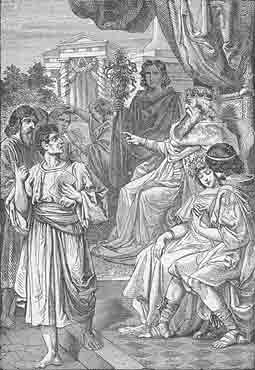
GOSPEL (Matt. XXII. 15-21.) At that time, The Pharisees went and consulted among themselves how to ensnare Jesus in his speech. And they send to him their disciples, with the Herodians, saying: Master, we know that thou art a true speaker, and teachest the way of God in truth, neither carest thou for any man, for thou dost not regard the person of men: tell us, therefore, what dost thou think? Is it lawful to give tribute to Caesar or not? But Jesus knowing their wickedness, said: Why do you tempt me, ye hypocrites? Show me the coin of the tribute. And they offered him a penny. And Jesus saith to them: Whose image and inscription is this? They say to him: Caesar’s. Then he saith to them: Render therefore to Caesar the things that are Caesar’s, and to God the things that are God’s.
Why did the Pharisees try to ensnare Jesus in His speech?
In order to find some reason to accuse Him before tho emperor, or to make Him hated by the Jews; for had He denied tribute to Caesar, they would have accused Him before the emperor as guilty of high treason; had He, on the contrary made it obligatory to pay tribute, then they would have denounced Him as a destroyer of the liberty of the people, who considered themselves a free nation owing allegiance only to God. Like the Pharisees are all those who, under the appearance of friendship, only cause vexation and misfortune to their neighbor.
Who are really hypocrites?
Those who in order to cheat their neighbor, appear outwardly pious and holy, whilst inward they are full of malice; those who have honey on the tongue, but gall in the heart, and sting like scorpions, when we least expect it. Because there are so many vices connected with hypocrisy, (Matt. XXIII.) therefore Christ has denounced no sin more emphatically than this one. Hypocrites are brethren of Cain, Joab, and Judas, of whom the first killed his brother, the second his cousin and the third betrayed his divine Master with a kiss. Such false men are cursed by God. (Mal, I. 14.) I hate a mouth with a double tongue. (Prov. VIII. 13.) “The devil silently possesses the hearts of hypocrites and quietly sleeps in them, whilst he gives them no peace,” says St. Gregory; and St. Jerome writes: “Pretended holiness is double malice.” Better is an open enemy, before whom we can be on our guard, than a hypocritical friend of whom we have no suspicion, because we look upon him as a friend. Beware, therefore, my dear Christian, of the vice of hypocrisy, which is so hateful to God; endeavor always to be sincere with God, thyself and thy neighbor, and to walk in-true humility before God, then mayst thou carry His image within thee.
PRAYER Help me, O Lord, for the number of the saints is decreasing and truth is becoming rare among men. They speak vain things each with his neighbor: their lips are deceitful, and they speak with double hearts. Let the Lord destroy all those who say: We will magnify our tongue; our lips are our own; who is Lord over us? O Lord, deliver my soul from wicked lips and deceitful tongues give me grace to preserve Thy image in my soul, by piety and virtue. Direct my heart to justice and keep it from avarice, that I may give to each his own.
INSTRUCTION ON THE FOLLY OF HUMAN RESPECT
Thou art a true speaker ‘ neither carest thou or any man, for thou dost not regard the person of men. (Matt. XXII. 16.)
In this Christians ought especially to follow the Saviour, and not permit themselves to be deterred from piety, and the practice of virtue by fear or human respect. What matters it, what people think and say of us, if we only please God? He alone can truly benefit or injure us; therefore he alone is to be feared, as Christ says: Fear ye not them that kill the body, and are not able to kill the soul: but rather fear him that can destroy both soul and body in hell. (Matt. X. 28.)
How foolishly, therefore, do those act who through fear of displeasing certain people, are afraid to serve God and practice piety; who even go so far as to commit sin; who in order to be pleasing to others, oppress innocent, poor and forsaken people; who adopt the latest and most scandalous fashions and customs; those who eat meat on days of abstinence, or give it to others; those who sing sinful songs, or what is still worse, do not hesitate to ridicule sacred things to give others occasion to laugh, or in order to be considered strong-minded. Implore God daily and sincerely, that He may take from you this vain fear of men and give you instead the fear of the Lord, which is the beginning of wisdom.
INSTRUCTION ON THE VALUE AND DIGNITY OF THE SOUL
Whose image is this? (Matt. XXII. 20.)
Thus we should often ask ourselves with respect to our soul, particularly when we are tempted to stain and rain it by sin, Whose image is this? We should then say to ourselves, “Is it not the likeness of God, a likeness painted with the blood of Jesus, an image for which the Saviour gave His life? Should I defile and deform this by sin and voluptuousness? God forbid!” For in truth, what among all created things, except the angels, is more beautiful and more precious than a -human soul, which is in the state of grace? “Could we,” says St. Catherine of Sienna, “behold with our corporal eyes a soul in the state of grace, we would see with astonishment that it surpasses in splendor all flowers) all stars, the whole world, and there is probably no one who would not wish to die for such beauty.” It is a dwelling of the Blessed Trinity! Christ did not give His life for all the goods and treasures of this earth, but for the human soul. And yet many estimate their soul at such little value that they sell it for a momentary pleasure, for a present not worth a penny! For shame! The body we estimate so highly that we take all pains to decorate it and keep it alive, and the soul the image and likeness of God, we take no pains to keep in the state of grace, and adorn with virtues! What folly!
INSTRUCTION ON THE OBLIGATION TO PAY TAXES OR TRIBUTE TO THE GOVERNMENT
Render to Caesar the things that are Caesar’s, and to God the things that are God’s. (Matt. XXII. 21.)
To pay tribute to the lawful government is a duty of justice which the Spirit of God Himself commands us faithfully to fulfil. (Rom. XIII. 6, 7.) Christ Himself paid the customary didrachma for Himself and St. Peter; (Matt. XVII. 23.) “and if the Son of God Himself paid duty and tax,” says St. Ambrose, “who art thou, O man, that thou wouldst free thyself from it?” The government must watch lest the life of its subjects be at hazard, that their property be not endangered or stolen, that there be security on the highways, that peace, harmony and order be preserved among the citizens, that their temporal welfare be promoted; that science and art flourish, etc. For this, teachers, judges, officers and soldiers are necessary, for whose support care must be taken, and whose trouble must be rewarded. Besides this the government must care for the security of the country, for public streets and bridges, and institutions necessary for the common good; to enable the government to perform these duties, taxes are necessary and lawfully assessed. If you oppose these laws, you oppose God, for by Him princes rule, and the mighty degree justice. (Prov. VIII. 16.) Let the payment of duties be done willingly, because you pay them for love of God, and resigned to His holy will as the early Christians did, who even served their heathenish government with pleasure, in all that was not contrary to God’s will, and cheerfully paid the duties.
October 19, 2024 No Comments
Twenty-first Sunday After Pentecost
Rev. Fr. Leonard Goffine’s
The Church’s Year
Twenty-First Sunday After Pentecost
At the Introit of the Mass is said a prayer of Mardochai, which may be used in all necessities:
INTROIT All things are in thy will, O Lord: and there is none that can resist thy will: for thou hast made all things, heaven and earth, and all things that are under the cope of heaven: thou art Lord of all. (Esth. xiii. 9, 10.) Blessed are the undefiled in the way: who walk in the law of the Lord. (Ps. cxviii.) Glory etc.
COLLECT Keep, we beseech Thee, O Lord, Thy family by Thy continued goodness: that, through Thy protection, it may be free from all adversities, and devoted in good works to the glory of Thy name. Thro’.
EPISTLE (Ephes. vi. 10-17.) Brethern, Be strengthened in the Lord, and in the might of his power. Put you on the armor of God, that you may be able to stand against the deceits of the devil: for our wrestling is not against flesh and blood, but against principalities and powers, against the rulers of the world of this darkness, against the spirits of wickedness in high places. Therefore take unto you the armor of God, that you may be able to resist in the evil day, and to stand in all things perfect. Stand, therefore, having your loins girt about with truth, and having on the breast-plate of justice, and your feet shod with the preparation of the gospel of peace: in all things taking the shield of faith, wherewith you may be able to extinguish all the fiery darts of the most wicked one: and take unto you the helmet of salvation, and the sword of the spirit, which is the word of God.
EXPLANATION The apostle teaches the Ephesians how hard and dangerous a struggle every Christian has to make, not against human enemies of flesh and blood, but against spiritual, invisible enemies, who were at one time powerful princes in heaven, but through sin became princes of the darkness of this world, who govern the adherents of the world, and exercise their evil influence in the air as well as on the earth, as far as God permits them, for our chastisement or trial.
He shows us also the manner in which we can gain the victory in the evil day, that is, the time of temptation, and particularly at the hour of death, when he admonishes us to have confidence in God and gives us the weapons for the contest. We should, therefore, gird ourselves with the girdle of truth, which shows us that honor, concupiscence and riches are vain and useless; we should put on the breast-plate of justice which is made of good works: the shoes, by regulating our lives according to the precepts of the gospel, which alone can give us true peace; the shield of faith, which teaches us how richly God rewards virtue and how terribly He punishes those who succumb to temptation and sin; the helmet of salvation, namely, confidence in God and the hope of heaven; the sword of the word of God, by making use, when violently tempted, of consoling and strengthening expressions of Holy Scripture, by which we can put the devil to flight, according to the example of Christ (Matt. iv.) and the saints. – Let us diligently use these weapons, and we shall be victorious in this spiritual combat, and be crowned with eternal glory in heaven.
GOSPEL (Hall. XVill. 23-35.) At that time, Jesus spoke to his disciples this parable: The kingdom of heaven is likened to a king, who would take an account of his servants. And when he had begun to take the account one was brought to him that owed him ten thousand talents. And as he had not wherewith to pay it, his lord commanded that he should be sold, and his wife and children, and all that he had, and payment to be made. But that servant falling down, besought him, saying: Have patience with me, and I will pay thee all. And the lord of that servant, being moved with pity, let him go, and forgave him the debt. But when that servant was gone out, he found one of his fellow-servants that owed him a hundred pence: and laying hold of him, he throttled him, saying: Pay what thou owest. And his fellow-servant falling down besought him, saying: Have patience with me, and I will pay thee all. And he would not; but went and cast him into prison till he paid the debt. Now his fellow-servants, seeing what was done, were very much grieved: and they came and told their lord all that was done. Then his lord called him, and said to him: Thou wicked servant, I forgave thee all the debt, because thou besoughtest me: shouldst not thou then have had compassion also on thy fellow servant, even as I had compassion on thee? And his lord being angry, delivered him to the torturers until he paid all the debt. So also shall my heavenly Father do to you, if you forgive not everyone his brother from your hearts.
Who are understood by the king, and the servants?
The King is God, and the servants are all mankind.
What is meant by the ten thousand talents?
The ten thousand talents, according to our money more than ten million dollars, signify mortal sin, the guilt of which is so great that no creature can pay it; even all the works of the saints cannot make atonement, because by every mortal sin the infinitely great, good, and holy God is offended, which offence it is as impossible for any creature to cancel as it is for a poor servant to pay a debt of ten million dollars. Nevertheless God is so merciful that He remits the whole immeasurable debt of sin, on account of the infinite merits of Christ, if the sinner contritely begs forgiveness and amends his life.
Why did the master order, not only the debtor, but also his wife and children to be sold?
Probably because they assisted in contracting the debt, or gave occasion for its increase. This is a warning to those who in any way make themselves partakers of others’ sins, either by counsel, command, consent, provocation, praise or flattery, concealment, partaking, silence and by defending ill-done things.
What is understood by the hundred pence?
By the hundred pence are understood the offences committed against us, and which, in comparison with our debt against God, are very insignificant.
What does Jesus intend to show by this parable?
That if God is so merciful and forgives us our immense debts, we should be merciful and willingly forgive our fellow-men the slight faults and offences, which they commit against us; he who does not this, will not receive pardon from God, in him will be verified the words of the apostle St. James: Judgment without mercy to him that hath not done mercy. (James ii. 13.)
Who are those who throttle their debtors?
These are, in general, the unmerciful, but particularly those who have no compassion for their debtors; those who immediately go to law and rest not until the debtor is left without house or home; those who oppress widows and orphans, if they owe them anything, thus committing one of the sins which cry to heaven for vengeance; (Ecclus. xxxv. 18. 19.) those who even in just lawsuits act harshly and severely with their opponent, without the slightest inclination to come to an agreement with him; finally, rulers and landlords who overburden their subjects with excessive tithes and taxes, and exact their share with the greatest rigor.
Who are those who accuse these hardened men before God?
They are the guardian angels and their own conscience; the merciless act itself cries to God for vengeance.
What is to forgive from the heart?
It is to banish from the heart all hatred, ill-will and revengeful desires, to treasure a true and sincere love towards our offenders and enemies not only in our hearts, but also manifest it externally by deeds of charity. Therefore those have not forgiven from their hearts, who, indeed, say and believe, that they have no ill-will against their enemy, but everywhere avoid him, refuse to salute him, to thank him, to pray for him, to speak to him, and to help him in necessity, even when they might do so, but who rather rejoice at his need.
INSTRUCTION ON THE VIRTUE OF PATIENCE
Nineth Sunday After PentecostHave patience with me. (Matt. xviii. z6.)
Since God has such great patience with us, ought not this to move us to have patience likewise with the faults and weaknesses of our fellow-men, and to resign ourselves patiently in all the sufferings and tribulations sent us from God? What will your impatience avail you? Will you thereby change or ease your sufferings? Do you thereby correct the faults of your neighbor? No; on the contrary, it makes suffering more oppressive, misfortune greater, and the erring neighbor more obstinate, so that he will ultimately refuse even mild and patient corrections. Besides impatience leads to many sins, to cursing, raillery, quarrelling, contention and murder. The pious Job gives us a good example of true patience and resignation to the will of God. He was a wealthy, respected, God-fearing man in the land of Hus, the father of seven sons and three daughters, and lived peacefully and happy. God wished to try him and permitted the devil to vent his entire rage upon him. Job was deprived of his children and all his property, and, finally, he was himself afflicted with the most painful disease of leprosy. But in the midst of all these dreadful misfortunes he remained calm. Naked, covered only with a few patches, he sits on a dunghill, a picture of misery, and yet no sound of murmuring comes from his lips, he does not curse, does not blaspheme God, but says resignedly: The Lord gave, and the Lord hath taken away: as it hath pleased the Lord, so is it done: blessed be the name of the Lord. To all this misery was added the baseness of his own wife, who came and mocked him, and of three intimate friends, who instead of consoling him, judged him falsely and said that his misery was a just punishment from heaven. Still Job did not murmur against God’s wise dispensations; with unshaken patience he faithfully confided in God, and he was not forsaken. God rewarded him well for his fidelity and patience; for He restored him to health, and gave him greater wealth than he had previously. See what patience can do, what reward is in store for it! And thou a Christian, a follower of Christ, the patient, crucified Lamb, art immediately irritated, become angry and morose at every little cross which you meet! Be ashamed of your weakness, and learn from the pious Job, to practice the virtue of patience, for patience proves hope, and hope permits us not to be put to shame. Patience always gains the victory, and will be rewarded in heaven.
If you find yourself inclined to impatience, make every morning a firm resolution to battle bravely against this vice and often ask God for the virtue of patience in the following prayer:
O God who by the patience of Thy only-begotten Son hast humbled the pride of the old enemy, vouchsafe that devoutly considering what He has suffered for us we may cheerfully bear our adversities, through the same Jesus Christ, our Lord, etc.
October 11, 2024 No Comments
Twentieth Sunday After Pentecost
Rev. Fr. Leonard Goffine’s
The Church’s Year (Angelus Press)
The Introit of the Mass is an humble prayer, by which we acknowledge that we are punished for our disobedience:
INTROIT All that thou hast done to us, O. Lord, thou hast done in true, judgment: because we have sinned against thee, and have not obeyed thy commandments: but give glory to thy name, and deal with us according to the multitude of thy mercy. (Dan. III. 28.) Blessed are the undefiled in the way: who walk in the law of the Lord. (Fs. CXVIII.). Glory etc.
COLLECT Grant, we beseech Thee, O Lord, in Thy mercy to Thy faithful pardon and peace; that they may both be cleansed from all their offences, and serve Thee with a quiet mind. Thro’.
EPISTLE (Ephes. V. 15-21.) Brethren, See how you walk circumspectly, not as unwise, but as wise redeeming the time, because the days are evil. Wherefore, become not unwise, but understanding what is the will of God. And be not drunk with wine, wherein is luxury: but be ye filled with the Holy Spirit, speaking to yourselves in psalms and hymns, and spiritual canticles, singing and making melody in your hearts to the Lord: giving thanks always for all things, in the name of our Lord Jesus Christ, to God and the Father; being subject one to another in the fear of Christ.
How may we redeem time?
By employing every moment to gain eternal goods, even should we lose temporal advantages thereby; by letting no opportunity pass without endeavoring to do good, to labor and, suffer for love of God, to improve our lives, and increase in, virtue.
Do you wish to know, says the pious Cornelius á Lapide, how precious time is: Ask the damned, for these know it from experience. Come, rich man, from the abyss of hell, tell us what you would give for one year, one day, one hour of time! I would, he says, give a whole world, all pleasures, all treasures, and bear all torments. O, if only one moment were granted me to have contrition for my sins, to obtain forgiveness of my crimes, I would purchase this moment with every labor, with any penance, with all punishments, torments and tortures which men ever suffered in purgatory or in hell, even if they lasted hundreds, yes, thousands or millions of years! O precious moment upon which all eternity depends! O, how many moments did you, my dear Christian, neglect, in which you could have served God, could have done good for love of Him, and gained eternal happiness by them, and you have lost these precious moments. Remember, with one moment of time, if you employ it well, you can purchase eternal happiness, but with all eternity you cannot purchase one moment of time!
ASPIRATION Most bountiful God and Lord! I am heartily sorry, that I have so carelessly employed the time which Thou bast given me for my salvation. In order to supply what I have neglected, as far as I am able, I offer to Thee all that I have done or suffered from the first use of my reason, as if I had really to do and suffer it still; and I offer it in union with all the works and sufferings of our Saviour, and beg fervently, that Thou wilt supply, through His infinite merits, my defects, and be pleased with all my actions and sufferings.
Be not drunk with wine, wherein is luxury!
[On the vice of drunkenness see the third Sunday after Pentecost. Here we will speak only of those who make others drunk by encouragement.] The Persian King Assuerus expressly forbade that any one should be urged to drink at his great banquet. (Esth. I. 8.) This heathen who knew from the light of reason, that it is immoral to lead others to intemperance, will one day rise in judgment against those Christians who, enlightened by the light of faith, would not recognize and avoid this vice. Therefore the Prophet Isaias (V. 22.) pronounces woe to those who are mighty in drinking and know how to intoxicate others; and St. Augustine admonishes us, by no means to consider those as friends, who by their fellowship in drinking would make us enemies of God.
GOSPEL (John IV. 46-53.) At that time, There was a certain ruler whose son was sick at Capharnaum. He having heard that Jesus was come from Judea into Galilee, went to him, and prayed him to come down, and heal his son; for he was at the point of death. Jesus therefore said to him: Unless you see signs and wonders, you believe not. The ruler with to him: Lord, come down before my son die. Jesus saith to him: Go thy way, thy son liveth. The man believed the word which Jesus said to him, and went his way. And as he was going down, his servants met him, and they brought word, saying that his son lived. He asked therefore of them the hour wherein he grew better. And they said to him: Yesterday at the seventh hour the fever left him. The father therefore, knew that it was at the same hour that Jesus said to him: Thy son liveth: and himself believed; and his whole house.
INSTRUCTIONS
I. God permitted the son of the ruler to become sick that he might ask Christ for the health of his son, and thus obtain true faith and eternal happiness. In like manner, God generally seeks to lead sinners to Himself, inasmuch as He brings manifold evils and misfortunes either upon the sinner himself or on his children, property, etc. Hence David said: It is good for me that thou hast humbled me, that I may learn thy justifications, (Ps. CXVIII. 71.) and therefore he also asked God to fill the faces of sinners with shame, that they should seek His name. (Ps. LXXXII. 17.) This happened to those of whom David says: Their infirmities were multiplied: afterwards they hastened in returning to God. (Ps. XV. 4.) O would we only do the same! When God sends us failure of crops, inundations, hail-storms, dearth, war, etc., He wishes nothing else than that we abandon sin and return to Him. But what do we? Instead of hastening to God, we take refuge in superstition, or we murmur against Him, find fault with or even blaspheme His sacred regulations; instead of removing our sins by sincere penance, we continually commit new ones, by murmuring and impatience, by hatred and enmity, by rash judgments, as if the injustice and malice of others were the cause of our misfortune. What will become of us if neither the benefits nor the punishments of God make us better?
II. Christ said to this ruler: Unless you see signs and wonders, you believe not. This was a reprimand for his imperfect faith; for if he had truly believed Christ to be the Son of God, he would not have asked Him to come to his house, but, like the centurion, would have believed Him able, though absent, to heal His son. (Matt. VIII.) Many Christians deserve the same rebuke from Christ, because they lose nearly all faith and confidence in God, when He does not immediately help them in their troubles, as they wish. He proves to us how displeasing such a want of confidence is to Him by withdrawing His assistance and protection from the fickle and distrustful. (Ecclus. II. 15.)
II. How much may not the example of the father of a family accomplish! This ruler had no sooner received the faith, than his whole household was converted and believed in Christ. Fathers and mothers by their good example, by their piety, frequent reception of the Sacraments, by their meekness, temperance, modesty and other virtues, may accomplish incalculable good among their children and domestics.
CONSOLATION IN SICKNESS
There was a certain ruler whose son was sick. (John IV. 16.)
As a consolation in sickness, you should consider that God sends you this affliction for the welfare of’ your soul, that you may know your sins; or if you be innocent, to practice patience, humility, charity, etc., and increase your merits. Therefore a holy father said to one of his companions, who complained, because he was sick: “My son! if you are gold, then you will be proved by sickness, but if you are mixed with dross, then you will be purified.” “Many are vicious in health,” says St. Augustine, “who would be virtuous in sickness;” and St. Bernard says: “It is better to arrive at salvation through sickness, than to have health and be damned.”
It is also a powerful means of consolation in sickness, to represent to ourselves the suffering Redeemer, who had no soundness from the top of His head to the sole of His foot, and contemplating whom St. Bonaventure used to cry out: “O Lord, I do not wish to live without sickness, since I see Thee wounded so much.”
When sick, we should carefully examine, whether we possess any ill-gotten goods, or have any other secret sin on our conscience; and if we are conscious of any, we should quickly free ourselves from it by a contrite, sincere confession, and by restoring the things belonging to others. Sins are very often the cause of disease, and God does not bless the medicine unless the sickness effects its object, that is, the sinners amendment. Still less can we expect help, but rather temporal and eternal misfortune, if we have recourse to superstition, and spells, as the King Ochozias experienced, who was punished with death, because in sickness he had recourse to the idol Beelzebub. (IV Kings I.)
PRAYER O Jesus, Thou true physician of souls, who dost wound and heal us, yea, dost even permit sorrows and adversities to visit us that our souls may have health, grant us the grace to use every bodily pain according to Thy merciful designs for the promotion of our salvation.
INSTRUCTION ON CARE OF THE SICK
Come down before my son die. (John IV. 49.)
All who have the charge of sick persons, should be like this father, that is, they should first of all endeavor to call upon Jesus to come in the most holy Sacrament, before the sick person is unable to receive Him. The devil seeks to hinder nothing more than this. He excites the imagination of the sick person, making him believe that he can live longer, that he will certainly get well again, in order to ruin him easier afterwards, because he defers his conversion. Those contribute to this end who through fear of frightening the sick person or of annoying him, fail to call the priest at the right time. This is cruel love, which deprives the sick person of the salvation of his soul and eternal happiness, and brings with it a terrible responsibility. Where there is question of eternity, no carefulness can be too great. We should, therefore, choose the safest side, because the suffering may easily increase and finally make the sick person unable to attend to the affairs of his soul. We should, therefore, not conceal from him the danger in which he is, and if he has still the use of his reason, should call in the priest that he may receive the Last Sacraments. He will not die sooner on that account, but rather derive the greatest benefit therefrom, since his conscience will be cleansed from sin, which may be the cause of his sickness, and perhaps, he may regain his health, or at least be strengthened by the newly received grace of God, to bear his pains with greater patience and to die far easier, securer, and more consoled. We should also endeavor to encourage the sick person to resignation, and a childlike confidence in God, should pray with him to strengthen him against desponding thoughts, and the temptations of the devil; we should present him a crucifix to kiss; repeat the holy names of Jesus, Mary and Joseph, and other consolatory ejaculations, such as are found in prayer-books; should sign him with the sign of the cross; sprinkle him with holy water, and above all pray for a happy death. We should not weep and lament, by which death is only made harder for him, nor should we hold useless, idle and worldly conversations with him which will prevent him from thinking of God instead of the salvation of his soul, and from preparing himself for the last dangerous struggle. Finally, we should by no means suffer in his presence persons who have given him occasions of committing sin, because they would be obstacles to his sincere conversion.
There is truly no greater work of charity than to assist our neighbor to a happy death.
October 4, 2024 No Comments
Nineteenth Sunday After Pentecost
Rev. Fr. Leonard Goffine’s
The Church’s Year
(Angelus Press)
| INTROIT I am the salvation of the people, saith the Lord: in whatever tribulation they shall cry to me, I will hear them: and I will be their Lord for ever. Attend, O my people, to my law: incline your ears to the words of my mouth. (Ps. LXXVII.) Glory etc.
COLLECT Almighty and merciful God, graciously keep us from all things that are hurtful; that we, being set free both in mind and body, may with ready minds accomplish whatever is Thine. Thro’. EPISTLE (Ephes. IV. 23-28.) Brethren, Be renewed in the spirit of your mind, and put on the new man, who according to God is created in justice and holiness of truth. Wherefore, putting, away lying, speak ye the truth every man with his neighbor, for we are members one of another. Be angry, and sin not. Let not the sun go clown upon your anger. Give not place to the devil. He that stole, let him now steal no more; but rather let him labor, working with his hands the thing which is good, that he may have something to give to him that suffereth need. EXPLANATION St. Paul admonishes the Ephesians to lay aside the- old man, like a worn out garment, and put on the new man, that is, to renew their internal and external life. This renewal according to his teaching takes place, when we by a true repentance put away our vices, shun all lies, anger, injustice, &c., and adorn our soul with virtues, and zealously seek after Christian justice and perfection. We have, perhaps, already sought to change our manner of living, for which a jubilee or some other particular solemnity of the Church gave us occasion, and at that time, perhaps, purified our soul by a general confession, making the firm resolution to live for God, and work out our salvation, we appeared converted, and to have become other men: but how long did this conversion last? Ah, how soon did we fall back into the old, sinful ways. And why? Because we lived in too great, deceitful security. We thought everything accomplished by the general confession; we were satisfied, and omitted to employ the means of remaining in the state of grace. We did not thank God for the grace of conversion; we did not ask Him for the grace of perseverance; we frequented evil company, and did not avoid dangerous occasions; we indulged in idleness and pleasures as before. How can it appear strange, if such a conversion is fruitless? Ah, we should remain in wholesome fear even after the remission of our sins. (Ecclus. V. 5.) Even if we could say that we have done everything, nevertheless we cannot be certain, whether we be worthy of hatred or love. (Ecclus. IX. 1.) We should, therefore, work out our salvation according to the advice of St. Paul (Philipp. II. 12.) in fear and trembling, and thus not fall into the old life of sin, losing the hope of a new conversion.
REMARK Thir parable agrees in many respects with that for the second Sunday after Pentecost, and has the same meaning. See, therefore, the explanation of that gospel, as also of the feast of SR Catherine, to which Maybe added the following: EXPLANATION In this parable the king is our Heavenly Father who has espoused His only-begotten Son to the Church, and on this occasion prepares the most sumptuous marriage-feast by giving the evangelical doctrine, the holy Sacraments, and the heavenly joys. The servants sent to invite the guests are the prophets, apostles and disciples of Christ. Those invited are the Jews who despised the honor and grace of the divine King, destined for them, abused and killed His servants, and were, therefore, cast aside and with their city Jerusalem, destroyed by the armies of their enemies, as a just punishment; in their stead the heathens and all those nations were called, who were on the broad road to destruction, and who now occupy the places of the unfortunate Jews at the marriage feast of the Church, and shall also occupy them in heaven. In the Jews to whom Christ addressed this parable, is verified that many of them, nay, all are called, but few chosen, because they would not heed the invitation. APPLICATION We have the honor not only to be invited to this marriage-feast, but are in reality guests at it, because we are members of the Church of Christ by faith. “But the Christian,” says St. Gregory, “who is a member of the Church by faith, but has not charity, is like to a man who comes to the marriage-feast without the wedding garment.” With this garment which is charity, Christ was vested, when He came to celebrate the nuptials with His spouse, the Church, and by the bond of charity the Son of God also unites Himself with His elect. He clearly lets us know that charity is the wedding garment which should vest us. Those, therefore, who believe and are in the communion of the Church, but who do not preserve the grace of charity, are indeed in the wedding-chamber, but they are not adorned with the wedding garment. They are dead members of the Church, and shall not be admitted without this garment into the celestial marriage-feast in the triumphant Church, but rather be cast like that unfortunate guest into exterior darkness. This guest was silent, when asked by the king, why he had not . the wedding garment. By this we see, that no one can excuse himself to God for not having charity, because everyone can have it, if he asks it from God, and, as St. Augustine says, our heart is the workshop of charity, and everyone who has a heart can practice it. PRAYER I thank Thee, O Jesus, that Thou didst call me to the marriage-feast in Thy Church; give me the wedding garment of charity that I may be present at the celestial marriage-feat, and not be cast into exterior darkness. INSTRUCTION CONCERNING HELL Cast him into the exterior darkness. (Matt, XXII. 13.) What is hell? Hell is that place where the damned must suffer eternal punishment. Is there a hell? Yes reason, holy Scripture and the Church teach us that there is a hell. Reason tells us that there is a just God who will punish sin. It is evident that all sins are not punished in this world; there must, therefore, be a place, where every mortal sin, not atoned for by sorrow and penance, will be punished, and this place is hell. All nations from the beginning of the world, even those who had not the light of revelation, believed this. But clearer still is the existence of hell shown by holy Scripture: The pious Job, (X. 22.) speaks of a region of misery and darkness, where the shadows of death and no order, but where eternal terror dwells. The Prophet Isaias (XXX. 33.) says that hell is deep and wide, and that the fire burning in it, is like a stream of sulphur, ignited by the breath of the Lord. Our Saviour expressly says that those who have done evil, shall go to everlasting torment, (Matt. XXV. 46.) that they shall be tortured by everlasting fire. (Matt. XXV. 41.) He makes mention of hell, and says that an inextinguishable fire burns there, and a worm which never dies, plagues the wicked. (Mark IX. 42. 43; Matt. X. 28.) All the Fathers of the Church teach and testify to the same doctrine. St. Augustine, among many others, says: “The infinite wisdom of God tells us that there is a hell, and the illimitable power of God it is that punishes the damned in a wonderful, but real manner.” Wherein do the pains of hell consist? Sacred Scripture and the Church teach concerning the pains, of the reprobate in hell, that the damned burn there in an inextinguishable fire. (Mark IX. 45.) The holy doctors of the Church say, that this fire is never extinguished, and its smoke ascends or rises from century to century, I see this fire,” says St. Gregory, “as if it were gifted with reason; it make a distinction between the guilty, and tortures the damned according to the nature of their sins.” This fire burns, but never consumes its victims; it communicates, as Cassiodorus says, immortality to the reprobate and lets them suffer pain, which preserves them, like salt which penetrates the flesh and keeps it from corruption, as Jesus says: Everyone shall be salted with fire. (Mark IX. q.8.) This fire does not shine, it leaves the reprobate in darkness, (Matt. VIII. 12.) and with this fire a never dying worm continually torments the damned. This worm is not only a bad conscience, say the holy Fathers, but particularly the privation of the Beatific Vision. Eternally will the thought torment the damned: I have lost God, the only true and highest Good, I have lost Him through my fault, I have lost Him for a brief pleasure, I have lost Him forever. In hell eternity devours all time; and if after millions and millions of years a damned soul wailingly asks his companion in misery: What time is it? he receives the answer: Eternity. Who would not fear hell, and avoid sin which incurs eternal punishment, when he reflects upon this! Arid yet there are many, upon whom the truth of the existence of a hell makes no impression, who even deny that there is such a place, and who say: God is love, He can have no pleasure in the torments of His creatures, He cannot eternally punish a sin which was committed in so short a time as is the life of man.” But those who speak thus, forget that God is just, that His love and mercy are indeed always ready to forgive the contrite and penitent, but that His justice must also be satisfied, when the sinner continually rejects the merciful love of God; they forget, that every grievous sin which man commits voluntarily and knowingly is an infinite, eternal insult, offered to God, which can only be atoned for by an eternal punishment. For the perverted and malicious will of a man, who dies in mortal sin, remains perverted and malicious forever, therefore he must also be punished eternally. O my dear Christian, do not listen to such deceivers; for just on account of their sinful life, they fear hell and therefore they endeavor to free themselves from this fear by denying the existence of hell; but they cannot succeed; for Jesus, the Truth, has told us that there is a hell, and His word remains for all eternity. Endeavor rather by a pious life to escape hell, descend there in spirit frequently according to the advice of a saint, contemplate the torments of the damned, and let this reflection urge you to imitate Christ, who has promised the joys of heaven to all His faithful followers. CONSOLING DOCTRINE ON THE JOYS OF HEAVEN The kingdom of heaven is likened to a king, who made a marriage for his son. (Matt. XXII. 2.) Heaven is compared by Christ to a marriage-feast because we will there enjoy all imaginable pleasures in the most perfect union with God. In what these joys consist, fit. Paul could not describe, although he was wrapt into the third heaven and tasted these pleasures; he only said: Eye hath not seen, nor ear heard, neither hath it entered into the heart of man, what things God hath prepared for them that love him. (I Cor. II. 9.) Holy Writ, indeed, gives us many descriptions of the celestial joys, by comparing heaven to a paradise of bliss, sometimes to a precious pearl, or a treasure which neither rust nor moth consumes, nor thieves steal; again it represents heaven under the picture of a kingdom, a throne, a crown, whereby we are raised to the highest honor; at another time to the picture of a city which is built of gold, precious stones and pearls, lighted by the splendor of God, filled with magnificence and glory, and where the inhabitants enjoy undisturbed peace and security. These are only images or similitudes, which are taken from the most beautiful, most precious, and magnificent things of the earth, to teach us that heaven is as beautiful and pleasant a place, as we can wish and represent to ourselves, and that all possible beauty, agreeableness and joy may be found there in the highest and most perfect manner, free from evil, anxiety, disgust and fear of losing them.. In heaven we will possess God Himself, the source of all joy and bliss, and will enjoy His own happiness for all eternity. More is riot needed to give us the highest conception of heaven. Who would not willingly despise the vain, short and imperfect pleasures of this earth, whilst contemplating this indescribable bliss? Who would not willingly bear all the misfortunes. and misery of this world, when considering that the more miserable we have been in this life the happier will we be hereafter. What would it avail us to have enjoyed all the pleasures of this world, if deprived of the pleasures of heaven, in, eternity! ASPIRATION How lovely are Thy tabernacles, O Lord, of hosts! my soul longeth and fainteth for the courts of the Lord. My heart and my flesh have rejoiced in the living God. (Ps. LXXXIII. 2-3.) How do I loathe the world, when I contemplate heaven. (St. Ignatius Loyola.) |
September 27, 2024 No Comments
“Ten Years That Shook the Church”: Archbishop Dwyer’s 1973 Critique of the Reform and the Post-Council Peter Kwasniewski
 |
| Dwyer as a boy and as a bishop |
Once again, it is nearly impossible to imagine a bishop writing this openly and bluntly in a Catholic newspaper today. To my mind, this suggests that the much-vaunted parrhesia is quite lacking, probably because knowledge of the traditional liturgy, of the Council, and of the details of the reform is quite lacking among those who did not personally experience all of it as Dwyer had done.


Archbishop Robert Dwyer
Twin Circle
October 26, 1973
What happens when an institution, be it a religious body or a nation state or what you will, deliberately cuts itself off from its historical and cultural roots? Rarely according to the record have such institutions been able to survive, the shock being too great, the trauma too devastating.
They may seek in desperation to renew those roots, by some legerdemain to recover them, or to substitute some seeming equivalent, but unless any such an institution has some sort of divine guarantee, the chances of its success are, as the airline stewardesses never fail to assure us in soothing tones, exceedingly remote.
Toward the end of the Second Session of the Vatican Council, late in November 1963, the Constitution on the Sacred Liturgy was triumphantly voted in by an overwhelming majority of the assembled Fathers. As we trooped out of St. Peter’s basilica that day, spreading our amaranthine stain over the great parvis, a palpable euphoria thrilled through the entire body. Something at last had been accomplished, one item of the business which had called us to Rome had been nailed down.
The members of the Commission which had hammered out the Constitution and guided it through the grueling tests of debate and modification, were obviously elated, and the most prominent American member, the late Archbishop Paul Hallinan of Atlanta, was the glowing recipient of hearty and even gleeful congratulations.
It was all in good fun and no one, least of all perhaps the drafters and proponents of the Constitution in question had the slightest notion, not to say intent, of tampering with the cultural life-lines of the Roman Catholic Church.
Nor was there, on candid reading, anything in the text or in the spirit of the document which would suggest the least deviation from the historic past of the liturgy, its sacred traditions, its venerable usages.
There was, of course, a loosening of certain restrictions. The vernacular was to share with the Latin the role of liturgical communication, not by any means to replace it. Greater simplicity in ritual was to be introduced.
Though the term had not yet swung so prominently into orbit as it was to do a year or so later, the liturgy was to be made more “relevant” to contemporary man, with his increasingly secular preoccupations.
Who dreamed on that day that within a few years, far less than a decade, the Latin past of the Church would be all but expunged, that it would be reduced to a memory fading in the middle distance? The thought would have horrified us, but it seemed so far beyond the realm of the possible as to be ridiculous.
So we laughed it off.
As a personal footnote, we had been visited by some misgivings in regard to the vernacular, by way of certain apprehensions that it could lead to invidious comparisons between those prelates and priests who read well and have all the arts of elocution, who have the gift of acting their part with dignity and conviction, the Suenenses and the Sheens, and those not so happily endowed, all the way down to the poor fellows who can only mumble as unintelligible in English or Swahili as in the ancient language of the Church.
With the difference that nobody expected to understand them in Latin, whereas the whole point of the vernacular was to make the liturgy, once again, relevant. But having voiced this unworthy fear, and told to go to the corner and hide our head for very shame for entertaining such an antidemocratic notion, we lapsed into chastened silence.
And when the vote came round, like wise Sir Joseph Porter, KCB, “We always voted at our party’s call; W never thought of thinking for ourself at all.” That way you can save yourself a world of trouble.
Well, here we are 10 years later, and what results do we see? The result, plainly and bluntly, is that the Western Church has just about completely cut herself off from her cultural roots, the Latin tradition of the West.
Latin is practically banned from the liturgy and banned as well from the courses of study required of candidates for the priesthood.
Fewer and fewer Masses in Latin are sanctioned or approved by local ordinaries, and fewer and fewer seminarians and young priests have now more than a nodding acquaintance with the language which nourished the devotion of countless generations of Christians and gave to theology and the other sacred sciences a common tongue, so that, even though imperfectly, communication was possible.
The Church which so long had preserved Latin consciously as a bond of unity, had quite suddenly decided to discard it as a useless encumbrance.
With this rejection, and as an almost inevitable consequence, went out the window also the whole magnificent musical heritage of the Church. For when you change your language you also change your song.
The Jewish exiles hanging their harps beside the waters of Babylon, so long ago, made that discovery.
Pope Paul VI, the other day, made an earnest plea for the revival of some parts of the Mass in Latin, the Kyrie, the Gloria, etc., with the obvious hope of salvaging something of our immense musical treasure, one of the glories of the Christian accomplishment; but whether his words will carry weight, whether his “cri de coeur” will be heard, is anyone’s guess.
Not, surely, until realization dawns on many minds how drastically we have robbed ourselves of our cultural wealth.
Less immediately cognate to the Latin past, yet in strict relationship, is the whole violent artistic rejection of the past. It is not a question of contemporary art being good or bad; it is a matter of its repudiating, often with contempt, those principles and traditions which gave art, visual or tactual, substance and meaning.
The creation of an anti-art, the sole pitiable boast of the contemporary schools, is mighty thin provender for souls hungering and thirsting for something greater than themselves, something of beauty and nobility. But we go along with the crowd, because we too have lost our way.
And the same rejection, not merely of our cultural and esthetic roots, but of our philosophical and theological foundations, is the reaction and reality of the moment. Who would be caught dead today citing a theologian older than Karl Rahner or a philosopher more antique than Bernard Lonergan?
The substitution of Teilhardism for Thomism, if not complete in our schools, our seminaries and universities, is within an ace of carrying the day. But only too insistently is it borne in on us that we are a cracked record, flawed by a fixation.
Is anything of this important? Does it matter that the Church has been led down the path of rejection, slowly at first and by imperceptible stages, then ever more rapidly and finally at breakneck speed?
Does it matter that we as Catholics have succeeded in cutting ourselves off from those cultural sources which nourished our fathers and gave support and assurance to their faith? Is it inevitable that in this last third of the 20th century the Catholic mind should seek a new milieu, new associations, new roots?
Doubtless Dr. Leslie Dewart [1] and his disciples would return a resounding yes to this.
But before we commit ourselves farther, and if there is still time for reflection, might we not do well to catch the echo of a great and now almost forgotten Father of the Council, the late Cardinal Michael Browne, who, at a decisive moment in the debate on the Constitution on the Church, raised his voice in warning with all the richness of the Irish brogue in Latin: Caveamus, Patres, caveamus! Let us take heed, Fathers, let us beware!
We thought it amusing then; we might take it a little more seriously now.
 |
| Illustration in the original newspaper article |
September 24, 2024 No Comments
Eighteenth Sunday After Pentecost

by Rev. Leonard Goffine
At the Introit of the Mass the Church prays for the peace which God has promised by His prophets:
INTROIT Give peace, O Lord, to them that patiently wait for thee, that thy prophets may be found faithful: hear the prayers of thy servant, and of thy people Israel. (Ecclus. XXXVI. 18.) I rejoiced at the things that were said to me: we shall go into the house of the Lord. (Ps. CXXI. 1.) Glory etc.
COLLECT O Lord, inasmuch as without Thee we are not able to please Thee, let Thy merciful pity rule and direct our hearts, we beseech Thee. Thro’.
EPISTLE (I Cor. I. 4-8.) Brethren, I give thanks to my God always for you, for the grace of God that is given you in Christ Jesus, that in all things you are made rich in him, in all utterance and in all knowledge: as the testimony of Christ was confirmed in you, so that nothing is wanting to you in any grace, waiting for the manifestation of our Lord Jesus Christ who also will confirm you into the end without crime, in the day of the coming of our Lord Jesus Christ.
EXPLANATION St. Paul shows in this epistle that he possesses true love for his neighbor, because he rejoices and thanks God that he enriched the Corinthians with different graces and gifts, thus confirming the testimony of Christ in them, so that they could without fear expect His arrival for judgment. – Do thou also rejoice, with St. Paul, for the graces given to thy neighbor, for this is a mark of true charity.
GOSPEL (Matt. IX. 1-8.) At that time, Jesus entering into a boat, passed over the water, and came into his own city. And behold, they brought to him one sick of the palsy lying in a bed. And Jesus seeing their faith, said to the man sick of the palsy: Be of good heart, son; thy sins are forgiven thee. And behold, some of the Scribes said within themselves: He blasphemeth. And Jesus seeing their thoughts, said: Why do you think evil in your hearts? whether it is easier to say, Thy sins are forgiven thee; or to say, Arise, and walk? But that you may know that the Son of man hath power on earth to forgive sins (then said he to the man sick of the palsy): Arise, take up thy bed, and go into thy house. And he arose, and went into his house. And the multitude seeing it feared, and glorified God who had given such power to men.
EXPLANATIONS
- Those who brought this sick man to Christ, give us a touching example of how we should take care of the sick and help them according to our ability. Christ was so well pleased with their faith and charity, that He cured the man sick of the palsy, and forgave him his sins. Hence we learn how we might assist many who are diseased in their soul, if we would lead them to God by confiding prayer, by urgent admonitions, or by good example.
- Christ did not heal the man sick of the palsy until He had forgiven him his sins, by this He wished to teach us, that sins are often the cause of sicknesses and other evils, by which we are visited, and which God would remove from us if we were truly repentant. This doctrine Jesus confirmed, when He said to the man, who had been sick for thirty-eight years: Sin no more, lest some worse thing happen to thee. (John V. 14.) Would that this were considered by those who so often impetuously demand of God to be freed from their evils, but do not intend to free themselves from their sins, which are the cause of these evils, by a sincere repentance.
III. “He blasphemeth.” Thus thought the Jews, in their perverted hearts, of Christ, because they believed that He in remitting the sins of the sick man, usurped the rights of God and thus did Him a great injury; for it is blasphemy to think, say, or do any thing insulting to God or His saints. But these Jews did not consider that they by their rash judgment calumniated God, since they blasphemed Christ who by healing the sick man, and by numerous other works had clearly proved His God-head. If Christ so severely reprimanded the Jews, who would not recognize Him as God, for a blasphemous thought against Him, what will He do with those Christians who, though they wish to be adorers of God and His Son, nevertheless, utter blasphemies, curses, and profanations of the holy Sacraments?
- When Jesus saw their thoughts, He said: Why do you think evil in your hearts? This may be taken to heart by those who think that thoughts are free from scrutiny, and who never think to confess their evil and shameful thoughts. God; the most Holy and most just, will, nevertheless, not leave a voluntary unchaste, proud, angry, revengeful, envious thought unpunished, any more than an idle word. (Matt, XII. 36.) The best remedy against evil thoughts would be the recollection that God who searches the heart sees them, and will punish them.
PRAYER How great, O Jesus! is Thy love and mercy towards poor sinners, since Thou not only forgavest the sins of the man sick of palsy, but calling him son, didst console and heal him! This Thy love encourages me to beg of Thee the grace, that we may rise from our bed of sins by true penance, amend our life, and through the ways of Thy commandments enter the house of eternal happiness.
INSTRUCTION ON INDULGENCES
Be of good heart, son, thy sins are forgiven thee. (Matt. IX. 2.)
The same that Christ says to the man sick of the palsy, the priest says to every contrite sinner in the confessional, and thus remits the crime or the guilt of his sins, and the eternal punishment, by virtue of the authority given him by God. But since sins not only bring with them guilt and eternal punishment, but also temporal1 and indeed spiritual or supernatural punishment, such as, painful conditions of the soul, as well in this world as in purgatory, and natural ones, as: poverty, disease, all sorts of adversities and accidents, we should endeavor to liberate ourselves from them by means of indulgences.
What is an indulgence?
It is a total or partial remission of the temporal punishment which man would have to suffer either in this or the next life, after the sins have been remitted.
How do we know that after the remission of the sins there still remains temporal punishment?
From holy Scripture; for our first parents after the forgiveness of their sin, were still afflicted with temporal punishment. (Gen. III.) God likewise forgave the sins of the children of Israel, who murmured so often against Him in the desert, but not their punishment, for He excluded them from the Promised Land, and caused them to die in the desert. (Num. XIV.) Moses and Aaron experienced the same, on account of a slight want of confidence in God. (Num. XX. 12., Deut. XXXII. 51. 52.) David, indeed, received pardon from God through the Prophet Nathan for adultery and murder, (II Kings XII.) still he had to endure heavy temporal punishment. Finally, faith teaches us, that we are tortured in purgatory for our sins, until we have paid the last farthing. (Matt. V. 26.)
Did the Church always agree with this doctrine of Scripture?
Yes; for she always taught, that by the Sacrament of Penance the guilt and eternal punishment, due to sin, are indeed forgiven for the sake of the infinite merits of Jesus, but that temporal punishment still remains, for which the sinner must do penance. Even in the earliest ages she imposed great penances upon sinners for their sins which were already forgiven. For instance, murder or adultery was punished by a penance of twenty years; perjury, eleven; fornication, denial of faith or fortune-telling, by seven years of severe penance with fasting, etc. During this time it was not allowed to travel, except on foot, to be present at the holy Sacrifice of the Mass, or to receive the holy Eucharist. If the penitents showed a great zeal for penance and sincere amendment, or if distinguished members of the Church, particularly martyrs, interceded for them, the bishops granted them an indulgence, that is, they remitted the remaining punishment either totally or partially. In our days, on account of the weakness of the faithful, the Church is lenient. Besides the ecclesiastical, the spiritual punishments which would have to be suffered either here or in purgatory for the taking away of sins, are shortened and mitigated by indulgences through he treasure of the communion of saints.
Has the Church the power to remit temporal punishments, or to grant indulgences?
The Council of Trent expressly states, that the Church has power to grant indulgences, (Sess. 25.) and this statement it supports by the words of Christ. For as Christ protests: Amen, I say to you, whatsoever you shall bind upon earth, shall be bound also in heaven; so He also promised, that whatever the Church looses upon earth, is ratified and loosed in heaven. Whatsoever you shall loose upon earth, shall be loosed also in heaven. (Matt. XVIII. 18.) Even an apostle granted an indulgence. In the person and by the power of Christ, that his spirit might be saved in the day of our Lord Jesus Christ, (II Cor. II. 10.; I Cor. V. 4. 5.) St. Paul forgave the incestuous Corinthian, upon whom he had imposed a heavy punishment.
What is meant by saying, indulgences are granted out of the treasury of the saints or of the Church?
By this is meant that God, by the Church, remits the temporal punishment due to sin for the sake of the merits of Christ and the saints, and supplies, as it were, by these merits what is still wanting in our satisfaction.
What kinds of indulgences are there?
Two; plenary and partial indulgences. A plenary indulgence, if rightly gained, remits all ecclesiastical and temporal punishment, which we would otherwise have to expiate by penance. A partial indulgence, however, remits only so many days or years of the temporal punishment, as, according to the penitential code of the primitive ages of the Church; the sinner would have been obliged to spend in severe penance. Hence the name forty day’s indulgence, etc.
What is a Jubilee?
It is a plenary indulgence, which the pope grants to the faithful of the entire world, whereby all the temporal punishments of sin, even in cases reserved to the pope or the bishops, are remitted, and forgiven in the name of God, if the sinner confesses contritely and receives the holy Eucharist and has a firm purpose of doing penance.
What is required to gain an indulgence?
First, that we should be in the state of grace, and have already obtained, by true repentance, forgiveness of those sins, the temporal punishment of which is to be remitted by the indulgence; and secondly, that we should exactly perform the good works prescribed for the gaining of the indulgence.
Do indulgences free us from performing works of penance?
By no means: for there are few in the proper state to receive a plenary indulgence in its fulness, since not only purity of soul is necessary but also the inclination to sin must be rooted out, it therefore cannot be the intention of the Church to free us from all works of penance by granting us indulgences. She cannot act contrary to the word of Jesus: Unless you do penance, you shall all likewise perish. Luke XIII. 3.) She rather wishes to assist our weakness, to supply our inability to do the required penance, and to contribute what is wanting in our penance, by applying the satisfaction of Christ and the saints to us by indulgences. If we, therefore, do not wish to do penance for our own sins, we shall have no part in the merits of others by indulgences.
Can indulgences be gained for the souls of the faithful departed?
Yes, by way of suffrage, so far as we comply with the required conditions, and thus beg of God, for the merits of His Son and the saints, to release the souls in purgatory. Whether God receive this petition or not, remains with Him, He will act only according to the condition of the deceased. We must, therefore, not depend upon the indulgences and good works which may be performed for us after death, but rather endeavor, during our life-time, to secure our salvation by leading a pious life; by our own good works and by the gaining of indulgences.
What follows from the doctrine of the Church concerning indulgences?
That an indulgence is no grant or license to commit sin, as the enemies of the Church falsely assert; that an indulgence grants no forgiveness of sins past or future, much less is permission given to commit sin; that no Catholic can believe that by gaming indulgences he is released from penance, or other good works, free from the fight with his evil inclinations, passions and habits, from compensating for injuries, repairing scandals, from retrieving neglected good, and glorifying God by works and sufferings; but that indulgences give nothing else than partial or total remission of temporal punishment; that they remind us of our weakness and lukewarmness which is great when compared with the zeal and fervor of the early Christians; that they impel us to satisfy the justice of God according to our ability. Finally, they remind us to thank God continually that He gave the Church a means in the inexhaustible treasure of the merits of Christ and His saints, to help our weakness and to supply what is wanting in our penance.
September 21, 2024 No Comments
Seventeenth Sunday After Pentecost
Rev. Fr. Leonard Goffine’s
The Church’s Year, Available from Angelus Press
At the Introit of the Mass the justice and mercy of God are praised:
INTROIT Thou art just, O Lord, and thy judgment is right; deal with thy servant according to thy mercy. Blessed are the undefiled in the way; who walk in the law of the Lord. (Ps. CXVIII.) Glory etc.
COLLECT Grant to Thy people, we beseech Thee, O Lord, to avoid the defilements of the devil, and with a pure mind to follow Thee, the only God. Thro’.
EPISTLE (Ephes. IV. 1- 6.) Brethren, I, a prisoner in the Lord, beseech you that you walk worthy of the vocation in which you are called. With all humility and mildness, with patience, supporting one another in charity, careful to keep the unity of the spirit in the bond of peace. One body and one spirit, as you are called in one hope of your calling. One Lord, one faith, one baptism. One God, and Father of all, who is above all, and through all, and in us all. Who is blessed for ever and ever. Amen.
ADMONITION Implore God continually for grace to accomplish and make certain your vocation by practicing these virtues, recommended by St. Paul.
INSTRUCTION ON THE ONE ONLY SAVING FAITH
One Lord, one faith, one baptism, one God and Father of all. (Ephes. IV. 5. 6.)
These words of the great Apostle of the Gentiles show clearly, that it is not a matter of indifference, what faith or religion we profess. Yet in our times so poor in faith, we often hear the assertion from so-called enlightened men: “It is all the same to what religion we belong, we can be saved in any, if we only believe in God and live uprightly.” This assertion is impious! Consider, ..my dear Christian, there is but one God, and this one God has sent only one Redeemer; and this one Redeemer has preached but one doctrine, and has established but one Church. Had God wished that there should be more than one Church, then Christ would have founded them, nay, He would not have preached a new doctrine, established a new, Christian Church; for the Jews also believed in one God. But Jesus cast aside Paganism and Judaism, promulgated a new religion, and founded a new Church. Nowhere does He speak of Churches, but always of one Church. He says that we must hear this Church, and does not add, that if we will not hear this Church, we may hear some other. He speaks of only one shepherd, one flock, and one fold, into which all men are to be brought. In the same manner He speaks always of one kingdom upon earth, just as there is only one kingdom in heaven; of only one master of the house and one family, of one field and one vineyard, whereby He referred to His Church; of one rock, upon which He would build His Church. On the day before His death, He prayed fervently to His Heavenly Father, that all who believe in Him, might be and remain one, as He and the Father are one, and He gave His disciples the express command to preach His gospel to all nations, and to teach them all things, whatsoever He had commanded them. This command the apostles carried out exactly. Everywhere they preached one and the same doctrine, establishing in all places Christian communities, which were all united by the bond of the same faith. Their principal care was to prevent schisms in faith, they warned the faithful against heresy, commanded all originators of such to be avoided, and anathematized those who preached a gospel different from theirs. As the apostles, so did their successors. All the holy Fathers speak with burning love of the necessary unity of faith, and deny those all claim to salvation who remain knowingly in schism and separation from the true Church of Christ.
Learn hence, dear Christian, that there can be but one true Church; if there is but one true Church, it naturally follows that in her alone salvation can be obtained, and the assertion that we can be saved by professing any creed, is false and impious. Jesus who is the Way, the Truth, and the Life , speaks of but one Church , which we must hear, if we wish to be saved. He who does not hear the Church, He says, should be considered as a heathen and publican. He speaks furthermore of one fold, and He promises eternal life only to those sheep who belong to this fold, obey the voice of the shepherd and feed in His pasture. The apostles were also convinced that only the one, true Church could guide us to salvation. Without faith it is impossible to please God, writes St. Paul to the Hebrews, (XI. 6.) and this faith is only one, he teaches the Ephesians. (IV. 5.) If the apostles had believed that we could be saved in any religion, they would certainly not have contended so strenuously for unity, they would not have declared so solemnly, that we should not belong to any other than to Christ alone, and that we must receive and obey His doctrine. As the apostles taught so did their successors and all the Fathers agree that there is no salvation outside of the true Church. St. Cyprian writes: “If any one outside Noah’s ark could find safety, then also will one outside the Church find salvation.” (De unit. eccl. c. 7.) From all this it follows, that there is only one true Church which insures salvation, out of which no one can be saved.
But which is this Church? The Roman Catholic, Apostolic Church, for she alone was founded, by Christ, she alone was watered with the blood of the apostles and of thousands of holy martyrs, she alone has the marks of the true Church of Christ, [see the Instruction for the first Sunday after Easter] against which He has promised that the powers of hell shall not prevail. Those who fell away from the Church three hundred years ago do, indeed contend that the Church fell into error and no longer possessed the true, pure gospel of Jesus. Were they right, Jesus might be blamed, for He established this Church, promising to remain with her and guide her through the Holy Ghost until the end of the world. He would, therefore, have broken His word, or He was not powerful enough to keep it. But who dare say this? On the contrary, she has existed for eighteen hundred years, whilst the greatest and most powerful kingdoms have been overthrown, and the firmest thrones crumbled away. If she were not the only true and saving Church, founded by Christ, how could she have existed so long, since Jesus Himself said: Every plant which my heavenly Father hath not planted, shall be rooted up. (Matt. XV. 13.) If she were not the Church of Christ, she would have been destroyed long ago, but she still stands today, whilst her enemies’ who battled against her have disappeared, and will continue to disappear; for the gates of hell shall not prevail against her, says our Lord. He has kept His promise and will keep it, notwithstanding all the oppositions and calumnies of her implacable enemies.
You see, therefore, my dear Christian, that the Catholic Church is the only true, the only saving Church; be not deceived by those who are neither cold nor warm, and who say: “We can be saved in any religion, if we only believe in God and live uprightly,” and who wish to rob you of your holy faith, and precipitate you into the sea of doubt, error, and falsehood. Outside of the Catholic Church there is no salvation; hold this firmly, for it is the teaching of Jesus, His apostles, and all the Fathers; for this doctrine the apostles and a countless host .of ‘the faithful have shed their blood. Obey the teaching of this Church, follow her laws, make use of her help and assistance, and often raise your hands and heart to heaven to thank God for the priceless grace of belonging to this one, true Church; forget not to pray for your erring brethren, who are still outside of the Church that the Lord may lead them into her, that His promise may be fulfilled: There will be one fold, and one shepherd.
GOSPEL (Matt XXII. 35-46.) At that time, The Pharisees came to Jesus, and one of them, a doctor of the law, asked him, tempting him: Master, which is the great commandment of the law? Jesus said to him: Thou shaft love the Lord thy God with thy whole heart, and with thy whole soul, and with thy whole mind.
This is the greatest and the first commandment. And the second is like to this: Thou shalt love thy neighbor as thyself. On these two commandments dependeth the whole law and the prophets. And the Pharisees being gathered together, Jesus asked them, saying: What think you of Christ; whose son is he? They say to him: David’s. He saith to them: How then doth David in spirit call him Lord; saying: The Lord said to my Lord, Sit on my right hand, until I make thy enemies thy footstool? If David then call him Lord, how is he his son? And no man was able to answer him a word: neither durst any man from that day forth ask him any more questions.
What is meant by loving God?
It means to find one’s pleasure, happiness and joy in God, because He is he highest and most perfect Good; to rejoice in His infinite majesty and glory; to direct one’s thoughts, words, and actions towards Him as our only end: to do His will in all things, an be prepared always rather to lose everything, even life itself, than His friendship.
What is meant by loving God with our whole heart, our whole soul, etc. ?
These different expressions all properly mean the same thing, namely, that we should cling to God with a true, sincere and heartfelt love, but by our heart our will may be understood, that power by which we wish God all glory, and desire nothing more than that He be known, loved, and honored by all men. The soul signifies the intellect by means of which we should endeavor to arrive at the knowledge and love of God, praise and glorify Him above all things. The mind may signify our memory, with Which we continually remember God and the innumerable benefits bestowed on us by Him, praise Him for them, thank Him, and always walk irreproachably before Him. Finally, we love God with all our strength, if we employ all the powers and faculties of our body in His service, and direct all our actions to Him as to our last end.
Is it true love, if we love God only because He is good to us?
This is grateful love, which is good and praiseworthy, but it is not perfect love, because the motive is self-love and self-interest.
What, therefore, is perfect love?
When we love God only because He is in Himself the highest Good, and most worthy of all love. In this manner we should endeavor to love Him; not through self-interest not through hope of reward, not through fear of punishment, but only because He, as the greatest Good, contains all goodness and, therefore, deserves to be loved only on account of Himself. Such love had St. Francis Xavier, which he very beautifully expressed in the following canticle, composed by himself:
O God, I give my love to Thee,
Not for the heaven Thou’st made for me,
Nor yet because who love not Thee
Will burn in hell eternally.
In dying throes on Calvary,
My Jesus, Thou didst think of me,
Didst bear the lance, the nails, the tree,
Rude scoffs, contempt and infamy,
And pangs untold, all lovingly, –
The scourge, the sweat the agony,
And death itself, -all, all for me,
A sinner and Thy enemy.
Why therefore, should not I love Thee,
O Jesus, dead for love of me?
Not that I may in heaven be,
Not that from hell I may be free;
Not urged by dread of endless pain,
Not lured by prize of endless gain,
But as Thou, Lord, didst first love me,
So do I love and will love Thee.
To Thee, my King, I give my heart,
For this alone t hat God Thou art.
Can fear exist with love?
Servile fear cannot, but filial fear may. Servile fear is rather a fear of punishment than a fear of offending God. Where such fear exists, love cannot dwell; for in love, writes St. Augustine, (in Joann. Tr. 9.) there is no fear, for perfect love casteth out fear. ( I John IV. 18.) Filial fear, on the contrary, is the fear of offending God. This fear leads to love and is also an effect of love; it is the beginning of wisdom. (Eccles. I. 16.) Let us cherish this fear, for it will drive away sin, as sentinels expel thieves; (Ecclus. I 16.) it will replenish us with joy, and gladness, and obtain for us in our last moments divine blessings and a holy death. (Ecclus.. I. 27.)
How may we obtain a perfect love of God?
By meditating on His infinite, divine perfections, such as His almighty power, His wisdom, His splendor, His beauty, etc.; by contemplating His boundless love for us, in the incarnation, sufferings, and death of His only-begotten Son; by frequently practicing this virtue; by fervent prayer; and by making acts of love, such as are found in good prayer-books.
When should we practice the virtue of love of Gods?
As soon as we have arrived at the age of reason; when the world, the devil and the flesh, endeavor to withdraw us from God, by their apparent goods and pleasures; when we have separated ourselves from God by mortal sin; when we receive the holy Sacraments, particularly holy Communion; when we receive a particular grace from God; when we use food and drink and other lawful enjoyments; when we contemplate God’s creatures; often during the day.; and especially in the hour of death.
[Concerning the love of our neighbor , see the twelfth Sunday after Pentecost].
Why is the commandment to’ love God and our neighbor’ called the greatest commandment?
Because in it are contained all the other commandments, for Christ says, in it consists the whole law. He who loves God with his whole heart, does not separate himself from God by infidelity, does not practice public or private superstition and idolatry; he does not murmur against God, does not desecrate the name of God by cursing and swearing; he does not profane the Sabbath, because he knows that all this is displeasing to God. On the contrary, he hopes in God, keeps Sundays and days of obligation holy, and observes all the commandments of the Church, because God wishes that we hear the Church; he honors his parents, inflicts no evil upon his neighbor; does not commit adultery, doe’s not steal, calumniates no one, does not bear false witness, does not judge rashly, is not envious, malicious or cruel, but rather practices the corporal and spiritual works of mercy; and all this, because he loves God and his neighbor.
What is the meaning of the question What think you of Christ?
Christ asked the Pharisees this question in order to convince them, from their own answer, that He was not only the Son of David, but that He as the only-begotten Son of God was the Lord of David and of all men from eternity. (Fs. II. 7.) , Unhappily, even today there are men who like the Pharisees deny the divinity of Christ, the Son of the living God, consider Him merely a very wise and virtuous man, and do not receive His doctrine, confirmed by so many miracles. Beware, my dear Christian, of these men who rob you of the peace of the soul, and the consoling hope of a future resurrection and eternal life, together with faith in Christ, the divine Redeemer. But if you believe Christ to be the Son of God and our Lord, LawÂgiver, Instructor, and Redeemer, follow His teaching, and do not contradict indeed what you profess with your lips.
PRAYER O most amiable Jesus! who hast admonished us so affectionately to love God an& our neighbor, pour the fire of Thy love into our hearts, that all our deeds and actions, x,11 our thoughts and words may begin and end with Thy love. Grant, that we may love Thee with all the powers of our body and. soul, ,and thereby be so united to Thee, that, like St. Paul, no temptation, no tribulation, no danger, not even death, may be able to separate us from Thee. Grant us also, that we may love our neighbors, friends, and enemies as ourselves for Thy sake, and thus be made worthy to possess Thee as our Redeemer and merciful judge.
September 13, 2024 No Comments
INSTRUCTION ON THE SIXTEENTH SUNDAY AFTER PENTECOST

Rev. Fr. Leonard Goffine’s
The Church’s Year, available from Angelus Press
At the Introit of the Mass implore with great confidence the mercy of God in the words of Ps. LXXXV.:
INTROIT Have mercy on me, O Lord, for I have cried to thee all the day; for thou, O Lord, art sweet and mild, and plenteous in mercy to all that call upon thee.
Bow down thy ear to me, O Lord, and hear me, for I am needy and poor. Glory be to the Father, etc.
COLLECT Let Thy grace, we beseech Thee, O Lord, ever precede and follow us, and make us continually intent upon good works. Through etc.
EPISTLE (Ephes. III. 13-21) Brethren, I pray you not to faint at my tribulations for you, which are your glory. For this cause I bow my knees. to the Father of our Lord Jesus Christ, of whom all paternity in heaven and earth is named, that he would grant you, according to the riches of his glory, to be strengthened by his Spirit with might unto the inward man, that Christ may dwell by faith in your hearts: that being rooted and founded in charity, you may be able to comprehend with all the saints what is the breadth, and length, and height, and depth:, to know also the charity of Christ, which surpasseth all knowledge, that you may be filled unto all the fulness of God. Now to him who is able to do all things more abundantly than we desire or understand, according to the power that worketh in us: to him be glory in the Church and in Christ Jesus, unto all generations, world without end. Amen.
EXPLANATION In the epistle of the following Sunday St. Paul tells us, that he was at the time of writing this letter in prison at Rome, whither he was brought’ upon the false accusations of the Jews. From prison he wrote to the Ephesians, whom he had converted to Christianity, and who zealously obeyed his counsels, in order to confirm them in their zeal and to console them in their grief on account of his sufferings which he bore for Christ’s sake. These sufferings which I bear, he writes, redound to your honor, since I, your spiritual father, am considered by God worthy to suffer like His Son; yes, I thank the Father of our Lord Jesus for it, and beg Him on my knees, that He vouchsafe to strengthen you with His Holy Spirit, so that you overcome, your evil inclinations and passions, cleanse your hearts more and more, and sanctify your souls, that if you live thus according to your faith, you may be made the habitations of Christ. He begs God also to. give them a well-grounded charity, which not only loves God on account of the reward, but also on account of our sufferings, thus to become like to Christ, the Crucified. By this constant love for Jesus, even in adversities, we only comprehend with the saints the greatness of the love of Jesus, the Crucified; its breadth, since all the members of His body, all the powers of His soul were tormented with all sorts of tortures, on account of the sins of all men; the length, since He had all these sufferings for thirty-three years before His eyes, and bore them in His soul; the depth, since these tortures surpassed in intensity all which men ever suffered or will suffer; the height, since Christ on the cross saw, with the most perfect knowledge, the malice of each single sin, and the terrible insult offered to the sublime Majesty of God, and He bore the punishment for them in Himself and did penance for them. Other holy Fathers say that by these words the w hole mystery of our, redemption is to be understood, and, indeed, the breadth thereof is, that it is for all men; the length, that it lasts for all centuries and reaches into eternity; the height, that its contemplation takes us away from earth and raises us to heaven; the depth, that it even penetrates. the kingdom of the dead. By contemplating these mysteries we learn to know the infinite love of God, to love Him more and more, and thus make ourselves partakers of His graces. – Obey the teaching of this holy apostle, contemplate the suffering Saviour and His love, endeavor to become like to Him by suffering, and when you see how the Church, her ministers, ,the bishops and priests, are persecuted and in tribulation, be not disheartened, but consider that the discipleship of Jesus consists particularly in suffering, that therefore, the Church and her ministers -must suffer, since their Head, Jesus, has suffered. The holy Church has borne the crown of thorns of Jesus for eighteen hundred years and drank from His chalice; but like Jesus, her Head, she will triumph over all her enemies, and whilst these are hastening to destruction, she will continually live victorious until the end of time and will triumph eternally in heaven.
GOSPEL (Luke XIV. 1-11.) At that time, When Jesus went into the house of one of the chiefs of the Pharisees on the Sabbath-day to eat bread, they watched him. And behold there was a certain man before him that had the dropsy. And Jesus answering, spoke to the lawyers and Pharisees, saying: Is it lawful to heal on the Sabbath-day? But they held their peace: but he taking him, healed him, and sent him away. And answering them, he said: Which of you shall have an ass or an ox fall into, a pit, and, will not immediately draw him out on, the Sabbath-day? And they could not answer him to these things. And he spoke a parable also to them that were invited, marking how they chose the first seats at the table, saying to them When thou art invited to a wedding, sit not down in the first place, lest perhaps one more honorable than thou be invited by him; and he that invited thee and him come and say to thee: Give this man place: and then thou begin with shame to take the lowest place: But when thou art invited, go, sit down in the lowest place: that when he who invited thee cometh he may say to thee: Friend, go up higher. Then shalt thou have glory before them that sit at the table with thee; because every one that exalteth himself shall be humbled, and he that humbleth himself shall be exalted.
Why did Jesus eat with the Pharisees?
To take occasion, as St. Cyril says, to instruct them that it is allowed to heal the sick on the Sabbath, and to show how those who give invitations to a supper, and those who are invited, should conduct themselves. The Pharisees’ invitation to Jesus was not actuated by kindness, but by the desire to find something in His actions which they might criticise; Jesus; however, approaches them with meekness and endeavors to inspire them with a better intention. Beware of the spirit of criticisms and like Jesus make use of every occasion to do good, even to your enemies.
Who may be understood by the dropsical man?
The debauchees and misers; for the more a dropsical person drinks the more his thirst increases, so the debauchee never succeeds in satisfying his shameful lusts; the same is the case with the miser. And just as the dropsical are hard to cure, so the debauchee and miser are difficult to convert.
Why is covetousness classed among the seven deadly sins?
Because it is the root of many evils, (I Tim. VI. 10.) for it leads to usury, theft, ,to the employment of false weights and measures, to the suppression of justice in courts, to perjury, to the oppression of widows and orphans, nay, even to the denial of faith, as was the case with Judas. Therefore the apostle says: They that will become rich, fall into temptation, and into the snare of the devil, and into many unprofitable and hurtful desires, which drown men into destruction and perdition; and admonishes us: to fly these things: and pursue justice, godliness, faith, charity, patience, mildness. (I Tim. VI. 9, 11 .)
A powerful remedy against avarice is to consider that we are not owners of what .we possess, and can take nothing with us in death, but must render a strict account of the use we made of our riches. (I Tim. VI. 7.)
INSTRUCTION ON KEEPING SUNDAY HOLY
Is it lawful to heal on the Sabbath-day? (Luke XIV. 3.)
Why did Christ put this question?
Because the Jews, particularly the Pharisees, were so very superstitious in keeping the Sabbath, they would not recognize Jesus as the Messiah, while He healed on the Sabbath, which was really a good work. But, if the Jews were so conscientious, through superstition and hypocrisy, and considered the performing of an external good work on this day as a sin, some Christians, on the contrary, blinded by avarice and worldly pleasure, place themselves heedlessly, nay, insolently above the commandment to observe the Sabbath, and do not consider those things as wrong which are sometimes very grievous sins.
Consider, my dear Christian, you serve your body the whole week, you use all your powers for temporal business, to support yourself and your family, and God blesses you, if you work with a good intention. Now God chose one day in the week, Sunday, and in the year several other holidays, which you should devote to His service and the salvation of your soul; is it not, therefore, the greatest ingratitude to steal these days from God and your soul, and employ them to gain a transient good, or to indulge in vain, sinful pleasures? At certain times man gives rest to irrational animals, and you give the powers of your body and soul none of the rest they would and should find in quiet devotion, in prayer and meditation, in attending divine service, in receiving the holy Sacraments, &c. If you inquire whence come these shameful violations of Sundays and holidays, you will find that there is no other reason than love of gain and avarice, sinful love of pleasure, and often complete want of faith and confidence in God’s providence. We wish to become rich by all means, and we do not reflect that. this will not happen without the blessing of God, and that wealth is a net, in which thousands entangle themselves to their eternal, perdition. We wish to live merrily and enjoy ourselves, but we do not consider that our life is only a time of penance, to attain that eternally blissful rest, of which Sunday is an emblem. We spend Sundays and holydays in idleness, vain conversations, buying and selling, servile work, or in still worse things, without experiencing the slightest scruple. But God will cover the violators of His sacred days with confusion and shame, (Malach. II. 3.) and permit many temporal evils to come upon them, as proved by daily experience. The blessing of God can never rest upon those who never care for it, but rather make themselves unworthy to receive it, by violating days consecrated to God. Let this be a warning to you.
PRAYER O good Saviour! how manifest are meekness, and wisdom in all Thy words and actions! O, grant, that we may regulate all our actions in such a manner, that they may be acceptable to Thee and tend to the edification of our neighbor. Give us the grace to employ all the days, consecrated to Thee, for Thy honor and our salvation, that we may never raise ourselves above others, but follow Thee in all humility.
September 7, 2024 No Comments
INSTRUCTION ON THE FIFTEENTH SUNDAY AFTER PENTECOST
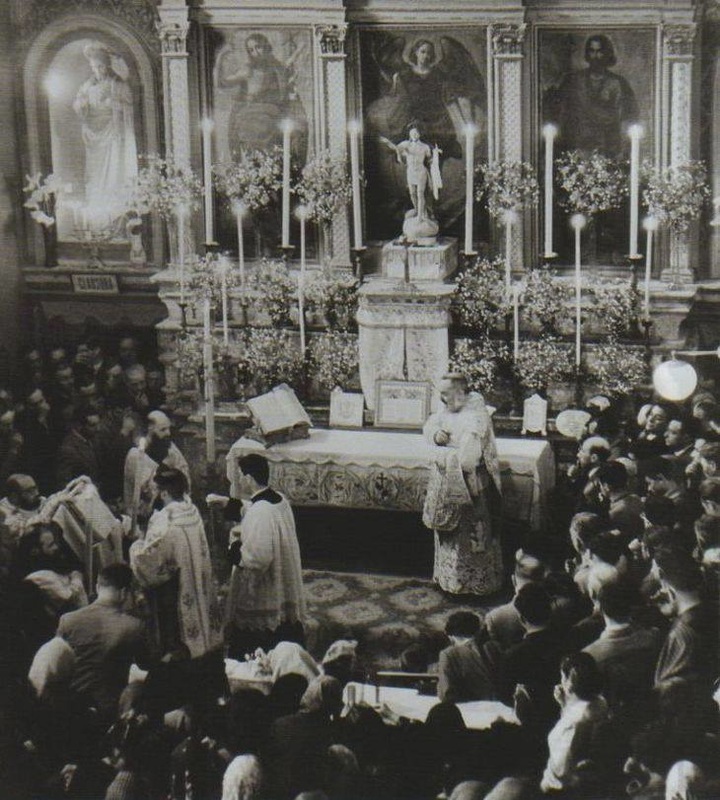
St. Padre Pio celebrating Solemn High Mass
Rev. Fr. Leonard Goffine’s
The Church’s Year, available from Angelus Press
The Introit of the Mass is a fervent prayer; which may be said in every necessity and adversity:
INTROIT Bow down thine ear, O Lord; to me, and hear me: save thy servant, O my God, that hopeth in thee: have mercy on me, O Lord, for I have cried to thee all the day. Give joy to the soul of thy servant: for to thee, O Lord, I have lifted up my soul. (Ps. IXXXV.) Glory etc.
COLLECT Let Thy continued pity, O Lord, cleanse and defend Thy Church: and because without Thee it cannot abide in safety, govern it ever by Thy gift. Thro’.
EPISTLE (Gal. V. 25, 26.; vi. I-Io.) Brethren, If we live in the Spirit, let us also walk in the Spirit. Let u5 not be made desirous of vain-glory, provoking one another, envying one another. Brethren, and if a man be overtaken in any fault, you, who are spiritual, instruct such a one in the spirit of meekness, considering thyself, lest thou also be tempted. Bear ye one another’s burdens, and so you shall fulfil the law of Christ. For if any man think himself to be something, whereas he is nothing, he deceiveth himself. But let every one prove his own work, and so he shall have glory in himself only, and not in another. For every one shall bear his own burden. And let him that is instructed in the word, communicate to him that instructeth him, in all good things. Be not deceived; God is not mocked: for what things a man shall sow, those also shall he reap. For he that soweth in his flesh, of the flesh also shall reap corruption: but he that soweth in the spirit, of the spirit shall reap life everlasting. And in doing good, let us not fail: for in due time we shall reap, not failing. Therefore, whilst we have time, let us work good to all men, but especially to those who are of the household of the faith.
EXPLANATION This epistle is taken, like that of the Sunday before last, from the epistle of St. Paul to the Galatians, in which St. Paul shows them the insufficiency of the Jewish law, and that they can only be saved by a lively faith in Christ, but now he admonishes them to the performance of good works. You now live, he tells them, in the Spirit, that is, the Holy Ghost animates your heart by His grace, enlightens, confirms, and inflames you, admonishes and teaches you, impels your heart to do good; you must, therefore, also regulate your external conduct accordingly, and in particular devote yourself to the practice of humility and charity, as the foundations of a truly spiritual life. Humility must teach and move you to think little of yourself, to avoid vain glory, and not to confide in your own strength. But charity should impel you to be meek and compassionate to all, even sinners, to correct them charitably, and lead them back to the path of virtue; since he who is harsh to the erring, despises and treats them roughly, is often permitted by God to fall into the same, nay, even into greater sins.
Particularly you must show your charity one for another, that one bears the burdens of the other: that you bear the faults and imperfections of others just as patiently as you wish others to bear with your own imperfections; thus you will fulfil the law of Christ, which commands us to love our neighbor; you will prevent many sins which are occasioned by considering yourself perfect, raising yourself above others, criticising their failings, and causing disturbance. True glory consists in knowing ourselves, our faults and evil inclinations, and in eradicating them. Be grateful to those who instruct you in the word of God, and give to them willingly of your earthly possessions. What you sow, you shall reap; if you only follow the dictates of the flesh, do not mortify yourself, do not correct your failings, and indulge your sinful appetites, you will one day reap death, destruction and damnation, whereas, on the contrary, if you follow the dictates of the Holy Ghost, you will reap of the Spirit of life.
Let us obey this doctrine, for it is of interest to us, and impress deeply on our heart that without mortification of body and soul we cannot be saved.
ASPIRATION. O. St. Paul! beg of God the grace for me, that I may always walk in humility, and the love of my neighbor, particularly in bearing with his imperfections and failings, and thus fulfil the law of Christ in this as in all things.
GOSPEL (Luke VII. 11-16.) At that time, Jesus went into a city called Naim: and there went with him his disciples, and a great multitude. And when he came nigh to the gate of the city, behold a dead man was carried out, the only, son of his mother, and she was a widow, and a great, multitude of the city was with her. Whom when the Lord had seen, being moved with mercy towards her, said to her: Weep not. And he came near, and touched the bier. And they that carried it stood still. And he said: Young man, I say to thee, Arise. And he that was dead sat up,. and began to speak. And he delivered him to his mother. And there came a fear on them all; and they glorified God, saying: A great prophet is risen up amongst us, and God hath visited his people.
Why did Christ show compassion to this widow?
To convince us that God takes sorrowful and destitute widows under His protection; and is to them a consoler and helper; and to teach us to do the same. Woe, therefore, to those who oppress them and cause them to weep. The tears and cries of widows will ascend to God, who will terribly punish the injuries inflicted upon them. (Exod xxii. 22. 23.)
Christ had still other reasons for compassion, for He saw in this deceased youth the death of sinners, and in the afflicted mother the pain which the Church experiences at the spiritual loss of so many of her children. Should this not also awaken our sympathy since it wad the principal cause which moved our Saviour to compassion. I£ we are faithful children of our mother, the Church, it is impossible for us not to share her sorrow, and we would surely not be her children, if we could contemplate without sorrow the multitude who daily die the death of sin, and thus separated from the living body of Christ, hasten to eternal destruction. O let us with the Church unceasingly, ask Jesus, that He raise sinners from their spiritual death, enlighten those in error so that all recognize the truth, find, and walk the path Which leads to life !
Why did Christ say to the widow: Weep not?
He wished to moderate her excessive sorrow, and to teach us that we should not mourn for the loss of our relatives, like the heathens who have no hope of resurrection to eternal life. (Thess. iv. I a.) Resignation to the will ofGod, with prayer and good works, will be of more use to the dead than many tears.
What else do we learn from this gospel?
That no one, however young and healthy, will escape death, wherefore we should always be prepared to die.
INSTRUCTION CONCERNING DEATH
IF there were locked up in prison several hundred persons, on whom sentence of death had irrevocably been pronounced, yet who knew not the day or hour of their execution; if one after the other, and often he who least expected it, were taken out to be executed; would not each one’s heart tremble, whenever the prison door opened? Now the irrevocable sentence of death is pronounced on us all; we are all locked up in our bodies, as in a prison; (Ps. cxiv. 8.) one after the other is called hence, yet we do not regard it. We live as though we could live forever; we think only of the body, but for the soul nothing is done, except that we load it with sins and vices.
Is this rational? The body will be food for worms, but the soul (without knowing when) will travel into the house of eternity, to which place she must bring treasures of good works, in order to live happy for ever. Who would, therefore, be so foolish as to care only for the body during life, and neglect the salvation of the soul?
O man, says St. Francis of Sales, (Phil. part. i. chap. 13.) represent to yourself in lively colors, that at your death the world will cease to exist with respect to you. In that last hour the pleasures, the vanities, the riches, the honors, the friendships, and all that was dear to you, will disappear before your eyes as so many shadows. O fool that I am! you will then say, for what trifles and fooleries have I lost all! On the contrary, piety, good works, penance, etc., will appear pleasant to you, and you will exclaim: O, why did I not travel on this blessed roadl Then the sins which you now consider as mere trifles, will seem to you like mountains, and all that you thought you had accomplished as, great things, with regard to piety, will seem to you very little.
What terrible fear will then seize your soul, when she must travel alone into the bottomless abyss of eternity which, as St. Bernard says, devours all possible, imaginable ages, and of which St. Gregory says, that we can easier say what it is not than what it is. What terrors will befall her, when she must appear before the tribunal of that God whom she never really loved and honored in her life-time and before whom she must now give the strictest account, and hear an irrevocable and just sentence!
Should not these thoughts make an impression upon you? How can you escape this terrible future? By living now, as you would wish to have lived at the hour of death. Die daily with St. Paul by crucifying the flesh and its lusts and by voluntarily withdrawing your heart from the world, its pomps and vanities, before death will do this by violence.
RESOLUTION O world! because I cannot know the hour, in which I must leave you, I will not be attached to you. O you dear friends and relatives, you, too, I will in future love only with a holy inclination, directed to God, which will not cease with death, but remain forever. O Lord! help me, that I may die totally to myself and the world, and live only for Thee, and partake of eternal happiness.
INSTRUCTION ON THE CEREMONIES USED AT FUNERALS
Behold, a dead man was carried out, the only son of his mother, and a great multitude of the city was with her. (Luke vii. 12.)
OF these people who accompanied the funeral of the youth, we should learn to pay the last honors to the dead, and follow their bodies to the grave. This is a meritorious work, one pleasing to God, if it be not performed from vanity and self-interest, but for love of God and the deceased, with the charitable intention of assisting him by prayers. Therefore those do very wrong, who from worldly motives either omit this good work entirely, or during the funeral procession indulge in idle talk and deny the deceased even a short prayer.
Why is a cross carried before the corpse?
By this is indicated that the deceased during life professed Christ, died believing in Him, and hoping for resurrection through Him.
Why are lighted candles carried before the bier?
To represent the desire of the Church that the deceased through the grace of God may be received into eternal light.This custom is very ancient; wax-candles and torches, together with prayer and great solemnity were made use of at the burial of St. Cyprian who was beheaded for Christ’s sake, in the year 258 after Christ. (Ruinart.)
Why are the coffin and the grave sprinkled with holy water?
In order, as St. Thomas of Aquin (Lib. iii. art. 21.) remarks, to implore God, on account of the prayers which the Church says when she blesses the water, that the souls of the faithful may be cleansed from all stains, and may receive consolation and refreshment in the tortures which they may still have to suffer.
Why are the body and the grave incensed?
By this the Church indicates that the deceased by his Christian vocation was a good odor of Christ, (ii Cor. ii. 14, 15.) and admonishes the faithful that their prayers should ascend like incense to heaven for the deceased.
Why are Psalms and other sacred canticles sung?
This is done to remind us of the teaching of St. Paul, (i Thess iv. 12.) not to be excessively sorrowful for the loss of the deceased, like the heathens who have no hope of eternal life. We also signify, thereby, that we congratulate the dead for the peace which they now enjoy. (Apoc. xiv. 13.) This custom, as St. Jerome shows, (Ep. 53.) is derived from the apostles, who interred St. Stephen, singing Psalms and hymns of praise.
Why are the bells rung?
To invite the faithful to the funeral and to pray for the dead who, during lifetime, was called very often by the same bells, prayed with and for us during religious worship, and who is not separated from us by death.
Why art the bodies of the faithful buried with the head towards the East, and those of the priests towards the West?
The faithful are buried towards the East, whence the sun rises, to indicate, that they are waiting for Christ who is called the Orient from on High, (Luke i. 78.) and whose voice they will hear at the end of the world, when He calls them to the resurrection; the priests towards the West, as a sign that on the day of judgment they will be placed opposite to the souls confided to them, to give an account of their charge and to bear judgment for or against them.
Why is a cross or monument erected aver the grave?
To show that the deceased was a follower of Christ, the Crucified, to admonish the passers-by to pray for him, and to remind us of the solemn moment of death.
Why is the body laid in consecrated ground?
This is done through reverence for the bodies of the dead which are, by baptism, temples of the Holy Ghost; to show that, even in death, they still belong to the communion of that holy Church, in which they were embodied during life by baptism, and to which they clung in faith even until death; to inspire the surviving with a holy fear lest they profane graves.
Why is the solemn funeral service of the Church denied to heretics?
Because they would not belong to the Church during life, and despised the holy customs and prayers of the Church for the dead. How should the blessing and prayer of the Church be useful in death to one who despised them during life.
Why does not the Church permit criminals and suicides to be buried on consecrated ground?
In order to express her horror for the crimes perpetrated by them, and to deter the faithful from committing similar actions.
August 30, 2024 No Comments
INSTRUCTION ON THE FOURTEENTH SUNDAY AFTER PENTECOST
Rev. Fr. Leonard Goffine’s
The Church’s Year
At the Introit of the Mass excite in your heart an ardent desire for heaven, with these words:
INTROIT Behold, O God, our protector, and look on the face of thy Christ:, for better is one day, in thy courts above thousands. How lovely are thy taberÂnacles, O Lord of hosts! My soul longeth and fainteth for the courts of the Lord. (Ps. LXXXIII.) Glory etc.
COLLECT Keep, We beseech Thee, O Lord, Thy Church with Thy perpetual favor; and because without Thee the weakness of man is ready to fall, may it be withheld by Thy aid from all. things hurtful, and devoted to all things profitable to salvation. Thro’.
EPISTLE (Gal. V. 16-24.) Brethren, Walk in the spirit, and you shall not fulfil the lusts of the flesh: for the flesh lusteth against ,the spirit, and the spirit against the flesh: for these are contrary one to another: so that you do not the things that you would. But if you are led by the spirit, you are not under the law.. Now the works of the flesh are manifest, which are, fornication, uncleanness, immodesty, luxury, idolatry, witchcrafts, enmities, contentions, emulations, wraths, quarrels, dissensions, sects, envies, murders, drunkenÂness, revellings, and such like: of the which I foretell to you, as I have foretold to you, that they who do such things shall not obtain the kingdom of God. But the fruit of the Spirit is charity, joy, peace, patience, benignity, goodness, longanimity, mildÂness, faith, modesty, continency, chastity. Against such there is no law. And they that are Christ’s have crucified their flesh with the vices and concupiscences.
What is it to walk in the spirit?
It is to obey the inspirations of the Holy Ghost always, and in all things. He who does this, says St. Paul, will not do the evil works of the flesh, which are here enumerated, but he will rather suppress and mortify all sensual desires, in this manner crucify his flesh together with its vices and lusts, and make himself worthy of the fruits of the Holy Ghost, which are also mentioned; he will belong to Christ, and secure for himself eternal happiness. On the contrary, he who lives according to the flesh, that is, gives way to the desires of the flesh, has no hope of salvation.
Is it not strange, that all Christians wish to belong to Christ and become heirs of His kingdom, but are unwilling to crucify the flesh and its lusts, though Christ says to all; If any man will come after me, let him deny himself, and take up his cross, and follow me. (Matt XVI. 24.)
ASPIRATION Intercede for me, O St. Paul, that God may give me grace to crucify my flesh with its lusts, that I may have part with thee in Christ:
GOSPEL (Matt. VI. 24-33.) At that time, Jesus said to his disciples: No man can serve two masters; for either he will hate the one and love the other, or he will sustain the one and despise the other. You cannot serve God and Mammon. Therefore I say to you, be not solicitous for your life, what you shall eat, nor for your body, what you shall put on. Is not the life more than the meat, and the body more than the raiment? Behold the birds of the air; for they neither sow, nor do they reap, nor gather into barns, and your heavenly Father feedeth them. Are not you of much more value than they? And which of you, by taking thought, can add to his stature one cubit? And for raiment, why are you solicitous? Consider the lilies of the field, how they grow; they labor not, neither do they spin; but I say to you, that not even Solomon in all his glory was arrayed as one of these. Now, if God so clothe the grass of the field, which is to-day, and to morrow is cast into the oven, how much more you, O ye of little faith? Be not solicitous, therefore, saying: What shall we eat, or what shall we drink, or wherewith shall we be clothed? For after all these things do the heathens seek. For your Father knoweth that .you have need of all these things. Seek ye therefore first the kingdom of God and his justice; and all these things shall be added unto you.
What is meant by serving God?
Doing the will of God, or performing faithfully and zealously all that God asks of us according to our age and condition, and for love of Him.
Who are the two masters whom we cannot serve alike?
God and Mammon or riches, whereby also, the other goods and pleasures of the world are understood. These we cannot serve at the same time, because they command things diametrically opposed to each other; for instance, God prohibits usury, theft, deceit, &c.; to which the desire for wealth impels us. God commands that we keep holy Sundays and holy days, and devote them to His service; the desire for riches tempts man to omit religious worship and to seek temporal gain; it disturbs him even in church, so that he is only present with his body, but absent in mind with his temporal goods and business.
To whom can riches be useful?
To those who, like the saints, perform works of mercy with them, and thus lay up treasures for themselves in heaven.
Why does Christ call our attention to the birds of the air and the lakes of the field?
To, excite in us confidence in the providence of God, which preserves even the birds and the flowers. Surely, if God feeds the young ravens which cry to Him; (Ps. CXLVI. 9.) if He nourishes the birds which neither sow, nor reap, nor gather into barns; if He vests the flowers of the field so beautifully, how much more will He care for man whom He has made to His own image and likeness, and adopted as His child, if he only acts as such, keeps His commandments, and always entertains a filial confidence in Him.
Should we, therefore, lay aside all care and never work?
This does not follow from what has been said. Christ condemns only the superfluous cares, which cause man to forget God and to neglect the salvation of his soul. Besides, God has Himself ordered (Gen. III. 17-19.) that man should obtain the fruits of the earth with much labor, that he should earn his bread by the sweat of his brow. St. Paul says: If any man will not work, neither let him eat. (II Thess. III. 10.)
What should preserve us from superfluous cares?
A firm and lively faith, that God can and will help us. That He can is evident, because He is almighty; that His will is certain, because He promises it in so many pasÂsages of Holy Writ, and because He is infinitely faithful to all His promises. Christ encourages us to this lively confidence with these, words: All things whatsoever you ask when ye pray, believe that you shall receive and they shall come unto you. Mark XI. 24.) Therefore the apostle also commands us to throw all cares upon the Lord, who provides for us. (I Pet. V. 7.) And why should God not care for us, since He sent us His Son and with Him all; for which reason St. Augustine says: “How can you doubt that God will give you good things, since He vouchsafed to assume evil for you!”
PRAYER O Lord Jesus! give me a firm confidence in Thy Divine Providence, and daily increase it in me, that when in necessity I may confidently believe if I seek first the kingdom of God and His justice, the rest shall be added unto me.
CONSOLATION IN POVERTY
Be not solicitous for your life. (Matt. VI. 25.)
If you were born in poverty, or accidentally, or through your own fault have become poor, be consoled, because God has sent you this poverty for your own good; for good things and evil, life arid death, poverty and riches are, from God. (Ecclus. XI-14.). Therefore receive it from the hand of God without impatience or murmuring, as a means by which He wishes to keep you from forgetting Him, which would, perhaps, happen if He were to bless you with temporal prosperity. Riches are a source of destruction for many. If you have brought poverty upon yourself by a licentious and sinful life, receive it in a spirit of penance as a just and salutary chastisement, and thank God that He gives you an opportunity to do penance for your sins. But if you have become poor through no fault of your own, be consoled by the example of the saints, of whom St. Paul says: they bear the unjust taking away of their goods with joy, because they know that a better and an unchangeable treasure is in store for them in heaven. (Hebr, X. 34.) But you should particularly take courage from the example of Christ who, being rich, became poor for us, (II Cor. VIII. 9.) and had not a place whereon to lay His head. (Matt. VIII. 20.)
In your distress say with job: The Lord gave and the Lord bath taken away: as it pleased the Lord, so it is done: blessed be the name of the Lord. Naked came I out of my mother’s womb, and naked shall I return thither. (Job. I. 21.) Fear not my son, says Tobias, we lead indeed a poor life, but we shall have many good things if we fear God, and depart from all sins, and do that which is good. (Tob. IV. 23.) To serve God and to be content with few things always brings rich reward, if not in this, at least in the next life. Therefore Christ promised the kingdom of heaven to the poor in spirit, that is, not only to the humble, busy also to the poor who imitate Christ in all patience and resignation. Follow, therefore, the poor Jesus, follow His poor mother, by imitating their example, and you will possess the kingdom of heaven.
INSTRUCTION CONCERNING USURY
You cannot serve God and Mammon. (Matt. VI. 24.)
Usury is to demand more than legal interest from our neighbor, to whom we have lent something, or who is otherwise indebted to us. Those are also commonly called usurers, who, in times of want, hoard up necessary food, such as grain, flour, &c., and only sell it at an exorbitant price; or who buy up all such articles to sell them to the needy for enormous prices. This is a grievous sin, and usurers are threatened with eternal death, for Christ exÂpressly prohibits lending with usury. (Luke VI. 34, 35.)
Usurers are the real leeches of the poor, whom they rob of their sweat and blood, and since they transgress the natural law, but still more the divine, which commands us to love our neighbor, and be merciful to the needy, they will surely not possess the kingdom of heaven. Would to God, the hard-hearted sinner might consider this, and take to heart the words of Christ: What doth it profit a man, if he gain the whole world, and suffer the loss of his own soul (Matt. XVI. 26.)
August 24, 2024 No Comments