
Category — Uncategorized
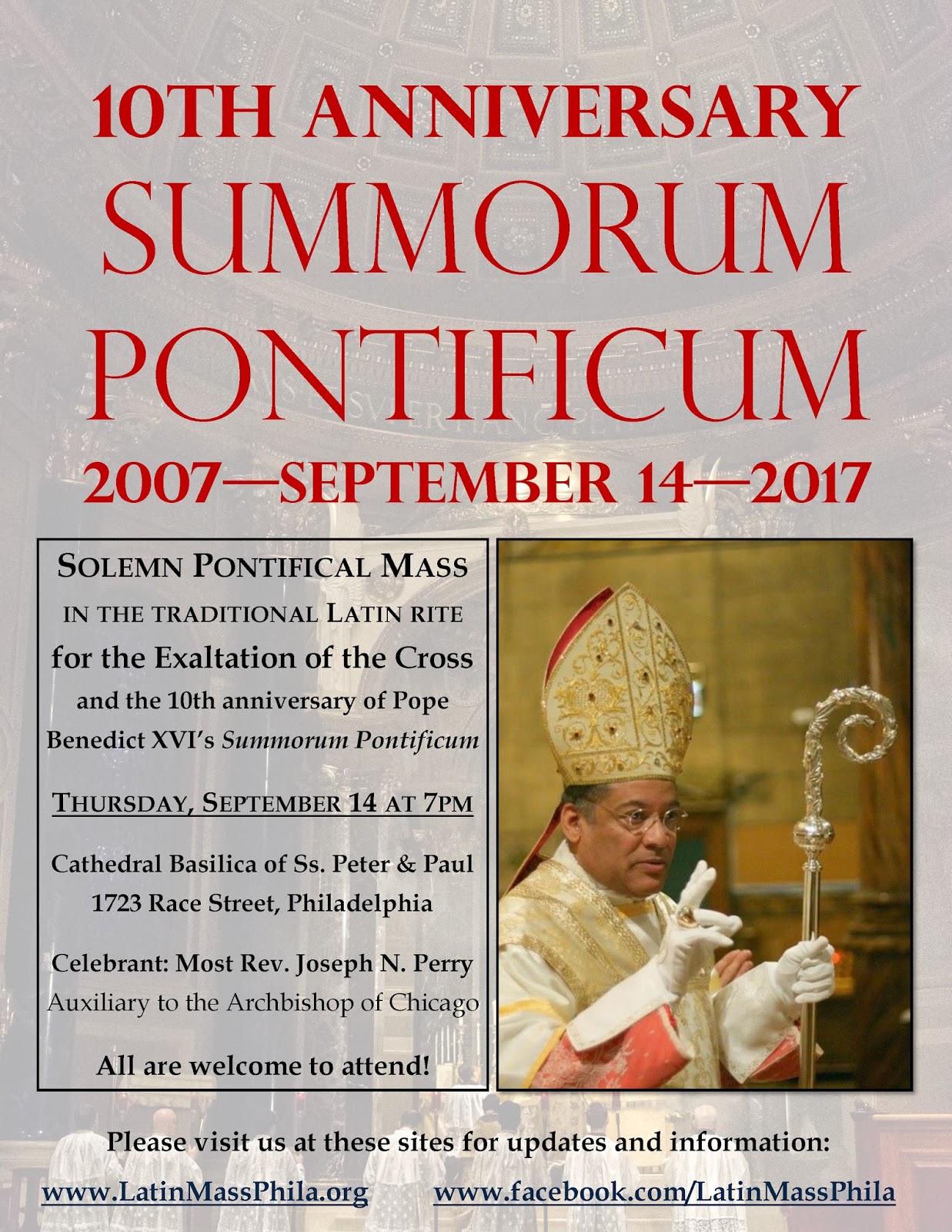
Pontifical Mass in Philadelphia for the Tenth Anniversary of Summorum Pontificum
September 3, 2017 No Comments
September First Friday and First Saturday TLM’s
The Traditional Latin Mass will be offered on Friday, September 1st and Saturday, September 2nd at:
Church of the Immaculate ConceptionÂ
of the Blessed Virgin Mary
602 West Avenue
Jenkintown, PA 19046
Please join us at this beautiful historic church. Mass will be offered in the Main Sanctuary.Â
First Friday, September 1st:
Priest: Rev. Harold B. Mc Kale (Parish Vicar, Our Lady of Mount Carmel Roman Catholic Church)
Location:Â Church of the Immaculate Conception
Time: 7:00Â p.m., preceded by Confessions at 6:30Â p.m.
This Traditional Latin Mass will be the Mass of The Sacred Heart of Jesus with Commemorations of St. Giles and The 12 Holy Brothers, offered in Reparation to The Sacred Heart of Jesus. (White Vestments)
First Saturday, September 2nd
Priest: Rev. Harold B. Mc Kale (Parish Vicar, Our Lady of Mount Carmel Roman Catholic Church)
Location:Â Â Church of the Immaculate Conception
Time: 9:30 a.m., preceded by Confessions at 9:00 a.m.
This Traditional Latin Mass will be the Mass of the Immaculate Heart of Mary with a Commemoration of St. Stephen of Hungary, offered in Reparation to The Immaculate Heart of Mary. (White Vestments)
Map from St. Albert the Great Parish
to theÂ
Church of the Immaculate ConceptionÂ
of the Blessed Virgin Mary
Â
Â
Directions from St. Albert the Great Parish to Church of the Immaculate Conception:
•Turn left out of the parking lot at St. Albert the Great onto Welsh Road (0.7 miles)
•Turn left onto Huntingdon Pike, PA-Rt. 232 South and drive for 1.1 miles
•Turn right onto Meetinghouse Road; drive for 2 miles.
•Turn right onto Jenkintown Road and drive for .14 miles
•Jenkintown Road becomes Greenwood Avenue. Continue for .19 miles
•Turn right onto Washington Lane;
•Go one block and make a left onto Vernon Road;
•Go up one block and make a left onto West Avenue;
•Cross over Old York Road; the church will be on your left.
•The church parking lot can be entered either from West Avenue or Cedar Street.
August 30, 2017 No Comments
Good News in Norwalk, Connecticut: Daily Traditional Mass (From New Liturgical Movement)
(Cross-posted from the Society of St. Hugh of Cluny.)
Starting September 5th, at St. Mary’s Church the daily morning Mass will be a Traditional low Mass. The time will be changed to 7:30 am, Monday to Friday. Deo gratias! This is the kind of thing we need to see happening everywhere, so that authentic liturgical renewal may flourish (dare one say, irreversibly?)
Father Richard Cipolla announced the change today on the St. Mary’s website:
The Traditional Roman Rite of the Mass lies at the very heart of Saint Mary’s parish. Since Father Markey introduced it in the parish some seven years ago, it has become integral to the very existence of this parish both in spiritual ways and in eminently practical ways. The Solemn Mass on Sunday has brought so many new people to the parish and continues to be a source of inspiration and genuine prayerful worship to all who assist at the Mass. The Traditional Mass, also known as the Extraordinary Form, is a gift from God via Pope Benedict to St. Mary’s.
When God gives someone a gift He expects it to be used for His glory and to be part of the missionary effort of the Church to bring the Good News of Jesus Christ to the world. In our case, I have decided that this gift needs to be used even more deeply in the parish than up to this point. After much thought and prayer, I have decided that the daily morning Mass will be celebrated in the Extraordinary Form. The time of the Mass will be moved to 7:30 a.m. to allow more people who go to work early to attend Mass. The readings will be in English. The quiet simplicity of the Low Mass will enrich us all. Cardinal Sarah’s book on Silence specifically mentions the silence of the Canon in the Extraordinary Form as something very good for the worshipping community. Most of our parishioners will notice little change, since we celebrate the daily Novus Ordo Mass in continuity with the form of the Traditional Mass. This change will also enable more of our parishioners to experience the beauty of the Extraordinary Form and enrich their understanding of the worship of the Church in the Holy Sacrifice of the Mass.
In no way should this change to the daily celebration of the Extraordinary Form be interpreted as a “return to the pastâ€. As Pope Benedict said: “What was sacred then is sacred now.†We live in the now, not in the past. And we look to the future with confidence that the presence of the Extraordinary Form at St. Mary’s will be a force within the Church to worship God in the Spirit, the God of Truth, Beauty and Goodness. The return to the Tradition of the Church is absolutely necessary in an age of spiritual amnesia within the Church that has sapped her strength to be who she is: the presence of Jesus Christ in the world.
Your support, as always, is very important to me. Let us pray for each other and our beloved parish church dedicated to Mary most Holy.
Father Richard Gennaro Cipolli
Pastor
 |
August 28, 2017 No Comments
Mario Palmaro’s Last Essay — “Kasper’s Speech is Made From the Stuff of White Flags”

(Rome) “We do not need a Church that moves with the world, but a Church that moves the world.” With these words, the legal philosopher Mario Palmaro quoted GK Chesterton a few days ago. On Sunday night, Mario Palmaro died after a long illness. Until the last moment, he remained a champion of his Catholic Church. On this occasion, we are publishing his last essay he wrote  together with Alessandro Gnocchi published on 5 March in the daily newspaper “Il Foglio”..Â
It is not known if Pope Francis in his address to the parish priests of the Diocese of Rome held on 6 March, could be  understood as a response to the article by Palmaro and Gnocchi. An answer ante eventum. The picture shows Mario Palmaro, already haggard from the disease, with his wife and four children in May of 2013, when he received the “Faith &  Culture” award.
Read entire essay:
http://eponymousflower.blogspot.com/2014/03/mario-palmaros-last-essay-caspers.html
August 23, 2017 No Comments
Traditional Latin Pontifical Mass – 9/14/17 – Cathedral Basilica of Sts. Peter and Paul, Philadelphia

From George E. Gunning
Dear Friend of the Traditional Latin Mass Community,
    This year we celebrate the tenth anniversary of the implementation of His Holiness Pope Benedict XVI’s motu proprio, Summorum Pontificum.  This document has been a great blessing to our community here in the Archdiocese of Philadelphia and we could not allow its anniversary to pass without a significant acknowledgement.  On September 14th, the Feast of the Exaltation of the Holy Cross, our community will gather at the Cathedral Basilica of Saints Peter and Paul for a very special celebration.  With the permission of the Archbishop of Philadelphia and the encouragement of the Rector of the Cathedral Basilica, a Solemn Pontifical Mass will be celebrated by His Most Reverend Excellency Joseph N. Perry.  Bishop Perry is an auxiliary of the Cardinal-Archbishop of Chicago and he is a great friend to the traditionalist community in that Archdiocese.
    This Solemn Pontifical Mass will be both beautiful and reverent.  It will also be expensive.  As a supporter of the Tradition Latin Mass we are appealing to you for your financial support of this Mass. It is our goal to fund the expenses of the Mass in total so we are not a burden on the already burdened budget of the Cathedral Basilica.  While some very generous donors have stepped forward already to help the Traditional Latin Mass Community of Philadelphia pay the expenses of this Mass, more support is still needed.
    Please consider making a tax deductible gift to the Cathedral Basilica of Saints Peter and Paul to support this important event in the life of the Church here in Philadelphia.  The best way to make your gift is by mailing a check directly to the Cathedral Basilica (1723 Race Street, Philadelphia, PA, 19103) with “Traditional Latin Mass†in the memo line.  If you wish to make a gift but credit card you can do so by calling the Cathedral Rectory during business hours at 215-561-1313.  If you choose to make a gift by credit card please indicate during the call that it is a gift for the Traditional Latin Mass on September 14th.
    Thank you for your help and prayerful consideration.  This is a major undertaking for the Traditional Latin Mass Community here in the Archdiocese of Philadelphia so your support is very important.  Please plan to join us for the Mass and help us spread the word!
Thank you,
Traditional Latin Pontifical Mass Committee
August 23, 2017 No Comments
DAILY TRADITIONAL LATIN MASS RETURNS TO THE ARCHDIOCESE OF PHILADELPHIA IN THE YEAR OF THE TENTH ANNIVERSARY OF SUMMORUM PONTIFICUM
Daily Traditional Latin Mass at the Carmelite Monastery
1400 66th Avenue, Philadelphia
(6600 N. Old York Road)
Saturday and Sunday at 8:00 a.m.
Monday through Friday at 7:00 a.m.
A.M.D.G.
August 21, 2017 No Comments
Sung High Mass of Requiem, Tuesday, August 22, 2017, at 7:p.m., According to the 1962 Edition of the Missale Romanum
In Memory of Philomena Stendardo, who returned to the Lord on July 23, 2017, at a tender young age.
Holy Martyrs Roman Catholic Church
               120 Allison Road
    Oreland, Pennsylvania  19075
             215-884-8575
Holy Martars Roman Catholic Church is designated as the National Center of the Archconfraternity of St. Philomena for the United States.
Reverend Jason V. Kulczynski, Pastor, Celebrant
Celebrant, Traditional Latin Mass Community of Philadelphia:Â Â www.latinmassphila.org
Host of AIM HIGH on Radio Maria: http://radiomaria.us/aimhigh/Â
U. S. National Director of the Universal Archconfraternity of St. Philomena:Â www.philomenafamilyusa.com
August 21, 2017 No Comments
Traditional Parish Thrives in Northern Kentucky

A recent article at the Cincinnati Enquirer introduced many around the country to a newly established parish in Park Hills, Kentucky. Our Lady of Lourdes Catholic Church, located within the Diocese of Covington, was established in 2016 following the purchase of a former Protestant church by the Missionaries of Saint John the Baptist. As noted at their site, the Missionaries were formed:
To work toward the establishment of a new religious Institute of Diocesan Right within the Diocese of Covington, Kentucky under the authority of the Bishop, and…
To establish a community in which common religious life is lived in a more disciplined and traditional way including the celebration of the liturgy according to the usus antiquior of the Roman Rite, with the liturgical books of 1962 being normative.
The success of the newly formed parish is due in no small part to the charism and preaching of the founding priests of the Missionaries, Fr. Shannon Collins, MSJB and Fr. Sean Kopczynski, MSJB. Both men are nationally recognized for their teaching, preaching, and traditional parish retreats.
In the year since Bishop Roger Foys of Covington consecrated the new parish, attendance has more than doubled at the second of their two Sunday morning Masses. On some weekends as many as 250 fill the pews. This is significant growth for Our Lady of Lourdes, which began with only 20-30 families, and is the only Latin Mass exclusive parish in the Diocese of Covington.
Consistent with other traditional communities around the country is the make up of the parishioners. On any given Sunday a visitor to the parish will find the pews filled with large, young, Catholic families. According to a recent report, as many as 98% of registered families home school their children, with many of those also participating in an educational co-op. To ensure the quality and orthodoxy of the program, only priests and educated laity instruct the young.
The result of this commitment to tradition has also resulted in some families picking up roots and relocating to Kentucky. Some have moved from as far away as Florida, Texas, and even Mexico.
Of course, as with any success realized, there is also criticism. A recent article at the Cincinnati Enquirer (Park Hills is just across the Ohio River from Cincinnati) seeks to paint the parish as being in conflict with the community. While there is some controversy surrounding the building of a proposed grotto (inspired by the original found in Lourdes, France), an official statement from the parish has sought to allay concerns over issues such as traffic, parking, and size.
Another effort even went so far as to hype a story from a same-sex couple claiming that a bumper sticker on a parishioner’s car (which read, “Male and Female He created Them -Genesis 1:27â€) was intended to harass. The couple, who prominently fly a rainbow flag on their front porch, contend that the bumper sticker said something more offensive. As parishioners point out, the car (which belongs to neighbor of the men) still has the bumper sticker on it, and could have simply been verified by interested news media seeking to clarify. Of course the key word is interested.
Where there is no controversy, however, is with the very Catholicity of the church, its parishioners, and the community. Simply put, northern Kentucky and Cincinnati are very Catholic. Largely made up of third and fourth generation immigrants from Germany, Ireland, and Italy, Catholicism is well represented in the area.
Park Hills, Kentucky may have as many as 50-60% Catholics. The city is also home to both Notre Dame Academy, the only all girls Catholic high school in the diocese, and Covington Catholic High School, an all boys school. Just up Dixie Highway, past these two schools, lies St. Agnes Catholic Church. Though it only offers the Ordinary Form of the Mass, the parish has been nothing but welcoming to their new neighbors.
Traditional Catholicism is also well represented in the tri-state area. Cincinnati is home to at least three Sunday Latin Masses (located at Sacred Heart, Holy Family, and Old St. Mary’s). Northern Kentucky is even home to a Society of St. Pius X chapel and even a SSPV sedevacanist community. It is in this setting, with all of these available traditional Masses, that Our Lady of Lourdes is thriving. Unlike other parts of the country, where traditional parishes can be hard to come by, some families are driving past other Latin Masses, and sometimes several hours, for a fully traditional parish committed to offering all of the sacraments in the old Rite.
This then is the story of Our Lady of Lourdes in Park Hills. Recent efforts to portray the parish as intolerant of its neighbors, or viewed with suspicion by the community, are simply disproportionate and incorrect. Tradition is indeed thriving in northern Kentucky, and for this we should all be grateful. Deo gratias!
(I would like to thank Maria Merklin for her significant contribution to this post).
Photo credit: The Enquirer/Meg Vogel
August 17, 2017 No Comments
Mater Ecclesiae 17th Annual Assumption Mass, Tuesday August 15, 2017
Mater Ecclesiae Roman Catholic Church will celebrate its 17th Annual Mass of Thanksgiving for the Feast of the Assumption on Tuesday, August 15, 7 p.m. at The Cathedral Basilica of Saints Peter and Paul, 18th Street and Benjamin Franklin Parkway, Philadelphia, Pennsylvania. The Reverend Robert C. Pasley, KCHS, Rector of Mater Ecclesiae, will be the Celebrant, and Reverend Dennis J. Carbonaro, Spiritual Director at St. Charles Borromeo Seminary, will be the Preacher.
The Solemn High Tridentine Mass will once again feature the Ars Laudis Festival Chorus and Orchestra. Our Cantor Mr. Nicholas Beck, a graduate of Westminster Choir College, will direct the singing of the Gregorian Propers. Dr. Timothy McDonnell will be the conductor.
Mater Ecclesiae celebrates this feast each year by the use of the great treasury of Sacred Music, especially the beautiful polyphonic Masses that are very infrequently prayed in their proper place: the Sacred Liturgy. We want to foster a greater love for the great works of our Catholic heritage. For notes on this year’s music from Dr. McDonnell, click here. For a detailed listing of the music click here.
In order to sponsor such grand music we cannot depend on our little parish of 500 families. We need the help of everyone in the Delaware Valley who wants to foster excellent sacred music as well as support professional musicians who have been blessed by God with magnificent talent.
To donate, click here for the Patron Donation Form, or send a check to Mater Ecclesiae Roman Catholic Church, 261 Cross Keys Rd., Berlin, NJ 08009-9431. When we receive the donation, we will send a letter acknowledging receipt that can be used for tax purposes. We will also put your name before the statue of Saint Jude, and specifically remember all the donors at our Novena to St. Jude on nine consecutive Wednesdays starting August 19th.
Parking at the Cathedral is available in the adjoining parking lot and at the underground garage at the Sheraton Hotel on 17th Street. A link to directions at the Cathedral’s website is here.
Click here for the donation form. Click here for the advertising form.
 © 2017 Mater Ecclesiae Roman Catholic Church
261 Cross Keys Road
Berlin, NJ 08009-9431
Phone: 856-753-3408
Fax: 856-753-2671
Rectory Office Hours:
Mon-Fri, 8:30 a.m. – 5:00 p.m.
Closed from 12:00p.m. – 1:00 p.m.
Rector:
Rev. Robert C. Pasley, KCHS
In-Residence Hospital Chaplian:
Rev. Glenn R. Hartman, KHS
Parish Secretary and Office Manager:
Barbara Rodio
Department of Religious Education:
Mrs. Cheryl Hughes, A.R.E.
Classes meet the second and third Sundays of each month, 9:45 – 10:45 a.m., September through May.
Sacred Music Program
Director and Cantor:
Nicholas Beck
Schola Caritas Men’s Chant Choir
Organist:
Karl Tricomi
Sacristans:
Mr. Robert Parker
Mr. Michael Graziano
August 14, 2017 No Comments
“The Organic Development of the Liturgyâ€
From “Liturgy Guy” Blog
In recent years the Church has witnessed an increasing appreciation for the writings of Benedictine priest Dom Prosper Guéranger. Abbot of Solesmes Abbey, founder of the French Benedictine Congregation, and author of both “The Liturgical Year†and “The Holy Massâ€, Dom Prosper is widely considered one of the foremost liturgists of the nineteenth century.
In his contemporary classic, “The Organic Development of the Liturgyâ€, Dom Alcuin Reid, O.S.B. discusses the twelve characteristics of what Guéranger called the antiliturgical heresy. Guéranger’s list today reads like a litany of the supposed liturgical reforms of the post-conciliar years. Dom Reid lists the twelve as follows:
The first is the hatred of Tradition in the formulas of divine worship.
The second is the substitution of writings from Sacred Scripture for formulas composed by the Church.
The fabrication and introduction of new liturgical formulas is the third.
Fourth is the contradictory principle that operates from an affection for antiquity that seeks to “reproduce divine worship in its original purity†while spurning development later in liturgical Tradition and yet introducing new elements of “incontestably human†origin.
Fifth, noting that similar attitudes are to be seen in Protestant liturgical reform, Guéranger proscribes the rationalistic removal of ceremonies and formulas that leads to a loss of the supernatural or mystical element of the Liturgy without regard for its tangible and poetic nature.
The sixth characteristic is the total extinction of the spirit of prayer or unction from the Liturgy. Guéranger speaks here of pharisaical coldness and cites the Protestant insistence on the vernacular by way of example.
The Protestant exclusion of the cult of the Blessed Virgin Mary and of the saints…is the seventh characteristic.
The use of the vernacular itself is the eighth. Here Guéranger warns of the transience of the vernacular and of the dangers of using mundane language in worship.
An overriding desire to lessen the burden of the Liturgy (by shortening it) is the ninth characteristic.
Rejection of all things papal or Roman is the tenth.
A consequent presbyterianism that downplays the ministerial priesthood forms the eleventh characteristic.
Finally, Guéranger deprecates secular or lay persons assuming authority in liturgical reform lest the Liturgy, and consequently dogma, become an entity limited by the boundaries of a nation or region.
Reid, Alcuin O.S.B. The Organic Development of the Liturgy. San Francisco: Ignatius Press, 2005. pp. 58-59
August 10, 2017 No Comments