INTROIT I am the salvation of the people, saith the Lord: in whatever tribulation they shall cry to me, I will hear them: and I will be their Lord for ever. Attend, O my people, to my law: incline your ears to the words of my mouth. (Ps. LXXVII.) Glory etc.
COLLECT Almighty and merciful God, graciously keep us from all things that are hurtful; that we, being set free both in mind and body, may with ready minds accomplish whatever is Thine. Thro’.
EPISTLE (Ephes. IV. 23-28.) Brethren, Be reÂnewed in the spirit of your mind, and put on the new man, who according to God is created in justice and holiness of truth. Wherefore, putting, away lying, speak ye the truth every man with his neighbor, for we are members one of another. Be angry, and sin not. Let not the sun go clown upon your anger. Give not place to the devil. He that stole, let him now steal no more; but rather let him labor, workÂing with his hands the thing which is good, that he may have something to give to him that suffereth need.
EXPLANATION St. Paul admonishes the Ephesians to lay aside the- old man, like a worn out garment, and put on the new man, that is, to renew their internal and external life. This renewal according to his teaching takes place, when we by a true repentance put away our vices, shun all lies, anger, injustice, &c., and adorn our soul with virtues, and zealously seek after Christian justice and perfection. We have, perhaps, already sought to change our manner of living, for which a jubilee or some other particular solemnity of the Church gave us occasion, and at that time, perhaps, purified our soul by a general confession, making the firm resolution to live for God, and work out our salvation, we appeared converted, and to have become other men: but how long did this conversion last? Ah, how soon did we fall back into the old, sinful ways. And why? Because we lived in too great, deceitful security. We thought everything accomplished by the general confession; we were satisfied, and omitted to employ the means of remaining in the state of grace. We did not thank God for the grace of conversion; we did not ask Him for the grace of perseverance; we frequented evil company, and did not avoid dangerous occasions; we indulged in idleness and pleasures as before. How can it appear strange, if such a conversion is fruitless? Ah, we should remain in wholesome fear even after the remission of our sins. (Ecclus. V. 5.) Even if we could say that we have done everything, nevertheless we cannot be certain, whether we be worthy of hatred or love. (Ecclus. IX. 1.) We should, therefore, work out our salvation according to the advice of St. Paul (Philipp. II. 12.) in fear and trembling, and thus not fall into the old life of sin, losing the hope of a new conversion.
GOSPEL (Matt. XXII. 1-14.) At that time, Jesus spoke to the chief priests and the Pharisees in parables, saying: The kingdom of heaven is likened to a king, who made a marriage for his son. And he sent his servants, to call them that were invited to the marriage, and they would not come. Again he sent other servants, saying: Tell them that were invited, Behold I have prepared my dinner; my beeves and fatlings are killed, and all things are ready: come ye to the marriage. But they neglected: and went their, ways, one to his farm, and another to his merÂchandise: and the rest laid hands on his servants, and having treated them contumeliously, put them to death. But when the king had heard, of it; he was angry: and sending his armies, he destroyed those murderers, and burnt their city. Then he saith to his servants: The marriage indeed is ready; but they, that were invited were not worthy. Go ye therefore into the highways, and as many as you shall find, call to the marriage. And his servants going forth into the ways, gathered together, all that they found, both bad and good; and the marriage was filled with guests. And the king went in to fee the guests; and he saw there a man who had not on a wedding garment: and he saith to him: Friend, how camest thou in hither, not having on a wedding garment? But he was silent. Then the king said to the waiters: Bind his hands and feet, and cast him into the exterior darkness: there shall be weeping and gnashing of teeth. For many are called, but few are chosen.
REMARK Thir parable agrees in many respects with that for the second Sunday after Pentecost, and has the same meaning. See, therefore, the explanation of that gospel, as also of the feast of SR Catherine, to which Maybe added the following:
EXPLANATION In this parable the king is our Heavenly Father who has espoused His only-begotten Son to the Church, and on this occasion prepares the most sumptuous marriage-feast by giving the evangelical doctrine, the holy Sacraments, and the heavenly joys. The servants sent to invite the guests are the prophets, apostles and disciples of Christ. Those invited are the Jews who despised the honor and grace of the divine King, destined for them, abused and killed His servants, and were, therefore, cast aside and with their city Jerusalem, destroyed by the armies of their enemies, as a just punishment; in their stead the heathens and all those nations were called, who were on the broad road to destruction, and who now occupy the places of the unfortunate Jews at the marriage feast of the Church, and shall also occupy them in heaven. In the Jews to whom Christ addressed this parable, is verified that many of them, nay, all are called, but few chosen, because they would not heed the invitation.
APPLICATION We have the honor not only to be invited to this marriage-feast, but are in reality guests at it, because we are members of the Church of Christ by faith. “But the Christian,” says St. Gregory, “who is a member of the Church by faith, but has not charity, is like to a man who comes to the marriage-feast without the wedding garment.” With this garment which is charity, Christ was vested, when He came to celebrate the nuptials with His spouse, the Church, and by the bond of charity the Son of God also unites Himself with His elect. He clearly lets us know that charity is the wedding garment which should vest us. Those, therefore, who believe and are in the communion of the Church, but who do not preserve the grace of charity, are indeed in the wedding-chamber, but they are not adorned with the wedding garment. They are dead members of the Church, and shall not be admitted without this garment into the celestial marriage-feast in the triumphant Church, but rather be cast like that unforÂtunate guest into exterior darkness. This guest was silent, when asked by the king, why he had not .the wedding garÂment. By this we see, that no one can excuse himself to God for not having charity, because every one can have it, if he asks it from God, and, as St. Augustine says, our heart is the workshop of charity, and every one who has a heart can practice it.
PRAYER I thank Thee, O Jesus, that Thou didst call me to the marriage-feast in Thy Church; give me the wedding garment of charity that I may be present at the celestial marriage-feat, and not be cast into exterior darkness.
INSTRUCTION CONCERNING HELL
Cast him into the exterior darkness. (Matt, XXII. 13.)
What is hell?
Hell is that place where the damned must suffer eternal punishment.
Is there a hell?
Yes; reason, holy Scripture and the Church teach us that there is a hell. Reason tells us that there is a just God who will punish sin. It is evident that all sins are not punished in this world; there must, therefore, be a place, where every mortal sin, not atoned for by sorrow and penance, will be punished, and this place is – hell. All nations from the beginning of the world, even those who had not the light of revelation, believed this.
But clearer still is the existence of hell shown by holy Scripture: The pious Job, (X. 22.) speaks of a region of misery and darkness, where the shadows of death and no order, but where eternal terror dwells. The Prophet Isaias (XXX. 33.) says that hell is deep and wide, and that the fire burning in it, is like a stream of sulphur, ignited by the breath of the Lord. Our Saviour expressly says that those who have done evil, shall go to everlasting torment, (Matt. XXV. 46.) that they shall be tortured by everlasting fire. (Matt. XXV. 41.) He makes mention of hell, and says that an inextinguishable fire burns there, and a worm which never dies, plagues the wicked. (Mark IX. 42. 43; Matt. X. 28.) All the Fathers of the Church teach and testify to the same doctrine. St. Augustine, among many others, says: “The infinite wisdom of God tells us that there is a hell, and the illimitable power of God it is that punishes the damÂned in a wonderful, but real manner.”
Wherein do the pains of hell consist?
Sacred Scripture and the Church teach concerning the pains, of the reprobate in hell, that the damned burn there in an inextinguishable fire. (Mark IX. 45.) The holy doctors of the Church say, that this fire is never extinguished, and its smoke ascends or rises from century to century, “I see this fire,” says St. Gregory, “as if it were gifted with reason; it make a distinction between the guilty, and tortures the damned according to the nature of their sins.” This fire burns, but never consumes its victims; it commuÂnicates, as Cassiodorus says, immortality to the reprobate and lets them suffer pain, which preserves them, like salt which penetrates the flesh and keeps it from corruption, as Jesus says: Every one shall be salted with fire. (Mark IX. q.8.) This fire does not shine, it leaves the reprobate in darkness, (Matt. VIII. 12.) and with this fire a never dying worm continually torments the damned. This worm is not only a bad conscience, say the holy Fathers, but particuÂlarly the privation of the Beatific Vision. Eternally will the thought torment the damned: I have lost God, the only true and highest Good, I have lost Him through my fault, I have lost Him for a brief pleasure, I have lost Him forever. In hell eternity devours all time; and if after millions and millions of years a damned soul wailingly asks his companion in misery: What time is it? he receives the answer: Eternity.
Who would not fear hell, and avoid sin which incurs eternal punishment, when he reflects upon this! Arid yet there are many, , upon whom the truth of the existence of a hell makes no impression, who even deny that there is such a place, and who say: God is love, He can have no pleasure in the torments of His creatures, He cannot eterÂnally punish a sin which was committed in so short a time as is the life of man.” But those who speak thus, forget that God is just, that His love and mercy are indeed always ready to forgive the contrite and penitent, but that His justice must also be satisfied, when the sinner continually rejects the merciful love of God; they forget, that every grievous sin which man commits voluntarily and knowingly is an infinite, eternal insult, offered to God, which can only be atoned for by an eternal punishment. For the perverted and malicious will of a man, who dies in mortal sin, remains perverted and malicious forever, therefore he must also be punished eternally.
O my dear Christian, do not listen to such deceivers; for just on account of their sinful life, they fear hell and therefore they endeavor to free themselves from this fear by denying the existence of hell; but they cannot succeed; for Jesus, the Truth, has told us that there is a hell, and His word remains for all eternity. Endeavor rather by a pious life to escape hell, descend there in spirit frequently according to the advice of a saint, contemplate the torments of the damned, and let this reflection urge you to imitate Christ, who has promised the joys of heaven to all His faithful followers.
CONSOLING DOCTRINE ON THE JOYS OF HEAVEN
The kingdom of heaven is likened to a king, who made a marriage for his son. (Matt. XXII. 2.)
Heaven is compared by Christ to a marriage-feast because we will there enjoy all imaginable pleasures in the most perfect union with God. In what these joys consist, fit. Paul could not describe, although he was wrapt into the third heaven and tasted these pleasures; he only said: Eye hath not seen, nor ear heard, neither hath it entered into the heart of man, what things God hath prepared for them that love him. (I Cor. II. 9.) Holy Writ, indeed, gives us many descriptions of the celestial joys, by comparing heaven to a paradise of bliss, sometimes to a precious pearl, or a treasure which neither rust nor moth consumes, nor thieves steal; again it represents heaven under the picture of a kingdom, a throne, a crown, whereby we are raised to the highest honor; at another time to the picture of a city which is built of gold, precious stones and pearls, lighted by the splendor of God, filled with magnificence and glory, and where the inhabitants enjoy undisturbed peace and security. These are only images or similitudes, which are taken from the most beautiful, most precious, and magnificent things of the earth, to teach us that heaven is as beautiful and pleasant a place, as we can wish and represent to ourselves, and that all possible beauty, agreeableness and joy may be found there in the highest and most perfect manner, free from evil, anxiety, disgust and fear of losing them.. In heaven we will possess God Himself, the source of all joy and bliss, and will enjoy His own happiness for all eternity. More is riot needed to give us the highest conception of heaven.
Who would not willingly despise the vain, short and imÂperfect pleasures of this earth, whilst contemplating this indescribable bliss? Who would not willingly bear all the misfortunes. and misery of this world, when considering that the more .miserable we have been in this life the happier will we be hereafter. What would it avail us to have enjoyed all the pleasures of this world, if deprived of the pleasures of heaven, in, eternity!
ASPIRATION How lovely are Thy tabernacles, O Lord, of hosts! my soul longeth fainteth for the courts of the Lord. My heart and my flesh have rejoiced in the living God. (Ps. LXXXIII. 2-3.) How do I loathe the world, when I contemplate heaven.
Image (c. 12th century): Saint Benedict of Nursia entrusting his Rule to the monks, with an exhortation to their central task of divine worship in the sacred liturgy: “Therefore let nothing be put before the Work of God†(RB 43).
…As my own journey to the traditional rites has been largely the fruit of study, my account will take the decidedly less interesting and more scattered form of a timeline spanning the past twelve years, interspersed with questions I asked myself along the way, for the record.
Received great consolations in prayer before the Blessed Sacrament, following grace of initial conversion as a young man. Continued in the Novus Ordo parish experience, raised by a faithful Catholic parents. Troubled by sporadic liturgical abuses, could not yet label them as such. Question: “If this is indeed the Incarnate Lord of Heaven and Earth, then why ____ [insert whatever example of irreverence]�
Summorum Pontificum issued by Pope Benedict XVI, prompting the thought: “Twouses of onerite – interesting!†Had no direct experience of the Latin Mass, but a general notion that “little groups here and there†preferred it to the “normal Mass.â€
College study-abroad program. Assisted at first Latin Mass: High Mass at the French Benedictine Abbey Le Barroux, on high feast of St. Benedict. Woah.
Mass with the monks brought keen and singular realization that I had been in heaven for the preceding three hours (or seconds)? Incomparable. Question: How long has this been going on, and where have I been? Growing theological interest in the rites, yet continued to view Traditional Latin Mass as something of a tourist attraction, an “event†with limited availability for special groups (monastic communities, for instance).
Began research on Catholic sacramentals in undergraduate theology at Franciscan University of Steubenville. Latin Mass rarely offered. In FUS program, the party line from many (though not all) professors regarding the current state of the Church was essentially: “The Second Vatican Council is an act of extraordinary magisterium consistent with tradition in the text of its decrees, although poorly implemented since that time – but thankfully, the Church has almost fully recovered by now; insert Pope Benedict XVI’s ‘hermeneutic of continuity‘.†But it just… seems… discontinuous.
Question: “Where might I find this continuity in actual fact?â€Â Seemed to find instead that change was everywhere visible, in every facet of Church life (sacred art, liturgy, canons, discipline, catechesis, etc). Cursory study of Vatican II texts was offered in course of study, but without great examination of their history or development – and rarely measured against previous magisterial teaching on certain subjects, most notably: ecclesiology, liturgy, and ecumenism.
Closer study of hagiography. Struck by continuity of belief and praxis even across multiple centuries and different cultures – nowhere more evident than in the Saints’ writings about Holy Mass… perhaps due to Church’s lex orandi having gone so long essentially unchanged, particularly after the codifications of the Council of Trent in the 16th century; following this Council, every Roman Catholic Saint across the globe had been formed in one, unified form of worship.
Latin Mass. Every saintly one of ’em.
Sensed that these Saints of prior ages would likely not feel quite “at homeâ€Â in the contemporary Novus Ordo Missae. Question: Why is it even a possibility to look for a “more reverent†celebration of Mass – as though the Holy Sacrifice were something we make ourselves, rather than the Church’s worship? All the words, gestures, tone, and seemingly endless “options†in the Novus Ordo appear to hinder rather than foster that unity of belief and praxis that has ever been a Mark of this true Church… Come to find out this was by design. As in, committees sat down in the 60’s to create a rite that would be adaptable to the “needs of our own times†and the sensibilities of the local congregation – and they came up with the Novus Ordo.
And this nonsense is still happening.
Question: “If liturgy could be impacted so dramatically, is there more? And if real continuity exists, why don’t I hear (from prof or pulpit) about Church teaching according to the First Vatican Council, or Pope AnybodybeforePaulVI?†Focused study on sacramentals revealed dramatic shift in postconciliar “reform†of these rites, too. Difficult to see anything but clear rupture with Catholic tradition in many of them, contra “hermeneutic of continuity†concept.
Married, started having children. Requested traditional rite of Baptism for our kids – it was awesome (more on that here). Drafted a little “read-and-follow-along†piece for those we invited to the Baptism, which generated profound conversations before and after among friends and family: “Wow, we never knew!†I know, neither did we!Â
Pope Francis elected – odd papal remarks begin. Chalked these up to bad press at first, then some began to evidence clear contradiction to previous magisterium (false exegesis, repudiating need for conversion, etc.). Add a sequence of open heresies and scandals in immediate surround (not-so-Catholic schools, hospitals, parishes, etc.) amid little or no Church response, and I began to wonder if something significant might be amiss in the Church at large. More prayer for clarity.
Relocated for work. Found parishes swimming in liturgical abuses, heterodox preaching, banal decor, Disney music, and congregational irreverence to a sad degree. Parish-hopped and found a Byzantine monastic community (water in the desert), but this wasn’t quite… ours. We’re Roman for keeps, I suppose.
Found traditional Latin Mass community some drive away – unsure if we could make the haul each week, and the rite itself was still quite foreign… but here at last was a profound sense of worship in spirit and truth, and the congregation was clearly “all in,†down to the last child (and there were lots of those!). They got it. Question: Why do I suspect that any child in here could recite the Ten Commandments backwards in Latin, but I have yet to attend a Novus Ordo Confirmation with a single confirmand able to name the Seven Gifts (or else it’s regarded as a huge achievement)?
Synod on the Family – seriously troubling direction, episcopal contradiction surrounding the documents, interpretation, and application. Growing conviction in prayer that Christ is trying to wake up his faithful, plus desire to DO SOMETHING… maybe permanent diaconate?
Investigated married diaconate through diocese. Surprised to find that Canon 277 is still in force (prescribing perfect and perpetual continence for all clerics) but isn’t exactly followed. Studied more on history and theology of the Sacrament of Orders as a whole, and found even more questionable changes per Vatican II – most striking to me being this quasi-invention of a non-continent, married diaconate. More study showed other striking shifts in canon law. Decided to put the lid back on that box. Forget diaconate, anyway.
Began regular family attendance at Latin Mass parish. Beautiful, Christ-centered liturgy, solid community, orthodox homiletics  – commute a pain but totally worth it. And the rite itself… wow. The more we pray it and learn it, the more we love it. Question: Just incidentally, why does there seem to be an inordinately high concentration of gallant and debonair gentlemen in here, both married and single? Does the Latin Mass attract and grow men as men?    “Happy the man whose strength is in Thee,
in whose heart are the highways to Zion.â€Â (Psalm 84:5)
Heard news of Rome reaching some understanding with the Society of Saint Pius X, which I had previously perceived as being (not sure where I learned it) some kind of schismatic heretical sect. Learned that a formal recognition of the Society has been in the works for some time, pursued on understanding (read: admission?) that not all of the content of Vatican II need be regarded as binding. Question: Wait, what? So they may just be plain ol’ Catholic after all?
Amoris Laetitia promulgated, and bishops across the globe begin issuing “guidelines for pastoral implementation†of the document – many of which contain theory or praxis on the Sacraments that are clearly contrary to the Faith. Tragic implementation in some sectors. Pope Francis explicitly or implicitly confirms some of these interpretations/applications of the document. Question: Whaaaat? More prayer and fasting for the Holy Father and our bishops.
Closer dogmatic and historical study on fallout since Vatican II, trying to “see the form†of what precisely has gone wrong over the past five decades. Becoming more aware of the bigger picture – the trajectory of this crisis promises to be quite difficult, though our forebears have doubtless suffered through worse. O Lord, spare Thy Church.
In the midst of all this, our little family has found the heart of the Church opening up before us through regular attendance at a traditional Latin Mass parish (although I seriously dislike the couplet “traditional Catholic,†as if tradition were optional for Catholics). We are greatly consoled, reveling in the fullness of Christian life maintained in sacred liturgy, doctrine, and discipline: all of it has remained intact here, and beautifully so. The more we discover this lost patrimony and our rightful heritage, the more we become enamored of her beauty. Here is our true refuge.
“Out of Zion, the perfection of beauty, God hath shined.†(Psa 50:2)
Can’t resist some Eliot:
“At the still point of the turning world. Neither flesh nor fleshless;
Neither from nor towards; at the still point, there the dance is
…I can only say, there we have been: but I cannot say where.
And I cannot say, how long, for that is to place it in time.†                                             -Burnt Norton
For me, discovering the traditional rites has been a kind of homecoming to a country that I once learned of and was taught to look for, but had never really seen with my own eyes, much less lived with body, mind, and spirit. Now I rejoice in the midst like a child in the surf, wading in that “fullness of grace and truth†entrusted to the Church by Christ our Lord. These are divine treasures, begging to be shared.
Deo Gratias!
Spread the Traditional Rites at Your Parish!
The profound human integration and spiritual growth that has occurred for both my wife and I through worship according to the traditional rites has been truly amazing.
Please join us at this beautiful historic church. Mass will be offered in the Main Sanctuary.Â
First Friday, October 6th:
Priest: Rev. Thomas D. O’Donald (Parochial Vicar, St. Bede The Venerable Parish)
Location:Â Church of the Immaculate Conception
Time: 7:00Â p.m., preceded by Confessions at 6:30Â p.m.
This Traditional Latin Mass will be the Mass of The Sacred Heart of Jesus with a Commemoration of St. Bruno, offered in Reparation to The Sacred Heart of Jesus. (White Vestments)
First Saturday, October 7th:
Priest: Rev. Harold B. McKale (Parish Vicar, Our Lady of Mount Carmel Roman Catholic Church)
Location:Â Â Church of the Immaculate Conception
Time: 9:30 a.m., preceded by Confessions at 9:00 a.m.
This Traditional Latin Mass will be the Mass of The Most Holy Rosary of the Blessed Virgin Mary, with a Commemoration of St. Mark, offered in Reparation to The Immaculate Heart of Mary. (White Vestments)
I haven’t always – it’s been a year at least, or probably more, since I left behind the “Novus Ordo†Mass introduced by Pope Paul VI in 1969, before I was born.
And I have never been so at peace, so full of joy in my Catholic Faith and, more specifically, in my regular experience of prayer and worship.
But I am jumping ahead.
My family converted to Catholicism when I was seven years old, just in time for me to receive First Holy Communion with the other first graders. My mom was a vibrant convert and shared our new faith eagerly with my siblings and I. I recall the allure and mystery of late nights with mom, praying rosaries by candle light. I recall the respect she taught me when visiting convents or monasteries. I recall the echoes of chants in various abbeys. I recall my simple, childlike observation of the various forms of liturgy to which mom exposed us. While we were always parishioners at Novus Ordo parishes (the most reverent or “traditional†ones we could find), mom would often find a Latin Mass or Byzantine Liturgy within driving distance and take us to visit. So while I didn’t grow up with a regular exposure to the older rites, it was occasional and always accompanied with respect and appreciation.
If I had to describe my adolescent perception of the Latin Mass and the other liturgies of yesteryears, it would be akin to seeing a magnificent piece of art hanging in a museum. It was lovely and I liked looking at it, even being drawn in by it, but it stayed at the museum where one could visit from time to time. I never really considered that it might be a regular — or even, central — part of my worship of God. Somehow, I just accepted that while the oldest liturgies of the Catholic Church were unarguably more beautiful, more reverent, more worthy of an All Loving God, for some reason we just do things differently now.
I grew older. Life and its journey caused me to invest more intentionally into my Faith. My relationship with Christ and His Holy Church became more important to me, and the simplicities of my childhood began to be thrust into the light. I became like a child who, recognizing her parents’ continued love for her, also begins to recognize their shortcomings – and through that knowledge, matures into a fuller understanding of the true shape of things.
In these years of personal growth, I saw clearly that not all Catholic parishes are created equal. That is why, as children, we would follow mom from one site to another while she sought out the most orthodox celebration of the Eucharist she could find. I have clear memories of the many “trial†parishes, and sadly, of some of the more grievous offenses committed in them. Even as a young girl, I saw these differences between the various parishes. And as I grew, I saw that these differences could even be found within a single parish; the 8:00am Mass might be vastly different from the 10:00am, depending on who was celebrating or what choir was in rotation or what parishioners gravitated toward that mass. Everything depended on external and material circumstances; everything was hit or miss. And I began to see that it was frequently miss.
I sometimes struggled with the Catholic invitation to a New Evangelization, recognizing that it might involve inviting someone to Mass… If I found the world’s most Sacred Treasure ensconced in kitchy pseudo-art and liturgical music sounding like a Disney score, offered by ministers who half-joke their way through the rite and preach little of real substance, in the presence of a congregation that is largely tuned-out or plugged in (maybe they’re all following the readings on their devices?), how could I ever explain to my non-Catholic guest: “Look, this really is a divine mystery… just trust me, it’s a lot more special than it appears�
Some years passed in this way. I left home for college and found that this game of hit-or-miss was present even at vibrantly Catholic universities. When I graduated, married, and began a family, the experience continued. Going to Mass remained something of a strategic feat of triangulating all the factors that would hopefully add up to a decently prayerful act of worship. But if you calculated wrong, if you weren’t able to line up the flashing light on the jackpot, you would find yourself in a Mass with that too-often ache in your chest as you wondered if this was really the best we had to offer Our Lord. Often, the thought was in the back of my mind: Why would Christ have instituted something that can be so easily botched?
As my husband and I continued having children, our desires in the Life of Christ became more focused: above all, we want to raise Saints. But as our fervor deepened alongside our love of these children springing up around us, our experience of the Sacraments grew worse: not only did it become more difficult to “line up†a moderately reverent celebration of Mass that focused on Jesus’ Eucharistic Presence rather than a funny, catchy, usually-semi-heretical homily as the “main dish,†but it grew increasingly discouraging to find so many priests declining to teach the Truth. In the many attacks on Holy Mother Church today, why is it almost impossible to find a shepherd who speaks out boldly, promoting the Truth of Christ and exhorting his flock to authentic holiness?
Driving home from these liturgical landslides time after time, we found ourselves feeling frustrated and disconnected…. And then ashamed for feeling that way, because isn’t this the Holy Mass, the greatest of all prayers, the prayer given to us by Christ Himself? Sunday afternoons were filled with burdened thoughts and irritated conversations, wishing that Mass that morning had been a more worthy – or at the very least, a less offensive – offering.
We flirted with a Latin Mass parish for some time, braving the hour-long drive with squawking toddlers and struggling to be fully present at the sacred mysteries (often out of earshot in the narthex). While we loved it and had such consolation from worshipping there (despite the squawkers), it still took a few more depressed Sunday-aftermaths at Novus Ordo parishes to finally make us commit to that long drive and the tackling of a daunting new missal.
And then it came: the deluge of the Glory of Christ.
This is what I had been missing all those years.
“How lovely is thy dwelling place, O Lord of hosts! My soul longs, yea, faints for the courts of the Lord; my heart and flesh sing for joy to the living God… For a day in thy courts is better than a thousand elsewhere.†(Psa 84:2-3, 11)
The first lesson that struck me after leaving the Novus Ordo for the “Extraordinary Form†is that the Massdoesn’t depend on us. Yes, we are invited into actual participation, but this is primarily an interior one – for the Mass is fundamentally something done by and for God Himself, and given to us as a gift, not something that we fabricate ourselves. That is to say, it is something so much bigger than us, and we are so much littler than it.
The second major difference I have observed is the vast margin for error in the Novus Ordo, as compared with the Latin Mass wherein one finds almost no margin for error, because there is little allowance for personal interpretation or personal creativity in the rubrics – it is the prayer of Christ himself, not ours for the shaping. It is objective. It is clear. It’s beauty is it’s own, not something people add to, like putting accessories on a customized cake. My husband, proud of his German heritage, is fond of paraphrasing a line from then-Cardinal Joseph Ratzinger: “The greatness of the liturgy depends on its unbeliebigkeit!†That is, its “unspontaneity.â€
Noting this contrast begs the question: If we have the option of giving something to God that is “fool-proof†in its worthiness – a Mass that is the organic fruit of dogmatic decrees, Popes and Saints, and the prayer of the Church spanning centuries – as opposed to an “option-rich†missal crafted by committee in the 1960’s and 70’s, why would we not choose the former? Again, this is an act of highest worship for God, not for us.
I’m convinced that this is why even the most reverently celebrated, externally splendid Novus Ordo Mass cannot compare to the dignity of even a private (mostly silent) low Mass in the traditional form – this has certainly been my experience. Moreover, it is in this regular, committed devotion to the right worship of God in the Latin Mass, in a context of right relationship to Him, that I have experienced the most profound interior freedom. Since making this transition to the Latin Mass that is at once a “return to the roots†and a “journey to the heights,†my clarity of thought and prayer has increased profoundly; my desires and my purpose are more defined, more sure than at any other time in my life; my yearning for virtue in every form is magnified; my inner peace and joy is as a child again, because I have come to such greater understanding of who I am before my Father.
The Mass is the constant into which we are invited to enter, the stillpoint of the turning world; it is the constancy of the Father’s love for us, made manifest through the ages and presented in this highest form for our participation. As a mother whose sole concern is for the sanctification of my family, I choose to give to my children this constant, this immovable, timeless mystery through which every other mother of Saints has ushered her children from birth unto glory.
I am not a theologian or a Saint. I am not even a veteran mother; my days are full to bursting with crayons and messes and giggles and diapers. I am quite young. But I can write with a joyful assurance of the fruits found in the right worship of God: Never have I experienced such consolation in my Catholic roots.
And yes, I can understand the objections; I had many of them myself at one time:
But the Novus Ordo is totally valid!
I don’t understand all that Latin, and even if I did, I can’t hear it anyway!
I don’t feel like I have a place or a role in the old Mass!
I’ve been attending my parish for x years, how could I change now?
The Latin Mass just isn’t for me – it’s an aesthetics thing.
But that’s just it, fellow pilgrims: The Mass is not “for us.†It is for Him. And when we love someone, we want to give them the very best. I love my husband deeply, and while I could make him a bowl of cereal for dinner and it would “count†as dinner, I don’t. I do my very best to make him a tasty, nutritious meal. Why? Because it’s not about doing the bare minimum. It’s not about doing what “counts†or what’s “valid.†It’s not about “enough†– with God, it is never enough. It’s about offering to God the very highest form of worship we possibly can. If we have this option, why do anything less?
As a newcomer to these heavenly treasures, my reflections cannot claim the form of a philosophical treatise or even a rant of righteous indignation. I simply see now that the Latin Mass is for everyone, the heritage of all Catholics and very life-pulse of the Church, not a secret reserved for scholars, mystics, or antiquarians.
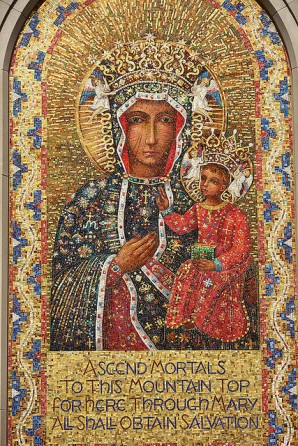
Exterior Mosaic at St. Stanislaus Catholic Church, Milwaukee
In the Old Testament, the prophet Haggai calls upon a “remnant†of people who must ascend to the mountaintop and rebuild the temple. My friends, the offering of Holy Mass by the Church Universal is the most important thing any of us will participate in during our lives. And if even a majority of Catholics will not respond to the call to make this the central reality of our lives and the very highest and noblest offering we can — the Mass of the Ages, the form offered and fundamentally unchanged in the Church for fourteen centuries — then let us together join that remnant who will do so, and ascend.
“At the still point of the turning world. Neither flesh nor fleshless;
Neiher from nor towards; at the still point, there the dance is
…I can only say, there we have been: but I cannot say where.
And I cannot say, how long, for that is to place it in time.†                                             -Burnt Norton
For me, discovering the traditional rites has been a kind of homecoming to a country that I once learned of and was taught to look for, but had never really seen with my own eyes, much less lived with body, mind, and spirit. Now I rejoice in the midst like a child in the surf, wading in that “fullness of grace and truth†entrusted to the Church by Christ our Lord. These are divine treasures, begging to be shared.
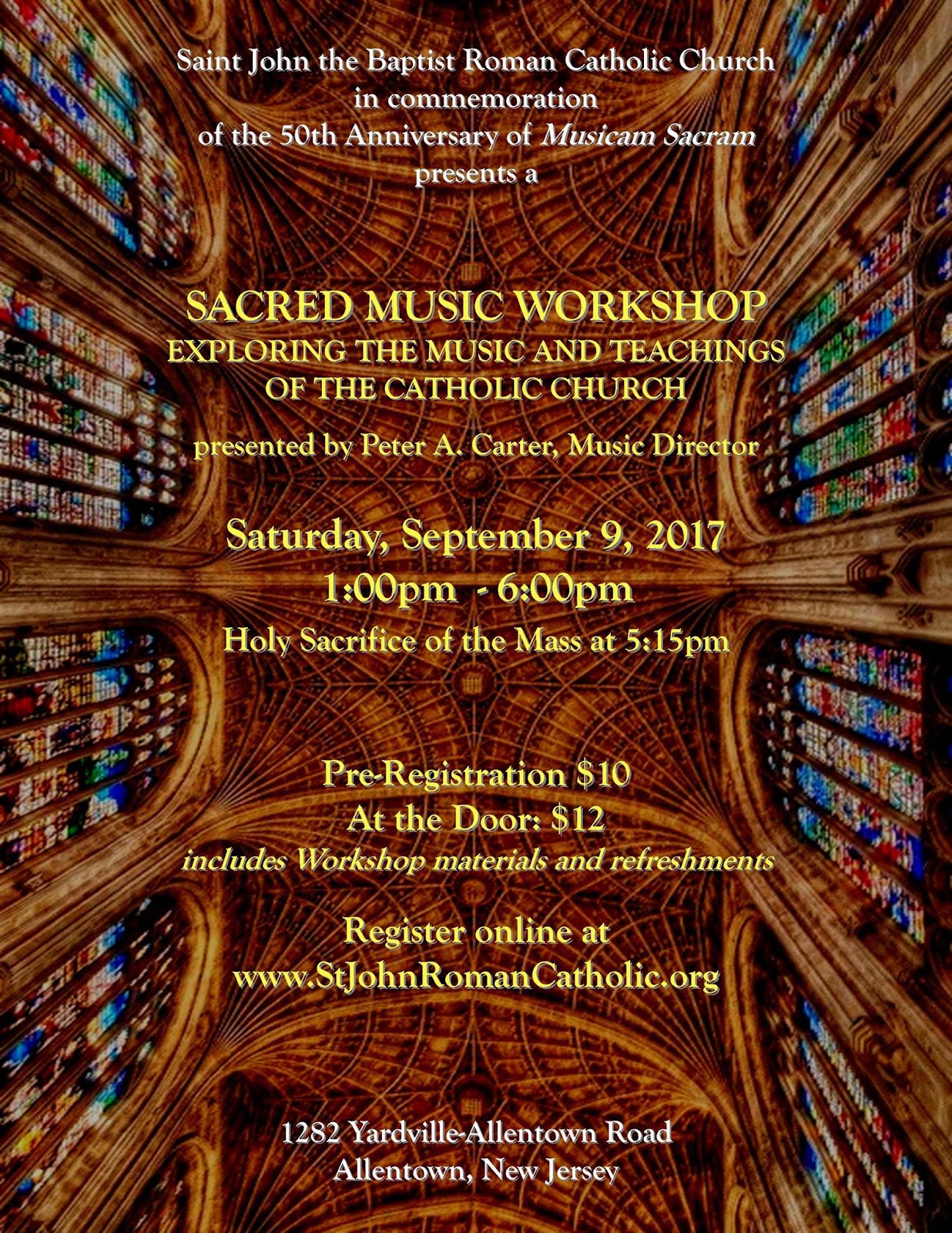
St John the Baptist Catholic Church in Allentown, New Jersey, will hold a sacred music workshop this coming Saturday, to commemorate the fiftieth anniversary of the instruction Musicam Sacram. The church is located at 1282 Yardville Road; for more information, see the poster below and the church’s website. Peter Carter, the presenter of the workshop, has also participated in the Pro Civitate Dei conferences given by the Fraternity of St Joseph the Guardian, which I have been blessed to attend twice; I can tell you from my own experience that he is a superb singer, and has an excellent knowledge of the Church’s tradition of liturgical music. If you are able to attend, you will certainly find it a good experience.

 Image (c. 12th century): Saint Benedict of Nursia entrusting his Rule to the monks, with an exhortation to their central task of divine worship in the sacred liturgy: “Therefore let nothing be put before the Work of God†(RB 43).
 Mass with the monks brought keen and singular realization that I had been in heaven for the preceding three hours (or seconds)? Incomparable. Question: How long has this been going on, and where have I been? Growing theological interest in the rites, yet continued to view Traditional Latin Mass as something of a tourist attraction, an “event†with limited availability for special groups (monastic communities, for instance).